Lactose intolerance is when your body can’t produce enough lactase, which is an enzyme that breaks down lactose into simpler, more absorbable sugars. Lactose is found in cows milk, and therefore cream, butter, ice cream, yoghurt and anything else containing milk.
Lactose intolerance is not an allergy; this means most sufferers can consume small amounts of products containing lactose without problems, and even when they do consume large amounts it usually isn’t a medical emergency like with nuts. But it can lead to some unpleasant symptoms.
I’ve always had problems with consuming large quantities of milk, and when I was a toddler I could only have goats milk, as regular cows milk didn’t agree with me. As I grew older it didn’t seem to be too much of a problem, but over the past few years, the symptoms of lactose intolerance have become more noticeable. I’ve frequently been quite bloated after meals, and unsavoury things would make their way out of my rear end at regular intervals.
And then we went to Paris for our honeymoon. Whilst we were there, my symptoms were much milder, and I eventually deduced why. On a morning, rather than having cereal with milk, I was having croissants instead.
A few weeks after we returned (and after having seen my symptoms return), I switched to LactoFree milk. This is regular cows milk which has been treated to remove the lactose, but keep everything else. I also cut out yoghurts from my lunch (although only after buying a large multipack). Since then, I haven’t had any of the earlier problems.
This should be a happy ending, but unfortunately it isn’t. Because so many things have milk or dairy products in them. I am now beginning to understand how hard it is to be a vegan (even though I still eat meat). The LactoFree milk is okay – it tastes like regular cows milk and doesn’t cost much more, although it is imported from Denmark. LactoFree cheese is, however, disappointing – rubbery, and largely flavourless, reminding me of the ‘cheese’ I used to get as part of my school dinners in the early 1990s. There are other products in the range but these aren’t stocked in my local small town supermarket, sadly.
Some sufferers of lactose intolerance can manage to have yoghurt – this is because yoghurt is a fermented dairy product, and so the lactose is already partly broken down. Sadly, as mentioned before, this isn’t the case with me, and so I now have to eat soya-based equivalents. Similarly, some people can have goat or sheep milk based products, others can’t.
On the odd occasion when I drink coffee, I have to ask for soya milk. I don’t particularly like soya milk as I find it very sweet when compared to cows milk, but it’s better than feeling awful later on. Sadly Starbucks charge an extra 35p for soya milk in their drinks; I’m not sure about Costa Coffee or Caffè Nero and whether they charge extra too.
If you’re reading this and think that you too may have lactose intolerance, then by all means try cutting out diary products from your diet, but please also make an appointment to see your GP to discuss it. Don’t self-diagnose; your GP may refer you to have a blood or breath test to confirm. Mine didn’t, but this was because I’d already cut back on dairy products and we agreed that it probably wasn’t necessary. However, some of the symptoms of lactose intolerance appear to be the same as some more serious diseases such as bowel cancer, so it’s really important that you see your GP just in case. It also means that, if you are lactose intolerant, then it’s on your medical record. Some drugs contain small amounts of lactose in them, for example. And if your symptoms are serious, then your GP may need to refer you to a dietician who can devise a suitable diet for you to eat.
There isn’t a cure for lactose intolerance. As well as avoiding dairy, it is possible to take lactase substitutes, which essentially act like lactase to break down lactose in your stomach. You add them to your food before eating. They’re available from some health food shops, and on prescription in some circumstances.
Last night Christine and I joined a few friends to be in the audience for Bollywood Carmen Live, a Bollywood-themed retelling of Bizet’s opera Carmen by BBC Three. It was broadcast live from Bradford city centre, in front of City Hall and in the adjacent City Park.
We managed to find a spot right in front of the main stage, where we got to see most of the dancing; a big screen behind us then showed the other bits (well, most of them). Admittedly the only person in it that I recognised was Meera Syal. It was great fun though. I didn’t take any photos during the broadcast but managed to snap the photo above about an hour beforehand.
Hopefully the show will show off the good side of Bradford – City Park is brilliant and still new to a lot of people. It’s also fitting that the BBC should choose to celebrate 100 years of Bollywood films in Bradford, which is the world’s first designated UNESCO City of Film.
On Friday both Christine and I had the day off work, and as it was a warm, sunny day, we went to visit the Victorian model village of Saltaire. I probably end up here at least once a year for some reason or other.Mostly to visit Salts Mill – home of many of David Hockney‘s paintings and photographs, as well as some quirky shops. But the village itself is worthy of a stroll around. Saltaire was declared a UNESCO World Heritage Site in 2001, and despite being built by Sir Titus Salt, an avid follower of the temperance movement, it now has several nice bars to spend time in.
There’s also Roberts Park, on the other side of the River Aire from the village, which is one of my favourite parks. A major restoration project was completed three years ago and the park now boasts a nice café. When the weather is like it was on Friday, it makes for a great place to sit with a cold drink.In a rare example of organisation, I’ve already uploaded the photos that I took to Flickr for your perusal. At some point, I’ll get around to uploading the rest of the photos from Paris as well…
It’s not often that I ask you, dear readers of this blog, to sign a petition. But please can you take a few seconds of your time to sign a petition to Save the National Media Museum in Bradford.
The museum, along with the National Railway Museum in York, and the Museum of Science and Industry (MOSI) in Manchester, are threatened with closure. Their parent company, Science Museum Group, cannot afford to run all three in addition to the Science Museum in London, due to cuts in funding from central government. It is therefore said that one of these will have to go.
I really, really hope that none of them close. As a child, I loved going to visit them and have also been recently as an adult, and enjoyed them all. Putting the museums against each other in a fight for survival is therefore not helpful.
But, I’m particularly keen for the National Media Museum to stay open. It’s the one big visitor attraction in Bradford city centre, with a strong reputation. Closing it would be an absolute disaster for a city which has fallen on hard times over recent years. Racial tension fuelled riots in the summer of 2001. In 2003, demolition work started on a new shopping centre, to be built by Westfield, but ten years on and there’s just a big hole in the ground. Meanwhile the recession has caused many of Bradford’s other shops to close, leaving even bigger gaps in the city centre.
Last year’s opening of the City Park, with its excellent mirror pool and fountains (a magnet for kids on hot sunny afternoons), was a big step in the right direction and shows that the city does have positive momentum. And, hopefully, work will start on our long-awaited shopping centre this year. But all the good work could be undone if the National Media Museum closes. Because people will stop coming to Bradford, and then more local shops and business will go under. It’s a horrible thing to even contemplate.
So please, sign the petition. And if you’re free tomorrow (Saturday), why not visit the museum? There’ll be a mass ‘visit’ of the museum at around 12pm. It’s free to get in, and it’ll show the powers that be that this museum is important, not just to Bradford but for the country as a whole. It is, after all, part of our national collection.
Saturday was my birthday. Not a big milestone this year, but I now have only 12 months of my twenties left. Having just got married, I didn’t expect to get many presents, but my main gift from my parents were …
The rest of this blog post may have been lost permanently.
We’re back from our Parisian honeymoon. We had a great time and I have over 200 photos to sort and upload to Flickr at some point.
Whilst I could write a detailed review of everything we did whilst in Paris, instead I’ll just cover the things that I found interesting and different. A mixture of advice and observations, if you will.
General observations about Paris and France
Unlike in the UK, where the green man means it’s usually safe to cross, in France it ‘may’ be safe to cross as traffic may still turn whilst you are crossing.
VE Day is a public holiday each year, on the 8th of May.
A service charge is included in all restaurant bills, so tipping isn’t strictly necessary. Rounding to the nearest €5 or €10 is considered polite for good service though.
Raisin swirl pastries are known as ‘Escargots aux raisins’, literally ‘snails of raisins’.
Around the Sacré-Cœur in Montmatre (but elsewhere as well) you may see the ‘String Men’, who have pieces of string in their hands. It’s a scam and you should walk away and ignore them. They are very persistent though.
Unlicensed street vendors are very prevalent in the tourist areas of Paris, and like the string men can be very persistent. Don’t buy from them.
Wifi hotspots called ‘Free Wifi’ aren’t free. ‘Free’ is a French ISP – you need to look for ‘Wifi Gratuit’ for hotspots that do not cost money to use.
Chartier is well worth visiting – it’s a late 19th-century dining hall that serves very good and very cheap (by Paris standards) food. We walked straight in on a Tuesday night but the queues can be 100 people deep at other times.
You now have to pay to get onto the roundabout where the Arc de Triomphe is.
The Moulin Rouge is not as interesting as it’s depiction in the Baz Luhrmann film. It’s also surrounded by sex clubs, adult shops, and the actually quite interesting Musée de l’Érotisme.
The original model for the Statue of Liberty is in a corner of the Jardin de Luxembourg. It’s a lot smaller than the one in New York.
The Louvre
It’s closed on Tuesdays.
The audio guides use Nintendo DS handheld consoles.
But rather than hiring an audio guide, you can download a smartphone app and use your own phone instead, if you prefer. There’s no wifi on-site though, so best to do it before you set off.
If it’s raining, rather than queue outside to get in, you’re better off going into the Carousel de Louvre shopping centre which is under the Arc de Triomphe de Carousel. It’s also connected to the Palais Royale – Musée de Louvre Métro station, so you can get from the Métro to the Louvre without needing to go outside.
Good luck with getting a good photo of the Mona Lisa – it’s a small painting and we had at least 100 other people jostling to get a picture. It’s pretty much in its own room now.
The museum was recently closed for a day after staff went on strike over pickpockets. As such, be careful with your valuables. Also, the French don’t have a separate word for ‘pickpocket’ so they just use the English word.
The Musée d’Orsay
It used to be a railway station. There’s still an RER station underneath but the nearest Métro station is about 200 metres away.
Many of the audio guides are iPod Touch devices, albeit ones that have been inserted inside a cheap, tacky-looking plastic case which covers the home button.
The café on the top floor is good and is located behind one of the two huge clocks. It is pricey but the mille-feuile is to die for.
There are a small number of Vincent Van Gogh paintings on level 2. ‘Exploding TARDIS‘ sadly isn’t one of them.
Paris Metro
There are very few escalators and lifts at stations. You’ll be going up and down stairs most of the time.
The Navigo card is the Parisian equivalent of London’s Oyster Card, but it isn’t promoted to tourists. We decided to stick with buying a ‘carnet’ of 10 tickets at a time, which is slightly cheaper than buying them individually.
Mobile phone coverage is available at most stations and even on the trains, although frequently it’s only 2G and not 3G.
Some lines, like 1 and 14, have modern, fully-automated trains, and platform edge doors like on London’s Jubilee Line, but some lines have trains that date from the 1960s and require you to turn a handle to open the doors. And on many of the older trains, the doors unlock a couple of seconds before the train has come to a halt, so it’s possible to alight from a moving train.
Line 6 of the Metro runs on an elevated section down the middle of a wide street to the west of Paris, near the Eiffel Tower. I gather this happens on the New York Subway from time to time as well.
Generally the ticket barriers only scan your ticket to enter the Metro, not to leave.
The RER is a bit like Thameslink (and Crossrail when that opens in London), in that it’s actually a full rail service that happens to pass through the centre of Paris. Some of the trains are double-deckers. Ticketing is fully-integrated with the Metro.
Some Metro trains run on rubber tyres, rather than metal wheels. It gives a smoother ride.
Note: This post is pre-recorded as Neil is on honeymoon.
There’s a quote by Irish comedian Ed Byrne on the lines of “The best thing about being married is that you don’t have to plan a wedding”. Whilst our experience was probably not as bad as his, your typical wedding will have several elements, all of which need organising separately, and it can be a big thing to take on.
Therefore, based on mine and Christine’s experience as a recently married couple, here are 10 things that we were advised or found out during the planning of ours.
Tip 1: Silk flowers are better than real ones
Almost all of our flowers were actually silk (or plastic). We bought them from Silk Floral Art near York, which meant that we could pick them up several days before the wedding. We also weren’t limited to using flowers which were in season – we could have any that we wanted that matched the colour scheme. For the table decorations there was a deposit for their return, and we have the option of converting Christine’s bouquet into a permanent decoration to keep. And, of course, silk flowers don’t wilt so they will always look good in your photographs, and even up close it’s hard to tell that they’re not real.
Tip 2: Think about what could go wrong
I’m not suggesting that you need to do a complete risk assessment, but it’s worth thinking about any problems that could arise, and, if so, what you could do about them. In our case, when we went to collect our flowers, it turned out that we hadn’t ordered enough for all of the tables; thankfully, we were collecting them four days before the wedding and so there was time for more to be made up for the day.
We also ensured that both myself and Christine were at the wedding venue (but in separate parts of the hotel) a couple of hours before the ceremony, so that we didn’t start late. And the cake was delivered to us by the bakery, rather than us collecting it and then potentially dropping and ruining it.
You may also want to consider wedding insurance, but we didn’t bother and wouldn’t have needed it anyway. We did, however, use credit cards for the expensive things, so there would have been the possibility of using Section 75 if things went wrong.
Tip 3: Your wedding needn’t cost the earth
On average, weddings in the UK cost £20,000, apparently. I find that hard to believe as ours cost less than half of that. They are expensive (and consequently we’re a bit broke at the moment) but you can avoid a lot of unnecessary expenses. As ever, MoneySavingExpert.com has a guide – 50 cheap wedding tips – and whilst some are extreme we did make a number of savings. With the help of Christine’s chief bridesmaid, we designed and printed our own wedding invitations on VistaPrint(sponsored link), which looked great and worked out at about 50p per invite – far less than some companies charged.
Also, when using some suppliers it’s sometimes worth not mentioning that it’s for a wedding, as some companies will want to charge you more because it’s your ‘special day’.
Tip 4: All-in-one packages are easier
We went for a big, all-in-one package with our hotel, the Best Western Monk Bar Hotel in York(Now known as the York DoubleTree by Hilton). The package was the single largest wedding purchase and cost almost half of our total budget, but it included lots of things that we would have otherwise had to organise separately. These included use of a room for the ceremony, along with some flowers (these were real but matched our silk flowers), the wedding reception with food and some drinks, plus placecards, and a DJ for the disco in the evening.
It may have been cheaper to hire a hall, caterers, and a DJ, and then buy in drinks and our own stationery, but more hassle. Considering all of the other things we’ve had to organise, having these things together was a big weight off our minds.
Tip 5: Get help from friends and family
Christine’s chief bridesmaid helped us with the invites, as already mentioned, and my mum also helped us make the wedding favours (which again cost around £1 each in the end), as well as some legwork last year looking for suitable venues.
But you could go further – if you have a friend with a decent camera who takes good photos, it may be worth approaching them to take your pictures on the day rather than hiring a professional photographer. Ditto if you have a friend who makes nice cakes. In the end we didn’t have any friends helping us on the day – we wanted our friends and family to enjoy the wedding as well – but it may be worth asking.
Tip 6: Get some ‘you time’ on the day
I’m saying this because we didn’t. We got married at 2pm and it was after midnight before Christine and I had any time alone with each other to sit down and relax. Ideally we would have taken some time out after the reception had finished to put our feet up, but we ended up spending some time with the photographers instead.
Tip 7: Go to wedding fairs, but get recommendations as well
Wedding fairs are a good way to find out about photographers, cake makers, florists and the like, but a personal recommendation is always better. The hotel and the bakery that we went for – 3 Tier Cakes in Halifax – both came recommended by several people and we weren’t disappointed. The hotel were fantastic and went out of their way several times to help us, and the cake looked and tasted fantastic.
However, we also found our flowers and our photographer – Michelle Heseltine – at separate wedding fairs and we very pleased with both. In all, we went to three wedding fairs in Leeds, Bradford and Manchester; the latter wasn’t so much use as it was so far away from York where we got married in the end, so I would recommend going to fairs closer to where you plan to get married. There are plenty of them and you can usually come away with a lot of freebies, but don’t feel pressurised to sign up to anything on the spot.
And I’d suggest setting up a throwaway email account for use at wedding fairs, as you’ll get asked for your contact details by lost of people which will result in a lot of junk email. Once you’ve got everything arranged then you can just close the account.
Tip 8: Think how long you want your photographer for
We’ve been to a number of weddings where the photographer turns up just as the bride finishes getting ready, stays for the ceremony and official photographs, then grabs a couple of shots of the newly-married couple pretending to cut the cake before disappearing. That means that you’re reliant on friends and family taking pictures during the reception and the disco.
We decided to pay a bit more and have two photographers all day. They were there about an hour before the ceremony to separately photograph Christine and I getting ready, and were there right through the ceremony, the reception and for the first hour of the disco. Therefore they were able to photograph the actual cake-cutting and also the guests who were only here in the evening. That way our photo album will record the events of the whole day.
Also, when choosing a photographer, make sure you sign a contract so you know exactly what services to expect, and whether you can buy the copyright for the photos (we didn’t do this, but we’re not too bothered about it). And make sure that the photographer is insured, and therefore able to provide a replacement photographer in case of illness. You don’t want to receive a phone call on the morning of your wedding saying the photographer can’t make it, leaving you high and dry.
Equipment isn’t everything. You absolutely should ensure that your photographers are using good quality kit, but make sure you see plenty of sample photos that they have taken as well. Ideally, you’ll be able to find someone who can take great pictures, and has top-end cameras, flashes and lenses so that you get plenty of quality and detail in your pictures.
Finally, always look at the photographer you’ve paid for. Your friends and family will have their own cameras too, and feel free to pose for those when your official photographer doesn’t need you looking at them.
Tip 9: Drink plenty of water
The abundance of alcohol at most weddings, combined with big wedding dresses or suits with waistcoats and shirts, and lots of dancing, means that you can get dehydrated. Make sure you drink plenty of water throughout the day, and alternate alcoholic drinks with non-alcoholic ones. Dehydration will be the main cause of a hangover the following morning, which makes things difficult when you need to tidy up and vacate the premises before lunchtime.
We were offered a lot of free drinks and ended up turning some down; not at least because I wanted to be able to do my speech without slurring.
If you’re planning on wearing a big dress, think about toilet breaks as well.
Tip 10: Relax and enjoy the day
I suppose this is a re-hash of tips 2 and 6, but with good planning, everything will work out fine on the day, and you won’t be overwhelmed and stressed. And try to relax – you are the focus of the day and people will always be there to help you.
Everything went well for us, and we had a fabulous day that we will want to remember for the rest of our married lives.
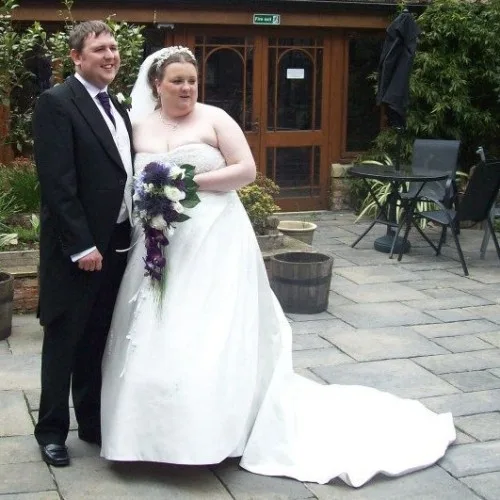
We’re a married couple now. It was a bit of an exhausting day, but we both had a really good time, as did our guests – hopefully! I didn’t take any photos myself (the above is lifted from a friend’s Facebook album) so it’ll be a while before we see the rest of them. Christine looked absolutely beautiful.
So we’re Mr and Mrs Turner now, and I have a ring on my finger which is going to take some getting used to. Today we’re having a rest and then tomorrow we’re off to Paris.
Tonight will be the last night that Christine and I spend together as an unmarried couple. Tomorrow night we will spend the traditional night apart – me at my parents, and her with her bridesmaid at the hotel, and then the next time I see her she will be coming down the aisle on Saturday.
We’re pretty much there with preparations. We have the flowers (which are silk), I’ve got my suit, and Christine’s got her dress. We just need to take things to the venue tomorrow, and then wait for everyone to turn up the day after. As such, we’re not too stressed out about things as – touch wood – there aren’t too many big things that could go wrong at this point.
Anyhow, the next time I blog (apart from any automated posts like Delicious links), I’ll have a shiny ring on my finger. See you all soon.
I have a new toy to play with – an iPad. It’s a hand-me down from my soon to be in-laws which I was only too happy to find a new home for.
It’s the first generation model, and is therefore a bit limited in what it can do. It’s a little slow at times, doesn’t have a camera or a retina display, and it can’t run iOS 6 – iOS 5.1.1 is the most recent release that works on it. This means that some apps, like 1Password, won’t run, but for the most part everything else works okay. But, it’s an iPad, and it didn’t cost me anything.
Since I already own an iPhone many of the apps also worked on the iPad so I was able to get up and running with it quite quickly. So far, the only extra apps I’ve added are Tweetbot, which has a separate iPad edition rather than a universal app, and Reeder, which again has a separate iPad app but is currently free.
The bigger screen is great for apps like Reeder, Feedly and Pocket, where being able to view a whole page makes reading much easier. It would be nicer if it had the retina display though – having owned an iPhone 4 and then iPhone 5 I’ve become accustomed to higher pixel depth.
Although this does mean that I no longer need to save up for an iPad in the short term (and with a wedding, honeymoon and probably a new house to pay for this is welcome), I may still consider buying an iPad Mini in future. I imagine the smaller screen is a bit easier to handle, and a good compromise between the full-size iPad and the iPhone. And if I do decide to upgrade, this iPad is still worth around £90 to recyclers.