Flying without checked-in luggage

Flight home

When we went to Dublin, Christine and I flew with Ryanair, the airline everybody loves to hate. This is mainly because Ryanair has unbundled just about anything that can be considered optional from its fares. Which means that the basic fare is cheap, but you may end up having to pay more for things that other airlines include. For example, the ability to check in luggage to be carried in the plane’s cargo hold.

Ryanair’s carry-on baggage allowance isn’t as bad as it once was, thankfully. For each passenger, two bags – a large one and a small one – are permitted, with the largest bag limited to 10 kilograms. That’s enough for a rucksack and a camera bag, for example. If you want to check in a bag, then there’s a £20 charge per person per flight for up to 15 kilograms, so that would be £40 if we wanted to take a larger case to Dublin and back. We decided, therefore, not to check in a bag.

We found that there are several advantages and disadvantages to not checking in luggage, some of which are listed below.

It may be cheaper

I’m sure Ryanair isn’t the only airline that offers cheaper fares for those that don’t need to check in their luggage. It saves the airlines quite a bit of time and money, so whilst it’s nice to find it included in your fare, you may find that if you can cope without it, savings can be made.

You may not need to check-in in person

Most airlines allow you to check-in online, and some, like Ryanair, pretty much mandate this. Not printing your own boarding passes on such airlines can cost quite a bit of money. Consequently, the ‘check-in’ desks for low-cost airlines essentially just become ‘baggage drop’ desks, where you can check-in your luggage to go into the hold. If you’ve no luggage to check-in, then you can just head straight for the security screening area. Unless you need a visa to travel and are required to have this checked by someone from the airline, in which case you will need to go to the check-in desk first.

You can’t carry liquids in containers larger than 100ml

Liquids in carry-on bags must be in containers of 100 millilitres or less, including any shampoo for example. So for our Dublin trip we bought travel size bottles of shampoo, deodorant and the like. These cost more per millilitre than regular-sized bottles so it’s another expense to consider. Alternatively, you could buy such things after passing through security (even a small airport like Leeds-Bradford had a Superdrug airside), or once you’ve arrived at your destination. And most hotels offer complementary shampoo and soap.

There’s no need to wait for baggage reclaim

If you carry your bags with you, then once you’re off the plane you already have all of your luggage. So there’s no need to wait at baggage reclaim – you can head straight out of the airport and onwards to your destination. Considering it can take some time for your luggage to make it off the aircraft and onto the carousels, especially at larger airports, this may save you quite a bit of time.

That being said, on the return flight from Dublin to Leeds-Bradford, practically no-one had checked in any luggage. Ours was the only flight landing at that time, so reclaim was a relatively quick and easy process for those that had checked in bags. I guess it’s a sign that Ryanair’s policy is working.

No risk of your luggage getting lost

You know where your bags are at all times. After all, you’re the one who brought them on the plane, put them in the lockers, retrieved them again and took them off the plane. So they can’t be left behind, put on the wrong plane, or picked off the carousel accidentally by somebody else. Plus, any fragile items are less likely to get broken if you’re careful with your bags, since you’re not at the mercy of the baggage handlers.

You may be limited to what you can take

Whilst we managed to fit in everything that we needed for our four night stay into two rucksacks and two shoulder bags, with room to spare, we may not have been able to manage this for longer trips. Indeed, we were somewhat conservative in what we took – I only had one pair of shoes, which I wore, and had a coat and jumper wrapped around my waist. We also had the benefit of travelling in summer – had we gone in January, for example, or to a cold country, we’d have needed more warm clothes which would have taken up more space.

You may need an iron

If you’re bringing smart clothes then you may have to crumple them up in your bags to make them fit. So it may be worth checking that your accommodation at your destination offers access to an iron or trouser press. Or, if you have space, take a travel iron, but make sure it’s drained of water and doesn’t push you over any weight allowances.

Buy yourself a luggage scale

We bought a luggage scale for less than £2, from which we could weigh our bags to ensure they were under the 10 kilogram limit. The scale itself was quite small and light, so we could also take it with us to make sure that our luggage was compliant on the way back as well. As it happens, at no point were we asked to weigh our bags but it was best to be on the safe side in case it happened.

You can buy these scales for £2.10 at Amazon (sponsored link), with more accurate digital ones in the £5-£10 range.

You may need to buy new bags or cases

Christine’s handbag was too large to be her ‘small bag’ under Ryanair’s rules, so she used this as an excuse to buy a new, smaller handbag. Thankfully, not an expensive one, so it was still cheaper than it would have been to check in her larger bag. Similarly if you only have small bags, you may need to buy a slightly larger one. Ryanair has a range of bags it recommends, that fit within its dimensions, but at quite a high price.

I wasn’t able to use my normal rucksack, which is designed to be comfortable when hiking. It fit the dimensions, but is curved to keep my back cool, at the expense of internal space. Instead, I used a less ergonomic bag which had a larger capacity, but at least it was one that I already owned. If you don’t own a suitable bag, then you need to consider the cost of buying one versus checking in a bag that you already have.

If you want to take this to an extreme, buy a wearable luggage jacket that lets you keep many items on your person, to maximise the space in your luggage. The cheapest ones are about £30 and have plenty of pockets.

Finally, I’ll leave you with this amusing video by the cabaret act Fascinating Aida, about cheap flights and the added extras.

Shiny new iPad

iPad Mini with Retina Display

As I mentioned on Sunday, my birthday present from my parents was a shiny new iPad Mini with Retina Display. We bought it from the Apple Store in Trinity Leeds, since we were going to Leeds for a birthday meal anyway.

This is to replace my old iPad, a first generation model. Although I’ve only had it for a year, it’s now over three years old and no longer supported by Apple. It won’t even run iOS 6, never mind iOS 7. Many apps either won’t install at all, or can only run as an older version. Plus, it’s rather slow and some apps, including Apple’s own like Safari, crash a lot. Whilst the larger screen means it’s better to use than my iPhone for some things, for others it was slow and frustrating – I’d avoid browsing sites like Buzzfeed or Lifehacker because of the risk of crashing it.

Choosing an iPad

I’d narrowed the choice down to the iPad Air or the iPad Mini with Retina Display. I ruled out the older models – the iPad with Retina Display and the iPad Mini (without Retina Display) – because they came with older processors which are much more likely to be deprecated by Apple within a few years. I didn’t want to be in the same situation again with my iPad in a couple of years’ time.

The two models are basically identical inside – same processor, battery life and features. The only difference is the size of the screen (the resolution is the same), the weight and the price. At £80 cheaper, we decided to go for the iPad Mini.

Personal setup

When you buy a product at the Apple Store, a ‘Personal Setup’ service is offered to get you up and running with the device. As we had some time to spare, I decided to take them up on the offer. This turned out to be a good thing. Because myself, and the member of staff who sold me the iPad, learned the hard way what happens when you try to restore an iCloud backup from an iPad 1 running iOS 5, to an iPad Mini running iOS 7. Suffice to say, it got stuck in a soft reboot loop and was completely unusable.

To their credit, the staff at the store were really good about it, and took responsibility for the problem. I should have been advised that this wouldn’t work. Instead, I should set the new iPad up as a new device, rather than using a backup from an iOS 5 device as a starting point. So the iPad Mini, now essentially bricked, will be sent back to Apple, and I was given another iPad Mini to take away. I decided not to go through the Personal Setup this time, instead waiting to get home so that I could do it at my own pace. It’s working fine, as shown in the above photo.

I’m glad that the reboot problem happened in the Apple Store and not at home, as I’m not even sure that I’d have been able to force a factory reset on the device. But perhaps Apple should have coded this into the iPad setup program, and displayed a warning that restoring a backup from such an old device to a new one is a bad idea.

Anyway, my new iPad Mini is great. It’s so much lighter than my old one, and the screen is only a bit smaller. It’s not quite so good for reading magazines, as the text is a bit small, but at least when I zoom in the text doesn’t become so pixelated as it did on my old iPad. And apps like Facebook, YouTube and 1Password are actually usable now, and others, like Pocket, are much, much faster.

Notes on Dublin

Following last year’s cultural observations about Paris, I’ve decided to do the same about Dublin. This isn’t about where we visited – that was yesterday – but all of the little things we saw or did.

Flight home

Getting from the airport

Following advice from the guidebook, we took the 747 Airlink bus from Dublin airport into the city centre. It’s a bit pricey, at €6 one way, but the €10 return ticket is valid for over 12 months. It’s probably the best compromise between price, speed and comfort, as it uses the Dublin Tunnel to get into the city centre quickly. There are more expensive, but probably more comfortable coaches operated by First, as well as some slower but cheaper buses. A taxi will set you back at least €20 each way for up to four people, although if there are four of you that means it’s the same return price as the Airlink so may be worth bearing in mind. The airport isn’t connected to the local rail or tram networks, sadly.

Open top tour buses

There are two open top tour bus companies operating in Dublin – one operated by Dublin Bus (the municipal operator) and another is a CitySightseeing franchise. The latter is cheaper overall, as its €22 ticket is valid for two days, whereas the €19 ticket offered by Dublin Bus is for a single day. Both offer small discounts for some of the attractions.

Whilst they are a good way to see lots of attractions from the outside, be aware that most of the buses have an open top deck and it rains a lot in Ireland. And there are cheaper ways to get around the city, using regular buses or the trams. We therefore didn’t bother with the tour buses.

Dublin Pass

If you’re going to do a lot of attractions whilst visiting Dublin, then the Dublin Pass may be worth considering. Once you’ve bought the pass, you get free entry to all of the participating attractions for the duration of the card. However, personally I feel it’s a bit of a rip-off as you’ll need to visit at least three attractions in a day for it to worth the €39 cost. For some places, this may mean cutting visits short. We didn’t bother with the pass.

Luas Trams

The Luas tram system

The aforementioned tram service is a quick and relatively cheap way of getting around the city – particularly to places like Dublin Zoo and Kilmainham Gaol which are some way out of the city (although you will still have quite a walk once you get off the tram in both cases). The trams are very frequent – as often as every three minutes – and the system only opened in 2004 so it’s modern and comfortable. There are two lines – the Red Line goes east-west to the north of the river, and the Green Line goes north-south to the south of the river. However, presently the two lines do not meet and so the north of the city isn’t served yet – a cross-city line is presently under construction.

Mobile phones

Ireland has three of the same mobile networks as the United Kingdom – O2, Three and Vodafone. There’s no EE but their fourth network is called Meteor, owned by the Irish national phone company Eircom. If, like me, you use Three then you’ll be pleased to know that Ireland is a ‘Feel at Home’ country, so you can use your inclusive minutes, texts and data allowance as you would in Britain at no extra cost. Vodafone charged £2 a day for internet roaming, by comparison.

I had a 3G signal everywhere in Dublin – in fact, it was better than some parts of Leeds or London – but no 4G on Three as yet, it seems.

Dublin Free Wifi

Free Wi-fi

It seemed like just about everywhere offered free wifi (or at least a wifi service that was free for a short time). This included our hotel, most cafés and restaurants, and most of the tourist attractions too. It was certainly more prevalent than what I’m used to in Britain.

My theory is to do with Ireland’s mobile phone networks. They all use GSM and UMTS, like in Britain and most of Europe. But Verizon and Sprint in the USA don’t use GSM or UMTS and so phones on these networks won’t work in Ireland. Ireland receives a lot of tourism from America, hence the need to provide Wifi (AT&T phones should work fine, and T-Mobile phones may work).

In any case, Christine, who is on Vodafone in the UK, decided not to pay the £2 a day for internet, and just use the free wifi hotspots. And rely on me.

The weather

It rains a lot in Ireland. We Brits may think we get a lot of rain, but Ireland gets even more. Make sure that you pack a waterproof jacket, and/or an umbrella to take with you. Many shops in Dublin also sold plastic ponchos for days when it gets really bad.

Security and crime

Crime levels in Dublin are, apparently, similar to any other large city. Sadly, Christine almost got pickpocketed by someone on O’Connoll Street, not far from our hotel. A young bloke sneaked up behind her and tried to open her handbag; thankfully, she felt the tug and very quickly had the miscreant pinned up against some railings and on the receiving end of a large amount of angry shouting. He didn’t manage to take anything but he did run off very quickly afterwards. After that, we put our passports, which had been in her handbag, into the hotel safe, just in case.

We also noticed that there were a lot of rough sleepers and beggars in the city, especially in the area around Trinity College.

Please do not irritate the animals

Language and signage

The official language of Ireland is Irish Gaelic, with English as the second language. This means that on most signs, you’ll see both languages, with the Gaelic text in italics and the English text in capitals. That being said, in our experience I don’t think anyone used Gaelic conversationally and so you’re highly unlikely to find anyone who doesn’t speak English.

Road signs are somewhat different to British and Europeans ones, and they more closely resemble American designs. However, the font is the same.

Prices

Dublin has a reputation of being an expensive city and this was partly true in our experience. In other words, there are many ways that you can spend lots of money unnecessarily, as I’ve mentioned above. Drinks in particular were often on the pricey side, with a pint of beer coming in at around €5 – £4, or almost double what I’d expect to pay in my local pubs here in Yorkshire. But there were cheaper places – for lunch, I can recommend KC Peaches on Nassau Street, opposite Trinity College, where you can fill a plate from a buffet and get a drink for less than €10.

Familiar brands like Subway are everywhere in Dublin, with many Londis franchises having a Subway concession inside, but they are slightly more expensive than Britain. The £3 Subway and drink deal is €4 for example. Also remember that shops in Ireland have to charge you extra for plastic carrier bags – 22¢ I think.

One potential way to save money is to book tickets for attractions in advance online. We didn’t do this because our British debit and credit cards charge extra for non-Sterling transactions, so any potential savings would be wiped out. But if you have an overseas spending credit card then you may be able to save 10-15% off entry for attractions this way.

The things we did in Dublin

This is the first of at least two posts about what Christine and I got up to last week whilst we were in Dublin – the focus of this one being about the attractions we visited, in no particular order.

Guinness Storehouse

Guinness Storehouse

Allegedly the most-visited attraction in Ireland, the Guinness Storehouse tells the history of Guinness, which is probably the most well-known brand of stout in the world. Although Guinness is still brewed in Dublin, on a huge site just outside the city centre, the Storehouse is across the road and not part of the main brewery site. Consequently everything inside is simulated or are static models, rather than actual, in-use brewing equipment like you would see on a tour of a microbrewery.

It’s one of Dublin’s more expensive attractions, however we spent a few hours here so it was somewhat worth it. Except that neither me or Christine particularly like Guinness – Christine hates beer altogether, and although I like stout and porter from time to time, I’ve never enjoyed Guinness in the past. And, sadly, our visit was to be the same – despite being shown how to pour my own pint, I still didn’t like it. The restaurants inside are very good though, with an above average food selection and many menu items using Guinness as an ingredient. For beer-haters, there is some interesting displays about Guinness’ advertising and how beer is made.

The Old Jameson Distillery

The Old Jameson Distillery

If Guinness is Ireland’s best known beer, then Jameson is its best known whiskey. Like the Guinness Storehouse, the Old Jameson Distillery is no longer an active distillery. Production was moved to the southern Irish city of Cork in the 1970s, although here some of the displays were active. It’s a guided tour, taking about an hour, with eight volunteers being picked for a whiskey test at the end. You should definitely volunteer if asked, as you get to try shots of Jameson’s whiskey, Jack Daniels’ bourbon, and a blended Scotch whiskey, to compare the three styles. Christine was chosen – I didn’t volunteer because I don’t like neat whiskey, but enjoyed a Jameson and ginger beer drink at the end, and a really nice Irish coffee in the bar. Again, a pricier attraction but we enjoyed this more than Guinness.

Sumatran Tiger

Dublin Zoo

Christine and I love visiting zoos so we spent most of last Monday at Dublin Zoo, as many other attractions in the city are closed on Mondays. It’s quite a big zoo, and whilst it has fewer animals than some others it does have some big enclosures. It was quite quiet when we went but it was a weekday and not especially nice weather, so at other times it will probably be busier. We were also wisely advised to take a packed lunch, as the food offerings there are not great. It’s home to two species of tiger (both very endangered), red pandas (my favourite animal), otters, lions, various apes, penguins and many others. The entry price is in line with other zoos over here in Britain.

Natural History Museum in Dublin

Natural History Museum

After you’ve visited the zoo, have a look at the ‘dead zoo’ – yes, it’s really known as that. Though significantly smaller than its London namesake, and less interactive, the Natural History Museum has an extensive collection of stuffed animals. The ground floor is set aside for species native to or resident in Ireland, with everything else upstairs. The two balcony floors are currently out of bounds due to a lack of fire exits but most of the exhibits are viewable. Some of the specimens are very old, and were stuffed at a time when people were less familiar with exotic animals, so there are some slightly dodgy examples of taxidermy on show. Entry is free, although it is shut on Sunday mornings and all day Monday. Set aside a little over an hour for a visit.

Temple Bar

Temple Bar

The Temple Bar is a district of Dublin which is home to many pubs and restaurants – the above pub gets its name from the area, rather than the other way around. It’s nice for a stroll through but livens up on an evening.

General Post Office

General Post Office

I’ve already briefly mentioned this one, but it’s worth a look. As well as being the main post office for the city, there is a small museum inside, which tells the history of Ireland’s postal service. In particular, there is quite a bit about its role in the Easter Rising of 1916, which set in motion various events over the next decade which ultimately led to Ireland’s independence from the United Kingdom. It’s only €2 to get in, and kept us occupied for up to an hour. You can also post letters and postcards into the oldest postbox in the country, and any mail collected from it will get a unique cancellation stamp.

Dublin Castle

Dublin Castle

We decided not to do the guided tour of Dublin Castle, which costs money, but there were plenty of bits to walk around for free. Follow the signs to the tearooms, and you will go past several boards with information about the history of the castle, and its wider role in Irish history. You can also cross a bridge into Dubh Linn Gardens, at the back of the castle, which are nice to walk around.

Kilmainham Gaol

Kilmainham Gaol

Another historical attraction worth visiting is Kilmainham Gaol. Though it’s been many years since prisoners were interned there, it forms an important part of the history of the nation. The population exploded during a crime wave brought on by the potato famine – as the potato crop failed for several years running, those without food had to steal to survive, and many were caught. But in the early twentieth century many of those involved in campaigning for Irish independence, and those that opposed the Irish Free State in the Irish Civil War, were imprisoned and executed here. There’s both a small museum, and a guided tour of the main jail.

The jail isn’t in the centre of Dublin and is a good 20 minute walk from the Guinness Storehouse, itself away from the city centre. If you’re not up for a long walk, you may wish to catch the bus out here. It’s worth the long trip though.

The big Three Oh

30 today

Today’s the day that I leave my twenties and become a thirty-something. One of a few ‘big’ birthdays that I’ll have in my lifetime.

Christine’s present to me was the trip to Dublin, and my parents bought me an iPad Mini to replace my ailing iPad. Plus a few little somethings from other friends and family.

I’ve had a couple of meals out to celebrate already but today will be mostly spent at home with Christine. Partly so that I can play with my new iPad (my precious…) but also because we need a bit of a rest. And the weather’s pretty awful, but then it is a bank holiday weekend so this is to be expected I suppose.

Thank you to everyone who has sent me a card or wished me happy birthday on Facebook.

Back from Dublin

General Post Office

We’re back from Dublin. Actually we got back on Wednesday – yesterday’s post was pre-recorded and I had foreseen having time to edit my photos and start writing some blog posts about it. Alas, that hasn’t happened so this is just a quick apology.

We had a good time though. The weather is best described as ‘Irish’ – i.e. it rained most of the time we were there. We did a number of the museums and tourist attractions, as well as Dublin Zoo. I’ll be writing up some notes about where we went and what we did over the weekend, and sorting out over 200 photos that I took whilst there.

For now, the above photo is the General Post Office on O’Connell Street – not far from our hotel. It’s still the main post office for the city, but also contains a museum with the history of the Irish postal system, and of the building itself. It was the scene of the 1916 Easter Uprising and played a major part in Ireland’s campaign for independence from the United Kingdom.

Eurovision Eve

Tomorrow night is the annual Eurovision Song Contest, a pan-European music competition where each of the nations of Europe can put forward a musician or band and hope to win the chance to host the following year’s contest. Last year’s winning act, Emmelie de Forest, was from Denmark, so this year’s competition will be broadcast from Copenhagen.

In Britain the main focus is always the ‘final’ on the Saturday night, but there have been two semi-finals this week. They’re broadcast here on under-threat TV channel BBC Three, and I bet a lot of Brits don’t even know about them. I think this because the semi-finals don’t matter to us Brits –  Britain is one of the largest contributors to the European Broadcast Union, the producers of Eurovision, and it means that British acts automatically qualify for the final. This is along with those acts from France, Germany, Italy and Spain. Consequently the semi-finals are not a big deal here, and are mostly watched by those more fanatical about Eurovision.

For most of the past few years, we’ve been to Eurovision parties, where we watch the final as a group, usually with ample amounts of alcohol. This started sometime around 2007, when one of our friends was an international student from Canada – we tried to convince her that Eurovision was a major cultural event. I think she believed us right up until the show started, when she realised it was just a massive camp-fest. Which it is, but that’s one reason why I like it so much. Another other big reason is getting to laugh at the various novelty acts that invariably make it through to the finals, and then get increasingly frustrated at the end when none of our European neighbours decide to vote for the UK entry. And there’s the commentary provided by Graham Norton throughout the night.

This year, we’re hosting a Eurovision party ourselves for the first time. Not a big one, and most of the people who are coming are the same ones that we watch Eurovision with every year. It’s probably the last chance we’ll have to host a Eurovision party in our current flat, as hopefully by this time next year we’ll have bought a new house.

The UK never does particularly well in Eurovision and we’ve not won since the 1990s, but we still enter every year. Despite putting up reasonably well-known acts, such as Blue, Engelbert Humperdinck and Bonnie Tyler, we haven’t placed inside the top 10 since 2009.

In the past there has been a public vote to choose the act that we sent to Eurovision – usually called A Song for Europe – but since 2011 the decision has been made by the BBC. This year’s act is ‘Molly’ with her song ‘Children of the Universe‘ – it’s not really my kind of song but hopefully it’ll do well. Molly, incidentally, is not using her full name of ‘Molly Smitten-Downes’ in the competition.

Political events often affect the results, and it will be interesting to see what effect the recent issues in the Crimea have on Ukraine and Russia’s rankings. It may also reflect Britain’s historically poor performance, as the rest of the Europe hates us apparently. The current rise of the UK Independence Party may indicate that the feeling is mutual. I wonder what UKIP’s policy is on Eurovision?

My favourite add-ons for Thunderbird

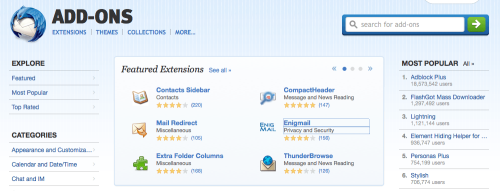
A screenshot of the Thunderbird add-ons web page

It’s been some time since I used Mozilla Thunderbird at home – I switched to Sparrow, then Apple’s own Mail app, before settling on Airmail last year. But at work, where I deal with a high volume of email, I prefer to use Thunderbird, instead of the provided Outlook 2010. There are a few add-ons which help me get stuff done, and so here is my list:

Lightning

Unlike Outlook, Lotus Notes or Evolution, Thunderbird doesn’t ship with a calendar. Lightning is an official Mozilla extension which adds a reasonably good calendar pane. Calendars can be local, subscribed .ics files on the internet, or there’s basic CalDAV support as well, and it works well with multiple calendars. A ‘Today’ panel shows up in your email pane so you can quickly glance at upcoming appointments.

Once you have Lightning installed, there are some other calendar extensions you can add. Some people use the Provider for Google Calendar extension – I don’t, as nowadays Google Calendar supports CalDAV so there’s no need for it. If you need access to Exchange calendars, then there’s also a Provider for Exchange extension too, although as we’re not (yet) on an Exchange system at work I haven’t yet tried this.

There’s also ThunderBirthDay, which shows the birthdays of your contacts as a calendar.

Google Contacts

If you use Gmail and its online address book to synchronise your contacts between devices, then Google Contacts will put these contacts in Thunderbird’s address book. It doesn’t require much setup – if you’ve already set up a Gmail account in Thunderbird then it’ll use those settings.

This is probably of most interest to Windows and Linux users. On Mac OS X, Thunderbird can read (and write, I think) to the global OS X Address Book, which can be synchronised with Google Contacts and therefore this extension isn’t needed. In the past, I used the Zindus extension for this purpose but it’s no longer under development.

Mail Redirect

This is a feature that older email clients like Eudora had, which allowed you to redirect a message to someone else, leaving the message intact. Mail Redirect adds this is a function in Thunderbird.

It’s different to forwarding, where you quote the original message or send it as an attachment – with Redirect, the email appears in the new recipient’s inbox in almost exactly the same way as it did in yours. That way, if the new recipient replies, the reply goes to the sender and not to you.

Thunderbird Conversations

If you like the way that Gmail groups email conversations together in the reading pane, then Thunderbird Conversations is for you. It replaces the standard reading pane, showing any replies, and messages that you have sent – even if they’re in a different folder. You can also use it to compose quick replies from the reading pane rather than opening a new window.

LookOut

Although this extension apparently no longer works, LookOut should improve compatibility with emails sent from Microsoft Outlook – especially older versions. Sometimes, attachments get encapsulated in a ‘winmail.dat’ file, which Thunderbird doesn’t understand. LookOut will make these attachments available to download as regular files. Hopefully someone will come along and fix it, but there hasn’t been an update since 2011 so I’m guessing this extension has been abandoned.

Smiley Fixer

Another add-on that will make working alongside Outlook-using colleagues a bit easier. If you’ve ever received emails with a capital letter ‘J’ at the end of a sentence, then this is Microsoft Outlook converting a smiley :) into a character from the Wingdings font. Thunderbird doesn’t really understand this and just displays ‘J’, which is where Smiley Fixer comes in. It will also correct a few other symbols, such as arrows, but you may still see the occasional odd letter in people’s signatures.
Enigmail

If you use GnuPG to encrypt messages, then you’ll probably have the Enigmail extension installed. Though it originally was a pain to set up, nowadays it seems to work quite well without a lot of technical knowledge. It includes a listing of all of the keys in your keychain, and you can ask it to obtain public keys for everyone in your address book should you wish.

Dropbox for Filelink

Some time ago a feature called ‘Filelink’ was added to Thunderbird, which allowed you to send links to large files, rather than including them as attachments. Whilst most people nowadays have very generous storage limits for their email, sometimes it’s best not to send large files as email attachments. Thunderbird supports Box and the soon-to-be-discontinued Ubuntu One services by default, but you can use the Dropbox for Filelink extension to add the more popular Dropbox service. Another extension will add any service which supports WebDAV which may be helpful if you’re in a corporate environment and don’t want to host files externally.

These are the extensions that I use to get the most out of Thunderbird. Although I’ve tried using Outlook 2010, I still prefer Thunderbird as it’s more flexible and can be set up how I want it.