After seeing Frisky & Mannish on Friday, Christine and I went to another comedy gig on Sunday. This time it was to see Susan Calman, a diminutive Scottish lesbian and stand-up comedian on her tour ‘Ladylike’, at the Trades Club in Hebden Bridge. Hebden Bridge is something of a lesbian capital and so it was not surprising that the gig had sold out a few weeks ago.
I’m familiar with Susan Calman through her work on BBC Radio 4 – she is a regular guest on the weekly panel show The News Quiz, and has presented two series of her own show Susan Calman is Convicted. On TV, she’s appeared on Have I Got News For You and a few other programmes, mainly in Scotland. She’s been top of my list of stand-up comedians whom I have yet to see live so last night was a chance to fix this.
And I’m pleased to say it was really worth waiting for. Calman is a fantastic observational comedian, with all of her material drawn from her own life and experiences. It helps that she has an interesting story to tell – about her height, her sexuality, her career change and her three cats, each of whom has its own theme song.
Her tour continues into next year and whilst a number of dates are already sold out, hopefully there will be a gig near you with tickets still available. If you want to hear someone who is charming, inspirational and, most of all, hilariously funny, then find the time to go and see her when you can. Tour dates are on her web site.
Now, to make time to see Bethany Black and Chris Addison, who make up the rest of my list of comedians to see live.
On Friday Christine and I went to The Wardrobe in Leeds to see Frisky & Mannish – a cabaret act who parody popular music. We’ve seen them before in September 2012 when they came to Bradford – we stopped back after the gig for the above photo. Which, incidentally, was one of the last photos taken on my iPhone 4 before I replaced it with my current phone.
Anyhow, as we enjoyed ourselves so much last time, we made a point of booking tickets for their gig in Leeds. This was for their new show, ‘#justtoomuch’, which was a departure from their previous shows. Whereas in the past they have focussed on ‘educating’ people about pop music, this show was about celebrity excess and the inevitable fall into depression and drug abuse – see Amy Winehouse, Miley Cirus et al.
Which sounds depressing but it’s put together in a great way. 2/3rds of the show was made up of new material, including some topical jibes at Bob Geldof, ballet dancing and made-up letters from Sinead O’Connor.
The rest was set aside for their greatest hits – nursery rhymes set to the tune of ‘Sound of the Underground’ by Girls Aloud (“The wheels on the bus go round/The wheels on the bus go round and round…”), ‘Beep’ by the Pussycat Dolls in the style of a Blackpool end of the peer variety act, and various love songs with creepy undertones sung in a psychotic way.
Frisky & Mannish have a very loyal fan base – Frisky asked the crowd who had been to one of their gigs before and more than half had – but it’s easy to see why people keep on coming back. F&M’s current tour has a few more nights to go, so if they’re in your area I’d thoroughly recommend taking the time to see them. If you remain unconvinced, their previous three shows are free to watch on YouTube, thanks to a successful Kickstarter campaign.
Last night I went to a preview night at Bradford’s newest bar, The Record Café, on North Parade. Officially it opens tonight, and it will be a great new addition to Bradford’s new independent quarter.
The Record Café is three things. First and foremost it’s a bar, with four hand-pulled cask beers and six keg beers, along with a fridge full of bottled beer. Most of the beers are either British (Saltaire, Great Heck, Brewdog and Camden Town were present when I visited) or American, including the Anchor Steam Brewery’s Porter available in a keg – this is the first time I’ve seen their beers in anything other than a bottle in this country. There were also a small number of bottled continental beers, and an eclectic selection of gin that eschews the more common brands. No mass-produced mainstream lager here.
It’s also a delicatessen, offering platters of ham and cured meats – there were plenty of samples available at the preview, and it was good quality stuff. In this sense, by offering beer and charcuterie it’s a bit like Friends of Ham in Leeds, but less hipster-y.
Where it differs is the third thing, and the clue is in the name – as well as being a bar, it’s also a record shop. There’s an upstairs mezzanine where you can browse and buy records on vinyl. This wasn’t quite ready with limited stock and some decorating to do, but the emphasis will be on new music, rather than it being an exchange for old records.
It’s located just opposite The Sparrow, which was Bradford’s first ‘bier café’ – that opened in 2011, just as craft beer started becoming popular in the UK. That’s still going strong, and joins Al’s Dime Bar further along North Parade, in an area becoming known for bars serving good beer. Next year, the Bradford Brewery opens around the corner, along with another new bar called The Beerhouse and an independent cinema which will have a bar as well.
For once, it’s becoming an exciting time to be in Bradford, and I hope these bars will do something to improve Bradford’s nightlife. In recent years people have travelled from Bradford to Leeds, Halifax and Huddersfield for nights out and I hope some of those will choose to stay in the city in future.
I’m a northerner, and I travel by train a lot. At least 95% of my journeys are with Northern Rail, a franchise run jointly by Serco (to whom all your base are belong to) and Abellio, which is owned by the Dutch government. The franchise was let in 2004 on a ‘no growth’ basis – the assumption being that passenger levels wouldn’t grow significantly during the franchise period, and so there was no real requirement for any extra trains or to increase service levels.
In reality there has been a huge growth in passenger levels in the north over the past ten years. Thankfully Northern has invested in some extra trains, although these are mostly old trains that other operators no longer need, and some services have been improved. But there haven’t been any brand new trains ordered, and whilst most have been ‘refreshed’ with a coat of paint, new flooring and seat covers, internally most of Northern’s fleet retains their original fixtures.
Around the time that the rail franchises in the north were re-jigged in 2004, the intercity services that Northern’s predecessor (Arriva Trains Northern) operated were mostly split off into a different franchise – First Transpennine Express. These services received new trains. Northern was left with mainly commuter and rural services, and the internal layout of its trains reflect this. But it still operates a few intercity services that I’ll get onto.
What makes a service ‘intercity’ anyway?
Simply put it’s a train service that connects two or more cities together, although I’d also state that the end-to-end journey time is over an hour, and it only calls at larger stations. Unlike short-hop commuter trains, where fitting on as many passengers as possible is the main goal, with intercity services you want to provide a more comfortable experience for longer journeys. To me, this means providing:
Refreshments, such as a trolley service or buffet car
First class accommodation
Wifi (free or paid-for)
Plug sockets
Seat reservations
Almost none of Northern’s services meet the above criteria, and yet some of its trains probably should. Here’s my list of “intercity” services that Northern runs.
Leeds – Nottingham
This is fresh in my mind as we took this train on Saturday. It’s actually a relatively new service that was first introduced in 2008. The full journey takes almost exactly two hours, taking in the cities of Wakefield and Sheffield, and the large town of Barnsley on the way. It’s actually not the quickest way between the two cities, as we found out coming back – taking an East Midlands Trains service to Sheffield and then a Crosscountry service to Leeds took marginally less time, even allowing for 20 minutes in Sheffield. This is probably because the direct train goes via Wakefield Kirkgate and the Erewash Valley Line, so whilst it is an express service that skips many intermediate stations, it still takes a long time.
Our mid-morning Saturday departure was on a two-carriage class 158 train, which had ample seats for the number of people using it. And whilst the 158s are the newest of Northern’s diesel fleet, they are showing their age somewhat. Case in point – I had to use the toilet and it took several attempts to get the door to close because we were going around a bend and its motor wasn’t powerful enough to cope.
Leeds – Carlisle
The service from Leeds to Carlisle was under threat of closure until around 25 years ago, when the line was reprieved. Nowadays there’s a train roughly every two hours, and each one takes a little under three hours to complete the journey. You could argue that this doesn’t qualify as being “intercity”; Carlisle isn’t a very big city, and it doesn’t pass through any other cities on the way. But it’s also the only one of the services that I’m writing about today which meets one of the five criteria I mentioned earlier.
Thanks to the Settle-Carlisle Partnership there is a trolley service on the train, between those two stations. It’s the only Northern-operated service where this happens though, because it’s provided by the Settle-Carlisle Development Company and not Northern themselves. Again, for the most part Northern operate class 158 trains on this service but not always.
York-Blackpool North
I used to catch this service from Bradford quite regularly when I lived there and Christine lived in Blackpool; later when we moved to Sowerby Bridge I also used to commute in on it on a morning, until the timetable change in May this year. It connects the cities of York, Leeds, Bradford, and Preston, which was granted city status in 2000, but also calls at Burnley, Blackburn, Halifax and Blackpool which are large towns. Travelling the full length of this service takes almost three hours.
Northern usually puts its class 158s on this service but I’ve also endured its older class 150 trains, which have narrower seats, no air-conditioning and only one toilet, on this route. Whilst the former is reasonably acceptable, the latter does not make for a good journey experience, especially for such a long period of time. I suppose it could be worse – it could be a Pacer, a train made of 1980s bus parts bolted onto a two-axeled freight wagon, which are sadly still common on many of Northern’s services.
Spending three hours on a train with no opportunity to buy refreshments on board, no wifi or sockets to plug in a laptop to do work on, and no guarantee of a seat, does not make for a good travel experience. And yet, passengers put up with this every day.
Next year the government will announce a new franchisee for the Northern franchise. Shortlisted are Abellio (on their own this time), Arriva and Govia, and the winner will take over in early 2016. I really hope that whoever wins puts some effort into improving the rail service in the north – but especially these services. Offering a decent intercity-standard service between the north’s major cities will hopefully encourage more people to travel, and allow them to make the best use of their time on board.
Whilst I spent Sunday wearing a top hat and too many cogs, on Saturday Christine and I went to Nottingham to meet up with some friends from university. In the past, the only bit of Nottingham that I’ve been to has been the marina; my grandparents had a narrowboat there for several years, but the last time I’d have visited would have been around 20 years ago. Until now I’d never been to the city centre.
We took the train, which from Sowerby Bridge was three hours each way; in all we spent more time getting to or going home from Nottingham than we did in the city. Nottingham’s rail connections going north aren’t that great, but it is served by regular trains going south to London and some cross-country services.
Nottingham has just the one central station nowadays, built in 1904 and recently restored with a new, glassed-in porte-cochère at the front. In fact the station has had a lot of work done recently, with changes to the track and platforms. It looks really nice and shows what can be done when a sympathetic restoration is carried out.
Sadly once you leave the station via the main entrance, no-one has really thought through how pedestrians should get into the city centre. You basically reach a huge concrete wall, with a tiny opening in it taking you into the Broadmarsh… sorry, intu Broadmarsh shopping centre. The Broadmarsh centre seems to be stuck in a 1980s timewarp (it was last refurbished in 1988) and doesn’t reflect well on the city – not at least because the name of it reminds me of Broadmoor. Thankfully its owners have plans to refurbish it again; whether these plans will go as far as turning into a more open space like Liverpool One or Leeds Trinity remains to be seen, as right now it comes across as a major barrier.
Public transport geeks (hello!) will like Nottingham for a few reasons – as well its large station, it has buses that are still run by a council-owned company, and an expanding tram network, called NET. NET opened a little over ten years ago, and unlike many other light rail schemes in Britain it has been very popular right from the start. So much so that it’s being extended and the fleet of trams increased from 15 to 37.
In our brief visit to the city the main thing we saw was the Old Market Square, and the Council House, which is the large imposing building pictured at the top of this blog post. It’s primarily home to council offices, as well as tourist information and a small shopping arcade called The Exchange. We also headed to the area around The Lace Market, which is now home to many small, independent shops including several that sell vintage clothing. Most of the city centre is pedestrianised.
When I said I was visiting Nottingham for the day most people I spoke to seemed a bit perplexed. At best, people perceive Nottingham as nothing special – whilst it doesn’t get the (unfair) bad rap that Bradford does, it’s not perceived as somewhere to go on a day out. Which is a shame because, apart from the aforementioned shopping centre issue, I quite like Nottingham. I’d be happy to go back there sometime, anyway.
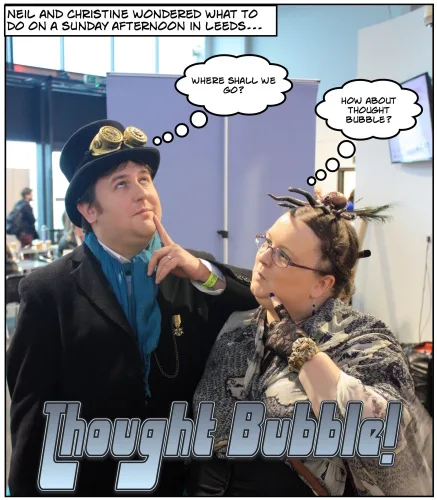
Yesterday Christine and I went to our first every comic convention, as part of this year’s Thought Bubble Festival in Leeds. It’s been running since 2007, and I’ve been aware of it since 2012 but this was the first time we’d been.
Running over two days, the comic con concludes the week-long Thought Bubble Festival which takes place across Leeds and celebrates comic art. It’s based at the Royal Armouries Museum, taking over the Royal Armouries Hall (recently renamed from the ‘Saville Hall’), the New Dock Hall, and a large marquee in the square outside, plus some small rooms for talks. There were hundreds of mainly independent comic book sellers, artists and all sorts across the three main venues.
One-day passes were £15, or two-day passes for both days – for die-hard comic fans who want to attend as many talks and panels as possible – were £24, and in both cases there was a £4 discount for cosplayers. So Christine and I dusted off our various steampunk paraphernalia and dressed up for the occasion. In doing so we spent more than the £8 that we saved on the entry price but we had a significant number of positive comments about our outfits – especially the octopus fascinator that Christine bought at a previousLeeds Steampunk Market. I’d say around 10-20% of attendees were in cosplay, some more elaborate than others. Kids under 12 had free entry so there were plenty of children around, many also dressed up. We saw a small Tardis, and a young, grumpy Hulk in a pushchair amongst others.
We followed the web site’s advice and made sure that we took out plenty of cash before we got there. The bigger stalls take cards but many of the exhibitors are regular people like you and me who just do this on the side, and the one cash machine nearby usually runs out of money on Saturday morning, apparently. And we spent most of the cash that we took.
Here’s the point where I’ll admit to not being an avid reader of comic books, but you don’t necessarily have to enjoy reading comics to have a good time at Thought Bubble. It did mean that we knew very few of the exhibitors – Moo and Keo being one of the only major exceptions, along with Dr Geof whose Tea Museum has recently returned from an exhibition at the Cutty Sark in London. However we did come across the official Professor Elemental comics, about the steampunk-themed ‘chap hop’ rhymer, and James Chapman whose Soundimals comics I’ve come across on Tumblr and Facebook. We bought their books, the latter signed, with a sloth illustration.
Speaking of sloths, we also had a couple of commissions, or pieces of art drawn for us. The first was by Sajan Rai, who offered to draw you as a sloth – Christine volunteered, hence the octopus. And Lucy Bellwood drew us the beautiful red panda, which we’re planning to get framed.
Part of the fun of Thought Bubble, for us, was simply people-watching. Obviously some of the cosplay outfits were amazing, although regrettably I only took one or two photos. But it was also fun looking at the bemused expressions of those who were on their way to the Royal Armouries Museum and weren’t aware that Thought Bubble was taking place – and were thoroughly confused by all the people dressed up. In Pizza Express, at lunch, we were one of two steampunk groups, with a girl on another table wearing a painted morphsuit showing all of the muscle groups in the style of a flayed corpse.
It was really good fun, and I can’t believe we’d never been before. We’ll be there next year.
Today’s blog post is about a bus service. You may be wondering if I’m scraping the barrel here – surely there’s nothing interesting about a bus service? But Diamond Geezer blogs about buses and makes them interesting, and I think that this particular bus service qualifies.
The 528 bus service
The 528 bus runs once every hour from Halifax to Rochdale, via my home town of Sowerby Bridge, Ripponden, Blackstone Edge, Littleborough and Smallbridge. Drawn on a map, it operates on a near direct south-westerly line, taking around an hour to complete the journey. And it’s quite a scenic route – the photo above is of Blackstone Edge reservoir, as between Ripponden and Littleborough the bus runs through open moorland. On a nice day it can be quite spectacular. I’ve used it a couple of times, once when I needed to get to Bury for work, and another time when the trains weren’t running because of engineering work.
It isn’t the only way of getting between Halifax and Rochdale though. It’s quicker by train, with the fastest services taking around half an hour. Plus the trains run twice an hour during the daytime whereas the 528 is hourly.
There’s also another bus service, the 590, which also runs hourly. The 590 runs via Luddendenfoot, Mytholmroyd, Hebden Bridge, Todmorden, Walsden before rejoining the 528’s route at Littleborough. It takes longer – about an hour and a half – but passes through more populous settlements.
At one time, both the 528 and 590 bus services were operated by First, the Scottish-owned large national bus and train company that operates the majority of buses in West Yorkshire. First still operate the 590 service, but several years ago the 528 was taken over by a company called Centrebus Holdings. This was a joint venture between the managers of Centrebus, a bus company in the Midlands, and Arriva, the large national bus and train company owned by the German state railway company Deutsche Bahn. Last year, the managers of Centrebus sold their stake to Arriva. This allowed Arriva to take full ownership of the company, which is now branded Yorkshire Tiger. Their buses retain Centrebus’ orange livery but with black tiger prints on the side. It makes me smile that a bus operated by Yorkshire Tiger crosses the border into Greater Manchester.
The reason for the change in operator is because the 528 bus is a subsidised service. It’s not commercially viable without taxpayer support, which comes from Metro (part of the West Yorkshire Combined Authority). Over recent years, First have pulled out of a number of subsidised services in West Yorkshire which run more as a public service than for profit. When these services have been put out to tender, Centrebus have often won.
The weak economy and austerity cuts being imposed by central government led Metro to review the services it was subsidising earlier this year. In some cases it was supporting services that were used by just a handful of people. This wasn’t providing value for money, and so a consultation process was held. And one of the proposed service cuts was the 528. Not just cut, but cancelled completely with some replacement buses running only as far as Ripponden as bus number 560. There would be no bus links between Ripponden and Rochdale, and those wanting to use the bus between Halifax and Rochdale would have to use the slower 590 service.
Whilst a large number of other cuts were proposed, the cut to the 528 received the most vocal opposition. In particular, the consultation was only held in West Yorkshire; residents of Littleborough and Rochdale were not asked for their views. Meanwhile the buses used on the 528 route were downsized from large single-decker Optare Tempo buses to smaller Optare Solos.
Redemption, of sorts
The outcome of the consultation was published a couple of weeks ago, and like many consultations that propose cuts, the end result was something in the middle. The 528 will still cease to exist when the changes take effect early next year, but it will be replaced with a new service called the X58 which will operate the same route. ‘X’ services are express services and this will hopefully reinforce the fact that it offers quicker journeys between Halifax and Rochdale than the 590, with the potential that more people will use it. It’ll retain the same hourly service interval as the 528 bus service, although it will not run late into the evening and its frequency will be reduced on Sundays.
I’m pleased that the bus service will be kept, even if I personally don’t use it very often. Whilst some buses can be run at a profit, it shouldn’t mean that those that aren’t profitable are withdrawn, provided that they serve a useful public service. Serving small outlying villages may not make much money for the bus companies but it can be a lifeline for the residents who rely on these services.
Whilst I did delete all of the Google apps off my phone, barring YouTube, within a few weeks they were all back and I was basically back to where I was originally – reliant on many of the services Google offers for free.
But recently I have managed to cut back on my Google dependency.
Contacts – iCloud
I used to use Google Contacts to keep my address book in sync between my various devices – iPhone, Mac, and Windows desktop at work. Originally I used Thunderbird at work which had a couple of unofficial extensions that synchronised the address book with Google, and my Mac and iPhone both natively supported contact sync.
And then we moved to Office 365, at which point Thunderbird just wasn’t up to the job. So I now use Outlook 2010 like everyone else, and there’s no easy way of linking Google Contacts. iCloud, on the other hand, works fine with Outlook and my Apple devices (obviously) so I successfully migrated a few months ago.
Mobile web browser – Safari
In April last year, when iOS 6 was the latest and greatest, Google Chrome was significantly better than Safari, in my opinion. However the improvements to Safari in iOS 7 and 8 have made them broadly equal in my view and so I’ve removed Google Chrome from my iPhone and iPad. Having just one web browser makes things a little easier to work with and third-party web browsers have always been second-class citizens on iOS. Plus, 1Password integrates with Safari through an app extension, which saves me having to open, close, copy and paste to retrieve passwords.
Two-factor authentication – Authy
Google Authenticator is probably the most well-known app for managing two-factor authentication codes, and indeed it was about the only one available for a long time. Now, there’s Authy, which has a few key advantages. Firstly it’s a universal app that can be installed on both iPhones and iPads, and secondly these can be kept in sync. So if I have my iPad to hand, I can use Authy on that to enter codes on my phone, rather than having to switch between apps. There are also a couple of web sites – namely Humble Bundle and Coinbase – which require Authy rather than Google Authenticator, and Authy can do everything that Google’s app can do anyway. So rather than have both, I’ve moved everything into Authy.
As for everything else, I’m still mostly using Google services. I don’t yet trust Apple Maps enough to use instead of Google Maps, even though it has improved since launch. My calendar is still in Google Calendar despite its woeful support in Outlook, because it allows Christine and I to view each others’ events. The results I get from searching with Google are better than Bing or Yahoo!. So whilst I don’t think I could ever completely give up Google, I’m pleased that I’ve been able to find better solutions elsewhere.
The photo was one of several taken of me, by friends but on my camera, in March 2005 whilst at university. I must stress that, even at the time, this was not how I used to dress normally – this was a fancy dress party where the theme was ‘chavs’. It was in honour of a friend who had recently started teaching in a school in a Yorkshire town, which, at the time, was known for having a population of people you could describe as ‘chavs’ – ‘a young lower-class person who displays brash and loutish behaviour and wears real or imitation designer clothes’, as defined by the Oxford English Dictionary.
The clothes were mostly bought cheaply from a charity shop especially for the occasion, and haven’t been worn since – I may have actually thrown them away in a previous house move. I’ve been informed that a real chav would not wear a Puma jacket.
After the event I uploaded the photo (and the one on the right) to Flickr.
So how did it end up on Wikipedia?
I had no part in this, but a Wikipedia user must have found the image, uploaded it to Wikimedia Commons and then added it to the page. Which they would be within their rights to do – the image is licensed under Creative Commons with a license that is compatible with Wikipedia. So I’ve implicitly allowed this to happen.
Whilst the photo is not on that page anymore, and not linked from any other Wikipedia pages, at time of writing that photo is the second result for a Google Image Search for ‘chav’, so it has made it into several derivative works. A friend posted an image that was supposed to be ‘people from Castleford’ containing the photo – I’ve never been there apart from passing through on the train once or twice.
How do you feel about this?
Honestly? I’m generally non-plussed about it. It’s just something that happens on the internet, I suppose. As far as I’m aware nobody has turned it into a meme yet, at least.
I was on annual leave all of last week, and so on Wednesday I and a couple of friends went to Hawes in the Yorkshire Dales for a day out. Hawes, pronounced like ‘hoares’ (and yes, there are plenty of jokes based on its name) is a small market town in the famous valley of Wensleydale.
Of the three of us, none of us can drive or has access to a car, so this was a trip done by public transport.
Hawes does have a railway station, but no trains have called there since 1959, and it’ll be quite a while before the Wensleydale Railway reaches it. The next nearest station is at Garsdale, on the wonderful Settle-Carlisle Railway, which this year celebrated 25 years since it was saved from closure by British Rail. It’s still a few miles away, is only served by six trains a day in each direction, and like many stations on the line is in the middle of nowhere.
Thankfully it’s connected to Hawes by the Little White Bus, which charges a £3.50 per person flat fare each way. It’s timed to meet some of the trains at Garsdale, although be aware that some journeys don’t normally run on Tuesdays, Wednesdays or Thursdays – we made this mistake and nearly got stranded in Hawes coming back. Outside of these times it operates on a request basis, so if you do need to travel you can phone them in advance.
Hawes’ main attraction is the Wensleydale Creamery, which produces Yorkshire Wensleydale cheese (now an EU Protected Origin product). After closing in 1992, it was rescued in a management buyout, and now employs almost 200 people and supports 36 local farms. The creamery includes a small museum, charting its history and how the cheese is made – on Fridays, Saturdays and Sundays you can actually see cheese being made, but we went on Wednesday so we didn’t. There’s also a huge shop, selling all of the varieties of cheese produced there with ample free samples, a café and a restaurant. You can probably spend up to a couple of hours here, and then it’s just a short walk back into the town.
The town itself is lovely, with narrow cobbled streets and plenty of small, independent shops. And, like most Yorkshire towns, several pubs serving local ales. Elijah’s is a good food emporium, and there was an excellent quirky second-hand bookshop.
Other attractions include the Ropemakers – a rope manufacturer that allows you to walk through its workshops and see how their ropes are made (and buy some yourself), and the Dales Countryside Museum, which we didn’t visit.
Earlier this year the first stage of Tour de France passed through Hawes. Having descended from Buttertubs pass, the peleton rode south into Hawes and then took a sharp right heading off east. There are still plenty of cycling and tour-themed things in the town, even though it’s been several months since the race.
All in all we had a really nice visit, even though it took me three trains and a bus each way to get there, and cost me over £20 in bus and rail fares. It was worth it though and I’d happily go again – but probably by car next time. All the photos from my visit are on Flickr.