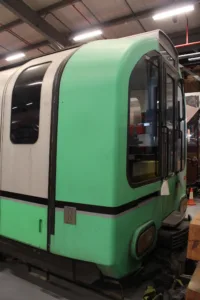
I’m a northerner, and I travel by train a lot. At least 95% of my journeys are with Northern Rail, a franchise run jointly by Serco (to whom all your base are belong to) and Abellio, which is owned by the Dutch government. The franchise was let in 2004 on a ‘no growth’ basis – the assumption being that passenger levels wouldn’t grow significantly during the franchise period, and so there was no real requirement for any extra trains or to increase service levels.
In reality there has been a huge growth in passenger levels in the north over the past ten years. Thankfully Northern has invested in some extra trains, although these are mostly old trains that other operators no longer need, and some services have been improved. But there haven’t been any brand new trains ordered, and whilst most have been ‘refreshed’ with a coat of paint, new flooring and seat covers, internally most of Northern’s fleet retains their original fixtures.
Around the time that the rail franchises in the north were re-jigged in 2004, the intercity services that Northern’s predecessor (Arriva Trains Northern) operated were mostly split off into a different franchise – First Transpennine Express. These services received new trains. Northern was left with mainly commuter and rural services, and the internal layout of its trains reflect this. But it still operates a few intercity services that I’ll get onto.

What makes a service ‘intercity’ anyway?
Simply put it’s a train service that connects two or more cities together, although I’d also state that the end-to-end journey time is over an hour, and it only calls at larger stations. Unlike short-hop commuter trains, where fitting on as many passengers as possible is the main goal, with intercity services you want to provide a more comfortable experience for longer journeys. To me, this means providing:
- Refreshments, such as a trolley service or buffet car
- First class accommodation
- Wifi (free or paid-for)
- Plug sockets
- Seat reservations
Almost none of Northern’s services meet the above criteria, and yet some of its trains probably should. Here’s my list of “intercity” services that Northern runs.
Leeds – Nottingham
This is fresh in my mind as we took this train on Saturday. It’s actually a relatively new service that was first introduced in 2008. The full journey takes almost exactly two hours, taking in the cities of Wakefield and Sheffield, and the large town of Barnsley on the way. It’s actually not the quickest way between the two cities, as we found out coming back – taking an East Midlands Trains service to Sheffield and then a Crosscountry service to Leeds took marginally less time, even allowing for 20 minutes in Sheffield. This is probably because the direct train goes via Wakefield Kirkgate and the Erewash Valley Line, so whilst it is an express service that skips many intermediate stations, it still takes a long time.
Our mid-morning Saturday departure was on a two-carriage class 158 train, which had ample seats for the number of people using it. And whilst the 158s are the newest of Northern’s diesel fleet, they are showing their age somewhat. Case in point – I had to use the toilet and it took several attempts to get the door to close because we were going around a bend and its motor wasn’t powerful enough to cope.

Leeds – Carlisle
The service from Leeds to Carlisle was under threat of closure until around 25 years ago, when the line was reprieved. Nowadays there’s a train roughly every two hours, and each one takes a little under three hours to complete the journey. You could argue that this doesn’t qualify as being “intercity”; Carlisle isn’t a very big city, and it doesn’t pass through any other cities on the way. But it’s also the only one of the services that I’m writing about today which meets one of the five criteria I mentioned earlier.
Thanks to the Settle-Carlisle Partnership there is a trolley service on the train, between those two stations. It’s the only Northern-operated service where this happens though, because it’s provided by the Settle-Carlisle Development Company and not Northern themselves. Again, for the most part Northern operate class 158 trains on this service but not always.

York-Blackpool North
I used to catch this service from Bradford quite regularly when I lived there and Christine lived in Blackpool; later when we moved to Sowerby Bridge I also used to commute in on it on a morning, until the timetable change in May this year. It connects the cities of York, Leeds, Bradford, and Preston, which was granted city status in 2000, but also calls at Burnley, Blackburn, Halifax and Blackpool which are large towns. Travelling the full length of this service takes almost three hours.
Northern usually puts its class 158s on this service but I’ve also endured its older class 150 trains, which have narrower seats, no air-conditioning and only one toilet, on this route. Whilst the former is reasonably acceptable, the latter does not make for a good journey experience, especially for such a long period of time. I suppose it could be worse – it could be a Pacer, a train made of 1980s bus parts bolted onto a two-axeled freight wagon, which are sadly still common on many of Northern’s services.
Spending three hours on a train with no opportunity to buy refreshments on board, no wifi or sockets to plug in a laptop to do work on, and no guarantee of a seat, does not make for a good travel experience. And yet, passengers put up with this every day.
Next year the government will announce a new franchisee for the Northern franchise. Shortlisted are Abellio (on their own this time), Arriva and Govia, and the winner will take over in early 2016. I really hope that whoever wins puts some effort into improving the rail service in the north – but especially these services. Offering a decent intercity-standard service between the north’s major cities will hopefully encourage more people to travel, and allow them to make the best use of their time on board.