Little Shop of Horrors

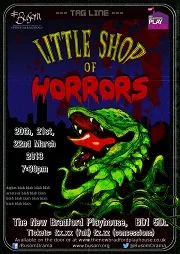
This coming Thursday, my wife Christine will be featuring in an amateur production of Little Shop of Horrors, along with other students from the University of Bradford where I work. It’s on at The New Bradford Playhouse and runs until Saturday.

As well as playing a character in the show, Christine has been helping out for a number of weeks now, and I also spent much of the weekend helping and/or hindering the technical team as they set up in the theatre. It promises to be a good show, and the puppets they’re using look really good.

So, if you’re available on Thursday, Friday or Saturday nights this week, we’d both very much appreciate it if you were able to come along. Tickets can be purchased online here.

Preventing Tetanus

Screenshot of the NHS information page about tetanus

When was the last time you had a tetanus vaccine? If the answer is ‘I don’t know’ or ‘more than ten years ago’, then you may wish to contact your GP to make an appointment to get vaccinated.

After a recent incident involving a colleague’s hand, a door, and their subsequent trip to the local accident and emergency department, I realised that the answer to that question was the latter in my case. I’m pretty sure that I’d not had a booster vaccination for tetanus since before leaving York to go to university in 2002, so I was overdue.

Thankfully, the vaccine is free to everyone in the UK (thank you, NHS). As I already had an appointment with the practice nurse for an asthma checkup yesterday, I just asked in advance if I could be given the vaccination at the same time. It’s mostly like any other vaccine but can make your arm hurt for up to 48 hours afterwards apparently.

Tetanus is actually pretty rare in the UK, with only three people contracting the disease in England and Wales in the whole of 2011. But that doesn’t mean that you shouldn’t have the vaccine, as though it is rare, it can be fatal. The symptoms can include lockjaw, followed by muscle spasms and stiffness, a fever, high blood pressure and an increased heartbeat. If left untreated, it can result in heart failure, and indeed 11% of those who contract the disease die. The disease is usually contracted through wounds on the skin, which is why you may be asked if you have had the vaccine recently if you present at casualty with an injury.

Some younger people may have lifelong immunity to tetanus, thanks to changes in the vaccination programme, but if you’re approaching middle age like me then you will probably need a booster vaccine every ten years. Either way, speak to your GP or practice nurse, as he/she will be able to advise you whether you need the vaccine.

Museum of Transport, Greater Manchester

Museum of Transport, Greater Manchester

On Saturday, whilst Christine was working, I took myself off to the Museum of Transport, Greater Manchester. I’ve been meaning to go for a while, but the recent opening of Queens Road Metrolink station nearby has made it somewhat easier to get to. Although railway engineering works, and the temporary closure of the Metrolink platforms at Victoria station, meant that it was still something of a trek taking a couple of hours each way from Sowerby Bridge. Normally, it’d take around an hour.

Anyway, the museum. It’s in the Cheetham Hill area of Manchester, to the north of the city centre, and is housed in the back of what was the Queens Road tramshed for Manchester Corportation Tramways – now used by First buses as a bus depot. It’s home to a wide variety of buses that operated in or are linked with Greater Manchester, plus a few other bits and bobs. But mostly buses – other forms of transport were not very well represented.

There are three trams, only one of which is complete (a horse tram). Of the others, one is Metrolink 1000, a half-tram mock-up of what would become the production T68 tram series. The T68s have only recently been retired from revenue service in Manchester and I imagine that a production model may enter the collection when one is preserved. The other bit of tram is the lower passenger compartment of what was originally a double decker tram, in the process of being restored.

There are also re-created transport offices, as well as an extensive collection of bus tickets, roller blinds and old signs. But, buses form the main attraction here.

On the whole I found it interesting but it’s not as good as other transport museums – particularly the excellent London Transport Museum. You definitely need to be more of a transport geek to enjoy it, and I’m sure Christine would have been bored stiff by it had I dragged her along. (I very nearly did last summer, but we ended up going bra shopping instead.)

The museum is open three days a week – Wednesdays, Saturdays and Sundays, or all week in August. Entry is only £4 for adults, and free for accompanied under-16s, which is good value for a museum that can keep your average transport geek occupied for a couple of hours.

Photos from my visit are available on Flickr.

Hearthstone: Heroes of Warcraft

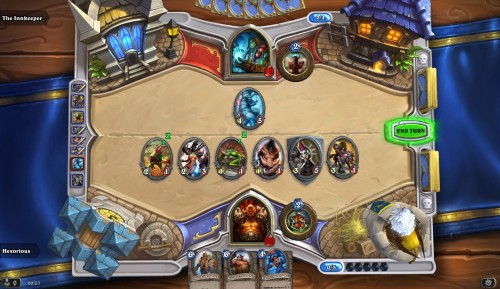
Screenshot of the game Hearthstone: Heroes of Warcraft

Some months ago, I was given access to the then-closed beta of Blizzard Entertainment’s new game Hearthstone: Heroes of Warcraft. If I’m honest, I didn’t really bother to play it until a few weeks ago.

The open beta cycle is now coming to an end, so presumably the final release of the game is imminent. Unlike other Blizzard games it’s expected to be free to play, but with in-app payments to be extras. It integrates with Blizzard’s Battle.net service so you can chat to friends playing other Blizzard games like World of Warcraft, Diablo III and Starcraft II whilst playing.

Hearthstone is, essentially, a turn-based card game. It can be played either against the computer, in practice mode, or against other players – either friends or random matches. So far, I haven’t ventured outside practice mode so I haven’t played against any other real people as yet.

The basic premise of the game is that you have a deck of cards, which belong to a class from one of the original nine World of Warcraft classes (i.e. no death knights or monks), and you play a hero of that class. As I started with the Mage deck, I played Jaina Proudmore. You then play against another hero of a different class – so choosing a Warrior opponent will give you Garrosh Hellscream. As you defeat other classes, you get access to those decks, until you can choose any of the nine class decks to play.

In the games, you start off with several cards, and receive at least one more card with each turn. Some cards produce minions, which can attack or defend you; others enable spells and abilities. You also gain a mana crystal with each turn – the number of crystals you have for each turn budgets the number of abilities you can use. If you defeat the opposing hero, you win.

It’s very similar to real world table top games, but with the bonus of having the computer enforce the rules. I occasionally play table top games but sometimes the rules can be bewildering, and some games have a steep learning curve that puts off more casual gamers like me. So I appreciate having my hand held by the game in this way. It’s also nice that it uses a familiar universe of characters, as all of them have appeared in the Warcraft game series at some point.

Hearthstone itself is relatively easy to play, and is controlled entirely with the mouse. I’m pretty sure it’s been designed so that it can be easily ported to tablets, although as yet it’s only playable on Windows and Mac OS X. Hopefully Android and iOS versions will be forthcoming when it’s finally released, as I think it would lend itself well to casual play on a tablet.

If you want to try Hearthstone before it exits beta, you’ll need to download it now. A Battle.net account is required, but it’s free to play.

A letter from me to myself in 1999 about the internet

This month marks 15 years since I first used the internet at home. I thought I’d write a letter to myself, aged 14, about how things have changed since then.

Dear Neil,

Hello. This is a letter from 2014, 15 years into the future. Around about now, you will be using the internet at home for the first time, and it will be awesome. What’s more, is that as time goes on, it will get even more awesome, and the ways that you use the internet will change.

Firstly, it’ll get faster. Right now you’re using a 56k modem, and downloading a 10 MB file can take the best part of an hour. But in a couple of years time, you’ll get ‘broadband’, and that’ll increase your download speeds tenfold, to around 512 Kbps. Better yet, it’s ‘always on’, so there’s no need to dial a number and hear the modem make all of those screechy noises, and you’re not charged by the minute, so no more £40 per month phone bills for your parents to pay.

Although you will still hear the screechy modem noises in the future, I’m afraid. You’ll spend a couple of years in university halls of residence with them, and then share an office with a fax machine.

Eventually your internet connection will hit the lofty highs of 20 Mbps – yes, megabits, not kilobits. You’ll be able to use the internet to watch full TV programmes, and you won’t even need to use that ghastly RealPlayer software anymore. Oh yeah, and if you think RealPlayer is bad now then I have bad news for you, but hey, it gets worse before it gets better (i.e. you can get rid of it completely!)

The music industry eventually figures out how to sell music legally online so you won’t be using Napster for much longer. Hurrah! In fact, you don’t really buy CDs anymore. Next year, your parents will buy you a portable MP3 player – a bit like a MiniDisc player – because you’ll do well in your GCSEs. Just not necessarily in the subjects that you expect.

And soon you won’t even need a computer to use the internet. One day, you’ll buy a mobile phone, but with a big touchscreen that also has the internet – and, it works anywhere! In fact in some places it’s faster than the internet on your computer and you’ll be able to sit in a bus station and use the internet at 38 Mbps! Because you’ll still be using buses when you’re almost 30 as you still haven’t passed your driving test yet. Sorry to be the bringer of bad news.

In better news, you will eventually find someone to love, and who loves you back in equal measures. It’ll take a while, but you will get there and you will be happy.

Also, and you may find this utterly bizarre now, but you are writing this letter on Firefox, a descendent of Netscape, running on an Apple Mac. You will, in time, give up your reliance on Windows and Internet Explorer. Oh, and Apple makes your phone too. And a ‘tablet’ – a flat touchscreen device that doesn’t have a keyboard but let you use the internet and programs, and watch videos, which is pretty cool.

I’m sorry to say that all of the time you spent learning to code in BASIC turns out to be for little value. You’ll end up knowing the very basics of several languages, but nothing substantial, sadly.

So anyway, on the whole the future is pretty awesome. See you in 15 years!

Yours,

Neil

The Two Together Railcard

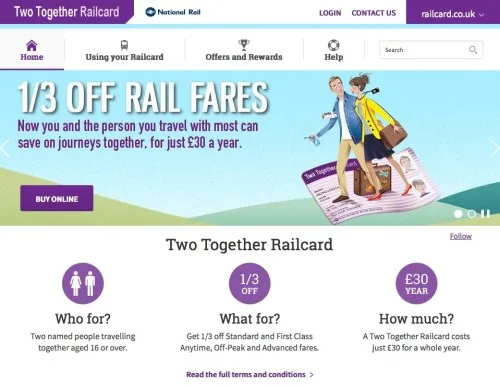
A screenshot of the Two Together Railcard web site

There’s a new addition to the railcard family – the Two Together Railcard. Launched some time ago as a pilot in the West Midlands, it’s now available nationally, as of yesterday.

Unlike most railcards, issued to a single person, this is issued to two named people who must travel together for it to be valid. You needn’t be related, so if you regularly travel with a particular friend or housemate then they can be on the card. Like most railcards, it costs £30 and is valid for one year, and gives you a third off almost all rail tickets. You can also get 10% from this link, so it costs £27 for the year. The card can be bought at staffed ticket offices at stations, or online.

As Christine and I do a lot of travel together, this card has the potential to save us a lot of money, so we’ve ordered one. The £30 cost will easily be recuperated as we regularly spend more than £90 per year on tickets where both of us travel. In fact, it may pay for itself after just one long return journey. Until now we’ve been making use of Northern Rail’s Duo tickets, which allow a second adult to go half price with a full-fare paying adult. But this is limited to only some of Northern’s trains and isn’t a national scheme.

Right now we don’t qualify for any of the four other existing national railcards. The 16-25 railcard is for those aged 16-25 (we’re too old) or older people in full-time education (we’re not). The Friends & Family railcard is for those with children aged 5-15, which won’t apply to us for some time – you need to be travelling with at least one child in that age range for it to be valid. We’re both thirty years too young for the Senior railcard, and neither of us are disabled, so the Disabled railcard is out.

So, if you’re like Christine and I – adults who work full time, are approaching middle age and are childless or don’t have any children over five years old – then the Two Together railcard is a welcome introduction.

How to: call Freephone numbers on mobiles for free

As more and more people use their mobile phones as their main phone, instead of landlines, it’s becoming more of a scandal that ‘freephone’ 0800 and 0808 numbers are usually not free on mobiles. Not only that, but users with contracts that have inclusive minutes (which is most people), will find that calls to freephone numbers aren’t included. My network, Three, charges me 15.3 pence per minute to call freephone numbers, and my allowance of 300 minutes per month won’t cover it. EE charges its customers 40p per minute.

The situation will, thankfully, change soon. Ofcom has mandated that calls to freephone numbers from mobiles must be free from late June 2015, but that’s not so useful if you need to call someone right now. So, instead, here are a few workarounds if you need to call a freephone number, and don’t have a landline phone that you can use.

1. Use Skype

If you have a smartphone with Skype installed, and have enabled SkypeOut which lets you call regular phone numbers, then you’ll be pleased to know that freephone numbers are completely free. You’ll also probably find that calls made through Skype to 0845 and 0870 numbers are also cheaper than on your mobile.

The downside is that you need to have access to a reasonable internet connection for this to work – 3G or Wifi is usually okay but you will struggle on anything slower. And this might not be a good option if you don’t have a very high data usage allowance.

2. Find the geographical equivalent

Freephone numbers like 0800 numbers, and the chargeable 0870 and 0845 numbers, all point to regular geographical numbers – ones starting with 01 or o2. So if you can find out that geographical number behind the 0800 number, you can call that instead, and make use of your inclusive minutes. SayNoTo0870.com is a rather dated web site that lists many of these numbers, and you can search both by company and by phone number.

3. Use a geographical call forwarding number

Instead of calling the freephone number directly, you can call a third party service using a geographical number, and then have your call forwarded. The call is billed as a geographical number and so will therefore be included in your call allowance. There’s a couple of services to try – 0800 Buster and 0800 Wizard. With 0800 Buster you can actually dial both numbers at once, by inserting a pause character between them, so you can save them to your contacts.

4. Use an app

The aforementioned 0800 Wizard service also has a series of smartphone apps – here’s a link to the iOS app, and it’s also on Android, Blackberry and Windows Phone. You open the app, dial the 0800 number as normal, and the app will automatically route it through a forwarding number as above.

I’m not aware of any privacy issues with using these services – although they forward your calls, I don’t think they’re able to somehow eavesdrop on your conversations.

Next year, none of this will be necessary, and freephone calls will actually be free for everyone. But in the meantime you can stop wasting money on calls that should be free.

Tapped Leeds

Tasting trays

On Saturday I visited the latest addition to Leeds’ craft beer scene – Tapped Leeds. It’s an American-style brew pub, where some of its beers are brewed on the premise. As you go in, there’s a huge bar on your left, and a microbrewery on the right wall.

Tapped Leeds is on Boar Lane, and located under the eastern wing of the Trinity Leeds shopping centre, next door to BHS. Go back a few years and Boar Lane wasn’t somewhere that you would spend much time, but the opening of Trinity Leeds has seen the area turned around and now all bar one shop unit is occupied. Together with Friends of Ham and the Leeds Brewery Tap (where the above photo was taken), there are now three good craft beer pubs within drunken staggering distance of each other, and two of them brew some of their beer on site. Brewdog Leeds is only a short walk away too.

Tapped Leeds is certainly the biggest of the three, and has the largest beer selection. Typically, there will be 13 cask ales (delivered by gravity feed rather than pump), and 14 keg beers. And then over 100 beers in bottles and cans in the fridges. This isn’t the sort of place where you go to drink the same thing every time.

It’s owned by Pivovar, and is their first Leeds bar. They started off with Pivni in York, as one of the first British bars to sell Bernard beer from the Czech Republic, and have since opened bars in renovated buildings at York, Sheffield, Harrogate and London Euston stations.The York Tap is one of my favourite York bars, which is saying something as York isn’t exactly short of pubs (the legend states there are 365 but in reality it’s closer to half that).

Compared with their other properties, Tapped Leeds is rather different as it’s not in an old renovated building – it’s in the ground floor of a shopping centre. Consequently, the interior is very different as it doesn’t have to show any original features. In some ways it’s lacking character, and indeed the bar is very plain – all of the beer pumps are on the back wall. Some of the beers can be on the pricey side, with my pint of Damson Porter from the Ashover Brewery costing £3.80 (expensive by Yorkshire standards).

Beer drinkers who like variety will find a lot to like at Tapped Leeds. It’s not somewhere that you would go for a quiet drink, and I personally prefer Friends of Ham. But it’s good to have the choice and it shows that the craft beer scene is in good health.

We Will Rock You

The 'Minion' Theatre

As I mentioned briefly earlier in the week, on Friday we went to see We Will Rock You at the Dominion Theatre in London. For those unaware, it’s a a so-called ‘jukebox musical‘, where the script is written around pre-existing songs. All the songs are by Queen, hence the title.

It opened in London in 2002, and it still going strong. When we went it was nearly a sell-out, although it was a Friday night, the beginning of the half term holiday for some schools, and Valentines Day, so that’s not so surprising.

The musical is set in a dystopian future, where one corporation, GlobalSoft, rules the world, and all original music is banned. Except one person, Galileo, who keeps hearing lyrics from music from the twentieth century in his head, but doesn’t know why. He teams up with a young woman, who he calls ‘Scaramouche’, and they flee to the sewers where the Bohemians live, all the while being pursued by GlobalSoft and its leader, the Killer Queen.

That’s the general synopsis of the plot, whilst trying to avoid spoilers. The story is rather contrived, and some of the links with the songs feel a little forced. The ending is also a bit rushed in my opinion, leaving several plot holes unclosed. And it’s very similar to the plot of The Matrix, in several ways, which is something that its writer, Ben Elton, has admitted.

Thankfully, what it lacks in plot, it makes up for in looks. Some of the lighting and effects are brilliant, and visually it is quite spectacular. Plus, you’ll probably know most of the songs already, even if sometimes the words are changed to fit the plot.

Furthermore, there have been some minor changes to the musical over the years to keep it topical. The Bohemians are all named after current pop acts, some of which were not around in 2002, so these have been changed. And references to Facebook and Twitter have been introduced as neither existed 12 years ago. What hasn’t changed is some of the computer graphics, shown on the backdrops, which arguably looked dated even in 2002. I’m sure your average computer animation student could do something better in an afternoon nowadays.

Should you go and see it? If you can get some of the cheaper tickets like we did – £30 each, for the back of the stalls but still with a good view – then sure, go for it. But there are better musicals out there in the West End – Wicked is amazing, and I’ve head good things about Book of Mormon, although tickets are still like gold dust for that. Of course, it also depends how much you like Queen’s music.

Reluctantly opting out of care.data

A screenshot of the faxyourgp.com web site

I wrote this article before the six month delay was announced yesterday. However, most of it still applies, so read on.

Yesterday, I reluctantly opted out of having my medical records shared with third parties. I’ll explain why, and how to do this yourself.

NHS England are compiling a new database called ‘care.data’, which will be available for health professionals, universities, drug companies and insurers to use. The main aim is for medical research, which could be ethnographic, or to look at individual cases for the advancement of healthcare and treatments. The NHS, being a mostly-integrated system which is used by a vast majority of the population, means that it is almost unique amongst healthcare systems in the world in providing cradle-to-grave care. The data produced by the NHS could be really valuable and lead to better health and wellbeing for everyone. Further information is on the NHS Choices web site, and this article in Nature explains why it is a good idea.

On this basis, it seems like a good idea. But whilst the idea is good, the execution isn’t.

The major issue is privacy. To compile this database, the full medical records of everybody who is registered with a GP in England will be imported into this database. You would expect, therefore, for this data to be anonymised; it is, but only slightly. Your name will be removed, but your date of birth, full postcode, NHS number and gender will still be included. That will still make just about everyone in the database uniquely identifiable.

For example, I work at a university – indeed, one where the data from such a database could be really useful, as we do medical research. In fact, I’ll make a shameless plug for our Crocus Cancer Appeal whilst I’m here. Anyway, we have a student database, and, given someone’s’ postcode and date of birth from their pseudo-anonymised medical record, I reckon we could match 99% of those records with our student records. So it’s not at all anonymous. And there’s a particular worry that insurance companies will be able to access records, which could make it very difficult for some people to obtain life insurance.

To make matters worse, this is an ‘opt-out’ scheme rather than opt-in. If you do nothing, then in just a few weeks your data will be irrevocably added to this database, at which point, you will not be able to opt out if you change your mind.

Unsurprisingly opposition to this has been growing. A petition on SumOfUs.org has over 250,000 signatures, and there are concerns from the British Medical Association and the Royal College of GPs. In particular, there are concerns that only around a third of adults recall receiving a leaflet about the changes (I certainly don’t remember receiving one) and that there is no form to opt out. Others are worried about the potential for accidental data leaks, or for information to end up in the hands of organisations like GCHQ or the NSA.

So, although I’m in favour of the general idea, and agree with the spirit behind the database, I have contacted my GP surgery asking for my medical records to not be included in the care.data database. Because I’m worried that my medical records could be abused or used in a way that would not be in my best interests, and because this is my only chance to opt out. I can’t just wait and see what happens, and try to opt out later, as it’ll be too late.

I hope that changes will be made, which will maintain the usefulness of the data whilst respecting the privacy of the people whose data is being used. In particular, a greater level of anonymity, perhaps with more vague dates of birth (month and year only) and less accurate postcodes (sub-districts rather than exact areas). And people should be able to opt out at any time, not just at the start of the project. If these changes are made, then I may consider opting back in.

So, if having read this, you also want to opt out, then the easiest way is using FaxYourGP, which will send a template fax to your GP. Alternatively, medConfidential has a form and covering letter which you can use. Whilst you can write your own letter, there are certain codes that you will need to include in your letter which is why I’d suggest using one of the two methods.

It’s sad that I feel like I need to opt out from what could be a great resource, and I’m angry that it has been managed so poorly.