We’re making some more progress with the house (here’s the previous update). The big news is that we will, finally, be moving in next weekend.
This is partly because all of the main jobs are done, but also because we’re basically broke. Trying to run two houses for four months has been very expensive, and the longer we stay in the rented flat, the more money we’re throwing away. In hindsight, the £2000 or so that we’ve spent on rent in that time could have been better spent on getting professionals in to move things on a bit quicker, but never mind.
The main bit of work that I have done is filling in holes in the dining room floor. Unlike other rooms in the house, the dining room has a solid floor, but there was a channel along the back wall which originally housed a gas pipe. That’s been removed, as after we took out two of the gas fires it became redundant, but it left a long gap between the floor and the skirting board, and quite a deep hole in one corner. I’ve filled it all in with mortar; this was the first time I’ve ever done such a job and actually I’m quite impressed with the result. The photo was taken just after I had put it down, but now that it’s dried and I’ve sanded down the rough edges, it looks just like the rest of the floor.
However, it won’t be there for much long as we are having laminate floor laid over the top next week. This will be after we’ve moved in so we’ll have to limit how much stuff we have downstairs.
Having a car has meant we’ve been able to take more of our belongings over and we’ve probably moved at least a third of the contents of our flat now. The big stuff remains, until the weekend when we’ll (hopefully) have some help shifting things.
It’ll good to finally be able to live in the house after all this time.
Last week, as part of the British Science Festival, we went to see George Egg perform his show ‘Anarchist Cook’ at The Studio theatre in Bradford. George Egg is a touring stand-up comedian who consequently spends a lot of time in budget hotels. As he finishes his comedy gigs in the late evenings, it’s often difficult to find any decent food available (apart from pizza and kebab shops).
So, the show is based on the premise of: what can you cook in an average hotel room, using only the equipment that’s there?
This is, of course, bearing in mind that you don’t usually get a cooker, oven or any cooking utensils in an average hotel room. Instead, George Egg cooks a three course meal in just over an hour, using an iron, a kettle, a pillow case, some of the complementary salt and pepper sachets, some foraged plants from hotel reception, and a Gideon Bible.
The starter includes crostini toasted on the iron, ricotta that had been strained through a pillow case using UHT milk sachets (209 sachets to be exact), and a salad with leaves from a spider plant (which until now I didn’t know was edible). For the main course, he steamed sea bass in the travel kettle, and desert was pancakes, again cooked on the iron.
These were just three of the recipes that George has come up with, and he mentions others in his show. This includes curing your own salami sausages (requires a hotel room with removal ceiling tiles and being able to request the same room a few weeks later), and making bread using a complimentary wine bottle as a rolling pin and the countertop in the bathroom.
It was a good show, clocking in at around an hour long, and the audience were invited to try the food at the end. Alas, by the time we’d made it out, it had all been eaten – the show was free, funded by the science festival’s sponsors, and so it was a full house. We did, however, buy the recipe cards – although we’ll probably use more conventional cooking utensils to make them.
The Anarchist Cook show has recently run at the Edinburgh Fringe Festival, and George Egg is due to reprise it at a couple of dates in Wales next month. Hopefully he’ll be able to tour it elsewhere soon as it’s a good show to watch – it’s both entertaining, and educational. If not, he also has plenty of stand-up dates coming up as well.
Disclosure: I work for the University of Bradford who were this year’s host of the British Science Festival.
Having bought a car at the weekend, I also needed to arrange car insurance. The law in Britain now requires all cars that are used on public roads to have a valid insurance policy; if you don’t, then you must park the car off-road and submit a SORN. If your car is found on a public road, parked or moving, then you can be fined. So I needed to have a policy in place before I would be able to drive the car away.
Like many things, buying car insurance can be simple and quick, but if you’re prepared to put some effort in, you can bring your premiums down significantly. I can wholeheartedly recommend the advice on MoneySavingExpert.com which gives some tips on how to reduce your premiums by tweaking the information you provide. I would advise you to read the whole article, but here are the things I tried that worked for me.
1. Trying multiple price comparison web sites
It’s hard to avoid the various price comparison web sites that advertise nowadays. Whether it’s the one with the meerkats, talking robots or annoying opera singer, these sites are well-advertised. They work by taking your details, and obtaining quotes from a range of insurers on your behalf, which are then ranked to show you the cheapest. The sites make their money from the referral fees that insurers pay when you take up a policy. Considering how much these sites advertise, they must make a lot of money from these referral fees.
It’s worth trying multiple sites, as different sites work with different insurers. I got different results from each. You can also usually get cashback if you click through to a price comparison web site from a cashback site like Quidco(referral link) or Topcashback(referral link). I got about £2 from them, just for getting a quote.
2. Go direct to insurance companies
Once I’d found the cheapest insurer – and the three comparison sites I tried all gave the same company – I also tried to get a cheaper quote by visiting their site directly. Again, going via a cashback site may net you cashback as well. Remember those referral fees? Cashback sites pay those to you.
It’s also worth checking Aviva and Direct Line, who do not advertise their policies on price comparison web sites. As it happens, both gave me unaffordable quotes that were nearly double the cheapest that I could find, but, worth a try.
3. Tweak your job description
I have a rather unique job title of ‘Student Recruitment and Data Officer’, which isn’t on the selection lists that insurers ask for. Originally I put it through as ‘Recruitment Consultant’ working in state education, but I found changing it to ‘Administrative Officer’ in the university sector lowered my premiums significantly (by about 20% in my case). As long as the title still accurately reflects your job role, you should be fine.
4. Add another driver
As Christine hasn’t passed her test yet, it was going to just be me on the car’s insurance policy. However, we found that adding another family member to the policy, as a secondary driver, reduced my quote by another 10%. To be effective, this must be someone that would realistically be likely to drive the car, and who has a good driving record with no penalty points or recent insurance claims. Adding an irresponsible or inexperienced second driver may increase premiums, but it’s worth trying.
5. Include some business use
If you think adding another driver is a bizarre way to reduce your premiums, here’s one that seemed even weirder. I will need to drive for work from time to time (I reckoned no more than 1000 miles per year) and so I included this in the policy. This means that I won’t need to arrange a hire car, so my employer also saves money too. After getting quotes with this included, I tried taking it out and stating that the car would only be for ‘leisure’ use (no commuting and no work-related activities). That actually pushed the premiums up by about 10%, so I put it back in.
Plus the things that I didn’t try
I didn’t try everything. I could have got an even cheaper policy if I had opted in to a ‘black box’ insurance policy. This involves the fitting of a recording device to your car that monitors your location and how you drive – and if you drive safely, you’ll save money. InsureTheBox is one of the better known firms that offers this (a friend works for them), but it’s available from a variety of insurers.
Sometimes, opting for third-party insurance can be cheaper, but it covers less than fully comprehensive insurance which could leave you out of pocket in the event of an accident. And, again bizarrely, sometimes comprehensive cover is cheaper than third-party because of risk factors.
And if you have another type of policy with an insurance firm (say home or travel insurance), some insurers may give you a discount if you take out more than one policy from the same firm. Our home insurance was arranged via a broker when we got our mortgage so I wasn’t able to approach them for a car insurance quote on this occasion.
In the end
As it happened, the cheapest quote I got was via Confused.com, for Diamond insurance – a company that historically only covered female drivers. Both are owned by Admiral Group, incidentally. Overall, the policy ended up being about £200/year cheaper than when I started, which isn’t bad for a couple of hours spent entering information into various web sites. Insurance for new drivers is always expensive and I’m hoping that, should I continue to drive like Captain Slow, my premiums should come down in future years.
Fortunately my parents kindly gifted us most of the money that we needed, so we were able to buy a decent-sized second hand car. After trawling the listings for local dealerships on Auto Trader, we found a local dealership with a good range of cars within our budget. We then narrowed this down to two cars, at the same price, which we took on test drives.
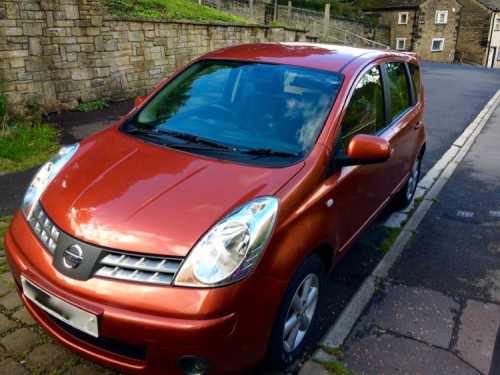
The first was a Hyundai i30, which was good car, and slightly newer with better equipment, but it didn’t drive so well and didn’t have as much internal space. So, we went for a 2008 Nissan Note.
It’s got a 1.4 litre petrol engine (which is fine for us) and a manual gearbox – I’m indifferent when it comes to manual or automatic but both Christine and I are/were learning in a manual car. The boot is big and there’s also plenty of legroom in the back, plus there are Isofix fixings for a child seat. It’s very much a family car, and whilst it may not be very cool or trendy, it should be very practical for us.
I’ve had a bit of time to drive it but the big test will be in a few weeks when we drive down to Staffordshire for a family wedding. I say ‘we’ – it’ll be me driving there and back as Christine still hasn’t sat her theory test yet, never mind her practical test. I may try to arrange a motorway driving lesson with my instructor before then.
After putting up with not having a car for so many years, it feels very weird to finally own one. We’ve managed to make do with public transport, but I am very much looking forward to not having to pay over the odds for taxi fares, or complicated bus and train journeys that take twice as long as driving would.
Last week, Christine had her 20 week ultrasound scan. Our baby is developing normally, it would seem – everything seems present and correct, and he or she is growing at the correct rate. And the image is much more clear than it was at the first scan at approximately 11 weeks.
We did found out the gender of the baby and have told some people (mainly family), but we’re not making it widely known. This is mainly because the sonographer wasn’t very confident about whether the baby is a boy or a girl, but also because we don’t want to end up with lots of pink or blue clothes in case we have another child later on.
Christine is still due to give birth in early January.
Last weekend some very dear friends of ours got married in St Andrews in Scotland, and so Christine and I made our way up there.
This was our first time in Scotland since a trip to Edinburgh four years ago, and the first time either of us had been to St Andrews. It’s a small town on the Fife coast, north of Edinburgh and south of Dundee. The town is dominated by its university, which is one of the oldest in Britain and has many famous alumni, including Prince William and the Duchess of Cambridge. It’s also rather isolated, with only a couple of roads in and out, and three miles from the nearest railway station at Leuchers.
There’s a small harbour which still receives boats carrying fish and shellfish, although not on the scale of other small port towns like Whitby. The major landmark is its ruined cathedral which sits on the top of the cliffs, overlooking the North Sea.
We had enough time for a stroll around the town, followed by lunch at the St Andrews Brewing Company – a very nice brewpub with an extensive gin and whisky selection. The town is very much geared up for tourists and students in equal measures.
St Andrews is somewhere I’d happily go back to but there isn’t a lot to do there. It really is quite a small town – just one that happens to be very well-known with a lot of history.
We haven’t hit any major snags but August has been a busy month for us (as evidenced by the lack of blogging) and so we haven’t progressed as much as we’d hoped. Here’s an update:
Plastering
The damp-proof plastering dried out mid-August, and so we have the first two coats of paint on the walls in the dining room. I’ve also been able to patch up some bits around plug sockets (for example) that weren’t quite finished to how we’d like.
I also mentioned last time that we needed some extra bits done – we had a builder in last week, who did these for us. So, the plastering is all done now, and we just need to wait for all of the new plaster to dry out. This means that we’ve finally had all of the holes from the old plug sockets filled in.
Bathroom
The bathroom was the one upstairs room that we planned to decorate, and also the one with the least amount of work required. However it ended up as a lower priority when we realised how much work the rooms downstairs would be. Anyway, we’ve got on with the painting in here and it’s basically done, but needs a little touching up to make it tidy with clean lines. The floor also needs a serious clean to get the paint splashes off, but otherwise, the bathroom is pretty much finished now.
Flooring
The living room, dining room and hallway all originally had the same dark blue carpet. We had to take this up as part of the re-plastering work, but we’ve decided to get rid of it. This is mainly because the new plaster is actually thinner than the old, so the dining room floor in particular now has a very slightly larger surface area – and so the carpet no longer fits correctly. We’ve instead decided to get oak laminate floor, with the same pattern across the kitchen, dining room, hallway and living room. The new flooring has been ordered and paid for, but we’re awaiting the last few bits to be delivered before it’s installed. As for the old carpet, a friend of ours took it off us for nothing for use in her house, which is great as it would have probably cost us money to dispose of.
‘The Triangle Room’
Beyond the living room is a room we’ve been calling ‘the triangle room’, as it’s roughly triangle-shaped. I assume it was originally part of what is now the living room as it’s separated by a comparatively modern stud wall. This part of the house used to be a shop, and the window in this room used to be full height. It’s been partly bricked up, but only on the outside, as we found when we took a bit of plasterboard off behind the radiator and opened up a void below the window.
I mentioned that we’ve had a builder in – he’s filled the void with insulation and covered it with some new plasterboard and plaster that is flush with the rest of the wall. We’ve also had an additional stud wall and door fitted in the room, as shown in the work in progress photo at the top, as eventually this will become a cloakroom with a toilet and washbasin. This probably won’t happen until after we’ve moved in as we’ll need to save up some more money first. It’ll also need flooring putting down, but again, after we’ve moved in.
Painting
We’ve started painting the dining room, as mentioned, and once the rest of the plaster is dry (which should be in the next couple of days) we can paint the living room as well. We’ve bought all of the paint already – the dining room is being painted green, and the living room a kind-of chocolate brown.
Exterior building work
We had two gas fires that we didn’t want, which both had external flues. Having removed these, we got the builder to fill in the holes in the external walls. He’s done a great job and it’s actually hard to see where the holes were originally. When the mortar dries, it’ll be almost impossible I reckon.
What’s next
We’ve not got many jobs left now. The flooring needs to go down, and we need to re-hang some skirting boards and lift some gripper rods that were left over from when the carpet was down. After that, it’s basically just painting, and then we can move in. Whilst this won’t be the end of the house renovation project, we’ll have done the most disruptive work before moving in. If all goes to plan, we’ll be living in the house by the end of the month.