Manchester Airport Runway Visitor Park

Etihad airplane

Planespotters can be viewed in several ways. I think most people would bracket them with trainspotters and busspotters – eccentric, but harmless.

Greece, not so much – in 2001, a group of planespotters were arrested for spying. Ultimately, they were acquitted.

Manchester Airport, however, saw planespotting as a way of making money. So the airport’s Runway Visitor Park isn’t just a handy viewpoint for the runway – it’s a fully-fledged visitor attraction. We called on the way back from Quarry Bank Mill; I’d seen it signposted and figured it would be a good opportunity to snap a few shots of planes.

As you’d expect, there are three raised platforms to watch the planes from, one of which has a ramp. But there’s so much more; plenty of picnic tables, a café and bar, and a children’s funfair is open on summer weekends. Plus, there are several disused aircraft that you can book tours to see, including Concorde, and a shop that sells plenty of model planes.

AVRO RJX

One of the aircraft, an AVRO RJX (I’m not a plane geek, so this means nothing to me) is open all of the time; it’s a small aircraft that was used briefly for testing and only flew for a couple of years before being retired. The others are by guided tour only; I was only dropping in for a quick visit and so I didn’t book on for one this time. I’d definitely like to take a look around Concorde some time, as I never got to go on one when they were in service.

The park is surprisingly close to one of the taxiways, so it’s perfect for photography. A handful of people with big lens cameras were there, but I think most people had come to spend a sunny afternoon there. The food from the café looked rather expensive and uninspiring, but, as long as it’s a nice day, there’s nothing stopping you from bringing your own food and eating it outside. Just don’t feed the birds.

Entry to the site is free, although it costs money to park. It’s £5 for two hours, £10 for 2-4 hours, and £12 all day, making it relatively cheap for a car full of people. It’s served by a local bus service, and if you arrive by bus, on foot or by bike, there’s no parking charge. Be aware that on sunny days, like last Sunday, the car park may be full. And, being so close to Manchester Airport, security is high as you would expect – there lots of CCTV cameras everywhere.

I commend Manchester Airport for having such a good place to watch planes. I’d like to say our toddler enjoyed it too, but they were actually asleep the whole time. I expect we’ll be back – they’ll enjoy the funfair, and I might get the chance to look inside one of the bigger planes.

Quarry Bank Mill

Quarry Bank Mill

Christine was working this weekend, and so, to keep our toddler entertained, we went to Quarry Bank, near Manchester Airport.

It’s a National Trust property, and is home to Quarry Bank Mill, a large, red-brick mill. Whilst it is still signposted as ‘Quarry Bank Mill’, the National Trust are spending a lot of money on other parts of the site as well. The mill is still the main draw – it’s big, and still has a lot of existing machinery inside. You enter at the top, and start with wooden looms and spinning wheels, before heading down to the mechanised machinery that were used in later years.

Quarry Bank Mill is also home to a very, very big water wheel. It’s still operational, but has been replaced by steam engines and electric power. Enthusiastic volunteers demonstrated the machines and explained how they work, making it feel more interactive than some industrial museums that I’ve previously visited (Leeds, Calderdale and Bradford).

A special exhibition at the top of the mill is based on Sir Tony Robinson’s book The Worst Children’s Jobs in History (sponsored link). Kids can practice shovelling (fake) horse poo, picking vegetables, sweeping chimneys and looking after babies (dolls). Our toddler loved this, and threw a bit of a tantrum when I had to extract the doll from them to move on. It’s on until the 10th September.

Quarry Bank Gardens

Gardens

Last year, the gardens at Quarry Bank were renovated and this was completed earlier this year. They’re home to some nice decorative planting, a kitchen garden and a newly-renovated glass house. You can even buy some of the produce for a donation. A new visitor centre will open later this year, improving access to the gardens.

Next year will see Quarry Bank House opened to the public for the first time, along with some mill workers houses.

We didn’t go to the Apprentice House, which is a separate guided tour. I didn’t think our toddler would enjoy it, but maybe we can go again when they’re older.

Quarry Bank Mill

Getting to Quarry Bank

Quarry Bank is near the village of Styal and is just to the south of Manchester Airport, so it’s relatively easy to get to. It took me about an hour to drive there from Sowerby Bridge, in light traffic.

As with all National Trust properties, members get in free. I’m a member, and under 5s get in free, so it didn’t cost anything for either of us to visit, but Christine isn’t. Had she come with us, it would’ve cost her £20. That being said, there’s a lot to see and do and it’s a full day out; I got there at 10:30 and left about 3pm, and didn’t do the Apprentice House. National Trust members will find it especially good value for money.

My photos from Sunday are on Flickr, as usual.

Fitbit Alta HR review

I’ve recently upgraded my fitness tracker, and now own a Fitbit Alta HR (sponsored link). I’ve previously owned a Charge, and a Charge HR, and this review will mostly focus on the differences between the Alta and the Charge. I reviewed the Fitbit Charge in October 2015.

Improvements

Compared with the Charge, the Alta HR is narrower, and the metal bands either side of the display make it feel more solid. I find that it fits my wrist better and it’s lighter, so it feels more comfortable. I feel happier wearing it when asleep than I did with the Charge models.

Battery life is much improved over the Charge HR, with the Alta HR typically lasting a full week on a full charge. You can also view the current battery status on the device itself, as it’s one of the screens that displays along with your step count, calories burnt, distance travelled etc.

Notifications are expanded beyond phone calls; the Alta HR will also notify you of text messages (and show the sender and first few words), and calendar events if you wish. If you’ve turned on Fitbit’s hourly movement tracking, then if you haven’t done 250 steps in the last hour, you’ll get a nudge at around 10 minutes to the hour to get up and move around.

In my experience, the Alta HR was better at synchronising throughout the day with my phone than the Charge models, which would sometimes go a few hours at a time without a proper synchronisation. This may be a quirk with my phone though.

Disadvantages

If you’re switching from a Charge to an Alta HR, you’ll need to turn off the floor climbing tracking. There’s no altimeter in the Alta HR and so you won’t be able to track how many floors you’ve climbed.

There’s no button on the Alta HR, so you have to wake the display either by raising your arm or double-tapping the screen. Also, the screen doesn’t automatically illuminate when you receive a notification. This probably improves the battery life but makes it a little harder to check your status quickly.

The screen is much bigger, and has a higher pixel density than the Charge. But it’s orientated lengthways, so when reading a message you’ll need to twist your arm. It also means that it’s not wide enough to display more than three digits of your step count, so once you hit 1000 steps, it’ll display ‘1.0k’ and then ’10k’ once you hit 10,000 steps. However, below this, a series of five dots shows whether you’re at 20, 40, 60, 80 or 100% of your daily goal.

Finally, your existing Charge or Charge HR charging cable won’t work with the Alta HR. It has a much improved cable that clips on to the device, but it’s incompatible with other models. You may want to order a spare cable.

Verdict

On the whole, I agree with this Gizmodo review – this is probably the best fitness tracker for most people. £10 more will get you the Charge 2, which overcomes some of the limitations of the Alta HR, but is bigger and probably less comfortable. If you’re the sort of person who wants to record their floor climbs, easily view GPS data, or practice relaxing breathing, go for the Charge 2. If not, then the Alta HR is a very good, comfortable fitness tracker.

Thornton Hall Farm Country Park

A couple of weeks ago we had a day out at Thornton Hall Farm Country Park, near Skipton in North Yorkshire. It’s an open farm, where there are various activities for kids along with an opportunity to meet the animals.

Thornton Hall is a relatively small farm, but with a variety of animals – llamas, donkeys, ponies, sheep, emus, cows, rabbits, ducks, pigs, chickens, goats and guinea pigs. We made it in time to feed the orphaned lambs and calves – our one-year-old was a bit young but older kids enjoyed it. There were regular petting sessions with the rabbits and guinea pigs.

Although Thornton Hall lacks an indoor soft play area, there are sandpits, a large slide for older kids, and space to drive toy tractors. Our one-year-old was just about big enough for the smallest tractors. There was also a small outside play area.

There’s a small café with reasonably good food, but not much space to sit inside. We visited on a quiet day but I would imagine that you would need to sit outside on busier days.

Available at extra cost were a ‘safari’ tour in a 4×4 around the fields,  a shorter ‘caterpillar’ tour, and pony trekking. The caterpillar was a series of converted plastic drums with wheels, linked together and hauled by a quad bike around the farm. With our toddler being rather small, we didn’t pay extra for these but may consider it on a return trip.

Thornton Hall farm isn’t very big, and would probably be of more interest for older kids. I think our one-year-old was a bit young – maybe once they’re two years old or more, that they’ll be able to get more out of a visit. But it was a nice, and relatively inexpensive day out – especially on weekdays, when it’s just £5 for one parent and one toddler. I think we’ll go back again in future.

What was your first Amazon purchase?

Inspired by @mikko I just looked at my first ever Amazon order and: yup, that’s 14-year-old me. pic.twitter.com/cAuNzAoKAj

— Alex Hern (@alexhern) July 4, 2017

I saw this tweet on Tuesday about your first Amazon purchase. Amazon, of course, remembers your order history going back to when you first registered an account.

My first purchase was in May 2003, a few days before my 19th birthday. I actually blogged about it at the time. I bought Just for Fun (sponsored link) by Linus Torvalds, the memoirs of the creator of the Linux operating system. Although I wasn’t, and still am not, a great reader of books, I did actually read this book – it kept me occupied whilst on holiday with my parents over the summer. I remember a few things from the book, but not much.

The rest of my purchases from 2003 were a couple of textbooks that I needed for my undergraduate degree course in Computer Science. One was about TCP/IP networking, and the other on software engineering. I’m sure they’re significantly out of date now. Oh, and I bought Shrek on DVD (sponsored link).

So what was your first Amazon purchase?

RSPB Bempton Cliffs nature reserve

RSPB Bempton Cliffs

A couple of weeks ago, at the height of the recent heatwave that hit Britain, we decided to head for the East Coast, and specifically the RSPB nature reserve at Bempton Cliffs.

Bempton is to the north of Flamborough Head, and the tall chalk cliffs are full of nooks and crannies that provide plenty of nesting opportunities for seabirds. Consequently, over 200,000 birds make Bempton their home during nesting season, including puffins, gannets, herring gulls, shags and kittiwakes.

I’ve been to Bempton a few times before, as my paternal grandparents used to live nearby. But this was my first visit in many years, and Christine had never been before. We expected the usual seaside locations like Scarborough to be incredibly busy, and so this would be a quieter alternative. Plus, June is peak season for spotting puffins, which are one of my favourite bird species.

The visitor centre at Bempton has expanded a little since my last visit. There’s now a small café with outdoor seating, toilets and a bigger gift shop. Entry is just £4 for adults and £2 for children aged 5-17, with family tickets also available, and parking is free.

RSPB Bempton Cliffs

Bird spotting at Bempton

Once you’re out of the visitor centre, a network of footpaths takes you to various viewing platforms along the clifftops. On weekends, volunteers will have some telescopes set up trained on key points of interest, including the ever popular puffins. Whilst the platforms over-hang the clifftops, you’ll need to bring a decent pair of binoculars to be able to see anything up close. If you’ve not brought any with you, there’s a good range back at the gift shop to buy or rent.

The platforms nearest the visitor centre are all accessible, with lower barriers for those in wheelchairs (or pushchairs in our case). There are also various information boards for kids to introduce them to the various bird species that can be seen on the cliffs, and how to tell them apart.

Puffin

I was delighted to be able to take this photo of a puffin. It has been cropped somewhat; my longest lens has a 80-250mm range, which is better than nothing but still not really up to taking photos of individual birds. There were plenty of people there with huge zoom lenses and high-end cameras.

Although there was a café, we brought a picnic and there are several picnic areas across the site.

We had a really good time at Bempton. Seeing puffins was a real highlight, but there’s a wide variety of other seabirds there too. If you’re planning a visit, I would recommend doing so sooner rather than later, as some of the birds (the puffins especially) will depart soon.

V&A Museum of Childhood

V&A Museum of Childhood

Not all of London’s museums are in the centre of the city. The East London suburb of Bethnal Green is home to the V&A Museum of Childhood, home to a wide range of toys from several decades.

Now that our 18-month-old is an easily-bored toddler, we felt that we needed to go to a museum that would keep them interested. Thankfully, a museum filled with toys fits the bill, especially during school holidays. It’s technically part of the Victoria and Albert Museum, but doesn’t focus on art and sculpture like its larger Kensington sister museum.

A lot of the toys are enclosed in big glass cabinets, but there are some interactive exhibits. The most popular of which was simply a big pile of differently sized cardboard boxes, perpetuating the oxymoron that children are sometimes more interested in the box than the toy inside. Upstairs there was a sandpit, and we arrived just in time for an interactive story-telling session.

Our 18-month-old also enjoyed the sensory exhibit, with bubble tubes and multi-coloured lights. Christine and I appreciated the range of toys, which included the very old and the quite new. At the back is a large display of dolls houses, lit up as if in a large night-time scene.

We didn’t have the time to see everything as we had to go to meet a friend in the afternoon, so we only had a fleeting glance at the upstairs exhibits (sandpit aside). There’s quite a good café in the central atrium of the museum, which seemed quite busy even before lunchtime.

Entry to the museum is free, and it’s just up the road from Bethnal Green tube station on the Central Line. The museum itself is fully accessible but the nearby tube station doesn’t have step free access. We brought Lizzie in her sling as we knew we’d struggle with a pushchair.

Goodreads

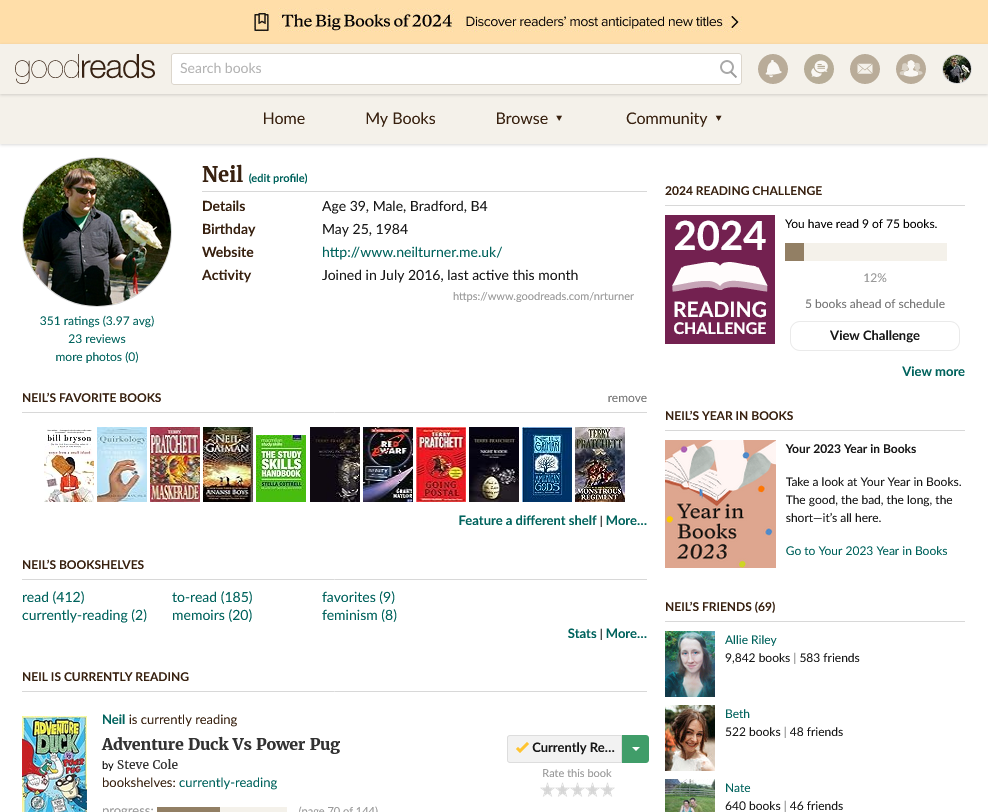
Screenshot of my profile on Goodreads

I probably don’t need to tell you about Goodreads, the social book recommending web site. After all, it’s used by millions of people, including over 50 of my own friends. But I am anyway.

I only recently joined Goodreads – recently being a year ago. For many years I didn’t read books; I didn’t have the time or the inclination to do so. But since restarting my Audible subscription last year, I’ve become more interested in books again. The advantage of an audiobook is that you can listen to it whilst doing something else, such as housework or commuting. This gets around the issue of not having time to sit down and read.

Goodreads became a good way to catalogue the books that I’ve read, and find new books to read. As you read and review books, Goodreads can recommend other titles similar to those that you’ve read. You can also see what your friends are reading, and what they thought of the books they’ve finished.

Goodreads integrates well with Facebook, and so you can see what your friends are reading without having to add them as friends separately. Friends can also be imported from Twitter.

Whilst originally independent, Amazon purchased Goodreads in 2013. Consequently, you can link up your Amazon account, and this allows you to import your previous Amazon book purchases. This is quite helpful if you’re new to the site, as it allows you to import your books in bulk.

As you’d expect, there’s also an app for iOS and Android devices. This includes a barcode scanner for adding books to your lists.

You can find my profile here. If you know me, feel free to add me as a friend if you haven’t done so already. I’ll continue to review books on here from time to time – right now, I’m listening to The Long Earth (sponsored link) by Terry Pratchett and Stephen Baxter.

Step-free access on London Underground

Bakerloo at Waterloo

I’ve talked briefly about our recent trip to London. It was our second trip with our toddler, but last time I drove us all down. This time, we went via train, and we brought a pushchair.

Our toddler now has two pushchairs. There’s the big Bugaboo Chameleon, which we’ve used since birth, and a lighter folding pushchair. The latter fits in our car boot more easily and can be stowed away in luggage racks, but it’s not so good on rough ground and doesn’t have a rain cover. So we still use the Bugaboo now and again, if it’s wet or we’re going somewhere off the beaten track. But for London, we took the lighter pushchair.

On the whole we coped well. The only station where we had major problems was Kew Bridge, a South West Trains station near where we were staying. Although it’s a simple two platform station with a footbridge, there’s no step-free access, and a very wide gap between the train and the platform edge.

We coped okay with the Underground. King’s Cross St Pancras has lifts serving all of its platforms, following a comprehensive rebuild of the station to tie in with the new Eurostar station. This is a major improvement over 2004, when I travelled to London with a friend in a wheelchair. It took two of us to balance the chair on the main escalator. Fortunately we were heading for Olympia, and both Earl’s Court and Kensington (Olympia) stations had lifts even back then.

This time, we were heading for Waterloo, to take a train to Kew Bridge (as mentioned before). Though not the most direct route, we were able to take the Victoria Line to Green Park. Lifts were installed at Green Park in 2012, ahead of the Olympic and Paralympic Games. Changing at Green Park took quite a long time, with some long walks between the platforms. Had we been able to use the escalators, I expect this would’ve been quicker.

Then, onward to Waterloo on the Jubilee Line. When the Jubilee Line was extended in the late 1990s, all of the new stations had step-free access from the beginning. Unfortunately, at stations like Waterloo, this didn’t include existing lines, so although it’s possible to get from the Jubilee Line to the street and mainline station without steps, you can’t change to the Northern, Bakerloo or Waterloo & City lines.

Step-free Tube guide

Transport for London (TfL) publishes quite a good step-free Tube guide. Whereas the basic tube map only shows stations with step-free access from the street to the platform or train, the guide goes further. For example, there is step-free interchange between the Bakerloo and Victoria lines at Oxford Circus, but no lifts to the exit. Others, like Cannon Street, have step-free access in one direction only. A map is provided and it greys out stations and lines that are not accessible. The whole of the Bakerloo Line south of Oxford Circus is missing, for example, as is the whole of the Waterloo & City Line.

It also tells you how wide the gap between the train and platform is at those stations which are accessible, and there are some detailed notes. For example, changing trains at Kew Gardens requires a 600 metre walk on nearby streets.

It’s perhaps also worth mentioning that the entire Docklands Light Railway, and Croydon Tramlink are step-free, should you find yourself in East or South London.

Future improvements

TfL is rebuilding a number of Tube stations, and these should all gain step-free access. Farringdon and Blackfriars recently became accessible as part of the Thameslink Programme, and Crossrail… sorry, “The Elizabeth Line”, will see many other stations gain lifts. These include Ealing Broadway, Paddington, Bond Street, Tottenham Court Road, Moorgate, Liverpool Street and Whitechapel.

Additionally, TfL are rebuilding Victoria and Bank stations, with plans for Camden Town. Again, these should all become step-free when the work is complete. Frustratingly, the recent rebuild of Shepherd’s Bush tube station on the Central Line, to tie in with the opening of the Westfield shopping centre, did not include the addition of lifts, apparently due to costs.

Ravensprings Park Model Railway open day

Ravensprings Park

On Sunday, the Brighouse and Halifax Model Engineers had one of their regular open days at Ravensprings Park in Brighouse. The park is home to two loops of track for model and miniature gauge railway locomotives, and both were in operation.

For a small fee payable at the gate, you get access to the whole of Ravensprings Park and unlimited rides on the trains. The locomotives are rotated during the day, and, thanks to a signalling system, multiple trains can run at the same time. So although we had to queue for each train, the queues moved quickly. Each ride includes two trips around the loops, and takes 2-3 minutes. The locomotives are a mixture of steam and diesel.

Ravensprings Park

The inner track is raised, and has three track gauges, so that different trains can run. The outer track is at ground level and a wider track gauge; it features a second smaller loop (forming a figure of eight shape) taking you to the far end of the park.

There’s a café and toilets on site. The day we visited was also a charity day, raising money for the Forget Me Not Childrens Hospice, so there was a tombola and a ‘frog in a bog’ – catapulting a toy frog through a toilet seat. Only in Yorkshire.

The open days are generally monthly on the second Sunday through spring and summer, with the next one on the 9th July. After that, the park is open again on the 13th August, 10th September and 8th October. Of course, you could join the Brighouse and Halifax Model Engineers if you fancy visiting at other times. The open days are a fun day out, especially if the weather is nice. Our one-year-old seemed to enjoy the train rides, and there were children there from all ages, so it’s a good family day out.

You can view the rest of my photos on Flickr.