Playlist of the month: Actors turned artists

Screenshot of the actors turned artists playlist on Spotify

Last month, I shared with you some appallingly bad cheese. This month, the theme is ‘actors turned artists’ – actors who have gone on to release music. There were quite a lot to choose from, although some are technically from musical films. Here’s the link to the playlist on Spotify.

  • ‘I’m Just Ken’ by Ryan Gosling. Gosling showed his singing talent in La La Land, but his solo in last year’s Barbie movie brought greater awareness. Especially to those who don’t remember him being on the Mickey Mouse Club.
  • ‘What If’ by Kate Winslett. Winslett sang this for a 2001 animated adaptation of Charles Dickens’ A Christmas Carol, and it was released as a single to promote the film. She has such an amazing singing voice, so it’s a shame that there aren’t more songs out there that she has recorded and released.
  • ‘Yellow’ by Jodie Whittaker. Whittaker is probably best known as being the 13th Doctor, and released this lovely cover version of Coldplay’s debut single for BBC Children in Need in 2019.
  • ‘On the Floor’ by Jennifer Lopez. JLo is probably as well known for her acting as for her singing. This song is probably my favourite of hers but ‘Waiting for Tonight’ is also top tier.
  • ‘The Greatest Show’ by Hugh Jackman. Oh no, another excuse to have a song from The Greatest Showman soundtrack in a playlist! Jackman was well known as musicals star before taking on the role of Wolverine in the X-Men films.
  • ‘Wild Wild West’ by Will Smith. There was a time when every Will Smith film had a song that accompanied it, although I’ve not seen Wild Wild West myself.
  • ‘Boy You Knock Me Out’ by Tatyana Ali. Ali was Will Smith’s co-star in the Fresh Price of Bel Air, and released a solo album in 1999 featuring a guest rap by Smith on this song.
  • ‘Under the Broadwalk’ by Bruce Willis. A friend at university had this on cassette tape, along with other novelty songs such as ‘Star Trekkin’ by The Firm.
  • ‘Looking for Freedom’ by David Hasselhoff. What can I say other than it’s David Hasselhoff singing?
  • ‘Falling Down’ by Scarlett Johansson. I could have chosen any number of other Marvel Cinematic Universe actors here as it seems that many of them have released albums (either solo or in bands) but I chose this one.

Our 2024 holiday: Seahouses

A photo showing a view across the harbour at Seahouses in Northumberland.

This is the first of a series of blog posts about what we did on our 2024 summer holiday. We stayed in Seahouses, a small village on the Northumberland coast, in a rented holiday cottage.

Seahouses is nice – much smaller than other seaside resorts like Blackpool or Scarborough and less brash. There was just the one amusement arcade, for example, which was in a relatively unassuming building away from the seafront. The main reason for Seahouses becoming a village was its harbour, which is known as the ‘North Sunderland Harbour’, as it acted as the harbour for the neighbouring village of North Sunderland. This village has nothing to do with the better-known City of Sunderland in the next county to the south.

The name ‘Seahouses’ came about from the small houses built around the harbour by the fishing community, and mainly came into use when the North Sunderland Railway opened. That’s now gone, having closed in the 1950s, and there’s a car park where the railway station used to be.

Many of these ‘sea houses’ are now holiday cottages, and if you walk down one of the streets you’ll see that most of the houses have key safes outside. I suspect that, in the winter, Seahouses gets a lot quieter than during the peak summer tourist season.

What’s there to see in Seahouses

We arrived late on the Friday night, and so we had a wander around the village on Saturday morning. As mentioned, there’s lots of holiday cottages and the harbour. There’s also plenty of gift shops, restaurants and a few pubs. At one time, there would have been many smokehouses, selling smoke fish – indeed, it’s believed that the kipper was invented in Seahouses. Nowadays, there’s just one smokehouse left: Swallow Fish.

There’s plenty of seabirds to watch. As well as the usual seagulls, we saw oyster catchers, sandpipers and a couple of grebes in the sea. There are also several eider ducks in the harbour.

Seahouses is also the main launch point for boats to the Farne Islands and Lindisfarne, which we visited later in the week (blog posts to come). There’s also a lifeboat station which is home to one of the larger lifeboats, and a tractor to haul it to the sea – plus the usual RNLI shop.

It’s a pretty little village and, if you’re not staying, maybe somewhere to look at on the way through. You can view more of my photos on Flickr.

Accessibility

As mentioned before, Seahouses’ railway station was closed in the 1950s. The nearest railway station is at Chathill, but it only gets a token service of two trains per day towards Newcastle-upon-Tyne, and there’s no connecting bus service. The 418 and X18 run every four hours (so collectively there’s a bus around every two hours in each direction) which connect to Berwick-upon-Tweed, Alnwick, Morpeth and Newcastle. With this in mind, you’re probably going to want to drive to Seahouses, and it’s on the Northumberland Coastal Route which is a signposted route along mostly B-roads.

In terms of getting around once you’re there, obviously it’s a coastal village and so there’s a slope down to the shore. Whilst there are steps in places, you should be able to find an alternative sloped route where needed. A public changing places toilet is available in the village.

Back from our holidays

This is another pre-recorded post – I’m actually writing this a couple of weeks ahead of time – but by the time you read this, we’ll be back from our 2024 summer holiday. We went to Northumberland, and stayed in the coastal village of Seahouses.

As mentioned in my domestic holidays post, we decided to have a holiday in England as my dad has had some periods of ill health recently, and wouldn’t have managed the driving that we normally do when we go to France. But it was also an opportunity to visit somewhere that I’ve only ever passed through; I haven’t had the chance to actually see some of the places that we’ve visited before properly. Which, considering that Northumberland is only three hours away by car, is a bit of a shame.

Consent

I also didn’t want to talk about where we were going in advance. Now, whilst this blog doesn’t attract the readership that it once did, I am also conscious that what I write here is public. And so I don’t really want to state exactly where I am at any given time, just in case someone uses that information against me. Of course, you may just decide that you like me and want to meet up with me, but I’d rather you didn’t – or at least, you contact me first and get my consent.

And it’s with consent in mind that covers my other reason for being vague about where I’m going. When it comes to my holidays, it isn’t just me going but my parents, my wife and our eight-year-old. And it’s our eight-year-old in particular whose identity I want to protect. I avoid using their actual name or gender on here, because they are too young to give informed consent for this to be public information. I don’t think they’re old enough to have a conversation about what a blog is, or that any information that I put up about them is public and likely to be available forever. Because even if I delete old posts (and a lot are missing), they may live on in places like the Web Archive.

Our eight-year-old watches lots of videos on YouTube Kids now (which is part of the reason for us cancelling Disney+), and many of these feature young kids. Now, obviously their parents are more comfortable with this, but it makes me cringe. It’s worth reading this Teen Vogue article about kids of influencers. I want my child to enjoy their time as a child, and I don’t want to have a difficult conversation when they’re older about all the things that I’ve shared about them in public.

Anyway, back to the holiday

Okay, so this blog post didn’t quite go the way I expected it to. Once I’ve had time to download and edit the photos that I’ve taken, I’ll be posting a series of blog posts about the things that we did whilst we were away.

Our 2023 summer holiday in the Loire

A photo of a model of Chateau de Chambord, one of the Loire castles

I’m away on holiday at the moment, so this week’s posts are about previous un-blogged holidays from 2019, 2021, 2022 and 2023. Yesterday was our 2022 holiday to Brittany, and today it’s our 2023 holiday to the Loire Valley in France.

Though I did go into some detail about our 2023 holiday in my 2023 review, here’s a bit more about what we did and where we went. Our holiday followed its usual format – an overnight ferry from Portsmouth to St Malo, and then we drove down to stay in a static caravan at a campsite. This year we stayed near St Catherine de Fierbois, to the south of the Loire valley and between Tours and Poitiers.

Here’s what we got up to:

A miniature model of Chateau de Chambord at the Parc des Mini-Chateaux

Parc des Mini-Châteaux

One thing the Loire Valley is known for are its many castles, or ‘châteaux’ in French. We limited ourselves to three this year, but we got to see miniature models of almost all of them at the Parc des Mini Châteaux. Here, there are models of Chambord, Chenonceau and many others that we had previously been to in person. It’s a fun way of seeing lots of places without having to travel to them all in person, and probably better for kids too.

A photo of Château du Clos Lucé

Château du Clos Lucé

The first real château that we visited was Château du Clos Lucé, in which Leonardo da Vinci spent some time. Consequently it’s a museum containing recreations of some of his inventions, and a print of that painting. What we enjoyed more were the gardens, which also contained several of da Vinci’s inventions, but on a much larger scale. Some, like an Archimedes screw, were interactive, and exploring the gardens was fun.

Three giant pandas at Zooparc de Beauval

Zooparc de Beauval

Zooparc Beauval is probably my favourite zoo that I’ve ever been to. We went there for the first time in 2018, and made a return visit last year. Since then, it’s expanded, and as was already too much to see in one day before, we focussed on the new bits and then our favourite bits from last time.

Its star attraction is probably the giant pandas, and we were lucky enough to see them. Unlike those that went to Edinburgh Zoo, those at Beauval have had more success at breeding and so there were four pandas there when we went. There had been a cub that we saw in 2018, but I believe it’s moved elsewhere to carry on the breeding programme.

The other thing that you should make time to see is Les Maitres des Airs, which is a fantastic daily bird flying show. Though there were fewer birds taking part compared to 2018, it’s still a great spectacle. Get there early to get a good view.

Other animals that I haven’t seen much elsewhere include hippos, dugongs and white tigers.

A spiny fish in the Aquarium de Touraine

Grand Aquarium de Touraine

We bought a joint ticket for both the Grand Aquarium de Touraine and the Parc des Mini-Châteaux, so when a wet day rolled around we had something to do. It’s interesting enough to spend half a day at; a particular highlight for our (then) seven-year-old was being able to draw a fish and have it scanned by a camera, to then appear in a virtual aquarium on a projector screen with others creations.

A photo of Château d’Ussé

Château d’Ussé

The second Loire château that we visited was Château d’Ussé, which allegedly was the inspiration for the story of Sleeping Beauty. This is something that the owners have capitalised on, and so as well as being able to go inside some of the interior of the château, there’s also a walk around the top floor where the rooms have been decorated to tell the story. There’s also some nice gardens to walk around, but part of the building is off limits as its owners still live there.

A photo of Château du Riveau

Château du Riveau

One château that wasn’t at the Parc des Mini-Châteaux was Château du Riveau, as it hasn’t been open to the public for very long. Again, its owners live here and so only a few rooms inside are open.

The gardens are really good – and we got a discount for being RHS members. There’s lots of sculptures, and a few pet birds around, and it’s very whimsically French. The whimsy continues inside – there’s lots of taxidermy on the walls wearing glasses or mounted backwards. We really enjoyed our visit here and it stands out compared to the other châteaux of the Loire. You can see the rest of my photos on Flickr.

Futuroscope

Futuroscope

Futuroscope is a theme park based around film. It opened in the 1980s, and I went twice with my parents in the 1990s. This time I introduced it to my wife and our (then) seven-year-old, and it was a lot of fun.

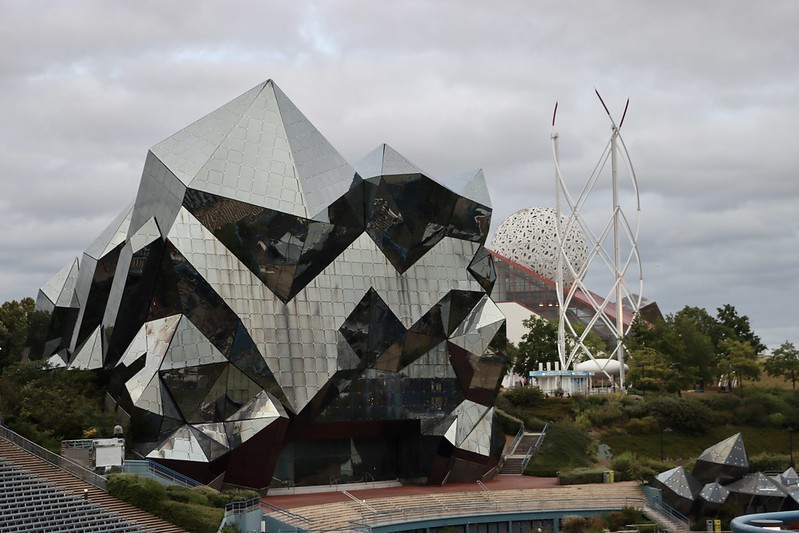
Each of the pavilions is a different kind of cinema. Some have massive Imax screens, others are in 3D or the seats move with the film. In some, you may find yourself sprayed with water or blasted with air. The architecture is also futuristic, in a way that (for the most part) still feels modern even after over 30 years.

And yes, it’s very French. The food is much better than your average British theme park, and there’s some really whimsical evening entertainment. We would have liked to have stayed around for the evening sound and light show, but being July it was quite late at night. Again, there’s more photos on Flickr since I actually got around to uploading them.

Our 2022 summer holiday in Brittany

A photo of Carnac beach on the coast of Brittany

I’m away on holiday at the moment, so this week’s posts are about previous un-blogged holidays from 2019, 2021, 2022 and 2023. Yesterday was our 2021 holiday to Kent and East Sussex, and today it’s our 2022 holiday to Brittany.

By the summer of 2022, almost all Covid restrictions were gone and so we ventured outside of England for the first time in three years. We returned to our usual holiday format of a couple of weeks in France, staying in a Eurocamp static caravan, and this time, we went to Brittany in Northern France.

I’ve been to Brittany a few times, but it was the first time for our then six-year-old and my wife Christine. We stayed near Carnac on the Atlantic coast, which is well-known for the Carnac Stones – around 3000 standing stones across the area.

Here’s where we visited:

A photo of St Malo in Brittany

St Malo

The easiest way to get to Brittany from England is by ferry, and so we took the overnight Portsmouth-St Malo ferry with Brittany Ferries. As (for once) we didn’t have a long drive on arrival in France, we spent the first morning in St Malo, having a wander around the town and harbour. The town is fortified, and inside the town walls there’s a Micro Zoo, with lots of small animals. It’s a nice little place, if not especially interesting, and was enough to pass the morning before heading onwards to Carnac.

A photo of the town of Pont Aven

Pont Aven

Pont Aven is a scenic little town in Brittany that’s home to lots of artist studios. We took advantage of the all day kid’s club at the campsite to have a grown-ups only day here. It’s a nice place to wander around – it’s in a steep-sided valley with a river running through it.

A zookeeper at Parc de Branféré holding a parrot

Parc de Branféré

We always seem to end up at a zoo on our holidays, and this year it was Parc de Branféré. Make sure you stick around for the bird show, as they bring out all of the hand-reared birds pretty much all at once. It was fantastic being able to get so close to the animals – many are not locked away in enclosures, but free to roam around. It’s definitely one of my top five zoos that I’ve visited.

A photo of the outside of the Insectaraium de Lizio

Insectarium de Lizio

Another zoo of sorts, but this time focussed mostly on insects. As well as many preserved examples in frames, there were a number of live insects here, as well as a bee colony and an outdoor butterfly garden. It was certainly enough to fill a morning, even if it’s not a very big place. And you probably need to like insects to really enjoy it.

A photo of one of the buildings at the Museum of the Junkyard Poet

Museum of the Junkyard Poet

Also in Lizio (which in reality is a rather small village) is the Museum of the Junkyard Poet, which we found whilst browsing TripAdvisor. It’s a fabulously whimsical place in the Brittany countryside, with buildings and contraptions made out of discarded materials. It’s very, very French, but fun to explore with lots of hidden things. Oh, and there were loads of frogs all over the place.

A metal sculpture of a fish at Quiberon

Quiberon

Quiberon is a town on the end of a peninsula that pokes out into the Atlantic Ocean. It’s a port for ferries to a few islands in Quiberon Bay, the largest being Belle-ÃŽle-en-Mer (which literally translates as, um, ‘pretty island in the sea’). There’s nice sandy beaches and it’s a seaside resort, sort-of like Blackpool but sunnier and French.

Our 2021 summer holiday in Kent and East Sussex

A photo of the beach at Camber Sands in East Sussex

I’m away on holiday at the moment, so this week’s posts are about previous un-blogged holidays from 2019, 2021, 2022 and 2023. Yesterday was our 2019 holiday to the Dordogne in France, and today, it’s our 2021 holiday to Kent and East Sussex.

In 2021, with some remaining Covid restrictions making travel a little difficult, we decided to have a domestic holiday and remain in England. We decided to stay on the south coast, at Parkdean’s Camber Sands resort in East Sussex. This wasn’t our first stay at a Parkdean resort – Sci-Fi Weekender is at Parkdean’s Vauxhall Holiday Park in Great Yarmouth – although it was the first time that my parents had stayed at such a place. My parents found it rather different to the Eurocamp sites that they’re used to in France – the static caravans are more tightly packed in and usually don’t have decking outside. But it was fine as a base to explore the area.

Here’s where we visited:

A photo of Hever Castle in Kent. It's made of stone and there's ivy covering most of the frontage.

Hever Castle

On the way down, we called in at Hever Castle, which is probably best known as being the childhood home of Anne Boleyn, the second wife of King Henry VIII and mother of Queen Elizabeth I. The castle itself isn’t that big, and we actually didn’t have time to go in to it properly, but there’s plenty to see and do in the grounds. There’s some really nice gardens, and regular jousting events at weekends, which are fun to watch. Our eight-year-old (who was five at the time) particularly liked the water maze, and there are several playgrounds too, so it’s a great place to take kids.

Unlike the other castles mentioned here later, this isn’t run by the National Trust. However, it’s possible to get discounted entry with Tesco Clubcard vouchers, Gardener’s World two-for-one cards, or membership of the RHS or Historic Houses.

A photo of a steam locomotive carrying a nameboard that says 'The Johnston Express'

The Romney, Hythe & Dymchurch Railway

Along the Kent coast is 13 ½ mile miniature railway – the Romney, Hythe & Dymchurch Railway. All the locomotives are â…“ of the size of regular mainline trains, and it runs from Hythe in the east to Dungeness in the west. We travelled the whole line. At Dungeness, there’s a small café and a visitor centre, and you should have time for a stroll around the village of Dungeness between trains. It’s quiet scenic apart from the massive nuclear power station.

A leopard resting on a platform at Howlett's Wild Animal Park

Howletts Wild Animal Park

We used more of our Tesco Clubcard vouchers at Howletts Wild Animal Park. It’s a zoo, but doesn’t call itself one; the focus is on breeding endangered animals and allowing them large habitats to live in. Consequently it’s quite a large site, with several big cat species, elephants and gorillas. It’s one of two animal sanctuaries in Kent run by the Aspinall Foundation, whose founder, John Aspinall, had some odd ideas about animal husbandry which has seen at least two keepers die over the years. Because the focus is on animal welfare rather than visitor experience, don’t be surprised if not every animal is available to see. We saw just about everything apart from the pallas cats.

A view of a street in the town of Rye in East Sussex

Rye

The nearest town to Camber Sands is Rye, which is situated on a natural hill and has a castle at the top. It’s a pretty little town, with narrow cobblestone streets and a harbour. There’s plenty of tourist-orientated shops, and the castle is open as a museum, with good views from the top.

Bodiam Castle

My mum sold this to us as a ‘proper castle’. It has a real moat, and bridge to cross it, to enter the keep. On the inside it’s mostly open to the elements, but when we went there were plenty of activities for kids. This is a National Trust property.

A photo of Scotney Castle

Scotney Castle

We had a two castle day that day, and followed up our visit to Bodiam Castle with a trip to Scotney Castle in the afternoon. You may recognise it as a filming location for the Sandman series that was on Netflix a couple of years ago. It’s also a National Trust property – between our National Trust membership and Tesco Clubcard vouchers, we had a good value holiday.

The old part of the castle is mostly ruins, but there’s also a newer castle which we didn’t go into. There’s also plenty of grounds and a playground for the kids.

A photo of a shark at Hastings aquarium.

Hastings

Our run of nice weather petered out and so we had a wet day in the town of Hastings. Here, we visited the aquarium, the Fishermen’s Museum and the Shipwreck Museum in the Rock-a-Nore, and had a wander around the harbour and lifeboat station.

On the way home

Outside of Kent and East Sussex, we stopped over in Slough and spent an afternoon in Windsor, following by a day at Legoland Windsor, before heading home. Our eight-year-old is desperate for a return visit to Legoland.

Our 2019 summer holiday in the Dordogne

A photo of a ferry leaving Ouistraham port on our way home from our Dordogne holiday

I’m away on holiday at the moment, so this week’s posts are about previous un-blogged holidays from 2019, 2021, 2022 and 2023. Today, it’s our 2019 holiday to the Dordogne in France.

For our 2019 summer holiday in France, we went quite a bit further south, to the Dordogne region (named after the river that runs through it). As well as the overnight ferry from Portsmouth to St Malo, we stopped off at a hotel in Poitiers and so it took the equivalent of three full days of driving to reach our campsite near Bergerac. We took our own car, but we had to abandon it after (what I presume) was a failed wheel bearing saw me skid off the road into a ditch, so the second half of the holiday was in an a hire car.

As this holiday was five years ago, in June 2019, my memories are not the best, which is why there’s not a lot of detail here. It’s thanks to checkins on Swarm and my own photos that I can recall what we did.

Here’s where we visited:

A photo of Beynac in the Dordogne

Beynac-et-Cazenac

Benyac overlooks the Dordogne river where it cuts through a deep gorge, and the village is built into the side of the steep valley. It’s a pretty little place with narrow, twisting streets and craft shops.

A photo of Château de Castelnaud. It is a castle on top of a hill in the Dordogne in France

Château de Castelnaud

Castelnaud is quite a good castle. It sits high up, in a commanding position over the surrounding valleys, and the courtyard is full of catapults, trebuchets and over siege engines that might have been used during the various wars that it has experienced over the centuries. I remember that we treated our (then) three-year-old to a wooden sword and shield from the gift shop.

Gouffre de Proumeyssac, and underground cave complex

Gouffre de Proumeyssac

Known as the ‘crystal cathedral’, Gouffre de Proumeyssac is a huge underground cave full of stalagmites and stalactites. Clever use of lighting makes it a fascinating experience. Whilst nowadays there’s a wheelchair-accessible main entrance, you can also opt to be lowered into the cave in a basket, as the original explorers would have done at the beginning of the last century.

A photo of a fountain ans some traditional French buildings at Le Bournat

Le Bournat

Le Bournat is an open-air living museum – a bit like Beamish or the Black Country Living Museum. The aim is to recreate how people lived in the Dordogne region in the past, with farms and small industry to look at. Whilst I would argue that it’s not as realistic as its British counterparts, it’s very pretty and makes for a nice day out. Like many of the places we went to in 2019, I seem to remember visiting when I was much younger and it seems to have expanded significantly since then.

A view of the village square in Eymet

Eymet

Eymet (pronounced ‘ay-may’) is an example of a Bastide, or fortified town. This means that there are walls around the town centre, and buildings such as the church are fortified. There’s also quite a large British diaspora here, with British ex-pats making up around a quarter of the population. Like many small French towns, its communal wash house has been preserved.

A photo of Château des Milandes in the Dordogne

Château des Milandes

Our second château of the holiday was the Château des Milandes. It was home to the American singer Josephine Baker, and so it has a number of her more famous (and infamous) outfits and tells her story. There are some nice gardens outside, along with an aviary which is home to a number of birds of prey. If you time your visit right, then you can watch a bird of prey show. I visited here with my parents when I was younger and had the interesting experience of having a harris hawk land on my head, which my dad took a photo of.

A photo of a Coypu at Aquarium du Perigord Noir

Aquarium du Perigord Noir

We usually end up at an aquarium whilst on holiday, as it’s a way to spend a wet day, and so we went to the Aquarium du Perigord Noir. Besides the many fish – mostly freshwater, as it’s a long way inland – they are a breeding centre for caimans, and have some coypu (also known as Nutria or Chilean beavers).

On the way back, we stopped off at a hotel in Le Mans, and also at Warwick Castle once back in England.

Using an SSD with a Raspberry Pi

A photo of a USB Solid State Drive (SSD) which looks like a standard USB flash drive

One of the Raspberry Pi’s big selling points is that you can install the operating system on an easily swappable SD card. But long term, a solid state drive (SSD) is probably better, and I’ve recently switched to one.

SD card limitations

The Raspberry Pi’s use of SD cards for storage does make sense. They can be easily swapped out, if you want to use different operating systems or load different configurations. And it means that they can be shipped without built-in storage, which keeps the cost down. Indeed, the Raspberry Pi Zero was given away free with a magazine when it launched in 2015.

But SD cards were mainly designed for storing images and videos from cameras, and not for running operating systems. SD cards do fail after a certain number of read and write cycles, and running an operating system on one is going to result in a lot of reading and writing. So whilst an SD card in a camera may last several years, in a Raspberry Pi, it could be a matter of months. This is especially true if you run software like Home Assistant.

And seeing as I do run Home Assistant on my Raspberry Pi, alongside a host of other server software, I decided that I would migrate everything to an SSD before something bad happened.

Choosing an SSD

I went for this basic 128 GB SSD by LQH Tech (sponsored link). It cost me less than £20 (well, actually it was bought with birthday money). It looks like a standard USB flash drive, but it houses an SSD instead. The two are different, and you should get both better performance and a longer life span out of an SSD compared to a flash drive or SD card. It simply plugs into one of the Raspberry Pi’s blue USB 3 ports.

There are other options. You can buy a HAT (Hardware Attached on Top) device which lets you connect a standard SSD inside a larger case, or a USB to SATA cable to connect a SATA SSD to one of your USB ports.

The LQH Tech SSD that I went for seems to work fine, although it does get quite hot when in use. Even so, it offers a noticeable performance improvement to Home Assistant.

Migrating from an SD card to an SSD

If you’re currently running Raspberry Pi OS on your SD card, then you could try the rpi-clone tool to copy the contents to an SSD. Then, once it’s done, all you should need to do is shut down your Raspberry Pi, take out the SD card and then turn it on again. If it’s worked, then your Raspberry Pi should happily boot from the SSD.

I run Debian on my Raspberry Pi. Now, rpi-clone may or may not work on Debian (Raspberry Pi OS is forked from Debian after all), and so I tried it. It didn’t work – the Raspberry Pi would not boot from the SSD.

Instead, I set the SSD up with a fresh Debian install (it helps that we’re a household with two Raspberry Pi computers), installed Home Assistant Supervised and then restored a backup from the installation on the SD card. Apart from requiring some minor configuration tweaks, mainly due to my existing external USB hard drive now being called ‘sdb’ rather than ‘sda’, this worked fine.

I made this migration a few weeks ago and haven’t had any issues. The SSD being rather warm is a concern, but it doesn’t seem to affect performance which is way better than on an SD card. And hopefully it’ll have a longer life too.

The benefits of a domestic holiday

A photo of the harbour in Scarborough

This year, we’ll be taking a ‘domestic holiday‘ – in other words, our main summer holiday will not involve overseas travel.

Normally, we go on a driving holiday to France, where we take our own car with us. However, my dad has had some periods of ill health over the past 12 months, including two long hospital stays. And whilst he is much better now, we didn’t want to risk booking such a holiday without knowing that he would be able to manage the many hours of driving that this will entail.

Instead, we’re staying in England for our holiday. This isn’t the first time – we also had a holiday in England in 2021, when there were still significant Covid-related travel restrictions. That time, we spent a week on the south coast in Kent and East Sussex, and had a lovely time. This year, we’re going further north instead.

Not a ‘staycation’

In 2021, many people had their holidays in the UK, and some referred to these as a ‘staycation‘ as they were ‘staying’ in their own country. I refuse to use this term in this instance, preferring ‘domestic holiday’, as not everyone can afford to go abroad for their holidays. A ‘staycation’ is when you have a holiday but stay at your own home.

Less need for insurance

Because we’re not travelling so far, we don’t really need travel insurance. Sure, you can buy travel insurance for a domestic holiday, in case you need to cancel non-refundable travel or accommodation. But it’s not needed to cover potential medical issues, as we’ll be able to use the NHS like normal. I also don’t need to purchase extra car breakdown cover.

There are other expenses you can avoid too. You don’t need to pay for mobile phone roaming (or have to buy a roaming eSIM). You don’t need to exchange foreign currency in advance, or worry how much currency you have left during the holiday.

Travel and food

There’s also less travel time; we should be able to get to our accommodation in about three hours of driving. When we go to France, travel usually takes up the first 2-3 days of the holiday, and at least two coming back again. Instead, it’ll just be a couple of afternoons. So although we’re away for fewer nights, the actual length of the holiday is broadly equivalent to previous years.

We can also take our own food with us. Pre-Brexit, we could do this when we went to France, but now there are strict limits of what food you can bring in to the EU, even for personal use. That also means we can save money by stocking up before we go.

Whilst I like travel and want to see more of the world, it’s also quite nice to have a holiday with less admin. Which, seeing as my job involves admin on a day to day basis, it’s nice to have break. And surely that’s what a holiday is all about?

Comparing different smart home protocols

An AI-generated image of various smart devices connecting to a home

When I started acquiring smart devices for my home, my focus was on those that worked over Wifi (or Ethernet) – I wasn’t really aware of the likes of Zigbee, Z-Wave and other protocols that were out there. In particular, I avoided those that required the purchase of a hub or bridge, due to the higher upfront cost.

Now that I’m further along my smart home journey, I’m more open to considering a range of different protocols. They all have their advantages and disadvantages to consider.

Wifi (and Ethernet)

I’m grouping these together as devices that are visible to a standard home network and have their own IPv4 address. The majority of smart home devices use Wifi, as there’s usually no need to buy an additional hub or bridge. Therefore, set-up is usually easy (sometimes aided by Bluetooth), and their range is fine as long as they can pick up your home’s Wifi signal. It’s also very easy to connect these devices to cloud services.

In terms of disadvantages: Wifi primarily uses the 2.4 GHz frequency band, which is used by lots of things and so there’s a potential for interference. The ease of connecting these devices to the cloud can also be seen as a flaw; they’re more susceptible to being compromised by bad actors, and don’t offer as much privacy. Wifi is also quite power-hungry – devices that don’t plug into the mains will need their batteries changing more frequently.

Bluetooth

As mentioned, Bluetooth is often used with Wifi to initially provision devices, but some Bluetooth-only devices can be used in a smart home. For example, there’s my Bluetooth thermometers, which connect to Home Assistant. Compared to Wifi, power requirements are much lower and so Bluetooth is good for battery-powered devices. They’re also more private, as they can’t easily be connected to from the wider internet.

However, Bluetooth has quite a limited range – it’s designed to be a ‘personal’ area network and won’t reach across large houses. You can use a Bluetooth Proxy in Home Assistant to extend the range, and whilst these devices are cheap, you’ll need to be comfortable flashing custom firmware and will usually need to plug them in as they bridge to Wifi. Like Wifi, it uses the 2.4 GHz band and so interference is possible – especially with the lower signal strength. Bluetooth connections also tend to be between two paired devices.

Zigbee

Zigbee is a mesh protocol, and it’s used by a number of smart home brands such as Philips Hue and Ikea Tradfri, as well as UK smart meters. This means that all devices on the same network talk to each other, and so a network with lots of devices could theoretically be quite strong. Like Bluetooth, there’s additional privacy as these devices aren’t connected directly to the internet like with Wifi. It’s also more energy efficient than Wifi, so battery-powered Zigbee devices will last longer between charges.

The key disadvantage of Zigbee is that you need a bridge to link it to your home network. Manufacturers like the aforementioned Philips and Ikea will sell you a hub that does this, although you can also buy USB dongles. Therefore, there’s a higher initial cost as you have to buy a hub as well as your devices. And it’s another 2.4 GHz protocol, so could have the same interference issues as Bluetooth and Wifi.

Whilst Home Assistant has good Zigbee support, both natively and through the Zigbee2MQTT system, if you don’t have a separate hub then getting these devices into Google Home can be a very involved process. Alexa is a little easier thanks to the Emulated Hue integration.

Thread

Thread is based on the same 802.16 standard as Zigbee, but differs in a couple of ways. Firstly, devices on a Thread network have an IPv6 address. Secondly, Thread is a simpler protocol that focuses just on being a mesh network with Matter taking over the device APIs. The benefit of integrating with Matter is that, unlike Zigbee, you may not need a separate bridge for Thread devices. A number of smart speakers from Google, Amazon Alexa and Apple can also act as Thread Border Routers, so it’s possible that you’ll already have the infrastructure in place in your home for Thread devices. Like Zigbee, Thread is a mesh network, and by using Thread Border Routers, the devices have a degree of separation from the wider internet that should improve privacy and security.

The downside is that Thread is still pretty new, and so there aren’t many Thread devices out there yet. You may also find that each device that incorporates a Thread Border Router creates a separate Thread mesh network. Home Assistant can be configured to join a preferred network, but it can be a bit of a faff. Ideally, they should all make one big, strong mesh network across your home, but we’re not there yet. And, once again, we’re dealing with a 2.4 GHz protocol here.

Z-Wave

Z-Wave sets itself apart from the aforementioned protocols by being on the lower 800-900 MHz frequency range. These lower frequencies have a longer range, and so are more suited to larger homes, but also avoid the interference of the 2.4 GHz band. Like Zigbee, it’s a mesh network, and should have similar privacy and security benefits by not being connected directly to the internet.

This also means that Z-Wave has the same disadvantage as Zigbee in that you’ll need a bridge to expose these devices to your home network. Furthermore, Z-Wave devices tend to be more expensive, so the upfront cost is usually higher than other protocols mentioned here.

RF and Infrared

I’m including these for the sake of completeness, but they’re not ‘smart home protocols’ in the same way as the above. It’s possible to connect the likes of Home Assistant to bridge devices that can communicate over Wifi and 433 MHz RF or Infrared. These will typically be doorbells or remote controls for devices that don’t connect using any of the above. But setting them up can be trial and error, and involves detecting and interpreting codes to trigger automations.

If you’re building a smart home system, then a bridge may be useful to bring existing devices in that don’t support standard smart home protocols. But if you’re looking to buy new devices, stick with the ones above.