
2024: a year in review

As is traditional at the end of each year, I review what I’ve been up to over the past 12 months.

You can read my previous posts from 2023, 2022, 2017, 2016, 20152014, 2013, 2012, 2011, 2010 and 2009.

January

January started with a trip to the Science and Industry Museum in Manchester, to have a look at their Operation Ouch exhibition about food and, um, poo. They have another exhibition about brains and bogeys in 2025 so I’m sure we’ll be back there soon. We also went to Eureka in Halifax; despite having an excellent children’s museum practically on our doorstep, we don’t go there that often. And there was also a brief trip to the Royal Armouries in Leeds.

On the blog, I wrote one of my perennially popular blog posts about installing Home Assistant Supervised on a Raspberry Pi and how I’d switched to using Simplenote for note-taking. I now take many more notes than I used to with Evernote. I also finally started regularly backing up my blog. January is my blogiversary month and 2024 marked 22 years.

February

After the Januariest January that ever Januaried, we made it to February. We had a bat in our cellar, which a kind volunteer rescued for us, and trips to the Trafford Centre and Beaumont Park in Huddersfield. Meanwhile, I cancelled Disney+ as we were no longer using it.

We ended February on our way down to London for a long weekend.

Houses of Parliament

March

Whilst in London, we went to the Bank of England Museum, the Cute exhibition at Somerset House, the Young V&A and the Cartoon Museum. We also had dinner in Chinatown one night, and Christine stayed an extra night to see Book of Mormon in the West End.

As usual in March, we went to Sci-Fi Weekender in Great Yarmouth, although this time we had friends in the car with us. This made the eight hour round trip much more enjoyable. And over the Easter Weekend, we went to East Riddlesden Hall, and went on the Snooks trail around York.

On the blog, I replaced Automattic’s Jetpack plugin with the much lighter Toolbelt.

April

In April, we went to see Unfortunate at the Alhambra Theatre in Bradford, and I moaned about our car needing more work on it again. I had the car serviced again earlier this month and needed four new tyres, new brake pads and brake discs, and some additional work which was another four figure sum. We probably could have bought a new car for the amount we’ve spent on keeping this one on the road over the past 18 months.

Christine and I had a child-free day out shopping in Manchester, which was nice.

Anteater

May

May is my birthday month, and I turned 40 this year. For my birthday, we went to Dudley, and visited Dudley Zoo and the Black Country Living Museum. We also had a day out at Jodrell Bank to use our annual passes before they expired, and another visit to the Tropical Butterfly House near Sheffield.

I added a newsletter to the blog in May, which is a weekly list of new blog posts. So far, a grand total of four people are fully subscribed, although two were in December so maybe it’s picking up momentum?

I also switched my bank account, but didn’t write about it until October.

June

In 2023, my dad had some health issues which persisted for some time into 2024, ultimately resulting in him going back into hospital again in June this year. Thankfully, this time the doctors treating him seemed to get on top of the issue, and so he’s now much better than he’s been in a while.

Our eight-year-old had an overnight residential school trip, giving Christine and I a rare chance to have a date night towards the end of the month. Meanwhile, we were in the run up to a General Election, and I wrote about the candidates that I could vote for in our constituency.

Seahouses

July

The General Election happened, and for once, the bad guys didn’t win, which was nice. I also made some predictions for 2029, when the next General Election is likely to be.

I fitted my Raspberry Pi with a new case and fan, and started using an SSD with it rather than an SD card.

As usual in July, we went on holiday with my parents. Though my Dad made a good recovery, we decided to have a holiday in the UK, and spent a week in Northumberland. Amongst the places we visited were Bamburgh Castle, The Alnwick Garden, a boat trip to The Farne Islands to see the puffins and seals, Warkworth Castle, Lindisfarne, Cragside, and Beamish on the way home.

August

Writing about our holiday took me well into August, and I also noted all the places we’d considered but didn’t visit. Storm Lillian visited us, cutting off our power for a few hours, and I wrote about our four most-used cookbooks. We also had a day out at the National Coal Mining Museum for England. At the end of the month, we went to Gawthorpe Hall and Mr Fitzpatrick’s Temperance Bar.

August is always my busiest month at work, and this year was no exception.

September

In September, I made Bluesky my primary social media presence and made my Twitter/X account private. Whilst I’ve logged in to X from time to time, I’ve not posted anything since.

Apple announced that its AirPods Pro could be used as hearing aids, and I wrote about how this could be a game-changer for people with mild or moderate hearing loss.

We didn’t have any days out in September (bar a trip to the cinema to see Inside Out 2), but I did write about travel more generally in a blog post about furthest compass points.

A photo of the Royal Iris ferry on the River Mersey in Liverpool

October

Christine and I went back to the cinema to watch Beetlejuice Beetlejuice, having watched the first film that morning – in my case for the first time. I also got my Covid-19 and Flu vaccines. We went to visit the new Eureka museum for older kids in Wirral, and then took a ferry across the Mersey and visited the Museum of Liverpool.

I had a grumble about parking apps, and why we can’t just have one app that works everywhere, and I summarised my adult life using the various railcards we’ve had over the years. For Halloween, we went to Lotherton Hall, which was full of dressed up skeletons.

November

Another cinema trip, this time to bawl our eyes out at The Wild Robot which is as good as everyone says it is. Our (now) nine-year-old got one of the follow-on books as a birthday present. We also went to Bolling Hall Museum with friends, and had a return visit to the Askham Bryan Wildlife & Conservation Park (which I wrote about in 2017 when it first opened).

America voted for the bad guy again (seriously guys?), and I successfully migrated this blog to a new hosting company, seemingly without anyone noticing. Considering my track record with losing data when doing this sort of thing, I consider this to be a massive win. We did our first Costco visit; we haven’t been back yet but planning a trip in the new year, probably with friends. I also wrote about my home working setup, and how it’s evolved over the past (almost) five years.

December

And so to this month. I wrote a long post about step-free access on the Waterloo & City Line, which pleasingly got picked up by a couple of London blogs and resulted in a few click-throughs. Which I knew about thanks to using Koko Analytics with WordPress.

Throughout the year, I mostly stuck with my target of publishing a new blog post every other day, which I’m really pleased about. I don’t have the time to contribute something every day – I’ve tried that in the past and I just end up writing waffle to fill up space. And, as we’re a family of two full-time working parents, our ability to have fun days out is mostly limited to weekends and holidays. But we did have the opportunity to do a few fun things this year, and have some new experiences. Whilst we didn’t go abroad this year, we squeezed a lot into our summer holiday to Northumberland, and seeing thousands of puffins on the Farne Islands will be something I hope to remember for a long time.

Reviewing my 2024 predictions

So, back in January, I made seven predictions about events that would take place in 2024. So, seeing as there’s just a few days left in 2024, let’s see how I did:

Twitter/X won’t become an ‘everything app’

Remember when Elon Musk took over Twitter in 2022 that it would become X, the ‘everything app’? I predicted that this wouldn’t happen in 2024, and, so far, it hasn’t. I don’t use X anymore, although I keep my account live, and upon logging in to write this, the only new things I could see were some kind of job search, and Grok, its AI ChatGPT competitor. This is a far cry from apps like WeChat.

One of the few things that Elon Musk is actually good at is over-promising and under-delivering, so this isn’t surprising. But X was supposed to be able to offer all sorts of new functionality, including financial services, if Musk were to be believed.

Labour will win the 2024 General Election

Yes, they did. But any other result was unlikely, to be fair. It has been a rocky ride since then, with Labour front-loading their time in power with unpopular policies like the limits on the Winter Fuel Payments. However, with the next general election not due until 2029, there’s time to re-build.

What I didn’t expect was how well the Liberal Democrats ended up doing in the election. Their tactics of concentrating on seats mainly in the south west massively paid off, with one of their best ever results.

There will be a ceasefire in Palestine

Nope, sadly. We’re over a year in now, and fighting continues. The recent regime change in Syria is a potential bright spot though.

But the war in Ukraine will continue

Yes, sadly. But it’s notable that things are not going well for Russia, with forces being drafted in from North Korea. That’s because Russia is rapidly running out of people fit to fight on the front in Ukraine, as shown by its massive fall in unemployment.

Energy prices in the UK will start to fall again

They did, and then they started going back up again in October, by around 10%. Overall, Brits are still paying significantly more for energy than we were a few years ago, although there are at least a wider range of tariffs available now.

The UK will do okay at Eurovision this year

No, we didn’t really. We came 18th out of 25th, with all the points coming from professional juries and none from the voting public. I was hoping we would do better, with Olly Alexander representing us, but I don’t think it was the best song.

Trump won’t win the US Presidential Election

Oh dear, a big no. Honestly, in the run-up to the election I though Kamala Harris had it in the bag, so I was surprised and disappointed that she didn’t win.

So, overall, half of my predictions were (mostly) correct. Which isn’t bad, although clearly there were some that I wanted to be correct but weren’t. Oh well.

Playlist of the month: New Year

A screenshot of the New Year's Day playlist on Spotify

So it’s time for a playlist of the month for December. I did my best Christmas songs last year, and whilst I considered doing a ‘worst Christmas songs’ playlist this time, I decided that no-one really wants that. Anyway, as it’s a new year in a few days’ time, here’s a New Year’s Day playlist. I cannot confirm or deny that these are the first 10 songs that I liked when searching for ‘new year’ on Spotify.

  • New Year’s Day by U2. I know this better as the 2003 remix, New Year’s Dub, but here’s the 1983 original. Yes, you’re old.
  • Happy New Year by Abba. I’m not a big Abba fan, and this was released before I was born. It’s a typical Abba song.
  • No Tears for New Years by Katy Perry. After a couple of older songs, here’s a brand new one from Perry’s latest album.
  • New Year’s Day by Taylor Swift. This is actually the first time I’ve included a Taylor Swift song in my playlists of the month. It’s from her sixth album Reputation, so, at the time of writing, there’s no (Taylor’s version).
  • New Year by Sugababes. The second single from their first album, and was released before any of their numerous line-up changes. I suppose you can consider it both a Christmas and New Year song.
  • New Year’s Revolution by NOFX. Start the new year with a bit of pop punk. Although “Next year is gonna be bad, The next one even worse” maybe isn’t the most upbeat way.
  • Is It New Year’s Yet? by Sabrina Carpenter. Another relatively new song, having been released last year.
  • New Year’s Resolution by Otis Redding and Carla Thomas. And now for a much, much older song; this one is from 1967. A bit of a slow jam this one.
  • What Are You Doing New Year’s Eve? by Ella Fitzgerald. Staying in the 1960s, Ella Fitzgerald is well known for her classic versions of Frosty the Snowman and Sleigh Ride, but she also did this New Year’s song too.
  • New Year’s Day by Rob Thomas. You may know Rob Thomas as the lead singer of Matchbox Twenty, or the guest vocalist on Carlos Santana’s song ‘Smooth’. This is another slow piano track.

Merry Christmanoëlavidad!

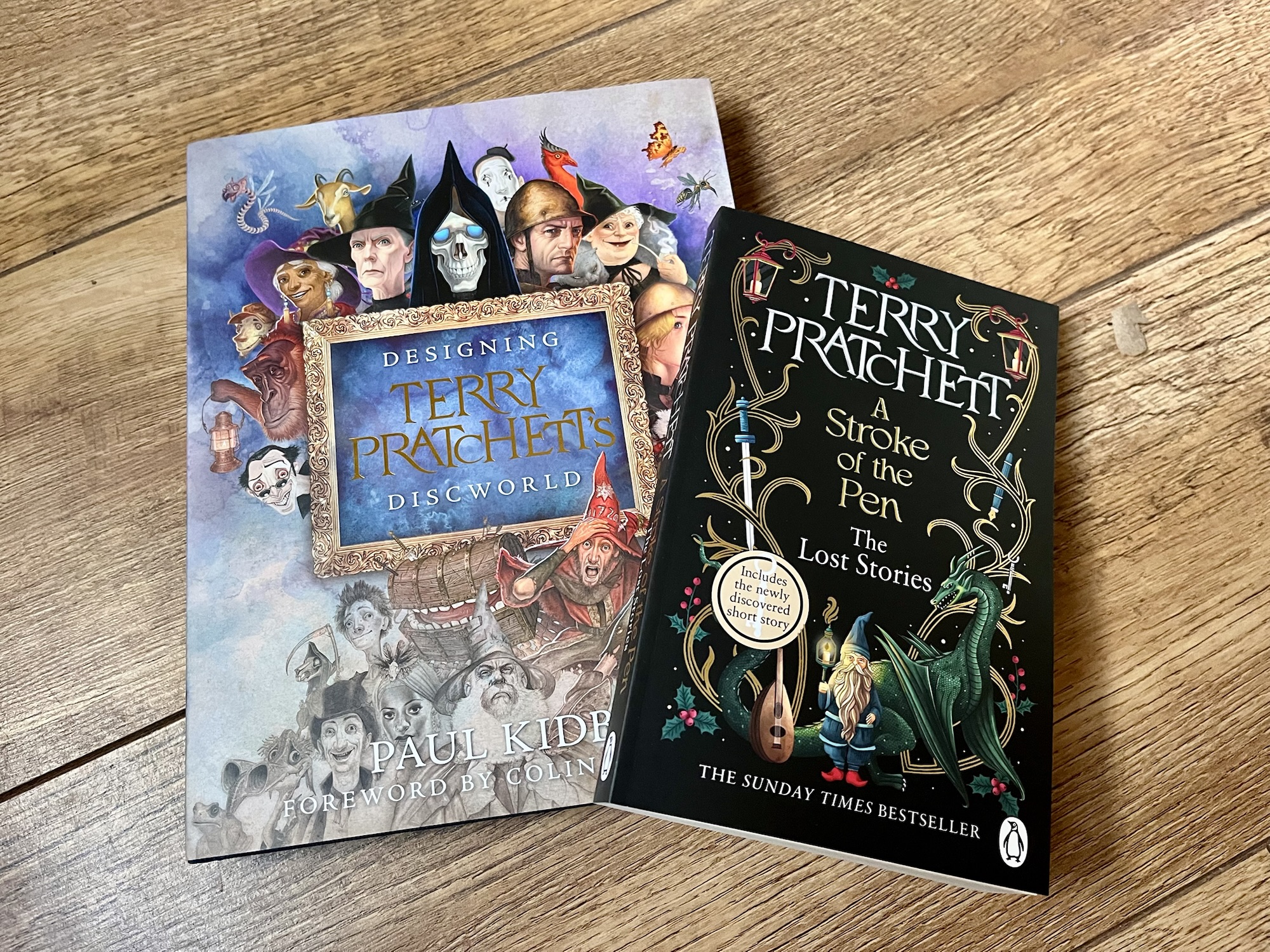
Photos of the two books that I bought Christine for Christmas: A Stroke of the Pen by Terry Pratchett, and Designing Terry Pratchett's Discworld by Paul Kidby

Wishing you all a very Merry Christmas, a Joyeux Noël and a Feliz Navidad, should you be celebrating today.

Once again, we’re staying with my parents in York for Christmas, having arrived last night. Whilst I’ve been lucky enough to work somewhere that closed at 4pm last Friday, for Christine, Christmas Eve was a normal working day. We’re here in York for a few days.

As per usual, we’re not having turkey – it tends to fall to my mum to cook Christmas dinner and she’s not a fan of turkey. Instead, we’re having pork.

Pictured above are the gifts that I bought for Christine:

Yes, there’s a theme. My gift to her last year was Tiffany Aching’s Guide to Being a Witch (sponsored link), written by Rhianna Pratchett about her father’s characters, and required a bit of a mad goose chase around the various bookshops of West Yorkshire to find a copy. Thankfully, the glorious Waterstones in Bradford came up trumps.

I’ll have probably opened my presents by the time you read this, but I’m writing this ahead of time.

My best children’s fiction books of 2024

Between now and Christmas Eve, I’ll be posting about the best books that I’ve read (or the best audiobooks that I have listened to), just in case you need any last minute present ideas. On Thursday, I wrote about my favourite non-fiction books, and yesterday, my favourite adult fiction books. Today, I’m focussing on the fiction books that I’ve read to our soon-to-be nine year old this year. All of these are books that I have awarded five stars on Goodreads.

The links below to buy the books are all sponsored links to Amazon, but you’re welcome to borrow these from your local library, or buy them from an independent book shop.

Luna Wolf: Animal Wizard by Alesha Dixon

The cover of Luna Wolf: Animal Wizard by Alesha Dixon

Our eight-year-old picked this out of the school library, and wasn’t aware that I used to listen to Alesha Dixon’s music as a teenager, from when she was part of the girl band Mis-teeq.

Luna Wolf: Animal Wizard is co-written by Dixon in collaboration with Katy Birchall, and is about a girl called Luna who has recently moved to London with her father, following her mother’s death. Through her volunteering at a local animal rescue centre, and her bond with one of the rescue dogs, she begins to uncover her mother’s exciting past, and a plot to capture some very special animals that her mother worked with.

The Day My Dog Got Famous by Jen Carney

The cover of 'The Day My Dog Got Famous' by Jen Carney

We picked up The Day My Dog Got Famous from our local library, and it’s written and illustrated by Jen Carney. It follows the story of Ferris, who lives with his two mums, his dog Aldo, and a revolving door of foster brothers and sisters. Alas, despite Ferris’s attempts to make Aldo appear amazing, by drawing comics, Aldo is anything but, and this presents a problem when his next-door neighbour Destiny challenges him to a video contest.

I’ve read many books to our nine-year-old over the years, and this stood out because it’s a bit more inclusive than others. It’s nice to see families represented that don’t fit the standard 2.4 children pattern.

Rainbow Grey by Lauren Ellen Anderson

The cover of Rainbow Grey by Lauren Ellen Anderson

Another book which is written and illustrated by the author. Lauren Ellen Anderson is probably better known as the writer of the Amelia Fang books, which we haven’t yet started.

Rainbow Grey follows the character of Ray Grey, who is a ‘weatherling’ and lives high up in the clouds. But whilst every other weatherling has powers to control the weather, she doesn’t. Until one day, when she ventures down to earth, and encounters a mysterious artefact.

There are now three books in the Rainbow Grey series and we’ll be on the lookout for the others.

Honourable mentions

Whilst the above books were deserving of five stars, these are the four star children’s fiction books that I also read this year:

That’s the end of my 2024 lists of best books; hopefully, if you were stuck for ideas for Christmas presents, these will have helped you. Obviously, it’s cutting it a bit tight to order anything in time for Christmas now…

My best adult fiction books of 2024

Between now and Christmas Eve, I’ll be posting about the best books that I’ve read (or the best audiobooks that I have listened to), just in case you need any last minute present ideas. On Thursday, I wrote about my favourite non-fiction books, and today, I’m focussing on the fiction books aimed at grown-ups that I’ve read or listened to this year. All of these are books that I have awarded five stars on Goodreads.

The links below to buy the books are all sponsored links to Amazon, but you’re welcome to borrow these from your local library, or buy them from an independent book shop.

Baby Does A Runner by Anita Rani

Cover of 'Baby Does A Runner' by Anita Rani. It's mostly pink at the top and green at the bottom.

Okay, slight conflict of interest time: Anita Rani is our chancellor at work, although it’s a largely ceremonial role and no, I haven’t actually met her in person yet. In 2021, she published her memoirs, The Right Sort of Girl, which were great – having spent some of my formative years in Bradford, I related to a lot of Rani’s experiences. Baby Does A Runner is fiction, and is about a young British-Asian woman who sets off to her family’s ancestral home in India to uncover a family secret. Whilst it’s not a true story, there’s a lot about topics like the Partition of India which certainly wasn’t taught to me in history lessons at school. It does well to tackle colonial-era views of India.

Rani reads the audiobook herself, and does an excellent job of it, giving each character a unique voice and accent.

Her Majesty’s Royal Coven and The Shadow Cabinet by Juno Dawson

The cover of Her Majesty's Royal Coven by Juno Dawson

I’ve grouped these books together as they form the first two books in a trilogy; book three, Human Rites, is due out in summer 2025. Book one, Her Majesty’s Royal Coven, follows four witches, Niamh, Leonie, Elle and Helena who knew each other from school, and now each have their own professional working lives. Only Helena remains part of the secretive government department, Her Majesty’s Royal Coven, and there are rumours that a ‘sullied child’ will bring forth Leviathan and a terrible disaster.

The Shadow Cabinet picks up from the same cliff-hanger scene at the end of the first book, and sees Leonie take off on a wild goose chase around Europe. Meanwhile, we find out about The Shadow Cabinet, a board consisting of witches, warlocks and so-called ‘mundanes’ (non-magic users) in government. Again, there’s a cliff-hanger at the end of this book, and I’ll have to wait several more months to find out how it ends.

The cover of The Shadow Cabinet by Juno Dawson

In the meantime, there’s a prequel, Queen B, set in Tudor times, which I’ve yet to read.

Both books come highly recommended. Again, I relate to the settings, as many scenes take place just up the road from us in Hebden Bridge, and Hardcastle Crags in particular. They’re also the first fiction books that I’ve read/listened to by Juno Dawson; I’ve previously enjoyed her non-fiction books, The Gender Games and What’s The T?

Both audiobooks are read by Nicola Coughlan, known for her roles in Derry Girls and the later series of Bridgerton, and her narration is excellent.

The Midnight Library by Matt Haig

The cover of 'The Midnight Library' by Matt Haig

Another author for which I’ve only really read their non-fiction before. I believe I picked up The Midnight Library cheaply in an Audible daily deal, and my only regret is that I didn’t listen to it sooner. It goes to some dark places; consider this a trigger warning for suicide, and a subject that Matt Haig has written extensively about in his non-fiction books.

The story follows Nora, who’s reached rock bottom and sees no way out. Except, she ends up in a mysterious library, seemingly staffed by the librarian from her school days, and each book shows her a possible life that she could have lived, had she made different decisions. The ending wasn’t quite as predictable as it could have been, which kept the book interesting, and it is very well written.

The actress Carey Mulligan narrates the audiobook and does a decent job of it.

Honourable mentions

Whilst the above books were deserving of five stars, these are the four star fiction books that I also read this year:

Tomorrow, I’ll focus on the best kid’s books that I read this year with our eight-year-old.

My best non-fiction books of 2024

Between now and Christmas Eve, I’ll be posting about the best books that I’ve read (or the best audiobooks that I have listened to), just in case you need any last minute present ideas. Today, I’m focussing on the non-fiction books that I’ve read or listened to this year. All of these are books that I have awarded five stars on Goodreads.

The links below to buy the books are all sponsored links to Amazon, but you’re welcome to borrow these from your local library, or buy them from an independent book shop.

‘Period. It’s About Bloody Time’ by Emma Barnett

The cover of the book 'Period. It's About Bloody Time' by Emma Barnett.

I don’t get periods, being a cisgender man, but my wife Christine does. Whilst this isn’t the first period book I’ve read (that would be Maisie Hill’s Period Power), I really enjoyed Period. It’s About Bloody Time by Emma Barnett. It’s funny, but also a very important book about how periods are perceived, and what society can do to better accommodate those who menstruate.

I like how it goes through lots of the euphemisms that people use instead of the word ‘period’ (it’s called ‘Shark Week‘ in our house).

The Book You Wish Your Parents Had Read by Philippa Perry

The cover to Philippa Perry's book 'The Book You Wish Your Parents Had Read (and Your Children Will Be Glad That You Did)'

Or to give it its full title, ‘The Book You Wish Your Parents Had Read (and Your Children Will Be Glad That You Did)’. If you only ever buy one parenting book, make it this one, as it was full of useful advice. It’s taught me to be more patient as a parent, and to focus on being present and nurturing with our child.

I also read Perry’s follow-up book, The Book You Want Everyone You Love To Read (and maybe a few you don’t) this year, which was still good but not as good as her first.

Barry Cryer: Same Time Tomorrow? by Bob Cryer

The cover of the book 'Barry Cryer: Same Time Tomorrow?' by Bob Cryer.

I’ve been to a couple of recordings of I’m Sorry I Haven’t A Clue, which is now into its 82nd series, and Barry Cryer was a regular contestant for over 50 years before his death in 2022, aged 86. Barry Cryer: Same Time Tomorrow? is a biography of him written by his son, Bob, along with many anecdotes contributed by Barry’s friends and colleagues. It’s a lovely tribute to someone who carried on working in comedy well into his senior years, and was loved and respected by comedians both new and old. As with Rob Wilkins’ biography of Terry Pratchett, it’s written with warmth and admiration.

A Girlhood: A Letter to My Transgender Daughter by Carolyn Hays

The cover to the book 'A Letter to my Transgender Daughter' by Carolyn Hays

Right now, the issue of care for young transgender people is very much in the news, and I would urge anyone wanting to have an informed opinion on the topic to read A Girlhood: A Letter to My Transgender Daughter by Carolyn Hays.

Published under a pseudonym, it’s written as a letter over several chapters, about a family who is doing their best to provide gender-affirming care for their child. There’s a lot of bravery on show, especially as the book starts in an American state which isn’t particularly trans-friendly.

Fix the System, Not the Women by Laura Bates

The cover of the book 'Fix the System, Not the Women' by Laura Bates

Laura Bates was the founder of the Everyday Sexism project, and wrote a 2014 book of the same name. This follow-up, Fix the System, Not the Women, is about how society’s systems and structures work against women and other marginalised people. But it also has positive recommendations for how society can change to be more equal.

It’s an important book for anyone committed to gender equality and inclusion.

“No Offence, But…” by Gina Martin

The cover to the book 'No Offence, But' by Gina Martin

Gina Martin is probably best known as a campaigner who pushed for the Voyeurism (Offences) Act 2019, which made upskirting a specific criminal offence. “No Offence, But” is a useful handbook for responding to claims such as ‘not all men’ and ‘playing devil’s advocate’. Whilst Gina herself has written around half the chapters, there are also contributions from other authors and activists who write in their area of expertise. Again, it’s a positive book that offers useful talking points to respond to lazy stereotypes.

Next time, I’ll be writing about the fiction books that I’ve most enjoyed this year.

Shopmium – cashback on grocery shopping

A screenshot of the Shopmium app

If you fancy small discounts on your grocery shopping each week, you could give Shopmium a try. It’s a cashback app, where if you buy certain promoted products, and upload a receipt, you’ll get some of the cost back.

I’ve used Shopmium and similar apps for a while. There used to be one called Shopitize, that worked in the same way, but it seems to have closed down (although its web site is still live). There’s also CheckoutSmart and GreenJinn, which work in a similar way, although to date I’ve never found anything in CheckoutSmart that I’ve actually wanted to buy. GreenJinn focuses on sustainable and/or vegan products, but also sometimes offers cashback on supermarket own-brand fruit and veg. Of the three, I have the most success with Shopmium.

Once you’ve signed up to Shopmium, you’ll need to download their app. At the top of the app, you can filter it by supermarket; some cashback offers are only valid at certain supermarkets. Once you’ve bought an eligible item, you scan the barcode, and upload a receipt. If it’s approved, then your account is credited with cashback.

Shopmium used to pay out for each individual cashback claim, but now you need to accumulate a minimum of £10 of claims before you can be paid. The money is sent by BACS to your bank account.

Once you’ve made 10 claims, you move up to ‘Gold’ status in Shopmium. This offers extra benefits, like a treat on your birthday and being able to see offers before they’re live, but to maintain your status you need to make at least one cashback claim every month. I’ve been a gold member for a couple of months, but I’m not sure if I’ll be able to maintain it. A lot of the products on offer are things that I would never buy. And sometimes, even with the cashback, there will be supermarket own brands that are cheaper. Oh, and (for the most part) it only works at Tesco, Asda, Sainsbury’s, Morrisons, Waitrose and Co-Op. We tend to do the majority of our shopping at Lidl, and some offers aren’t valid there.

If you fancy trying Shopmium, you can sign up with my referral code CI54t4. I believe this gets you a free gift, which looks to be a bag of Cadbury’s Dairy Milk buttons.

Adventures with a Homey Pro

A photo of the Homey Pro with ethernet adaptor

Recently, I’ve been reading about Dave2‘s adventures with his new Homey Pro, which he is using as his smart home controller. For context, Dave2 has tried to use devices certified for Apple HomeKit for years, and it’s been a struggle. Devices disappear randomly, automations fail to work, and so on.

The Homey Pro is an all-in-one smart home controller, supporting Zigbee, Matter, Z-Wave, Bluetooth, Wi-Fi (and optionally Ethernet), Infrared and RF devices, in one neat package. That’s basically every smart home protocol covered. There’s also the Homey Bridge, which is available separately to increase range, but it can also be bought separately.

Dave2 has written five blog posts about his journey: part one, part two, part three, part four and part five. If you’re considering buying a Homey Pro, I would suggest reading each one – especially if you’re moving away from Apple HomeKit.

How does the Homey Pro compare to Home Assistant?

As regular readers will know, I’ve basically gone all in on Home Assistant as a smart home controller. It works fine for me, and I like its do-it-yourself nature up to a point. Where Homey stands out is that everything is in one box, and, as far as I can tell, you don’t need to sign up for developer accounts to integrate services. That removes a large amount of friction which can be intimidating to new users. Home Assistant Cloud makes integration with Google Assistant and Alexa much easier, but it’s a paid add-on.

However, where Home Assistant stands out compared to Homey Pro is the number of integrations. Homey Pro offers a good range of apps, and has an open SDK. But there isn’t the same range as Home Assistant, and there doesn’t appear to be the equivalent of HACS to install additional integrations.

Whether Home Assistant or Homey Pro is right for you depends on how much time you have, and how much control you want. The Homey Pro will work much better out of the box, and it should be quicker and easier to get started with it. Home Assistant is definitely more complicated, even if you buy a device with the software pre-loaded, but it’s much more powerful and customisable.

One final thing to bare in mind is updates. Homey’s developers have committed to supporting the current Homey Pro model until January 2028, but that’s only three years away. They’ve also recently been acquired by LG, which may or may not be a good thing long-term. It should be noted, though, that in last month’s Home Assistant update (2024.11), LG contributed their own official ThingQ integration, so you can monitor your smart Kimchi refrigerator. Hopefully that means that Homey is in good hands.

Splitting and renaming the Underground

An extract of the London Underground map showing the Northern Line around Camden Town

This is the second of two blog posts about the new London tube map, which saw the six lines that make up the London Overground gain their own identities. The previous blog post was about the ambiguous nature of the Waterloo & City Line’s step-free access. Meanwhile, today, I’m wondering whether some lines that make up London Underground could be given their own identities, like the Overground.

Some lines on the London Underground are simple through routes, with no branches – namely, the Jubilee, Victoria and Bakerloo Lines. For others, it gets a bit more complicated, and so this is a discussion of splitting some lines up, and giving them their own identity. None of these ideas are new – they’ve been talked about for years and exist in some official Transport for London plans – but it’s an opportunity to think of some names for them.

A history of splitting Underground lines

If you look at one of Harry Beck‘s tube maps from the 1930s, broadly speaking, you’ll be able to compare it easily to a modern day tube map – certainly when looking inside the Circle Line. The Victoria, Jubilee and Elizabeth Lines aren’t there, but otherwise, not a lot has changed in 90-odd years.

What you will notice, however, is the Metropolitan Line has lots more branches than it does now. Over time, however, the Metropolitan Line has been split up; firstly, the branch to Stanmore became a branch of the Bakerloo line, and is now part of the modern-day Jubilee Line. Then, in 1990, the line from Hammersmith to Barking was given its own identity as the Hammersmith & City Line, and the isolated East London branch became the East London Line. Incidentally, the East London Line is now part of London Overground, and recently gained its new identity as the Windrush Line.

I mention this because branches of tube lines have been given their own identities before, and so there is precedent for doing this.

The Wimbleware Line

Oh where is the Wimbleware? It’s a colloquial name for a service on the District Line, where trains run from Wimbledon in the south, to Edgware Road in the north. Wimbleware is a portmanteau of Wimbledon and Edgware, a bit like how the Bakerloo Line is a portmanteau of Baker Street and Waterloo, and indeed a contraction of its old name, the Baker Street and Waterloo Railway.

Operationally, the Wimbleware has always been somewhat separate from the rest of the District Line. Whilst nowadays, all District Line services operate using S Stock trains, it used to be that Wimbleware services used a different type of rolling stock to the rest of the line. Most District Line services used D78 stock (some of which is enjoying a new life as Class 230 and Class 484 trains on the main line), whilst Wimbleware services used C stock trains, more commonly found on the Circle Line.

Taking the Wimbleware out of the District Line, and giving it a distinct identity, would significantly simplify how the District Line appears. Right now, you essentially have two eastern branches, to Edgware Road and Upminster, and four branches to the west – to Ealing Broadway, Richmond, Wimbledon, and very occasionally Kensington (Olympia). The Wimbleware would just operate Wimbledon to Edgware services, leaving one eastern branch and essentially just two western branches.

But what will we call it?

I doubt we’ll see the name ‘Wimbleware’ on any tube maps in the future. It’s a nice colloquial name, but we also know that several lines of the London Overground had colloquial names that weren’t used. The Overground line from Gospel Oak to Barking was known as ‘The Goblin’, but its new official name is the Suffragette Line, and the Watford DC Line between Watford Junction and Euston has become the Lioness Line.

My suggestion would be the ‘Carnival Line‘ as it passes through Notting Hill, home of the annual Notting Hill Carnival. As with the new names of the Overground lines, like the aforementioned Windrush line, it highlights and celebrates London’s diverse culture, as well as giving a really obvious suggestion of which line to take if travelling to the carnival.

Alternatively, if permission could be obtained from the estate of Elizabeth Beresford, how about the Womble Line? It would celebrate the famous fictitious residents of Wimbledon Common, who look after the environment by reusing people’s rubbish.

Splitting the Northern Line

Another line that’s rather confusing is the Northern Line, which has two branches which pass through central London, meet up again between Euston and Camden Town, and then separate again. Now, Transport for London has long planned to split the line in two, but the aforementioned Camden Town station is the sticking point.

What is now the Northern Line was formed from two separate railways. The ‘Bank branch’ was the world’s first successful deep tube line, and was known as the City and South London Railway, first opening in 1890. Meanwhile, the ‘Charing Cross branch’ was formed from the Charing Cross, Euston and Hampstead Railway between 1907 and 1914. Whilst both reached Euston station, they were completely separate until the 1920s. They collectively became known as the Northern Line in the 1930s, as part of the ambitious Northern Heights plan to take over some suburban rail lines in North London. Alas, only some of the Northern Heights plan ever came to fruition.

Splitting the Northern Line into separate branches has some key advantages. Currently, with trains from both the Bank and Charing Cross branches serving both the Edgware and High Barnet branches, there’s a limit on capacity. At peak times, there are 24 trains per hour on the Northern Line – which is still pretty frequent, especially by the standards of trains that I’m used to up here in the north of England. But having two fully separate lines could allow much more frequent trains – potentially as many as 36 per hour. That would be a 50% capacity increase and make each branch of the Northern Line equal to the Victoria Line in terms of service frequency.

The Camden Town problem

I mentioned that Camden Town tube station would be a sticking point. Along with nearby Euston, and Kennington in the south, it would be one of three stations where passengers would need to change from one branch to the other. Remember, the plan would be to completely separate each branch, so trains heading north from Charing Cross would only go to Edgware, and trains heading north from Bank would only go to High Barnet or Mill Hill East. At the moment, you can get a direct Northern Line train from Charing Cross to High Barnet, if you’re prepared to wait long enough – about 10 of the 24 trains per hour make this journey at peak times. Should the split be implemented, you would have to change at either Euston or Camden Town, but with the benefit of much more frequent trains.

So why is Camden Town a problem? Well, it’s just not big enough for a huge increase in passengers changing trains. Indeed, it’s just not big enough full stop; on Sunday afternoons, the station is typically exit-only (meaning you can’t enter the station from the street) to manage crowds. Transport for London plans to build an additional entrance, and add extra passenger tunnels and more escalators. The plans also include providing lift access, making it completely step free; at present, there’s step-free interchange between the two Northern Line branches, but it’s not possible to enter or exit the station without using steps or an escalator.

The plans to rebuild Camden Town have existed for years, but funding hasn’t been forthcoming.

Also, simply rebuilding Camden Town station will not, in itself, be enough. To operate a more frequent service, London Underground will also need extra trains. There were plans to order additional trains for both the Northern and Jubilee Lines, which operate similar trains built around the same time by the same manufacturer (Alstom). However, the business case was hard to justify at the time. Perhaps new trains could be ordered just for the Jubilee Line, and then the old Jubilee Line trains would operate on the Northern Line?

But what do we call it?

If the split does occur, it would be interesting to see if both new lines get a new name, or whether one remains the Northern Line. And if so, which one? I would argue that the Morden to High Barnet/Mill Hill East line (Bank branch) would be the best to rename, as Morden is actually the most southerly tube station on the network. It seems a bit strange that the most southerly tube station is on the Northern Line.

It could honour the original builders of the line and be called the Southern and City Line. The original train company was the City and South London Railway, but I’ve re-ordered the name to match the other two ‘and City’ lines – the Hammersmith and City, and the Waterloo and City Lines. That might get a little confusing with the Southern railway company, although with rail franchises now being brought back in house, that might not be such an issue.

I also note that one suggested name for the line back in the 1920s was the ‘Tootancamden Line‘, as it passed through both Tooting and Camden but also sounded a but like Tutankhamun. However, whilst there are several Egyptian mummies in the British Museum, Tutankhamun isn’t one of them, and the British Museum is closer to Goodge Street on the Charing Cross branch of the Northern Line. Also, I don’t think we need another reminder of Britain’s colonial past.

Another suggestion could be the Market Line, as the line passes via both Borough and Camden Markets, and the London’s financial centre. That being said, the closest tube station to the London Stock Exchange is St Paul’s on the Central Line. Although to be fair, the newly-named Mildmay Line is not the closest Overground line to the Mildmay Hospital.

Now, I’m not a Londoner – I generally only have the opportunity to visit London once a year – so I’m sure locals could think of some much better names. I quite like the new names for the Overground Lines, and they celebrate ordinary, modern, diverse Londoners. Which is nice since the three most recent new lines, the Victoria, Jubilee and Elizabeth, have all been about royalty. I’d hope that Transport for London would carry on with interesting new names for any newly-split Underground lines.