I now have two dongles – both Sonoff ZBDongle E devices – connected to the Raspberry Pi which runs my Home Assistant instance. One is for Zigbee, and the other one is for Thread.
During the further development and testing of the multiprotocol firmware, we have concluded that while Silicon Labs’ multiprotocol works, it comes with technical limitations. These limitations mean users will not have the best experience compared to using dedicated Zigbee and Thread radios. That is why we do not recommend using this firmware, and it will remain an experimental feature of Home Assistant Yellow and Home Assistant SkyConnect. If you currently have the multiprotocol firmware installed but don’t actively use it to connect to Thread devices, we recommend that you disable multiprotocol.
For the time being, I have been operating a single ZBDongle E just with Zigbee firmware. However, now that I have some Thread devices, I decided to buy a second dongle and flash that with Thread firmware, using this web flasher.
Now, my Thread smart plugs can be reached by Home Assistant without its own Thread dongle – I have a Google Nest Wi-Fi system which also acts as Thread Border Routers. Therefore, having a Thread dongle isn’t necessary – Home Assistant can see and interact with the devices using Google Nest Wi-Fi. But having a dedicated Thread dongle for Home Assistant does offer some advantages:
Thread is a mesh network, so adding another Thread device extends the mesh and should improve resilience.
It gives Home Assistant direct access to the Thread network.
It enables another Thread Border Router, offering an additional exit node.
The Home Assistant Thread Border Router addon includes a web interface, allowing you to view your network’s topology and get a visual representation of how the devices connect to each other.
If you’re looking to buy your own Sonoff ZBDongle E, you can, of course, buy one from Amazon(sponsored link), but (whispers: they’re cheaper on AliExpress).
Just a note: I was unable to flash any updated firmware on the newer dongle that I bought this month, using the Web flasher, so that’s now the Zigbee dongle. Apparently it may be an issue with the Windows drivers, as I was able to use Home Assistant’s Silabs Firmware Flasher addon to update it instead. If you specify this custom URL in the addon settings, it’ll use the latest (as of November 2024) Zigbee firmware. It’s also worth noting that, if you use Zigbee2MQTT, once you’re running the latest Zigbee firmware, you’ll need to tell Zigbee2MQTT to use the new ’ember’ driver rather than ‘ezsp’.
The older dongle seemed to happy to accept different firmware using the web flasher, having done so in the past. So, that’s the one with the Thread firmware.
Now that the weather is improving a bit, and the days are getting longer, we’ll be planning to make the most of our National Trust membership by getting out and visiting places. In this blog post, I’m going to detail all the National Trust properties that we can get to from our home in Sowerby Bridge, West Yorkshire, within a maximum of 90 minutes driving team (one way). We’ve visited the majority of them, and I’ve blogged about many of them, so this will hopefully serve as a useful guide for me to see where we haven’t been to.
I’m armed with my copy of the National Trust 2025 handbook, and have been through all the properties listed that I know we can get to.
Part one: Properties we’ve been to
I’ll start with the places that we’ve been to before.
Hardcastle Crags
Starting with the most local is Hardcastle Crags, in the hills above Hebden Bridge. I’ve never blogged specifically about our visits to Hardcastle Crags over the years, but it’s been mentioned in passing a few times. Most recently, I mentioned how the main visitor centre at Hardcastle Crags is off-grid, and it came up in last year’s book review as several scenes in Juno Dawson’s Her Majesty’s Royal Coven series take place there. Our most recent visit was in 2023, and it gets a mention in my year-end review. Over the years, I’ve been many times, as it was reachable by train and on foot from Bradford. I’m sure we’ll end up back there in time.
Beningbrough Hall
Beningbrough is close to where my parents live in York, and so I’ve been a few times – the most recent time was in 2022. I blogged about our 2017 visit.
Beningbrough Hall is, I suppose, typical of what you think of when you imagine a National Trust property – a big, stately home, with nice gardens.
Brimham Rocks
Another place I used to go to a lot whilst growing up, and again whilst at university. Brimham Rocks is home to various rock formations, many of which have been given names and backstories over the years. We last visited in 2014, so over 10 years ago and so we’re probably due a repeat visit at some point.
East Riddlesden Hall
This is the nearest indoor property to where we live, on the outskirts of Keighley. We’ve been a few times, with the most recent visit just last year. East Riddlesden Hall is a smaller site, so best for half a day, and isn’t as grand as some other country homes. If anything, that makes it more interesting. There are also gardens at the back.
Fountains Abbey and Studley Royal
One of the National Trust’s larger estates, Fountains Abbey and Studley Royal Water Garden includes the ruins of an abbey and monastery, a water garden with ponds and fountains, a stately home, a church, a water mill and a huge deer park. It’s big enough to require two separate car parks and entrances.
Our last visit was in early autumn in 2020, during a time when we could meet relatives outdoors. It was the first time I’d seen my parents face-to-face in almost six months, and would be the last time in a while too. Prior to that, our previous visit was in 2015, so again, we’re probably due another trip.
Mount Grace Priory
Mount Grace Priory is rather pushing the 90 minute journey time. I’ve been before with my parents, but it was many years ago. Both English Heritage and National Trust members get in free, as it’s jointly managed by both organisations.
It’s another ruined church and monastery (Henry VIII had a lot to answer for) but on a smaller scale than Fountains Abbey. There’s also a 13th Century Manor House, and formal gardens.
Nostell
I mentioned Nostell earlier this month as somewhere we’d planned to go, but the weather had other ideas. We’re back to large country house and formal gardens territory here; Nostell is well-known for having masses of snowdrops at this time of year. Inside the house is a range of Chippendale furniture.
I’ve been twice; once with Christine and my parents, and once with our nine-year-old when they were much younger. We haven’t been as a family yet, and I haven’t previously blogged about it.
Nunnington Hall
Nunnington Hall is another place I’ve been to as a child, but not as an adult. Again, it’s pushing the 90 minute journey time – it’s actually further away than Mount Grace Priory, but on slower roads. That being said, it’s also somewhere that we could go when staying in York with my parents.
The hall is smaller than others, but hosts regular exhibitions, and the garden has been completely organic for over 20 years.
Treasurer’s House
Being as it is in York city centre, I’ve been to the Treasurer’s House a few times. It’s so named as it was the home given to whoever was the Treasurer at the nearby York Minster. It’s also very haunted, and on Hallowe’en one year I went on a ghost tour. Though I’ve been past it a few times in recent years, I haven’t visited as an adult.
Wentworth Castle Gardens
Wentworth Castle Gardens is one of the newest properties to join the National Trust’s portfolio, having been taken over as recently as 2018. We went in 2021, on a gloriously sunny day that let us see the flowers in the gardens in full bloom. More work has been undertaken since, and so we’re probably due another visit.
The most recent National Trust property that we went to was Gawthorpe Hall. We went at the end of August. It’s also a smaller property; whilst there is extensive parkland, the gardens are small. It’s fine for half a day.
Hare Hill
Hare Hill is a nice, peaceful garden in Cheshire, and home to lots of rare trees. It’s not very big – it was enough for a morning, but not a full day out. Thankfully, there are other National Trust properties nearby, including…
Nether Alderley Mill
Nether Alderley Mill is a medieval corn mill, that has been restored to working order, and one a few that survive to this day. Indeed, it was still in commercial use as recently as 1939, using the power of water to mill corn.
We combined our visit with Hare Hill, back in September 2022, which is nearby. It’s only open on Thursdays and Saturdays during the summer months, and visit is by guided tour only. There’s also limited parking.
Lyme
Lyme is not far from Stockport, and it’s another larger site with a big country house, formal gardens and a deer park. There’s plenty to do and it’s certainly one for a full day out – especially if you want to walk out to a viewing point with a view across most of Greater Manchester. We went in June 2021, and previously I had been in my late teens as well.
Quarry Bank
Another top-tier National Trust property, this time on the western side of Greater Manchester and not far from Manchester Airport. Quarry Bank is big, with the main attraction being a restored cotton mill. It’s now a museum, and has lots of hands-on activities for kids. Elsewhere, there are formal gardens as well as a huge kitchen garden, and a hydroelectric generator with a fish bypass system. My first visit was in 2017, and we went back in 2019 and 2020.
Speke Hall
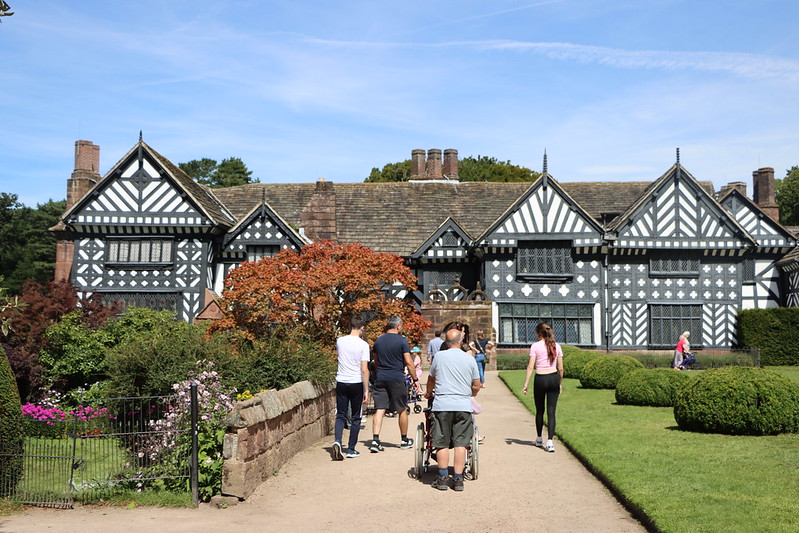
Speaking of properties near airports, Speke Hall rubs up against the runway of Liverpool John Lennon Airport. If you haven’t already guessed from the architecture, it was built in Tudor times, and Catholic priests were hidden there (like I said, Henry VIII had a lot to answer for). It was restored in the 19th century, so a lot of the interior decor is in the Arts and Crafts style.
Outside, there are extensive gardens, including a ‘secret’ garden accessible by a tunnel, a maze, and a story trail for kids. We’ve been a couple of times, in winter 2019 and August 2022.
Tatton Park
Another large site, although the National Trust is only responsible for part of it. That means members have to pay for parking, and the farm. That said, the farm is worth it, as it’s home to many rare breeds and plenty of talks about the animals.
The gardens at Tatton Park are really good. On the times we’ve visited, we’ve only had time for the farm and the gardens; we haven’t been into the houses yet. Yes, there’s more than one house there; the one pictured, and a medieval house now known as Tatton Old Hall. Our visits were in May 2019, May 2021 and June 2022.
Biddulph Grange Garden
Biddulph Grange is in North Staffordshire, and again at the limits of how far we would go in a day. I went there lots of times as a kid, as I had family nearby, and it’s one of my happy places. To call it simply a ‘garden’ isn’t doing it justice – there are lots of different themed areas, with various follies and hiding places. The Japanese garden is my favourite. Our recent visits were February 2019 and during lockdown in August 2020, seeing as it’s mainly outdoors. I haven’t blogged about our visits before.
Later this week, I’ll post part two – the places where we’ve not been to yet.
Typically every other week, we have a slow-cooked meal at home. Along with sous vide cooking, which I wrote about last month, slow cooking a form of low temperature cooking where the food isn’t heated as much, but cooked for longer.
We used to have a dedicated slow cooker, but it was basic, and took up space that we needed for the more capable Instant Pot. The most basic models have one heat setting and turn on as soon as they’re plugged in, but many include multiple temperature settings and timers now.
Benefits of using a slow cooker
To me, there are several benefits of using a slow cooker over cooking meals using ‘traditional’ high heat methods.
The first of these is cost. Generally, it will cost less to run a slow cooker, even for several hours, than a hob or an oven for a shorter period. This is especially true for us, as we have solar panels – a slow cooker lets us do the majority of cooking during daylight hours with our free solar energy. In the winter, it’s dark when we get home after work and, even with a home battery, the amount of energy needed to run an oven means that we have to pay to use grid energy. I suspect that the cost of living crisis is one reason why slow cooking has become more popular in recent years.
Many slow cooker recipes simply require you to put the ingredients in the slow cooker, and leave it. They’re therefore quick to prepare, with no need to stir or keep an eye on a pan. You can put the ingredients in and turn the slow cooker on before leaving for work, and come home to a delicious meal that doesn’t require any work. If I’m working at home, I tend to put slow cooker meals on during my lunch break. Friends of mine who have issues with chronic fatigue find slow cooker recipes really beneficial, as it means they have something to eat at the end of the day which doesn’t require preparation, even when they’ve run out of spoons.
As with other low temperature cooking methods like sous vide, slow cooking is great for tenderising tougher cuts of meat like brisket. Coincidentally, these tend to be the cheaper cuts, and so you can save money this way too.
Not just soups and casseroles
There’s a perception that you can only use slow cookers for liquid-based meals like soups, stews, curries and casseroles. That’s not actually the case, and you can cook a wide variety of meals if you layer the ingredients correctly. In some cases, you essentially steam-cook ingredients that sit on top of others. Some recipes allow you to add rice, noodles or pasta shortly before the end, so that you can cook an entire meal in one pot.
That being said, one thing you are not going to get from using a slow cooker is anything crispy. That crispiness comes about thanks to the Maillard reaction, which usually requires cooking temperatures of at least 115°C. Even on their highest settings, slow cookers do not get as high as that. As such, some recipes call for ingredients like meat to be flash fried before or after slow cooking.
Slow cooker cookbooks
Last summer, I wrote about our go-to cookbooks, which included Nathan Anthony’s Bored of Lunch book(sponsored link). He has also written a follow-up – Bored of Lunch – Even Easier(sponsored link) which I’ve included in the photo above. We don’t use this as often as the first book, but there’s a nice recipe for Butter Chicken in there which uses yoghurt rather than cream. We also picked up his latest book, 6 Ingredient Slow Cooker(sponsored link), last weekend. It looks good but we’ve not attempted any of the recipes in there yet.
The first slow cooker book we bought was Slow Cooker Heaven by Lorna Brash(sponsored link) which is published by The National Trust. There are some good recipes in there, but they’re quite involved – some of them require a lot of preparation prior to turning the slow cooker on, or ask you to make your own spice mixes from scratch.
More recently we’ve picked up Poppy Cooks – The Actually Delicious Slow Cooker cookbook(sponsored link) by Poppy O’Toole. Poppy is apparently the ‘potato queen of Tiktok’, and used to be a professional chef before ending up out of work due to the Covid lockdown in 2020. Her recipes are generally also quite simple, and a little more authentic. We’ve cooked quite a few recipes from this book recently – Honey Garlic Chicken Thighs probably being my favourite.
For us, slow cooking tends to work best if I’m either working at home, or if Christine is working on a weekend. In the latter case, she can be held up and may not finish until 7pm, in which case it’s great coming home knowing that dinner can be ready and on the table within a few minutes, and with little effort.
I had an idle though recently about the number of people who have been British Prime Minister in my lifetime, and how that compares to people older or younger than me.
I was born in 1984, when Margaret Thatcher (urgh) was Prime Minister. She was first elected in 1979, and was around until 1990, when John Major took over. Then in 1997, Tony Blair came to power for 10 years, followed by Gordon Brown, until the general election in 2010 which saw David Cameron take over.
Following the Brexit referendum, Cameron stepped aside to allow Theresa May to take over for 3 years, and then we had 3 years of Boris Johnson. In 2022, we had Liz Truss for all of six weeks before Rishi Sunak took over, and then when Labour won last year’s General Election, Kier Starmer took over. And that’s where we are now.
So, in my 40 years of being alive, I’ve known 10 British Prime Ministers. A simple mean average of a new Prime Minister every four years then.
However, let’s compare that to our nine-year-old, born whilst David Cameron was Prime Minister. In their lifetime, there have been six Prime Ministers so far, for an average term of 18 months.
What about my Dad, who is in his 80s? He’s known 19 Prime Ministers (I’m counting Winston Churchill’s non-consecutive terms as one here), so an average of four and a bit years.
The point I’m trying to make, I suppose, is that historically Prime Ministers have lasted around four years on average, until very recently. Sure, Liz Truss only having been in power for six weeks has skewed things quite a bit. But Rishi Sunak also had a comparatively short term, and Gordon Brown, Theresa May and Boris Johnsons’ terms were all around the three year mark. The political upheaval we’ve seen in Britain in recent years is therefore unusual.
As for how long Keir Starmer will remain in power? I would be surprised if he’s not still Prime Minister in 2029, which is when the next election is due. That would make five years, and so would push the average up a bit. Whilst last summer, I was confident that Labour would win the 2029 general election, I’m not so confident now.
Considering the millions of people who already use it, I probably don’t need to tell you about Duolingo. It’s arguably the most popular app for learning a new language, and I’ve been using it daily for over three years now.
Until now, I’ve been learning French. Now, I studied French for seven years at school and college, obtaining a Grade A* at GCSE, and then a Grade D at A-level. But my A-levels were in 2002, and my opportunities to practice French were limited in subsequent years.
I first dabbled with Duolingo in 2018, when we were due to go to France on holiday. I kept a streak for a few weeks to brush up my French, but didn’t manage to keep it up. I tried again the following year, as we went to France again in 2019, but I couldn’t keep the momentum going. Then lockdown happened and I couldn’t go anywhere.
Super Duolingo
However, we did book a France holiday for 2022. And coincidentally, on the 1st January 2022, Duolingo offered a year’s premium membership for £48, which was 60% off the standard price. So, I took advantage, and, apart from one day in 2023 (ironically because we were in France), I’ve kept my streak going. Having Super Duolingo made a big difference – not having to sit through repetitive adverts, and having unlimited retries, made it a more pleasant experience. I think that’s why I’ve stuck with it.
Indeed, as per the screenshot, I’ve managed to remain the Diamond League for 114 weeks – which is more than two years, if you’re counting. I have managed to come top of the Diamond League a few times, although I’ve yet to come top of the Diamond Tournament.
In terms of progress, my Duolingo French score is currently 105. On the CEFR, that puts me at the lower end of the B2, or ‘vantage’ scale. A high B2 score would probably be enough to study a degree course in French, should I ever have the desire to. Currently, the maximum obtainable Duolingo score for French is 130, which is high B2. In future, the maximum score may go up to 160, which would be C1, or ‘Advanced’ on the CEFR.
Switching to Welsh
Whilst my aim is to complete Duolingo’s French course up to a score of 130, I’m planning to switch to Welsh for a while. Our summer holiday this year will be in Wales, and it would be nice to learn a few phrases to use. And yes, I’m fully aware that almost every native Welsh speaker also speaks English, but so far all I know is ‘Bore Da’ (hello) and ‘Diolch’ (thank you). And Welsh is technically one of the UK’s official languages, albeit one that is little used outside of Wales.
The Welsh course on Duolingo is significantly shorter than the French course, and it apparently hasn’t been updated since 2023. It’s therefore possible that I may complete it before our holiday in July, at which point, I can go back to finishing the French course.
What’s next
After I’ve completed French and Welsh, I would have to decide what to do next. A while ago, I stopped doing the ‘legendary’ levels on Duolingo in French, so I could go back and re-do those. Or, I could switch to another language entirely. Alongside my A* in French GCSE, I also got an A* in German, having studied both, so maybe I could start the German course. After 25 years, I only remember small bits of German, and so I would probably still have to do the course essentially from the start. I’ve also never actually set foot in a German-speaking country (apart from a very brief visit to Switzerland in 1992), although I would like to.
Hopefully, the arrival of Spring means that the weather will be nicer, and we can get out and have some more days out. Last month, we only managed a visit to Magna. We’d hoped to go to Nostell, as their half term activities looked good, but we could have only gone last Sunday when the weather wasn’t really conducive to being outside. Now that it’s been saved from closure, we may pop in to the Abbey House Museum at some point as we haven’t been for a while.
The other big planned activity this month is going to Sci-Fi Weekender in a couple of weeks. Once again, we’re going with friends, and though there are a few changes this year, I’m hoping it’ll be another good weekend. It’s just a shame that it’s at the end of such a long and boring drive across the fields of Lincolnshire to get there. On the plus side, it won’t be me doing all the driving this time as Christine will be able to do some of it; she passed her driving test at the end of last year.
Mid-March will also be five years since the UK went into lockdown. I have vivid memories of a day out to St Ives Country Park on Mother’s Day, which happened to be our last full day of freedom. So much has changed since then – I still haven’t worked a full five day week in the office since.