
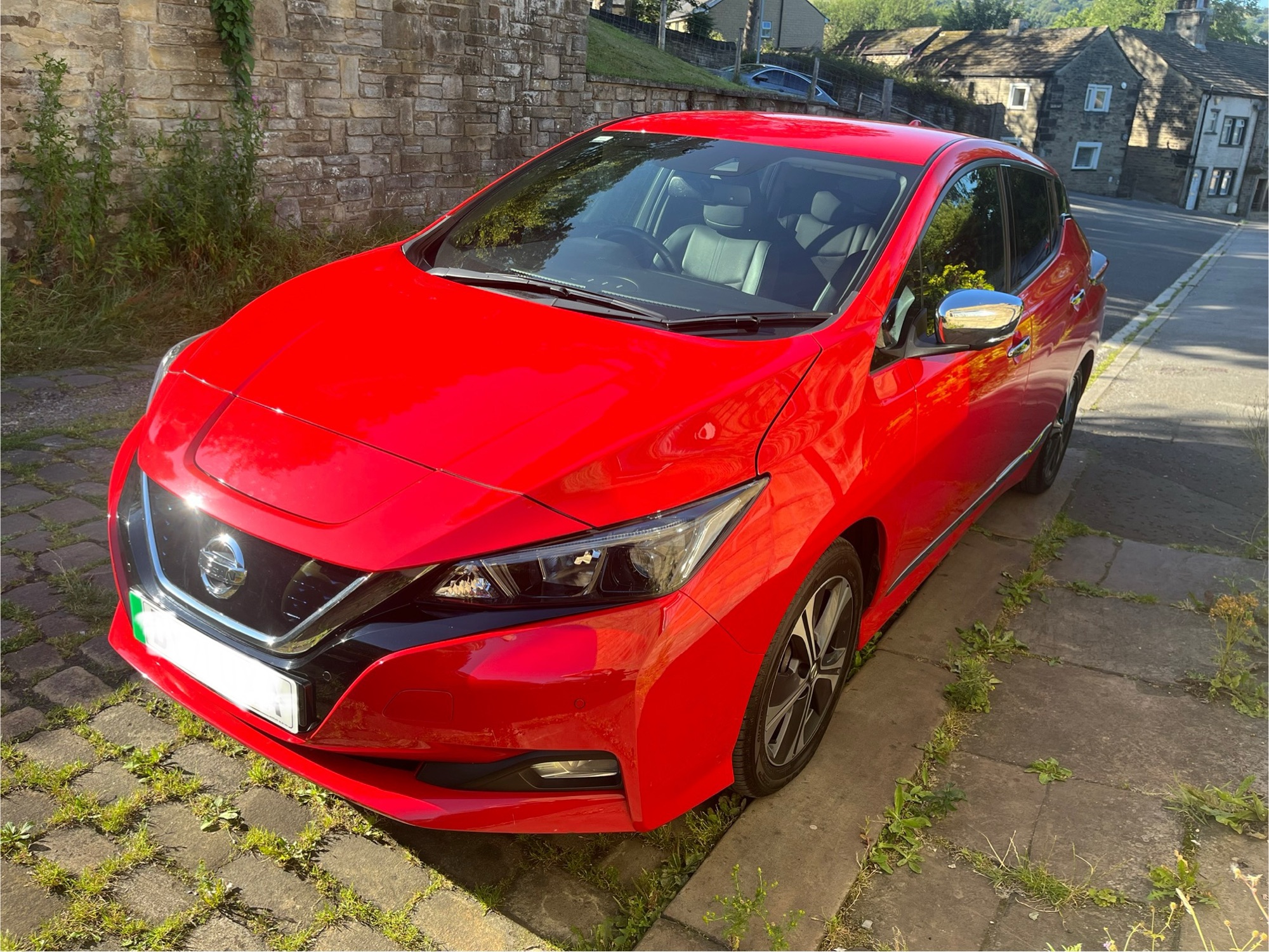
Well, our journey towards an electric car is complete, as on Friday, we bought a new (to us) Nissan Leaf. It’s a second generation model, built in 2021, and replaces our diesel Peugeot 3008. It’s also our second Nissan, having previously owned a Nissan Note from 2015 to 2019.
Both of our previous cars have been around 6 years old when we’ve bought them, whereas this Nissan Leaf is less than four years old. It’s the ‘n-Connecta’ trim, so a mid-range model with a similar level of features to our Peugeot. Our local dealership also had a cheaper model with the ‘Accenta’ trim level, but we decided to pay more for the additional features that we were used to with the Peugeot.
Driving the Nissan Leaf
Like almost all electric cars, the Nissan Leaf just has one gear, so it drives like an automatic. I’ve only ever driven cars with a manual transmission before, and so this took a little getting used to. In particular, one quirk of the Nissan Leaf is the parking brake (i.e. handbrake) is foot operated, roughly where the clutch would be on a manual car.
The car has three driving modes: standard, eco, and e-pedal. Standard is best for motorway driving, giving you better acceleration at the cost of higher power usage. Eco is fine for day-to-day driving, but turning on e-pedal enables single pedal driving. That means that you press the accelerator pedal to go, and take your foot completely off the pedal to slow to a stop. As it the car brakes, the energy generated is then recovered to the battery – known as regenerative braking. As well as meaning you only need to keep your foot on one pedal most of the time, it’s also the most energy efficient way of driving.
Compared to the Peugeot, the steering is much lighter, and even in Eco mode, it’s got good acceleration. But most electric cars will accelerate faster than an equivalent car with an internal combustion engine.
In common with the Nissan Note, the legroom isn’t great when driving, but Christine finds it more comfortable to drive than the Peugeot.
Energy use
We’ve only had the car a couple of days, and have used around 40% of its charge across around two and a half hours of driving. This equates to about 40 miles. The Lithium-Ion batteries in most electric cars are less efficient in really hot weather, like what we’re currently experiencing in the UK as I write this. Therefore, you should keep your EV below 80% charged in hot weather (if you can). Indeed, when I picked the car up on Friday, the dealership had charged it to this level.
The maximum stated range of the Nissan Leaf is around 150 miles. That’s quite a bit less than our Peugeot, which could do around 400 miles on a full tank. And, of course, a key disadvantage of electric cars is that even a quick charge takes longer than fuelling a car with petrol or diesel. We’ll have to plan our longer journeys with recharge stops, although most motorway service stations include several quick charge points now. That being said, a quick charge should mostly recharge our Nissan Leaf’s battery in about 40 minutes.
Size
We deliberately decided to buy a smaller car than our previous Peugeot 3008. There are a couple of occasions each year, when the Peugeot’s extra capacity would be helpful, like holidays. But for 95% of the time, we were driving around a car that was bigger than we needed it to be. That’s a waste of fuel, and also makes it more difficult to park in narrow space.
Compared to the Peugeot 2008, the Nissan Leaf is around 5 cm (two inches) narrower, so parking should be a little easier. It’s also shorter in height, by around 10 cm (four inches). However, weirdly, it is actually longer – by around 30 cm (6 inches). It doesn’t look like it should be longer, but it is.
As such, the actual amount of space inside the Nissan Leaf is only slightly less than in the Peugeot. And on the few occasions that we may need extra space, we’ll considering hiring a roof box, which will also be easier to reach with the lower roof.
Charging
So far, I’ve only charged the car at home, using our dedicated Rolec EVO car charger. The previous owner of our car had set it to charge on an overnight schedule, so by default, it won’t start charging as soon as it’s plugged in. However, there is a dashboard button to over-ride this to start an immediate charge. Three lights appear on the dashboard, visible from outside the car, to show how charged the battery is.
On a ‘slow’ 7 KW home charger, expect a full charge to take around 6 hours. At present, I’ve knocked the current down to 16 Amps, so a full charge would probably take closer to 14 hours at this rate. This is where the equation to calculate power, voltage and current that you learned for GCSE Science comes in.
The Nissan Leaf supports two charging sockets. There’s a standard ‘Type 2’ socket, which only supports ‘slow’ chargers up to 7 KW, like our Rolex EVO. Then there’s a second ‘CHAdeMO’ socket, for use with supported fast chargers. Type 2 is essentially the European standard, and some public charge points only offer type 2 sockets, even for fast charging. Therefore, if we need to use a fast charger, we’ll need to find one that offers a CHAdeMO socket. Many do, but not all.
All the extra fancy gubbins
Being nine years newer than our previous car, our Nissan Leaf has lots of additional features:
- Adaptive cruise control. I used cruise control extensively on the Peugeot and so pleased to have it on here. Combined with no need for gear changes, I can drive for longer without using any of the pedals with this on. ‘Adaptive’ means that it will slow down to match the speed of the car in front if needed, which I didn’t have before.
- Built-in Apple CarPlay and Android Auto. Our Peugeot had the most basic entertainment system without a colour screen, so it’s nice to have these built-in. However, it only supports these over USB – if you want to use either CarPlay or Android Auto wirelessly, you need to buy a separate USB adaptor (sponsored link).
- Heated seats and steering wheel. I suppose these will be useful in winter. Our nine-year-old seemed very keen on the idea of heated seats, until we pointed out that they still need to use a car seat until they’ve grown a bit more.
- Remote start air conditioning and heating. Whilst the car is plugged in, you can use the Nissan app to remotely start the air conditioning or heating systems, so that your car is the right temperature before you set off. This also reduces the load on the battery.
- Forward, rear and around view cameras. Our Nissan Note had no parking sensors whatsoever, whilst our Peugeot 3008 had standard rear parking sensors. The Nissan Leaf, meanwhile, offers a reversing camera, a forward camera, and ‘around view’ cameras. The around view gives you a top-down, ‘bird’s eye’ view of your car whilst reversing. This makes it much easier to park straight, especially if there are no white lines marking out the space. There’s also moving object detection.
- Blind spot alerts. A small red light flashes on your wing mirror, along with an audible warning, if there’s something in your blind spot.
There’s a higher level of trim called ‘Tekna’ which adds a self-parking feature. That would have been lovely to have, but as we were buying used, we were limited to what was available at the dealership.
Compared to the Peugeot, the only things that I’m missing so far are:
- The large storage box between the front seats (the Nissan Leaf has a smaller one)
- The head up display, which showed the current speed and whether cruise control or the speed limiter was enabled.
The Nissan Connect app
The Nissan Connect mobile app allows you to control aspects of your car remotely, like checking its charge status or starting the heating or air conditioning. Alas, although I’ve downloaded the app, I can’t use it yet. The previous owner of my Nissan Leaf didn’t unlink the car from their account, and so I’m waiting for someone at Nissan to un-link it. Thankfully, the dealership gave me a copy of the DVLA ownership change confirmation and so hopefully that’ll be enough evidence.
Overall, we’re really happy with the Nissan Leaf. It’s easier to drive, easier to park, and should be much cheaper to run. I suppose it’s major test will be when we need to drive longer distances – like when we go on holiday next week.