Unblogged September

A depiction of the Cheshire cat on the roof of Trinity Leeds

Considering that I still haven’t written about everything we did in July and August (there’s one more blog post to follow on Thursday), then surely there’s lots more to come from what we did in September. Right?

Well, we did do quite a few things this month, but not all of them merited blogging about on their own. Diamond Geezer normally writes a summary of unblogged things each month (here’s his from August) and whilst I won’t be writing a day-by-day summary, here are some of the things we did:

Trips to Manchester

I went to Manchester twice this month. The first was for a birthday meal for Christine, and also a shopping trip. We naturally went to Afflecks, which is an indoor market focussed on alternative lifestyles and has many small businesses selling clothes, jewellery and music. It’s in an old department store which closed in the 1970s after being taken over by Debenhams (who already had a larger store nearby). It’s operated in its current format since 1982, and is a very quirky place.

My second trip was for work, attending a training session about international qualifications delivered by UK ENIC. That was held at the University of Manchester.

Trip to Leeds

We also had a shopping trip to Leeds, which also doubled up as a second birthday meal for Christine, this time with my parents. This was at Bibi’s Italianissimo, which is a huge art deco restaurant near the station. Bibi’s has been in Leeds for years and retains a reasonably good reputation for food and hospitality – especially for families.

We also went into the Corn Exchange, which is similar in some respects to Afflecks in Manchester as it’s also home to many smaller shops – a couple of which are also in Afflecks. Architecturally, the Corn Exchange is far more interesting, being as it is circular with a huge glass domed roof over the central atrium inside. It’s unsurprisingly Grade I listed.

Back to school

Our nine-year-old is back at school, and started year five – their penultimate year at primary school. Next year, we’ll need to start looking at secondary schools.

Getting cold

This time of year is when we see how long we can hold out before turning the heating on. Which turned out to be Tuesday 16th September, after a run of cold days. It warmed up again afterwards, and so the thermostat didn’t come on until it turned cold again last weekend. Normally, the heating stays on until early May.

Speaking of heating, I’ve had major issues with my Nest thermostat recently with it refusing to work with either the Google Home app or Home Assistant. Ultimately, I had to completely remove it from both, and then re-add it, to get it working again. Which is a faff because the Nest integration in Home Assistant is one of the most difficult to set up, and it’s actually gotten worse since last time as you now have to create a Pub/Sub topic too. I’m pleased that it’s working again, but you can tell Google are phasing out their Nest thermostats in Europe. It will certainly get replaced with a different system, as and when we’re ready to replace our gas boiler with a heat pump.

Playlist of the month: Symphonic Metal

Screenshot of the symphonic metal playlist

This month’s playlist is all about symphonic metal, a subgenre which combines metal with classical music. That might be the use of classical music, or classically-trained singers who sing in a more operatic style.

Symphonic metal happens to be one of my favourite styles of music; music by Within Temptation has showed up in several of the previous monthly playlists. Christine and I have seen them live twice; we’ve also seen Delain live twice, although one of those was where Delain were supporting Within Temptation.

I first got into symphonic metal when I met Hari, my ex-girlfriend, as she was already into bands like Nightwish and owned a couple of their albums. Though we split up over sixteen years ago, I’ve continued to enjoy this genre of music and Christine likes it too. Anyway, on with the playlist – as always, you can listen along on Spotify.

  • “Faster” by Within Temptation. This was the first single from Within Temptation’s fifth studio album, The Unforgiving, and is their most played song on Spotify. And with good reason – it’s one of my favourites and shows off lead singer Sharon den Adel’s huge vocal range.
  • “Bring Me To Life (Synthesis)” by Evanescence. I’ve specifically chosen this newer version from Evanescence’s 2017 album Synthesis, rather than their debut single, as it’s a better fit for the genre with what sounds like a full orchestra backing the band. It also doesn’t have Paul McCoy’s vocals that were in the 2003 single version (also featured on the soundtrack to the early Marvel film Daredevil); these were not included in the original demo (also on Spotify) and were added at the insistence of the record label.
  • “I’d Do Anything For Love (But I Won’t Do That)” by Xandria. It’s a gender-flipped symphonic metal cover version of the epic Meat Loaf song, and yes, it’s of a similar length too. I really like this version.
  • “Victims of Contingency” by Epica. Epica really go all in for orchestral accompaniments for their songs, and this is a really good example. It’s definitely metal, with a growly male voice during the verses, but with lead singer Simone Simmons singing the chorus.
  • “Nemo” by Nightwish. Nemo was taken from Nightwish’s 2004 album Once, which was their final album featuring their original lead singer Tarja Turunen (who has since pursued a solo career). Again, this is big with the orchestral accompaniment, especially after the key change towards the end.
  • “We Are The Others” by Delain. This song was the second single from Delain’s third album, and is a tribute to Sophie Lancaster. It’s a song about feeling like an outcast, and the importance of becoming friends with other outcasts.
  • “Hunger” by Amaranthe. Amaranthe are towards the commercial end of symphonic metal, with relatively tight songs that are more friendly to radio play. They’re also quite prolific, having released seven albums since this, their first single, came out in 2011.
  • “Magic Forest” by Amberian Dawn. This song has a bit of an 80s feel to it. I’ve listened to a few of Amberian Dawn’s songs, including their ABBA cover, but this is my favourite.
  • “Hunting High and Low” by Metalite. This is also a cover, of a song by Stratovarius, but I prefer this version. They’re relatively new, compared to many of the bands on here – this was released as recently as 2020.
  • “Edge of Your Sword” by LEAH. Unlike the others on this list, LEAH isn’t a band but a solo music project by Leah McHenry. She releases all her songs independently of a major label, and this is my favourite of hers.

Bolton Abbey

A view of Bolton Abbey overlooking the River Wharfe

Bolton Abbey is yet another of those ‘I can’t believe I haven’t written about this before’ places that we went to again last month. But, apparently, I’ve never written a blog post about a visit, even though I’ve been loads of times over the years.

The Bolton Abbey estate is one of the ‘seats’ of the Dukes of Devonshire, along with Chatsworth (see 2016 blog post although we’ve visited again more recently) in Derbyshire and Lismore Castle in Ireland – none of which are in Devonshire. The 11th Duke of Devonshire, Andrew Cavendish, transferred ownership of the Bolton Abbey estate to a charitable trust who operate it to this day.

As the name suggests, the main feature of the estate is an abbey, now known as Bolton Priory. Part of the church is still in use today, but the rest of it is a ruin, following the Dissolution of the Monasteries by Henry VIII. I’m beginning to understand why we spend so long learning about the Tudors in our history lessons at school. The priory was built next to a crossing point of the River Wharfe, and the estate essentially covers the river valley.

Our last visit was in the summer of 2020, during the pandemic, and over the years I’ve been on some hikes with the University hiking club,

The Strid

I’m going to let you watch this Tom Scott video about The Strid. Upstream from the abbey, the River Wharfe hits a section of harder rock, and is forced into a narrow, fast-flowing channel, known as The Strid. It’s regarded as being one of the most dangerous stretches of water in the world, as whilst it may look sedate from above, there are fast-flowing currents below the surface. And we’re not entirely sure how deep it is – there may be hidden caverns down there.

Due to the exceptionally dry year that we’ve had, there was less water flowing through The Strid when we visited. But there are big warning signs around, advising that people have lost their lives after having fallen in. We had a look at it from a safe distance.

The Stepping Stones and the beach

Back down towards the priory, there are a set of stepping stones across the river. It’s particularly wide and shallow here, and possible to wade across in summer. There have been stepping stones here since the abbey’s heyday, although they’re often replaced due to damage. There are 62 stones in total, and our nine-year-old raced across whilst I nervously followed behind. Nowadays, there’s a bridge alongside, and so Christine took the easy route.

Next to the stepping stones is a beach – a sandy area inside one of the river’s meanders. This is popular, especially on sunny days, as an inland alternative to the seaside. Our nine-year-old had a nice paddle.

On the eastern bank of the river was the Welly Walk, which I understand is only here for this year and closes in November. It’s essentially a series of play areas over a one mile walk. It can get muddy, and the path isn’t suitable for wheelchairs or pushchairs, but it’s a fun challenge for kids.

Accessibility

The map given to you on arrival shows the more accessible paths around the estate, but there are some relatively steep ramps even on the more accessible routes. Some paths have steps, and almost all are gravel with some uneven surfaces.

There’s plenty of parking on site, across four car parks. Payment is £15 per car for a whole day on arrival, or £12.50 if pre-booked at least a day before. You don’t need to pay to enter the site, so if you’re able to arrive by some other method, you won’t need to pay anything.

That said, public transport options are limited. There are buses on Mondays, Wednesdays and Fridays, and Dalesbus services at weekends. Due to a narrow arch on the road through the valley, these tend to be small buses. Bolton Abbey railway station is about a mile away, but it’s on the Embsay and Bolton Abbey Steam Railway which doesn’t have a mainline connection.

Route planning apps for electric cars

A screenshot showing various route planning apps, including Google Maps, Apple Maps, ZapMap, Electroverse, PlugShare and ABRP

Since I first got my own car (10 years ago), we’ve used Google Maps for directions. I’ve never bothered with a stand-alone satnav, and our Nissan Leaf is the first car that we’ve owned to have one built-in.

With our electric Nissan Leaf, Google Maps is still our go-to app for route planning and directions, but there are some other apps that I’ve considered. Here’s an overview of them.

Google Maps

Starting with Google Maps. Its support for electric vehicles is okay; you can tell it that your car is an electric vehicle, and it’ll offer the most energy-efficient routes as well as the fastest. Remember, electric and hybrid cars have regenerative braking; in a petrol or diesel car, a shorter but slower route may only use a little less fuel, but a lot less energy in an electric car. On one recent journey, a slower but more direct route took five minutes longer, but used 29% less charge and meant that would get there and back without having to recharge en route.

You can also tell Google Maps what plugs your car supports. Our Nissan Leaf, for example, can charge from a 3-pin plug, a Type 2 AC charger and CHAdeMO DC chargers. Then, when you switch your car from being petrol/diesel to electric, it’ll no longer offer to show you directions to petrol stations, but to public electric car chargers instead.

Google Maps will show public chargers from the majority of major operators, and their occupancy. However, compared to some of the other apps mentioned here, it won’t show all chargers.

If you have a really new electric car with Google Maps built-in, then it’ll know your car’s current charge and be able to add charging stops for long journeys. Our Nissan Leaf doesn’t – we can just use Google Maps through CarPlay or Android Auto. As such, it won’t automatically suggest charging stops on longer journeys.

Apple Maps

Note: I’m writing this about Apple Maps in iOS 18, which was current at the time of writing

I’m sure that Apple Maps works great, if you live in California. I don’t, and since Apple launched it 13 years ago in iOS 6, it’s been a disappointment. If you do live in California, or a supported country, then there are EV features available to you. But it appears that the UK either isn’t a supported country, or it just doesn’t work with my Nissan Leaf. Either way, for me, there are no special features available in Apple Maps.

I can’t even tell Apple Maps that I drive an electric vehicle, and so it still bubbles up petrol stations which are of limited use to me now. You can search for ‘charging point’ and get directions to charging points, but it can’t easily incorporate these into a route. It also recommended a charging point to me which didn’t actually exist.

ZapMap

ZapMap has probably the best list of UK electric car chargers. As well as listing all of those on the main charging networks, including availability, users can also add chargers themselves. These are often ‘destination chargers’ at places where you can visit, which may be offered for free and are not part of a larger network.

The app is ad-supported, and won’t work with CarPlay or Android Auto unless you pay for ZapMap Premium. This currently costs £5 per month, or £35 for a full year if paid in advance (£30 if you sign up before the end of the month). As well as hiding the ads, you get a free ZapMap RFID charging card (normally £10) and a 5% discount if you pay for certain public chargers through the ZapMap app. As I only use public chargers occasionally, I may consider the £5 per month option when needed, and then cancel.

The free app lets you plan a limited number of routes, which can then be sent to either Apple or Google Maps for navigation.

Octopus Electroverse

Electroverse is the public charging app from Octopus Energy. It doesn’t list as many chargers as ZapMap, as it focusses just on those on the major networks. However, it offers things like route planning, CarPlay and an RFID card for free, unlike ZapMap, and there are no adverts. It also looks nicer.

It’s worth noting that, by default, it’ll only show public chargers that are compatible with the Electroverse app and RFID card. This means that public chargers from Pod Point initially don’t appear, for example. You can turn this off if you want to prioritise seeing a wider range of chargers.

The route planning is quite good. You can tell it what car you drive, your start and end points, and how much charge you expect to start with. It’ll then calculate a route that includes stops at compatible chargers, and it’ll tell you how much you need to charge at each stop and how long it’ll take. You can then send the route to Google or Apple Maps. Note that in CarPlay mode, handoff is only to Apple Maps and not Google Maps, so bare that in mind.

PlugShare

PlugShare is another site that allows user contributions of public charger places. Unlike ZapMap, which is UK focussed, PlugShare is global. Its list of chargers is extensive, and even includes chargers which are ‘under construction’. I checked a couple of these locally, and found that, whilst there was planning permission in place for these, construction work hadn’t started. I think this is where Apple Maps may be getting its data from, but without the knowledge that they’re under construction.

It supports route planning, but this seems to be limited to showing public chargers on a given route. Unlike Electroverse, it didn’t tell me how much to charge up by and how long to stop for, and wouldn’t send the details to a mapping app. It supports CarPlay though.

ABRP – A Better Route Planner

A Better Route Planner is worth considering. It’s a full replacement for Apple Maps or Google Maps, and is designed for electric cars. Like with Electroverse, you can select your car and the starting charge, and it’ll plan routes to include car chargers.

CarPlay is limited to ABRP Premium, which also allows you to factor in weather conditions when driving, and to prefer chargers where there are toilets or children’s play areas. And, like Google Maps, ABRP Premium incorporates traffic data. It can also connect to live battery data in more cars, albeit in a somewhat roundabout way. For my Nissan Leaf, it needs an OBD2 adaptor and the Leaf Spy Pro app (£20) set up. ABRP Premium costs €5 per month, or €50 per year.

Combining the apps

At the moment, I’m using a combination of all three:

  • Google Maps for general navigation
  • Electroverse for calculating charge levels on a route, or incorporating charge points into a route plan
  • ZapMap for finding charger locations

It would be nice if Google Maps included charge levels in its route planner on cars that don’t have it built-in; that would minimise my need to use other apps. Still, by planning my routes in Electroverse and sending them to Google Maps, I can achieve most of the features of ABRP without their premium subscription. Once I’ve picked up an OBD2 adaptor that’s fully compatible with Leaf Spy, I may give ABRP another try though.

Little Moreton Hall

A photo of Little Moreton Hall, a Tudor house

Back in March, I listed the National Trust properties reachable from our home that we hadn’t been to. Last month, we were able to tick Little Moreton Hall off that list.

Now, I’m reasonably sure that I’ve visited Little Moreton Hall before, but if I did, it would’ve been in the 1990s. Certainly, I don’t have any photos of it saved anywhere. In any case, neither Christine, nor our nine-year-old had visited before.

Little Moreton Hall probably classes as being one of the National Trust’s medium-sized properties. During the English Civil War in the 17th Century, the Moreton family backed the Royalists loyal to Charles I. The hall was later confiscated by the government, and much of the surrounding land ended up being used for farming. So whilst the hall itself has survived, it sits on a relatively small site – unlike other grand homes in the countryside, you don’t spend five minutes driving through parkland full of deer.

Wonky

What Little Moreton Hall is best known for is that it’s very wonky. If you look at the photo above, it’s as if someone accidentally dropped the hall from a height, and it’s got bent out of shape. The reason for its wonkiness is partly due to a lack of deep foundations, but also its owners adding a third floor on top without taking the extra load into account. As such, the Long Gallery on the top floor has a very uneven floor, and until quite recently remained out of bounds for visitors. The National Trust has had to work hard to sure up the building and allow all parts to be opened to the public.

Originally the hall was H-shaped, with the dining hall and what is now a tea room in the oldest part. Subsequent extensions have made it look like an inverse ‘C’ from above. Around the hall is a moat, and access is via a bridge and through a gateway, above which sits the Long Gallery. Oh, and the original toilets, which opened out onto the moat. Lovely.

As well as the hall, on the island formed by the moat are some small formal gardens. They’re not very extensive – it’s a small site after all – but they’re well maintained. The moat itself is home to a number of different species of duck.

The Long Gallery at Little Moreton Hall

Inside Little Moreton Hall

The interior is laid out largely as it would have been during its heydays in Tudor times. The family crest for the Moreton family features a wolf, and so there are a number of toy wolves, dressed in different outfits, dotted around the rooms. There’s also a focus on how people in Tudor times slept, as a result of a research project with the University of Manchester. In those days, people would sleep propped up on pillows, to aid digestion, and have various sleepy herbs around to help them nod off. One of the beds has an embroidered bed spread featuring these herbs.

The Long Gallery at the top is probably the highlight – it has plenty of windows and so is a very light space, especially on the sunny day that we visited.

Accessibility

As befits an old house known for its wonkiness, access isn’t great. There is step-free access to the hall, where you can view photos of the other rooms, but to see them in person you’ll need to be able use steps. The Long Gallery is atop quite a narrow spiral staircase.

Limited parking is available on site; you may struggle to find a space on weekend afternoons in the summer. There are no electric parking facilities; we ended up charging our car in nearby Congleton where there are two sites with rapid chargers (though neither were working). An infrequent bus service between Alsager and Congleton runs Monday-Saturday, and at three miles away, Kidsgrove is the nearest railway station.

Button battery charger

A photo of a button battery charger with a LIR2450 battery inserted.

Battery chargers are just for AA and AAA batteries, right? Nope – it turns out you can buy rechargeable button batteries (also known as coin batteries) and a charger for them. Today, I’m reviewing this starter kit that I bought from Amazon (sponsored link) which includes a charger and four LIR2450 batteries.

The battery charger can charge two button batteries at a time. A red light shows that the battery is charging; it shows a green light when there’s no battery inserted, or the battery is fully charged. It’s not an intelligent charger, so it won’t tell you if the battery is dead, or give you an idea of progress.

As well as the provided LIR2450 batteries, this battery charger can also charge LIR2032 and LIR2025 batteries if you have these. These batteries should be compatible with any devices that take CR2450, CR2032 and CR2025 batteries, which aren’t rechargeable. It’s quite small, and gets its power via a USB-C cable, which is included. Batteries seem to take around two hours to fully charge.

I’ve got a Zigbee motion sensor that uses a CR2450 battery, and whilst it’s not needed its battery replacing yet, I can ensure that its new batteries are rechargeable. Disposing of batteries properly can be a pain, as they’re not supposed to go in household waste.

The starter pack, that includes the battery charger and four batteries, currently costs £16. Extra packs of four batteries seem to cost around £8 (sponsored link), so the equivalent of £2 each. That’s more expensive than buying the equivalent disposable CR2450 batteries, which can be had for about 50p each, but they should last longer and are better for the environment.

Cadbury World

A photo of the outside of the Cadbury's Factory in Bourneville, West Midlands

We’ve had quite the busy summer, as it happens, which is why I’m writing about something that happened right at the beginning of August now, towards the end of September. We were invited to a round number birthday for a family member down in Oxfordshire, and so we decided to make use of the fact that we’d be heading through the Midlands to call off at Cadbury World.

This was my third visit to Cadbury World. I first went with my ex, Hari, back in the 2000s as she has family nearby in Worcestershire. My second visit was with Christine and our then two-year-old in 2018, in similar circumstances in that we needed to pass through the West Midlands on the way down to Portsmouth to go on holiday. So, this was our first visit in seven years, and the first one post-Covid.

What’s new

Since our last visit, a few things have changed. The history of the model village of Bournville has been refurbished, and made a core part of the attraction. Before, it felt like an optional extra that hadn’t seen much attention in recent years. The rides have been updated too, and there was a new bit where you could use liquid chocolate to make art. Another bit that I don’t remember from last time was where you could order personalised chocolate items and have them presented to you after a short wait. We ended up buying a personalised chocolate teapot as an additional birthday present.

The other good reason to go to Cadbury World is the factory shop, which has also been refurbished since our last visit and has a huge range. It’s not always the cheapest place to buy Cadbury chocolate (or other Mondelez brands) but they have plenty of stock.

If you’re planning to go to Cadbury World, I strongly recommend booking in advance. When we got there at about 11am, there were no more tickets to buy on the door. But not only that, it’s usually cheaper booking in advance. Cadbury World is run by Merlin, and so it’s often (but not always) included in some discount schemes. As I work in education, I was able to get a discount via Discounts for Teachers, and cashback on my Curve card; combined, we essentially got one of our three tickets for free. You can also get a 1/3 off if you travel by train.

Accessibility

Christine had a fall on the morning before we set off (don’t worry, she’s better now), and so we hired a wheelchair on arrival at Cadbury World. As such, I’m arguably in a better position to comment on accessibility than normal. Wheelchair access was pretty good on the whole; in the first part of the attraction, there are some ramped cobbled floors, but a powered chair shouldn’t have issues. Most of the videos in this section include British Sign Language interpretation too.

There is a car park on site, but there isn’t any electric car charging available there. There are some public chargers about a half mile walk away on the other side of the railway line. We ended up using a rapid charger at the Art Deco McDonald’s in Parsons Hill.

Bournville station is a short walk away, hence why there’s a discount for arriving by train. It’s painted in Cadbury’s purple, and it has step-free access. There are currently four trains per hour from Birmingham New Street. The 27 bus also passes by and runs half-hourly.

Energy monitoring over Matter

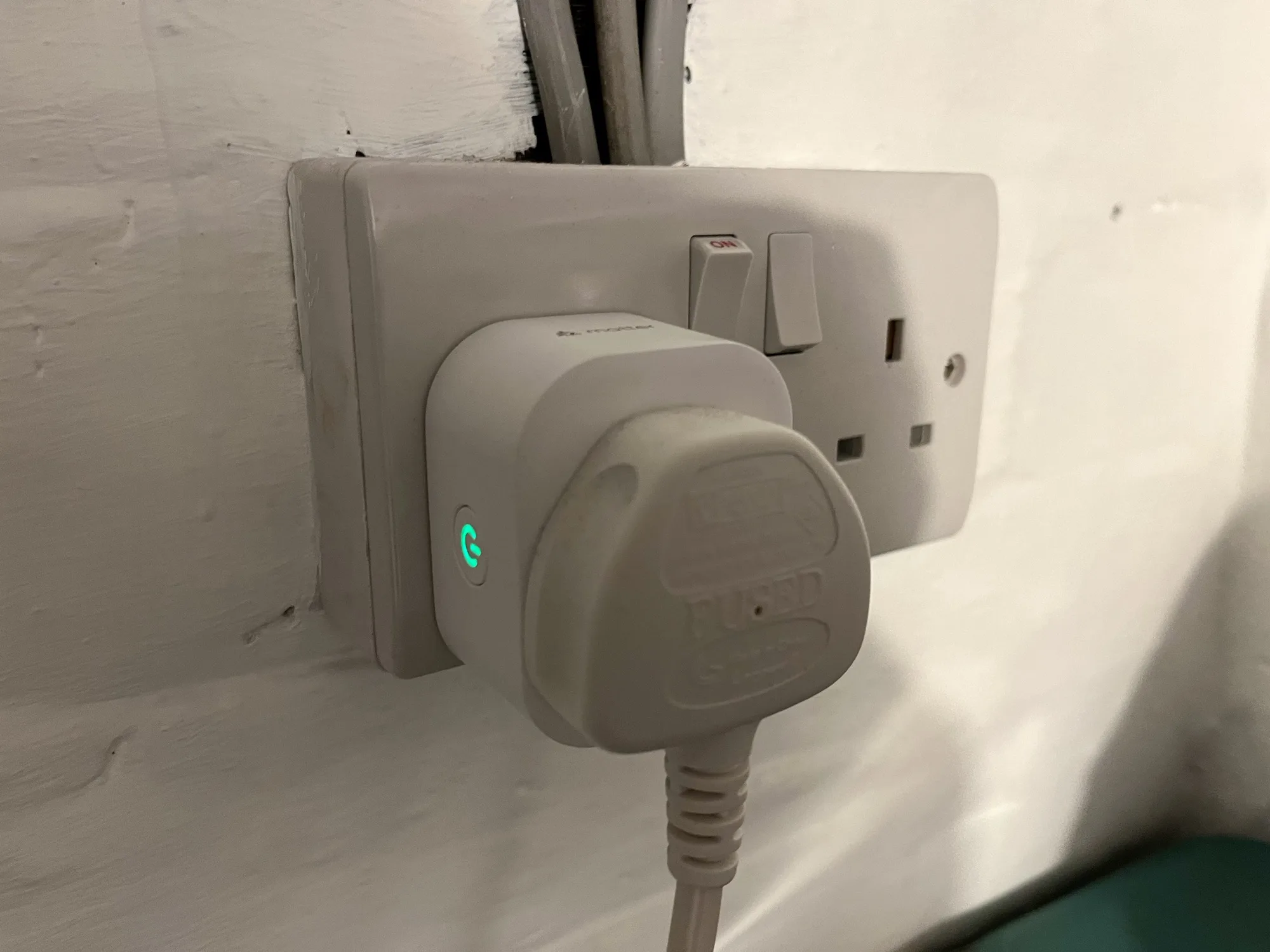
A photo of a Meross energy monitoring smart plug in a UK plug socket

Back in April last year, I bought a pair of Meross energy monitoring smart plugs (sponsored link). I’d chosen them because they supported Matter, and so could be easily added to Home Assistant, Google Home and Apple Home all at the same time. However, I lamented that their Matter support was limited to turning them on and off; the energy monitoring data wasn’t available through Matter. That has now changed.

If you have these plugs, or are looking at buying them, here’s how to get energy monitoring over Matter into Home Assistant:

Step 1: Update the Firmware

Firstly, you’ll need to open the Meross app on your phone, and ensure that the smart plug is linked to the app. Next, you’ll need to do a firmware update – this is located on the user tab, for some reason. The firmware update should take a couple of minutes.

A screenshot of the Home Assistant interface, showing the settings for the Meross energy monitoring smart plug and the 're-interview device' option.

Step 2: Re-interview your smart plugs

Originally, the way I found out that this was working was because one of my plugs had stopped working, and needed a factory reset. I then had to remove and re-add it to Home Assistant, Google Home and Apple Home. When I re-added it to Home Assistant, that was when I found that it now supported energy monitoring over Matter, as the power, wattage, voltage and current for the smart plug now appeared in the device settings.

The good news is that you don’t need to remove and re-add the device. Instead, you can ‘re-interview’ the device. Open it up in Home Assistant’s device settings, and then click the three dots next to ‘Share device’, and then ‘Re-interview device’. Home Assistant will then attempt to find out what capabilities the device has, and should add the new entities for you.

Step 3: Uninstall the Meross LAN custom integration

Now that Home Assistant can receive the energy monitoring data over Matter, you shouldn’t need the Meross LAN integration from HACS anymore. You’ll need to amend any existing automations that use the Meross LAN entities (I use this energy monitoring blueprint), and then remove the devices before uninstalling it through HACS. This was one of the integrations that was causing the biggest slowdowns in my Home Assistant, and it seems to be more responsive now that I’ve removed it.

The key advantage of using energy monitoring over Matter is that the data remains local to your home network. Otherwise, you’re sending and receiving data to Meross’ servers (unless you’ve managed to reconfigure them to use a local MQTT broker like Mosquitto). That also means that, if those servers go down or Meross withdraws support, you would no longer get energy monitoring data. Switching to Matter should therefore give your smart home system more resilience.

The Art of the Brick exhibition in Leeds

Various large animals made out of Lego at the Art of the Brick exhibition

A couple of weeks ago, we went to see The Art of the Brick, an exhibition of Lego sculptures by Nathan Sawaya which is currently visiting Leeds.

Sawaya is an American sculptor who primarily uses Lego to make his pieces. As you enter the exhibition, there’s a short film where you get to hear more about Sawaya and how he works, before you continue into several rooms with different Lego sculptures. Each room broadly has a theme.

Some are quite abstract – humanoid shapes, with a single colour of brick. But there are also animals – many life size – and some Lego depictions of famous sculptures like Michaelangelo’s David, or of paintings like Edvard Munch’s The Scream. Some sculptures are designed so that you can see inside them – most are hollow. Almost all of them are made using standard sized Lego bricks – there’s very few of the bespoke pieces you get in some official Lego sets nowadays.

At the end of the gallery is the ubiquitous gift shop, and also a huge pit full of Lego for little ones to play in.

For me, my favourite bit was the animals – the models are quite detailed, and are a bit like those you would see at Legoland.

It’s not a very big exhibition – we got around it in about an hour, and it cost us about £30 for the three of us. The exhibition has been on a world tour and only has Montreal, Marseille and Schenectady to go; it was in London last year. If you do decide to go, use the promo code AOTB10LEEDS to get 10% off. It’s around until the end of next month.

Miscellaneous notes on North Wales

This is the one final holiday post before I get on with writing about the other things we’ve done on this holiday. It’s a few assorted notes and observations from our time away.

North Wales is popular with dog owners

If you want to bring your dog on holiday, then North Wales seems to a popular choice. The cottage we rented was dog-friendly, with hard floors in most of the rooms, and in Llandudno we saw at least one hotel specifically marketing itself as dog-friendly. In fact, there was even a dog toileting area to the side. Alas, I didn’t catch the name of it, and can’t find it on Google Street View, but I think it was on Church Street.

We certainly saw plenty of people out and about with their dogs.

Charging our electric car wasn’t much of an issue

Getting a new electric car less than a week before we went on holiday was an interesting decision in retrospect, but we coped well. Whilst there are literally no public chargers in Conwy, and we weren’t permitted to charge it at the cottage we rented, there were a couple of rapid chargers a few minutes away in Llandudno Junction. These kept us going when we couldn’t charge on days out, however, several of the places that we visited did offer public charging. We only had to go out of way once to charge up; the rest of the time, we fitted our charges around the activities that we’d planned.

Signage is in Welsh first, then English

North Wales has a higher concentration of people who speak Welsh as their first language, than other parts of Wales. So, Welsh tends to appear first on road signs with English beneath. This isn’t universal, and elsewhere in Wales it’s English first. And whereas in Ireland, where the Irish text on road signs is in italics, both the English and Welsh are in the same font, same colour and not italicised. I don’t speak Welsh – I tried it on Duolingo for a couple of weeks before going back to French – and so reading signs took a little longer as I had to look where the Welsh stopped and the English started.

Christine, meanwhile, is still learning Welsh on Duolingo.

It’s also notable that all the Welsh signs instantly disappear as soon as you cross the border back into England.

The Welsh NHS is separate to the English NHS

I forgot to pack any spare hearing aid batteries, and so needed to find somewhere that sold them. Being English, I went to the nhs.uk web site to find somewhere that would sell them, but it turns out that, despite ending in ‘.uk’, nhs.uk is just the web site for NHS England. So when I searched for nearby pharmacies, for example, all the results were in Cheshire and Merseyside.

Healthcare is a ‘devolved’ matter in the UK, and so the regional governments in Wales, Scotland and Northern Ireland have their own branches of the NHS. (Technically, it’s not the NHS in Northern Ireland but HSC instead).

NHS Wales confusingly has two web sites. The main NHS Wales web site, at nhs.wales, is more of a corporate web site – if you want health advice, or to find services, you need NHS 111 Wales, which is at 111.wales.nhs.uk.

I know NHS England is being abolished but you would expect a web site called ‘nhs.uk’ to apply to the whole of the UK, and not just England.

For completeness, health advice in Scotland comes from NHS Inform, at nhsinform.scot, and in Northern Ireland, it’s part of NIDirect.