Unblogged October

A photo of Fountains Church on Chester Street in Bradford

Last month, for the first time, I did a summary blog post of things we did in September, but that didn’t merit a whole blog post. So here’s some of the things I did this month.

Away day in a former nightclub

Every now and again, we have an ‘away day’ at work. This time, it was hosted at Fountains Church, located on Chester Street in Bradford, pictured above. I’ve been in the building before it was a church, as it used to be three separate nightclubs: Revolution (the national chain of vodka bars), Walkabout (the national chain of Australian-themed bars) and Dr Livingstone’s, a nightclub themed around Dr David Livingstone, a colonialist and explorer. I visited them all regularly back when I was a student.

It was weird seeing the building now used as a place of worship.

A blue postbox in Manchester

A blue postbox on Liverpool Road in Manchester

On the way back from seeing Brains, Bogies and You, we walked past a blue postbox on Liverpool Road in Manchester. Normally, British postboxes are painted red (or occasionally gold), so this one is unusual.

Fortunately, a plaque on the side explains all. Originally, blue postboxes were more common, as they were used for air mail post. Nowadays, air mail no longer needs to be sorted separately from domestic post, and so all but one of these have been removed. The only remaining genuine blue air mail post box is outside Windsor Castle. This one is actually just a regular post box, painted blue.

This specific post box was painted blue because it sits next to what was the Manchester Aerospace Museum. This later became the Air and Space Hall of the Museum of Science and Industry, but was permanently closed a few years ago.

Playing with an ESP development board

Back in July, I picked up an ESP development board (sponsored link) to use as a firmware flasher. I’ve been experimenting with it, to try to add Wi-Fi control to an existing non-smart device. Let’s just say that I need more soldering practice, but I’m hoping to write more about it should I succeed.

Danny Boyle in Sowerby Bridge

I didn’t spot the film crew myself, but Danny Boyle has been filming scenes for his new film Ink in Sowerby Bridge, near where we live. It’s a biographical film about the early life of Rupert Murdoch. It’ll be interesting to see if we can recognise the filming locations when the film comes out.

Much of Happy Valley was also filmed locally, as was the more recent CBBC series High Hoops, so we often see filming trucks parked up around the town.

Old posts brought back

I’ve also re-instated a number of old blog posts written in October 2015 from the Web Archive. These include Losing the Language of Love, which I quite enjoyed reading again, and several posts from a trip to London that month:

We also went to Crossness Pumping Station on that trip, but unfortunately my post about it was never indexed by the Web Archive and so it’s probably lost forever. It’s a shame – it’s a very interesting place. It’s not often that a sewage pumping station would be Grade I listed, and it’s only open on selected days of the year.

Rude Science

A photo taken during the Rude Science show at the Halifax Victoria Theatre

If you like explosions, or want to know what chemicals make up a fart, then the Rude Science live show may be right up your street. Especially if, like us, you have kids in the 6-14 age bracket.

The Rude Science show came to the Victoria Theatre in Halifax last weekend, and so we took our nine-year-old along. It was hosted as part of this year’s Halifax Comedy Festival, which runs until Sunday.

Rude Science is hosted by Stefan Gates, who has hosted and guested on a number of BBC TV shows, for both kids and adults. He’s also the author of a number of books – we picked up his Rude Science (sponsored link) and Insects: An Edible Field Guide (sponsored link) from the foyer after the show, and had them signed. Oh yes, I should mention that Stefan has a thing for ‘eating the science’ and this includes various substances used during the show.

The show is very well put together, considering that it incorporates highly flammable materials and lots of different cameras (including infrared) and smoke machines. Certainly, there were only one or two minor balloon-related technical hitches. And whilst it wasn’t quite a sell-out crowd, there were very few of the 1500 or so seats remaining empty at the Victoria in the showing that we saw.

Rude Science is well targeted at upper primary and lower secondary school aged kids, and has a good balance of being funny, engaging and educational. Our nine-year-old really enjoyed it. The show remains on tour for the rest of this week, with it being half-term – it’s in Hull tonight, Guildford on Thursday, Chelmsford on Friday and Reading on Sunday. At each venue, there’s usually a lunchtime and afternoon slot, and, with an interval, the show runs for around two hours. It’s then back on the road for February half term.

Meeting the Map Men in Leeds

Mark Cooper-Jones and Jay Foreman, aka the Map Men, in front of a crowd at Waterstones in Leeds

Last week, I went to meet the Map Men at Waterstones in Leeds. They have a new book out, called This Way Up, which you can buy from Waterstones or Amazon (sponsored link).

The Map Men are Jay Foreman and Mark Cooper-Jones. They’re both stand-up comedians, and Mark used to be a geography teacher before going into comedy, hence the interest in maps. Jay, meanwhile, has long had a YouTube channel; I first came across his ‘Unfinished London‘ series many years ago. Mark and Jay started collaborating on their Map Men series way back in 2016, with a video about Bir Tawil:

The show started out primarily as a sketch show that happened to be mostly factual. This became an issue when Mark and Jay found out that teachers were using their videos in classes at school, and so newer episodes undergo rather more fact-checking before they’re published. In all, there’s been 34 episodes across four series, with each episode typically getting 3-4 million views. They’re good – they manage to be entertaining whilst also educational.

The Map Men Book

Every successful thing seems to result in a book nowadays, and so ‘This Way Up’ is their first book inspired by the show. It’s worth noting that it’s all new content – essentially, lots of the content in the book are things that are interesting, but would probably not make a good video. That also means that the book isn’t treading the same ground as the videos.

Here’s a couple of interesting points that I picked up from the book launch. Firstly, the first draft of the book was almost finished, when Mark and Jay realised that there was nothing about the UK in the book. So those chapters were some of the last to be added.

The second was about whether Yorkshire appears, seeing as the event was in Leeds. The answer is yes, but not a whole chapter. It comes up in a chapter about ITV regions, and how the area covered by Yorkshire Television included a lot of places which were emphatically not in Yorkshire, and didn’t cover many that actually were. For example, King’s Lynn, all the way down in Norfolk, picked up Yorkshire Television, but Scarborough, further up the coast and very much in Yorkshire, did not. The broadcast area also included the tiny county of Rutland, and thus merits a mention of Eric Idle’s sketch show Rutland Weekend Television.

A photo of me (on the left) with Mark and Jay (the Map Men) and my friend Phil

Book launch

This Way Up was released last week, and so I attended one of the five launch events being held in various branches of Waterstones across the UK. Of those five, three sold out; this one in Leeds wasn’t quite a sell-out, but around 200 people gave up time on their Tuesday evening to see the Map Men speak. I turned up slightly late, thanks to Northern Rail, but managed to see almost all of their hour-long Q&A session.

Of course, the best thing about attending a book launch is the opportunity to meet the authors, which we did after the Q&A. So, I have a lovely photo of me with Mark and Jay, and my friend Philip Lickley, and a signed copy of the book. Incidentally, neither Phil nor I knew each other would be there ahead of time (despite me saying so on Facebook – curse you, algorithms!) and yet we ended up sat next to each other.

As I write this, I haven’t yet read the book, apart from the short passages that were read out at the event. I have, however, separately picked up the audiobook, which Mark and Jay narrate themselves, and will listen to it soon.

Castlefield Viaduct

A photo of the Castlefield Viaduct

In my review of local National Trust properties, I somehow missed out Castlefield Viaduct in Manchester. It’s one of the newest, having only been open for a few years, and occupies an abandoned railway viaduct that crosses the Castlefield area of Manchester.

It’s a similar concept to the High Line in New York; take an abandoned elevated piece of railway infrastructure, plant things on it and open it to the public. The Castlefield Viaduct isn’t as long – around 330 metres, rather than 2.3 kilometres – and it’s not yet open as a through route. That will come in time, with work hopefully starting as soon as this year. When complete, it will open up a segregated walking route from the Manchester Central exhibition centre (still often known by its former name of G-Mex) towards Cornbrook.

History

The viaduct was built in 1892, by the same firm that built the Blackpool Tower. Trains would use the viaduct to access Manchester Central station (as was) and the Great Northern Warehouse. It was closed in 1969, after becoming surplus to requirements, and has stood empty ever since. A second viaduct runs parallel; this is still in use by Metrolink trams and forms the core section of the network.

Inside Castlefield Viaduct

About a third of the viaduct is open now, and it’s being managed by the National Trust. The first section has been largely left untouched – a hard path has been laid, but the original ballast has been left behind to show the wild plants that have grown there. The second section is a series of small gardens, each managed by a different local community group. These vary – one has various native Manchester trees whilst another incorporates a pond. Finally, there’s an indoor bit, where you can find out more about the extension plans. The back wall of this is glass, so you can see the rest of the viaduct beyond.

If it weren’t for the neighbouring Metrolink viaduct alongside, this would be a quiet and tranquil place, but trams pass about every two minutes. The viaduct also crosses a railway line that is frequently used, so there are regular rumbles as trains pass.

Accessibility

The viaduct is open between 10am and 5pm every day except Mondays and Tuesdays. Though it’s managed by the National Trust, entry is free even if you’re not a member. Donations are encouraged to support the next phase of work to open it as a through route.

As it was designed for trains, it’s all on one level, and you can get up to the viaduct by using the lift at the nearby Deansgate-Castlefield Metrolink stop. Accessible toilets are also provided.

How many theatres are there in Bradford?

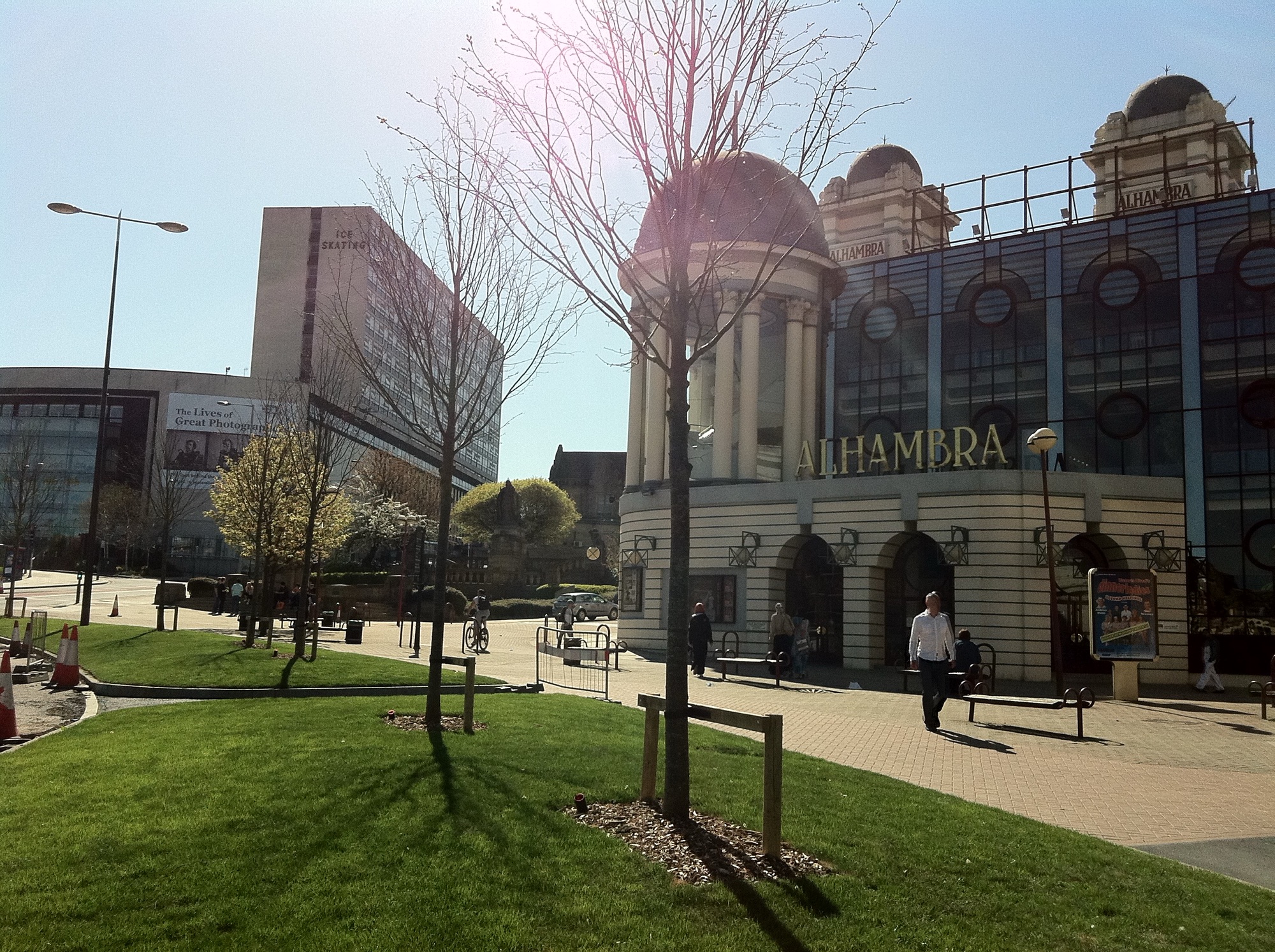
A photo of the Alhambra Theatre in Bradford.

Seeing as it’s UK City of Culture this year, and theatres are places where you can see cultural things, how many theatres are there in Bradford? I think there’s eight, and here’s a list.

By the way, I’m defining Bradford as the area within the A6177 Bradford ring road. That means that I’m not including the theatres and arts centres in Ilkley, Bingley and Keighley that are in the wider City of Bradford district. And I’m defining ‘theatre’ as anywhere with a stage and seating that can be used for performances.

1. The Alhambra Theatre

Probably the best known theatre in Bradford is the Alhambra Theatre in the city centre. Opening shortly before the First World War, and extensively refurbished in 1986, it seats 1456 people and is where most major shows take place. It’s Grade II listed, and next month it’ll be hosting the touring production of Matilda, Tim Michin’s musical adaptation of the Roald Dahl novel. Earlier this month, it hosted the annual CBeebies Pantomime which will be on TV and BBC iPlayer this Christmas.

The last show we saw here was Unfortunate, last year, but we may well go to see Matilda as it’s a favourite in our household. It’s a Grade II listed building.

2. The Studio

Right behind the Alhambra Theatre is The Studio. As the name suggests, it’s a ‘black box’ studio theatre with a movable seating rig. This can seat up to 200, and is used for smaller productions and stand-up comedy. We saw George Egg here 10 years ago, but haven’t been to another show since.

3. Theatre in the Mill

Okay, disclosure alert: The Theatre in the Mill is run by my employer, the University of Bradford. As the name suggests, it’s in part of what was the Phoenix Mill, and now forms one of the university buildings. Like The Studio, it’s a black box studio theatre with movable seating, and seats around 100 people. Its programme of events includes stand-up comedy – both performances and workshops – film screenings and shows. I’ve also been to a number of student shows here over the years, but as Bradford isn’t really a performing arts university, there currently aren’t many of these.

4. Siobhan Ullah Performance Space

Next door to the university is Bradford College, which is home to Bradford Arts School, and in turn, the Siobhan Ullah Performance Space. Although it’s primarily used by the college students, it can also be used for events and seats 125 people. Again, it’s a black box studio theatre. It’s named after a former performing arts student of the college who sadly died of an asthma attack, aged just 18. I haven’t been to this theatre before.

A photo of Bradford Live, a theatre in Bradford

5. Bradford Live

Back down towards the city centre, and next door to the Alhambra is Bradford’s newest and biggest performance venue, Bradford Live. It only opened this summer, and seats over 3000 people. It’s hosted in what was the Victoria Theatre, and later and Odeon Cinema which closed in 2000, and laid empty for almost a quarter of a century. Indeed, it survived a plan to demolish it in the late 2000s, and has now undergone a huge amount of restoration. It’s not currently a listed building.

As the name suggests, Bradford Live is more about live events and will be hosting a number of bands in coming months. Ocean Colour Scene are playing next month, as is CBeebies entertainer Justin Fletcher, and the Kaiser Chiefs are playing their first album in full in the new year. But there are some shows that you would typically expect in a theatre playing there too, such as Bluey’s Big Play, which I’m sure we’d be dragged to if our nine-year-old was a bit younger. We haven’t yet been here.

6. Bradford Arts Centre

Okay, technically the Bradford Arts Centre is even newer than Bradford Live, having opened under its current name as recently as this month. Previously, it was known as Kala Sangam, with a focus on South Asian arts. Its new name reflects its broader remit and engagement across all of Bradford’s populations. It’s located at what used to be Bradford’s crown post office at Forster Square, around the back of the Broadway shopping centre and next to Bradford Cathedral. The building is Grade-II listed.

There are several spaces in the arts centre, including a 200 seater studio theatre. We’ve been once, to see a pantomime that a friend was in about 10 years ago.

7. Bradford Playhouse

A few years ago, I used to volunteer at the Bradford Playhouse, and so it’s come up on here a few times. It was at risk of closure in 2014, but is now flourishing and is now fully accessible, following a successful crowdfunder early this year. The theatre offers two spaces: an art deco main auditorium seating up to 265 people, and a smaller black box studio theatre, seating up to 40 people. It hosts a mixture of professional shows and performances by amateur dramatic societies and dance schools. The building isn’t listed, but it was registered as an Asset of Community Value for five years in 2014.

8. St Georges Hall

Like Bradford Live, St Georges Hall is more of a live events venue than a theatre, with stand-up comedy and live bands. It’s also the oldest on this list, having opened in 1853. At one time, over 3000 seats were squeezed into the space, but nowadays its seating capacity has been reduced to 1335, or 1550 for standing events. It’s Grade II* listed, and was renovated between 2016 and 2019. The last show we went to see was a recording of I’m Sorry I Haven’t A Clue in 2014.

I think that’s quite an impressive list of theatres, actually, considering Bradford’s size.

Operation Ouch: Brains, Bogies and You

Our family of three appearing as skeletons at the Operation Ouch: Brains Bogeys and You exhibition

Last weekend, we made a return visit to the Science & Industry Museum in Manchester, to see the Operation Ouch: Brains, Bogies and You exhibition. This is the second consecutive Operation Ouch exhibition at the museum; last year, they had ‘Food, Poo and You’ which we visited in January. Twice in fact, as the first time I went with our (then) eight-year-old, and so we visited again a few weeks later as a family of three.

For those without kids (or grandchildren) in the 7-14 years old age range, Operation Ouch is a CBBC TV show hosted by twin doctors Dr Xand and Dr Chris, and in later series, joined by Dr Ronx who is probably one of the most visible non-binary people in UK children’s’ TV. Dr Chris is also the author of the book ‘Ultra-processed People’, which I reviewed back in 2023. As you would expect from a BBC series, Operation Ouch aims to inform, educate and entertain (the three principles on which the BBC was founded), so as well as teaching kids about science, it’s designed to be entertaining and disgusting too.

Inside Dr Xand’s head

The exhibition therefore follows a similar style. The idea is that you are shrunk down at the start, and enter a reluctant Dr Chris’ ear, where you can then enter different parts of his head to see how they work. There’s the brain, eyes, nose, ears, mouth, and a section on touch to cover all five senses. Unlike the previous exhibition, which was a linear journey through the digestive system, the layout is more free-form, with links between the sections and back to the core brain section.

Because it’s aimed at kids, the exhibition has lots of interactive elements. We particularly liked the screen which monitors your movement and displays an image of you as a skeleton. In the eyes section, there’s some optical illusions to try out, and, as someone with hearing loss, I appreciated the ears section too. Here, you could see how cochlear implants work; I don’t have one yet, but might need one in future. There’s also a demonstration of how your hearing changes over time, as you lose your ability to hear certain frequencies. Our nine-year-old could hear everything, Christine could hear two of them and I could only hear one, even when using the telecoil through my hearing aids.

In all, we spent about an hour in the exhibition, but could have spent longer.

Elsewhere in the museum

Having only visited last year, we mainly just came to see the exhibition. In recent years, there hasn’t been much of the museum available to see; of the five buildings that used to make up the museum, only one (the New Warehouse) has been open. The Air and Space Hall permanently closed in 2021; this was across the road from the rest of the museum and is now in use as a co-working space. The 1830s buildings, consisting of a warehouse and the original Manchester Liverpool Road railway station, are also closed for refurbishment, and due to re-open in 2030 for their 200th anniversary.

The good news is that The Power Hall has re-opened, as of Friday last week. We’ll plan to visit next year, when the next exhibition is on.

Accessibility

The Science and Industry Museum as a whole is pretty good for accessibility, and this extends to the Operation Ouch exhibition. All video content has subtitles and BSL interpretation, and any audio content that you can listen to includes a telecoil system for hearing aid users. The exhibition is all on one level.

Whilst the museum as a whole is free to enter (donations welcome), the Operation Ouch exhibition is a paid-for addon. Essential carers can get a free ticket when purchased with a regular-priced ticket.

The only on-site parking is for Blue Badge holders. There are various smaller pay-and-display car parks nearby, if you don’t mind parking under an unlit railway arch. Alternatively, there’s a multi-storey NCP car park at the Great Northern Warehouse, which is expensive but probably safer and more secure. This is a short walk away.

The nearest railway station and tram stop is Deansgate-Castlefield, which is reachable from literally every other Metrolink stop. There’s a lift down to street level at the tram stop, and then it’s only a short walk to the museum.

Park and Ride for Northern English Cities

A photo of Temple Green Park and Ride in Leeds

I like a good Park and Ride system. You park your car somewhere on the edge of a city, usually for free, and then switch to a more sustainable mode of transport to get to the city centre.

I grew up in York, whose Park and Ride system has been around since the late 1980s. Nestlé Rowntree were an early sponsor, and I remember as a kid getting a box of Smarties when boarding. Back then, it was operated in the car park of the (then) York College of Art and Design on Saturdays, using hired in coaches. Later, it moved to a purpose built site on the other side of the A1036 Tadcaster Road and eventually got its own dedicated fleet of buses. Nowadays, York’s system operates from six sites and is the largest one in the UK, as befits such an ancient city.

Most other cities in the north of England have some kind of Park and Ride scheme, and this is my attempt at summarising them. I’m including every settlement in the North East, North West and Yorkshire that has official city status.

Bradford

In a way, it’s a shame to start with Bradford, as there isn’t an official Park and Ride scheme there yet. Bradford definitely needs one – I think part of the reason why Bradford has such a reputation for bad driving is that congestion is a major issue, and you almost have to drive aggressively to be able to get anywhere because otherwise no-one will let you in. One was proposed for south Bradford, near the northern end of the M606, but it seems that a majority of respondents to a consultation opposed it, and nothing has come of it since.

There is also Low Moor railway station, which opened in 2017 and is located a short drive from the M62. If you time it right, you can park there and commute by train to Bradford. However, there’s only a couple of trains per hour, so it’s not a ‘turn up and go’ service, and only around 100 car parking spaces.

Carlisle

I’ve only been into Carlisle once, in 2012, and I apparently didn’t see fit to write much about it. We were there just for an afternoon and, it being January, it was pouring with rain.

From what I can tell, Carlisle does not have a formal Park and Ride scheme.

Chester

Chester, however, does have a formal Park and Ride scheme. At present, there are three services, located in the north, south and east of the city. A fourth site, to the west, is closed at the time of writing. These are all bus-based services, and the northern site is next to Chester Zoo.

Back in 2011, Christine and I used the Park and Ride service in reverse, to get from Chester city centre, where we were staying, to the zoo. At the time, the Park and Ride called at Chester railway station and so we actually had ‘train’ tickets to use the bus. However, none of the current Park and Ride services call at Chester station and so zoo visitors are instead advised to catch the Chester-Liverpool X1 service; this also drops you at the zoo entrance, rather than the Park and Ride site which is a 5-10 minute walk.

Doncaster

Yes, Doncaster is a city, as of 2022, thanks to Queen Elizabeth II’s Platty Jubes. Travel South Yorkshire list 10 (!) Park and Ride sites for Doncaster, although some of these are ‘railway stations with car parks’ and not all of them have a turn-up-and-go service. Still, it’s good that they’re being promoted in this way.

Durham

Durham is a bit like York, but with additional altitude, and so it has three Park and Ride sites. These are all bus services.

Kingston upon Hull

Hull just has the one Park and Ride service, and unlike most others, it looks like it’s purely a commercial service operated by Stagecoach. It’s for traffic approaching from the west, which is where most of the traffic to Hull comes from to be fair, with it being on the East Coast. It’s located at Priory Park, which is the next junction on the A63 after the Humber Bridge as you head east.

Lancaster

Like Hull, Lancaster has one site, located by junction 34 of the M6 to the north of the city. It’s a bus service.

Leeds

Leeds has three Park and Ride sites: one at Elland Road, the Leeds United Stadium, serving the west of the city, one at Stourton, to the south, and a third at Temple Green, serving the east. There isn’t currently a northern site. We use the Elland Road service quite frequently, as it’s cheaper than parking in Leeds city centre and has recently started running on Saturdays again. It’s a bus service, with buses every 10-15 minutes. We’ve used the Temple Green service once, which is the header image for this post.

If the West Yorkshire Rapid Transit System goes ahead, then you may also be able to catch a tram from the White Rose Centre into Leeds in a decade’s time.

Liverpool

There’s no formal Park and Ride service in Liverpool, but Merseyrail has information about car parking at its stations. Of these, Headbolt Lane, Liverpool South Parkway, Maghull, Southport, Bidston, Birkenhead North, Hooton and Leasowe all have 200 or more car parking spaces. Generally, trains on Merseyrail run every 15 minutes.

Manchester and Salford

Salford is a city in its own right, but I’ve grouped it with its larger neighbour as it shares a transport authority. The Bee Network lists a staggering 41 Park and Ride sites, using a combination of rail, bus and tram. Not all of them have lots of spaces, but many have 200+. For some, you may have to pay for parking as well as your travel. Helpfully, the Bee Network page also lists those that have electric car charging facilities.

We tend to use Hollinwood Metrolink, which is just off the eastern side of the M60, and has a modest multi-storey car park with 178 spaces. You can tell that it’s well-used but we’ve also always managed to find a space when we’ve used it. Metrolink services are normally every 12 minutes.

Newcastle upon Tyne and Sunderland

I’m also grouping these two local rivals for the same reason as Manchester and Sunderland. Nexus list the stations on the Tyne and Wear Metro with parking, rather than offering a formal park and ride scheme. Again, you may need to pay to park at some of these stations. Trains are typically every 12-15 minutes.

Preston

There are two Park and Ride sites in Preston; one at Walton-le-Dale, to the south-east of the city near the M6, and a second at Portway, to the west. Whilst the Walton-le-Dale site is run by the county council, the Portway site is a commercial one, run by a local operator.

There’s been a long-standing proposal for a privately-funded tram line running to Preston city centre from a potential park and ride site at Junction 31A of the M6, but nothing seems to have come of it.

Ripon

I’m including Ripon on this list as it is officially a city, despite its small size. There have long been proposals for a park and ride scheme, but there isn’t one at present. Elsewhere in North Yorkshire, the towns of Whitby and Scarborough have Park and Ride schemes, but neither is a city.

Sheffield

As with Doncaster, Travel South Yorkshire offer a list for Sheffield. Unlike Doncaster, the majority of these are tram services, and each has a decent number of car parking spaces. Trams typically operate every 12 minutes.

Wakefield

No formal scheme here either. You could park at Outwood, or Sandal & Agbrigg railway stations, I suppose.

York

And we’re back to York. York wasn’t the first city in the UK to adopt a Park and Ride – services in Oxford date back to the 1960s. But it’s one of the biggest and has a dedicated fleet of all-electric buses. As it’s a dedicated service, the buses are limited-stop services that skip stops in the suburbs.

It makes sense that York was an early adopter of Park and Ride services, being an ancient city with roads that weren’t designed for cars and therefore limited capacity for car parking.

Difference between level 1, 2 and 3 chargers

A photo of my Nissan Leaf, with the car charging port open and a Type 2 cable plugged in.

This is one of those blog posts where I’d wondered something, looked it up, and am now sharing what I’ve found out. When it comes to charging your electric car, you may hear the terms ‘level 2’ or ‘level 3’ charger being used. They’re not common terms in the UK, but you may encounter them in other countries – especially the US.

Level 1 chargers

A level 1 charger is, essentially, just a standard 3 pin plug like you have at home. Your electric car will probably come with an adaptor cable, with a 3 pin plug on one end, and a Type 2 plug on the other end. There’s usually a chonky box on the cable, known as an EVSE (Electric Vehicle Supply Equipment), that regulates the power flow. Colloquially, these are known as granny chargers.

In the UK, our standard power supply is 240 volts and 13 amps. Going back to GCSE Science, we know that power is the product of voltage and current (amps), so the maximum output is 3.1 kW. An electrician may be able to fit a waterproof external plug socket for you which is rated at 16 amps, upping the maximum power output to 3.8 kW. One of our neighbours had this done for charging their plug-in hybrid as it was cheaper than a dedicated car charger (level 2, as we’ll encounter in a bit).

In the US, the voltage is lower (typically 120 volts) but the current can be as high as 20 amps, depending on how it’s been wired. However, even a 20 amp socket in the US can only output a maximum of 2.4 kW due to the lower voltage.

A level 1 charger is therefore going to charge your car quite slowly – especially if you have a big battery. I have also seen photos of plug sockets that have melted due to continual use for charging electric cars. And it’s (probably) the least efficient; some tests suggest that 25% of the electricity doesn’t make it into your car’s battery and is lost as heat.

Level 2 chargers

Level 2 chargers are the dedicated electric car chargers that you can get fitted at home. In our case, we have a Rolec EVO unit, and this will be fitted to the outside of your house. In the UK, it’ll have a Type 2 connector, and will be capable of much higher current – up to 32 amps. That equates to (almost) 7.7 kW, which is the maximum that you can get on a single-phase electrical supply that is standard in UK homes.

My Rolec charger lets me vary the current, so I can set it below 10 amps if I’m not in a hurry and want to make the most of my solar panels. Level 2 chargers also incorporate EVSE inside them, so the cables just tend to have a standard type 2 plug on each end.

Many public chargers are also level 2 – especially older ones. Some may be connected to a three-phase electrical supply, which triples the power output to 22 kW. You’ll generally find these at places where you can park your car all day.

I personally describe level 2 chargers as ‘medium’ speed, but a full charge at 7 kW will take a long time for larger vehicles. For our Nissan Leaf, a full charge (from 0 to 100%) would take 6 hours and 30 minutes, although that’s partly because it can only accept 6.6 kW from level 1 or 2 chargers.

Level 3 chargers

Level 3 chargers are the rapid and ultra-rapid chargers that can output 40 kW or more – some can do up to 150 kW. Unlike level 1 and 2, these chargers use DC (Direct Current) rather than the standard AC (Alternating Current) that you would get from a standard 3-pin plug. They also use different plugs – CCS2 is the most common, but some cars, like our Nissan Leaf, use a competing standard called CHAdeMO. You’ll also find that these are almost always ‘tethered’ chargers that include their own cable, so you won’t need to plug your own cable in.

I doubt you would be able to get a level 3 charger installed at home, as they’re expensive and would probably need planning permission and authorisation from the electricity distribution network operator (DNO). But increasing numbers of these rapid chargers are available when out and about, and especially at places like motorway service stations where you need to charge quickly whilst en-route somewhere.

How fast your car will charge will again depend on its maximum charging speed. Our Nissan Leaf, when using CHAdeMO, can only accept up to 46 kW. Still, that means a full charge in less than an hour.

DC chargers are also more efficient, in that you’re less likely to lose power as heat than AC chargers. As these chargers are generally the ones you pay a premium for, that’s a good thing as almost all the electricity you pay for will make it into your car’s battery. However, regular use of rapid chargers can degrade the battery more quickly.

Playlist of the month: Rain

Screemshot of the rain playlist on Spotify

This month’s playlist is coming a little earlier than usual. As I write this, Storm Amy is delivering lots of wind and rain, and I’ve had a complete change of clothes having got completely drenched merely by being outside for ten minutes. So, this month’s theme is rain, seeing as I did Halloween last year.

As usual, you can listen along on Spotify.

  • “Rain on Me” by Lady Gaga and Ariana Grande. A collaboration between two of America’s biggest music stars was bound to be the first song that came up when I searched Spotify for ‘rain’.
  • “Raindrops (Encore Une Fois) by Sash! featuring Stunt. This was a 2008 remix of the 1996 Sash! original, featuring additional vocals by Stunt. One half of Stunt, Molly Smitten-Downes, represented the UK at the 2014 Eurovision Song Contest.
  • “It’s Raining Men” by The Weather Girls. By far the most recognisable song on this list and a staple at every wedding disco. This original is better than Geri Halliwell’s cover version.
  • “It’s All About Me (Rain)” by Amaranthe. I mentioned Amaranthe in last month’s symphonic metal playlist, and this is another single from the same album.
  • “Let It Rain” by Eliza Doolittle. Christine and I saw Eliza Doolittle play at Bingley Music Live in 2011 and she did a really good performance with a full live band. This is from her second album and is quite lovely.
  • “Kiss The Rain” by Billie Myers. This is top tier 1990s guitar pop. Billie Myers was something of a one-hit wonder; whilst she released several albums, this single is by far her biggest hit.
  • “The Day It Rained Forever” by Aurora. Aurora were a trance act which changed to pop. This was their fourth song, and is a great driving song.
  • “Sunshine After The Rain” by Berri. Berri is also from York, like me, and this was a big hit in 1995 thanks to this remix. Berri has recently started releasing new music.
  • “Nice Weather For Ducks” by Lemon Jelly. This is quite a delightful song that came out about the same time I started university.
  • “The Rain” by The Menagerie featuring Professor Elemental. Oh look, another Professor Elemental song has snuck into a playlist. He gets everywhere, doesn’t he?

Windows 10 Extended Security Updates

Screenshot which says 'You're eligible to enrol in Extended Security Updates at no extra cost'

Microsoft is ending support for Windows 10 in just two days time. What this means is, if you’re using Windows 10 and don’t take action, you’ll no longer get security updates for your computer. And that would be bad – your computer is therefore at greater risk of viruses and malware.

Previously, when Microsoft ended support for Windows, if you were a home user then you were on your own. This time, Microsoft is offering the Extended Security Updates programme, and making it available to home users for the first time. I suppose this is because Windows 11 installs only exceeded Windows 10 as recently as June this year, and around 45% of Windows users still use Windows 10 despite it being 10 years old now. This includes us.

Upgrade or replace

Ideally, Microsoft wants you to upgrade to Windows 11. Many Windows 10 computers can be upgraded, but not all. If not, then, as far as Microsoft is concerned, you should be considering purchasing a new computer.

At home, we have a Lenovo Ideapad 320S which is approaching its eighth birthday. That’s pretty old for a laptop, and it’s been used heavily as it was my main work computer during lockdown. Theoretically, it might run Windows 11, if I backed everything up, wiped its SSD and did a fresh install. But Microsoft’s PC Health Check app won’t allow an in-place upgrade, as its processor (an Intel Core i3 in the 7000 series) doesn’t meet its minimum hardware requirements.

We will, eventually, replace this with a new laptop running Windows 11 – probably some time next year. But for now, this little survivor meets our needs – especially as, back in 2021, I upgraded its RAM from 4 gigabytes to 16 gigabytes.

Enrolling for Extended Security Updates

If you open Windows Update on a Windows 10 machine, you should see the option to enrol for Extended Security Updates. This gives you an additional year of security updates, to allow you time to either upgrade or buy a new computer. As mentioned, this is a new offering for home users; previously, only enterprise users ever had this option.

Enrolling for extended security updates may cost you, depending on your system settings. If, at the time you sign up, you’re already synchronising your PC settings, then you may be offered the extended security updates at no charge. This is what happened to us, as per the screenshot at the top of this blog post. Which was nice.

Alternatively, if you live in the European Economic Area (EEA), then you should also get the updates for free. Thanks to Brexit, us Brits unfortunately no longer live in the EEA.

If you’re not eligible for free updates, then Microsoft will charge you. If you use Microsoft Rewards, then you can redeem 1000 reward points instead of paying money. Alternatively, there’s a $30 charge, which works out at about £24 for the year.

What about Linux?

If you don’t want to buy a new PC, aren’t eligible for free updates and don’t want to pay, then I suppose the other option is to consider running some flavour of Linux on your existing PC. I wouldn’t necessarily recommend this, but if you’re really stuck for money and have the time to learn how to use a new operating system, then sure, I guess it’s an option to consider.