Unblogged November

I quite like doing these round-ups of previously unblogged minor things at the end of each month. You can read what I wrote in October, and now here’s November:

Peter Pan-to time (oh no it isn’t)

We’re off to see Peter Pan at the Bradford Playhouse this weekend. It’s the annual pantomime from one of the local amateur dramatics societies, The Bradford Players. It also marks ten years since I helped backstage with Sleeping Beauty, a previous pantomime production. We don’t see a panto every year, but we know some of the cast and so we want to support them. Some tickets still available for the performances taking place today and tomorrow, but be quick.

The Bradford Playhouse is hosting another panto next month – Cinderella. By contrast, this is a professional production – several showings have already sold out but others have good availability. It’s cheaper than many mainstream theatres, and by booking to see it, you’re supporting smaller independent theatres.

I suck at soldering

In last month’s unblogged update, I mentioned how I was playing with a ESP development board to add Wi-Fi control to an existing non-smart device. In the end, I gave up, as my soldering skills just weren’t sufficient to keep the wires soldered to the contact points on the circuit board. If you’re interested, the device I was modifying was an Ikea Uppåtvind air purifier, and I was using this guide. To be fair, even if it had worked, I was using a much larger board than the D1 Mini recommended and so there’s no guarantee that I would have been able to re-assemble it anyway.

York Christmas Market

Whilst we were in York last weekend, alongside visiting York’s Chocolate Story, we also had a browse of York’s Christmas Market in Parliament Street. Even on a Sunday morning, it was very busy, and overall the city was the busiest I’ve seen it (remember, I grew up in York). Indeed, people have been complaining about how busy it is.

Christmas markets can be a bit hit-and-miss – I remember going to the Manchester Christmas market several years ago to find it was basically the same four stalls repeated across the whole city. York’s market is mostly local businesses, and it’s a good mix of food, drink and gifty things. We always buy a litre bottle of barbecue sauce from The Chilli Jam Man when we go.

Black Friday

I literally only bought two things on Black Friday this year, both from Amazon:

  • A 3 way plug with USB-A and USB-C (sponsored link). Christine has had one of these for a while and uses it daily; I’ve bought a second one because I want a charger for the bedroom that doesn’t have any LEDs on it.
  • The Actually Delicious One Pot Cookbook (sponsored link). This is the latest cookbook from Poppy O’Toole, aka Poppy Cooks, and it’s reduced to £10 (from £22) in their Black Friday sale. We already have her Potato Book and Slow Cooker books and use them both frequently.
York’s Chocolate Story

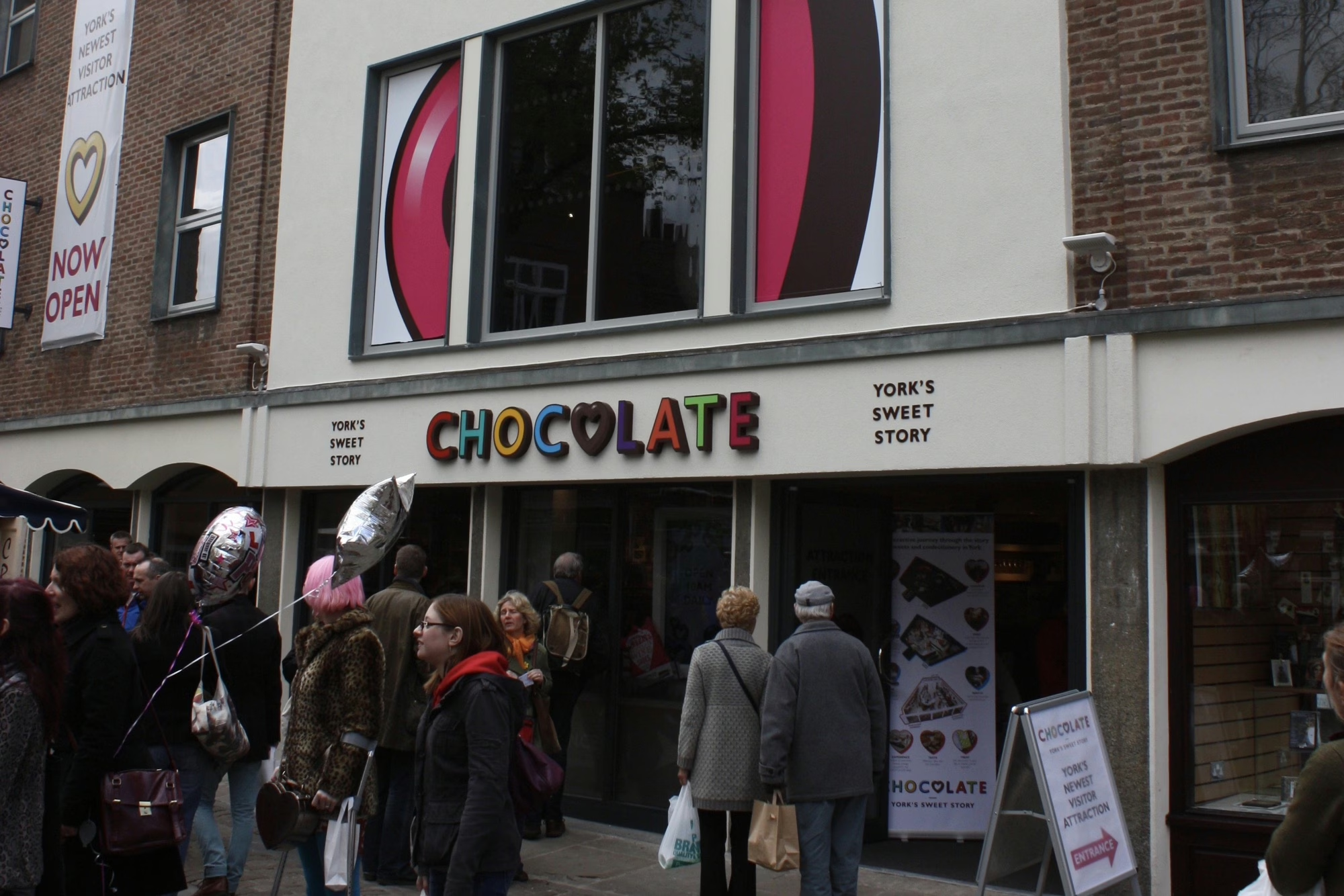
The photo of the outside of York's Chocolate Story

York, my city of birth, is known for a lot of historical things – the Romans, the Vikings, the medieval city walls and others. But it’s also known for chocolate, and was once home to three large confectionary companies: Rowntree’s, Terry’s and Cravens. And the story of York’s chocolate industry is the focus of one of its newer museums: York’s Chocolate Story.

Christine and I visited shortly after it opened, back before we got married, in 2012. Then, it was known as Chocolate: York’s Sweet Story, but its name has changed since. I hadn’t been back since – Christine had her hen do there – but last weekend I took our nine-year-old along.

Having visited Cadbury World earlier in the summer, it was good to compare the two. Cadbury World is a Merlin attraction, and so it’s more of an indoor theme park with some history. Meanwhile, York’s Chocolate Story, is primarily a museum, although both offer you chocolate samples to eat on your way around.

Inside York’s Chocolate Story

Guests follow a guided tour around the museum, although there are videos to watch as well. Whilst we waited for the rest of the group to come up in the lift, our knowledgeable guide asked everyone what their favourite chocolate bar was, and he was able to quickly look up when they first went on sale. It turns out that many chocolate bars have been around longer than we might expect.

The first room is about the ancient history of chocolate, and how Spanish colonialists ‘discovered’ it when they reached Mexico. At this point, you get to try a sample of the bitter chocolate drink that people would have drunk back then.

Next, we’re introduced to the aforementioned three confectionary businesses, and the people behind them. Of these, Rowntree’s still has a factory in York, but is now part of the massive Nestlé conglomerate. Terry’s are still making chocolate, but the York factory (close to where I went to secondary school) is now flats, with production shifted to Strasbourg. Whilst I’m old enough to remember Craven’s sweets, the company is no longer around.

Making chocolate

We then head downstairs, to find out more about how chocolate bars are made. This included a chance to make our own white chocolate lollipop, with a choice of flavours. They use white chocolate as it sets more quickly. We could also watch a demonstration where filled chocolate truffles were made, and of course we got samples to taste. The same room has a history of KitKats, and you can watch various classic KitKat TV adverts too.

All in all, it takes about an hour to get around. Of course, there’s a shop at the end which also does a range of hot chocolate.

Accessibility

Being a newer museum, accessibility is good – there’s a lift taking you to all floors. It’s in York city centre, around the corner from The Shambles, so within walking distance of the station. Whilst you can try to park your car in York city centre, please don’t – we saw loads of people queueing to get into car parks and blocking the roads whilst doing so, and besides, you’ll pay a small fortune. Instead, take one of the six Park and Ride services.

It’s best to book in advance – if you turn up on the day, all the tour slots may have gone or you may have to hang around for a while. Plus, there’s a 20% discount for booking in advance, and York residents get a 30% discount for visits on Sundays.

Getting ready for Christmas

A photo of the top of our Christmas tree

Well, it’s the 25th November, and so Christmas Day is only a month away. We’ve already put our Christmas tree up – indeed, it’s been up since the Saturday before last. Now that is exceptionally early even by our standards, but we’re running out of free weekends between now and Christmas and we had the time. I sorted out the lights (and the smart plug running ESPHome) whilst our nine-year-old decorated it. At least with it being up early, we can appreciate it for longer.

When it comes to presents, we’re making good progress. Christine has a week off work this week, and so she’ll be doing the majority of the work. Which is fine, and what we agreed – our plan is for many of the gifts to be handmade this year.

As for my gift to her, I’ve already got something sorted – again, exceptionally early by my standards. I’m 99% sure it’s something that she’ll really like, too.

Due to the school holidays, I’m taking leave in the run-up to Christmas, and so after the end of this week I’ll just have three full weeks at work to go. Unfortunately, Christine is working Christmas Eve, and so it’ll be a late-ish start to the festivities. We’re planning to spend Christmas with my parents in York, as per usual.

Filler content

I try very hard to make sure that a new blog post goes live on here every two days. And sometimes I have so much to write about, that I have three weeks’ worth of blog posts scheduled to go live. Typically, this is just after we come back from holiday, for example.

This is not one of those times. So this is a filler blog post, to make sure that I keep my unbroken streak of posting every other day, going back to last June.

We haven’t had many days out of late, and those that we have had, have all been written about already. Unless we went out somewhere yesterday – I’m writing this on Tuesday – but I probably won’t have time to write that up until later this week if we do. I also haven’t bought much new technology recently, nor had much time to tinker with WordPress or Home Assistant.

In terms of blog posts that I’m planning, I expect I’ll discuss our reasons for changing to a new ISP, and also reviewing the new router that we got. There’ll probably be an ‘unblogged November’ round-up of things that weren’t quite important enough for a blog post on their own. And probably a ‘oh good grief, how is it December already!’ post.

Full of your daily dose of fibre (broadband)

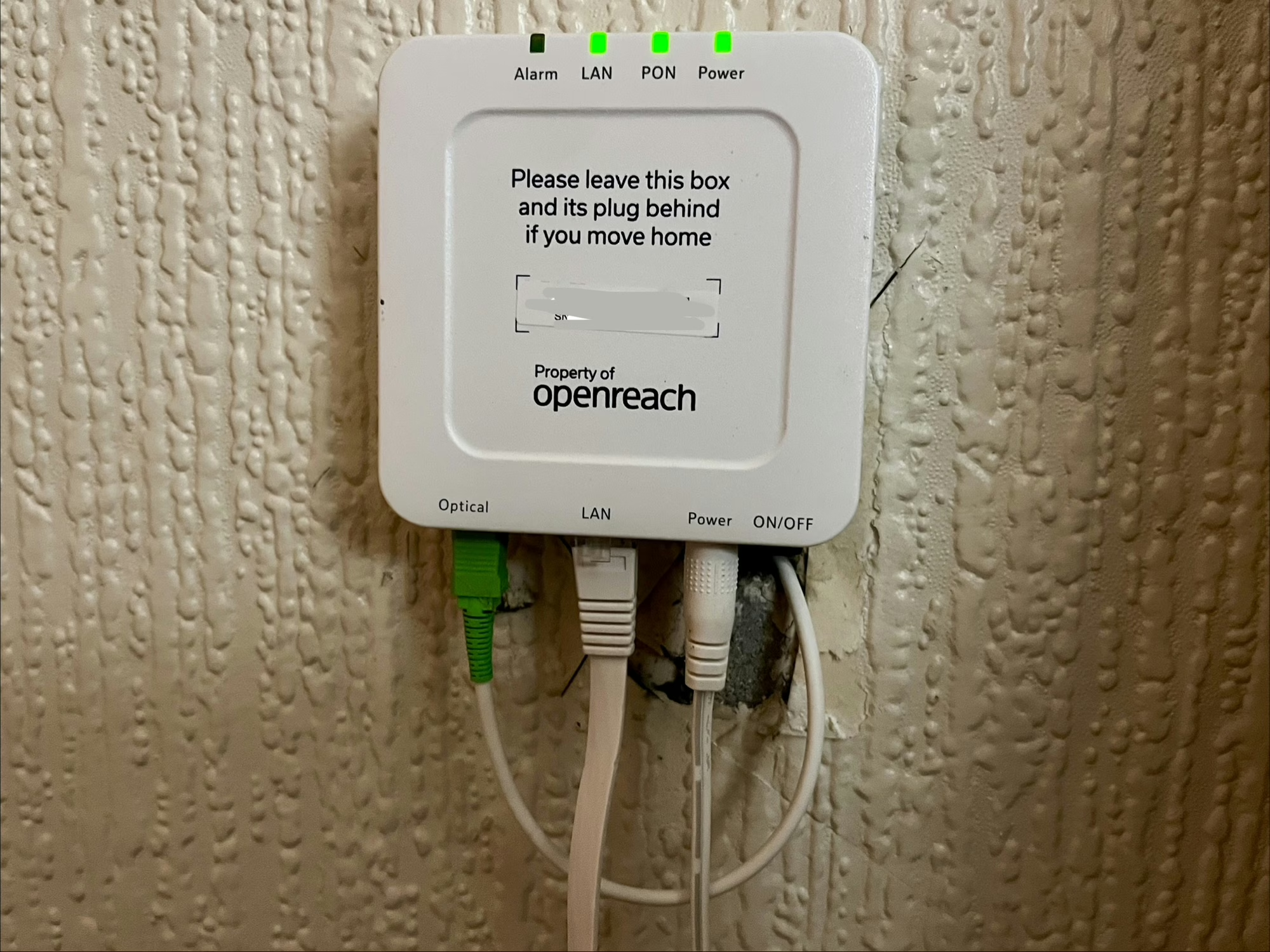
Our OpenReach fibre broadband Optical Network Terminal (or modem)

We’ve brought our home internet connection into the 21st Century and are now hooked up to Openreach’s full fibre broadband network. This is a full fibre-to-the-home (FTTH) connection, where the fibre optic cables run all the way into our house.

Previously, we had a fibre-to-the-cabinet (FTTC) connection, where there were fibre optic cables running to a street cabinet a short distance away. However, the final distance was the same copper cable installed when the house was first connected to the analogue phone network. And whilst we were able to get 80 Mbps speeds over that connection, that was really the limit of that technology. With fibre-to-the-home, we could get speeds of up to 1.6 Gbps, which is frankly ludicrous. When I started university in 2002, the entire university’s internet connection wasn’t even that fast. And yet, provided you’re willing to pay for it, you can get online at speeds that are over 30,000 times faster than dial-up.

Fibre broadband installation

The installation took around 3 hours. Although we pay for our internet service from a retail ISP, it’s Openreach (part of BT) who own the infrastructure and who will do the installation. For us, this involved replacing the copper cable from the nearby telegraph pole, removing the phone socket, and installing an Optical Network Terminal (ONT) – essentially a modem – inside the house. That’s what’s pictured above – you’ll note that it says to leave it behind if moving house. You then plug in your router to this using an Ethernet cable; your router will need to support PPPoE, which any router provided by your ISP will be capable of.

As part of the installation, we also changed to a new ISP, having previously been with Vodafone – more about that in a later blog post.

Once the installation is completed, you may have to wait up to an hour for your connection to start working again. I found I also had to restart the router, but once done, we were back in business.

No landline phone number

One decision we made this time is that we would no longer have a voice line. We had the option of paying extra for it, but the only people who call us on our landline nowadays tend to be scammers, so we decided it wasn’t worth it. Even though we’ve been living in this house for 10 years now, barely anyone has our landline number. If you do switch to fibre broadband and haven’t already been migrated to a digital voice line, then this will happen as part of the installation. That means that your phone is connected to your broadband router, rather than the wall socket. Indeed, the ONT doesn’t have a RJ-11 or BS 6312 socket to connect an analogue phone. It’s worth bearing in mind that your landline phone won’t work in a power cut if this happens.

This also means I can finally get rid of my supply of ADSL microfilters.

Speeds

We’ve actually gone for a modest 100 Mbps package. We were getting by quite well on 80 Mbps, and so for now we don’t really need the extra speed. As I write this, the installation was only completed a few hours ago, and so it’s too early to share what our new speeds are.

We may consider faster speeds in future, should our nine-year-old take up online gaming for example, and at least now the hardware is there to support it.

Thought Bubble 2025

A photo of the comics, posters and related paraphernalia that we picked up at Thought Bubble

Last Sunday, we went to Thought Bubble Festival Comic Con in Harrogate. Overall, it’s our fifth time that we’ve been, and the second year in a row.

We first went to Thought Bubble in 2014. Back then, it was hosted at the Royal Armouries in Leeds, and used their event space, the New Dock Hall and a temporary marquee. We also went in 2016, when Christine was pregnant, and again in 2017, with our then 10 month old baby in tow.

We then had a seven year gap, before going back last year. By this point, Thought Bubble had outgrown the Royal Armouries, and so it’s now hosted at the Harrogate Convention Centre. This was first built in 1982, and hosted that year’s Eurovision Song Contest thanks to Bucks Fizz winning with ‘Making Your Mind Up’ the year before. It’s been expanded a couple of times since, and Thought Bubble takes over 4 of the halls plus the Queen’s Suite.

What we like about Thought Bubble is that the focus is on comic art and the artists that create it. The only celebrities there are the comic artists themselves – you generally won’t find anyone who’s acted in a superhero film here. And whilst there are comic artists for the likes of Marvel, DC and Dark Horse here, there are many, many independent creators too. Amongst these creators, LGBTQ+ people are well-represented, and there were a few people of colour there too. This is no accident – Thought Bubble offers micro-bursaries to under-represented groups, which is really welcome. After all, comic books are about telling stories, and it’s great to have a wide variety of people able to tell their stories.

Kid’s zone

Another great thing about Thought Bubble is that about half of one hall is a designated kid’s zone. This includes those whose comics are primarily for kids, but also includes a play area, and a big area sponsored by The Phoenix. The Phoenix is a weekly kids comic – a bit like the Beano in some respects, except the individual comic artists are more prominent. If you’ve ever come across Bunny vs Monkey, Super Robo Bros or Donut Squad, these are all regulars in The Phoenix. Our nine-year-old loves all of these, and was delighted to be able to take part in a workshop with Donut Squad’s creator, Neill Cameron.

The photo at the top shows most of the things we picked up there, which should keep us busy for a while. Christine also bought a new pair of socks, and we bought a couple of games, including The Necrohamster.

I’m pretty sure we’ll go back next year. It’s fun and all three of us enjoy it.

Kelham Island Museum

A photo of the Don Valley Engine at the Kelham Island Museum

If I had to guess where the Kelham Island Museum was, I’d probably suggest it was somewhere off the coast of northern England. It’s not – it’s in Sheffield city centre, and it’s a museum of Sheffield’s industrial history.

The Kelham Island Museum has been on my to-do list for several years. I seem to remember that, in the past, it was only open on weekdays, which made visiting difficult. Thankfully, it is now open at weekends, and so we went along last weekend for our first visit.

I like a good industrial museum, and the north of England is full of them. I’ve been to the ones in Manchester, Leeds, Halifax, Bradford, and I suppose the World of Glass in St Helens counts too. And whilst St Helens is known for its glass, Sheffield is know for its steel. So, you’ll find a lot of steel at the Kelham Island Museum – it’s home to the Hawley Tool Collection, which is the world’s largest collection of tools. What’s nice about the tool collection is that, whilst many items are on display, there are also pull-out drawers with plenty more to see if you’re so inclined.

The River Don Engine

If you visit at the right time on Thursdays through to Saturdays, you’ll get to see the River Don Engine powered up – it’s the photo you can see at the top. This is an absolute beast of a steam engine, and is currently the most powerful working steam engine in Europe. During its working life, it was, as you would expect, used for making steel. Its maximum output is around 12,000 horsepower, which is around 9 megawatts or the equivalent of 3 wind turbines at full speed.

Whilst it now lives in the Kelham Island Museum, the River Don Engine used to be elsewhere in Sheffield. Indeed, despite its massive size, it’s been moved twice in its lifetime. It last underwent restoration in 2007, when the museum was flooded, ironically, by the namesake River Don.

Kelham Island

The Kelham Island Museum gets its name from Kelham Island, an artificial island in the River Don dating back to the 12th Century. Back then, a mill race was constructed to power water mills. The museum itself is in what was originally an iron foundry, and later a power station for Sheffield’s first generation electric trams. The museum isn’t the only building on the island – there’s also student accommodation to serve Sheffield’s two large universities, and the Kelham Island Brewery.

It’s also worth noting the museum café, Joni, which does very good food – certainly way above average for a museum of its size. In fact, you may need to phone ahead and book a table on busy days. There’s also a pub, The Millowners Arms.

We visited in an afternoon, which wasn’t quite enough time to get around the whole museum, so it’s probably almost a full day out.

Accessibility

As mentioned above, Kelham Island Museum is in Sheffield city centre. There is limited on-site parking, which you need to pay for at a machine or on the RingGo app. Alternatively, it’s a five minute walk from Shalesmoor tram stop, or a 25 minute walk from Sheffield’s main railway station (so you may wish to consider the aforementioned tram).

Entrance is free, but donations are welcome. The museum shop is also great – especially if you or people you know like the local delicacy, Henderson’s Relish.

If you’re in a wheelchair or can’t handle stairs, then you should still be able to see most of the museum. Not all of the floors are flat. A lift is provided to the upper floors. The River Don Engine, when it’s in steam, is particularly noisy.

Ecosia

A screenshot of the Ecosia home page

For some time now, I’ve been using Ecosia as my primary search engine, rather than Google search. It aims to be a more ethical alternative; Ecosia is a non-profit company, and any money that would normally go to shareholders instead goes towards planting and protecting trees. In 2014, it became the first German company to become a certified B Corp.

If you create an account on Ecosia (and this is optional), then when you use it, you can see how many trees you’ve helped to plant. For me, this is two, although it would probably be more if I’d remembered to sign in more often.

The results you see from your search are generally provided by either Google or Bing. This is broadly the same as other third-party search engines like DuckDuckGo, which repackage results from the big two search engines in a way that is more respectful to user privacy. However, some results may come from EUSP, which is trying to build a Europe-focussed search engine. EUSP is a joint venture between Ecosia and a French search engine called Qwant.

In my experience, the results are good enough 80-90% of the time. If I’m looking for something super-specific, then I’ll defer to Google, but generally Ecosia works fine. It’s been my default on the desktop since at least last year. Aside from this, my only other criticism is that, on a laptop screen, sponsored results take up all the visual space, and you have to scroll to see the actual results. As Ecosia claims to care more about your privacy, frequently these sponsored results are less relevant. Indeed, it will respect the ‘do not track’ setting in your web browser. Also, if you have an account, you can disable Ecosia’s AI features.

There’s also a web browser available, which looks to be a re-packaged version of Chromium with Ecosia as the default search engine. I haven’t tried it, as I’m happy with Firefox.

If you want to reduce your carbon impact whilst searching (especially with Google’s AI summary appearing by default), consider giving Ecosia a try.

Playlist of the month: Songs about Trains

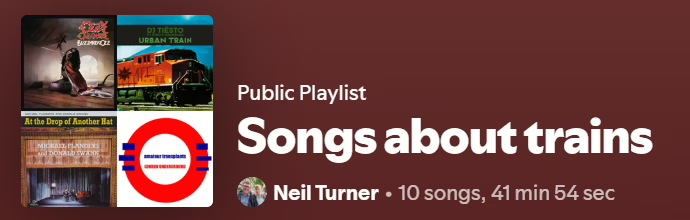
Screenshot of the Songs about Trains playlist

Inspired by Sunday’s blog post, this month’s playlist is all songs about trains.

There’s no shortage of songs about trains – Wikipedia has a list of almost 800 – but what I did notice when compiling this is that many are minor key laments. There don’t seem to be many songs about liking trains, but instead they’re metaphors for life not going well. In other words, the subject of the song is taking the train because they don’t have a car and can’t afford to fly. I was also surprised at how many American songwriters have written songs about trains, considering that the American train network is nowhere near as extensive as it could be.

On to the playlist. As always, you can listen to this on Spotify.

  • “Crazy Train” by Ozzy Osbourne. We sadly lost Ozzy earlier this year, although not until after a massive farewell gig for charity. As far as I’m aware, Ozzy never had a train named after him, crazy or otherwise, but there is a tram in Birmingham named after him.
  • “Urban Train (Wippenberg Remix)” by Tiësto featuring Kirsty Hawkshaw. I chose this remix over the original as I think it’s superior, but also because it has a clickety-clack feel as if you’re on a train going over jointed track.
  • “Slow Train” by Flanders and Swann. This was written in 1963, and laments the closure of railway stations and lines in Great Britain as part of the Beeching cuts. Wikipedia helpfully lists every station referenced in the song; not every station mentioned actually closed.
  • “London Underground” by Amateur Transplants. The Amateur Transplants were a musical comedy double act, consisting of two doctors: Dr Suman Biswas, now a consultant anaesthetist, and Adam Kay, who quit medicine and is now better known as the author of ‘This Is Going To Hurt’. This is a parody of ‘Going Underground’ by The Jam; released in 2005, it’s a complaint about Tube drivers going on strike. Notably, it complains about the drivers earning £30,000 per year – 20 years later and it’s closer to £80,000 per year. And this is why you should join a union.
  • “I Like Trains” by LilDeuceDeuce. I had to include at least one upbeat song in here. This probably makes more sense if you watch the video, and are familiar with TomSka’s asdfmovie series on YouTube.
  • “Don’t Stop Believin'” by Journey. “She took the midnight train going anywhere…” Fun fact – when originally released in the UK in 1981, it only reached number 62 in the singles charts. It wasn’t until 2009 that it broke into the top 20, but by 2014 it had sold a million copies in the UK.
  • “The Nightrain” by Kadoc. Not much to say about this, other than that I used to have it on audio cassette.
  • “The Train” by Macklemore and Ryan Lewis. Another downbeat song about getting the train. See what I mean?
  • “Train Kept a Rollin'” by Aerosmith. I’ll be honest, I hadn’t come across this song until compiling this list. I think it’s notable that there’s three classic rock songs in here.
  • “King’s Cross” by Pet Shop Boys. Yes, another rather downbeat song about the station and the area of London surrounding it. This was before the massive regeneration that has taken place in recent years.

WordPress Wayback Link Fixer plugin

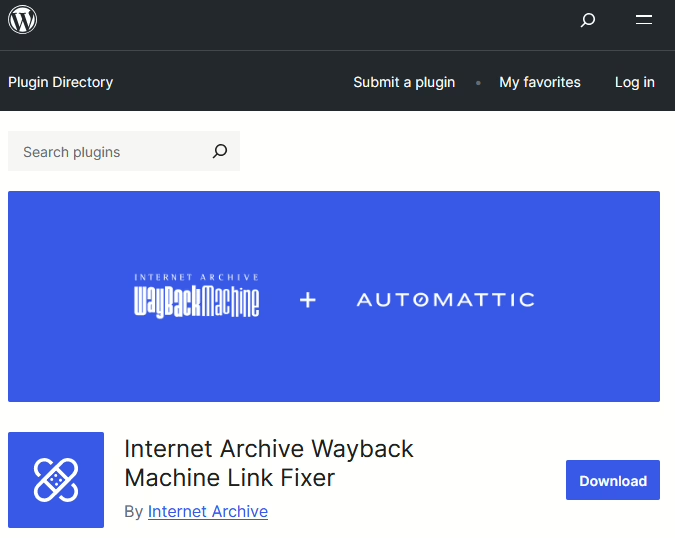
Screenshot of the Internet Archive Wayback Machine Link Fixer

Link rot is a major problem for long-established web sites that link to other sites. It’s a particular problem for blogs – the word ‘blog’ is, after all, a shortened form of ‘web log’ and the original blogs were links to interesting things the blogger writing it had found.

I’ve been blogging since 2002, and in that almost one quarter century, lots of the things I’ve linked to have gone missing. Companies close, web sites change and decide not to preserve their URLs, or are sold on to new owners. As such, many older sites are full of links that no longer point to anywhere useful.

This is where the Internet Archive Wayback Machine Link Fixer plugin for WordPress comes in. Once installed, it pro-actively scans outgoing links from your blog posts on a regular basis. If any no longer work, then, where possible, the plugin will amend that link to point a cached version of that link on the Internet Archive’s Wayback Machine. That way, people following the link will still get to see something, rather than a dead link. It’s an official plugin from the Internet Archive that has been developed with support from Automattic.

Backup to the Wayback Machine

But that’s not all! Once installed, you can opt-in to have all of your blog posts automatically backed up to the Wayback Machine. So, if your WordPress blog ever goes dark, all of your posts and pages should be available there for others to find.

Normally, the Wayback Machine uses a crawler which usually scoops up most web pages in time. But it can miss those that may only be online for a short time, or not linked from a web site’s home page. This is a problem I’ve faced myself; I lost all my blog posts in 2018, and over the past three years I’ve been slowly reinstating old posts. Alas, some are missing from the Wayback Machine and are therefore (probably) gone forever. Whilst making sure that the Wayback Machine has copies of your blog posts is a good thing, you should also have your own backups and I now use UpdraftPlus for this.

So, if you’re a WordPress user, and care about preventing link rot and the sharing of information, go and install the plugin. Thanks to Matt for the head’s up, and maybe consider donating to the Internet Archive as well?