Making Waves at York Art Gallery

A print of 'The Great Wave off Kanagawa' on display at the Making Waves exhibition at the York Art Gallery

As we were staying with my parents at Easter, we popped into York city centre on Easter Sunday to see the Making Waves exhibition at York Art Gallery. The exhibition is all about the art of Japanese block printing, where printers would carve wooden blocks that were then painted, to reproduce artworks on a massive scale.

The name Making Waves comes from the painting The Great Wave off Kanagawa by Katsushika Hokusai, which is one of the most recognisable paintings from this method. There is one of the 111 surviving original prints of this on show in Making Waves, on loan from the Maidstone Museum.

Now I keep saying that I’m not really into art, despite visiting a Banksy exhibition and the V&A last month, and now this. I stand by this, and I found the information about how the prints are made more interesting than the prints themselves.

A modern print creating using Japanese Block Printing, with the blocks shown.

Making Waves starts with an explanation of the process; there’s a video as well as a step-by-step guide. It’s notable that the process generally results in the original painting being destroyed, and so there is usually no surviving ‘original’, just the first print run. I particularly appreciated the display of a modern print, made using the traditional method, on show with some of the wooden blocks that were used to make it.

You then proceed around the exhibition largely in chronological order. The exhibition ends in the modern day, with some newer commissions of block printed art featuring characters from Japanese video games. Also, in the final room, you can use a series of rubber stamps to create your own block print, which is a nice touch.

Japanese Zen Garden

Around the back of the art gallery is a small Zen Garden that has been created for the exhibition. This is connected to the Museum Gardens and leads around the back to the nearby Yorkshire Museum.

We visited York Art Gallery a couple of years ago, and so we didn’t go upstairs to the rest of the galleries this time. The Making Waves exhibition is open until the 30th August this year.

Accessibility

York Art Gallery offers step free access throughout the building, with lift access to the upper floors. Accessible toilets are available, and there is a Changing Places toilet around the corner at York Central Library when that is open.

Parking your car in York city centre is unwise, and many buses stop right outside the art gallery, including Park & Ride services from Rawcliffe Bar. York railway station is a short walk away.

Admission is currently £9 per adult, but there are many discounts available, including free entry for Art Pass and Max Card holders, and York residents aged 16 and under.

Playlist of the month: London songs

Screenshot of the Songs About London playlist

Okay, so here’s one last blog post about London, following our trip there last month. This time, it’s songs about London. As usual, you can listen along on Spotify.

  • London Calling” by The Clash. If you asked most people to name a song about London, this is probably the first one that they would name and is one of The Clash’s most popular song (third most played on Spotify).
  • “London Bridge” by Fergie. This refers more to the traditional song about London Bridge falling down, but the music video is at least set in London. Even if it focuses on Tower Bridge, rather than London Bridge, which, to be fair, is comparatively boring.
  • “Londinium” by Catatonia. Catatonia are famously very Welsh, and so this song is about everything that is wrong with London. “I come alive outside the M25” indeed.
  • “London Boy” by Taylor Swift. Considering how many songs Swift has written over the years, it’s not surprising that she has written a song about London. Ostensibly an album track, like much of Taylor’s work, it charted in some countries.
  • “LDN” by Lily Allen. This is from Allen’s first album and is about her cycling through London. It describes the shiny veneer of London, and its sometimes grimy reality.
  • “Take Me Back To London” by Ed Sheeran featuring Stormzy. Ed Sheeran has collaborated with just about everyone in recent years and so it’s no surprise that he’s collaborated with Stormzy for this song about London.
  • “Waterloo Sunset” by The Kinks. Another classic pop song about London. It’s inspired by the view from St Thomas’ Hospital, looking along the River Thames by Waterloo Bridge.
  • “Warwick Avenue” by Duffy. Another Welsh pop act, this time singing about the famous street in West London, known for its markets.
  • “Brixton Briefcase” by Chase & Status featuring CeeLo Green. This song is about the Brixton riots of 2011, although having it sung by American singer CeeLo Green is certainly a choice.
  • “Electric Avenue” by Eddy Grant. Finishing with another song about Brixton is this classic song by Eddy Grant, about the first market street to be lit by electric lights. I prefer the 2001 Ringbang Remix, but this isn’t on Spotify unfortunately.

Queer Britain, the national LGBTQ+ museum

A photo inside the galleries at Queer Britain.

This is the sixth and final of my blog posts about last month’s trip to London. Following our trip to the Vagina Museum in the morning, we decided to continue the theme of ‘woke museums’ and visit Queer Britain, the national LGBTQ+ Museum.

I’ll be honest, our main reason for visiting was that it’s in King’s Cross, and was therefore close to where we needed to be for our train home that afternoon. But as someone who identifies as a member of the LGBTQ+ community, I decided it would be good to visit.

Queer Britain is a small museum – we were in and out within the hour – and despite having ‘national’ in its name, it’s very London-focussed. There’s not a lot about LGBTQ+ history in other parts of the UK; there was a bit about Justin Fashanu, a footballer who played for Norwich City and was Britain’s first openly gay professional player. But there was nothing about Manchester’s Gay Village, for example. Perhaps if the museum is able to expand in future, it will have more things to show that are from outside the capital.

There is also an events space, and if we hadn’t needed to catch a train, we would have stuck around for a panel discussion platforming LGBTQ+ migrants. We did, however, manage a quick selfie with the panel moderator, Tia Kofi, who you may know from Season 2 of RuPaul’s Drag Race UK. They’re very tall.

Accessibility

The museum is all on one floor, with a ramp to the main door; however, extra wide wheelchairs may present an issue. An accessible gender neutral toilet is available; Changing Places toilets are available a short walk away at Pancras Leisure and King’s Cross station.

Entry is a recommended fee of £10, or pay what you feel. As it stands, I broadly agree with Ian that £10 is a big ask for a relatively small museum. The gift shop is good though.

Queer Britain is in Granary Square, on the other side of the Regents Canal from King’s Cross and St Pancras stations (which are all step-free). If it still existed, York Road tube station on the Piccadilly Line would be closest, but it closed 94 years ago.

Operation Mincemeat, the musical

A photo of the inside of the Alhambra Theatre in Bradford showing the logo for Operation Mincemeat on the curtains whilst we were waiting for the show to start.

A couple of weeks ago, the hit musical Operation Mincemeat made its way to Bradford’s Alhambra Theatre, and so Christine and I went to see it. It’s very good.

The true story of Operation Mincemeat

Like Kinky Boots, which we saw last month, Operation Mincemeat is based on a true story. The actual Operation Mincemeat took place in 1943 and was a distraction strategy by allied forces during the Second World War. It involved planting the body of a street tramp, disguised as a high ranking military official, off the coast of Spain. The body contained important (but crucially faked) documents implying that the Allies planned to invade Sardinia. Instead, the actual plan was to invade Sicily, which, at the time, was heavily guarded by Nazi forces. Sure enough, forces were re-allocated from Sicily to Sardinia, allowing the Allies to liberate Sicily.

Two books have been written about Operation Mincemeat; a novel in 1950 called Operation Heartbreak, and a second book in 1953, The Man Who Never Was. This second book was written by Ewen Montagu, one of the intelligence officers involved, and it was adapted for a film in 1956. A later film followed in 2021, called Operation Mincemeat, and now there’s a musical adaption too.

The musical

The musical largely follows the actual events of Operation Mincemeat, with some artistic license. It’s performed with just five actors, who, through many rapid costume changes, play lots of different parts. The set is relatively simple, with lighting used to great effect throughout. The songs are all original, and number over 20 – much of the show takes place in song.

It’s a lot of fun to watch. The cast were all great singers and performers, and despite the many, many costume changes, it always felt slick and well-rehearsed. A nice touch comes towards the end, where there is a tribute to the street tramp, and a revealing of his actual identity.

Whilst not aimed at children, Operation Mincemeat is fine for families with children to watch. I don’t think our ten-year-old would have liked it, but teenagers may be interested.

The musical opened in London in 2019, and moved to the West End in 2023 where it’s still running. It’s therefore unusual for a musical to go on tour so soon afterwards, but it appears that the West End run is almost completely booked up for months. Indeed, there appears to be a ballot to get tickets now. As such, you have more chance of seeing it on tour. Whilst the Bradford Alhambra Theatre run is over now, as I write this it is coming to the end of a two week run in Sheffield, after which it is off to Stoke-on-Trent and then Chester. It makes it back to Halifax in October, and I’m highly tempted to see it again.

The Vagina Museum

A photo of the outside of the Vagina Museum in Bethnal Green.

This is one of those blog posts where I’m glad I don’t take advertising on this blog anymore, as I imagine this post would get demonetised. This is the fifth of my blog posts about last month’s trip to London; I’m aware that we’ve been back for a month now, and there’s still a sixth and final post to go live this week. Today’s post is all about The Vagina Museum.

A Vagina Museum‽

Yes, a museum all about vaginas. Well, and the wider reproductive organs of women and others with vaginas – the museum tries very hard to be inclusive of trans and non-binary people as well.

It’s not a very big museum, and occupies two railway arches under the Weaver Line of the London Overground. It’s made up of three small named exhibitions spaces, called Betsey, Lucy and Anarcha, named after three enslaved Black American women who were all experimented on, and from whom our modern understanding of gynaecology is derived. Betsey’s gallery, upstairs, is home to the permanent exhibition, where you can see a complete preserved uterus (Christine commented that it was smaller than expected, considering how much it hurts when she’s on her period) and many photos of different types of vulvas.

Also upstairs is Anarcha’s gallery, which has written pieces from migrant women about their first period, and the challenges that their status as refugees has caused.

Downstairs, as well as the excellent gift shop, is Lucy’s gallery, and the current temporary exhibition about menopause, including its history and how our understanding of it has changed over time.

In all, we spent about an hour in the museum. It’s quite text heavy, and I don’t think our ten-year-old would have got much out of it, but we both found it enlightening. I’d definitely recommend visiting if you have a vagina, or live with someone who does.

Accessibility

Accessibility is good – there is a lift to the upstairs galleries, and no steps. There’s a single, gender-neutral, accessible toilet available. If you need a Changing Places toilet, then there is one nearby at the Young V&A (which we visited in 2024).

Entry to the museum is free, but a £5 donation is strongly encouraged. And did I mention that the gift shop is excellent? Note that museum is closed on Mondays and Tuesdays.

The museum is very close to Cambridge Heath station on the London Overground, and a little further from Bethnal Green tube station on the Central Line. We got there on the 254 bus from outside Aldgate tube station, which is probably your best option for step-free transport; the nearest step-free station is Hoxton on the Windrush Line, which is a 20-25 minute walk.

I haven’t been noting about car parking or electric car charging in these London reviews, as we didn’t drive and I think you would be mad to drive in London, but there is a rapid Shell Recharge station around the corner.

Super Mario and the Magic Faraway Tree

The film posters for the Super Mario Galaxy Movie and the Magic Faraway Tree

I’m breaking my self-imposed rule of posting every other day and bringing forward what would have gone into the ‘unblogged April’ post at the end of the month. I’ve taken our ten-year-old to see a couple of films this month, and as they’re both still showing at the cinema, here’s my reviews of the Super Mario Galaxy Movie, and The Magic Faraway Tree. Besides, the last time I reviewed two films together, Wish and Wonka, it was one of my most popular blog posts for a while.

The Super Mario Galaxy Movie

I mentioned that we’d probably go and see this on Good Friday, and indeed we did. We went to the Everyman Cinema in Leeds (top of my highly subjective ranking) which also permitted a bit of shopping on the side.

My review is probably broadly in line with what I wrote about A Minecraft Movie: it’s basically fine. I think Peter Bradshaw’s 1* review in the Guardian was a little harsh; it’s not terrible, nor was it aiming to be a cinematic masterpiece. As someone who doesn’t really play console games, a bit more explanation of who people are may have come in useful. For example, Fox McCloud appears in the second half of the film, with barely any introduction and I had no idea who he was or why he was important. I don’t mind fan service – it’s expected in films like this – but non-fans need a way in too.

The Magic Faraway Tree

We saw this today (yes, I’m posting about something I did the same day for once), albeit at our local Vue Cinema in Halifax as we had limited time. It’s been out in the UK for the duration of the Easter holidays, however, it has only just secured a distributor in the US and so won’t be out there until August. Knowing this, it’s therefore not surprising that it’s not a big Hollywood blockbuster; I don’t know what the budget was, but I wouldn’t be surprised if it was on the comparatively low side.

There are, of course, special effects – it would be hard to make a film about a magic tree without them – but I suspect much of the film uses good old-fashioned sets rather than lots of green screens. The screenplay is by Simon Farnaby, who also wrote the script for Wonka, and he has a cameo role in the film.

The film is based on The Enchanted Wood, the first of Enid Blyton’s four books in the series, but set in modern times. Indeed, I’m sure that Enid Blyton would probably be turning in her grave, but considering that she was a big old racist, that’s no bad thing. Like all good family films, this adaptation has some jokes for grown-ups as well as kids. The evil character Dame Snap pops up, with a cheeky reference to her being called Dame Slap in the first editions.

Which to choose

If you can only see one of these two films, pick The Magic Faraway Tree. It’s a great, relatively gentle family film. I can see it being a big hit on TV at Christmas time.

Like I said, the Super Mario Galaxy Movie isn’t bad, but it helps if you’re a player of the games.

Posts that were elsewhere and are now here

Since I started blogging, almost everything that I have written has been posted on here. But not absolutely everything; I occasionally wrote some blog posts and longform writing elsewhere. However, I’ve decided that I want to consolidate my previous writing here, and so there are some new ‘old’ blog posts available.

Medium

Over the years, I experimented with posting long-form pieces on my Medium account. This was primarily to see if I could reach a new audience, and also to see if I could get some money from Medium’s Partner Programme. Suffice to say, the most I ever made in a month was $1.14, and I haven’t earned anything in over two years, so I’ve republished everything here. It also helps to partially fill in the gap when I wasn’t blogging regularly between 2018 and 2022:

Stupid Evil Bastard

From time to time, I contributed guest posts to a blog called Stupid Evil Bastard, run by Les Jenkins. It was mainly focussed on atheism; back then, I identified more as a ‘capital A’ Atheist, rather than the more lowercase atheist that I identify as now. As such, some of these posts are more critical of religion than I would be now, and there’s a couple of posts I chose not to re-instate as it doesn’t reflect the views I presently hold.

Les sadly passed away in 2022, after being diagnosed with stage four pancreatic cancer. His blog is no longer online, but you can read his final blog post and a tribute from his son on the Web Archive which thankfully preserved these entries. It also preserved my guest posts, and seeing as they’re no longer online otherwise, here they are:

V&A Cast Courts and Design Gallery

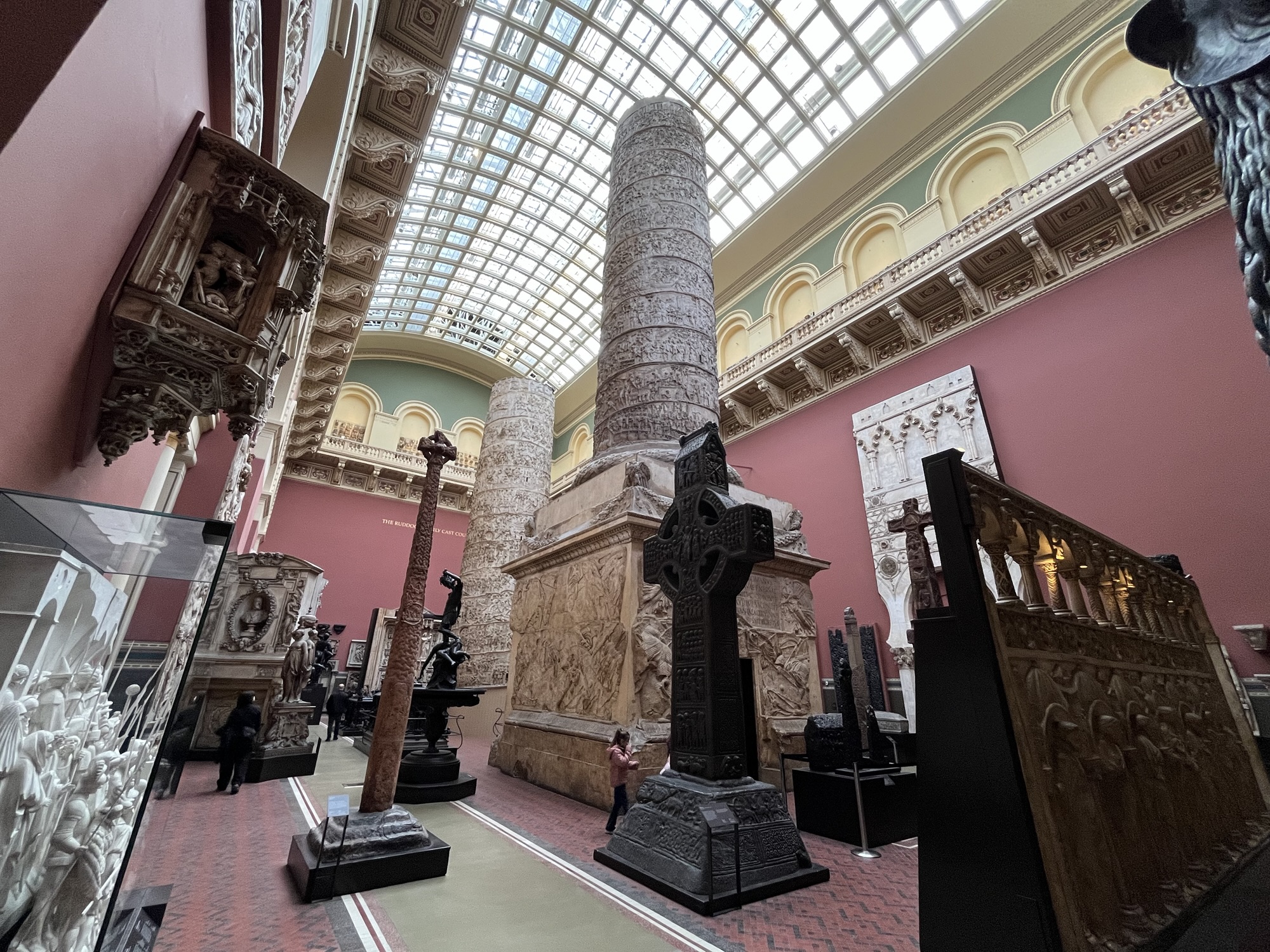
A photo of the Cast Court at the V&A

This is the fourth of my blog posts about last month’s trip to London. After visiting the Natural History Museum, we walked across the road to the V&A, where we visited the Cast Courts and the Design 1900-Now Gallery.

As I mentioned in my write-up of Banksy: Limitless, I’m not massively in to art, and so most of what the V&A offers isn’t of interest to me. Christine likes it though, and she has visited the V&A more often than I have. This time, she insisted on taking me to the Cast Courts on the ground floor.

Cast Courts

These three rooms are huge, extending to the full 25 metre height of the building. Their size is by necessity, as they contain some of the largest objects in the V&A’s collection.

As the name ‘cast’ suggests, these are plaster casts of various famous artefacts that exist elsewhere. There’s a cast of Michaelangelo’s David, for example, complete with a plaster fig leaf that was put over his manly bits when Queen Victoria visited. By far the biggest is a cast of Trajan’s Column, which is so big that it appears in two pieces. The cast courts were built as part of the original museum in the 1870s, and are now rather tightly packed with various pieces.

They’re impressive spaces, and it would be hard not to be wowed when walking in to them for the first time.

A photo of an Apple II computer and disk drive on display at the V&A

Design 1900-now

Whilst art may not be my thing, design and architecture are. So we went upstairs to the Design 1900-now gallery, which features 250 objects that show how design has changed over the past 126 years.

As well as furniture (including a standing lamp designed by Salvador Dali), there’s also technology here. There were two Apple computers on show; an Apple II, and a much newer MacBook that had been deliberately disassembled as it contained documents from Edward Snowden. There are also examples of objects that have been recently acquired, such as a Lababu.

The information included with each object is concise but thorough, but by virtue of being in central London, the limited space means that many objects are not on show here. Indeed, V&A has over a million objects in its collection, and has recently opened the V&A East Storehouse in Hackney Wick to allow visitors access to more of its objects. There’s also the Young V&A in Bethnal Green, which we visited in 2024.

Accessibility

Entry to the museum is free, but like most free museums, some special exhibitions require paid-for tickets. The main entrances are step-free, but not the entrance from the Museum tunnel that links to South Kensington tube station which is the nearest. Knightsbridge is the nearest step free tube station.

There is step-free access to all parts of the museum, but as it’s an old building that has been added to over time, step-free routes may take longer than some more direct ones. Disabled toilets are available, but for a Changing Places toilet, you’ll need to go across the road to the Science Museum.

App review: Octo-Aid

A screenshot of the Octo-Aid app

If you’re an Octopus Energy customer, then you should consider downloading Octo-Aid. It’s a smartphone app that links to your Octopus Energy account, and analyses the data from your meters to give you insights.

To use it, you need to:

  • be an Octopus Energy customer
  • have a working smart meter

I downloaded Octo-Aid ages ago, but as our electric smart meter stopped working last year, I’ve had to wait until it was fixed in January to give the app a proper review. Happily, this coincided with a re-design of the app, which now looks more like a standard iOS app. Before, it looked like a rather quick port from another platform – even though it’s iOS only. For Android users, there’s a different but unrelated app called OctoTracker.

Linking your Octopus account to Octo-Aid

To access your data, you’ll need your Octopus Energy API key. You can get this here; I’d suggest saving it somewhere as you may need it for other things. For example, I use mine with the SolaX app, and for the Octopus Energy Home Assistant integration. So, I have it saved in 1Password, alongside my Octopus Energy account information.

You can only have one API key per account, and once it’s generated, Octopus won’t show you the full key again. If you don’t have it saved somewhere, you’ll need to regenerate it and then re-link any services to your account.

Once you’ve copied and pasted your API key into Octo-Aid, it’ll start downloading your data. This may take a couple of minutes if you’re running Octo-Aid for the first time, as it’ll download a lot of historical data. In future, it should open more quickly. Whilst you wait, Octo-Aid will show you a little cephalopod-themed joke.

Data analytics

So what can Octo-Aid tell you about your energy usage? Well, it can compare your usage with previous days, weeks and months, and whether you’re using more or less. It can also give you a forecast of how much you may use for the rest of the month. There’s also an estimate of your home’s ‘base load’ – how much power your always-on devices need. These are things like your fridge and freezer, or devices that have a standby mode. Because Octo-Aid has access to your tariff information, it’ll also tell you how much this is costing you.

If you have some way of exporting electricity, such as solar panels, a battery or a wind turbine, then Octo-Aid will also display this data and include it in its cost calculations.

If you’re lucky enough to have an Octopus Home Mini, then this data will be in almost real-time for your electricity meter, and on a half hour delay for gas. We don’t have one yet (I’ve signed up for the waiting list but not heard anything) and so our data for the previous day normally appears around lunchtime.

Tariff comparisons

A really useful feature of Octo-Aid is to be able to compare Octopus Energy’s tariffs, based on your actual usage data. Octopus has a wider range of more advanced tariffs than its rivals, including its Tracker and Agile tariffs where electricity costs can vary daily or half-hourly respectively. It also offers specialist electric vehicle charging tariffs that can integrate with your home charger, if you drive a supported vehicle and have a supported charger installed. In our case, our car is supported, but our charger isn’t yet.

Octo-Aid was able to tell us that we’re on the best gas and export tariffs, but that Octopus Intelligent Go would be cheaper for us for electricity. Unfortunately, this is one that requires a compatible charger, and so I’m on a waiting list for that too. With energy prices likely to shoot up soon, and the withdrawal of many fixed tariffs last month, it’s worth using Octo-Aid to see if another tariff would be cheaper.

Budgets

There’s also a budgets tab in Octo-Aid, where you can set maximum monthly spends. You can set these yourself, or let Octo-Aid suggest values for you. You can then track how your energy usage compares to the budget. There’s some nice graphs, which overlay your current usage with the previous month. As we’re in spring, and it’s (mostly) getting warmer and sunnier, we’re obviously using a bit less.

Other tools in Octo-Aid

Octo-Aid includes an electric vehicle charge planner. You’ll need to tell it your car’s charge rate and maximum battery capacity, and then it’ll tell you when it will be cheapest to charge. You can even tell Octo-Aid to pop up a reminder notification when it’s time to start charging.

We’re on a fixed tariff, and so the cost doesn’t really vary for us unless it’s really sunny. But if you’re on one of Octopus Energy’s time of use or electric vehicle tariffs, then this is potentially quite useful.

Overall, it’s a handy little app, and it’s free to download and use. If you’re not already an Octopus Energy customer, here’s my referral link to join – we’ve been with them since 2023 and they’ve been better than any other provider that we’ve used. The referral link gives you £50 off once you’ve paid your first bill by direct debit, and I’ll get the same. That being said, Octopus has almost 25% market share in the UK now (not bad for a 10 year old company) so I’d be surprised if many of you reading this aren’t already customers.

Wildlife Photographer of the Year 2025

Outside the Natural History Museum which hosts the Wildlife Photographer of the Year award.

This is the third of my blog posts about last month’s trip to London. Following our visit to Banksy: Limitless in the morning, and a bit of lunch, we strolled around to the Natural History Museum for their Wildlife Photographer of the Year exhibition.

The exhibition displays the top 100 entries for the competition. The gallery is dimly lit, with all of the photographs displayed in lightboxes to make them really stand out. They’re split by category, and show the winning entry in each category alongside those highly commended by the judges. Each photograph also has a bit of blurb about where it was taken, and the lengths that the photographer took to get the shot. In some cases, these photographs took weeks or even months of planning. You also get to see which model of camera was used, the lenses and camera settings used to take the photograph.

The two winners of Wildlife Photographer of the Year 2025 were announced in October, a couple of days before the exhibition opened. There’s an overall winner, and a separate winner for under-18s. Both winning photographs are then displayed on bigger lightboxes at the end, and there are video interviews with the winners and the judging panel.

Whilst the Natural History Museum offers free entry, this exhibition is a paid add-on. Tickets start at £15.50 each for adults at off-peak times – we went on a Friday so paid this lower rate. Full-price tickets are £18 for adults, payable at weekends and weekdays during school holidays. You have until mid-July to see this year’s photos.

The Evolution Garden at the Natural History Museum

Evolution Garden

This was the first time we’d been to the Natural History Museum since 2022, and so it was the first time we’ve seen the new Evolution Garden. The museum used to be surrounded by grass lawns at the front, but one of these has been replaced with something rather more biodiverse. As you walk through the garden, you can see various fossils, showing (briefly) how life evolved over millions of years. The planting fits the theme, with ferns playing the role of ancient plants that would have been common the time of the dinosaurs.

It’s a good improvement to an under-utilised area. As well as being better for biodiversity, it supports the museum’s role in education, and is easily accessible even if you don’t want to go into the museum itself.

Pokemon Pop-up Shop

If you can make it to the museum before the 19th April, there’s a Pokemon Pop-up Shop. You need to book a timed ticket to go in, and these aren’t normally available to book online. We didn’t manage to get a ticket when we went, unfortunately.

Accessibility

All of the museum’s entrances are accessible, and wheelchair access to all parts of the museum should be achievable. Disabled toilets are available, but you’ll need to go next door to the Science Museum for a Changing Places toilet.

South Kensington is the nearest tube station, and there’s a tunnel link to the Evolution Garden from the ticket hall. Knightsbridge, on the Piccadilly Line, is the nearest step-free tube station.

Creative Commons License
Except where otherwise noted, the content on this site is licensed under a Creative Commons Attribution-ShareAlike 4.0 International License.