
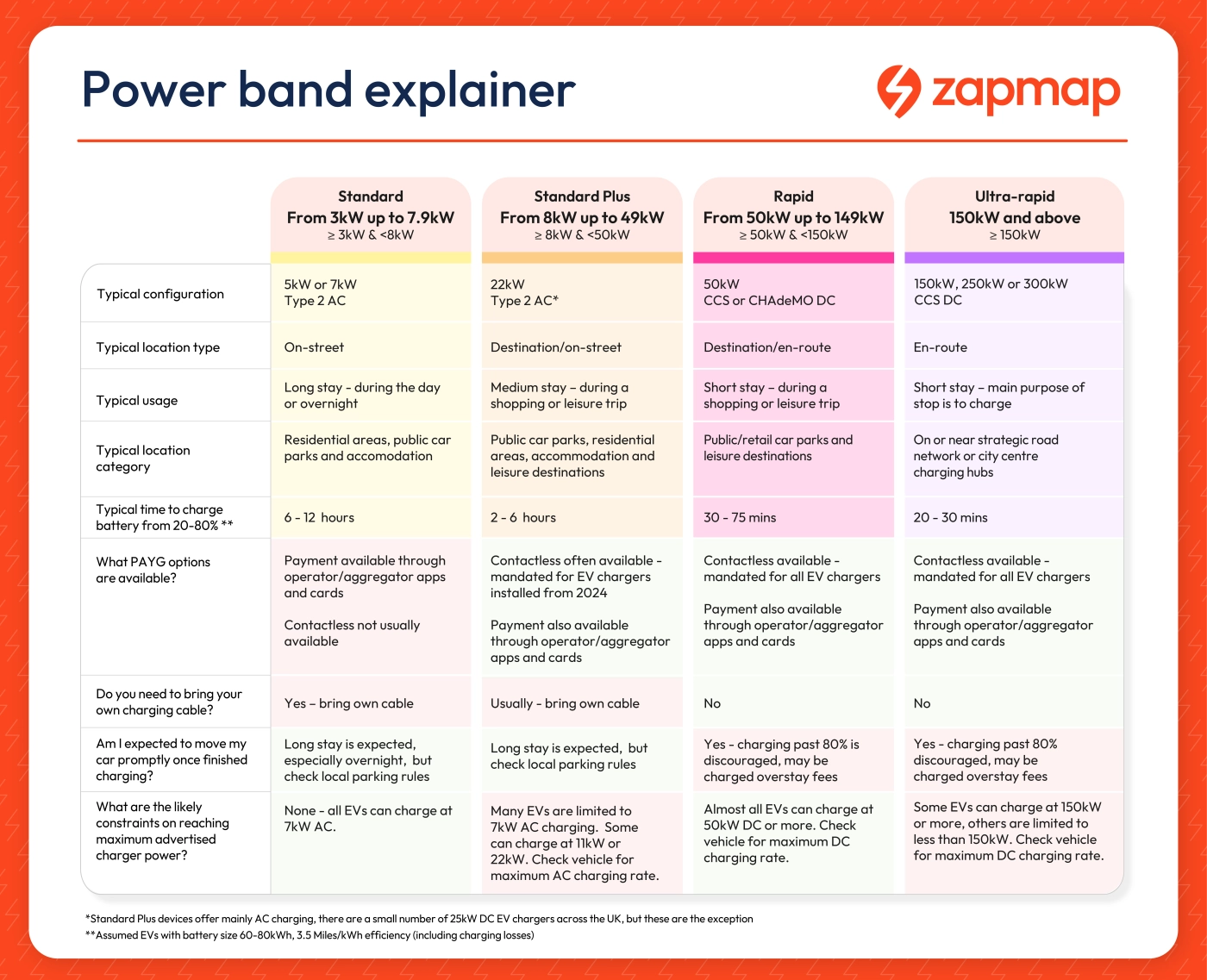
Zapmap recently published updated guidance about EV charger speeds, and the names that we give the different types of chargers. The same guidance has been supported by the Department for Transport, and now categorises electric vehicle chargers into these four categories:
- Standard
- Standard-Plus
- Rapid
- Ultra Rapid
I’ve put their infographic as the featured image above, and here’s how each category works in practice.
Standard charger
Standard chargers were often known as ‘slow’ chargers before, and cover speeds from 3 kW to 7 kW. These are the single-phase AC chargers that use a Type 2 cable (that you usually have to provide yourself). If you have a charger installed at home, then it will most likely be a Standard charger.
Renaming it from ‘slow’ to ‘standard’ is deliberate because ‘slow’ implies that these chargers are inferior. They’re not – I have one at home and so it’s the type of charger that I use the most. They’re also common as ‘destination chargers’, at places such as hotels or attractions where you would typically spend the whole day. As such, the slower speed is fine, and so ‘standard’ is a better term for these.
Standard-Plus charger
What are now known as ‘standard-plus’ chargers are those in the 8 kW to 49 kW speed bracket. Typically, these will also use Type 2 connectors, but will draw their power from a three-phase AC electricity supply. These were known as ‘fast’ before, but ‘standard-plus’ is a better name as they’re still slower than rapid chargers, and not all cars support the faster speeds.
For example, our Nissan Leaf can only charge at up to 6.6 kW. It’ll charge from a ‘standard plus’ charger, but at a ‘standard’ speed.
Both ‘standard’ and ‘standard plus’ chargers can be considered to be ‘level 2’ chargers, as per this guide I wrote in October. There exist a few older 25 kW DC chargers that would fit into this category based on speed, but these are in the minority and I haven’t personally come across them.
Rapid charger
Rapid chargers haven’t changed their name, and are still used to describe DC chargers that offer between 40 kW and 149 kW charging speeds. These will have a CCS-2 or CHAdeMO connector (or both), and are designed for fast charging. The charger units will include the cables, so you don’t need to bring your own.
Ultra Rapid charger
Increasingly, a new generation of charger can offer speeds of 150 kW or higher, and these are categorised as ‘ultra rapid’ – again, no change to the name. Like rapid chargers, these use a DC electric supply and will use CCS-2 or CHAdeMO connectors – although most that I’ve seen at this speed don’t offer CHAdeMO.
Our Nissan Leaf can only slurp down 46 kW using CHAdeMO, so whilst we can use an ultra rapid charger, we can’t take advantage of the faster speeds over a rapid charger.
Overall, I like the new categories, and I think they better manage the expectations for EV users needing to charge. Standard chargers are fine for even the biggest electric vehicles when staying overnight, for example, and so renaming them from ‘slow’ to ‘standard’ should mean that people aren’t discouraged from using them.


Reposts