Just a short one this month – as mentioned yesterday, I’m still in my recovery, and my typing is slow and not particularly accurate.
What we didn’t do in May
I did my usual look ahead to the start of the month on the 1st, listing the things we expected to do. Alas, my injuries meant that I never made it to the Everything Electric show in Harrogate, or the gig that I mentioned. That was a Professor Elemental gig in Leeds, being supported by fellow ‘chap hop’ artists Mr B the Gentleman Rhymer and Thomas Benjamin Wild Esq. Ironically, this is the second Professor Elemental gig we’ve missed this year, as we were supposed to see him at Sci-Fi Weekender in March before that got cancelled.
Christine also never made it to London, as she stayed back to help me, and we’re not at UKGE this weekend. Oh well.
Does bad luck come in threes?
There’s a saying that bad luck comes in threes. If we take my injuries as one, then number two would be that we had a gas leak at home last week, and number three would be that we got a flat tyre on our car on Friday.
The gas leak was easily solved – we rang the National Gas Leak Emergency Number, and an engineer from our local gas distribution network was over within the hour. It was a minor leak – the pipe connecting our meter to the inlet pipe had come very slightly loose. Once tightened, it was fine. And as the leak was on the network side of the meter, we would not have been charged for the excess gas. It’s probably a good thing we no longer have a gas cooker, as that would have ignited the leaking gas and could have caused a major explosion. As it is, we only need gas for our central heating and hot water, and in the long term, we’ll replace our boiler with an electric heat pump so that we can come off the gas grid all together.
As for the flat tyre, we used our breakdown cover to get a recovery truck to bring the car home (seeing as it was after 7pm on a Friday and we weren’t too far from home), and we have a technician coming to us to replace it today. Like the gas leak, easily fixed, but a bit annoying. Let’s hope that I don’t have any more bad luck, eh?
The Wolverhampton Taxi Problem
Back in 2015, I wrote a (comparatively) lengthy blog post about taxis registered in the borough of Rossendale in Lancashire, but operating elsewhere, and the issues this causes. A decade on, and it seems like the issue has shifted to Wolverhampton: there’s a lengthy piece on Mobility Matters about it. Almost 30,000 private hire vehicles are registered in Wolverhampton, which would mean one taxi for every ten residents, against a national average of 3 to every 1000. Of course, they’re not all operating there, and it’s reckoned that around a third of those operate in Greater Manchester. A hat tip to London Reconnections for the link.
I’m still in my recovery period – I’m not allowed to lift anything for another three weeks – but I am going to post a few, short blog posts again to get myself used to typing again. So, here’s this month’s playlist, which should give you an idea about how my recovery is going. Here’s the link to Spotify.
“Everybody Hurts” by R.E.M.
“Broken Bones” by Love Inc
“The Drugs Don’t Work” by The Verve
“Give Me Novacaine” by Green Day
“I Need A Painkiller” by Armand van Helden
“Wonderful Life” by Hurts
“Insomnia” by Faithless
“Can’t Sleep” by Above and Beyond
No extra analysis this month, I’m afraid. I can’t type at my normal speed, and my accuracy is lower than usual. Hopefully, normal service will be resumed next month.
It’s my birthday today. I’m still recovering, and not yet able to spend a long time typing, so this is coming from my phone again. However, I have re-gained some movement in my arms compared to a couple of weeks ago, and I’ve been out of hospital for almost two weeks now.
The 25th May is also Towel Day, marking the life of Douglas Adams, author of The Hitchhikers Guide to the Galaxy. Those of you familiar with the book, radio series, TV series or film will know the significance of the number 42. Well, today is my 42nd birthday.
As I’m still recovering, today will be a quiet day with possibly a nice meal out somewhere at lunchtime. Once I’m fit enough to start using a proper keyboard again, I’ll be able to resume blogging more regularly.
This is a short blog post that I am tapping out on my phone. Since Thursday last week, I have been in hospital, having had a fall at home which resulted in me fracturing bones in both my shoulders (specifically necks of humerus).
I’ve now exhausted the scheduled posts that I’d written before the fall, and both arms need to be non-load baring for another five weeks or so to allow them to heal, so I’m going to have to take a blogging hiatus for now. Which is a shame; I was working on my views of this year’s Eurovision entries when the fall happened.
See you all soon, hopefully when I no longer have T-rex arms.
WLED is custom firmware for controlling multi-colour LED lights. It’s designed for string lights, with lots of individual LEDs that can be controlled independently. I’ve recently given it a try for the first time.
ESP devices
WLED runs on Espressif’s ESP32 and ESP8266 chips (although the latter isn’t recommended for new installs). That means it’s like ESPHome, Tasmota and ESPurna, in that it is also open source and customisable. However, whereas these alternatives can be used on a wide variety of devices, WLED is designed just for controlling LED lights. Sure, you can probably configure ESPHome to do the same, but you would end up with a huge and unwieldy YAML file to be able to recreate WLED’s functionality.
You can build your own controllers with an ESP chip like those from Seeed Studio and m5stack, and there are wiring diagrams to help you. It’s recommended that you include some capacitors, fuses and level shifters, along with the MCU chip, and you’ll need to be good at soldering.
Or, you could do what I did, and buy a pre-built controller box with the WLED firmware pre-installed. Amazon will sell you one from Gledopto for £25 (sponsored link), however, I purchased mine from AliExpress for £10.79, which is less than half price. Whilst buying the individual components may be cheaper, a pre-built box doesn’t require any soldering. Gledopto offer a range of different units, and some more expensive models include a built-in microphone to allow the lights to synchronise with music.
Replacing Tuya with WLED
The lights that I wanted to use originally came with a Tuya Wi-Fi controller. I try to avoid Tuya Wi-Fi devices, as they require access to Tuya’s servers to work. WLED can work entirely locally, with no need to connect to cloud servers (apart from for firmware updates). I also found that, whilst the Tuya app offered lots of effects, these weren’t available on other smart home platforms.
The MCU in the Tuya controller looks like a Beken BK7231 chip, and so I may have been able to install OpenBeken or ESPHome on it, but not WLED as WLED is ESP-only. As mentioned above, WLED is designed to control LED lights, whereas OpenBeken and ESPHome would have needed a lot of configuration. Besides, I couldn’t seem to use the Tuya-Cloudcutter exploit, and couldn’t find the pins I would have needed to upload new firmware via UART.
So instead, I bought a replacement WLED controller, and then cut the wires from the old circuit board. Thankfully, the terminals where the wires connected were labelled, and so I could easily match these with the new WLED controller. Like I said, there was no soldering required – on the new controller, I just lifted the plastic pins to open the ports, fed the wires in, and then locked the pins. The controller needs a minimum of 5 volts, which is what you get from USB and so I just wired in the existing USB cable from the Tuya controller. It can accept higher, going up to 24 volts DC.
Once power was provided, the LEDs all light up with a bright orange glow. I then used my phone to connect to the WLED-AP hotspot that appeared, and used the hotspot login screen to give WLED my Wi-Fi network details. And that was it – after that, I could use the controller’s IP address to open a web page to control the lights.
Using WLED to control lights
WLED is very powerful. With LED lights like the ones I used, it can control the colour and brightness of each individual LED. That means each one can be a different colour, and you can have patterns as each one fades on and off and to different colours. It comes with lots of built-in effects, and you can save these as presets that come on as soon as the lights are turned on. Multiple presets can be combined into a playlist.
Whilst the main way to use WLED is using the web interface, there are official apps for iPhone and Android, that will detect your lights using mDNS. That being said, the iPhone app is mostly just a wrapper around the web interface. Third-party apps seem to exist which offer a more native interface, but I haven’t tried these myself yet.
Smart home integration
If you’re a Home Assistant user, then WLED has a built-in integration. New WLED devices should be detected automatically by Home Assistant, and you can control almost all of the features within Home Assistant. This includes setting presets and playlists, amending the speed of effects and the intensity.
Getting your WLED devices into other smart home ecosystems is a little more difficult. There is a Matter bridge, which needs to run on another device that has Docker installed. I tried this, but couldn’t get it to work; I gather from one of the bug reports on Github that it’s not compatible with newer versions of WLED.
With a bit of trial and error, I managed to get it working with Matterbridge. I had to hide some of the sub-entities as otherwise it wouldn’t show and caused errors in the logs. This allowed me to control it with Google Home and Apple Home. However, this control was limited to selecting a single colour and brightness for all LEDs, or switching on and off. Better than nothing, but not as granular as Home Assistant.
WLED isn’t for everyone – I found it easy enough to set up, and I like the high level of control it offers. But it is very much a DIY solution, that requires you to buy (or build) the controller and lights separately, so it’s not for everyone.
I’m planning another WLED project; this time to replace the non-smart controller for my ring light. I’ve seen a guide for replacing the controller; that guide involves building your own controller and 3D-printing a box for it. I think I’ll just buy another Gledopto box.
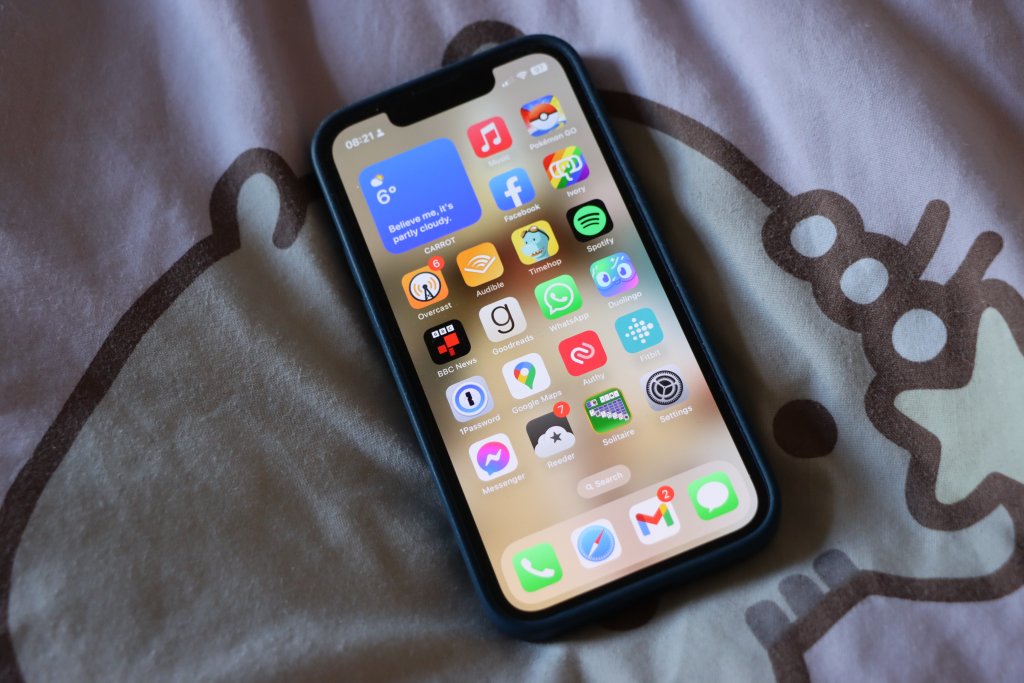
Last month marked three years since I bought my iPhone 13 Mini. Unfortunately, it was starting to show its age a little – the battery was not holding charge very well, and the charger port was being awkward, which exacerbated the charging issue.
I quite like the size of the iPhone 13 Mini, and I’m disappointed that Apple has stopped making iPhones this small. As I write this, the smallest iPhone is the iPhone 17E, which is 15mm taller and 7mm wider, as well as weighing 30 grams more. And compared to the iPhone 17 Pro Max, my phone is 2/3rds of the weight, 30mm shorter and 12mm narrower. I resisted moving from the iPhone 5/5S form factor to the iPhone 6/7/8 partly because I felt that was too big – the iPhone 13 Mini has turned out to be an almost perfect size.
So, I have a good reason for sticking with my current iPhone. Plus, sorting out the issues with my phone would prove to be much cheaper than buying a new one.
New iPhone battery
I had previously had the battery on my iPhone 8 replaced, which helped it last for five years. So, doing the same with my current phone made sense. I was able to get a local phone repair shop to do the job in about half an hour, so that I didn’t have to be without my phone for too long. The ‘new’ battery isn’t actually brand new; it’s been recovered from another iPhone 13 Mini that had been disassembled. As such, it didn’t have its full 100% battery capacity as new from the factory. Instead, it offered 94%, which is better than the 80% that my current battery offered. 80% doesn’t sound too bad, but I was having to charge it multiple times per day – especially when we were in London. At 94%, it can do some whole days without needing a top-up charge.
As the new battery is a genuine Apple battery, the phone doesn’t complain about it. Indeed, the engineer who fitted the new battery walked me through how newer iPhones are able to authenticate genuine Apple batteries fitted outside of the factory. Once the new battery is fitted, it reboots into a cut-down version of iOS where it authenticates over Wi-Fi, and then reboots again when done.
Cleaning the charger port
The phone repair shop also cleaned out the charger port for me. I’ve tried blasting it with a can of compressed air, which helped, but it could still be awkward with some cables. Instead, the shop used tweezers to pull out stray dust that was insulating the contacts in the charger port. It now charges much better.
I wouldn’t go far as to say that my iPhone is like new again. Arguably it now acts like a one year old phone, rather than a three year old phone, but that’s a big improvement. It would be great to get this one to five years old, like its predecessor, before needing replacement. By then, maybe Apple will have started offering a smaller form factor iPhone again?
As for the cost? For the new battery, installation and charger port cleaning, I paid £60 at the local repair shop. Had I opted for a third-party, non-genuine battery, it would have been cheaper. By contrast, Apple charges £85, and I would have also had to factor in getting to the nearest Apple Store in Leeds. £60 for what I hope will be another two years of use isn’t bad.
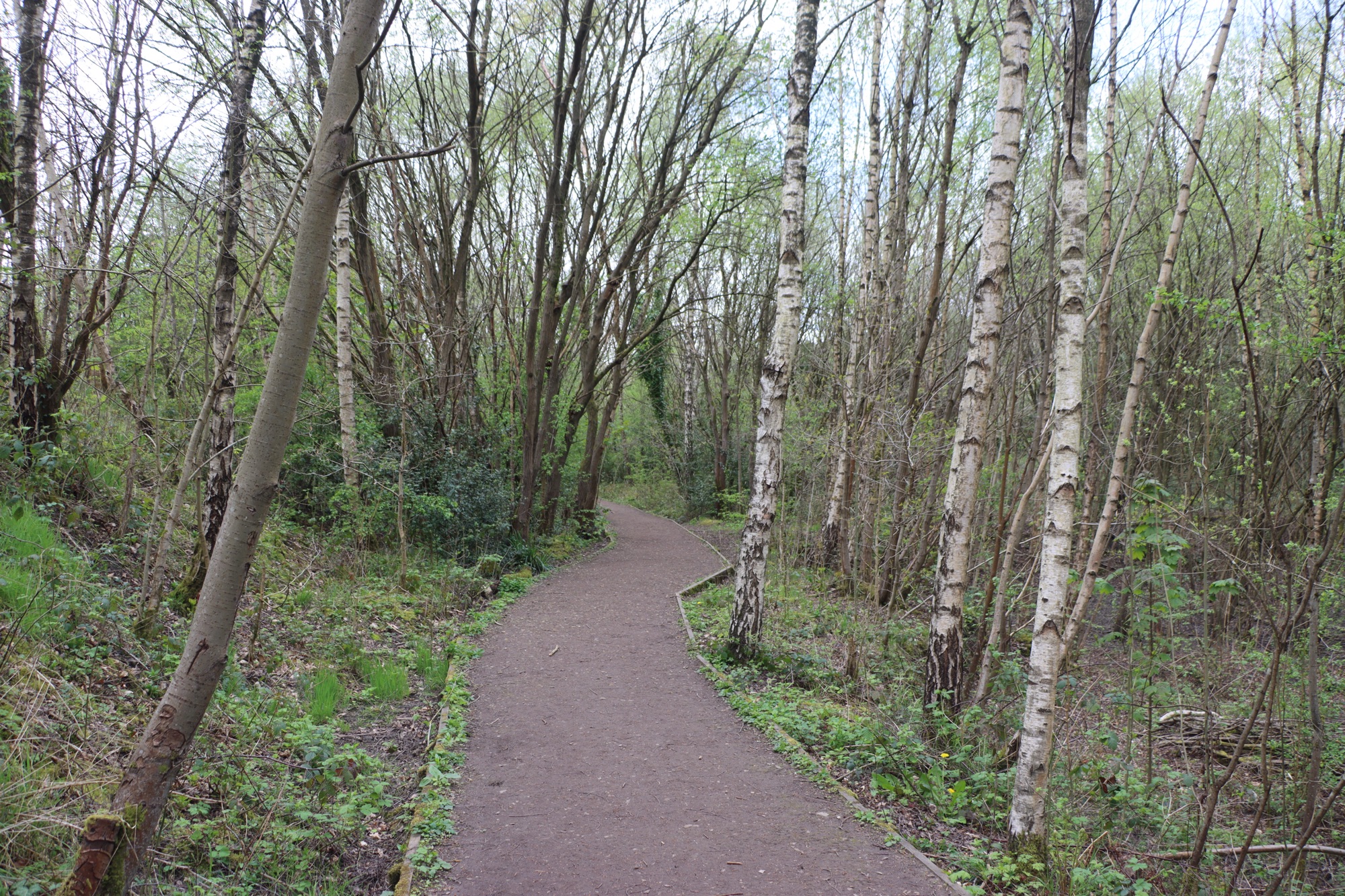
Last month, we had a nice, quiet Sunday afternoon strolling around Cromwell Bottom nature reserve. We’ve been a few times as it’s not far from us, and indeed it was one of the few places we could get out to during lockdown. However, it appears that this is the first time I have blogged about it.
History of Cromwell Bottom
There’s not much history online, but what is now the nature reserve was originally a quarry. Later, fly ash from Elland power station was dumped here, and then more recently it was used as a landfill site. In 2000, it was allowed to return to nature.
It’s a comparatively isolated site, being as it is squeezed in between the River Calder, the Calder and Hebble Navigation, and the lower section of the Calder Valley railway. As such, it has lent itself well to becoming a nature reserve, and is easily accessed from the canal towpath.
Different habitats
Different parts of Cromwell Bottom offer different habitats. There’s a large wooded area, mostly full of silver birch trees, but there’s also a meadow and some marshy wetland areas. As such, it’s possible to see quite a wide variety of wildlife.
Whilst Calderdale Council, the local authority, own and manage the nature reserve, there is an active volunteer organisation called Cromwell Bottom Wildlife Group. In particular, they look after an area of bird feeders, with a bird hide. We stopped there for around 20 minutes, and saw a number of different bird species. The largest was a hen pheasant, but we also saw chaffinches, robins, blue tits, coal tits, great tits and pigeons. On a previous visit, I also saw a nuthatch, and we heard a buzzard, confirmed by Merlin Bird ID.
Out on the river, I saw a heron and a goosander, the latter of which I don’t think I’ve previously seen before.
The Wildlife Group also publish several leaflets, with suggested walking routes around the site. You can download these as PDFs.
Accessibility
Most of the paths around the site are step-free, but there are some steep slopes. They are not paved and the ground can be uneven in places. There are gates on some of the paths which require a radar key to open for wheelchair access.
The Cromwell Bottom Wildlife Group runs a visitor centre, at the western end of the site just off the canal, and this includes disabled toilets. However, it’s operated by volunteers, and is only open on Tuesdays, Thursdays and Sundays between 10am and 4pm. The nearest Changing Places toilet is in Tesco in Brighouse.
Limited parking is available near the visitor centre. It’s on rough ground and often fills up. Buses stop on the main road – the E4 bus runs hourly between Elland and Brighouse on weekdays and every two hours on Saturdays. There’s no Sunday service, so if you need to get there by bus and may need the toilet, visit on a Tuesday or a Thursday.
If you’re reading this in 2029, then Elland railway station may be the closest, but as construction hasn’t started yet, Brighouse railway station is the closest. It’s then a sedate 45 minute walk along the canal towpath.
If you’re out and about in nature a lot, then I can recommend the Merlin Bird ID app. It’s a project of the Cornell Lab of Ornithology, part of Cornell University in New York State in the US. Its aim is to help you identify birds.
What sets Merlin Bird ID apart from other bird-identifying sites and books is that it can use audio. Turn your phone’s microphone on with the app open, and it’ll listen for bird calls. You’ll then get a list of the birds it can identify as it analyses the sound it records. You can even download a data pack for your part of the world, so that it can analyse the sound data offline. Whilst it makes for a big download, it’s helpful for when you’re somewhere remote, and don’t have a phone signal.
I’ve used it a few times. Most notably, we went to Quarry Bank Mill just before Christmas, and I used Merlin Bird ID to identify some parakeets in the trees. Parakeets are, of course, not native to the countryside south of Manchester, but as they were a little distance away, it was good to have them confirmed.
I’ve included a screenshot of a recent day out where it identified:
Eurasian Treecreeper
Eurasian Blackbird
Eurasian Blue Tit
Great Tit
Eurasian Wren
Indeed, we then saw most of these birds as we walked around. There is also a visual guide for identifying the birds, but it isn’t (yet) able to analyse photos. However, I find that Apple Photos does a reasonably good job of automatically identifying birds from photos. It’s the audio feature that I appreciate most in Merlin Bird ID.
On Easter Monday, we took advantage of the nice weather on Easter Monday to visit Nunnington Hall. Yes, I am aware it has taken me a month to get this published. I’ve been to Nunnington Hall before, but it was many, many years ago. Such that I don’t really remember it, and certainly didn’t have any photos of it.
History of Nunnington Hall
Nunnington Hall gets its name from the village of Nunnington, itself named after a nunnery that once stood in the village. There has been a hall in Nunnington since the 13th Century and in the 14th Century, it passed to the Grene family. In 1499, Maud Grene, the lady-in-waiting to Queen Elizabeth of York (wife to King Henry VII) married Sir Thomas Parr, and so the property passed to him. He had a daughter, Catherine Parr, who followed in her mother’s footsteps by marrying Henry VII’s son, King Henry VIII. Catherine Parr was famously the last of Henry VIII’s six wives and outlived him.
In the 16th Century, the property passed to Catherine Parr’s brother, William, Marquess of Northampton. He started a trend of choosing the wrong side in royal conflicts, by favouring the succession of Lady Jane Grey over Mary Tudor. As such, he forfeited Nunnington Hall to the crown.
About a hundred years later, Ranald Graham bought Nunnington Hall for £9500 – around £2.5million in today’s money. He made many changes to the hall, which resulted in many of the historical features still seen today. Another member of the Graham family, Sir Richard Graham, was the second to get a bit of pickle with royalty, being a supporter of Catholic King James II when the Protestant William and Mary ascended to the throne. He was arrested, imprisoned, and only avoided the death penalty for high treason by being an informant for his accomplices. He was stripped of his land and titles and quietly retired to Nunnington Hall. The Graham family sold Nunnington Hall in 1839.
The buyers were the Rutson family, with whom it remained until 1952 when it was left to the National Trust. However, whilst the National Trust took ownership, family members remained living there as tenants until 1978, after which more rooms could be opened to the public.
The hall
Whilst much of the hall dates from Tudor times, it has been renovated several times over the years. Inside, it mostly appears as renovated in the 1920s in the Arts and Crafts style. This included the addition of indoor plumbing. Most of the hall is open to the public, including the main entertaining rooms and the bedrooms. The servants would have lived in the attic, and this has been opened up as an exhibition space. At present, it’s a series of nature pieces by a collective called Diverse Threads 2; later this month, you’ll be able to see entries from the British Wildlife Photography Awards.
Nunnington Hall is also home to the Carlisle Collection of miniature rooms. These are essentially small rooms, like those in a doll house, but not part of an overall house. Some are very intricate – there’s one of a music shop, where each miniature instrument can be played.
The gardens
Nunnington Hall’s gardens are modest; you can walk around the entirety in about half an hour. The National Trust switched to organic gardening at Nunnington Hall in 2002.
They are laid out mostly as they would have been in the 17th Century, with some nods to its 20th Century heyday. This includes a kitchen garden, and a new iris garden that was added last year. There is also a children’s play area, hidden away in the trees.
The house sits next to the River Rye, which gives its name to Ryedale which was the former name of the district council until it was abolished in 2023. Apparently, wild otters have been spotted on the river, but we didn’t see any.
Accessibility
As alluded to above, Nunnington Hall has been altered significantly over the years. And whilst it’s not as higgledy-piggledy as, for example, Little Moreton Hall or Bolling Hall, there is almost no step-free access inside the hall beyond the ground floor. The grounds are largely step-free, but not always on hard surfaces. A disabled toilet is available, but the nearest Changing Places toilets as several miles away in either Pickering or Malton.
Nunnington Hall is a mid-tier National Trust property, so entry prices are currently around £13 for adults. National Trust members get in free, as do RHS members and National Art Pass Holders.
There is a car park on the other side of the River Rye from the hall, linked by a footbridge, and this includes electric vehicle charging. There are four Standard (7kW AC, Type 2) chargers, although two were out of order when we visited. A £5 donation is requested if using the chargers. Additional charging is available in Nunnington village.
How are we a third of the way through the year already? Mind you, the recent weather has seemed rather more summery than spring, so it’s not surprising that summer is fast approaching. And May should be quite a busy month for us.
Bank holiday celebrations
Our wedding anniversary, on the 4th, and my birthday, on the 25th, both fall on the two bank holidays respectively, which is nice. Neither is a particularly notable number – we’ll have been married 13 years, and I’ll be making further progress into my mid-forties. But at least we both get days of work. I suspect some of our wedding anniversary may end up being spent in Ikea, but we’ll see.
As for my birthday, we may plan a nice meal somewhere.
Travel
Christine has an overnight stay in London coming up in the middle of the month, related to a professional development course that she is doing alongside her work. Meanwhile, I’m planning to go the Everything Electric Show in Harrogate.
We have tentative plans to go to a gig around my birthday weekend. Tickets haven’t yet been booked, but we have provisional childcare in place. We’re also considering a trip to the UK Games Expo in Birmingham at the end of the month, but we’ll see. At least it happens just after we get paid, although that could prove dangerous.
Health
It turns out I should have had another hearing test last summer. Anyhow, instead, I’m having one this month, which may mean I get new hearing aids. Last year, I took one of mine in to be replaced, as it had stopped working, and was told that my particular model was no longer issued by my local NHS trust. As such, my replacement was a refurbished model from another patient. I assume that, following this new test, I’ll be due the newer model, but we’ll see. It would be great if these new ones work with Bluetooth, so that I can stream audio directly from my phone.
We’ve also got a couple of appointments for our ten-year-old, which we’ve been waiting almost three years for. Which will be a big relief.