This month was something of a grim anniversary for those of us who used to call Twitter our home on social media, as it marked one year since Elon Musk took it over and basically ruined it.
In that time, many users have left for other platforms — mainly Mastodon, Bluesky and Threads. I too have left Twitter, or rather ‘X’, as Elon wants us to call it now, albeit with my account still technically active and a placeholder tweet.
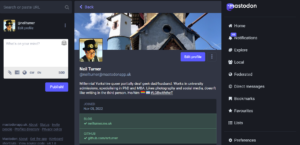
For me, Mastodon is where I spend more of my time (I also use Facebook a lot, but that’s locked down so that everything is friends-only), but I have accounts on Bluesky and Threads. Bluesky seems to be where all the nice people from Twitter went, whilst on Mastodon I’m following mostly new people that I didn’t previously follow elsewhere.
As for Threads — I think I’ve posted there once but despite importing the accounts I follow on Instagram, it seems like the people I already follow there don’t use it much, so nor do I.
And yes, I’m having some nice interactions on Mastodon and Bluesky, but this recent post by Dan Sinker really resonates with me. Especially this:
One of the main topics of discussion on all three is how they’re not as good as Twitter, which is true. They are not as good as Twitter. But neither is Twitter. And the reality is that nothing will ever be as good as something that grew organically — largely through user-driven innovation — over the course of 15 years. Because, whether you knew it or not, so much of what we loved about Twitter was the work it took to become the thing we knew.
On the occasions that I do log into X/Twitter, I still see some people posting regularly, whilst others have gone to one or more of the other platforms. And the best analogy I can think of is when an event causes people to be displaced — war, famine and so forth — which results in some people staying put, and others seeking refuge in various different places.
Displaced people may gravitate to where they have existing connections. After all, if you have to move to a new place at short notice, knowing that there will be familiar people there to help you settle in may be some comfort in what would otherwise be a very stressful situation. For example, when Russia invaded Ukraine last year, a number of Ukrainians sought refuge in the UK where there was already a small Ukrainian diaspora; others went to nearby countries and some stayed put.
Similarly, when Twitter became too toxic for people, some may have chosen Mastodon because people they knew already had accounts there; whilst Mastodon took off in 2022, it has been around since 2016 and there were a series of smaller exoduses in response to changes to Twitter in the pre-Musk years. Some may also have preferred it because it had been around for longer and is a more mature platform, or liked the idea of federation and each instance having its own community.
For others, Threads will have made sense because of its links with Instagram; rather than signing up and having to search for people to follow, you could import your Instagram followers and have content to scroll through from day one.
Others will have followed their friends to Bluesky by being invited there, and may appreciate the invite-only status that it has at present which seems to be keeping out some of the nastier elements of Twitter.
Whilst this explains why some people have chosen one (or more) particular platform(s), it does mean that our friends are scattered across several places — there’s not yet one place that can amalgamate these different social networks into one feed. Mastodon does have an open and permissive API, and is part of the Fediverse, but Threads isn’t yet (although its a proposed feature) and Bluesky looks to be developing its own protocol instead. I have fond memories of TweetDeck, before it was bought by Twitter, offering a single feed with both tweets and Facebook posts in it. But its acquisition by Twitter resulted in gradual enshittification and such features were removed.
Maybe there will be some kind of super-app that will allow you to interact with your social media follows, regardless of which service they’re signed up — just like email. And maybe a post-Musk Twitter would be on there too; despite Musk’s lofty plans to turn X into some kind of everything app, I wouldn’t be surprised if he sells it on when it fails to become a financial services nexus. Something tells me that his ‘lol, whatever’ attitude to regulation is not going to sit well with the financial services regulators. But for now, we’ll have to make do with a series of smaller, more dispersed communities.
This post was originally posted on Medium.