Back in hospital

I’m writing this from my hospital bed, having been re-admitted on Sunday. I had a seizure at home, and this time Christine and our ten-year-old were there to witness it.

Last month I had a fall at home, which I put down to feeling faint but a seizure hadn’t been ruled out. Now it seems like a seizure was the most likely explanation. This time, I was lying down, so no broken bones, but my first memory after coming around was when the paramedics had arrived. This resulted in my first ever trip in the back of an ambulance.

During this hospital stay, I’ve had another CT scan, and an MRI scan as well. I may have some kind of infection which hasn’t been cleared by the medication I was given last time, but we’ll see. I’m also now taking anti-seizure medication, and I cannot drive a car for at least another six months.

I’m hoping to be discharged today.

The injury explanation post

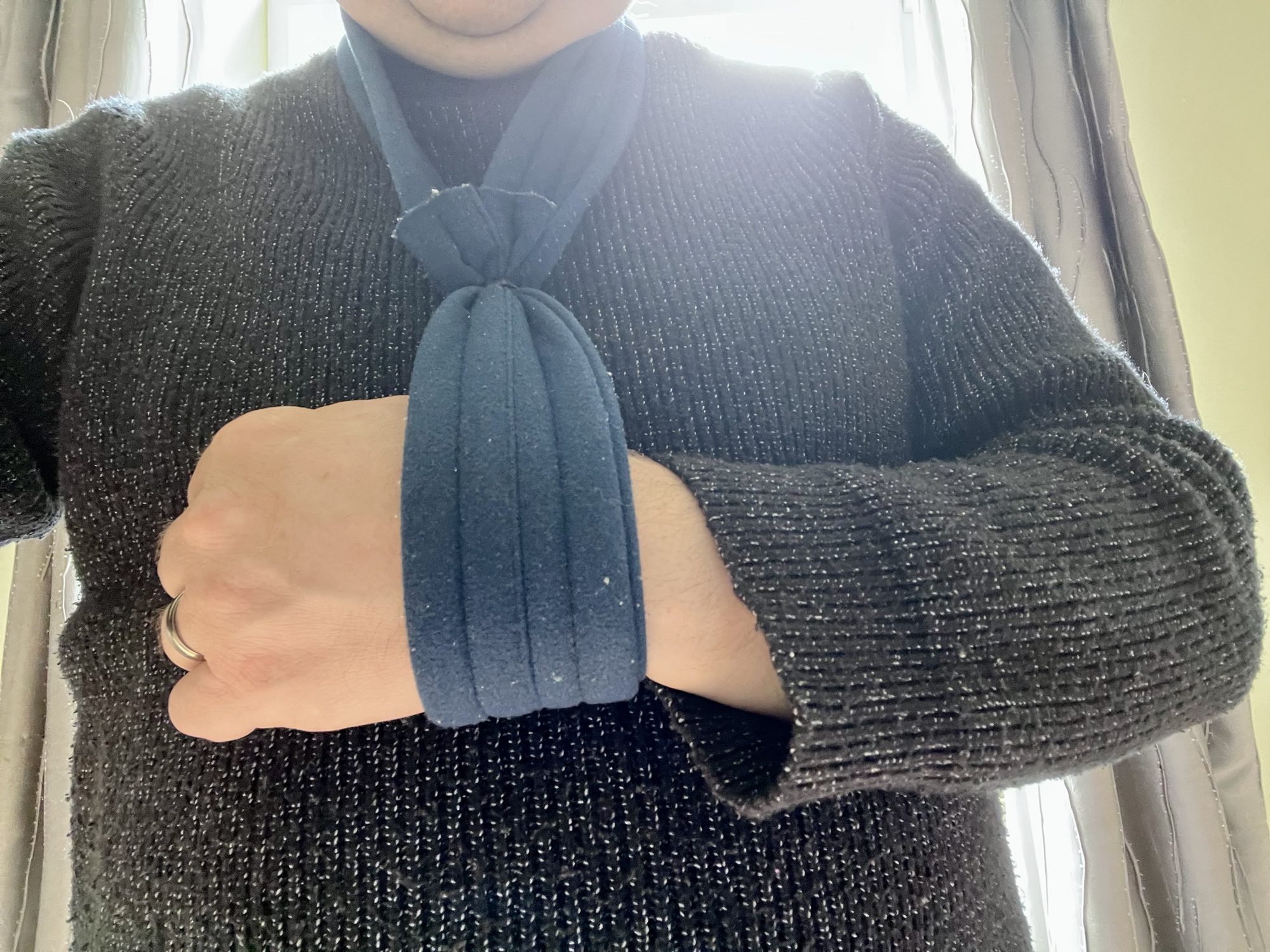
A photo of me wearing a sling

As it’s been almost five weeks since my fall, it’s probably about time that I explained what happened, and how I’m recovering.

How did I fall

I actually don’t remember the fall, or getting up from the fall. What I do know was that I had felt faint a couple of times earlier in the day, and had lunch much later than I would do normally. I was at home on my own, so there was no-one else there to see what happened, and no CCTV footage, so we don’t know for sure what happened. It’s likely that I fainted, which would explain why I didn’t stop the fall by putting my arms out. I also had a bruise on my nose, and I was treated for an infection in hospital, which may have been a contributory factor to me fainting.

What we can’t yet rule out is that it was a seizure instead of fainting. That’s more of a problem; if I’ve had one seizure then it’s possible that I may have others in future. As such, even once my arms are better, I can’t start driving again until I’ve been signed off by neurology, as having a seizure whilst driving would be dangerous. I have a phone call with them next month, but it may be some months before I’m seen in person.

What did I break

The specific injury I’ve sustained is a stable bilateral humeral fracture. Let’s, ahem, break that down (pun not intended):

  • Stable – though the bones are broken, they’ve not moved out of place. This is the ‘good’ kind of fracture to have, as it’s meant that I haven’t needed an operation to pin the bones back together, or a cast.
  • Bilateral – I fractured the same bone on both sides of my body.
  • Humeral – the fractures are in my humeri – better known as the funny bone. It’s the bone that makes up the top part of your arm and connects your shoulder to your elbow. Both breaks are at the top, by my shoulders.

For someone like me, who is relatively fit and healthy and in my forties, to sustain such an injury is unusual. As such, I’ve had a number of blood tests to check calcium levels, and I’m due to have more to check my liver and kidney functions.

The good news is that the fractures are healing well – I had follow-up X-rays last week which show significant improvement. However, I still have pain in my rotator cuffs, which are the muscles surrounding my funny bones at the top, and limited mobility in my arms.

I didn’t study Biology past GCSE, and so I have learned quite a bit about my anatomy in recent weeks.

Treatment

I spent six nights in hospital, which included treatment for the infection, investigations, and fitting with slings. Until last week, I had both arms in slings, but I have stopped wearing the one on my right arm now. I should be able to stop wearing the left sling next week. The fracture on my left arm was slightly more severe, but I’m also right-handed.

I’ve then had three and a half weeks of recovery at home. Yesterday, I started a phased return to work – 25% hours initially, and only working at home. By next month, provided I make good progress, I should be back up to full-time hours and also be able to go back into the office in person.

I’m receiving fortnightly physiotherapy sessions to work on regaining mobility in my arms. As it stands, I can mostly dress myself, but can’t put on t-shirts or jumpers without assistance. I also need assistance with washing myself on a morning, and I’m still not allowed to lift anything for at least another week. I’m still taking painkillers, although I only need prescription-strength medication (Codeine) at night now. The pain comes and goes, and depends on how active I have been.

A month on, and I still have a way to go before I’m mostly recovered. But I’m getting there.

New Bluetooth hearing aids

A photo of one of my new hearing aids

Back in autumn 2022, following a decline in my hearing, I started wearing hearing aids. Almost four years on, and following a new hearing test, I’ve got new, upgraded hearing aids – and these ones have Bluetooth.

Bluetooth hearing aids have been around for some time now, but were normally only available if you paid to have them fitted privately. And privately paid-for hearing aids are not cheap – Specsavers charge a minimum of £500 for a pair, and up to £3000 for top-of-the-range models. So I’ve gone with standard issue NHS hearing aids, which don’t cost me anything as long as I don’t lose them.

It’s only been recently that hearing aid manufacturers have started offering Bluetooth functionality in the cheapest models that they sell to the NHS. It offers some advantages to them – my old hearing aids had metal contacts on the bottom so that my hearing profile could be uploaded to them, but now this can be done wirelessly by Bluetooth. That, in turn, allows for a more streamlined casing for the hearing aids.

Phone connectivity

For me, the major advantage of Bluetooth is that I can connect my hearing aids to my phone. They support Apple’s Made for iPhone (MFi) standard, and so they work a bit like Bluetooth earbuds. Once paired, then you can route your phone’s audio to your hearing aids. However, unlike most Bluetooth audio devices, you can opt to not route system sounds and ringtones to your hearing aids, which is good. You also get to see the battery status of your hearing aids if you have the battery widget enabled on your home screen, and can use your phone to control the volume.

Another feature on iPhones is Live Listen. This allows you to use your phone’s microphone to route sound to your hearing aids. It’s useful for noisy environments, where people can talk into your phone’s microphone to help you hearing them better. Whilst you can buy microphones that also do this, it’s handy to be able to use a phone that you already own.

Other Apple devices linked to the same Apple account should be able to interact with your hearing aids when in Bluetooth range, even if not paired. I say should because my iPad says it can see my hearing aids, but I haven’t yet worked out how to route audio from my iPad to my hearing aids via my iPhone. I assume that if I buy a Mac in future, this will also work.

I’m sure Android phones also support these features, but I haven’t had any experience with them.

iPhone App

My hearing aids are manufactured by Oticon, and they also offer a companion app for your phone. This also allows you to control the volume (for both hearing aids together or individually), switch modes to enable Telecoil, and also mute the microphones. This latter option is useful for listening to music or podcasts over Bluetooth; by default, the hearing aids still listen for sound in your environment (albeit a slightly reduced volume) when Bluetooth audio is playing. If you just want to listen to audio and not your environment (essentially using your hearing aids as headphones), then the mute function is useful.

You can also enable a ‘SpeechBooster’ mode that amplifies speech in noisy environments. Being as I am mostly stuck at home at present, I haven’t tried this yet.

Not rechargeable

Whilst most paid-for hearing aids now come in a charger box, like Apple’s AirPods, these basic ones that I have still use disposable batteries. I don’t have to pay for these either – I get a supply of free batteries from the NHS. And thankfully they’re the same type as my previous models, so I can still use the spare ones I had left over. I expected the Bluetooth support to affect battery life, but they seem to last 8-10 days, which isn’t a major difference.

I’m really happy with my new hearing aids, as they negate the need to take them out to use earbuds or headphones to listen to music and podcasts. Whilst the sound quality isn’t as good as some earbuds, they’re a lot more convenient – especially when you can mute the microphones. Most of all, I’m glad Bluetooth hearing aids are now available on the NHS and that I haven’t needed to pay for them.

Hiatus

This is a short blog post that I am tapping out on my phone. Since Thursday last week, I have been in hospital, having had a fall at home which resulted in me fracturing bones in both my shoulders (specifically necks of humerus).

I’ve now exhausted the scheduled posts that I’d written before the fall, and both arms need to be non-load baring for another five weeks or so to allow them to heal, so I’m going to have to take a blogging hiatus for now. Which is a shame; I was working on my views of this year’s Eurovision entries when the fall happened.

See you all soon, hopefully when I no longer have T-rex arms.

Shapewear: is it worth it?

Recently, my Facebook feed has been full of adverts for male shapewear – essentially vests which push your tummy in. The idea being that you can hide a beer belly and look more confident. Of course, the adverts have lots of before and after videos of men who have squeezed themselves into one of these vests.

Of course, when it came to writing this, none of the adverts showed up for me to take a screenshot.

Whilst I rarely drink beer nowadays, it’s fair to say I’m more portly than I used to be. Between the start of the Covid lockdown five years ago, and the summer of 2021 when things started re-opening again, my waist size increased by a couple of inches. It used to be that I did around 30 minutes of brisk walking every weekday, but despite my efforts to get out during lockdown, I don’t do as much exercise now as I used to.

Therefore, on the face of it, shapewear offers an easy solution – squish your belly into a tight-fitting vest to look better. But besides the price of these vests, I’ve been hesitant to try them, for a couple of reasons.

Shapewear health risks

A quick search with a well-known search engine brought up this article from BBC Science Focus about the ‘hidden health risks of shapewear’. Feel free to read it, but the summary is that shapewear may not be suitable for people who experience issues with breathing, digestion, skin irritation or who have nerve or circulatory issues. And I tick two of those boxes: I’m asthmatic, and, without wanting to go into TMI, I have some digestive issues. Wearing shapewear regularly could exacerbate both of those.

Health risks aside, forcing your body to look a certain way, or only feeling confident if you’re wearing shapewear, isn’t a healthy relationship with your body. I’m reading (well, listening to the audiobook of) You Are Not A Before Picture by Alex Light (sponsored link), which is a really good book about the history of the diet industry, and how to have a good relationship with your body regardless of its size. It also dispels the myth that fat = unhealthy and thin = healthy. For more, see HAES – Health At Every Size, which offers advice for healthcare professionals who work with differently-sized people in a way that is affirming and supportive.

So, no – as much as I’m not a big fan of my sticky-out-tummy, I won’t be trying to force it into a restrictive vest.

100 days of Fitbit

Yesterday, I completed 100 consecutive days where I recorded at least 10,000 steps on my Fitbit. That means that I had done a minimum of 10,000 steps every day since mid-July.

My previous record had been 57 days, earlier this year. That was forcibly ended when the Fitbit Charge HR that I had at the time stopped working. Before that, I’d managed 32 days last year. Getting to a triple digit number has been a much bigger achievement.

10,000 steps is the default target, and, whilst I can achieve this with ease on weekdays, weekends are another matter. Sunday was a good example – knowing that I wouldn’t have many opportunities to get my steps in, I took advantage of the clocks going back and went out for an early morning walk whilst the rest of the household slept in. This is why I haven’t changed my target to be more challenging; I’d rather it be obtainable with some effort than feel bad about not meeting it.

I’m going to try to keep this steak going if I can, although next week may present some difficulty. Christine and I are both off work all week – we had planned to go somewhere, but left the planning too late and can’t really afford to stay over anywhere. Not having my regular routine may make it difficult to reach 10,000 steps every day, but I’ll give it a go.

Fitbit Alta HR review

I’ve recently upgraded my fitness tracker, and now own a Fitbit Alta HR (sponsored link). I’ve previously owned a Charge, and a Charge HR, and this review will mostly focus on the differences between the Alta and the Charge. I reviewed the Fitbit Charge in October 2015.

Improvements

Compared with the Charge, the Alta HR is narrower, and the metal bands either side of the display make it feel more solid. I find that it fits my wrist better and it’s lighter, so it feels more comfortable. I feel happier wearing it when asleep than I did with the Charge models.

Battery life is much improved over the Charge HR, with the Alta HR typically lasting a full week on a full charge. You can also view the current battery status on the device itself, as it’s one of the screens that displays along with your step count, calories burnt, distance travelled etc.

Notifications are expanded beyond phone calls; the Alta HR will also notify you of text messages (and show the sender and first few words), and calendar events if you wish. If you’ve turned on Fitbit’s hourly movement tracking, then if you haven’t done 250 steps in the last hour, you’ll get a nudge at around 10 minutes to the hour to get up and move around.

In my experience, the Alta HR was better at synchronising throughout the day with my phone than the Charge models, which would sometimes go a few hours at a time without a proper synchronisation. This may be a quirk with my phone though.

Disadvantages

If you’re switching from a Charge to an Alta HR, you’ll need to turn off the floor climbing tracking. There’s no altimeter in the Alta HR and so you won’t be able to track how many floors you’ve climbed.

There’s no button on the Alta HR, so you have to wake the display either by raising your arm or double-tapping the screen. Also, the screen doesn’t automatically illuminate when you receive a notification. This probably improves the battery life but makes it a little harder to check your status quickly.

The screen is much bigger, and has a higher pixel density than the Charge. But it’s orientated lengthways, so when reading a message you’ll need to twist your arm. It also means that it’s not wide enough to display more than three digits of your step count, so once you hit 1000 steps, it’ll display ‘1.0k’ and then ’10k’ once you hit 10,000 steps. However, below this, a series of five dots shows whether you’re at 20, 40, 60, 80 or 100% of your daily goal.

Finally, your existing Charge or Charge HR charging cable won’t work with the Alta HR. It has a much improved cable that clips on to the device, but it’s incompatible with other models. You may want to order a spare cable.

Verdict

On the whole, I agree with this Gizmodo review – this is probably the best fitness tracker for most people. £10 more will get you the Charge 2, which overcomes some of the limitations of the Alta HR, but is bigger and probably less comfortable. If you’re the sort of person who wants to record their floor climbs, easily view GPS data, or practice relaxing breathing, go for the Charge 2. If not, then the Alta HR is a very good, comfortable fitness tracker.

Fitbit-less

A photo of a Fitbit Charge HR which is stuck on a firmware update

I’m currently without my Fitbit, as it seems to have died. It looks like a firmware update failed, leaving it basically bricked. I spent about an hour on Sunday chatting to a very helpful support agent called Ulises, and despite trying several methods to get it to reboot correctly, we weren’t able to.

Thankfully, the kind people at Fitbit offered me either a free replacement, or 30% off a new model. I decided to go for the former; though the new models are better, right now I can’t afford the 70% balance that I’d need to pay. Hopefully it’ll arrive soon.

Frustratingly, I had managed to reach my 10,000 step goal every day for the previous 57 days, up to and including Saturday. This beat a record of 32 days that I set in April last year. Reaching 10,000 steps is relatively easy on weekdays; my commute involves around 45 minutes of walking. But weekends can be a challenge, and keeping it up for so long required some forward planning.

Even though I haven’t been wearing a fitness tracker for the past couple of days, I’m still following similar habits. This includes not standing still if I can avoid it, such as waiting for a train. When at work, I still go to a set of toilets a little further away from my desk, and I try to move around at least once every hour.

Since getting my Fitbit in September 2015, I’ve lost around 9 kilos in weight. That’s almost 20 lb, or nearly 1 1/2 stone, if you use old-fashioned measurements. Whilst I am also eating better, having a Fitbit motivates me to do just a little more exercise every day, and it seems to be making a difference. It’s brought my Body-Mass Index (BMI) down to 23.3, which is well within the ‘healthy’ zone; previously, I was straying into being ‘overweight’. And whilst BMI is a very crude measurement, it’s used as a kind-of ready-reckoner by a lot of health professionals.

I’ll be looking forward to my replacement Fitbit arriving, not at least because I don’t currently have a working watch. Let’s see if I can beat my 57 day record, and manage to walk 10,000 steps for a whole two months.

30 days of Fitbit

Back in February I was lamenting my lack of exercise whilst on paternity leave. And following an Easter weekend where I had some particular sedentary days, I decided to set myself a challenge: meet my 10,000 step goal on my FitBit, every day, for 30 days. Day 1 was the 30th March.

I didn’t blog about it at the time as I decided that it would be better just to do it on the quiet, without public pressure. Not meeting my target would let me down, but I’d have also let other people down if they knew. Christine knew – she deserved to know why I’d disappear downstairs from an hour and do housework on an evening – but I didn’t make a big public declaration.

The good news? I managed it. Day 30 was Thursday, and I even managed to make it to 32 days so as to encompass every day in April. Today would be day 33, but it’s nearly 5pm and I’ve barely managed 3000 steps; I think I deserve a rest day.

Hitting my target every day varied in difficulty. On some days, I could reach 10,000 steps with ease. At work, I could reach 8,000 without much extra effort, but found that walking to a toilet further away from my desk, and taking regular breaks to stretch my legs, helped to push things on a bit. This was helped by a recent new feature added to the FitBit app, which encourages you to take at least 250 steps each hour through a series of red dots. So far, my best is being active 13 of the 14 hours that fall between 6am and 8pm – I’ve yet to get all 14, but it’s a good motivator.

I was hoping for some kind of FitBit badge to appear to reward me for doing this, but sadly there isn’t one. Which is a shame. And whilst I don’t plan to challenge myself again any time soon, I hope that this will ensure that I keep up with some good habits to keep my step count up.

Vaccinations

Our baby is now 12 weeks old, and has had their first round of vaccinations. These should have been given at 8 weeks, but our town was flooded out at the time of birth, and this included our GP surgery.

The first round is four individual vaccines. One of these, the rotavirus vaccination, is given orally as drops, but the rest are needles. These are the 5-in-1 vaccine (diphtheria, tetanus, whooping cough, polio and Hib), Pneumococcal, and the brand new Meningitis B vaccine. Sadly some older children aren’t and there is pressure for it to be made more widely available.

As you’d perhaps expect, our little cherub wasn’t very happy about the needles, although it can’t have been worse than the various blood tests in their first week of life. This was as a result of developing jaundice, which required regular blood tests to monitor. Some pre-emptive Calpol (or rather generic-brand Paracetamol Suspension for Infants – it’s the same thing) hopefully helped. Later on, our baby was a little feverish, but more Calpol helped and has been fine since.

Whilst we didn’t really ‘choose’ to vaccinate our baby, there is no way that we would have opted out of the vaccinations. Christine and I are both in favour of vaccinations and the protections it gives people. I always have the ‘flu jab every year, which I get free because I’m asthmatic, but also because ‘flu is horrendous. Christine gets it free as well, as she is professional healthcare worker.

By ensuring that our baby is vaccinated, we’re not just protecting them, but others as well; not everyone can receive vaccinations, either because they’re too young or have compromised immune systems. Herd immunity is important.

The next round of vaccinations will be in a few weeks, for the 5-in-1 and rotavirus vaccines again, along with Meningitis C. Whilst it won’t be a pleasant experience at the time, it’ll be far better than for them to contract those diseases.

Creative Commons License
Except where otherwise noted, the content on this site is licensed under a Creative Commons Attribution-ShareAlike 4.0 International License.