A return trip to Cannon Hall Farm

A photo of the start of a ferret race at Cannon Hall Farm

Last weekend, we went back to Cannon Hall Farm, which is in the so-called ‘Tuscan hills‘ surrounding the town of Barnsley. We’ve been many times before, the most recent of which was in 2024, and I last wrote about it in 2017.

Since that visit, Cannon Hall Farm has seen a number of developments. All of the outdoor play areas have been renovated, with new equipment installed, and there are a couple of new indoor attractions. These include a reptile and minibeasts room, and a mammal house, where the lights are kept low as most of the mammals are normally nocturnal. In other words, it’s now a farm with a small animal zoo tacked on. I suppose they had to get a zoo license to have meerkats, which have been there for many years now, and have leaned into it. On the plus side, it means that there are more indoor areas, and so it’s still a good place to visit even if the weather isn’t great.

Still a farm

Despite the new additions, Cannon Hall Farm is still fundamentally a farm. There are still plenty of opportunities to see farm animals, and this time of year is a good time to visit. Many of the sheep have newborn lambs, some of which are wearing woolly jumpers donated by the public. We saw quite a few little bouncy bundles of joy on our visit.

There are also regular sheep and ferret races (pictured above) throughout the day. Get there a few minutes before the races start, and you can get a free coloured ticket; if that ticket is drawn after the race, then you win a free day pass for a return visit. That’s assuming that your chosen colour of ferret doesn’t decide to fall asleep for the duration of the race.

The huge soft play gym is still there, which again is good for rainy days. There are also more food options available; as well as the Hungry Llama inside the soft play gym and the White Bull at the entrance, there’s now a dog-friendly café called the Lucky Pup, also at the entrance.

Expanding into other media

Nowadays, Cannon Hall Farm is well-known nationally, thanks to various TV programmes on Channel 5. They’re also very active on Facebook, offering ticketed live streams for events such as lambing season.

The Nicholson family, who have owned the farm since the late 1950s, have now written three books and a cookbook, all of which can be bought at the farm or online. There’s also a wide range of branded merchandise, including an official set of Top Trumps.

Accessibility

As mentioned, Cannon Hall Farm is on a hillside, so the site is on a slope. However, almost everything has step-free access. Wheelchairs and mobility scooters are available to hire. Assistance dogs are welcome, but ideally with some form of identification – it is, after all, a farm, and so untrained pet dogs shouldn’t be brought along as they may upset the animals.

There is a Changing Places toilet next door at the Cannon Hall Museum (which I also wrote about in 2017), however, the museum is shut until next month. Having one on site, as well as a dedicated quiet space, would be really good additions to improve accessibility for people with more profound disability needs.

There is a £3 charge to park on site; it’s pay and display (cash and cards accepted), although you can also pay in advance online when purchasing tickets. If you want to visit by public transport, there’s the number 94 bus from Barnsley bus and rail interchange which runs every two hours to the nearby village of Cawthorne. From there, it’s about half a mile off-street walk through the Cannon Hall Country Park.

Entry prices vary; midweek is usually cheaper than weekends. Carers get in free with a paid ticket, and Max card holders can (at the time of writing) get up to two free tickets – one each per paid ticket.

Bowland Wild Boar and Animal Park

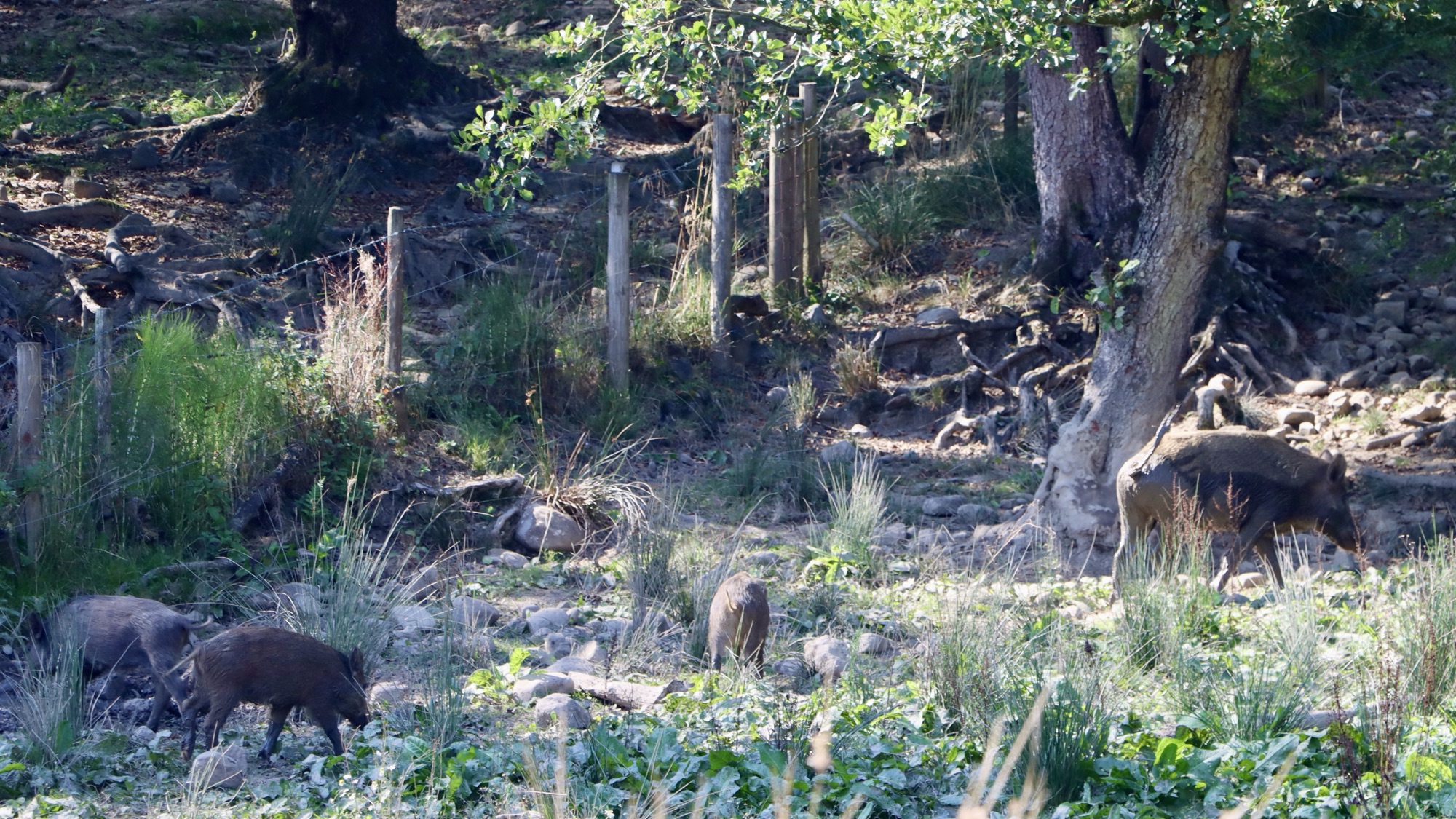
A photo of some wild boar at the Bowland Wild Boar Park

We’re finally at the end of the list of the things we did over the summer. And yes, I’m aware that it is now October and the weather is distinctly un-summery. On the August Bank Holiday Monday, we went to the Bowland Wild Boar and Animal Park, which is in the Forest of Bowland Natural Landscape in North Lancashire.

The Bowland Wild Boar Park is an open farm, and one of many across the UK that doubles as a visitor attraction. However, as the name suggests, it’s also home to a herd of wild boar, who have a large paddock to roam around in. Indeed, the photo at the top of this post was about the best shot as I could manage on the day. Besides the wild boar, there are also emus, goats, llamas, alpacas, peacocks, geese, hens, owls, deer, pigs, donkeys, ducks, and the ubiquitous meerkats.

It’s quite a large site, with the animals having plenty of space. You can also buy bags of animal feed, to give to (some of) the animals, and there’s a playground, café and ice cream shop. If you’re able to stay for a whole day, then there are walks around the site that you can go on, but we mainly stayed around where the animals were. On the day we visited, there was an excellent food truck visiting, so I can’t comment on the food at the café.

Geese and goats at the Bowland Wild Boar Park

Accessibility

If this all sounds great, just be aware that the park has limited opening outside of the summer peak, so don’t head off there this weekend. It’s open throughout the forthcoming October half term, with Halloween themed activities (Saturday 25th October to Sunday 2nd November), but not until then. After that, you’ll need to check the web site as it’s often only open at weekends or for special events. I gather that the site doesn’t have mains electricity, and so it’s reliant on a couple of massive free-standing solar panel arrays and generators.

The site is on a slope, and there’s a lot of uneven ground. However, you can rent a rugged mobility scooter in advance if needed.

We drove there, taking a rather scenic route across the top of the Calder Valley avoiding Todmorden, and then through some of the more well-to-do villages near Clitheroe. If you don’t have a car, then there are hourly buses from Clitheroe (which is the nearest railway station with trains from Manchester and Bolton) that take you to the village of Chipping, where it is then a 3-4 mile walk. Maybe bring a bike.

Kilnsey Park Estate

A photo looking across the trout ponds at Kilnsey Park Estate

A couple of weeks ago, Christine, Lizzie and I went to Kilnsey Park Estate in North Yorkshire. I’d been many years before with my parents, as it has a well-known inland trout farm. Located in the Yorkshire Dales, in the shadow of Kilnsey Crag, it was a place we’d often stop off at on the way home from a day walking in the hills.

This time, we made a day of it. Arriving in time for lunch, we ate at the café, which, as you’d expect, offers mostly trout-based dishes. Lizzie had trout and chips, and I had a nice trout salad. The café is open to all and there’s a gift shop which sells local produce. And trout.

Explorer trail

It’s around £5 per adult to enter the rest of the site. We followed the ‘Explorer trail’, which starts at the bottom of the valley and heads up to Kilnsey spring. This provides the water for the trout farm, and drives two small hydroelectric generators. Combined with a water-based heat pump, Kilnsey Park is able to generate all of its own energy.

There’s a small farm area with some pygmy and Angora goats, pigs, sheep and various chickens. Kilnsey is also home to some red squirrels; once prevalent in the UK but now restricted to just a few remote places in the wild. The red squirrels are in a cage, which, combined with their quick movements, make them quite hard to take photos of.

Heading out into the fields, and there are pheasants and grouse. And some alpacas – Kilnsey Park has been home to alpacas for around 100 years, and used to supply wool to Salt’s Mill in Saltaire near Bradford.

Further up the hillside, there’s a small butterfly garden, which lived up to its name – there were plenty of butterflies there.

And trout

And yes, there were more trout. You get to see the various different pools across the site, from the nursery at the top down to the mature pools at the bottom. Bags of fish food are available to purchase and Lizzie really enjoyed feeding the fish. For an extra cost, you can hire a fishing rod to catch the trout, although you also have to pay £3 for every fish you catch. Processing facilities are provided should you wish to take your catches home to eat. Lizzie was a bit too young for this but it would be great to come back when she’s older and a bit more patient.

It was nice to visit Kilnsey again, and I was pleased that there was enough to do there to be able to spend a whole day. It’s not expensive, and seeing the red squirrels was a highlight for me. Lizzie enjoyed it as well – it’s a good place to take an adventurous toddler. And there are plenty of good photo opportunities – especially if the weather is nice.

Cannon Hall Farm

A pygmy goat standing on top of a llama at Cannon Hall Farm

Following last month’s visit to Thornton Hall Farm, we took our toddler to Cannon Hall Farm a couple of weeks ago. It’s another farm park, but on a much bigger scale.

This was actually our second visit; our first was in September last year, when our toddler was 9 months old. I seem to remember them being asleep for a lot of it. This time, they were awake the whole time, and seemed to really enjoy themselves.

The main attractions are the barns where the farm animals live. The barns are designed for visitors, with raised viewing platforms at the back. The first four barns are for the pigs, several of which had piglets; then there are cow barns, and a rare breeds barn with a wide variety of animals. These include goats, donkeys, llamas, alpacas and rare breed pigs. To access these barns, you pass through a small animals shed, and there are regular rabbit and guinea pig handling sessions.

The farm is also home to some meerkats – not typical farm animals, but popular with visitors. Elsewhere, there’s a roundhouse with some more animals, and sheep and ferret racing events.

What makes the farm a great place for families is the soft play barn. It’s huge – one of the biggest I’ve seen, with an extensive area for the under 4s. There’s a large café attached, with some of the produce coming from the farm. You can sip Prosecco whilst your kids throw themselves down a giant slide, should you wish to. Bigger kids can also play in the outdoor play areas.

Childrens’ parties are big business for Cannon Hall Farm, and there are several bookable party rooms. If we lived more locally, we’d probably consider it for one of Lizzie’s birthdays.

Outside the main entrance (and therefore open to the public without paying for entry) is a restaurant called The Black Bull. Again, some of the food comes from the farm, and it’s good quality food at a reasonable price. There’s quite a big farm shop too, although it’s focused on the higher end of the market – you wouldn’t want to do your weekly shop here, unless you have a very high disposable income.

We all had a very good day out at Cannon Hall Farm. The entry price is reasonable, and although there is a £3 charge for parking, you get this back provided you spend £10 or more at one of the restaurants or farm shop on the site. It’s around 10 minutes drive off the M1, to the west of Barnsley. It’s worth watching out for special events, which take place regularly throughout the year.

Thornton Hall Farm Country Park

A couple of weeks ago we had a day out at Thornton Hall Farm Country Park, near Skipton in North Yorkshire. It’s an open farm, where there are various activities for kids along with an opportunity to meet the animals.

Thornton Hall is a relatively small farm, but with a variety of animals – llamas, donkeys, ponies, sheep, emus, cows, rabbits, ducks, pigs, chickens, goats and guinea pigs. We made it in time to feed the orphaned lambs and calves – our one-year-old was a bit young but older kids enjoyed it. There were regular petting sessions with the rabbits and guinea pigs.

Although Thornton Hall lacks an indoor soft play area, there are sandpits, a large slide for older kids, and space to drive toy tractors. Our one-year-old was just about big enough for the smallest tractors. There was also a small outside play area.

There’s a small café with reasonably good food, but not much space to sit inside. We visited on a quiet day but I would imagine that you would need to sit outside on busier days.

Available at extra cost were a ‘safari’ tour in a 4×4 around the fields,  a shorter ‘caterpillar’ tour, and pony trekking. The caterpillar was a series of converted plastic drums with wheels, linked together and hauled by a quad bike around the farm. With our toddler being rather small, we didn’t pay extra for these but may consider it on a return trip.

Thornton Hall farm isn’t very big, and would probably be of more interest for older kids. I think our one-year-old was a bit young – maybe once they’re two years old or more, that they’ll be able to get more out of a visit. But it was a nice, and relatively inexpensive day out – especially on weekdays, when it’s just £5 for one parent and one toddler. I think we’ll go back again in future.

Home Farm at Temple Newsam

Pig and piglets

On Saturday, Christine and I took out little one to the Home Farm, part of the Temple Newsam estate near Leeds. It’s a working farm with many rare breed animals, that is open to the public for visits. And, with it being the springtime, it was also full of cute baby farm animals.

Although much of the Temple Newsam estate is free to access, including the parkland, gardens and an accessible adventure playground for kids with disabilities, entry fees are in place for the farm. But it’s free for the under-5s and it’s only £3.60 per adult, and you’ll probably spend over an hour there so it’s good value. There’s also an additional playground that’s only accessible to those who have paid to enter the farm, and a lower field with donkeys.

Goat and kid

At three months old, our little cherub is a bit too young to appreciate the farm (and was asleep most of the time anyway) but it’s great for families with young kids. Most of the animals are willing to be petted, and there are information boards and staff on hand to talk about the animals. Many of the animals are ‘rare breeds’ – breeds that are less common in British farming, and, in some cases, under threat. The pigs, for example, are British Saddleback, Tamworth and Middle White breeds, and the sheep include Manx Loaghtan which are native only to the Isle of Man (although I don’t think any where publicly viewable when we went).

With it being the Easter holidays, I expect the farm to be really busy at present, but it’s well worth a visit, as long as the weather is okay. There are some indoor bits, but most of the farm is outside so it’s probably not the best way to spend a rainy day. Also, if you’re pushing a pram or wheelchair like we were, be aware that there are a lot of uneven cobbles, and that the farm is on a hillside.