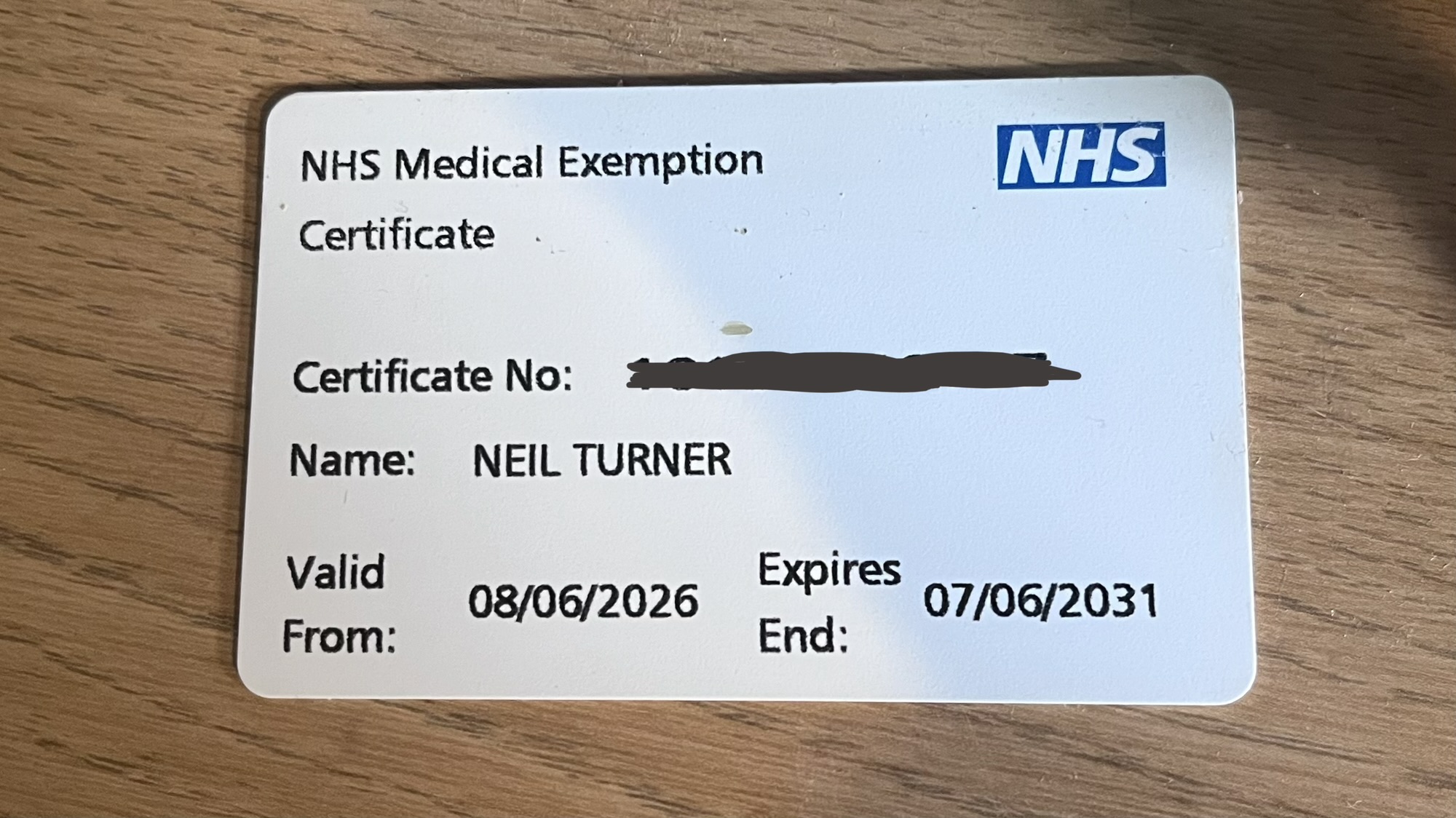
As well as a free bus pass, one of the silver linings of being diagnosed with epilepsy is that I no longer have to pay for prescription medication. Epilepsy is one of several medical conditions which makes me eligible for a medical exemption certificate which you can get from the NHS Business Services Authority.
There are several other reasons why you may qualify for free prescriptions:
You live in Scotland, Wales or Northern Ireland. The devolved administrations in these countries have abolished prescription charges, so all their residents get free prescriptions. Yorkshire hasn’t yet obtained sufficient devolution from the rest of England to roll this out, and we’re not in a position to move over the borders at the moment.
You’re under 16, 16-18 and in full-time education, or over 60. Children don’t pay for prescriptions, nor do those receiving full-time further education, and once you turn 60, you don’t have to pay either.
You’re in receipt of certain benefits. Some recipients of universal credit, pension credits or who are on low incomes can claim free prescriptions too.
You have a medical condition that requires regular medication. This is the one I now fall into.
Asthma and free prescriptions
Now, I’ve been asthmatic since I was three, and have had to take prescription medication every day since then to literally help me breathe. However, asthma is not one of the medical conditions where you can claim a medical exemption certificate. This means that, since I turned 19, I have been paying for my asthma medication – until this summer, that is.
In recent years I have had an NHS Prescription Prepayment Certificate (PPC), which is like a season pass for prescriptions. I make 10 monthly payments by direct debit, and can then get as many medicines as I am prescribed without having to pay for them individually. If you need at least one item of medication each month, then a PPC will save you money.
How to apply for free prescriptions
Once it became clear that I would need to take Levetiracetam twice a day, every day, probably for the rest of my life, I filled out an exemption form. Most pharmacies should have a supply of these forms (which are on paper), and you’ll just need to take it along to your GP practice for it to be signed and stamped. Within a few weeks, I had received my medical exemption certificate – a credit-card sized piece of card which gives me free prescriptions for five years. Notably, my direct debit payments for my PPC were also automatically cancelled when this was issued, which was nice.
It would have been nice if my asthma would have been enough to get free prescriptions on its own. Over the years, I have literally spent thousands of pounds on medication just to ensure that I can breathe. But at least now I probably won’t have to pay any prescription charges again – unless we manage to somehow cure my epilepsy within the next five years.
A couple of weeks ago, we went to the Thackray Museum of Medicine in Leeds. It’s next to St James Hospital, and tells the history of medical care in the UK from the 18th century until the present day.
History of the Thackray Museum
The Thackray Museum first opened in 1997, so it’s just shy of its 30th anniversary. It gets its name from the pharmacist Charles Thackray, who opened a chemist shop in Leeds in 1902; over time, the company branched out into manufacturing medical devices such as replacement hips. The company’s archive, in the care of Charles Thackray’s grandson Paul, became the basis of the museum’s collection.
The building housing the museum pre-dates the hospital next door, and opened in 1861 as a workhouse. However, a medical wing was established, and it was requisitioned as a hospital during the first world war. It then remained in use as part of St James Hospital until 1990, when it was deemed no longer fit for modern medical use. However, by this time it had become Grade II listed, and so rather than demolish it, the building was converted for use as a museum.
This wasn’t our first trip to the Thackray Museum. I visited with my parents when I was still living in York, within a few years of it opening, and Christine and I visited some time in the early 2010s when we were living together. We also visited in 2022, as a family of three; this was our first visit following a major refurbishment that started just before the Covid-19 pandemic. So our visit this month was our fourth visit.
Inside the Thackray Museum
Whilst you can pick and choose the order in which you view each of the museum galleries, the recommended route is to start off with Disease Street. This is a recreation of a street in Leeds in the early nineteenth century, towards the start of the Industrial Revolution when large numbers of people moved into the cities to work. You can choose to follow the fate of a person who would have lived during that time, and would find out why diseases thrived in the filthy conditions that working people had to live in. The person we chose ended up dying of consumption (tuberculosis) aged just 27.
Opposite Disease Street is a recreation of an old operating theatre, from a time before anaesthesia. You can watch a recreation of an operation on a young girl having an amputation, following a factory accident. Or not; the room rightly comes with significant trigger warnings and certainly our ten-year-old wasn’t keen to watch. But, you can see why we still refer to such rooms in hospitals as ‘theatres’ as they were designed to accommodate lots of spectators.
Also downstairs is Disease Detectives, about microorganisms and their impact on our health. There’s quite a bit about our microbiome and how this is an emerging area of science that is updating our understanding of the role of bacteria.
Upstairs
Christine’s favourite bit of the Thackray Museum is the apothecary shop, which has (probably) the world’s largest collection of ceramic apothecary jars. It explains the role of an apothecary, and how this evolved over time into the modern day Pharmacist. Outside, there used to be a jar of live leeches, but it wasn’t there when we visited this time.
The largest room upstairs is home to Cutting Edge, which shows some of the museum’s collection of medical equipment, and how this has changed over time. Something that the museum has always had is an ’empathy belly’, which is a wearable harness that simulates what it’s like to be pregnant. You can try it on yourself; it’s not the original one from 1997 but a newer one of a type used in current medical training.
Opposite is another large gallery called Normal and Me. This focusses on the stories of people who live with various disabilities or health problems, as well as ‘normal’ life stages such as puberty. It includes plenty of artwork by local artist Bobbie Rae, who we’ve met at Thought Bubble these past two times. To the side of this is an exhibition about medical car in war zones, and a section about sexual health.
Inclusivity
As you would expect from a museum that underwent a major renovation this decade, some effort has been put in to ensuring that the exhibits are inclusive. A description of a pregnancy test refers to ‘people with a uterus’, to include trans men and non-binary people who may want to see if they are pregnant, for example. And there are contributions from LGBTQ+ people, including those unfortunate enough to have experience conversion therapy.
Leeds is a diverse city, and its healthcare workforce especially so, and again, this is represented in the museum. It’s also very up-to-date, with several exhibits related to the Covid-19 pandemic, and recent medical advances.
Accessibility
Accessibility at the Thackray Museum is pretty good; despite it being an older building, there are wide doorways, a changing places toilet and sensory spaces. However, when we visited, the lift was broken.
The Thackray Museum is run by a charity, and there is some flexibility with the admissions prices depending on your circumstances and how generous you feel. You can therefore pay £9 per person, or more – there’s a £16 per person ticket which subsidises the £9 tickets for others. Under 7s get in free, as do holders of the National Art Pass and Max Cards.
There is some on-site parking, which is right outside the front entrance. It’s pay-and-display at £2 per hour, or you can pay on the PayByPhone app. A typical visit will be 2-4 hours; there’s a café, shop and a kid’s soft play area as well. The car park doesn’t offer electric vehicle charging, but there’s a Morrisons offering rapid charging a short drive away (CCS2 plugs only, no CHAdeMO).
As it’s next to St James Hospital, the museum is served by regular direct buses from Leeds Bus Station. If you arrive in Leeds by train, then the number 16 bus leaves from City Square, near the station, and drops you pretty much outside the museum. Otherwise, it’s a 45 minute walk from Leeds station.