How we dry laundry

A photo of our tumble dryer that we use for drying our laundry.

One of the benefits of our kitchen renovation in 2022 was that it gave us space to install a tumble dryer in our cellar. Previously the cellar was inaccessible, and so our washing machine was in the kitchen; now both are in the cellar and out of the way.

Tumble dryer

We bought this Grundig heat pump tumble dryer at the end of 2022. Being a heat pump model, it’s very energy efficient; if you want to know how heat pumps work, this interactive guide from The Guardian is worth watching. Consequently, it’s cheap to run; whilst it cost more upfront than a regular condensing tumble dryer, over time, it works out cheaper. It’s not a ‘smart’ model but it’s simple enough to use, and at some point I may connect it to a smart plug with energy monitoring, so I get notified when it’s finished.

However, we can’t dry all of our laundry in a tumble dryer. About a third of our clothes aren’t suitable, due to either being handmade or having care labels advising against tumble drying.

Drying laundry outside

Ideally, we would dry as much laundry as possible outside. We have a small garden with washing lines, and there’s no cost involved when you let the sun and wind dry your clothes for you.

But we also live in the Pennines, which is one of the wetter areas of England, so we get fewer dry days than elsewhere. Indeed, it’s rare that we can dry our laundry outside at all in winter. When it is sunny and there’s a gentle breeze, drying laundry outside can be the quickest way, beating even the tumble dryer. But on a dull day with no wind, even after a full day outside, our laundry can still be damp.

Heated drying rack

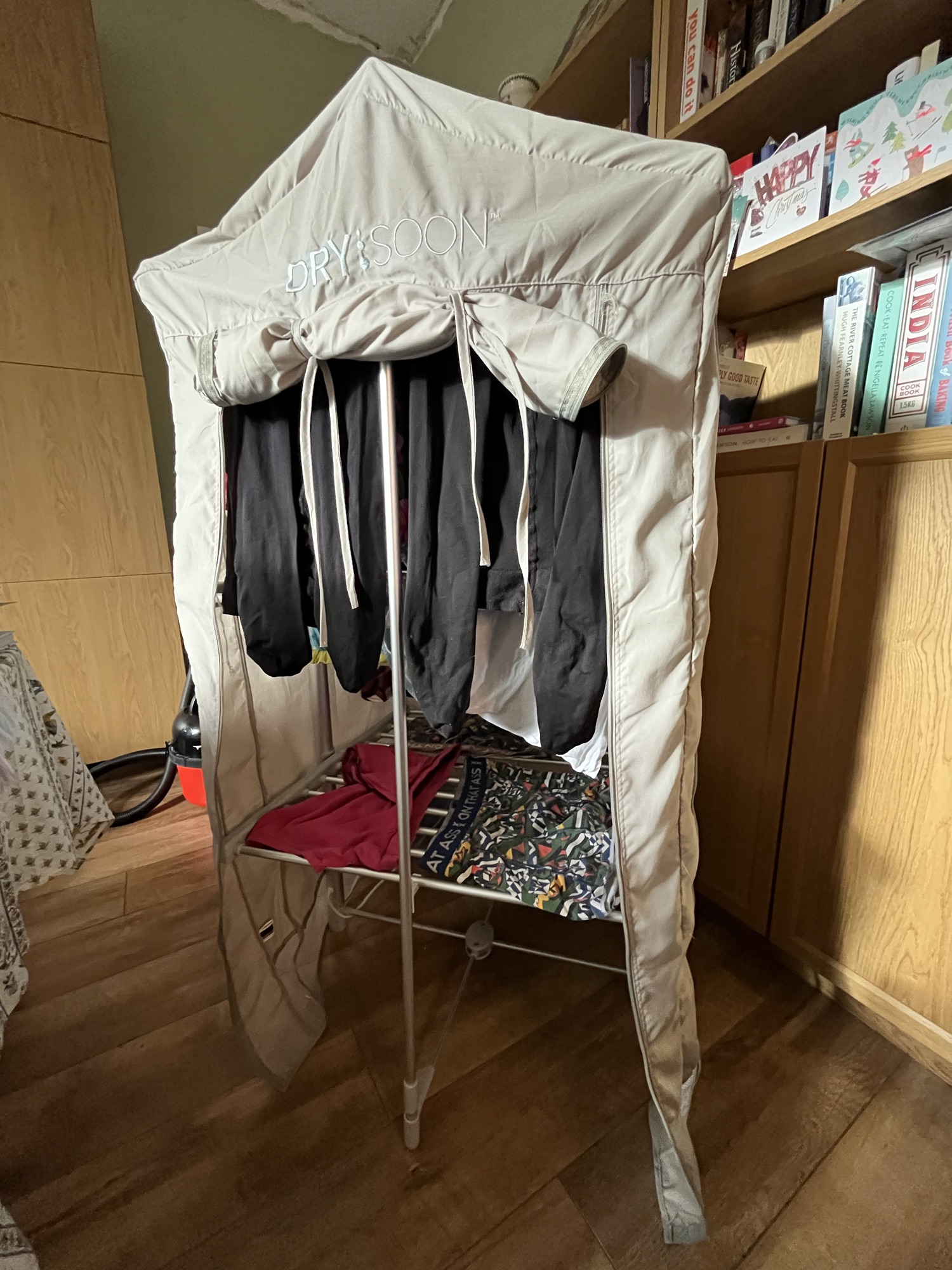
A Dry:soon heated airing rack, for drying laundy

So we needed a way of drying our laundry indoors that doesn’t use the tumble dryer. For this, we bought a Dry:Soon heated airing rack from Lakeland. The rack gently heats your clothes to dry them, and there’s an optional cover to go over the rack to keep the heat in.

These became popular in 2022 when electricity prices started to rise, as a cheaper alternative to tumble dryers. Indeed, they are cheaper to run than older condenser dryers. However, they don’t save much energy compared with our heat pump dryer, and so we just use it for clothes that can’t go in the tumble dryer.

How long clothes take to dry depends on how full the rack is and what material they’re made of, but I typically found 18 hours is enough to get all clothes completely dry. Our model doesn’t have a timer or a moisture sensor – just a rocker switch to turn it on and off. So I have it connected to a smart plug, and an automation in Home Assistant that turns it off automatically after 18 hours.

App of the Week: Laundry Day

A screenshot of the Laundry Day app on an iPhone

When you’re a child, your parents are usually kind enough to wash your clothes for you. This means that, when you become a responsible adult and have to wash your own clothes, it can be a bit of a shock. Especially if you own clothes which can’t be shoved in a standard mixed load wash at 40°C.

Most clothes include written washing instructions on the label, but will usually also have 5 symbols on which tell you what temperature you should wash it, whether the clothes can be bleached, tumble-dried or ironed, or whether you should take them along to the dry cleaners. These symbols are essentially a de-facto international standard, which is handy if you’ve bought clothes overseas and the care label isn’t in English.

To help you decipher these symbols, there’s an iOS app called Laundry Day. Give it access to your iPhone’s camera, and then point it at the care label of the garment in question. It’ll do its best to identify the symbols, and, with a tap of the screen, it’ll explain what each symbol means in plain English.

I found that the camera struggled a bit, especially on labels where the text had faded following many washes. In most cases, it wasn’t able to correctly identify all five symbols.

A screenshot of the Laundry Day app on an iPhone

Fortunately, the first tab of the app shows you every possible symbol, so if you’re having no luck with the camera, you can manually select the symbols and still get the information in a readable format. The last tab, ‘Help & About’, also offers some general tips for working with certain types of fabric like silk and wool. There’s a checklist as well – did you empty the pockets first?

It’s a handy little app and I could see many students wanting to use it when they first go to university come September. For years, our student magazine at Bradford used to have a page about washing clothes, with an explainer for the various symbols, in the freshers week issue. I suppose this is the more modern equivalent of it. And it’s more accurate than this list.

Laundry Day is 79p, and available on the App Store for iPhone.

It’s worth buying a new washing machine

Today, I’m going to talk to you about washing machines. We bought a new one last month, and it is so much better than our old one in several ways.

The new washing machine is this Bosch model, which is normally £399 from John Lewis. We actually paid much less, by combining loads of gift vouches from the wedding and a cashback offer that was on at the time. This is now installed in our new house.

Our old washing machine is the one in our flat. It’s a Hotpoint washer-dryer, so it will wash and tumble-dry our clothes in one process. It’s probably around 10-15 years old as we assume that it was installed when the building was converted from a mill into flats.

For a start, washer-dryers are never as good as stand-alone washing machines and tumble dryers. Indeed, the dryer part of our old Hotpoint machine is pretty rubbish – if you’re lucky, it’ll get a half load mostly dry in around two and a half hours after the wash cycle is completed. Bigger loads will come out wet.

But it’s also not that great at washing either. It’s okay, but takes its time, and the drum can only take 6 kilograms of washing – about 13 pounds in old money.

The new Bosch machine has a much bigger drum that can take 8 kilograms (17.6 lb), so we can wash a third more clothes in each cycle. It’s significantly quieter, and barely makes any noise apart from during the spin cycle, which is still comparatively quiet. This is good for us as the washing machine is in the kitchen, which is directly below the room that will become the baby’s room when it’s born.

As well as being a good price, we also chose the Bosch model because of its energy and water efficiency. It’s rated A+++ for energy usage, which is the highest possible rating, and it required the least amount of water. Indeed, it looks like it uses less water than our current machine despite being able to handle bigger loads.

Despite using less water and electricity, the Bosch machine still manages to be quicker than the old Hotpoint machine – even when you enable its energy efficient mode. So not only does it wash clothes more quickly, it costs less money to do so. And it has a countdown timer telling you how long it has left. Timers these tend to be standard on new machines nowadays but this is the first time I have owned one with a timer, and it’s really useful.

We chose to get a water meter fitted to the house, and so conserving water will save us money in the long term, as will the reduced electricity costs. Furthermore, as we’ve opted not to buy a tumble dryer, this will save us more money on electricity bills in future. The house has a drying rack in the kitchen and space outside for washing lines, which we don’t have in the flat. And with a little one on the way, we’re likely to be using the washing machine far more often than now.

If you have an old washing machine, I would advise you to consider a newer model. The improvements in energy and water efficiency may well save you money in the long term and make up for the cost of buying a new machine. We’re really pleased with ours.

Plus, if you get rid of your old machine, you can create silly YouTube videos like this one.