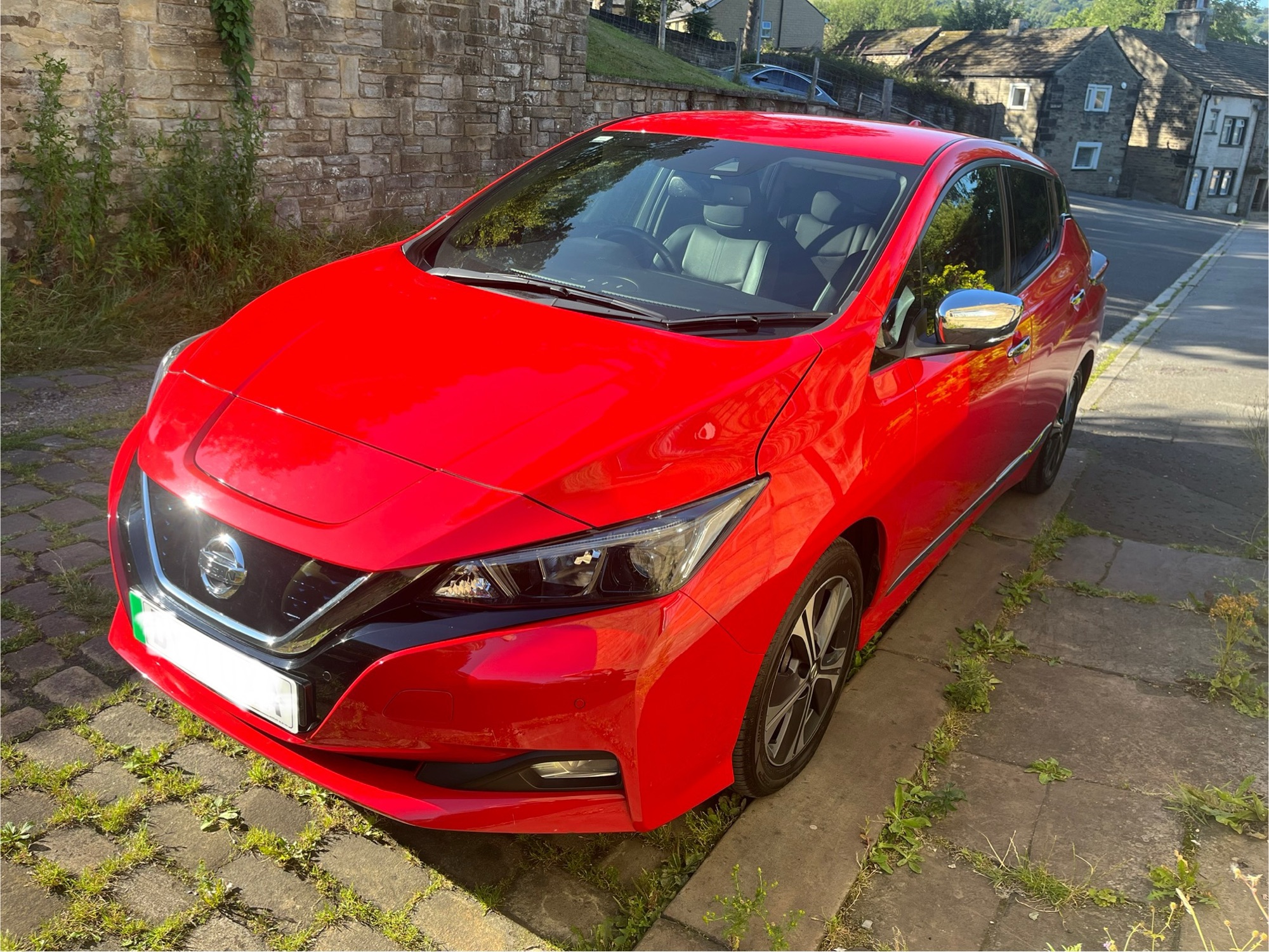
On Good Friday, we paid a visit to Knowsley Safari Park, on the eastern edge of Liverpool. This was actually our sixth visit, going back to 2018 when our nine-year-old was only two, but apparently I’ve never blogged about it before. We received gift tickets as Christmas presents from my parents.
Knowsley Safari Park is the only drive-through safari park in the North of England, and one of only six in the UK. You may know it from the Channel 4 series, the Secret Life of the Safari Park, which aired last year and is available to stream on 4oD, or whatever it’s changed its name to this week. For us in Sowerby Bridge, it’s only an hour’s drive in good traffic, despite being in Merseyside and on the other side of Manchester. However, its distance means that, in bad traffic, it can take much longer, and on a previous trip in 2019 I remember having to take a huge diversion via Preston and Burnley to get home, due to a closure on the M60.
The Safari Drive
Knowlsey Safari Park is split into two parts. As mentioned, there’s a drive-through safari, where you stay in your own car and drive (slowly) past lots of different animals. The drive is split into several zones to split the animals up, nominally by where you would find them in the wild. Expect to see lots of different species of deer and antelope, but there are also several rhinos and camels. There are also some wandering ostriches which like to peck at the rubber seals around your car windows.
Speaking of animals which like to damage cars, there’s a separate section for the baboons. The baboon colony at Knowsley is quite large, both in terms of space and population. There are warning signs as you drive in that your car will be damaged, and so there’s a ‘baboon bypass’ you can take if you’d rather not have a cheeky baboon steal your windscreen wipers. We drove through on our first visit in 2018, and ended up without some rubber windscreen seals that we weren’t able to replace. On subsequent visits, we’ve parked up next to the baboon enclosure for the schadenfreude of watching other peoples’ cars getting damaged.
The other animals that have their own section are the African Lions, mainly because they would probably hunt the other animals on the safari drive, given the chance. As well as cattle grids between each zone, you drive over electric webbing to enter the lion zone.
This time we also saw plenty of animals which weren’t part of Knowsley’s collection, that just happened too be there. There were plenty of pheasants, as well as partridges, oyster catchers and lapwings.
Foot Safari
The other part of Knowsley Safari Park is the ‘foot safari’, which is where you can park up your car and walk around, like in a traditional zoo. This is where you’ll see the Amur Tigers, tapir, giraffes, bears, sealions, bush dogs, meerkats and birds of prey. The foot safari used to be in a horseshoe shape, but since our last visit they’ve added a wildlife walk to make it a complete circuit. This also gives access to a new area with sheep and goats. We actually did this bit first, having arrived at opening time, and it was nice and peaceful.
Shows and displays
There are a couple of shows that are worth watching whilst you’re at the foot safari. The first is the sealion show, where they show the zoo’s sealions performing tricks. And the second is a birds of prey show, where they will fly several of their birds. The sealion show is indoors, and the birds of prey show is either indoors or outdoors depending on the weather. Though the weather on Good Friday wasn’t great (definitely worse than recently and Good Friday last year), the birds of prey show was outside. There are also various talks about the animals on the foot safari at set times.
The shows are all in the afternoons, as I think the expectation is that you’ll do the safari drive first and then the foot safari. We did it the other way around, as we expected the weather to be worse later on. Compared to other zoos, being able to use your car to drive through has its advantages in bad weather.
Most people will drive to Knowsley Safari Park, and it’s located just off the M57 (which itself isn’t far from the M62). But it is reachable by public transport – the nearest town is Prescot, and there’s a direct bus from the bus station there. You can also get the train to Prescot and walk – it takes about half an hour, apparently. If you want to do the safari drive, but haven’t arrived in a car, then you can take the Baboon Bus. You need to pre-book, and my experience you should book at least a couple of weeks in advance. It goes around the whole safari drive, including the baboon enclosure. It’s fitted with ropes and things for the baboons to climb on, and presumably they have access to a good supply of spare parts.
The foot safari is almost exclusively on one level, and where it isn’t, ramps are provided. There are two Changing Places toilets on site. Assistance dogs are only allowed outside of the animal areas, however; kennels are provided if needed.
Also, I feel it’s worth mentioning that the food at Knowsley Safari is above average, compared to most other zoos, and it’s not too over-priced. Sure, you can have the usual hotdogs and burgers, but I had quite a nice katsu curry when we went.
Yes, I’m writing about transport in London again, even though I live the best part of 200 miles away. This time, it’s about the ongoing efforts to get diesel trains out of the capital, and what progress is being made. I’m going to look at each of London’s rail termini in turn, and see what proportion of trains are running on electric power.
Background: London’s air quality problem
London, like many cities, has had an air quality problem for centuries. There was the Great Stink in 1858, the rise of pollution during the Industrial Revolution, and more recently, emissions from transport. Though I’ve never lived in London, I’ve made regular visits over the years, and still remember having black snot from the poor air quality.
The good news is that air quality in London is improving. Over the years, the Ultra-Low Emission Zone has expanded to cover just about all of London, and reduced the number of polluting vehicles on the road. Improving air quality has been a particular aim of mayor Sir Sadiq Khan, who has even written a book about it(sponsored link). It’s worth a read – it’s relatively short but gets the message across.
But the ULEZ is just about road transport. Today, I’m focussing on rail transport, and specifically looking at the twelve key London termini. Long-distance rail travel in Great Britain is generally focussed on London, and so if you get rid of diesel trains from London, you also get rid of them from other parts of the country too.
Cannon Street
Starting alphabetically, Cannon Street is the first terminus, and one that I personally have never been to. For many years, it was never open on Sundays, although it has operated seven days a week since 2015. All the trains to Cannon Street are operated by Southeastern, who only operate electric trains. So, Cannon Street is fully electrified – probably a good thing, as it’s an enclosed station with low ceilings.
Charing Cross
A little further west along the River Thames is Charing Cross. Like Cannon Street, it too has low ceilings due to over-site development, and is also only served by Southeastern. So, no dirty diesel trains here either.
Euston
Euston was controversially rebuilt in the 1960s as part of the then British Rail’s upgrade of the West Coast Main Line. This included electrification, and so nowadays almost all of the trains which operate from Euston are electric. Avanti West Coast operated a few diesel services to Chester and onwards to North Wales, but are being replaced with new Hitachi bi-mode trains that can operate on electric power as far as Crewe in Cheshire.
There may be some diesel visitors to Euston on occasion, as services that would normally call at Paddington are diverted to Euston during construction work at Old Oak Common. This includes the Night Riveria Sleeper, and some of GWR’s Hitachi bi-mode trains that may have to run on diesel power as they navigate through their diversionary routes.
Fenchurch Street
Fenchurch Street is the smallest of London’s rail termini, with just four platforms. It’s another one that I’ve never been to, as I’ve never needed to go to places like Tilbury or Southend. If I did, I would be able to catch an electric train there courtesy of c2c, whose entire fleet is electric. Indeed, the lines out of Fenchurch Street were some of the first to be electrified using overhead cables in the late 1950s.
King’s Cross
Being from Yorkshire, King’s Cross is the London terminal I’m most familiar with. Most (but not all) of my rail journeys to and from London include King’s Cross.
Though overhead electric wires were strung up for commuter services in the 1970s, the wires didn’t go north of Peterborough until the 1990s. Even then, British Rail still operated a mixture of electric and diesel trains (the venerable High Speed Train) and this persisted until very recently. Their replacement came in the form of more of Hitachi’s bi-mode trains, introduced by LNER. Such trains are also operated by open access operators Hull Trains and Lumo (although Lumo’s trains are all electric).
The outlier is another open access operator, Grand Central. Whilst they operate a small fraction of the services from King’s Cross, at present, they’re all still diesel-powered. That’s due to change, once again thanks to Hitachi who are building some tri-mode trains that can run on electric wires, batteries and diesel. The order for these was only announced a few weeks ago, so it’ll be 2-4 years before we see the back of the last purely diesel trains from King’s Cross, but there’s good progress being made.
Liverpool Street
I’ve only ever been to Liverpool Street mainline station once, which was to use the Stansted Express back in 2009. That was, and still is, an electric train, and indeed all the trains that operate from Liverpool Street are electric. Well, almost: Greater Anglia has a small fleet of bi-mode trains, which for once are not made by Hitachi but by Stadler. Occasionally these run to Liverpool Street, although their main stomping grounds are across Norfolk and Suffolk running regional services. In any case, they should run on electric power when available, so we can tick off Liverpool Street as being electric.
London Bridge
London Bridge underwent a stunning rebuild in the 2010s. I used the old station a bit pre-rebuild and it was awful – the new station is much better.
In the 1930s, the then Southern Railway invested in extensive electrification of its lines, using the third rail principle. Instead of overhead wires, a third metal rail is added to the outside of the two running rails and trains pick up power that way. As such, almost all of the railways in the south-east of England are electrified. Indeed, many have never routinely hosted diesel trains, having gone straight from steam to electric.
However, a handful of lines didn’t get electrified, including services to Uckfield along the Oxted Line. Therefore, there’s a small fleet of diesel trains that serve London Bridge.
Marylebone
Oh dear.
We were doing so well, weren’t we? Seven stations in, and all were either completely electrified, getting there, or had just a handful of diesel services. And then Marylebone has to ruin everything for us.
Okay, so Marylebone is quite a nice London terminus. Whilst not as small as Fenchurch Street, it’s still quite dinky and less overwhelming than some others. It survived closure in the 1980s, and Chiltern Railways has been one of rail privatisation’s few success stories, with new services, new stations and improvements to infrastructure. Indeed, if you want to get a train between London and Birmingham, and don’t mind it being a bit slower, it’s much nicer going from Marylebone to Birmingham Moor Street.
But Marylebone isn’t electrified – at all. Every service that terminates there is a diesel train. And it shows – the last time I was there, there were advertising boards proudly telling us that they had air purification technology built into them. But this wouldn’t be necessary, if the trains that were calling there didn’t spout diesel fumes.
There have been some lacklustre efforts to improve the situation – one of Chiltern Railways’ trains was modified to be a diesel-battery hybrid, and it could use its battery at low speed and in stations. Alas, this was never rolled out to other trains in the fleet. Also, the oldest of Chilterns’ trains are now around 30 years old and need replacing, so putting up electric wires would be timely to prevent a new order of diesel trains.
One issue is that trains from Marylebone to Aylesbury share track with London Underground’s Metropolitan Line services (a relic from when the Metropolitan Line went all the way to Aylesbury). These lines are owned by Transport for London, and electrified using a unique four-rail system. Any electrification scheme would need to take this into account, especially as TfL probably won’t want overhead wires stringing up over their infrastructure. Dual-voltage trains, which can run on both overhead and third-rail electrified lines, are a thing and are used daily on Thameslink services, for example, but this would need careful planning to work out.
Moorgate
Moorgate is a London terminus, albeit of just one line nowadays – the Northern City Line. Historically, this line was considered part of London Underground and was grouped with the Northern Line, and so it’s electrified.
Until the 2010s, some Thameslink services terminated here too, but these were axed to allow platform extensions at Farringdon station. They too were electric though.
Paddington
Paddington was a latecomer to the electrification party (which sounds like a round from I’m Sorry I Haven’t A Clue). The first electric trains started in the late 1990s, and even then, it was just the new Heathrow Express service. However, the announcement of the Great Western Main Line Electrification project allowed it to catch up, with electric wires extended all the way from Airport Junction in West London across the Welsh border into Cardiff. However, that project also went massively over budget, and as such, lines to Bristol and Oxford never received their wires.
Whilst some electric trains run from Paddington, the majority are those Hitachi bi-modes again, which can run on electric power where available and switch to diesel if needed. This has meant that Paddington has moved from having only a handful of electric trains in the 2000s, to being almost entirely electric now. There’s just a handful of commuter trains at peak times that use diesel Networker Turbo units, and the Night Riveria Sleeper train, which uses diesel locomotives. Perhaps, in future, the Night Riveria will be hauled by bi-mode locomotives, such as the new Class 93 and Class 99 locomotives under construction.
See Marylebone? It can be done.
St Pancras
The rebuild of St Pancras for High Speed One services was excellent. I have vague memories of the tired old station, and now it’s much better.
However, there are still a few diesel trains plying their trade at St Pancras. These are the trains which take the Midland Main Line up to Sheffield and Nottingham. This line should have been electrified in its entirety by now; instead, it’s being done on a piecemeal basis and currently the wires are projected to stop just south of Leicester.
The good news is that new trains are on order – and yes, they’re yet more bi-mode trains from Hitachi, although they’ll be slightly different than the units used by other operators. And East Midlands Railway has introduced electric trains from Corby into St Pancras – impressive as Corby station only re-opened in 2009.
Victoria
Victoria is big and confusing. I’ve used it a few times and can’t say I’m a fan. But all the trains that run from Victoria are electric, so that’s good.
Waterloo
Until the Elizabeth Line came along, Waterloo, with its 24 platforms, was the busiest station in the UK. Now it’s third, but still very busy.
It’s also a bit like London Bridge, in that the vast majority of trains are electric, but a handful of diesel services limp on to serve places beyond the reach of the third rail network. Doing something about these services is more pressing than those from London Bridge to Uckfield, as the trains are older and due for replacement. Various ideas have been floated around, but it seems probable that we’ll see existing electric trains getting batteries bolted onto them, and some discontinuous electrification to charge them up. That could be some of the new Class 701s, which have had one of the most protracted entries into service of any new train, or some Class 350s which are about to go off-lease from London Northwestern.
Conclusion
Overall, the majority of train services into London are already electric, including all services to seven of the twelve stations. Of the remaining five, diesel trains make up a small number of services at three of them, and we’ll likely see the back of the last remaining diesel trains at King’s Cross and St Pancras by the end of the decade. The lack of any sort of electrification at Marylebone is a bigger problem to tackle, but then Paddington has gone from being all diesel to almost all electric within 30 years; indeed much of that progress has been within the last 10-15 years. It’s also clear that bi-mode trains have a future until further electrification outside the capital takes place.
The weekend before Easter, we went to the National Emergency Services Museum in Sheffield. It’s a place we’ve been past a few times and so it’s been on our to-do list for a while, but this was our first visit.
The museum is housed in what was originally rare example of a combined police, ambulance and fire station, which opened in 1900. Over time, the various services outgrew the building and by the time it closed in 1965 only the police remained. The museum first opened in the year of my birth, 1984, originally just as fire service museum. It became a fire and police museum in 1991, and adopted its current name of the National Emergency Services Museum in 2015 following an extensive refurbishment.
Whilst the building is rather small, there’s a lot packed in there. It’s spread over three floors, with a yard at the back that houses a full-sized lifeboat and an Embrace ambulance. Inside, there are a number of police vehicles, ambulances and firefighting equipment, and you can also go inside some of the old police cells. Upstairs, there are galleries about the role of the emergency services on the front lines during the First World War, and a history of fire services in the UK.
Steamers and Scallywags
The principal reason that we went when we did was the Steamers and Scallywags event. Many of the staff were dressed up in Steampunk outfits, and there were market stalls in the stables. Upstairs, in the event space, you could try your hand at tea duelling, and there were regular performances from various Steampunk-adjacent acts over the weekend. We specifically went to see Madam Misfit, who we’ve seen before. This was our nine-year-old’s first time seeing her and she put on a great family-inclusive performance.
Elsewhere, there were animal handling sessions where Christine and our nine-year-old got to handle various snakes. I feel like there may be a pet snake in our future.
Commitments in the morning meant that we could only spend an afternoon at the National Emergency Services Museum, and as we prioritised the Steampunk activities, we didn’t get to see all of the rest of the museum. Thankfully, it’s one of those museums where your tickets can become an annual pass at no extra charge, and so we’ll be back soon.
Accessibility
The National Emergency Services Museum is located in Sheffield city centre, and so it’s quite easy to get to by public transport. Car parking is also available nearby – we parked at the NCP car park on Solly Street which is just around the corner.
Being a 125 year old building, accessibility isn’t perfect and there are some uneven surfaces on the ground floor. This is also reflected by a discounted entry fee for wheelchair users. However, there is a lift and most of the doorways are nice and wide to fit wheelchairs through. There is a disabled toilet on site. A sensory map and sensory backpacks are available.
NHS staff (like Christine) and people who work in the emergency services get discounted admission. The museum is normally open Wednesday to Sunday each week, and on Bank Holiday Mondays.
As usual, we’re spending Easter with my parents in York. Christine was working yesterday, and so we travelled over last night. We’ll be heading back home tomorrow on the bank holiday. Whilst we have no specific plans, should the weather be nice, we’ll hopefully get out and see places. It’s either that, or spend a quiet weekend gently stuffing our faces with chocolate.
One advantage of the Zigbee smart home protocol that I didn’t mention in last summer’s comparison was Bindings. This is where you bind a function of one Zigbee device to another, allowing the first device to control the second device directly.
Zigbee, as you may be aware, is a mesh network protocol. That means that every Zigbee device will connect to every other Zigbee device in range. Now, every Zigbee network also has a Controller, which is a device that issues commands to the network. In my case, this is my Raspberry Pi running Home Assistant, with a Sonoff ZBDongle-E plugged into it.
The advantages of bindings
However, when you bind two devices together, they can issue commands directly, without needing to go via the Controller. This is useful, because it means that devices can still work, even if your Controller is offline.
For example, let’s say you have a Zigbee motion sensor in your bathroom. You can set up a binding so that, when the sensor detects motion, it’ll turn on the bathroom lights. Once the binding is saved, this will work regardless of whether your Zigbee controller is online.
The other key advantage of bindings is that they should be faster. We’re probably only talking micro-seconds here, but as commands can be sent directly from one device to another without a round-trip to the Controller, they should be a little more responsive.
If you’ve ever bought Ikea TrĂĄdfri bulbs, these usually come with a remote that has already had a binding set up. That way, the remote will work with the bulb out of the box without an Ikea Dirigera hub (or other Zigbee controller). But both can also be paired with a Zigbee controller if you have one.
In Zigbee2MQTT, you need to select your device, and then go to the ‘Bind’ tab. It’ll then expose a list of ‘endpoints’ that can be bound. In my experience, these are just numbers, so you may need to experiment to see what, for example, ‘endpoint 242’ controls. You can then bind this to the endpoint of any other Zigbee device to control it.
It’s worth noting some key points here:
Not all Zigbee devices support bindings
Those that do may only allow expose limited endpoints for binding, so you won’t be able to control all aspects using bindings.
For example, I have some Zigbee colour lights (which I used in my grouping example). I can bind them to another Zigbee device to turn them on or off, but not to change the colour. That still requires communication from the Zigbee controller.
Other protocols
If you have more than one Z-Wave device, then you can set up ‘Associations‘ between devices which work in a similar way to Bindings in Zigbee. Home Assistant users can set these up using the Z-Wave JS UI addon. I’m not aware that Matter offers anything similar.
In most years, schools have their two week Easter holidays either side of the Easter weekend. But this year, Easter falls comparatively late – Easter Sunday will be the 20th April and a full three weeks later than last year.
If schools were to stick to the ‘two weeks either side’ model, that would mean they would be off this week and next week, with kids not back at school until the 28th April. It also means that the spring term at school will have been longer than normal, leaving a long stretch of teaching from Christmas onwards, and then a compressed summer term. So, our nine-year-old’s school is now in its second week of the Easter holidays, having had last week off as well. School re-opens the day after Easter Monday, on Tuesday 22nd April.
But not all schools are doing this. One local secondary school had an extended half term break before Christmas, giving them two weeks in October/November, and then shortened the Easter holidays to just a week and a bit. Over in South Yorkshire, they’re already done with their Easter holidays – they broke on the 28th March and were back at school on Monday. The actual Easter weekend is therefore detached from their Easter holidays. I suppose this keeps the spacing of the holidays more consistent but it feels a bit weird to have ‘Easter holidays’ that don’t include the actual Easter weekend.
My workplace always offers a customary holiday on the day after Easter Monday, and so I’ll be off work when our nine-year-old goes back to school. It gives me an extra break, I suppose.
Next year’s Easter holidays
In 2026, Easter Sunday will be a couple of weeks earlier on the 5th April. And, certainly where we are, that means a return to the standard pattern where the Easter holidays wrap around the Easter weekend. It’ll be another week earlier in 2027 as Easter Sunday will be the 28th March.
If you need to know when school holidays are, you can check local authority web sites which usually have dates for both this year and next year. However, individual schools may vary their dates – especially if they have Academy status.
The latest date for Easter
Wikipedia has a list of when Easter falls, and, in particular, the earliest and latest possible dates for Easter. Easter Sunday is comparatively late this year, but the latest possible date is actually the 25th April. The last time this happened was in 1943, and it’ll happen again in 2038. We’ll also have a late Easter in 2030 when it falls on the 21st – a day later than this year.
The earliest date for Easter is the 22nd March, and the last time this happened was before living memory, way back in 1818. Indeed, the next time it happens will also be (most likely) beyond the lifespan of anyone living today, as it won’t be until 2285. However, Easter Sunday fell on the 23rd March in 2008, something which I apparently didn’t blog about at the time. A shame, because the next time Easter Sunday falls on the 23rd March will be in 2160.
So, is it the Easter holidays?
So, to answer the question I posed in the title of this blog post: it depends. Most schools are off this week (the roads have definitely been quieter) but not all of them are. It’ll most likely be back to normal next year though.
Last Sunday, we spent an afternoon at Fairburn Ings, an RSPB nature reserve that straddles the border between North and West Yorkshire.
Fairburn Ings was previously used for coal mining and industry, until the 1950s. It’s been left to return to nature, and is now a series of ponds, lakes and bogs, with the River Aire flowing past. These wetlands have attracted many birds, and it’s now run by the RSPB who have a series of hides across the site, and a visitor centre.
The visitor centre sits in the middle of the site. On our most recent visit, we walked around the western side of the site, in the hope of seeing some spoonbills. Alas, we didn’t, but we saw plenty of swans and cormorants, along with a black-necked grebe which isn’t native to Britain. We also saw a white egret.
There are a number of marked footpaths around the site, but many areas are kept out of bounds to give safe spaces to the wildlife. The visitor centre has binoculars for sale and to hire, and you can also hire a pond dipping kit for kids.
About 10 minutes drive away is another RSPB reserve at St Aidans – indeed, the two are jointly managed, and you could combine both as a single day out. We actually planned to go to St Aidans, but couldn’t get parked; it seemed that with the recent lovely weather, lots of other people had the same idea.
Accessibility
Fairburn Ings is near the village of Fairburn, which until 20 years ago was bisected by the A1 but is now a relatively quiet backwater. You probably want to drive there, as there aren’t any buses that get particularly near Fairburn Ings, and the nearest railway station is three miles away in Castleford.
There are two car parks at Fairburn Ings; the central one is run by the RSPB and is close to the visitor centre. There’s a separate one run by Leeds City Council at the western end. Both are pay and display, but otherwise entrance to Fairburn Ings is free.
Whilst there are few steps on the site, the ground is often uneven and there are some steep slopes. The visitor centre has a disabled toilet, but if you need a Changing Places toilet, you’ll need to go to the Junction 32 Outlet or Ferrybridge Motorway Services which are both a short drive away.
It’s been a particularly good Spring, hasn’t it? Lots and lots of sunshine, warm daytime temperatures, and almost no rain. It’s almost like the lovely Spring that we had in 2020, but without the lockdown restrictions. As such, we’ve been able to enjoy it a bit more.
As solar panel owners, it’s been particularly welcome. In March, our solar panel system saved us ÂŁ50 by not needing to import energy from the grid, and we exported another ÂŁ25 of excess electricity. And this month, despite us not being halfway through yet, we’ve already exported ÂŁ25 of electricity. Overall, we’ve certainly exported far more than we’ve used from the grid. However, we’re having some issues with our smart electric meter not reporting usage, and so I’m not able to properly quantify this yet.
Although it’s been cold at nights, we’re still using less gas and electric than we would typically use at this time of year thanks to the nice weather. It’s been warmer during the day, and we’ve been able to dry more laundry outside too. We haven’t used our heated drying rack for a few weeks now.
Energy prices
Speaking of energy prices, I’m hoping that this will mean that Ofgem’s Energy Price Cap will go down when it changes again in July. The warmer weather should have reduced the use of gas central heating, and the increased contribution of solar energy will have reduced the amount of gas that’s burned to generate electricity. Seeing as it’s mainly wholesale gas prices that drive the price cap calculations, reduced demand for gas will hopefully see the price cap fall.
Hosepipe bans
It’s been that long since it rained that I can’t remember the last wet day that we had. Which has been good for getting out and about, but not so good for keeping the reservoirs topped up. Rain is forecast for next week, but if the general trend is for lots of hot dry days, then I wouldn’t be surprised if we end up with a hosepipe ban in the summer.
If you want to plan now for a hosepipe ban and don’t already have a water butt to store excess rainwater, consider getting one from Save Water Save Money. Pop your postcode in to find out if you can get one subsidised by your water company. They’re at least ÂŁ10 cheaper than elsewhere, as long as you’re prepared to wait around six weeks for delivery. We haven’t invested in one yet (we need additional work doing on our guttering) but it’s something to consider.
One thing we have bought in response to the warm weather has been a portable air conditioning unit. British homes are not typically built with air conditioning systems (and our house is around 100 years old in any case). Whilst the nights have been cold, I’m fully expecting that, if this good weather continues, there will be some hot nights on the way. A standard pedestal fan can help keep you cool by blowing away sweat, but it can’t cool the air in a room. Once it’s arrived and I’ve had time to evaluate it, I’ll do a blog post.
Last week saw the release of Home Assistant 2025.4, and with it, a new type of dashboard called Areas. This is an automatic dashboard, managed by Home Assistant itself, which displays your devices sorted by room, or ‘area’. At present, it’s ‘experimental’, but I wouldn’t be surprised if it becomes the default in future.
The default dashboard in Home Assistant is also automatically managed, but if you have more than a few devices and integrations, it can quickly become overwhelming. Therefore, my default dashboard is one that I manage myself. I can decide what to show, and in what order. However, it’s taken me quite some time to build and tweak that dashboard, and at one point I had almost 30 different cards showing. I’ve reduced that somewhat, and now use badges to highlight information that I need to know, but it still represents a significant investment of my time.
The new Areas dashboard therefore sits somewhere in the middle. The first tab shows an overview of your home, with sections for each ‘area’ that you have defined in Home Assistant. Most people will make each room an area, but it’s up to you – you may define parts of a room as a distinct area, for example. Personally, I’ve gone down the room = area paradigm, but I also have areas for ‘roof’ (where the solar panels are) and ‘outside’.
Setting up your home’s areas
You can set up your home’s Areas in the Settings pane in Home Assistant. When you do so, you can also specify any entities that represent the temperature and humidity in that room. This is useful, as these entities will then show up on your Areas dashboard.
Once you have defined your areas, you’ll need to add your devices to these areas. Again, in Settings, navigate to the Devices section. You can sort your devices by Area, so you’ll be able to see which ones are not allocated. Some of these ‘devices’ will represent virtual things, like HACS integrations or web services, so you don’t necessarily need to allocate these to a room.
Adding the Areas dashboard
Again in Settings, you’ll need to open the Dashboards pane. Here you’ll typically see three dashboards there already. These will include your current default dashboard, the built-in energy dashboard and the built-in Map dashboard. At the bottom right, click ‘Add Dashboard’, and choose ‘Areas (experimental)’. Give it a title and an icon, and then enable to show in your sidebar. Once done, you’ll be able to access it at any time from the side bar.
Initially, every area that you have defined will have a section and a tab along the top. If you click the Pencil icon at the top right to edit, you can re-order the areas, and also make any invisible. You may want to do this if the dashboard doesn’t show anything useful for that particular area. If you click into each area, you can also hide any devices that you don’t want to see on the dashboard. For example, in my screenshot, each programme on my Bosch dishwasher shows as an individual entity; I can therefore hide all of those apart from the dishwasher’s power status if I want to.
The areas dashboard is still experimental
We’re only a week on from this feature having been made available in Home Assistant, and so it’s still ‘experimental’. In particular, you’ll only see a handful of devices on this dashboard. In my case, this includes lights, sockets, my dishwasher, my TV, media players, and thermostats.
But it’s a lot easier to set up and manage than it would to create a new dashboard from scratch. And it’s less overwhelming than the other default managed dashboard, which shows a huge amount of data. As time goes on, I hope that the Areas dashboard is developed further and becomes the new default. It’ll make Home Assistant feel more like other smart home apps like Google Home, and make it easier for new users to manage.
Back in December 2023, I wrote about why you shouldn’t give gift cards as presents in the run-up to Christmas. I still stand by that, but wanted to expand on the last section of that post about when it is appropriate to buy gift cards. Because, it turns out, buying gift cards can actually save you money.
This is all about exploiting the difference between the actual cost of gift cards, and their value. Go to any supermarket, and there’s usually a display at the end of an aisle full of gift cards for various other shops, restaurants, cinema chains, subscription services and the like. When you buy one of those cards, a small percentage of what you pay goes to the shop (otherwise they’d be selling them at cost price). To give an example, when you buy a ÂŁ10 gift card, 50p of that ÂŁ10 may be kept by the shop, and the gift card supplier gets ÂŁ9.50.
What we can therefore do is find places that, instead of pocketing that 50p, they pass some of that on to you as a saving. It’s a bit like cashback sites like Quidco(referral link), where they share some of the money they get as commission with you. I’ve listed a few options below:
Pluxee and other employer schemes
I work for an employer who is signed up to Pluxee. This means that I can buy online gift cards, usually at a 3-5% discount, for many stores. The ‘big four’ supermarkets are included, as are the likes of M&S, Boots, and many online retailers. It also handily keeps track of how much money I’ve saved – we’ve had it for close to ten years now and collectively I’ve saved over ÂŁ100.
You can use it for big ticket items – back in 2020, I bought our LG TV mostly using Curry’s vouchers. At the time, the discount was 8% (I think) and at present it’s 6%. Ultimately it knocked around ÂŁ25 off the cost of the TV.
The big advantage of Pluxee is that you can buy the gift cards and be able to use them almost straight-away. So, say you’re in a supermarket, and you’ve used one of those handheld scan and ship gizmos, so that you know exactly how much your shopping will cost. You can then quickly buy a gift card for that amount, go to the checkout, and use it to pay for your shopping.
Costco
Another place to buy gift cards at a discount is Costco (something I didn’t mention in my overview last year). As with most things from Costco, you have to buy in bulk. For example, you can buy five ÂŁ20 Pizza Express gift cards, collectively worth ÂŁ100, for ÂŁ85 – that’s a 15% discount, and better than the 7% I get with Pluxee. You can buy the cards both in-store and online, and the online prices include postage.
Bear in mind that these are physical gift cards, and so you will need to actually buy them from the shop, or wait for them to come in the post. You can’t just buy one whilst waiting for your bill in a restaurant, for example. And you’ll need to be a Costco member to take advantage.
Sprive
I did a more detailed overview of Sprive last April. Sprive is an app for managing mortgage over-payments, but it includes a feature called Sprive Rewards for buying gift cards. It works in a similar way to Pluxee, except that the discount goes towards over-paying your mortgage. So, for example, if you buy a ÂŁ10 M&S voucher through Sprive, it’ll still cost you ÂŁ10, but Sprive will add another 40p onto your next mortgage over-payment for you.
The discount rates on Sprive tend to be lower than other apps – most supermarkets are only 2.5% for example. But it’s also the only place I’ve seen that offers Amazon gift cards, albeit at only 1%. However, one could argue that, because the savings are taken off your mortgage, you’ll save more in the long run due to lower interest payments.
If you do decide to sign up to Sprive, use my referral code HTWH65PM for an additional ÂŁ5 off your mortgage. Incidentally, in the year since I originally wrote about Sprive, we now own 63% of our home, up from 55%.
Obviously, Sprive is only of use if you have a mortgage, Pluxee is only available to people who work for certain employers, and Costco also requires a membership. So, for everyone else, there’s Snip:
Snip
If none of the above options are available for you, then you may wish to consider Snip. I haven’t used it myself, but it allows you to buy gift cards in a similar way to Pluxee. The catch is that there is a monthly (ÂŁ3) or annual (ÂŁ30) membership fee. Now, if you use Snip regularly, you will easily save more than the monthly membership fee – assuming that a typical supermarket gift card has a discount rate of 4%, then one ÂŁ75 shop per month would be enough to cover the fee.
Whilst savings of 3-5% may not seem like much, they do add up over time. This is why I like the tracker on Pluxee – saving a few pence here and there may not seem like much, but over the course of a year, it’s enough to pay for a trip to a cinema and a restaurant (which you could probably also pay for with gift cards). I will admit that it’s also a bit of a faff – I remember spending ages at a self-checkout in Ikea trying to get a voucher for 5% off, and struggling to get the payment to go through. It would be nice if things were just cheaper, rather than having to use workarounds like these.