2022 in review

Seeing as it’s the afternoon of the 31st December, I suppose it’s time to do a review of the year.

Overall, it’s been a good year. As Covid-19 restrictions have eased, we’ve been able to go out and do things, and at home we have a brilliant new kitchen.

Speaking of which…

The kitchen

I wrote in more detail about our new kitchen earlier this month, and now that our new fridge-freezer has arrived, it’s complete. It’s the first time either of us have had a kitchen that has been designed around our needs, and whilst we had to make some compromises due to the available space, it’s a massive improvement.

The kitchen was probably the biggest thing about 2022 for us; we broadly agreed the design in December 2021 but paid the deposit in February 2022, with work starting in earnest in May. This of course meant that April was spent preparing – moving everything we wanted to keep out of the kitchen and stripping wallpaper (I mean, who puts wallpaper in a kitchen? It was disgusting after years of grease and grime).

Work continued for several months and it wasn’t until September that we had our washing machine back; it then took over a week for our decorators to finish painting it. It’s done now, so we can start 2023 with a completed kitchen.

The holiday

In 2022, we had our first overseas holiday since 2019. 2020, and the pandemic, put paid to any holiday plans, and last year we decided to have a holiday in England rather than travel internationally. Note – I refuse to call this a ‘staycation’, which is a holiday you have based at home. Calling a holiday in your home country a ‘staycation’ is demeaning to those who can’t afford an overseas holiday.

We went back to France again, but to Brittany this time. Apart from driving through, I haven’t been to Brittany for many years, and it was Christine’s first time. We stayed at a static caravan site near Carnac on the west coast, and from there explored the area. We benefited from the on-site kid’s club to have some child free time, and a highlight was a visit to Parc zoologique du château de Branféré which is one of the best zoos we’ve ever visited.

We also came across the Museum of the Junkyard Poet, somewhat accidentally when looking for something else on TripAdvisor, and it’s a wonderfully whimsical place made of reclaimed junk and building materials.

It was a good break, and we’ve already booked another trip to France for 2023 – this time staying near Tours.

Work

Work has been busy this year – like most universities, we’ve experience a huge increase in applications from international students and they all need processing by admissions officers such as myself. I’ve had some changes to work – I’ve been able to delegate some responsibilities elsewhere but taken on others.

Whilst we started the year working at home full-time, thanks to scares around the Omicron variant, we were back to hybrid working within weeks and so I now spend a minimum of two days each work in the office. It’s an arrangement that works well for me; being at home some days is helpful as I can do washing or prepare dinner in the time that I would spend commuting, but some aspects of my job are easier in a formal office environment.

Things haven’t been universally positive – I applied for a couple of promotion opportunities and didn’t get them, although those that did are already showing that they’re a good fit for the roles.

I attended the AUA Annual Conference in Manchester in July, and this included graduating from my PG Certificate in Higher Education Administration, Management and Leadership in front of many of my industry peers.

Parenting

This year our child (who has a name and a gender but it’s not public knowledge, sorry) turned seven, and is now in year two (top of the infants). This meant a bigger role in this year’s Nativity play, which we actually got to see in person for the first time.

They’ve also started more extra-curricular activities; swimming, dancing and more recently karate. Considering that myself and Christine are borderline sloths, it can be a little exhausting having such an active child but we’re happy to support them in their own interests.

Days out and weekends away

As we have an annual National Trust membership, and because I’m from Yorkshire and therefore naturally tight with money, I keep a list of where we’ve been so that I ensure that we get our money’s worth. This year, we visited six properties:

  • Dunham Massey
  • Beningborough Hall
  • Tatton Park
  • Speke Hall
  • Hare Hill Gardens
  • Nether Alderley Mill

Dunham Massey, Hare Hill and Nether Alderley Mill were new properties, and Christine went to Speke Hall near Liverpool for the first time. Overall, we almost got our money’s worth from our annual family membership – just down by £6.70. It’s renewed for 2023 although we have visited almost every property within an hour’s drive of home now.

Other days out included the Yorkshire Wildlife Park, The Deep in Hull, the Blue Reef aquarium in Portsmouth (on the way to catch the ferry to France), the Tropical Butterfly House near Sheffield, Magna, Knowlsey Safari and our first visit to the Great Yorkshire Show since 2016.

We also had a couple of weekends away. November saw the return of Sci-Fi Weekender after a three year absence and it was good to see some familiar faces after such a long break. The following weekend, we had a weekend in London, including a trip to see Dippy at the Natural History Museum, the Science Museum next door, and the National Maritime Museum in Greenwich.

Health

My health has been good this year, and I’ve had the opportunity to be more active. We agreed a minor change to my asthma medication – same drugs but taken differently, which seems to result in my asthma being better controlled.

When I wrote this yesterday (31st Dec), I forgot to mention that I had Covid-19 in March. It was a minor case and I was able to continue working from home. It was probably the second time that I’ve had it, as I’m pretty sure that I had it in April 2020, but there wasn’t sufficient testing available at the time to check. I had my fourth Covid-19 jab in the autumn.

The big change is I’m now a hearing aid user. I meant to blog about this in more detail, but, you know, good intentions and all that. I have ‘moderate’ hearing loss, and have experienced issues with hearing for a few years now, but it took until this autumn to finally have hearing aids fitted. They’re standard issue NHS models, which means that they’re basic (no Bluetooth or phone connectivity) but haven’t cost me anything – even the replacement batteries are free. They’ve made a massive difference, especially when in the office at work.

Christine had her gall bladder out earlier this year, after suffering with gallstones. She’s doing much better now.

Looking forward to 2023

So that was 2022. It was a good year on the whole. I’ll aim to write more about what we have planned for 2023 – you never know, I may even finish it this side of June. I hope you have had a good year as well, and a good new year’s eve if you celebrate it (we’ll most likely be asleep).
Merry Christmas!

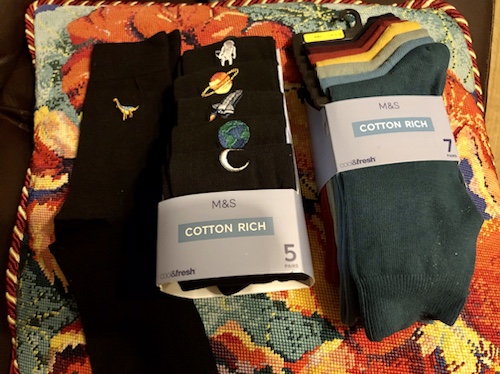
A photo of some socks received for Christmas as presents

It’s been a while since I’ve been able to write a Christmas blog post, what with having taken a few years out from blogging.

I received a variety of presents:

  • A bard outfit for future cosplay opportunities
  • A total of 13 pairs of socks (pictured above)
  • A handmade chopping board made by a relative
  • Plenty of chocolate
  • plus plenty of other things besides

We’re staying with my parents in York, as we normally do.

Christmas past

That being said, I was intrigued by Diamond Geezer’s list of places he has spent Christmas over the years, and thought about my own list.

As a child, from as early as I can remember, we would spend Christmas at my grandparents in East Yorkshire. This continued until my early 20s, when my grandparents became too old to host us and so my parents took on hosting duties. In Christmas 2008, we just had my grandfather over as my grandmother was in a care home by that point; she passed away in 2009.

This arrangement continued until 2012, by which time Christine and I had moved into our rented flat together. As a key worker in the NHS, Christine’s work patterns over the festive period meant that we had our first Christmas just as a couple – neither of us could drive back then so a parental visit wasn’t possible. 2013 was in York again but 2014 was back in the flat.

Christmas 2015 was also very different. By now, we had bought out house and I had passed my driving test and bought a car, but Christine was also heavily pregnant and so we didn’t want to stray too far from home.

2016 through to 2019 were back to normal, albeit with the addition of a small person. But then in 2020, the pandemic necessitated remaining at ours, so we had our second Christmas in our house and a scheduled Zoom call to speak to family.

Thanks to the various Covid vaccines, 2021 and now 2022 have been back to normal. However, I was surprised that I’ve only ever spent Christmas in 4 places, in almost 40 years of life.

If you celebrate Christmas, then I hope you have a joyous and merry one in whatever way suits you.

The joy of having a new kitchen

Back in 2019, my grandfather passed away, a few weeks shy of his 99th birthday. Whilst he had generally been in good health, considering his age, he had been taken to hospital with an infection. My grandmother had died 10 years earlier and we think he decided that it was his time to go.

This might seem like a rather sad and confusing way to start a blog post about a new kitchen, but his passing meant that I inherited a sizeable sum of money once all of his affairs had been sorted. We used some of this money to renovate our child’s room, a small amount was invested and I used some to fund a postgraduate university course.

The rest was used to renovate our kitchen. We moved to our current house in 2015, which is an early twentieth century property that’s needed quite a bit of work over the past 7 years. We renovated all of the rest of the downstairs before we moved in – mainly out of necessity due to damp issues – but had only made minor changes to the kitchen at the time. These were limited to a new washing machine, new power sockets and a new laminate floor.

The old kitchen mostly dated from the 1950s, when what was presumably a Yorkshire Range was removed and the chimney breast covered up. It had some new units and work surface in the 1980s/90s, when the previous owners also blocked up the access to the cellar underneath. So in all it was very dated, and once the money and opportunity came to renovate it all, we decided it needed updating.

We actually started the process over a year ago, although it wasn’t until February that we paid the deposit, and work started in May. During May we had a makeshift kitchenette in our dining room – we moved the existing fridge and freezer out, and purchased an Ikea Tillreda portable induction hob for cooking, in addition to our existing Instant Pot, microwave and kettle. Between these, we could cook most things that didn’t require an oven.

By early June the kitchen was substantially finished, but some small jobs weren’t complete until September and our decorators only finished painting it last week. As it stands, we don’t yet have the replacement fridge-freezer but it’s on order and should be here by Christmas.

Here’s an overview of what we changed:

  • Opened up access to the cellar. We removed the kitchen cupboards and work surface that were built over the steps down to the cellar, and installed a new bannister. We could then move our washing machine out of the kitchen and into the cellar, where it’ll soon by joined by a tumble dryer which we’ve not had before. This also gives easier access to our gas and electric meters, which we also had replaced with smart models, and gives us more storage space. As part of this, we had the cellar window replaced (the old one was broken and not watertight) and a radiator installed, along with plumbing and electrics for the washing machine.
  • Opened up the chimney breast. Previously there were some small but deep cupboards that were where the range presumably used to be, but these were awkward to access. Instead, we’ve got two wide draws for cookware and utensils, along with the hob and recirculation unit.
  • Induction hob. Speaking of these, we ditched our gas-powered oven and hob unit, and replaced it with an induction hob and two electric fan ovens. The old cooker unit was small and only had four rings; it was actually smaller than the space allocated for it and so we must have dropped all sorts down the side of it over the years. The replacement induction hob is twice the width and has five zones. It also heats up pans much quicker, although we had to replace the majority of our cookware as many of our older pans were not induction-compatible (i.e. they didn’t have any magnetic material in them). Not that this was a bad thing – many of our pans were cheap ones bought when we were students, whereas we could afford better ones this time. Switching away from gas to electric is also safer (no naked flames) and better for the environment, although we still have a gas boiler for heating and hot water.
  • Ovens. We opted for two identical large Bosch ovens, each with a grill, rather than a unit with a large oven and a smaller combination oven/grill (I believe Americans would call the grill a ‘broiler’). These are built-in and mounted off the wall with drawers underneath, making it easier to get food in and out of them. The ovens perform significantly better than our gas oven did – much shorter cooking time, and we particularly appreciate the pizza mode.
  • Recirculation unit. Above the hobs is an air recirculation unit, which sucks up cooking fumes, filters them and then has an exhaust back into the kitchen. Ideally we would have the outlet leading outside but this is still better than before: previously, we had an extractor fan that was on one window, well away from the cooker, and it hadn’t worked for a couple of years anyway.
  • New fridge-freezer. This hasn’t arrived yet – we only ordered it last weekend – but we decided to have one large unit that would replace the existing under-counter separate fridge and freezer. Both have seen better days; the brackets holding the bottle shelf in the fridge have broken off and the plastic drawers in the freezer are cracked. Plus, it’s not great having to constantly bend down to access the fridge, so we’ve gone with a wider, American-style fridge-freezer with the fridge compartment above. It’ll also have a cold water dispenser, which will be useful for me when working at home on hot summer days. It’s a Hisense model which seems to score well in independent testing.
  • More storage. One major issue with our previous kitchen was small cupboards, which we filled before we’d even unpacked all of our cookware, crockery and food. This time we’ve gone for more storage; the centrepiece being a full height larder where we can store (just about) all of our food and drink. We also have more, bigger drawers; like with the fridge-freezer, this should reduce the amount of bending down required. The major benefit of having more storage is that we can put more things away and keep our work surfaces clear – before, we had to keep all sorts out due to a lack of space and so often our utensils would get covered in grease.
  • Easier to clean. By being able to put more things away the whole kitchen should be easier to keep clean, and we’ve gone for relatively simple fixtures to facilitate this. We’ve also gone for painted walls; before, the walls were covered in wallpaper which over time had absorbed grease and all sorts.
  • Better lighting. Previously the kitchen had two long fluorescent strip lights, although I replaced these strips with LED bulbs a couple of years ago. Unfortunately one strip stopped working, and so we had a small Ikea clip-on light to illuminate the main working area, which helped but also meant we couldn’t close the cupboard door it was clipped to. In the new kitchen, we have under-shelf lighting for all of the worksurfaces, and seven spotlights in the ceiling.
  • Two radiators. When we moved in, there was just a small electric fire to heat the kitchen; when we had the new boiler installed in 2016, we had this replaced with a standard radiator but it had to be small to fit the space. That radiator is now in the cellar; whilst its replacement is also small, we have a much larger tall radiator at the top of the stairs down to the cellar. Apart from when the oven was on, the kitchen was one of the coldest rooms in the house before.
  • New smart dishwasher. The old dishwasher that was there when we bought the house was terrible; sometimes, our crockery would come out more dirty than when it went in, despite our efforts to clean it out. We didn’t specifically ask for a smart dishwasher but our kitchen company provided one – I understand that earlier this year there was a worldwide dishwasher shortage and that’s what they could get. As with the other built-in appliances, it’s Bosch, and uses Home Connect, which is fully compatible with Alexa, Google Assistant and IFTTT. Mainly it’s useful for getting a phone notification for when it’s finished, or when the salt or rinse aid needs re-filling, and you can ask Google how long it has left. Most importantly, it works really well as a dishwasher, and we’re able to use it more extensively than the old one, including washing cookware.
  • Tumble dryer. This is actually going in the cellar, but previously we had to use a ceiling mounted drying rack for drying clothes – which inevitably ended up smelling of bacon or whatever else we were cooking as well as getting in the way. Whilst we have also bought a heated drying rack, it takes around 24 hours to dry a full load, and having a tumble dryer will help for bulkier items like bedsheets and towels. It will use more energy, but we’re using the last of our savings to have solar panels and a battery installed next month; this was another reason for switching from gas to electric for cooking. We’ve opted for a Grundig dryer which is a heat pump model, and therefore has much lower running costs than condenser models.

We have had to make some compromises with the new kitchen, which is namely work surface space. To be able to fit in access to cellar and the larder, we have significantly less work surface available, but the extra storage means that we can actually keep what we have clear and so the amount of useable space is about the same as before. And as mentioned, we had to buy new pans from ProCook, but those that we’ve bought are a significant improvement over our old pans anyway.

It’s been a long journey, but by Christmas it should all be finished. Back in March I actually made a short video listing all the things that we hated about the old kitchen and how we’re addressing them, which informed this blog post. We’re very lucky that we inherited enough money to be able to get a kitchen which better suits our needs; it not only looks good but also works for us. I hope my grandfather will be happy with what his inheritance has allowed us to get.

We still have more work to do on the house; the downstairs is almost done but two of the three bedrooms need work in time, as does the stairwell and upstairs landing. We’ve done some redecorating in the bathroom which has made it look less 1980s but eventually it’ll need replacing. I’m hoping that we’ll be able to save some money once the solar panels and battery are installed next month.

WordPress in the Fediverse

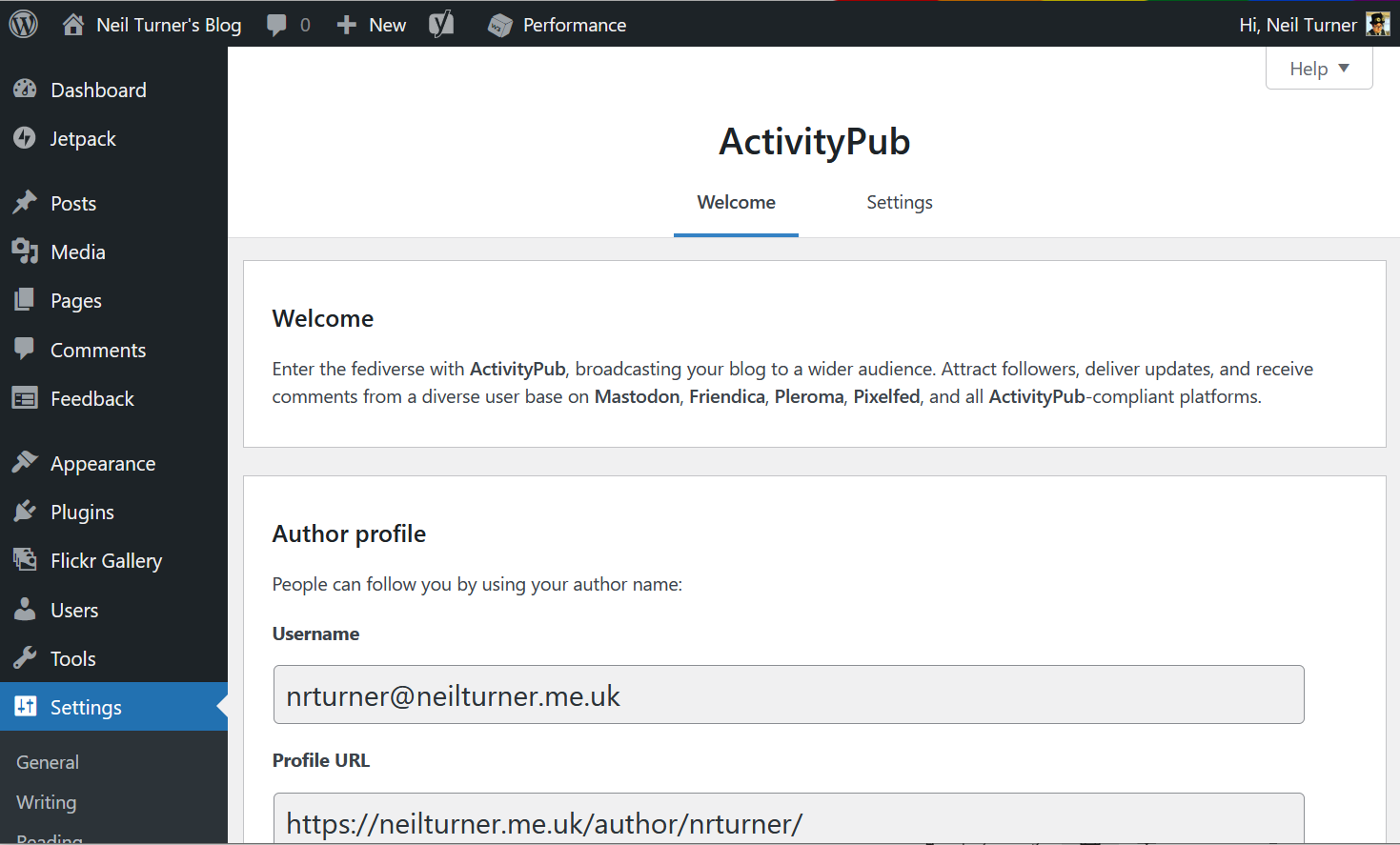
A screenshot of the settings page for the ActivityPub plugin for WordPress

If I’ve set up everything correctly, then you should be able to subscribe to this blog in your favourite Fediverse app, such as Mastodon, by following @nrturner@neilturner.me.uk .

You’ll need to install the ActivityPub plugin, and then it should just work where your fediverse username is @your-wordpress-username@your-domain.tld. If you’ve used a plugin to disable author archives, such as Yoast’s SEO plugin, you’ll need to re-enable it for this to work.

I found this guide particularly useful, as it links to Webfinger to test that you’ve set it up correctly.

(Update: since this post was written almost 12 months ago, the ActivityPub plugin has been formally adopted by Automattic and so enjoys wider support)

Good intentions and Mastodon

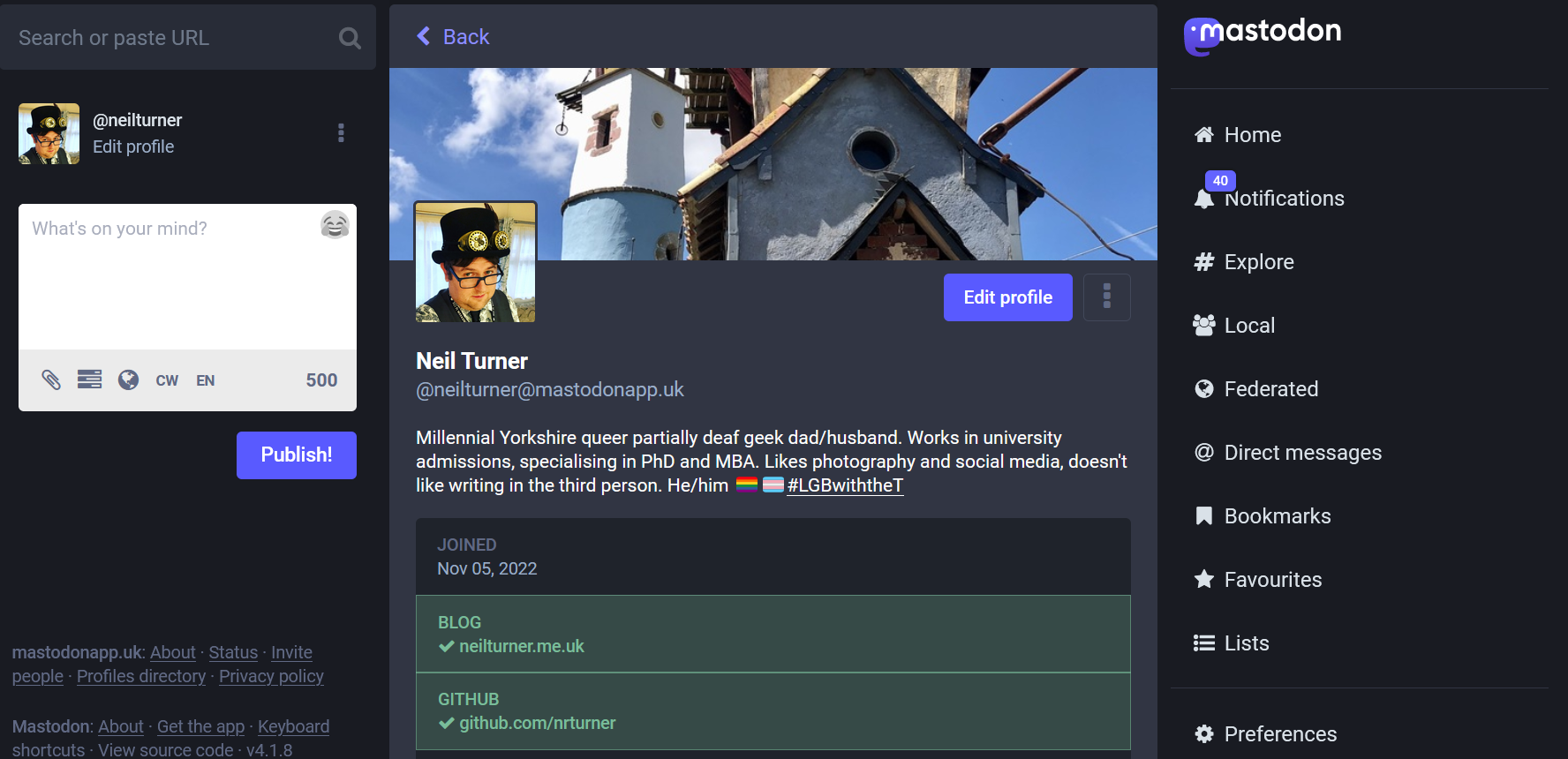
Screenshot of my Mastodon profile

Well, here was me promising to blog here more regularly, and then completely ignoring the blog for 5 months. Go me?

The main purpose of this blog post is to include a link to my Mastodon profile. As I write this, Elon Musk has taken over Twitter and looks to be unleashing his libertarian hellscape vision very quickly. Whilst I don’t intend to leave Twitter, I’ve decided to keep my options open and have set myself up on Mastodon.lol, which is an LGBTQ+-friendly server that doesn’t integrate with any servers that host fascists.

Whilst we’ve been here before with Ello, App.net, Google+, Clubhouse and innumerable other sites that have tried to compete with Twitter and failed, Mastodon seems to be the most popular ‘non-fascsist site’. Good, lord, what a thing to have to type.

We’ll see what happens, eh?

Home improvements

We bought our first home back in 2015, when my wife was pregnant. The house we bought is one that estate agents would describe as ‘having potential’. That’s not to say it was derelict, but it had dated decor and needed a lot of work doing.

We spent much of 2015 renovating the downstairs rooms – new plaster on the walls, new electrics and fixing various issues which meant that, whilst we got the keys in June, it was October before we could finally move in. In 2016, we converted a newly-partitioned room into a downstairs toilet, and had a new central heating boiler fitted.

Progress with renovating the rest of the house slowed down after this. Working full-time and having a child meant that we just didn’t have the time, and money was also an issue. But then in 2020 I inherited a sizeable amount of money from a deceased relative, and so we were able to start work again.

Whilst we had done a lot of work downstairs, the upstairs rooms had remained pretty much as before. Of the three bedrooms, the one we had earmarked for our child needed the most work, so this is the first of the bedrooms to be renovated. As with the downstairs rooms, it was a big job.

Firstly, there was a large, built-in wardrobe which had to be removed – it was falling apart anyway, and it was partly there to house a water tank which was removed when we had the new boiler fitted. Once that was out, and after stripping the wallpaper, it became clear that re-plastering was necessary here as well. We also needed new wiring – before, we only had two single plug sockets for the whole room – new floorboards, and some central heating pipes needed re-routing. Thankfully, we were able to employ a builder who could do all of this for us.

The room now looks totally different; as with downstairs, we’ve gone for painted walls rather than wallpaper. We’ve also decided to have the floorboards varnished and put rugs down, rather than carpets, so that the room can more easily evolve with our child’s changing tastes as they get older. And it’s a more flexible space, with more options for where the bed can go.

This year, we’re renovating the kitchen. I’ll write more in detail about this later, but again, it’s a big project. When we moved in, we didn’t do much work on the kitchen, compared to the other downstairs rooms – just a few extra plug sockets and a new floor – but this time it’s a total renovation. It also includes opening up one of our cellars as a utility room.

There’s still more work to be done elsewhere – the bathroom needs renovating as well, as again we only did a small amount of work when we moved in. And the other two bedrooms could do with a refresh. We’ll need some more money first though.

Parenting a six year old

So, the last time I blogged regularly, I had a 2 1/2 year old child who had just had their first trip abroad to France. Now, that child is 6 and is in their last term of their second year at primary school.

It’s been an interesting time, not least because a big chunk of 2020 was spent stuck at home. Days before the UK went into full lockdown in March 2020, our childminder closed and initially I spent time at my parents’ house in York for childcare. When that became an impossibility, I had the joy of working at home whilst trying to keep a four-year-old entertained for four months.

In some respects, I was lucky; my child hadn’t started formal education yet and so home-schooling wasn’t required, but it was hard; taking awkward phone calls for work whilst your child is demanding attention isn’t anyone’s idea of fun. A lot of CBeebies was watched, as were various Netflix and Disney+ shows. Indeed, my child watched so much of Jake and the Never-land Pirates on Disney+ that Jake became their imaginary friend for a while. I had to do this on my own as my wife is a front-line NHS worker, and had no choice but to carry on going into work throughout the pandemic. Unsurprisingly, she contracted Covid-19 in April 2020 and was very ill with it, but thankfully made a full recovery.

Fortunately, in September 2020, my child was able to start school, and settled in well. The school wasn’t our first choice – indeed, it was actually our third. Our top two choices where schools that were more convenient for us, being as they were on our commute to work; this third choice of school was further away in the opposite direction to our workplaces. However, whilst it may not have been our first choice, in retrospect, it was probably the best choice for our child as it has much smaller class sizes due to it being comparatively under-subscribed. We were also fortunate to get a place in the out of school club.

We were also blessed with good fortune in January 2021, when the country went back into lockdown and the schools closed. This time around, the government widened the categories of key workers, meaning that I qualified as well (and our HR department responded very quickly to my request for a letter confirming as such) so we were able to get a key worker place and avoided two months of home schooling. Thankfully, apart from short periods due to possible exposure and ‘having a cough’, there’s not been so much disruption to their education this year.

Despite a rough time in 2020, I’m still enjoying being a parent and we have a lot of fun as a family. We have regular days out, and our child now has regular out of school activities on Saturdays too. Most importantly, they’re happy and healthy, with a group of friends.

We still only have the one child at present; that could change in future but we’re still waiting for my wife to take her driving test before we consider having another.

What’s this? A blog post?

Well, hello. This is my first blog post in almost four years.

I last wrote a post on here in September 2018, and then took an un-planned break from blogging. This was exacerbated at the end of 2018, when I attempted to upgrade the server that this web site runs on, and ended up wiping everything. And I mean, everything, including the backups that I thought I’d saved elsewhere but hadn’t.

Just like that, 16 and a half years of blog posts were gone, along with all the comments. Now, it’s possible that I could have re-built most of the blog posts, using things like the Web Archive and help from others, but between working full-time and being a parent, I just didn’t have the time or the inclination to do so.

Furthermore, I was beginning to become uncomfortable with how much I had shared about my life over the years. Back when I started the blog, aged 17, I had a tendency to over-share. Over time I reigned that in; I was in a relationship with someone between 2005 and 2009 where I agreed not to share her real name on here, and though we’ve both moved on I’m keeping that commitment – not least because we’re still in touch and actually met up recently.

But I also wanted to reign in how much I talk about my child, who is now six. I’m happy to share their age, but I’m afraid you won’t be knowing their name or seeing recent photos, and I’m even keeping their gender off here now too. It’s about consent and privacy – as a parent, I want to protect my child, and they’re too young to really know what a blog is, never mind have lots of information about their life made public.

I am hoping to get back into the habit of blogging regularly, though not on a daily basis as I had aimed for in the past. Initially I’m aiming for twice a week, as there are four years of news to catch up on, but my minimum aspiration is for one new blog post per week.

Why now? Well, I’ve wanted to get back into writing for pleasure again. I’ve written a few things on Medium, but it feels like writing for a magazine; I’d rather stick to somewhere more personal that’s just about and run by me. I feel like I have things to say now, and hopefully the time to put those things into written words.

If you’re an old-time reader of my blog, welcome back, and I hope that this wasn’t too much of a surprise when it popped up in your RSS reader. And if you’re a new reader, hello. You can read my very dry ‘about me‘ page which is more focussed on my work, but I hope you’ll stick around and will get to know me better.

Why your next slow cooker should be a multi-cooker

A photo of an Instant Pot next to a standard slow cooker

Since the start of lockdown, almost a year ago, I’ve been working at home and used more slow-cooked recipes for our evening meals. I like being able to do the preparation during my lunch break, and then leaving the slow cooker to do its work, so that when I’m done all I need to do is serve (or quickly cook some carbs, like pasta). Not having to do lots of food preparation at the end of the day is nice.

Originally we had a very basic slow cooker. Ours was old – inherited from a grandparent – but similar models are still on sale today. The most basic just heat at one setting once plugged in; this one was slightly more advanced in that it had three heat settings, but that was it.

Nowadays, you can buy ‘multi-cookers’. These are devices that combine several different modes; as well as slow cooking, they will also offer a sauté mode and perhaps even a pressure cooking mode. We have an Instant Pot, which is the brand leader, but others are available. Crockpot, who are best known for slow cookers, have also branched out into multi-cookers as well.

So what makes a multi-cooker more useful? I’m going to go through some of the key features, which I think you should look out for when buying your next slow cooker or multi-cooker.

Sauté mode

Quite a lot of slow cooker recipes actually require you to do some pre-cooking – especially those involving meat, where you often need to brown it off before starting the slow cooking process. Sauté mode allows you to do the frying stage in the multi-cooker itself, rather than using a separate frying pan. This cuts down on the washing up and mess, and also means that the inner pan of your multi-cooker is already warm when you start. Some newer slow cookers that don’t offer a sauté function have inner pans that can be used on a regular hob, which achieves a similar result.

Timer

As mentioned, our basic slow cooker did not come with a timer. Of course, you can use an external timer, or even a timer switch to cut the power after a time to stop your food being overcooked. But the main advantage of having a built-in timer is that, once the time is up, the cooker will go into a ‘keep warm’ mode until you’re ready to serve. This should avoid over-cooking but also prevent your food from getting cold if you’re running late.

Delayed start

Building on this is delayed start mode. Let’s say you have a recipe that should be slow cooked for 6 hours, but you leave the house at 8am and aren’t back until 5:30pm. Delayed start allows you to prepare your ingredients and place them in the slow cooker before you go, and then have the slow cooker start at, say, 11:30am, so that when you are back six hours later the meal should be ready. It’s a useful function and not all slow cookers offer it – even those with timers.

Using an Instant Pot as a slow cooker

As mentioned, we have an Instant Pot, and slow cooking is one of its modes (as is sauté). It’s worth taking a couple of minutes to read how an Instant Pot can be used as a slow cooker, because although it offers low, medium and high settings, the low setting essentially only keeps food warm and doesn’t really cook it. Even the ‘more’ (high) setting is probably closer to ‘medium-high’ on a dedicated slow cooker.

The Instant Pot is, first and foremost, a pressure cooker. If you are going to use it regularly as a slow cooker, then I would advise buying a glass lid for it, rather than using the provided pressure cooker lid. Instant Pot sell an official one and it’s available from the usual places.

The other advantage that we have found is that because our Instant Pot has a bigger inner pot, we don’t encounter issues with liquids running over. But a larger slow cooker would also not have this issue, so it’s not a specific advantage of the Instant Pot.

This post originally appeared on Medium.

Some predictions about the post-Covid-19 ‘new normal’

When there’s effective treatment and we can stop social distancing, what will the world look like?

As I write this in July 2020, we’ve had 4 months of ‘lockdown’ in England where all but the most essential shops have been closed, travelling by public transport has been almost completely discouraged, and all forms of hospitality and nightlife have been suspended, to prevent the spread of Covid-19. Whilst we’re emerging into another ‘temporary normal’, where we can do many of these things again but with social distancing, I wanted to look further into the future.

Let’s assume that the various studies into a vaccine and new treatments are successful in the near future (and this is by no means guaranteed). What will the world be like? And how will it differ from a pre-lockdown world that we enjoyed before March 2020?

I live in England, and so this will mostly focus on what I am most familiar with, but of course some of these ideas are transferable elsewhere.

The old/new normal

To clarify, I’m using the following terms in this piece:

  • The ‘old’ normal is what we experienced before lockdown, i.e. before March 2020
  • The ‘current’ or ‘temporary’ normal is what we’re in now, where we need to socially distance, work at home where possible and wear masks in some situations
  • The ‘new’ normal will be when such restrictions are no longer necessary because the virus has been essentially eradicated from the population, or we can treat it effectively. Arguably, this is where New Zealand is, albeit with strict immigration controls to prevent the virus being re-imported.

Travel

When lockdown began in England, we were told:

  • Don’t leave your home for more than an hour, and only go out for essential journeys or for exercise
  • Avoid public transport unless it is your only option

Over time, this messaging has eased as active Covid-19 cases have fallen. As I write this in July, the public are now being encouraged back onto public transport, albeit with mandatory face masks and needing to sit at least a metre apart, preferably two metres. This may have something to do with the millions of pounds that the government has had to spend over the past few months to prop up Britain’s transport companies so that they can run a minimum service for key workers. But also, as more people return to work, there’s a risk of major congestion on the roads if everyone who can drive decides to, rather than taking a train or a bus.

I suspect it will be several years before the usage levels of public transport return to pre-lockdown levels. People will remain wary of using public transport – especially in places where buses and trains are often full and standing, like London. I also think more people will carry on working at home, and more meetings will take place virtually – points which I will cover in more detail later. So fewer people will need to commute to work every day, and there will be less of a need for long distance and international business travel.

Face masks

At the start of lockdown, the scientific evidence behind the effectiveness of mask-wearing to prevent infections seemed unclear. In many cases, recommendations were made that the public not wear masks, as doing so improperly would be ineffective and may give a false sense of protection.

But the advice evolved, and soon face masks became mandatory on public transport in England. Later in July, it’ll also become mandatory to wear a face covering in shops, or risk a financial penalty. Having a mask on means that the advice to keep two metres apart from anyone outside of your household can be relaxed to one metre, without substantially increasing the risk of infection – provided that everyone complies, of course.

In future, even when not mandatory to do so, I can see it being more socially acceptable to wear face masks in public. Prior to 2020, people in some far eastern countries would wear masks in public, to avoid catching airborne diseases or spreading their own minor infections. I would expect this to be more common in western cultures as well – especially amongst those who have invested in reusable cloth masks. It would be interesting to see if, long term, this would have an effect on reducing transmission rates of infectious diseases.

Working at home

Like many people, back in March I was sent to work from home for the foreseeable future. This wasn’t something that employees of the organisation I worked for often got to do in the past – whilst the option was there, there was the expectation that you would be less productive and doing so was generally the exception.

Once we were forced to do so, it turned out that, for many of us, we could be just as productive at home. I’m fortunate that the organisation had invested in IT systems that allowed off-site access to many of our services and platforms, so we could do the vast majority of our work at home and retain access to telephony and database systems remotely.

Office workers can begin to return to on-site work from August in England and I expect some will be keen to get at least some of their employees back in the office as soon as possible. But some big organisations like Twitter have already decided that, even when the situation improves, employees can continue to work remotely indefinitely. Companies like Automattic and AgileBits had, prior to 2020, embraced remote work, but many others were reluctant to do so until forced to, and will now be changing their attitudes.

I expect more companies will include the availability of remote work in their job adverts, and this could have a knock-on effect on where people choose to live. If you no longer need to commute to central London to work, then theoretically you can live anywhere with a good internet connection. That could have a noticeable effect on commuting into London, and demand for property. That being said, if people start living further away from work, then it’s important that mid-distance travel remains available, and therefore we will still need schemes like HS2 which will enable more capacity for such journeys.

My personal preference would be for a mixed mode – say, three days a week in the office and two at home, with the flexibility to adjust this based on the need to attend meetings, or be home to look after ill children, receive deliveries or have work done in the house. I used to work extra hours to bank up flexi-time to take as and when our four-year-old was ill; in future, I may be able to work from home instead, and not feel like I constantly had to take shorter lunch breaks. And hopefully the days of booking a whole day off work for a plumber who turns up at 16:55 will be over, as I would be able to work from home during the day.

Online meetings

Whilst videoconferencing technologies have been around in some shape or form for years, they reached a point of maturity just at the right time. I had only heard of Zoom last year – and now everyone uses it. Back in October, myself and a colleague went to a meeting with a client in Coventry, which involved booking a hire car and travelling over five hours there and back. The meeting took all of a couple of hours, with lunch – and really, there was nothing that couldn’t have been done over a video call.

I strongly suspect such meetings are a thing of the past – a two hour Zoom call would’ve been a lot cheaper and had less of an impact on the day. For some of the meetings I attend, I’m only needed for parts of it – being online, I can carry on working whilst listening in and then contributing when needed.

I think this will have an impact on the demand for international travel – I’ve heard stories of creatives who have flown to Los Angeles literally just for a two hour meeting. I can’t see those being common in the new normal.

Decline in air travel

Air travel is pretty bad for the environment, and even before lockdown some people were vowing to cut down their use of planes. Sleeper trains, which were at risk of being completely eradicated across Europe, were starting to launch new routes or re-established services that had been cancelled.

There will be a fall in international business travel, as online meetings are seen as a suitable alternative. And I expect some airlines will simply go bust, along with some smaller airports. I would be very surprised if the controversial third runway at Heathrow Airport ever gets built now. High speed rail will hopefully attract more people away for the journeys that remain necessary – especially if they can offer good quality internet connections during the journey.

The importance of good internet

One policy of the Labour Party in the run-up to the General Election in 2019 was of universal broadband provision – and internet access being treated as an essential utility along with water and electricity. It was laughed off by some at the time, and yet the only way that many companies have been able to continue business over the past few months is because their employees have had good internet connections at home. Every property in the UK should be able to access some kind of broadband internet connection; ideally, we would have fibre connections rolled out to every home and office, but there is a role for mobile internet services as well. 5G connections will help where a fixed line connection isn’t possible or practical.

I’ve been fortunate that, despite us only having an ADSL line, it’s enough bandwidth for streaming Netflix (for our ten-year-old), a video call and access to work systems at the same time. For families struggling with just one pre-pay mobile handset between several kids, the last few months must have been very hard.

When it comes to buying or renting property, those buildings with poor internet access are not going to be able to command such a high price in future.

Patience and planning

This is something less tangible, but we’ve had to get used to waiting for things and planning ahead as lockdown has eased. We’ve had to queue for shops, so that they can manage the numbers of people inside and maintain social distancing. Similarly, for days out, many places have moved to pre-booking only. There aren’t many places that you can go to on a whim anymore; and popular attractions tend to be booked up weeks in advance.

The decline of cash

So far this year, I think I have withdrawn cash from an ATM approximately three times. The shift to purchasing goods online and shops preferring customers to use contactless forms of payment means that I just haven’t needed to have coins and notes available to pay for goods, most of the time. There will always be a need for cash but I wouldn’t be surprised if more shops and venues become card-only.

The rise of online learning

Schools and universities had to very quickly adapt to a model where students could not physically be on campus. Some universities have begun to offer some programmes by distance learning, but for most courses there was an expectation that you will take at least a year out to study full-time for a qualification. In future, I expect more universities to offer completely online programmes, including online tests, or adopt a more blended approach where students are not required to be on campus as much. Many people will have lost their jobs as a result of the economic crash; offering flexible and online degree courses will be one way that universities can encourage people to up-skill whilst they wait for the job market to improve. Similarly, international students will be less willing, or indeed able to travel across the world to study, so offering courses that they can take in their own countries would replace the lost income from international students.

These online courses need to be proper courses, with assessments – whilst MOOCs (massively open online courses) have been popular, they are not a replacement for a full degree.

Takeaway delivery and online shops

Faced with being unable to open for weeks and months, restaurants and shops pivoted to online sales, and delivering takeaways. Many restaurants near us that had never offered takeaways, never mind deliveries, suddenly started appearing on services like Just Eat and Deliveroo. Whilst these places can now re-open, I expect that many will carry on offering food for delivery, and shops will continue to sell online where they perhaps wouldn’t before. Of course, this may have a knock-0n effect on footfall on high streets and in shopping centres – and with one of Britain’s largest shopping centre owners going into administration, I wouldn’t be surprised if at least one closes down in the coming years.

These are some of the things that I think will change, when compared to the ‘normal’ that we knew before March 2020. I’m mostly writing this down as a way of recording what we accepted for normal now, and what I hope or expect will come about. I may be completely wrong and things will largely go back to how they were, but for many, ‘how things were’ wasn’t ideal. The Covid-19 crisis has been awful for everyone – I lost a friend and former colleague to the disease – but it’s also an opportunity for society to reset, and challenge the norms and expectations that we had before the crisis. I hope that, once we’re in the ‘new’ normal, we’ll be able to embrace technology for remote and flexible work and study, be more patient and understanding, and stop doing the things that are destroying our planet. We’ll see what happens.

This was originally posted on Medium.

Creative Commons License
Except where otherwise noted, the content on this site is licensed under a Creative Commons Attribution-ShareAlike 4.0 International License.