In a couple of months time, Christine, our one-year-old and I are off down to that there London for three nights. Typically, we go to London once or twice a year.
Travelling down
Our last visit was in October, and we travelled down by car for the first time. This was because we went via Oxford, but also because of the logistics of managing a 10-month old baby on a train for three hours each way was daunting. Especially when you add in all of the extra paraphernalia that you need to haul around with a small baby. Last time, we had to take plenty of food, changes of clothes, nappies etc.
This time, our toddler will be approaching 18 months old, and so we’re going to attempt the train. We’ll do without a pushchair, as our toddler should still be small enough to carry in a sling, and can walk short distances now. And, apart from a few snacks, our toddler doesn’t need their own food, as they’re happy eating from regular menus now.
It’ll also be cheaper. Fuel and parking cost us around £60 last time, plus the pressure of driving. Christine hasn’t passed her test yet and I can’t supervise her, so I have to do all of the driving. By contrast, two standard class adult returns with a Two Together Railcard booked last month cost us just £41. And, we’ve accumulated enough Nectar points to get two £20 Virgin Trains East Coast vouchers, so we actually only paid £1. That’s cheaper than the Megabus.
Staying over
Booking well in advance also ensured a cheap hotel stay. When booking accommodation, my usual tactic is to check the major budget hotel chains one by one, and then an aggregator like Expedia or Lastminute.com (which are often not the cheapest). Typically, we end up staying in a hotel in the IHG group, as I’m an IHG Rewards member, but they didn’t come out cheapest this time.
As usual, we’re not staying in central London. London’s public transport is really good, and the cost of travelling a bit further out is usually much less than the price of a more central hotel room. This time, we’re staying near Kew, in south-west London.
London attractions
The hotel is handy for the London Museum of Water & Steam, which I’ve not heard of before but it looks interesting. It’s in an old pumping station, and now tells the history of London’s water supply. This will be the second London pumping station that we’ve visited, after going to Crossness in 2015. It looks like it’ll be good for kids – especially if it’s a nice day where Lizzie can play outside.
The Musical Museum is also nearby and we may visit, depending on time.
Further away is the Museum of London Docklands. We popped in for about an hour on our last visit, but were only able to see the gallery on the top floor, about slavery and the history of the area. So we’d like the see the rest of the museum, but also the special exhibition on the archaeology of Crossrail that runs until November.
The Hunterian Museum has been on our to-do list for some time. Sadly, it closes next month for a three year refurbishment, so it’ll be shut when we visit.
Seeing friends
We try to make time to see friends when we’re in London, and so, in addition to the above, we’ll plan to meet up if we can. There’s a lot to fit in to a three night stay but we’ll do our best.
If I mentioned the abbreviation ‘PPE’, you may think that I’m talking about ‘personal protective equipment’ – equipment that you wear when working in environments with potential health and safety risks.
Last month, The Guardian’s Long Read featured PPE. It starts by naming many of its alumni, which included the then leaders of Britain’s two largest political parties along with MPs from others. The course has strong heritage, having run at Oxford for almost 100 years, and with a glittering list of well-known graduates. As well as British politicians, it has attracted those from other countries and former US president Bill Clinton, former Pakistani president Benazir Bhutto, and Burmese political campaigner Aung San Suu Kyi are among its many international graduates.
Getting into the course, like any degree at the universities of Oxford and Cambridge, is an achievement in itself. (Note: I work in admissions at a rival UK university). Applicants are expected to achieve at least three straight A grades in their A-levels, though this can be from any three subjects and doesn’t need to include Philosophy, Economics or Politics. There’s also an admissions test called the Thinking Skills Assessment, and an interview, so academic ability alone is not enough to get admitted.
With so many of our politicians having graduated from a single course at a single university – and one that is attended by a large proportion of privately-educated students – it’s easy to see why there are accusations that Britain is ruled by an ‘elite’. I agree that it attracts those who plan to be career politicians, although I’m conflicted about whether that’s necessarily a bad thing. Certainly, you have to be intelligent and articulate to pass an interview and get a place on the course. Michael Gove claimed last year that we’ve had enough of experts; Gove is not a PPE graduate but studied English at Oxford. But personally, I’d rather have experts running the country, in the same way that you wouldn’t want your mate Dave from down the pub performing your keyhole surgery. Unless Dave was a qualified surgeon.
Which brings me to the point I’m trying to make. PPE at Oxford has become a de facto qualification for a high-level political qualification in Britain. We don’t have a kind-of ‘General Political Council’ to regulate politicians and ensure that our MPs and councillors are sufficiently qualified to stand for office. Nor do we have a ‘Chartered Institute’ that accredits degree courses. Whether we should is another matter – there have been many perfectly good MPs who are not career politicians, and who have switched to politics following careers in other industries. But it’s an interesting idea, and perhaps the reason why there are so many successful politicians who are PPE graduates, is because it’s such a good preparation for a political career.
As for Apple’s tablets, there’s a new iPad Air, but with the ‘Air’ moniker dropped. It’s now just known as the iPad, but uses the same form factor as the iPad Air. Externally it looks the same, but the chip has been bumped up from an A8X to an A9, which brings better performance. It’s available with either 32 or 128 gigabytes of storage, and the cheapest model is £339. This is a significant price cut from the £379 iPad Air 2 that it replaces.
The iPad Mini remains at version 4, and, interestingly, is now only available with 128 gigabytes of storage. Consequently, the cheapest iPad Mini is £419, which is only £10 cheaper than the new 128 GB iPad; back in 2014, the difference was £80 between the equivalent 16 GB models. I suspect that Apple plans to stop selling small form-factor tablets in the near future, which would be a shame as I think it’s a nice size.
Replacing my iPad
My current tablet is a 16 GB iPad Mini 2, which was a present for my 30th birthday in 2014. I use it daily, both at home and at work. At home, it’s effectively my primary computer. I use it far more than my Mac, which, being a desktop, is fixed in one place. Being able to use it anywhere in the house is a major advantage when looking after a small child.
At work, it’s useful in meetings as I don’t need to print off reams of documents beforehand. I also find it handy at events, for checking information whilst away from my desk. And it provides entertainment whilst travelling; I can read Pocket articles or magazines whilst commuting to work.
However, its screen is badly cracked. The screen has already been repaired once, for which I paid about £40 to a shop in Bradford. The workmanship wasn’t great and the home button sticks sometimes. In any case, I broke the screen again literally only a few weeks later. A decent repair job on the screen is likely to cost around £100, or around a third of the cost of a new iPad.
Advantages and disadvantages
There would be several advantages of buying a new, standard-sized iPad:
Larger screen, which would suit me as I read a number of digital magazines.
Touch ID.
Being able to use two apps in split-screen mode (my iPad Mini 2 only supports slide-over).
Faster processor.
More storage, as I often run out of space with only 16 GB.
Being eligible for continued iOS updates, as I suspect Apple may drop support for the iPad Mini 2 after iOS 11.
And some disadvantages:
I like the smaller size and lighter weight of the iPad Mini.
A new case would be needed – Christine hand-made my current one, but I doubt she will have time to make a new one for me.
I would also need a new Bluetooth keyboard, although as Lizzie likes playing with my current one I’m sure she would like to keep it as a toy.
Although the large crack on my iPad’s screen is unsightly, I’m seriously considering holding out with it, until I can afford to buy a new model. Right now, money is tight, and I can’t really justify paying for repairs to my existing model, or for buying a new one.
I could, of course, consider an Android tablet, which may be cheaper. But I’m worried that I would then have the additional expense of buying replacement apps again and getting used to an unfamiliar operating system. The current best Android tablets cost around the same as an iPad, and a cheaper model may not be any better than what I already have.
I’ll revisit this in the summer, when I’ll hopefully have some more money. By then, we will hopefully know more about iOS 11, and which devices it will support. That could sway my decision further.
I’m currently without my Fitbit, as it seems to have died. It looks like a firmware update failed, leaving it basically bricked. I spent about an hour on Sunday chatting to a very helpful support agent called Ulises, and despite trying several methods to get it to reboot correctly, we weren’t able to.
Thankfully, the kind people at Fitbit offered me either a free replacement, or 30% off a new model. I decided to go for the former; though the new models are better, right now I can’t afford the 70% balance that I’d need to pay. Hopefully it’ll arrive soon.
Frustratingly, I had managed to reach my 10,000 step goal every day for the previous 57 days, up to and including Saturday. This beat a record of 32 days that I set in April last year. Reaching 10,000 steps is relatively easy on weekdays; my commute involves around 45 minutes of walking. But weekends can be a challenge, and keeping it up for so long required some forward planning.
Even though I haven’t been wearing a fitness tracker for the past couple of days, I’m still following similar habits. This includes not standing still if I can avoid it, such as waiting for a train. When at work, I still go to a set of toilets a little further away from my desk, and I try to move around at least once every hour.
Since getting my Fitbit in September 2015, I’ve lost around 9 kilos in weight. That’s almost 20 lb, or nearly 1 1/2 stone, if you use old-fashioned measurements. Whilst I am also eating better, having a Fitbit motivates me to do just a little more exercise every day, and it seems to be making a difference. It’s brought my Body-Mass Index (BMI) down to 23.3, which is well within the ‘healthy’ zone; previously, I was straying into being ‘overweight’. And whilst BMI is a very crude measurement, it’s used as a kind-of ready-reckoner by a lot of health professionals.
I’ll be looking forward to my replacement Fitbit arriving, not at least because I don’t currently have a working watch. Let’s see if I can beat my 57 day record, and manage to walk 10,000 steps for a whole two months.
York, the city I was born in, now has yet another tourist attraction – the Askham Bryan Wildlife and Conservation Park. Located on the edge of the city by the ring road, it’s on the site of Askham Bryan College, one of the largest agricultural colleges in the UK. It’s been open just over a week, and I visited with Christine and Lizzie yesterday.
Fish and reptiles
The visit starts inside the visitor centre, with a look at fish and reptiles. Sadly the fish tank had broken already, and so was empty. To make up for it, visitors were allowed behind the scenes to one of the back rooms. Here, there were many more small aquatic and amphibious animals that were not normally on show to the public. Plus, students from the college were on-hand to answer questions.
It’s worth noting here that the wildlife park isn’t just a tourist attraction, but is part of Askham Bryan College itself. Many of the keepers are also students of the college, who are doing courses in animal management. The courses range right from basic level 1 qualifications in land-based studies all the way through to degrees. The wildlife park therefore gives the students practical experience as an integrated part of their course, without the need to go elsewhere.
After the reptiles, there’s a nocturnal animals section with dimmed lights. The animals here included a civet, a sugar glider, an armadillo and several chinchillas. All apart from the chinchillas were active when we first arrived in the morning, but were nowhere to be seen in the afternoon. The chinchillas seemed to be asleep the whole time.
The visitor centre also includes an ‘Education Pod’, and we went to two handling sessions during the day. One focused on reptiles, with the opportunity to stroke a snake, a bearded dragon and a tortoise, and the other on bugs – stick insects and cockroaches.
Meerkats and farm animals
Outside, there’s a meerkat and mongoose enclosure, with two gangs of meerkats in separate areas. The Yorkshire Wildlife Park, a few miles south near Doncaster, also mixes its meerkats and mongooses (not ‘mongeese’) and this is because the two species often share burrows in the wild. There were a couple of talks about the meerkats during the day, and we stayed for the second talk in the afternoon.
Next is a farm enclosure, home to seven goats, spanning three species, and three alpacas. Again, there was a ‘Meet a goat’ talk, where kids got chance to pet a large goat called Steve.
Arboretum
The rest of the site is in what used to be Askham Bryan College’s arboretum. There’s a wide variety of trees and plants, with the same information boards as the animals. Some of the trees, like the animals, are endangered, and so it was interesting to read about them.
The next set of enclosures housed lemurs, raccoons and skunks. The lemurs were quite active but we didn’t get to see a raccoon until the afternoon, and even then it was asleep. American readers may wonder why an animal that is considered a pest is in a zoo in Britain, but they’re not native here. Interestingly though, it will shortly become illegal in the EU to breed raccoons, as they’re classed as an invasive species.
As for the skunks, we only got to see them at feeding time in the afternoon. They’re nocturnal, so this isn’t so surprising.
Wallabies and birds
There are six wallabies at Askham Bryan, one of which is a joey. The joey is a few months old, but it doesn’t yet have a name as it’s still in its mother’s pouch. Next to that were two monkey enclosures, home to some marmosets and tamarins – the latter had only been at the zoo for a few weeks.
Further on is an aviary with a variety of parrots. Unfortunately, issues with avian flu meant that the aviary was closed, although you could hear the birds. Finally, visitors can access York Falconry at the far end of the site, for a small additional fee – £2 for adults, cash only. York Falconry is home to several birds of prey – owls, hawks, and some ferrets. When we went, there was an opportunity to hold a Little Owl. Despite the small extra cost, this end of the zoo was very quiet and we saw several groups turn back when they realised there was an additional charge, which is a shame.
Work in progress
The wildlife park is, of course, brand new, and so there were some areas that weren’t ready. There’s a wetland area with a pond that was open, but with nothing to see. And an enclosure for some Scottish wildcats was being finished, ready to open soon.
Without attending the talks, we could have done the park in less than two hours, as it’s not very big and certainly on a much smaller scale than many other zoos in the UK. The talks were good, although some of the students delivering the talks seemed a bit unsure of what they were saying. The cafe in the visitor centre was rather underwhelming, and just offered drinks, pre-packed sandwiches and cakes. The sole member of staff was clearly overworked with patrons, and it wasn’t even lunchtime. So there’s room to improve.
I also think it would be good to see more of the behind the scenes areas. We were lucky to be able to see one of them, but this won’t normally be open, which is a shame – it was good to see how the park was run, and could be a good recruitment tool for the college’s courses.
Opening times
Unlike most zoos, which are open almost every day of the year, Askham Bryan’s wildlife park is normally only open on weekends. Exceptions are school holidays, when it’s open throughout the week, and bank holidays. At £7 for adults and £5 for children, it is considerably cheaper than most other zoos. And, whilst there isn’t a lot to see right now, what they do have so far is good. It’s also worth mentioning that, at present, you have to pre-book your tickets online and print them out. You’ll also need to bring cash if you want to see the falconry. I hope that, in future, there’ll be an option to include the falconry in the entry tariff on the door, or at least a way of buying a voucher with a credit card.
Askham Bryan is very close to where my parents live, and I imagine that when Lizzie stays with them she’ll be a regular visitor. Certainly, had this existed 30 years ago, I think my parents would have taken me there regularly. And whilst York isn’t short of tourist attractions, it’s an interesting and unique addition.
I’m really worried about the on-off-on-off travel ban that’s the subject of ongoing legal action in America. To summarise: President Trump (urgh) enacted an Executive Order stopping anyone arriving from Iraq, Syria, Iran, Libya, Somalia, Sudan, and Yemen from entering the US for 90 days, and suspending the US’s refugee programme. Right now, the ban has been temporarily lifted by the courts, but I expect this to go back an forth for some time.
I’m not from any of those countries, nor am I related to anyone from that region or have been to any of those countries. But I have been to the middle-east region for work, including to Amman in Jordan, which is around an hour from the border with Syria. My passport, valid for several more years, carries visas for Oman and Jordan.
And I’ve heard stories where those arriving at US airports are being asked to show their social media profiles, or asked about their opinions about the new US president. My opinions are hardly favourable. I think Trump is a disaster for America and the world, and have shared a number of anti-Trump statuses on Facebook and Twitter.
I’ve never been to America but have always wanted to go. Christine has family out there, and her uncle recently gained American citizenship. Whilst he has met our one-year-old on a recent visit to Britain, the rest of Christine’s relatives haven’t yet had the chance.
Of course, the main factor stopping us from getting to America is money – getting across the Atlantic is going to be expensive, and we have a lot of other things that we also need to spend money on. But I don’t want to be in a situation where we’ve spent hundreds of pounds on flights, to then be turned away at the border, or lose several hours whilst being interrogated by immigration officials. Nor do I want to be forced to keep quiet on social media about issues I feel strongly about.
Having visited last Valentines Day, we made a return visit to the Yorkshire Wildlife Park near Doncaster at the weekend. We really enjoyed it last time, but our visit was cut short when the weather turned. Saturday was a cold but dry day, so we headed over for another visit.
Getting there was a little easier this time, thanks to the opening of the Great Yorkshire Way. This links the M18 – the motorway that bypasses Doncaster to the south – with the A638, the road that feeds the wildlife park and nearby Robin Hood Airport. A second phase, due to start construction shortly, will see the road make it all of the way to the airport. But even the first phase cut our travelling time by at least 10 minutes each way.
The main attraction that we missed last time was the lions, so we went there first. The lions were rescued from a run-down zoo in Romania, and flown to the UK on a specially-adapted Jet2 plane. Their new enclosure is as big as the whole of the zoo that they called their home previously. Indeed, one thing I like about the Yorkshire Wildlife Park is that the enclosures are big, and designed so that visitors can see in over the fencing in many cases. On both visits, my Canon EOS 600D DSLR camera has seemed almost amateur compared to some of the specialist photography kit that other visitors have brought, and it’s easy to see why.
We also got to see one of the leopards; last time, none of them fancied making an appearance. And we saw a stoat – not one of the zoo’s animals, but it was on an area of rough ground near the polar bears that has yet to be developed.
Over the Christmas break, my iPhone would randomly decide that I was in my office. I’d have an app open that used my location, but instead of showing me where I actually was, it’d suggest that I was in Bradford. Which isn’t so useful when, in reality, you’re at home, or in York.
It caused particular problems when using Google Maps for directions, as it’d randomly jump to Bradford and then back again. Swarm was basically unusable. And it completely broke the ‘Track Exercise’ function of the Fitbit app. I had to actually uninstall and reinstall the Fitbit app a couple of times because it wouldn’t let me stop the exercise. This was even after restarting the app.
Turning Wifi off helped. Apple’s iPhones, and indeed many other devices, use the SSIDs of available Wifi networks to approximate your location. This is done by querying a web service, which means that you can still get an approximate location even when indoors, and out of view of GPS satellites. But turning off Wifi was hardly a long term solution.
How to actually fix the location problem
A bit of Googling uncovered this article about fixing your location. It offers several solutions, depending on whether the issue affects just one application, or all. In my case, it was all applications, and the solution that worked was the fifth on the list. This involves resetting your phone’s location and privacy settings.
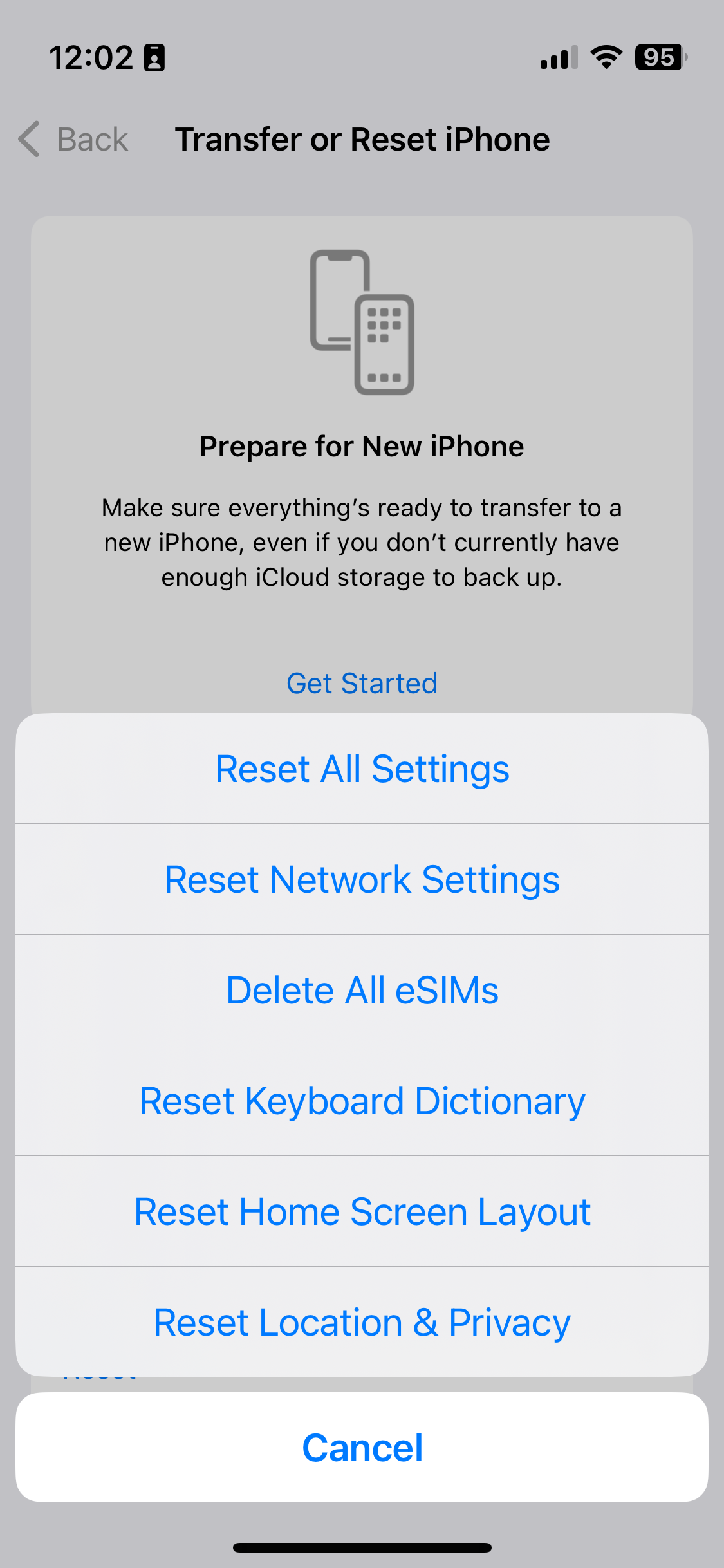
To do this, open Settings, and choose General. Then, scroll right down to the bottom and choose Reset, then select ‘Reset Location & Privacy’ – on iOS 10.2, this is the last option. Your device will ask you for your unlock password – pop this in, confirm, and hopefully your device will get the location correct from now on.
There is a drawback to doing this, however. You’ll have noted that this resets both your location and privacy settings. This means that any apps that you have granted access to your contacts, photos, calendars, camera, microphone, media library and so on will need to request them again. Although, oddly, apps will retain their location permissions, along with any permissions regarding background app refresh, notifications or mobile data access.
Despite these issues, it was a relief to fix the problem.
This blog post was updated in November 2023 with an updated screenshot, but the instructions are broadly the same.
There were only a couple of presents that I specifically asked for Christmas this year, and one of these was a Google Chromecast. At £30, it’s a cheap and easy way of getting internet content onto your TV.
The Roku is good little device, especially as it now supports almost all streaming media services in the UK with the recent additions of Rakuten’s Wuaki.tv and Amazon Prime Instant Video. And it’s easy to use, since it comes with a remote control – unlike the Chromecast. The main issues I’ve been having are:
Speed – apps such as BBC iPlayer are very slow. You can press pause, and the Roku will take several seconds before it actually responds in any way. I imagine newer Roku devices (the third and fourth series) are much faster; the Roku 2 series was on its way out when I bought it in 2014. That being said, it’s still receiving software updates which is good.
Stability – sometimes the Roku crashes, and has to reboot. I’ve had particular problems with the YouTube app causing this.
Netflix – the Netflix app on the Roku (second series at least) is poor. It doesn’t support multiple user profiles per account, so whatever you watch goes on the viewing history of the main profile. And parental controls don’t work, so you can’t watch any shows on the Roku which require a parental control PIN.
Spotify – Roku has a Spotify app, but you need to be a Premium subscriber to use it – that means paying £10 per month. I’m on Spotify’s £5 per month ‘Unlimited’ plan, which suits me but doesn’t work with the Roku.
Where the Chromecast excels
Setting up the Chromecast is quite easy – it took around 10 minutes which included installing a software update. And installation is as simple as plugging it into a spare HDMI socket, and then connecting the USB cable to a spare socket (a mains adaptor is included if required).
To ‘cast’ something, you just need to open an app on your Android or iOS mobile device, and look for the cast icon. Whatever you’re streaming will then appear on your TV, and you use your device to control it – playing, pausing etc. And, it only casts the content that you’re streaming, so your TV won’t flash up any notifications for example. This is a big advantage over simple Bluetooth speaker systems, for example, which simply broadcast all of the sounds that your device makes.
Compared with the Roku 2, the Chromecast is very fast. Tapping the cast icon in an app registers almost straightaway on the Chromecast and the only delays seem to be caused by buffering, rather than the device itself being slow.
Netflix works as well as it would do on a mobile device, so we can watch more adult things when our one-year-old isn’t about, but also ensure that their profile doesn’t show them. And Spotify streaming via Chromecast is available to all users – even those with free accounts.
There’s also a guest mode, which lets anyone who doesn’t have your Wifi password to cast to your Chromecast – provided that they have the PIN code displayed on the home screen. The PIN changes at least once a day.
…and some pitfalls
I’ve already mentioned the lack of a remote. But this problem is exacerbated, in my view, because you have to go into the app to access the controls to play and pause. On iOS, at least, the controls don’t appear on your device’s lock screen. You can lock your device and the content will still play, but pausing when the phone rings (for example) is a bit more involved. It’d be nice if there was an iOS widget that could pause whatever is playing, but I don’t know if that’s possible.
Not all apps support Chromecast. The big one that’s missing is Amazon Prime Instant Video, although there is a relatively easy workaround. The other app that I miss is UKTV Play, which is the only way that we can watch shows on Dave, like the new series of Red Dwarf. Living in a valley prevents us from receiving Dave via Freeview, we can’t get Virgin Media, it’s not on Freesat and we’re too cheap to pay for Sky.
I was also hoping that my favourite Podcast app, Overcast, would work, but apparently not. A tweet from the developer suggests that it would not be trivial to add this in future. And you’ll need to use an app such as AllCast if you want to view photos and videos from Dropbox on your Chromecast. I had mixed results with this in my testing.
Also, none of the built-in apps on iOS support Chromecast. This isn’t surprising – Apple sells a rival device, the Apple TV, and has a rival protocol called AirPlay. AirPlay is, in my view, more basic than the Chromecast protocol. With AirPlay, your mobile device acts as an intermediary – it receives the content stream, decodes it, and then sends it via AirPlay to your Apple TV. The Chromecast, instead, streams directly from the content provider – your device merely sends some instructions. The main benefit is that it won’t drain your device’s battery.
Sadly, I also had some stability issues when using the NextUp Comedy app with the Chromecast. Like with the Roku, these caused the Chromecast to lock up and restart. However, at least my device remembered where it was, so I could pick it up again easily after a restart.
Putting Chrome into Chromecast
There’s a reason for the Chromecast having such a name, and that’s because you can cast web pages from the Google Chrome web browser on the desktop. This is how you can get the aforementioned Amazon Prime and UKTV Play onto your Chromecast, but it does mean that you’ll have to play and pause playback using your computer. Which isn’t ideal when your computer is in a different room to your TV, like it is in our house.
Overall
The Chromecast isn’t perfect and has some key pitfalls as mentioned. But it’s great value for £30, and relatively simple for a moderately tech-minded person to use.
It’s time for my annual review of the year just gone. 2016 was a year that many will want to forget, thanks to the many celebrities who passed away this year (Victoria Wood arguably being the loss I’m saddest about), and major world events like Brexit and Donald Trump’s election. For us, it was a year of adapting to the major changes that took place in our lives in 2015, and coping with a rather limited income, thanks to Christine’s maternity leave and childcare costs.
Our baby arrived in the world late in December 2015, and was re-admitted to hospital on the 30th December with jaundice. So Christine and I were apart for New Year’s Eve, for only the second time since 2009 when we first met. Indeed, we didn’t have a great January; an undiagnosed tongue-tie meant a struggle to consume enough breast milk, and so we had to top-up feed with formula. Thankfully, the tongue-tie was picked up, the operation was a success, and 12 months on Christine is still breast-feeding in the mornings and evenings.
I was lucky enough to be on paternity leave for the whole of January. People whose partners give birth are allowed two weeks statutory paternity leave at 90% pay, in addition to any other leave entitlements; I topped this up with two weeks annual leave. A fifth week came about as my workplace is closed for Christmas. I’m really glad that I was able to take more time off – having spoken to other new dads who could only take two weeks, they found it not nearly long enough.
We made some progress on the house, with new doors downstairs. All year, we’ve been close to finishing the dining room by putting up coving and new architrave – but nearly a year on, those two jobs are still outstanding.
Later in the month, I went on the first of two visits to London this year, to attend a seminar on Big Data with my expenses paid. I also managed to squeeze in some time with friends whilst there which was nice, especially as I was on my own. And it was my blog’s 14th blogiversary. At the end of the month, we went to Halifax’s Bankfield Museum, to see the launch of a series of paintings by local artist (and friend of a friend) Kate Lycett, featuring various stately homes in Yorkshire that met an untimely end.
Right at the end of January, I had the first of three job interviews this year.
February
February saw me return to work after paternity leave, and on my first day back I was informed that I had got the job. It was a six month secondment working in timetabling at the university – same office, but different team. It was also quite a good pay rise and the extra money really came in useful this year. I hoped that this would become a new career path for me, but it didn’t really work out – I didn’t enjoy the job as much as I had expected, and other factors came into play in the summer.
Valentines Day was spent at the Yorkshire Wildlife Park, near Doncaster. It’s a fantastic open-air zoo, and we’ll definitely go back there again.
I spent an evening at an arts centre in Sale, near Manchester, for a recording of the Guilty Feminist Podcast. It was good fun, although I wish Christine could have come with me as she would’ve enjoyed it too. Alas, we’ve not really been able to get a babysitter and it wouldn’t have been appropriate to bring a baby along. At least Christine got to listen to the show a few weeks later.
We had a few days out in March – the farm at Temple Newsam, York Model Railway Show and Lotherton Hall, where I was able to make use of my new (to me) Canon EFS 55-250mm lens on my SLR camera. It’s great, and has allowed me to take some brilliant photos this year.
We also took our baby to the theatre – an amateur dramatic production of ‘Back to the 80s’. It was a relief to know that we could still go out with a baby in tow.
April
We started April by making a return visit to Hebden Bridge, for the first time since the devastating flooding on Boxing Day 2015. There was also a day out at Springtime Live at the Yorkshire Showground – a smaller scaled version of the Great Yorkshire Show with a focus on activities for kids and families.
A visit to the Trafford Centre (now much easier to get to as we have a car) saw our first visit to Five Guys, which is still relatively new to the UK. They’ve since opened in Bradford and we’ve been 3-4 times now.
May is my birthday month, and was also our third wedding anniversary. At home, we moved forward with a couple of projects – a new boiler, and a downstairs toilet. The new boiler, combined with a Nest thermostat, seems to be saving us money. Which is good, as we’ll still be paying back the cost of the boiler installation (on interest-free credit, thankfully) until May 2018.
Whilst it took me two months to write about it, we had a nice day out at Hollingworth Lake, a reservoir near Rochdale that’s become an inland tourist attraction. At the end of May, we had a day out in Scarborough, including a visit to the Sea Life Centre.
In other politics news, I joined the Labour Party. Historically I’d voted for the Liberal Democrats, but following their collapse in the 2015 general election, I felt it was important to support the left-wing party best-placed to form a government in 2020. So far, the regular emails that I get from my local MP and councillor (both Labour) have been useful but I’ve not yet got further involved.
June was my first Fathers Day, which was nice.
July
I started July with three job interviews scheduled, for four jobs (one was for two posts). Restructuring at work meant that my substantive post was being made redundant, and so I needed to find a new post. My secondment was also about to run out at the same time, and the third interview was to continue this on a fixed-term 9 month contract.
I got offered both jobs in the first interview, but failed the second. I accepted one of the jobs, and declined the third interview, as the job I accepted was a permanent post. Best of all, it was on the same wage as the secondment, so I finished the year with more pay, better job security, and, thanks to several workshops, a massively improved CV. 2016 wasn’t all bad after all.
Having booked a Friday off for something that then got cancelled, Christine and I ended up with a free weekend, and so we booked a last-minute impromptu trip to Liverpool. We took our baby with us, and it proved that we could still spontaneously go away even with a small child in tow. It was our first visit to Liverpool since 2010.
Whilst we were there, Christine started playing Pokémon Go, which hadn’t officially launched in Europe but it was possible to side-load the APK on her Android phone. I started playing when the official launch happened, and we both still play to this day. I’m level 27.
Although we’d been to Springtime Live earlier in the year, we went back to the Yorkshire Showground for the Great Yorkshire Show proper in July. Because we were meeting with friends whilst there, it meant that we didn’t see as much as usual, but it was still a fun day out.
At the end of July, Christine finished her maternity leave and returned to work. Our baby now spends weekday daytimes with a childminder, although until September this would only be four days a week. Christine and I took it in turns to take Wednesdays off, and I had my first full day on my own with our baby. It wasn’t a total success but I managed better on later occasions.
August
I started my new job on the 1st August, processing PhD applications. The first couple of months were basically spent firefighting, as I started at a peak time, but things have settled down somewhat and I’ve been able to make some improvements to processes. I’m enjoying the job; I get to work with some of my old team and lots of new people who I get on with well.
We attended a couple of wedding receptions in 2016, but it wasn’t until August that we went to a full ceremony and reception, for two friends from university. It was up in County Durham, in a really nice part of the world that I’d not previously been to before. And we had a day out in Ripon on the way home which is one of Britain’s ‘Cathedral Cities’ – it’s a small town that has city status by the virtue of having a massive cathedral.
On one of my ‘Daddy Days’, we followed the Hebble Trail from Salterhebble into Halifax. Someday, I’ll actually write up the blog post that I’ve been meaning to write about it.
September
We’d finally ‘finished’ the living room – all the paint is on the walls and we’ve installed the furniture that we want. The living room is also a designated ‘baby safe’ room, so we spent some time erecting a TV stand and fixing the TV to it. Indeed, just about all of the furniture in there is fixed to the wall. Our baby had learned to sit up by July and was crawling by this time, and later in September had learned how to pull themselves up on furniture. Still not able to walk independently yet, but not far off.
Only one major day out in September, which was a visit to Cannon Hall Farm, near Barnsley. It’s a great place for families, with an indoor soft-play area, lots of animals to look at (including meerkats, bizarrely) and activities. Our baby enjoyed it, and we’ll be back sometime. Especially as it was quite cheap.
We also managed a child-free day closer to home. After dropping our baby off at the childminders, we went to see Doctor Strange at the cinema. This was our first cinema visit in almost a year – the last film we’d seen was Spectre, when Christine was still pregnant.
November
America decided to emulate Brexit by electing a man whose surname means ‘fart’ in British English as their next president. I was hoping Hillary would win, and I guess we’ll have to see what happens. I wouldn’t be surprised if he’s not still president in four years’ time – whether he resigns due to corruption or boredom, or gets impeached, I don’t know.
Despite not getting as much sleep as usual, I managed to stay reasonably healthy this year, until a bought of gastroenteritis hit me in November. Annoying, I got ill with it again in December, and then had a horrendous cold right through the Christmas period.
As in previous years, we went to the Thought Bubble comic con, this time with our baby in tow. We didn’t have chance to dress up this time though.
December
And so to this month. We haven’t had any days out – it’s winter, and we’ve been spending time doing Christmas shopping. But we did manage another child-free day, this time to see Fantastic Beasts and Where to Find Them at the cinema. We spent Christmas itself with my parents in York. Plans for New Year are sketchy, but shouldn’t involve our baby being in hospital this time, hopefully.