
Eurovision Eve

Tomorrow night is the annual Eurovision Song Contest, a pan-European music competition where each of the nations of Europe can put forward a musician or band and hope to win the chance to host the following year’s contest. Last year’s winning act, Emmelie de Forest, was from Denmark, so this year’s competition will be broadcast from Copenhagen.

In Britain the main focus is always the ‘final’ on the Saturday night, but there have been two semi-finals this week. They’re broadcast here on under-threat TV channel BBC Three, and I bet a lot of Brits don’t even know about them. I think this because the semi-finals don’t matter to us Brits –  Britain is one of the largest contributors to the European Broadcast Union, the producers of Eurovision, and it means that British acts automatically qualify for the final. This is along with those acts from France, Germany, Italy and Spain. Consequently the semi-finals are not a big deal here, and are mostly watched by those more fanatical about Eurovision.

For most of the past few years, we’ve been to Eurovision parties, where we watch the final as a group, usually with ample amounts of alcohol. This started sometime around 2007, when one of our friends was an international student from Canada – we tried to convince her that Eurovision was a major cultural event. I think she believed us right up until the show started, when she realised it was just a massive camp-fest. Which it is, but that’s one reason why I like it so much. Another other big reason is getting to laugh at the various novelty acts that invariably make it through to the finals, and then get increasingly frustrated at the end when none of our European neighbours decide to vote for the UK entry. And there’s the commentary provided by Graham Norton throughout the night.

This year, we’re hosting a Eurovision party ourselves for the first time. Not a big one, and most of the people who are coming are the same ones that we watch Eurovision with every year. It’s probably the last chance we’ll have to host a Eurovision party in our current flat, as hopefully by this time next year we’ll have bought a new house.

The UK never does particularly well in Eurovision and we’ve not won since the 1990s, but we still enter every year. Despite putting up reasonably well-known acts, such as Blue, Engelbert Humperdinck and Bonnie Tyler, we haven’t placed inside the top 10 since 2009.

In the past there has been a public vote to choose the act that we sent to Eurovision – usually called A Song for Europe – but since 2011 the decision has been made by the BBC. This year’s act is ‘Molly’ with her song ‘Children of the Universe‘ – it’s not really my kind of song but hopefully it’ll do well. Molly, incidentally, is not using her full name of ‘Molly Smitten-Downes’ in the competition.

Political events often affect the results, and it will be interesting to see what effect the recent issues in the Crimea have on Ukraine and Russia’s rankings. It may also reflect Britain’s historically poor performance, as the rest of the Europe hates us apparently. The current rise of the UK Independence Party may indicate that the feeling is mutual. I wonder what UKIP’s policy is on Eurovision?
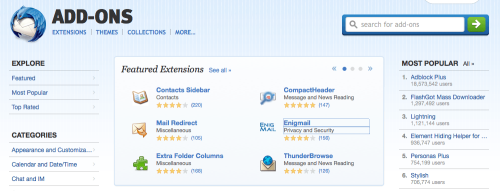
My favourite add-ons for Thunderbird

A screenshot of the Thunderbird add-ons web page

It’s been some time since I used Mozilla Thunderbird at home – I switched to Sparrow, then Apple’s own Mail app, before settling on Airmail last year. But at work, where I deal with a high volume of email, I prefer to use Thunderbird, instead of the provided Outlook 2010. There are a few add-ons which help me get stuff done, and so here is my list:

Lightning

Unlike Outlook, Lotus Notes or Evolution, Thunderbird doesn’t ship with a calendar. Lightning is an official Mozilla extension which adds a reasonably good calendar pane. Calendars can be local, subscribed .ics files on the internet, or there’s basic CalDAV support as well, and it works well with multiple calendars. A ‘Today’ panel shows up in your email pane so you can quickly glance at upcoming appointments.

Once you have Lightning installed, there are some other calendar extensions you can add. Some people use the Provider for Google Calendar extension – I don’t, as nowadays Google Calendar supports CalDAV so there’s no need for it. If you need access to Exchange calendars, then there’s also a Provider for Exchange extension too, although as we’re not (yet) on an Exchange system at work I haven’t yet tried this.

There’s also ThunderBirthDay, which shows the birthdays of your contacts as a calendar.

Google Contacts

If you use Gmail and its online address book to synchronise your contacts between devices, then Google Contacts will put these contacts in Thunderbird’s address book. It doesn’t require much setup – if you’ve already set up a Gmail account in Thunderbird then it’ll use those settings.

This is probably of most interest to Windows and Linux users. On Mac OS X, Thunderbird can read (and write, I think) to the global OS X Address Book, which can be synchronised with Google Contacts and therefore this extension isn’t needed. In the past, I used the Zindus extension for this purpose but it’s no longer under development.

Mail Redirect

This is a feature that older email clients like Eudora had, which allowed you to redirect a message to someone else, leaving the message intact. Mail Redirect adds this is a function in Thunderbird.

It’s different to forwarding, where you quote the original message or send it as an attachment – with Redirect, the email appears in the new recipient’s inbox in almost exactly the same way as it did in yours. That way, if the new recipient replies, the reply goes to the sender and not to you.

Thunderbird Conversations

If you like the way that Gmail groups email conversations together in the reading pane, then Thunderbird Conversations is for you. It replaces the standard reading pane, showing any replies, and messages that you have sent – even if they’re in a different folder. You can also use it to compose quick replies from the reading pane rather than opening a new window.

LookOut

Although this extension apparently no longer works, LookOut should improve compatibility with emails sent from Microsoft Outlook – especially older versions. Sometimes, attachments get encapsulated in a ‘winmail.dat’ file, which Thunderbird doesn’t understand. LookOut will make these attachments available to download as regular files. Hopefully someone will come along and fix it, but there hasn’t been an update since 2011 so I’m guessing this extension has been abandoned.

Smiley Fixer

Another add-on that will make working alongside Outlook-using colleagues a bit easier. If you’ve ever received emails with a capital letter ‘J’ at the end of a sentence, then this is Microsoft Outlook converting a smiley :) into a character from the Wingdings font. Thunderbird doesn’t really understand this and just displays ‘J’, which is where Smiley Fixer comes in. It will also correct a few other symbols, such as arrows, but you may still see the occasional odd letter in people’s signatures.
Enigmail

If you use GnuPG to encrypt messages, then you’ll probably have the Enigmail extension installed. Though it originally was a pain to set up, nowadays it seems to work quite well without a lot of technical knowledge. It includes a listing of all of the keys in your keychain, and you can ask it to obtain public keys for everyone in your address book should you wish.

Dropbox for Filelink

Some time ago a feature called ‘Filelink’ was added to Thunderbird, which allowed you to send links to large files, rather than including them as attachments. Whilst most people nowadays have very generous storage limits for their email, sometimes it’s best not to send large files as email attachments. Thunderbird supports Box and the soon-to-be-discontinued Ubuntu One services by default, but you can use the Dropbox for Filelink extension to add the more popular Dropbox service. Another extension will add any service which supports WebDAV which may be helpful if you’re in a corporate environment and don’t want to host files externally.

These are the extensions that I use to get the most out of Thunderbird. Although I’ve tried using Outlook 2010, I still prefer Thunderbird as it’s more flexible and can be set up how I want it.

My first BuzzFeed Listicle

A screenshot of the 9 Surprising Facts About Sowerby Bridge listicle on BuzzFeed

Last week, whilst coming with ideas for a new blog post, I realised that one of them was essentially a BuzzFeed-style listicle. So, rather than posting it here, I decided to publish it as a community post on BuzzFeed. And so 9 Surprising Facts About Sowerby Bridge was born.

One of the main reasons why I did it was as an experiment, to see what kind of engagement community posts on BuzzFeed get. It’s something of a niche topic – I don’t know how many people would search for it, and I deliberately haven’t shared it on my own social media channels until now. Articles by BuzzFeed’s own journalists often do well with lots of clicks, but I’m under the impression that community posts can be somewhat hit and miss. We’ll see.

All but two of the photos were my own, linked to on Flickr.

In any case, I hope that it serves as an interesting look at my home town of Sowerby Bridge. It’s a town that’s overshadowed by its more famous neighbours of Halifax and Hebden Bridge, but has some of its own claims to fame. We’ve got Britain’s deepest canal lock, for example, and it’s possible to do a circular pub crawl taking in twelve pubs, almost all of which serve decent beer. There’s our annual Rushbearing festival, and we have a pretty good high street. It’s a surprising place and more people should take the time to come and visit, in my opinion.

A bank holiday visit to Hebden Bridge

Hebden Old Bridge

As it was such a nice day on Good Friday, and we were both off work with it being a bank holiday, Christine and I paid a visit to Hebden Bridge. We’ve been there many times over the years, however, this was actually the first time we’d been in almost two years.

In June and July of 2012, the upper Calder Valley was badly affected by floods. Whilst it didn’t cause too many problems here in Sowerby Bridge, Hebden Bridge was hit hard, with large parts of the town underwater. This included the main road through the town and the main shopping streets.

It’s taken the town quite a long time to get itself back together again, so we were pleased to see it looking rather resplendent when we visited last week. There were almost no empty shops; though some hadn’t re-opened following the floods, others had taken their place. And the town was bustling with people taking advantage of a day off work and some nice sunshine.

Hebden Bridge features on this year’s Tour de France route. The Tour de France has its ‘Grand Départ’ in different places across Europe each year, and Yorkshire won the bid for 2014, so the first two days of the course are in Yorkshire. Riders will pass through Hebden Bridge before tackling a long, sustained incline further down the Calder Valley at Cragg Vale. Hopefully the weather will be equally nice as it was when we visited, and the local economy will get a nice boost.

Speaking of which, there is large amount of disquiet in the town about a proposed Sainsbury’s supermarket opening nearby. What makes Hebden Bridge so special is that the vast majority of shops are independently run, including a number of clothing boutiques, delicatessens and craft shops. The worry is that a big supermarket like Sainsbury’s would adversely affect business in these small shops. Many shops had posters in their windows about it and there’s a web site encouraging people to object to the planning application.

Hebden Bridge Duck Race

Finally, as today is Easter Monday, there is the annual duck race, where hundreds of rubber ducks are dropped into the river. Each duck is sponsored, and there are prizes for the first ducks to cross the finish line. Again, the local community are strongly behind this with many shops having duck-themed displays in their windows.

Hebden Bridge is always a lovely place to visit and it’s a shame that we haven’t had chance to drop by recently. Apart from the looming potential of a new supermarket, I’m glad the town is doing well.

Debating whether to ditch Dropbox Pro

A screenshot of Dropbox settings showing how much storage I am using

I’m a Dropbox Pro user. This means that I’m paying around £60 per year (or £5 per month if you will) for an extra 100 gigabytes of storage, over and above what free users get. This is mainly because I use it to keep photos in sync between my devices – and as I have a SLR camera, those images can be quite large – but also because I believe in paying for services that I rely on.

But lately, two things have happened.

One, I signed up for Office 365, which gave me an additional 20 gigabytes of storage in Microsoft’s rival cloud storage service OneDrive. Coupled with the 28 gigabytes that I have free, that means I have almost 50 gigabytes available that I’m also partly paying for anyway. As I was able to purchase the Office 365 University package, that means that I paid less than £60 for four years, and also get access to Microsoft Office and some Skype minutes thrown in. So, using OneDrive would still give me plenty of space, at a significantly reduced cost.

The other thing that happened was a recent appointment to Dropbox’s board, in the form of Dr Condoleeza Rice, the former US secretary of state under George W Bush’s presidency. During her time in office, she authorised widespread wiretapping, which is a bit of an issue when it comes to privacy and cloud storage. Plus there are all of the uncomfortable things that surround the War on Terror that happened during that time. Whilst I’m pleased that Dropbox has a woman – and a woman of colour at that – on its board, this appointment makes me feel a little uneasy, in the same way as Brendan Eich’s brief presidency of the Mozilla Corporation.

With these two factors in mind, I decided to explore OneDrive a little more, and see if I could really replace Dropbox with Microsoft’s cheaper alternative. Last year, this would have been a non-starter, as I was still using Windows XP at work which SkyDrive (as OneDrive was called at the time) would not run on. But whilst OneDrive supports fewer platforms than Dropbox, it does support the ones I use – Windows 7, Windows 8, Mac OS X and iOS.

However, its Mac client isn’t as good as Dropbox’s client, and this is the first reason why (spoiler alert!) I’m not going to ditch Dropbox. Sure, it does the same basic job of synchronising the content of a folder to the cloud, but without any status icons on each file informing you of its state. So whereas Dropbox shows you which files have been successfully uploaded, and which are still pending, with OneDrive you’re in the dark.

Dropbox’s other useful feature is photo importing. Now OneDrive is happy to import the contents of my phone automatically – as is Dropbox, and indeed Google+ and most recently Flickr in its version 3.0 update released yesterday. But on the desktop? Not so much. With Dropbox, I can put the SD card from my SLR camera into my Mac, and have it automatically import the new photos, which saves me the effort of doing it manually.

There’s also the issue of third-party app integration. OneDrive does have an open API and integration with sites like IFTTT, but not to the same extent as Dropbox. For example, I use Dropbox to keep my 1Password keychain in sync between my devices. If I didn’t use Dropbox, then I’d either have to use iCloud (which wouldn’t work on Windows) or over a local Wifi connection (no use at work). I suppose I could switch to using another service like LastPass instead, but I’ve already paid for the individual 1Password apps and like using them.

I also use Dropbox for collaboration – Christine and I had a shared wedding folder for planning our wedding, which was really helpful. OneDrive does this as well but I’d also have to convert Christine over as well.

So really, I can’t use OneDrive as a drop-in replacement for Dropbox. I could cancel my pro subscription for Dropbox, and drop back to being a free user for those services that need it. But then OneDrive makes it more difficult to upload photos and that’s the main reason why I pay for extra space in Dropbox. And I’d have to run both the Dropbox and OneDrive clients simultaneously and remember which one has which documents in it.

As much as Dropbox is the more expensive option, for me, it’s the better service.

The big post-Heartbleed password change

Screenshot of the Heartbleed web site

Following last week’s revelations about the Heartbleed bug, I spent quite a bit of time over the weekend changing passwords. Not all of them – I’ve been using this list of affected sites from Mashable – but quite a lot.

At the same time I’ve also taken the opportunity to audit other passwords from non-affected sites. I use 1Password as my password manager, on OS X, Windows and iOS, and it has a ‘Password Audit’ feature that shows weak, old and duplicated passwords. Ashamedly, I had quite a few of all three.

As a reminder, the generally accepted guidelines for strong passwords are as follows:

  1. As long as possible
  2. Using a mixture of lower and uppercase letters, numbers and special characters
  3. Are unique
  4. Avoiding any words that could appear in a dictionary

Using a password manager is therefore a very good idea, as they can usually generate strong passwords that meet those criteria, and offer to remember them for you. I tend to go for 24 character passwords like ‘3&yjGJNrE)Up2no8W:iNduYg’, to give an example of one that 1Password has just given me, and there’s no way that I could memorise that. The only passwords I have committed to memory are my 1Password Master Password, for obvious reasons, and my logins for Google, iTunes and Facebook. Whilst they satisfy the first three criteria above, they do use actual words – albeit with numbers and symbols replacing some of the letters – because these are the ones I use the most frequently. They’re still ‘strong’ according to most password meters.

Having said all of that, your passwords also have to fit within the constraints set by the web sites with which you have accounts. Whilst most of the sites I’ve been using have no problem with 24 character passwords, and are happy to accept symbols, not all of them are. Quite a few would only take passwords up to 16 characters, and others won’t accept special characters – or both. In which case, I had to make do with weaker passwords, but at least they’ll be unique.

There are, however, two web sites that were significantly worse than others. hmvdigital doesn’t let users change their password, unless you contact customer services. The worst offender, however is the Intercontinental Hotels Group, who owns the Holiday Inn and Crowne Plaza chains. If you’re in their IHG Rewards scheme – I am, and I have gold membership – then your password is a 4 digit numeric PIN. So there are only 10,000 possible password combinations, which could be cracked within minutes by an average home desktop computer. In 2014, this is horrifying, and for this reason, if you use IHG’s hotels, please don’t store your credit card details with them.

On the other hand, it’s been enlightening seeing which sites have removed my accounts for inactivity. For example, dabs.com have deleted my account, presumably because my last purchase from there was circa 2005. And other sites simply don’t exist anymore.

Kickstarted: Frisky & Mannish’s Pop Education Trilogy

What was it?

The twelth project I backed on Kickstarter was Frisky & Mannish’s Pop Education Trilogy, which sought to edit and post their three tour shows online for everyone to watch.

How much did I pledge?

Just £1.

What did I get?

I didn’t select a reward so I didn’t get anything specific in return for backing the project, but the money raised meant that all three videos are available on YouTube for everyone to watch free of charge.

Christine and I went to see Frisky & Mannish when they came to play in Bradford in September 2012. I’ve been aware of them for a while, after a former housemate shows me some of their videos on YouTube. Essentially they are a cabaret duo who do musical parodies, such as Kate Bash – combining the works of Kate Bush and Kate Nash, and a ‘grime’ re-working of Top of the World by The Carpenters. Though these short videos are good, they are far better live as it’s the interactions between the songs that make them worth watching. So now that they have posted three of their full length shows for all to see, you can see what they’re really like.

At the moment, Frisky & Mannish are on a break, but they are doing a stint at the Edinburgh Fringe Festival this summer. Hopefully this will lead to another tour – either way, if you have the chance to see them, please do, as we had a really good time.

Disconnecting from work email

iPhone 4

When I first got my iPhone in 2010, I very quickly set up my three most-used email accounts on it – my personal account at this domain, my Gmail account, and my work email account. Soon, every time I got an email on any of those accounts, no matter what time of day it was, my phone would duly ping me.

At weekends, when going through the unified inbox overview of all three, I’d duly delete the ‘calls for papers’ that various conferences send me (because they assume that anyone who works at a university is an academic) and carefully flagged up the emails that needed action for when I got back in the office on Monday. I thought I was being more productive this way, but actually, all I was doing was spreading what would be a five minute task at work throughout my weekend, when I should be relaxing.

More to the point, it was making it harder to switch off from work, and making checking my personal accounts more difficult as I had to wade through work emails to get to them.

It took until the start of 2012 before I finally decided that this was a silly way to do things. I was off work for two weeks – I’m lucky enough to work for an employer that gives everyone time off between Christmas and New Year, and I had some annual leave in early January. I was getting notifications of work emails, but it would be more than a week until I would be back in the office in order to actually do anything about them. So, I deleted my work email account off my phone.

In the time since, I have kind-of added it back. I use the now abandoned Sparrow client to access my work email on a purely ad-hoc basis, if required, but it’s kept separate from my personal email accounts (in the stock Mail app on my iPhone) and I don’t get notifications for it. So it’s there if I do need to access it – usually if I’m at work but away from the office – but I can’t be disturbed by work emails when I’m not at work.

I’m therefore pleased that, in France, there’s a new labour agreement to stop employees looking at work email after 6pm. France already has a mandatory 35 hour working week, meaning that French employees work shorter hours to improve their work-life balance. This goes further, and helps to prevent employees from doing work-related activities outside work hours.

If you are regularly checking work email when you’re not at work, I would recommend you to stop. It’ll help you disconnect from work and enjoy your free time more. And it often doesn’t save you much time at work either.

Stem my bleeding heart

Screenshot of the Heartbleed web site

If you read tech news on the internet, then you will have almost certainly come across the Heartbleed bug. As well as being probably the first programming bug to have a logo and brand name, it’s also very serious. It affects, or affected, a significant number of web sites and web services – pretty much anything that used SSL or TLS and the OpenSSL library. This will include many sites using the open source Apache and nginx web servers, which between them account for a majority of web sites.

The Heartbleed bug was in the ‘heartbeat’ component of OpenSSL, and first appeared in a code commit made at around 11pm on New Years Eve 2011 – make of that what you will. The first stable release of OpenSSL with the bug came in March 2012, and it was only fixed relatively recently. It’s therefore estimated that 17% of the world’s web sites may be affected.

If you administer a server that uses OpenSSL, then you’ll need to make sure that you update to the latest version which fixes the bug. But you may also need to revoke your SSL certificates and acquire new ones, and, if you suspect any foul play, do a full security audit. You can check your server using this tool – I’ve verified that this site was never affected.

If you’re just a regular user of the internet, then you may notice that some web sites will have forcibly logged you out. Some may also require you to change your password, and possibly re-connect any third party apps linked to your account. IFTTT emailed me to suggest changing my password, and Pocket has advised its users to do the same. Ironically, so has the web site Should I Change My Password which notifies of data breaches. If you are not already, I would suggest using a password manager such as 1Password, RoboForm, Keypass or LastPass. LastPass users can also find out if any sites they use have been affected by Heartbleed.

Some security experts have suggested that users change all of their passwords, although only once the web sites have implemented their fixes. This may not be necessary and PayPal has said they were not affected by Heartbleed. However, if you’re not using strong, unique passwords for every web site then now may be a good time to do so, regardless of whether sites have been affected or not, and the aforementioned password managers will help you in that regard. A lot of sites will now accept passwords that are more than 20 characters long, with special characters, which should be very, very difficult to crack.