Over the Christmas break, my iPhone would randomly decide that I was in my office. I’d have an app open that used my location, but instead of showing me where I actually was, it’d suggest that I was in Bradford. Which isn’t so useful when, in reality, you’re at home, or in York.
It caused particular problems when using Google Maps for directions, as it’d randomly jump to Bradford and then back again. Swarm was basically unusable. And it completely broke the ‘Track Exercise’ function of the Fitbit app. I had to actually uninstall and reinstall the Fitbit app a couple of times because it wouldn’t let me stop the exercise. This was even after restarting the app.
Turning Wifi off helped. Apple’s iPhones, and indeed many other devices, use the SSIDs of available Wifi networks to approximate your location. This is done by querying a web service, which means that you can still get an approximate location even when indoors, and out of view of GPS satellites. But turning off Wifi was hardly a long term solution.
How to actually fix the location problem
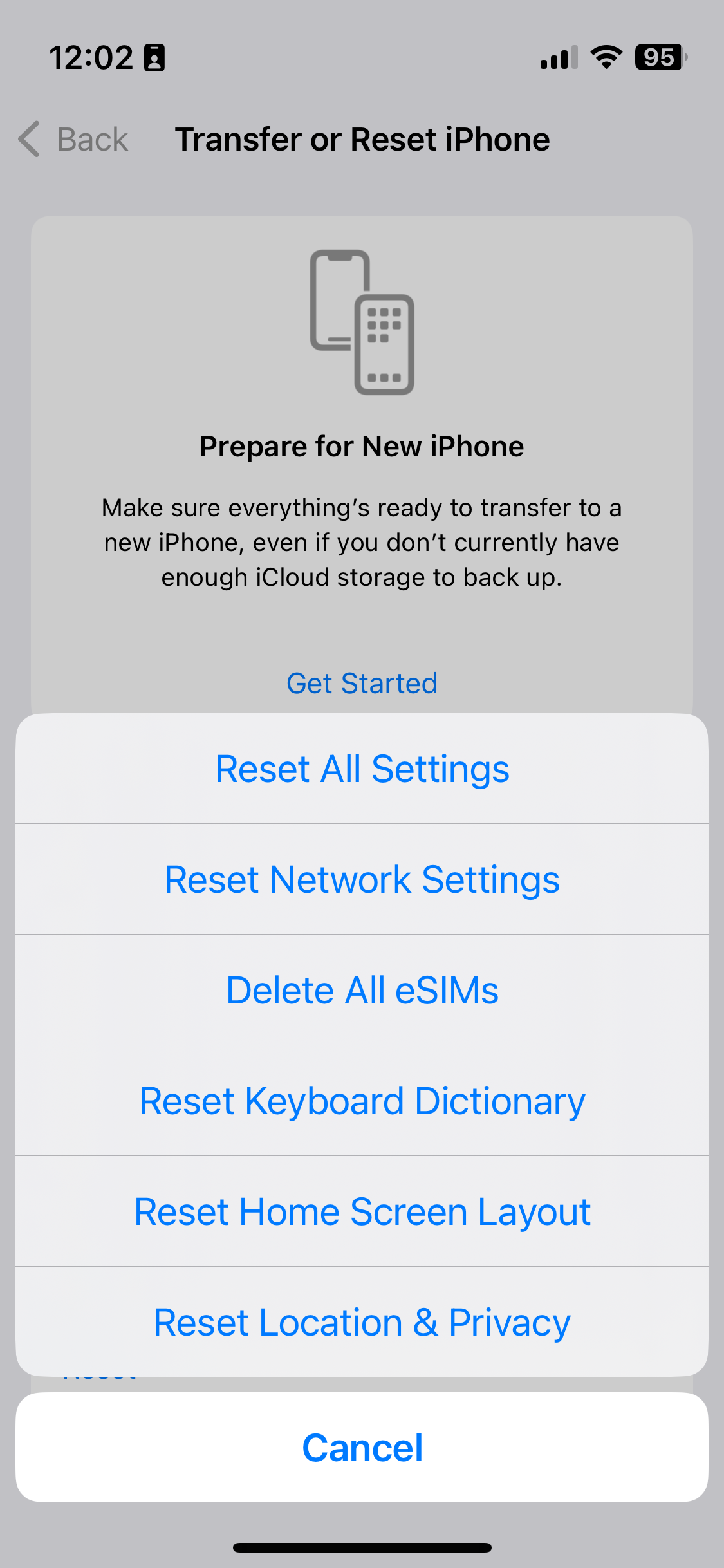
A bit of Googling uncovered this article about fixing your location. It offers several solutions, depending on whether the issue affects just one application, or all. In my case, it was all applications, and the solution that worked was the fifth on the list. This involves resetting your phone’s location and privacy settings.
To do this, open Settings, and choose General. Then, scroll right down to the bottom and choose Reset, then select ‘Reset Location & Privacy’ – on iOS 10.2, this is the last option. Your device will ask you for your unlock password – pop this in, confirm, and hopefully your device will get the location correct from now on.
There is a drawback to doing this, however. You’ll have noted that this resets both your location and privacy settings. This means that any apps that you have granted access to your contacts, photos, calendars, camera, microphone, media library and so on will need to request them again. Although, oddly, apps will retain their location permissions, along with any permissions regarding background app refresh, notifications or mobile data access.
Despite these issues, it was a relief to fix the problem.
This blog post was updated in November 2023 with an updated screenshot, but the instructions are broadly the same.
It probably won’t surprise you that I’ve spent quite a bit of the last week playing Pokémon Go. I downloaded it within hours of its official UK release; the screenshot shows how far I’ve got, and overall, I’m level 11. This is mostly through capturing Pokémon on the way to and from work, and on my lunch break.
Christine has been playing it a little longer. She has an Android phone, and so she was able to sideload the APK file from a third-party web site prior to its official release on the Google Play Store. She’s therefore slightly ahead of me, and has had the benefit of being on maternity leave to have more time to catch Pokémon.
I’m enjoying it, although it is further exacerbating my iPhone’s battery issues. As I write this, Pokémon Go has used 51% of my battery over the past 24 hours. Even before last week, I was struggling to get through a full day on one charge. To be fair, I use multiple Bluetooth devices with my phone, and use it on a train journey with frequent tunnels. So my iPhone’s battery was already getting a strong workout even before I started playing. But, notice how my phone was already down to 61% before 9am in the screenshot.
I haven’t added any Pokémon to gyms yet, and have only played a couple of battles. I’m waiting until I’ve collected more, and had the chance to upgrade or evolve them. Many of the nearby gyms have Pokémon with combat power over 1000 already, and my best is under 800.
It’s been fascinating to see how much of a phenomenon Pokémon Go has become. It’s already outperforming many other social apps, including Twitter and Tinder, in terms of how long people use it. And the news has been full of stories, both good and bad, about the game and its players. I never played Ingress, its spiritual predecessor, but I had friends who did. It seems that Niantic, its developer, has found the perfect balance between Ingress’ gameplay, and the popularity of the Pokémon franchise.
I don’t know how long I’ll keep playing. At the moment I’m still discovering new Pokémon and enjoying levelling them up – even if I’m sick of always finding Drowzees everywhere. Maybe the game will become less fun or stale after a while, but at the moment I like it.
The four hour session, split into two halves, was chaired by two members of the House of Lords, Lord Inglewood and Lord Witty, and the speakers represented various users of big data in the UK. These included the ABPI, whose members carry out research and development into new medications, Dunnhumby, who worked with Tesco to launch the original Clubcard in the 1990s, academics and industry partners.
The talks given by the speakers were interesting, and focussed more on policy and high-level overviews, rather than technical details. For example, whilst Hadoop was passively mentioned on some slides, there wasn’t much about deployment and how it works. But there was some discussion about database design, as companies move away from traditional relational databases to big data capturing solutions.
Privacy implications came up several times as well, an irony not lost on one of the speakers who noted that the event coincided with Data Privacy Day. In particular, there was a focus on how to design systems with privacy in mind, but also that the UK’s and Europe’s more restrictive privacy laws may be part of the reason why the world’s biggest data users – GAFA (Google, Apple, Facebook & Amazon) – are all based in the US.
I came into the seminar essentially wearing two hats. My main reason for attending was as a blogger (or ‘freelance writer’ according to the attendance list), but data analysis is also one of my roles at work. However, we’re not yet at the stage where we’re using ‘big data’ – most of our data is all within standard relational databases and I can’t see that changing any time soon.
As always, such events also offer a chance to network and it was good to speak with some of the other attendees. As you’d expect from a more high-level seminar, this was an event for people with suits and ties, and not t-shirts and hoodies. Many were from government departments, regulators and other public sector bodies, as well as large organisations such as the BBC and Arqiva.
I came away with plenty of notes, and some action points to perhaps bring up at work. Channel 4’s Viewer Promise video was mentioned as great example of best practice for explaining their privacy policy – far better than pages and pages of legalese. Maybe universities could do something similar to explain the student contract at enrolment.
This day was made possible by Dell, but all thoughts are my own.
I’ve written another post on Medium. It’s just a short two-minute read, but covers an issue I’ve been experiencing in iOS as I’ve amassed more Bluetooth devices: how on earth do you work out which one is which when they’re all called things like ‘SE50’ and ‘MM256’?
I’ve chosen to post it on Medium in the hope that it might get exposed to a slightly larger audience than usual. I think my previous piece on Medium got a little more exposure than it would have done normally – it didn’t exactly ‘go viral’ but I get the impression that more people saw it than if I had just posted it here on my blog.
If you enjoy my Medium pieces, then please ‘recommend’ them.
On Sunday last week, I packed my Mac up ready to move to our new house. 10 days on and it’s still packed up.
The main reason is that my computer desk will be in the dining room and we haven’t painted all of the walls in there yet. I’d rather not unpack my computer until the painting is done so that I don’t damage it, but it’s going to be a week or two before we’re at that stage. So, in the meantime, my computer stays in its box.
What surprised me is how well I’ve been able to manage without it. Normally my Mac is on all the time, and although I put it to sleep when I’m out, I usually use it every day before and after work. But I’ve been mostly coping fine with my iPad and iPhone instead.
95% of what I do on my Mac, I can do on my iOS devices. The main things I use a computer for are social media, reading feeds and articles, email, a bit of photo editing and playing World of Warcraft. Most of these things can be done on my iPad or iPhone as easily as they can on my computer.
Obviously I haven’t been able to play World of Warcraft in that time, and I’ve had to put off editing photos for now. Writing blog posts is possible on my iPad but it’s not as easy as on a proper computer. But I’ve been pleasantly surprised at just how replaceable my Mac has ended up being.
We also haven’t unpacked the TV for similar reasons. Watching Saturday’s episode of Doctor Who on my iPad wasn’t as great as it would’ve been on a proper TV, but it was acceptable.
Eventually we’ll have all of the painting done and we can go back to having a TV and desktop computer and be a normal household again, and I’m looking forward to it. But it’s not been nearly as disruptive as I’d expected it to be.
I wear a watch on my right hand – even though I’m right-handed. It’s not a fancy watch – it’s analogue, and as well as telling me the time it also shows the day of the month (although it’s usually wrong). It doesn’t automatically adjust for daylight savings time, or have alarms. It doesn’t even have a stopwatch, which means that I, ironically, have to use my phone as a stopwatch, rather than my watch.
But it’s simple, and in the 3-4 years I’ve had it, the battery has only had to be replaced once after running out of charge. It doesn’t need charging, updating or to be in range of another device.
Yesterday Apple finally announced pricing and a launch date for its new smart watch. Brits can expect to pay £299 for the most basic model, with more expensive models available at prices that make my inner Yorkshireman cry. It can do all sorts of things, like display text messages, make and answer phone calls, manage your calendar, display maps and monitor your fitness, and you can install third-party apps to make it do even more. It’ll even work as a watch and display the time – which is kept up to date from internet time servers.
Which sounds all rather flash. But I won’t be buying one.
Having a smartphone has changed my life – indeed, I’ll soon be facing a week where I’ll have patchy internet access and I’m already trying to work out how I’ll manage. But I don’t think I need yet another device that does the things my iPhone can do.
And the battery life is a concern – it’s estimated to last 18 hours, so I’d need to charge it up every night. A big change from my current watch that needs a new battery every few years.
I’ve yet to be convinced about the need for a smart watch, but I’ll try to retain an open mind. I’m sure Apple will sell millions regardless.
Later today I will have a brand new iPhone 5S, which I ordered on Friday. I wasn’t expecting to need a new phone so soon but sadly my current iPhone 5 is not in a good way.
The need to upgrade
I bought my iPhone 5, along with a new two-year contract, in September 2012, shortly after launch. My iPhone 4 had pretty much conked out: it kept randomly rebooting, and was getting rather slow. However, by September 2014, my iPhone 5 was still in good shape. Sure, the battery life wasn’t as good but it still worked fine. So instead I took out a new 12 month SIM-only contract with the intention of keeping my iPhone 5 until next year.
Unfortunately, more recently, my iPhone 5 has developed a fault with the Lightning port. It will only charge if I plug a cable in at a certain angle – and if the cable becomes even slightly loose, it won’t charge. Whilst I can usually get the cable in a good enough position to charge it at home, it’s almost impossible to do when out and about unless you actually hold the cable in position. And there have been several occasions when the cable has been knocked slightly and I’ve ended up starting the day with a phone on 30% battery.
It’s been like this for a while but it seems to have got worse of late. I’ve tried cleaning out the Lightning port as best I can, and I’ve used many different cables, but it still doesn’t work properly.
It may be fixable, but as the battery life isn’t great either, I decided that really, I’d be best with a new phone.
Rule-breaking
Co-incidentally, I recently received an ‘exclusive’ offer from Three, the network I’m with, to upgrade early to a new iPhone 6. Normally ending my contract now, and not when it ends in September, would incur a penalty, but Three were willing to waive these charges if I signed a new two-year contract with them. I registered my details on their ‘rulebreakers’ page and got a call back later on Thursday to discuss the deal.
The offer was for a brand new iPhone 6, in my choice of colour, at no up-front cost, with a 2-year contract that included 2 GB of data (including tethering), unlimited calls, unlimited text messages and a few other perks. The catch was that the monthly charge would be £46 per month, and it was only the 16 GB model. I’m currently paying £18 per month for a SIM-only deal so this would be a huge hike in my monthly payments – more than 2.5 times higher.
But I agreed to it – I needed a new phone, and I’d be getting Apple’s latest and greatest model. Even though I had the opportunity to home test an iPhone 6 in September, and found it rather too big for my liking.
Cutting too many corners
At first, I didn’t think the lack of storage would be an issue. My iPad Mini 2 is the 16 GB model, and whilst I don’t have much space left on it, it does just about everything that I need it for.
My iPhone 5, however, is the 64 GB model. And it turns out I was using half of the space on it. At first I thought these were things I could do without – a 2.5 GB full HD quality episode of Sherlock, for example. But after deleting the stuff I didn’t use, and then the stuff I occasionally used, and then stuff that I didn’t really want to delete but would do if I absolutely had to, I was still using over 20 GB of space. Essentially, if I wanted to get by on a 16 GB phone, I’d have to make do with not having all the apps I wanted, all my photos, or all of my music. And it’d be a compromise that I’d have to live with for the two years of the contract. A contract that would be costing me over £1000 over the two years.
The lack of storage might not have been so bad if it weren’t for the limited data allowance as well. Whilst I’ve only ever used more than 2 GB in a month once or twice, if I have less storage capacity on my phone then I’d need to store more data in the cloud, which would eat further into my data allowance. A small capacity phone and unlimited internet might have worked, as would a large capacity phone and limited internet, but not the worst of both.
Cooling off
I’m fortunate, in some respects, that I’d agreed to this over the phone, which meant that I was legally entitled to a 14-day ‘cooling off’ period, as per the Consumer Contracts Regulations. And in fairness to Three, they made me fully aware of my rights to cancel on the phone call and what to do. So on Friday I called them, and cancelled the upgrade, which was done without any fuss. After all, I’ll still have a contract with them until September. The iPhone 6 had already been dispatched at this point, so I’ll need to refuse the delivery when it comes today.
With that sorted, I ordered a new 32GB iPhone 5S direct from Apple. Whilst not as big as my current 64 GB model, I can comfortably get by with 32 GB of space – and Apple doesn’t offer larger storage on the 5S anymore. It cost £499, which I can pay off from my credit card over the next few months, and even with a bit of interest, it’ll save me around £180 over two years, assuming that I stay on an £18 per month contract. And the phone is unlocked too – whilst I’m happy with Three and don’t intend to switch networks, if I do, then I can take my phone with me.
I also prefer the size of the iPhone 5S to the 6. I’m not bothered about a bigger screen and would prefer a device that I can use with one hand, for the times when I’m standing on a train and need to hold onto a grabrail, for example. Whilst it is last year’s model, Apple tend to offer updates for 3-4 years after release, so it should be good until September 2018. And there aren’t many other improvements to the iPhone 6 that are relevant to me: I don’t have any 802.11ac wifi devices and Apple Pay hasn’t been launched here yet.
With hindsight I should have turned down the ‘rulebreaker’ deal in the first place, as soon as I heard it was a 16 GB model, but I guess desperation got the better of me. I’m fortunate that I’ve been able to cancel without penalty, and been able to find a solution that serves me better. Even if it does mean using last year’s model.
It’s almost August, so I’m within a couple of months of my initial 24 month mobile phone contract with Three coming to an end. I bought my iPhone 5, along with a new contract, in September 2012.
At the time I decided to go for a new contract because my current phone at the time, an iPhone 4, was not in a good state. It would randomly reboot around once a week, and sometimes when it came back up it would ask to be connected to iTunes, as if it hadn’t been activated. The battery life was starting to get rather poor by this point as well. Rather than spend money on a new battery and hope that it would also fix the reboot problem, I decided to take advantage of the launch of the iPhone 5 and just get a new phone. And because iPhones are so expensive when bought without a contract, I took on a new two year contract at the same time.
This time, my iPhone 5 is in a better state by comparison. Admittedly it too doesn’t have the same battery life as it did when I got it, but that is to be expected, and I have backup batteries in both my usual bags to top it up if needed (which actually isn’t that often). It’s as reliable as it was when I got it, and thanks to the improvements in iOS 7, it’s more useful now than it was two years ago. And iOS 8 will hopefully make it even better.
So, unless the rumoured iPhone 6 is amazing and has must-have features, I’ll sit it out and stick with my current model for the next twelve months. Not only will I not have the upfront cost of a new handset but a SIM-only contract will be much cheaper – around £14 per month instead of the £34 per month I’m paying now, saving me £240 over the year, or £5 per week.
Christine is in a similar position with her phone as well, so hopefully between us we’ll have the capacity to save quite a bit of money over the next year. There’s no point having the latest and greatest model if the current one works fine, and does everything I need it to. I’d rather have the extra money.
Yes, I know, that didn’t take long. But having spent a week with Microsoft OneDrive, I decided that Dropbox Pro was actually worth paying extra for after all.
I originally cancelled Dropbox Pro because I didn’t need the extra space that I was paying for, and indeed had access to enough extra space in OneDrive. So I spent most of last week moving my photos (which take up most of the space) from Dropbox to OneDrive – almost 15 GB in total. This took several days to upload, on and off.
I then decided to enable the photo backup feature in OneDrive’s iOS app. Dropbox has a similar feature, as does Google+ and Flickr – all of the photos in your camera roll are backed up. And this is one of the key reasons why I decided to go back on my original decision and re-subscribe to Dropbox Pro – OneDrive is a bit dumb. It wanted to upload every image on my iPhone again, even though they were already there, having been copied across from Dropbox.
To put this into context, this amounts to over 1000 images, plus a few videos. That’s a lot of data to duplicate. I’m lucky that both my home broadband and mobile internet services are “unlimited” but it would still take a long time and require tidying up afterwards.
This is something I mentioned a couple of years ago in the technical superiority of Dropbox. Dropbox does a lot of things to reduce the amount of bandwidth it needs, by automatically detecting duplicate files, only uploading the modified portions of files, and synchronising files on the same network directly as well as with Dropbox’s servers. And last week an update to the Dropbox desktop client enabled ‘streaming sync’, which should allow large files to upload more quickly. OneDrive is evidently a much more basic client, that doesn’t check for pre-existing files.
What’s more, when I copied all of my photos back into my Dropbox folder, there was no need to upload them all again. Dropbox keeps copies of all files deleted within the past 30 days – or, for an extra $39 a year, its packrat feature will keep any deleted files indefinitely (business customers get this as standard). So it was able to bring all 15 GB of photos back online within a few minutes, and not several days.
Of course, cloud storage is pretty much the only thing that Dropbox does as a company, so of course it has a greater focus on the quality of its product. Microsoft, Google, Amazon, Apple and most of Dropbox’s other rivals all focus primarily on other products, with cloud storage as a small sideline.
As much as I would prefer to pay less for Dropbox Pro, my experiences over the past couple of weeks have convinced me that it’s worth paying a bit more for a better service. OneDrive may now be giving me over a terabyte of storage as part of my Office 365 subscription, but I can do so much more with the 100-and-a-bit gigabytes I get with Dropbox Pro, even though it costs extra.
At the weekend, with a heavy heart, I cancelled my Dropbox Pro subscription, and reverted to a basic account.
I’ve been a Pro user, paying $99 each year, for almost the past two years. But when Dropbox emailed me to say that my Pro account was up for renewal in a couple of weeks, I didn’t feel like I could continue to pay for it. $99 is a bit less than £60, which is money that I could spend on other things.
This isn’t to say that I will no longer use Dropbox – it’s still my favourite cloud storage service, and besides, I have some shared folders that I need to keep going. But I’ve shifted all of my photos over to OneDrive, since they take up most of the space. So I’ll be using both in tandem, at least for now.
Dropbox is now one of the most expensive cloud storage services, when compared to Microsoft, Google, Amazon and the rest. I may be tempted back if its prices drop (and I noted this in the survey that I was asked to fill out when I cancelled). Also, I’m looking forward to seeing how Apple’s iCloud Drive service turns out when that launches in the autumn. Though iCloud’s extra storage tiers are also rather pricey – 100 gigabytes is £70, which is more than Dropbox, and the next smallest is 20 gigabytes which may be too small. Perhaps Apple will also drop its prices nearer the launch, as I expect more people will be upgrading.
I do feel a bit sad about downgrading my account, even though it makes financial sense. Perhaps as and when Dropbox lowers its prices, I’ll come back.