York’s Chocolate Story

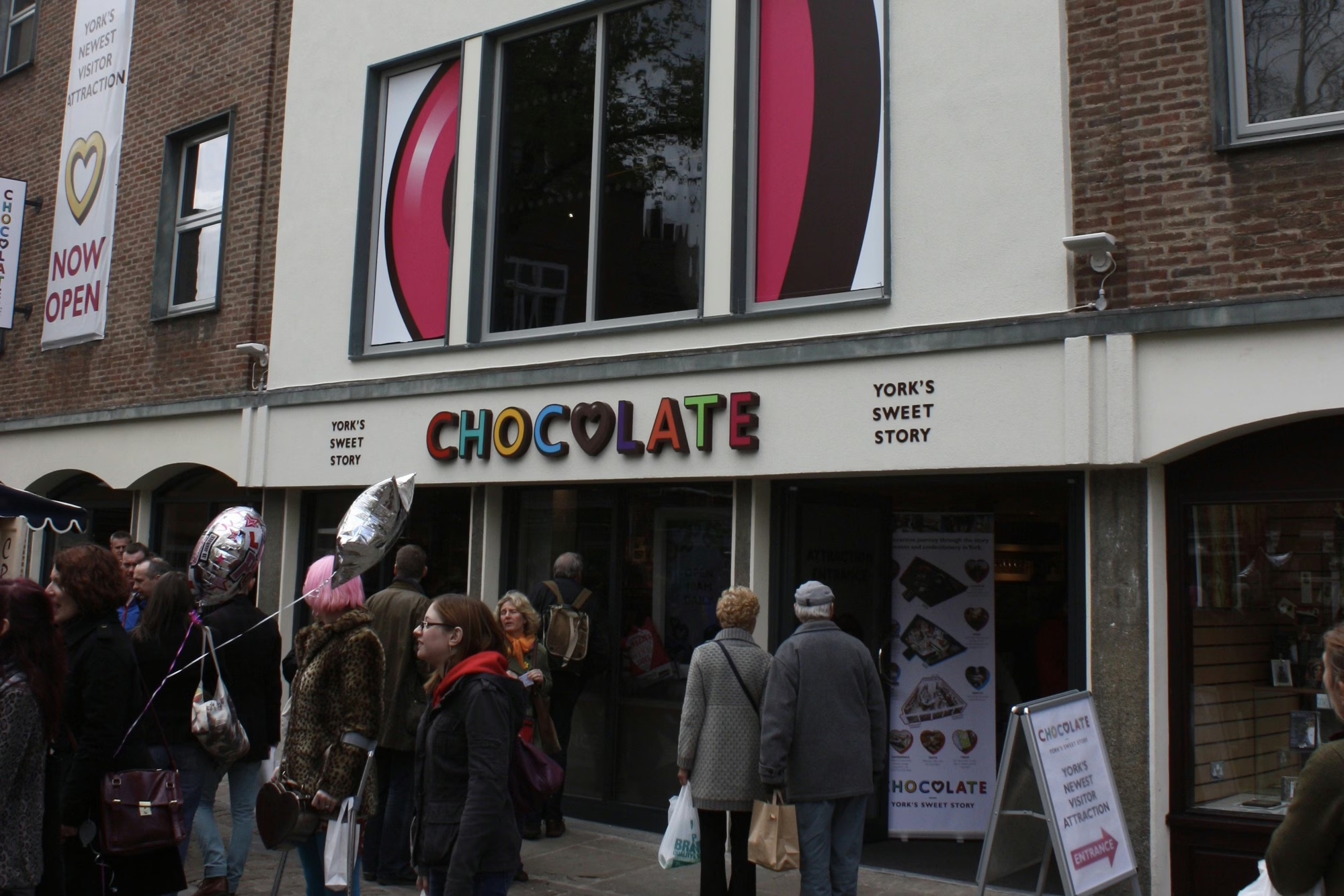
The photo of the outside of York's Chocolate Story

York, my city of birth, is known for a lot of historical things – the Romans, the Vikings, the medieval city walls and others. But it’s also known for chocolate, and was once home to three large confectionary companies: Rowntree’s, Terry’s and Cravens. And the story of York’s chocolate industry is the focus of one of its newer museums: York’s Chocolate Story.

Christine and I visited shortly after it opened, back before we got married, in 2012. Then, it was known as Chocolate: York’s Sweet Story, but its name has changed since. I hadn’t been back since – Christine had her hen do there – but last weekend I took our nine-year-old along.

Having visited Cadbury World earlier in the summer, it was good to compare the two. Cadbury World is a Merlin attraction, and so it’s more of an indoor theme park with some history. Meanwhile, York’s Chocolate Story, is primarily a museum, although both offer you chocolate samples to eat on your way around.

Inside York’s Chocolate Story

Guests follow a guided tour around the museum, although there are videos to watch as well. Whilst we waited for the rest of the group to come up in the lift, our knowledgeable guide asked everyone what their favourite chocolate bar was, and he was able to quickly look up when they first went on sale. It turns out that many chocolate bars have been around longer than we might expect.

The first room is about the ancient history of chocolate, and how Spanish colonialists ‘discovered’ it when they reached Mexico. At this point, you get to try a sample of the bitter chocolate drink that people would have drunk back then.

Next, we’re introduced to the aforementioned three confectionary businesses, and the people behind them. Of these, Rowntree’s still has a factory in York, but is now part of the massive Nestlé conglomerate. Terry’s are still making chocolate, but the York factory (close to where I went to secondary school) is now flats, with production shifted to Strasbourg. Whilst I’m old enough to remember Craven’s sweets, the company is no longer around.

Making chocolate

We then head downstairs, to find out more about how chocolate bars are made. This included a chance to make our own white chocolate lollipop, with a choice of flavours. They use white chocolate as it sets more quickly. We could also watch a demonstration where filled chocolate truffles were made, and of course we got samples to taste. The same room has a history of KitKats, and you can watch various classic KitKat TV adverts too.

All in all, it takes about an hour to get around. Of course, there’s a shop at the end which also does a range of hot chocolate.

Accessibility

Being a newer museum, accessibility is good – there’s a lift taking you to all floors. It’s in York city centre, around the corner from The Shambles, so within walking distance of the station. Whilst you can try to park your car in York city centre, please don’t – we saw loads of people queueing to get into car parks and blocking the roads whilst doing so, and besides, you’ll pay a small fortune. Instead, take one of the six Park and Ride services.

It’s best to book in advance – if you turn up on the day, all the tour slots may have gone or you may have to hang around for a while. Plus, there’s a 20% discount for booking in advance, and York residents get a 30% discount for visits on Sundays.

Thought Bubble 2025

A photo of the comics, posters and related paraphernalia that we picked up at Thought Bubble

Last Sunday, we went to Thought Bubble Festival Comic Con in Harrogate. Overall, it’s our fifth time that we’ve been, and the second year in a row.

We first went to Thought Bubble in 2014. Back then, it was hosted at the Royal Armouries in Leeds, and used their event space, the New Dock Hall and a temporary marquee. We also went in 2016, when Christine was pregnant, and again in 2017, with our then 10 month old baby in tow.

We then had a seven year gap, before going back last year. By this point, Thought Bubble had outgrown the Royal Armouries, and so it’s now hosted at the Harrogate Convention Centre. This was first built in 1982, and hosted that year’s Eurovision Song Contest thanks to Bucks Fizz winning with ‘Making Your Mind Up’ the year before. It’s been expanded a couple of times since, and Thought Bubble takes over 4 of the halls plus the Queen’s Suite.

What we like about Thought Bubble is that the focus is on comic art and the artists that create it. The only celebrities there are the comic artists themselves – you generally won’t find anyone who’s acted in a superhero film here. And whilst there are comic artists for the likes of Marvel, DC and Dark Horse here, there are many, many independent creators too. Amongst these creators, LGBTQ+ people are well-represented, and there were a few people of colour there too. This is no accident – Thought Bubble offers micro-bursaries to under-represented groups, which is really welcome. After all, comic books are about telling stories, and it’s great to have a wide variety of people able to tell their stories.

Kid’s zone

Another great thing about Thought Bubble is that about half of one hall is a designated kid’s zone. This includes those whose comics are primarily for kids, but also includes a play area, and a big area sponsored by The Phoenix. The Phoenix is a weekly kids comic – a bit like the Beano in some respects, except the individual comic artists are more prominent. If you’ve ever come across Bunny vs Monkey, Super Robo Bros or Donut Squad, these are all regulars in The Phoenix. Our nine-year-old loves all of these, and was delighted to be able to take part in a workshop with Donut Squad’s creator, Neill Cameron.

The photo at the top shows most of the things we picked up there, which should keep us busy for a while. Christine also bought a new pair of socks, and we bought a couple of games, including The Necrohamster.

I’m pretty sure we’ll go back next year. It’s fun and all three of us enjoy it.

Kelham Island Museum

A photo of the Don Valley Engine at the Kelham Island Museum

If I had to guess where the Kelham Island Museum was, I’d probably suggest it was somewhere off the coast of northern England. It’s not – it’s in Sheffield city centre, and it’s a museum of Sheffield’s industrial history.

The Kelham Island Museum has been on my to-do list for several years. I seem to remember that, in the past, it was only open on weekdays, which made visiting difficult. Thankfully, it is now open at weekends, and so we went along last weekend for our first visit.

I like a good industrial museum, and the north of England is full of them. I’ve been to the ones in Manchester, Leeds, Halifax, Bradford, and I suppose the World of Glass in St Helens counts too. And whilst St Helens is known for its glass, Sheffield is know for its steel. So, you’ll find a lot of steel at the Kelham Island Museum – it’s home to the Hawley Tool Collection, which is the world’s largest collection of tools. What’s nice about the tool collection is that, whilst many items are on display, there are also pull-out drawers with plenty more to see if you’re so inclined.

The River Don Engine

If you visit at the right time on Thursdays through to Saturdays, you’ll get to see the River Don Engine powered up – it’s the photo you can see at the top. This is an absolute beast of a steam engine, and is currently the most powerful working steam engine in Europe. During its working life, it was, as you would expect, used for making steel. Its maximum output is around 12,000 horsepower, which is around 9 megawatts or the equivalent of 3 wind turbines at full speed.

Whilst it now lives in the Kelham Island Museum, the River Don Engine used to be elsewhere in Sheffield. Indeed, despite its massive size, it’s been moved twice in its lifetime. It last underwent restoration in 2007, when the museum was flooded, ironically, by the namesake River Don.

Kelham Island

The Kelham Island Museum gets its name from Kelham Island, an artificial island in the River Don dating back to the 12th Century. Back then, a mill race was constructed to power water mills. The museum itself is in what was originally an iron foundry, and later a power station for Sheffield’s first generation electric trams. The museum isn’t the only building on the island – there’s also student accommodation to serve Sheffield’s two large universities, and the Kelham Island Brewery.

It’s also worth noting the museum café, Joni, which does very good food – certainly way above average for a museum of its size. In fact, you may need to phone ahead and book a table on busy days. There’s also a pub, The Millowners Arms.

We visited in an afternoon, which wasn’t quite enough time to get around the whole museum, so it’s probably almost a full day out.

Accessibility

As mentioned above, Kelham Island Museum is in Sheffield city centre. There is limited on-site parking, which you need to pay for at a machine or on the RingGo app. Alternatively, it’s a five minute walk from Shalesmoor tram stop, or a 25 minute walk from Sheffield’s main railway station (so you may wish to consider the aforementioned tram).

Entrance is free, but donations are welcome. The museum shop is also great – especially if you or people you know like the local delicacy, Henderson’s Relish.

If you’re in a wheelchair or can’t handle stairs, then you should still be able to see most of the museum. Not all of the floors are flat. A lift is provided to the upper floors. The River Don Engine, when it’s in steam, is particularly noisy.

The World of Glass

A photo of the entrance to The World of Glass in St Helens

Until a few weeks ago, I wasn’t aware that there was a museum dedicated to glass in St Helens. But Diamond Geezer recently visited on one of his non-London gadabouts, and so I took our nine-year-old along to The World of Glass last month.

The World of Glass opened in 2000, and fulfils several roles as a museum. Obviously, the focus is on glass, and so there’s a history of glassmaking starting with the ancient Egyptians through to the present day. In particular, it focusses on glassmaking in St Helens – the location of the museum is no accident. If your house has windows made by Pilkington Glass, then St Helens is where the company was founded. And, as the town’s main museum, it also covers the history of the town, especially during the Industrial Revolution. It’s also home to the St Helens central library.

Entry to the museum is through an original brick cone, used for glass making and designed to draw cool air in from the bottom. This features an art installation by Johnny Vegas – yes, that Johnny Vegas – who is local to the area.

Inside the museum

Though this is its 25th year, it’s clearly had some updates to its exhibits since then. I think it manages to strike a good balance between things in glass cabinets, and interactive exhibits to keep kids entertained. Certainly, our nine-year-old enjoyed learning about fibre-optic communications, and the various light and colour mixing activities. Its star attraction is a chandelier that was salvaged from Manchester Airport during a refurbishment, made of hundreds of hand-blown Venetian glass tubes.

As well as the main exhibition, there’s an art gallery in the main building. Then, there’s a bridge over the Sankey Canal to the Tank House, which is the proper old bit. This is the remains of an original glassmaking furnace, used by Pilkingtons. Much of it had been filled in with rubble, and had to be dug out by archaeologists. You get to go down into the tunnels (hard hats available) to see inside the furnace. Incidentally, the bit of the canal next to the Tank House was known as ‘The Hotties’ because the water used to cool the furnace would be pumped out here, warming the canal water. There are photos of it being used for bathing.

We visited on a Sunday, which meant that we didn’t get to see a glass-blowing demonstration. These take place on other days of the week, usually at 12pm and 2pm. Whereas the museum itself has free entry, this is a paid-for addon.

In all, we spent a couple of hours at The World of Glass. If you stop to look at everything, you could probably eke out another half an hour, plus the time for the glass-blowing. There is also a café, although the menu was very limited when we visited.

Accessibility

As mentioned, entrance is free, though donations are welcome. As befits a museum of its age, accessibility is pretty good, although the Tank House tunnels are a confined space. It’s on two floors with a lift available.

There’s a small pay and display car park on site, which is free on Sundays and Bank Holidays. It’s also a very short walk from St Helens Central station, which has direct trains from Liverpool, Wigan, Preston and Blackpool. St Helens bus station is a little further, but still within walking distance.

Rude Science

A photo taken during the Rude Science show at the Halifax Victoria Theatre

If you like explosions, or want to know what chemicals make up a fart, then the Rude Science live show may be right up your street. Especially if, like us, you have kids in the 6-14 age bracket.

The Rude Science show came to the Victoria Theatre in Halifax last weekend, and so we took our nine-year-old along. It was hosted as part of this year’s Halifax Comedy Festival, which runs until Sunday.

Rude Science is hosted by Stefan Gates, who has hosted and guested on a number of BBC TV shows, for both kids and adults. He’s also the author of a number of books – we picked up his Rude Science (sponsored link) and Insects: An Edible Field Guide (sponsored link) from the foyer after the show, and had them signed. Oh yes, I should mention that Stefan has a thing for ‘eating the science’ and this includes various substances used during the show.

The show is very well put together, considering that it incorporates highly flammable materials and lots of different cameras (including infrared) and smoke machines. Certainly, there were only one or two minor balloon-related technical hitches. And whilst it wasn’t quite a sell-out crowd, there were very few of the 1500 or so seats remaining empty at the Victoria in the showing that we saw.

Rude Science is well targeted at upper primary and lower secondary school aged kids, and has a good balance of being funny, engaging and educational. Our nine-year-old really enjoyed it. The show remains on tour for the rest of this week, with it being half-term – it’s in Hull tonight, Guildford on Thursday, Chelmsford on Friday and Reading on Sunday. At each venue, there’s usually a lunchtime and afternoon slot, and, with an interval, the show runs for around two hours. It’s then back on the road for February half term.

Castlefield Viaduct

A photo of the Castlefield Viaduct

In my review of local National Trust properties, I somehow missed out Castlefield Viaduct in Manchester. It’s one of the newest, having only been open for a few years, and occupies an abandoned railway viaduct that crosses the Castlefield area of Manchester.

It’s a similar concept to the High Line in New York; take an abandoned elevated piece of railway infrastructure, plant things on it and open it to the public. The Castlefield Viaduct isn’t as long – around 330 metres, rather than 2.3 kilometres – and it’s not yet open as a through route. That will come in time, with work hopefully starting as soon as this year. When complete, it will open up a segregated walking route from the Manchester Central exhibition centre (still often known by its former name of G-Mex) towards Cornbrook.

History

The viaduct was built in 1892, by the same firm that built the Blackpool Tower. Trains would use the viaduct to access Manchester Central station (as was) and the Great Northern Warehouse. It was closed in 1969, after becoming surplus to requirements, and has stood empty ever since. A second viaduct runs parallel; this is still in use by Metrolink trams and forms the core section of the network.

Inside Castlefield Viaduct

About a third of the viaduct is open now, and it’s being managed by the National Trust. The first section has been largely left untouched – a hard path has been laid, but the original ballast has been left behind to show the wild plants that have grown there. The second section is a series of small gardens, each managed by a different local community group. These vary – one has various native Manchester trees whilst another incorporates a pond. Finally, there’s an indoor bit, where you can find out more about the extension plans. The back wall of this is glass, so you can see the rest of the viaduct beyond.

If it weren’t for the neighbouring Metrolink viaduct alongside, this would be a quiet and tranquil place, but trams pass about every two minutes. The viaduct also crosses a railway line that is frequently used, so there are regular rumbles as trains pass.

Accessibility

The viaduct is open between 10am and 5pm every day except Mondays and Tuesdays. Though it’s managed by the National Trust, entry is free even if you’re not a member. Donations are encouraged to support the next phase of work to open it as a through route.

As it was designed for trains, it’s all on one level, and you can get up to the viaduct by using the lift at the nearby Deansgate-Castlefield Metrolink stop. Accessible toilets are also provided.

How many theatres are there in Bradford?

A photo of the Alhambra Theatre in Bradford.

Seeing as it’s UK City of Culture this year, and theatres are places where you can see cultural things, how many theatres are there in Bradford? I think there’s eight, and here’s a list.

By the way, I’m defining Bradford as the area within the A6177 Bradford ring road. That means that I’m not including the theatres and arts centres in Ilkley, Bingley and Keighley that are in the wider City of Bradford district. And I’m defining ‘theatre’ as anywhere with a stage and seating that can be used for performances.

1. The Alhambra Theatre

Probably the best known theatre in Bradford is the Alhambra Theatre in the city centre. Opening shortly before the First World War, and extensively refurbished in 1986, it seats 1456 people and is where most major shows take place. It’s Grade II listed, and next month it’ll be hosting the touring production of Matilda, Tim Michin’s musical adaptation of the Roald Dahl novel. Earlier this month, it hosted the annual CBeebies Pantomime which will be on TV and BBC iPlayer this Christmas.

The last show we saw here was Unfortunate, last year, but we may well go to see Matilda as it’s a favourite in our household. It’s a Grade II listed building.

2. The Studio

Right behind the Alhambra Theatre is The Studio. As the name suggests, it’s a ‘black box’ studio theatre with a movable seating rig. This can seat up to 200, and is used for smaller productions and stand-up comedy. We saw George Egg here 10 years ago, but haven’t been to another show since.

3. Theatre in the Mill

Okay, disclosure alert: The Theatre in the Mill is run by my employer, the University of Bradford. As the name suggests, it’s in part of what was the Phoenix Mill, and now forms one of the university buildings. Like The Studio, it’s a black box studio theatre with movable seating, and seats around 100 people. Its programme of events includes stand-up comedy – both performances and workshops – film screenings and shows. I’ve also been to a number of student shows here over the years, but as Bradford isn’t really a performing arts university, there currently aren’t many of these.

4. Siobhan Ullah Performance Space

Next door to the university is Bradford College, which is home to Bradford Arts School, and in turn, the Siobhan Ullah Performance Space. Although it’s primarily used by the college students, it can also be used for events and seats 125 people. Again, it’s a black box studio theatre. It’s named after a former performing arts student of the college who sadly died of an asthma attack, aged just 18. I haven’t been to this theatre before.

A photo of Bradford Live, a theatre in Bradford

5. Bradford Live

Back down towards the city centre, and next door to the Alhambra is Bradford’s newest and biggest performance venue, Bradford Live. It only opened this summer, and seats over 3000 people. It’s hosted in what was the Victoria Theatre, and later and Odeon Cinema which closed in 2000, and laid empty for almost a quarter of a century. Indeed, it survived a plan to demolish it in the late 2000s, and has now undergone a huge amount of restoration. It’s not currently a listed building.

As the name suggests, Bradford Live is more about live events and will be hosting a number of bands in coming months. Ocean Colour Scene are playing next month, as is CBeebies entertainer Justin Fletcher, and the Kaiser Chiefs are playing their first album in full in the new year. But there are some shows that you would typically expect in a theatre playing there too, such as Bluey’s Big Play, which I’m sure we’d be dragged to if our nine-year-old was a bit younger. We haven’t yet been here.

6. Bradford Arts Centre

Okay, technically the Bradford Arts Centre is even newer than Bradford Live, having opened under its current name as recently as this month. Previously, it was known as Kala Sangam, with a focus on South Asian arts. Its new name reflects its broader remit and engagement across all of Bradford’s populations. It’s located at what used to be Bradford’s crown post office at Forster Square, around the back of the Broadway shopping centre and next to Bradford Cathedral. The building is Grade-II listed.

There are several spaces in the arts centre, including a 200 seater studio theatre. We’ve been once, to see a pantomime that a friend was in about 10 years ago.

7. Bradford Playhouse

A few years ago, I used to volunteer at the Bradford Playhouse, and so it’s come up on here a few times. It was at risk of closure in 2014, but is now flourishing and is now fully accessible, following a successful crowdfunder early this year. The theatre offers two spaces: an art deco main auditorium seating up to 265 people, and a smaller black box studio theatre, seating up to 40 people. It hosts a mixture of professional shows and performances by amateur dramatic societies and dance schools. The building isn’t listed, but it was registered as an Asset of Community Value for five years in 2014.

8. St Georges Hall

Like Bradford Live, St Georges Hall is more of a live events venue than a theatre, with stand-up comedy and live bands. It’s also the oldest on this list, having opened in 1853. At one time, over 3000 seats were squeezed into the space, but nowadays its seating capacity has been reduced to 1335, or 1550 for standing events. It’s Grade II* listed, and was renovated between 2016 and 2019. The last show we went to see was a recording of I’m Sorry I Haven’t A Clue in 2014.

I think that’s quite an impressive list of theatres, actually, considering Bradford’s size.

Operation Ouch: Brains, Bogies and You

Our family of three appearing as skeletons at the Operation Ouch: Brains Bogeys and You exhibition

Last weekend, we made a return visit to the Science & Industry Museum in Manchester, to see the Operation Ouch: Brains, Bogies and You exhibition. This is the second consecutive Operation Ouch exhibition at the museum; last year, they had ‘Food, Poo and You’ which we visited in January. Twice in fact, as the first time I went with our (then) eight-year-old, and so we visited again a few weeks later as a family of three.

For those without kids (or grandchildren) in the 7-14 years old age range, Operation Ouch is a CBBC TV show hosted by twin doctors Dr Xand and Dr Chris, and in later series, joined by Dr Ronx who is probably one of the most visible non-binary people in UK children’s’ TV. Dr Chris is also the author of the book ‘Ultra-processed People’, which I reviewed back in 2023. As you would expect from a BBC series, Operation Ouch aims to inform, educate and entertain (the three principles on which the BBC was founded), so as well as teaching kids about science, it’s designed to be entertaining and disgusting too.

Inside Dr Xand’s head

The exhibition therefore follows a similar style. The idea is that you are shrunk down at the start, and enter a reluctant Dr Chris’ ear, where you can then enter different parts of his head to see how they work. There’s the brain, eyes, nose, ears, mouth, and a section on touch to cover all five senses. Unlike the previous exhibition, which was a linear journey through the digestive system, the layout is more free-form, with links between the sections and back to the core brain section.

Because it’s aimed at kids, the exhibition has lots of interactive elements. We particularly liked the screen which monitors your movement and displays an image of you as a skeleton. In the eyes section, there’s some optical illusions to try out, and, as someone with hearing loss, I appreciated the ears section too. Here, you could see how cochlear implants work; I don’t have one yet, but might need one in future. There’s also a demonstration of how your hearing changes over time, as you lose your ability to hear certain frequencies. Our nine-year-old could hear everything, Christine could hear two of them and I could only hear one, even when using the telecoil through my hearing aids.

In all, we spent about an hour in the exhibition, but could have spent longer.

Elsewhere in the museum

Having only visited last year, we mainly just came to see the exhibition. In recent years, there hasn’t been much of the museum available to see; of the five buildings that used to make up the museum, only one (the New Warehouse) has been open. The Air and Space Hall permanently closed in 2021; this was across the road from the rest of the museum and is now in use as a co-working space. The 1830s buildings, consisting of a warehouse and the original Manchester Liverpool Road railway station, are also closed for refurbishment, and due to re-open in 2030 for their 200th anniversary.

The good news is that The Power Hall has re-opened, as of Friday last week. We’ll plan to visit next year, when the next exhibition is on.

Accessibility

The Science and Industry Museum as a whole is pretty good for accessibility, and this extends to the Operation Ouch exhibition. All video content has subtitles and BSL interpretation, and any audio content that you can listen to includes a telecoil system for hearing aid users. The exhibition is all on one level.

Whilst the museum as a whole is free to enter (donations welcome), the Operation Ouch exhibition is a paid-for addon. Essential carers can get a free ticket when purchased with a regular-priced ticket.

The only on-site parking is for Blue Badge holders. There are various smaller pay-and-display car parks nearby, if you don’t mind parking under an unlit railway arch. Alternatively, there’s a multi-storey NCP car park at the Great Northern Warehouse, which is expensive but probably safer and more secure. This is a short walk away.

The nearest railway station and tram stop is Deansgate-Castlefield, which is reachable from literally every other Metrolink stop. There’s a lift down to street level at the tram stop, and then it’s only a short walk to the museum.

Bowland Wild Boar and Animal Park

A photo of some wild boar at the Bowland Wild Boar Park

We’re finally at the end of the list of the things we did over the summer. And yes, I’m aware that it is now October and the weather is distinctly un-summery. On the August Bank Holiday Monday, we went to the Bowland Wild Boar and Animal Park, which is in the Forest of Bowland Natural Landscape in North Lancashire.

The Bowland Wild Boar Park is an open farm, and one of many across the UK that doubles as a visitor attraction. However, as the name suggests, it’s also home to a herd of wild boar, who have a large paddock to roam around in. Indeed, the photo at the top of this post was about the best shot as I could manage on the day. Besides the wild boar, there are also emus, goats, llamas, alpacas, peacocks, geese, hens, owls, deer, pigs, donkeys, ducks, and the ubiquitous meerkats.

It’s quite a large site, with the animals having plenty of space. You can also buy bags of animal feed, to give to (some of) the animals, and there’s a playground, café and ice cream shop. If you’re able to stay for a whole day, then there are walks around the site that you can go on, but we mainly stayed around where the animals were. On the day we visited, there was an excellent food truck visiting, so I can’t comment on the food at the café.

Geese and goats at the Bowland Wild Boar Park

Accessibility

If this all sounds great, just be aware that the park has limited opening outside of the summer peak, so don’t head off there this weekend. It’s open throughout the forthcoming October half term, with Halloween themed activities (Saturday 25th October to Sunday 2nd November), but not until then. After that, you’ll need to check the web site as it’s often only open at weekends or for special events. I gather that the site doesn’t have mains electricity, and so it’s reliant on a couple of massive free-standing solar panel arrays and generators.

The site is on a slope, and there’s a lot of uneven ground. However, you can rent a rugged mobility scooter in advance if needed.

We drove there, taking a rather scenic route across the top of the Calder Valley avoiding Todmorden, and then through some of the more well-to-do villages near Clitheroe. If you don’t have a car, then there are hourly buses from Clitheroe (which is the nearest railway station with trains from Manchester and Bolton) that take you to the village of Chipping, where it is then a 3-4 mile walk. Maybe bring a bike.

Bolton Abbey

A view of Bolton Abbey overlooking the River Wharfe

Bolton Abbey is yet another of those ‘I can’t believe I haven’t written about this before’ places that we went to again last month. But, apparently, I’ve never written a blog post about a visit, even though I’ve been loads of times over the years.

The Bolton Abbey estate is one of the ‘seats’ of the Dukes of Devonshire, along with Chatsworth (see 2016 blog post although we’ve visited again more recently) in Derbyshire and Lismore Castle in Ireland – none of which are in Devonshire. The 11th Duke of Devonshire, Andrew Cavendish, transferred ownership of the Bolton Abbey estate to a charitable trust who operate it to this day.

As the name suggests, the main feature of the estate is an abbey, now known as Bolton Priory. Part of the church is still in use today, but the rest of it is a ruin, following the Dissolution of the Monasteries by Henry VIII. I’m beginning to understand why we spend so long learning about the Tudors in our history lessons at school. The priory was built next to a crossing point of the River Wharfe, and the estate essentially covers the river valley.

Our last visit was in the summer of 2020, during the pandemic, and over the years I’ve been on some hikes with the University hiking club,

The Strid

I’m going to let you watch this Tom Scott video about The Strid. Upstream from the abbey, the River Wharfe hits a section of harder rock, and is forced into a narrow, fast-flowing channel, known as The Strid. It’s regarded as being one of the most dangerous stretches of water in the world, as whilst it may look sedate from above, there are fast-flowing currents below the surface. And we’re not entirely sure how deep it is – there may be hidden caverns down there.

Due to the exceptionally dry year that we’ve had, there was less water flowing through The Strid when we visited. But there are big warning signs around, advising that people have lost their lives after having fallen in. We had a look at it from a safe distance.

The Stepping Stones and the beach

Back down towards the priory, there are a set of stepping stones across the river. It’s particularly wide and shallow here, and possible to wade across in summer. There have been stepping stones here since the abbey’s heyday, although they’re often replaced due to damage. There are 62 stones in total, and our nine-year-old raced across whilst I nervously followed behind. Nowadays, there’s a bridge alongside, and so Christine took the easy route.

Next to the stepping stones is a beach – a sandy area inside one of the river’s meanders. This is popular, especially on sunny days, as an inland alternative to the seaside. Our nine-year-old had a nice paddle.

On the eastern bank of the river was the Welly Walk, which I understand is only here for this year and closes in November. It’s essentially a series of play areas over a one mile walk. It can get muddy, and the path isn’t suitable for wheelchairs or pushchairs, but it’s a fun challenge for kids.

Accessibility

The map given to you on arrival shows the more accessible paths around the estate, but there are some relatively steep ramps even on the more accessible routes. Some paths have steps, and almost all are gravel with some uneven surfaces.

There’s plenty of parking on site, across four car parks. Payment is £15 per car for a whole day on arrival, or £12.50 if pre-booked at least a day before. You don’t need to pay to enter the site, so if you’re able to arrive by some other method, you won’t need to pay anything.

That said, public transport options are limited. There are buses on Mondays, Wednesdays and Fridays, and Dalesbus services at weekends. Due to a narrow arch on the road through the valley, these tend to be small buses. Bolton Abbey railway station is about a mile away, but it’s on the Embsay and Bolton Abbey Steam Railway which doesn’t have a mainline connection.