Sea Life Centres tend to vary. We’ve been to the one in Scarborough a few times, most recently in 2019, and it’s branded as a ‘Sea Life Sanctuary’ as it includes a seal hospital. The Manchester Sea Life Centre, being quite far inland, is very much a tourist attraction. It’s all indoors, and whilst there are endangered species there, it doesn’t have as much of a focus on protecting wildlife not already in its collection.
Sea turtles
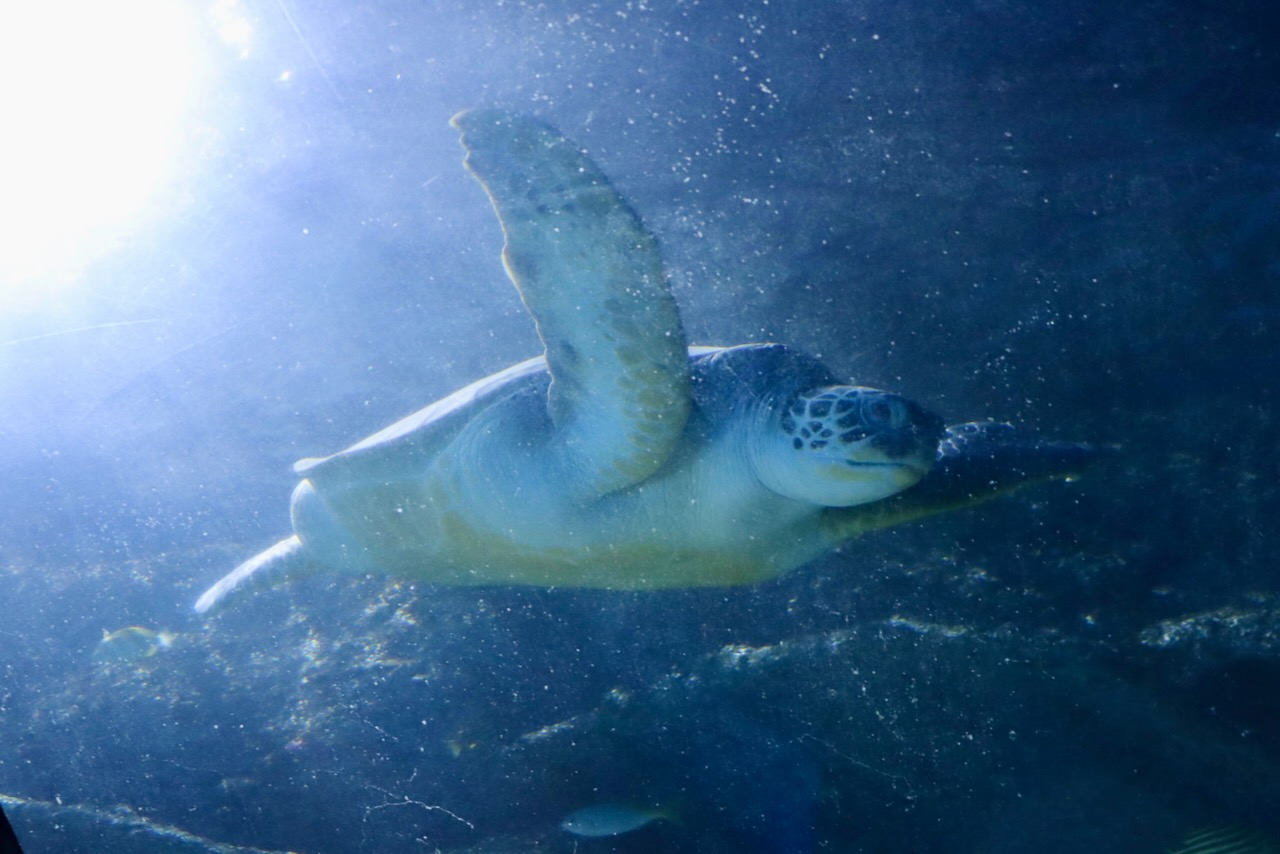
On entering the Sea Life Centre, you first watch an interactive film about sea turtles, and how they lay their eggs on sandy beaches. You then pass through a series of themed zones, including a glass tunnel where you can see into the largest tank. This is home to several sharks, and Ernie, the sea turtle. There’s a tank focussing on rays, a coral reef, a rockpool, and another turtle exhibit including lots of terrapins which have been captured in the UK as an invasive species. Finally, just before the exit, is a large soft play frame for kids.
This was our third visit to the Manchester Sea Life Centre, the last one being in the run up to Christmas in 2019. We’ve generally whizzed around in about an hour each time; there are usually some talks and demonstrations to pad out your visit to perhaps two hours, but it’s not a full day out. We did this and the Legoland Discovery Centre next door in one afternoon.
Accessibility
Most of the Sea Life Centre is step-free, apart from some areas used for VIP experiences. Standard disabled toilets are available inside the attraction; a Changing Places toilet is available elsewhere in the Trafford Palazzo.
You can book both the Sea Life Centre and the Legoland Discovery Centre together if you wish, and Merlin will claim that this will save you money. In my experience, it doesn’t – it was cheaper to book both separately a few days in advance. I think that’s because the combo deal includes a fully flexible ticket, rather than one for a specific date and time – if you’re able to book for a certain time slot, it’ll probably be cheaper.
There is a shop inside, but no café – just a couple of vending machines selling drinks and ice cream. There are a number of food outlets elsewhere in the Trafford Palazzo though, and loads in the Trafford Centre which claims to have Europe’s largest food court.
All the rest of the information about getting there and discounts is the same as it was for the Legoland Discovery Centre, so I won’t repeat myself. In my view, it’s not the best Sea Life Centre – the Scarborough one is much better – but as somewhere easily reachable by public transport it fit the bill.
A couple of weekends back, Christine had some coursework to do and wanted me and our ten-year-old out of the way for a day. So, we went to the Legoland Discovery Centre, located at the Trafford Palazzo in Manchester.
This was actually our second visit; our first was in August 2017. Back then, our now ten-year-old was only about 18 months old, and as such, way too young. Whilst there is a small Duplo area, it’s not a big attraction and so we didn’t get much out of it at the time. It’s best for primary school aged kids, so 4 to 12-year-olds. Older kids may find that they’re too big for some of the attractions.
What’s inside the Legoland Discovery Centre
Like I said, the Legoland Discovery Centre isn’t a big attraction, especially compared to Legoland Windsor. We went to Legoland Windsor in 2021, at which you really need two days to see everything. Handily, there are two themed hotels on site, but at a price – instead, we stayed in a Premier Inn in Slough. By comparison, you can do pretty much everything at the Legoland Discovery Centre in two hours. Indeed, at busy times, you may find your visit is actually limited to two hours.
It’s all indoors, and starts off with an exhibit showing how Lego bricks are made. On our previous visit, this was an interactive exhibit with a member of staff walking us through it and presenting us with a special exclusive Lego brick at the end. On this visit, it was a static exhibit with information panels.
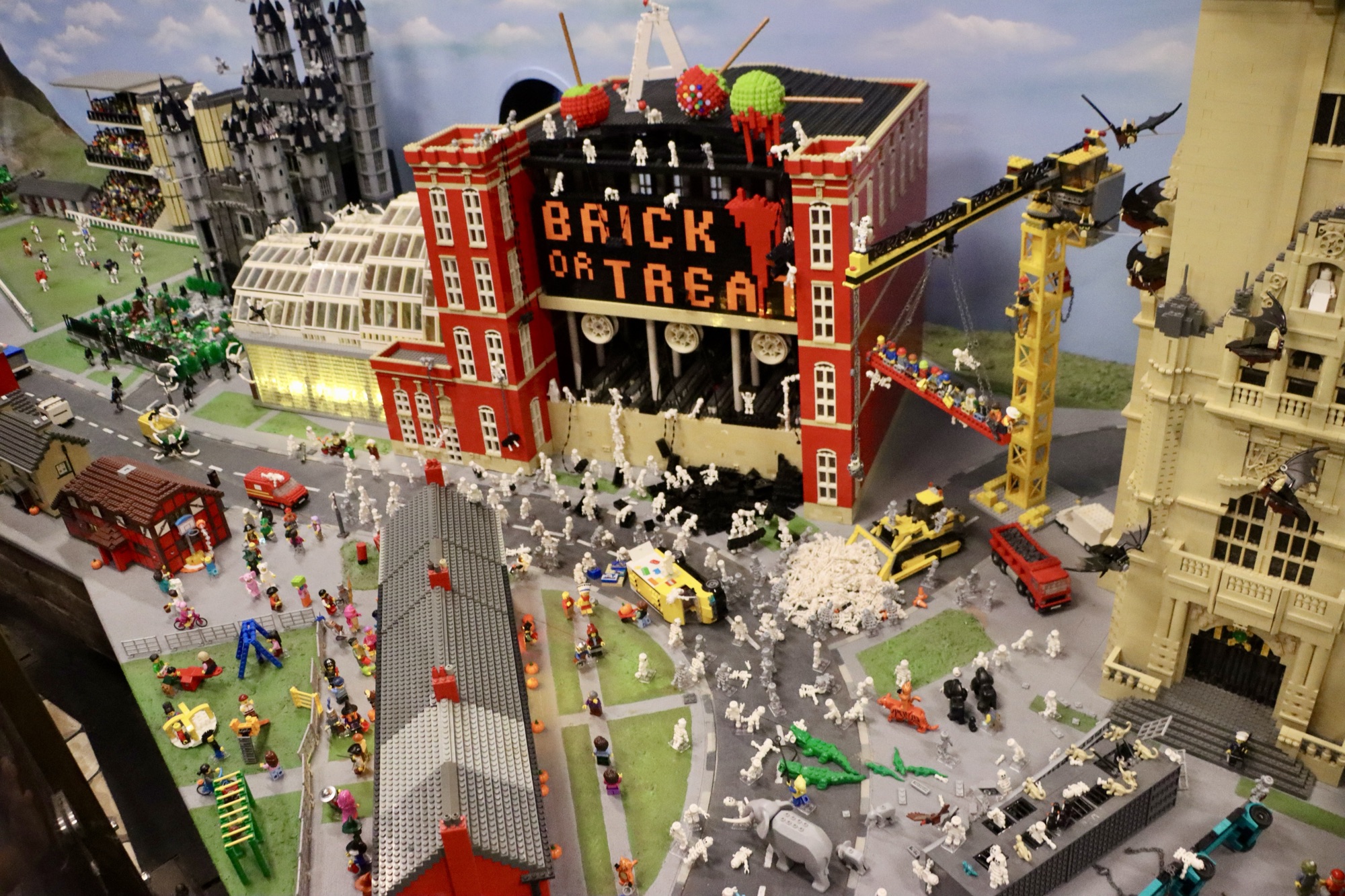
Next, was Miniland, where there are Lego models of real places. These are all in the north west of England, so Manchester but also Chester and Blackpool. If you visit this month, like we did, the models have all been spooked up for Hallowe’en. So, expect to see spiders attacking the model of the Blackpool Tower and tentacles coming out of a model of the Trafford Centre.
There are two rides:
Kingdom Quest, where you sit in a chariot and shoot lasers at invading trolls
Merlin’s Apprentice, which spins you round and lifts you up and down as you pedal
There’s a Ninjago themed soft play area, the aforementioned Duplo area and a ‘4D cinema’ where you get to watch a short 3D computer-animated film and have air and water sprayed at you. This was also Hallowe’en themed. This is all included in your entry fee.
Paid-for extras
Without realising, I booked the ‘Legoland Discovery Package’, which includes some paid-for extras. As I write this, these cost an extra £5.50 per ticket when booked in advance, which is cheaper than buying on the day.
These included the Lego VR Experience, where you sit in a pod and put on a virtual reality headset. The pod then moves in time with a virtual reality film. You get to choose one of two films – a Lego race, and a roller-coaster, which our ten-year-old chose for both of us. The roller-coaster is actually set in nearby Salford Quays, just by the Imperial War Museum North, and has you descending a huge tower on the roller-coaster.
We also got two bags of Lego (presumably one each) on entry, which were probably worth the extra £5 or so each on their own.
The other thing we paid extra for was a green screen photo. We went for the £20 package, which got us two large printed photos, the same two photos on keyrings, and digital downloads of all the photos that were taken, including one on the Kingdom Quest ride. A bit pricey, but these things always are.
In all, we spent a little over two hours at the Legoland Discovery Centre. Having booked in advance and used a discount (see below), it was merely moderately expensive. I would not have wanted to pay the full, on the gate price.
Accessibility
There is full step-free access to the attraction, and inside there is a Changing Places toilet. The regular toilets are currently closed for refurbishment, but there are plenty of toilets elsewhere in the Trafford Palazzo.
It’s always cheaper to book at least 24 hours ahead of time, and entry charges vary depending on the time of day, so you can save even more if you’re willing to be even just a little bit flexible. Like all Merlin attractions, there are lots of ways to save money – I got 15% off via the CSSC, but you can also get a similar discount with a Max card when booking in advance. It’s also worth checking the Merlin Deals page on MoneySavingExpert.com – right now, you can save 25% by buying a packet of Kellogg’s cereal (although I’m not 100% sure that the Legoland Discovery Centre is included).
There’s a café inside, and a Lego shop on the way out.
The nearest car parking is at the Trafford Palazzo itself, and there is plenty of car parking at the nearby Trafford Centre too. Electric car charging of all types is available across the site.
We got there by tram; the Trafford Palazzo tram stop is right outside, and it’s the penultimate stop on the Trafford Park line. The Trafford Centre bus station is a 10-15 minute walk away, but at least it’s an indoor walk.
2026 marked 70 years since the very first Eurovision Song Contest, and so the National Science and Media Museum in Bradford is holding a special exhibition called Setting the Stage. I visited a couple of weeks ago, along with our ten-year-old and some friends from university.
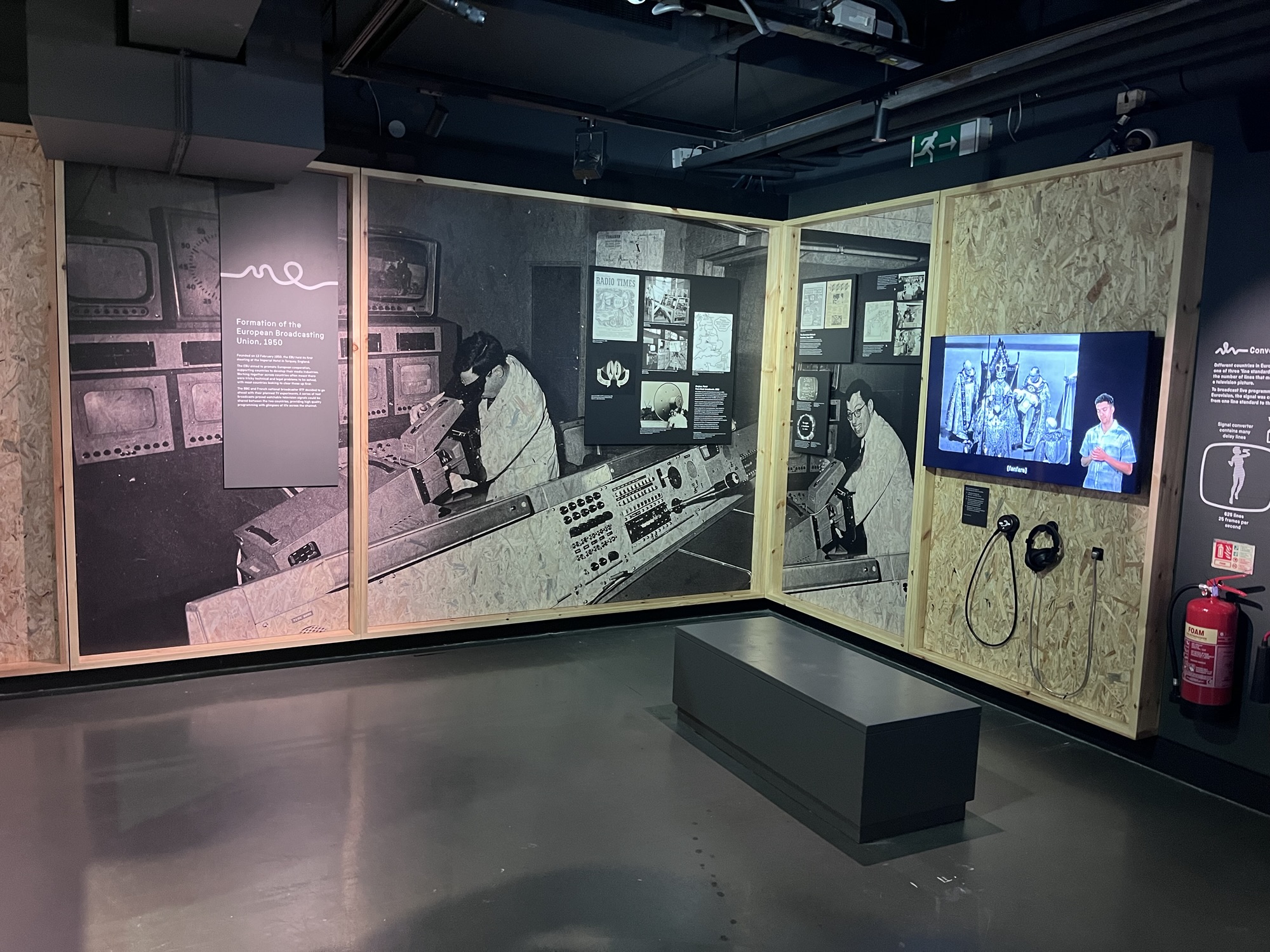
Setting the Stage spans two floors, taking up both of the museum’s temporary exhibition spaces, so it’s a large exhibition. You start off on the first floor, and with it the beginnings of the European Broadcasting Union. Here, there’s a lot about the technical challenges that had to be overcome in the 1950s to be able to broadcast the same TV programme live across multiple countries. A network of broadcast masts had to be set up across the continent to relay TV pictures and sound, and mountain ranges like the Alps provided particular challenges, as did differing TV standards in use in different countries.
Even now, the Eurovision Song Contest is a massive technical undertaking for the host nation, requiring a huge venue, multiple cameras, microphones, staging, lighting and crews to make it all run smoothly.
Fan stories and Objects
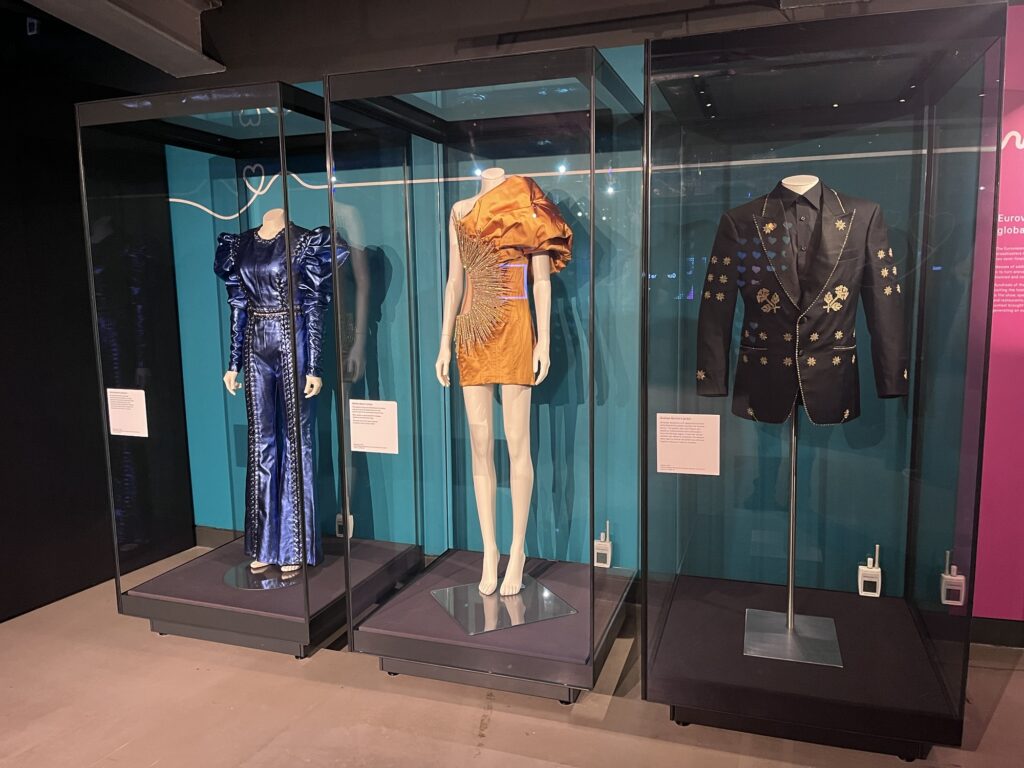
The Media Museum has used the Setting the Stage exhibition as an opportunity to put on show various objects related to Eurovision in its collection. It helps that the UK was a recent host of Eurovision, as we hosted the 2023 competition on behalf of the 2022 winners, Ukraine. The exhibition has the outfits worn by the hosts, Julia Sanina, Alesha Dixon and Graham Norton on show, pictured above. There’s also one of the flight attendant uniforms worn by a member of the band Scooch, for their 2007 entry Flying the Flag.
There are also plenty of objects donated by fans, including some home made items. Expect to see more than one star hat based on the one worn by 2007 Ukrainian act Verka Serduchka, for example. It’s similar to an earlier exhibition that I visited in 2014 about Doctor Who which focussed on the show’s relationship with its fans.
Upstairs, you have a chance to do a bit of karaoke with a choice of songs. Thankfully, no-one videoed my rather poor attempt at Oooh Aaah, Just A Little Bit by Gina G.
Setting the Scene is running at the National Science and Media Museum until the 24th January, so you still have some time to go and visit. If you’re a Eurovision fan, then I’d definitely recommend it, but even if you’re not, you may learn quite a bit about what it’s like to put on a massive live show across an entire continent (and Australia, for some reason).
Accessibility
Accessibility at the National Science and Media Museum is good; all floors are level and there’s lift access available. Disabled and Changing Places toilets are provided.
Entry to the museum is free, as it’s home to several national collections, but a £5 per person donation is encouraged. There’s limited pay and display parking behind the museum, and there are apparently two electric vehicle charge points (standard AC, Type 2) here which show up on Google Maps, but not on Zapmap. I personally park at the Broadway shopping centre and walk across. The museum is only a short walk from both Bradford Interchange and Bradford Forster Square railway stations and indeed we visited by train on this occasion.
If you fancy seeing a bit of free public art, head along to the Manchester Arndale Centre some time in the next three weeks to see the MCR Made Icons. These are massive balloons, suspended from the shopping centre’s ceilings, depicting various famous Mancunians.
All the designs are by Mancunian illustrator Stanley Chow. He’s done quite a lot of work, and indeed until very recently the social media profile picture for Andy Burnham, now our prime minister, was one of his designs.
We didn’t go to the Arndale specifically to see the MCR Made Icons. We actually went in because our ten-year-old really likes eating at Five Guys, and happened to spot them. The majority of the balloons are in the ‘new’ bit with the posher shops and – crucially for balloons – higher ceilings. We first spotted the Emmeline Pankhurst balloon on the way in, and then got to see the likes of Marcus Rashford, the Gallagher brothers, Lemn Sissay and Alan Turing. The balloons in the older part of the Arndale are rather smaller.
If you’re wondering why there have been several Manchester-based blog posts in recent weeks, it’s because I was in Manchester three times last month; our trips to IWM North, Mackie Mayor and the Manchester Museum were all separate trips.
Accessibility
MCR Made Icons is on show every day at the Manchester Arndale until the 23rd October, and it’s free to get in, like the rest of the shopping centre is. The shopping centre is fully accessible, with lifts, disabled toilets and a changing places toilet. You can park your car there, but we tend to get the tram in from Hollinwood as Exchange Square tram stop is right outside.
It’s taken us almost nine months, but we finally got to redeem Christine’s Christmas present, and go behind the scenes at the Vivarium at the Manchester Museum to meet their collection of frogs and toads at the weekend just gone.
The Vivarium is actually a little unusual for a museum to have. Whilst the Manchester Museum is full of animals, these are mostly stuffed, whereas the Vivarium includes live animal specimens. There are a variety of amphibians and lizards on show, but frogs and toads make up the majority of the exhibits. Some are on show, but a number of species are kept behind the scenes, and this was what our tour allowed us to see.
There are a couple of notable species of frog that the Manchester Museum cares for.
The Variable Harlequin Toad
This species was, at one point, declared extinct as none had been seen in the wild for some time. Thankfully, a small colony was found in Panama, and six live specimens – three males and three females – were brought to the Manchester Museum. Thankfully, they’re now ‘merely’ critically endangered, and the Manchester Museum has been successful at breeding them. Indeed, it’s the only place in the world where you can see this particular species in captivity.
With the numbers remaining being so small, breeding is tightly monitored to encourage better genetic diversity, and so the males and females are kept separate. The tanks face each other, so the males could still see the females and were, to be frank, rather frisky when we visited. It was one of these toads that we sponsored when we bought the package.
Sylvia’s Leaf Frog
Most of the frog species at the Manchester Museum are leaf frogs, and one, the Sylvia’s Tree Frog, was ‘discovered’ here as recently as 2018. They were thought to be the closely related Splendid Tree Frog, which the Vivarium also holds, but had different markings and, following genetic testing, were found to be a different species. They’re kept in adjacent tanks, so you can see how to two species differ. ‘Sylvia’, incidentally, is the name of the granddaughter of the zoologist, Andrew Gray, who first described the species.
We also got to handle a couple of different species of frogs – namely the black-eyed leaf frogs and the red-eyed leaf frogs, pictured at the top. These species tend not to be on show as they’re largely nocturnal, so this presented a good opportunity to see them.
The Vivarium isn’t very big, and so the tour is only scheduled for an hour. As it was, we spent way longer than that chatting with our guide, so we definitely got our money’s worth. It was a great visit, especially for Christine and our ten-year-old who loved handling the frogs.
Closing for refurbishment
If you want to see the frogs for yourself, you’ll need to go to the Manchester Museum pretty soon, as the Vivarium will be closing next month for a refit. It’s due to re-open in the spring, but it does mean that the behind the scenes tours are not available to book at present. In the meantime, here’s a video (also embedded below) when Maddie Moate went on a similar tour around 10 years ago, with Andrew Gray (who would go on to describe Sylvia’s Tree Frog). As well as her YouTube channel, Maddie also presents science shows for young kids on CBeebies. It was this video that inspired me to book the visit in the first place.
Back in 2024, when we went to Northumberland for our summer holiday, I posted a list of the places that we didn’t go to but had considered. I didn’t publish a list last year, as I knew we were going back to Wales this year. But we’ve decided we’ll be going to the Yorkshire Coast on holiday next year, which means I can share the list of places that we considered, but didn’t end up visiting.
The reasons why we didn’t visit these places varies, but mainly it was a lack of time. With me still recovering, and not able to drive, we took things a little more steady this year than last year.
Yr Wyddfa (Snowdon)
Yr Wyddfa, or Snowdon to use its English name, is the tallest mountain in England and Wales. It’s also one of the most accessible, with several walking routes and a narrow gauge railway running up it. Whilst I have been up several mountains in my time, including Yr Wyddfa twice, our ten-year-old has never been up a ‘proper’ mountain and so this would have been a first for them.
Because we were holidaying with my parents, who are both getting on a bit, walking up wasn’t an option for us. And, in peak season, the train is very expensive. A return journey with a diesel train would have cost £230 for the five of us, or £300 for a steam train. And these are the prices when booked in advance, which is strongly recommended as availability of tickets on the day can’t be guaranteed. Weather conditions atop Snowdon can be very different than at lower levels, so there’s a risk of booking ahead and ending up with bad weather.
Welsh Highland Railway
By comparison, the Welsh Highland Railway offers much better value for money, being a longer journey all the way from Porthmadog to Caernarfon. However, heritage railways have a maximum speed limit of 25mph, so a journey there and back basically takes all day and doesn’t leave you much time in Caernarfon.
I went on the Welsh Highland Railway from Beddgelert to Caernarfon in 2009, but was part of a group who was able to pick us up in Caernarfon and take us back. It’s a lovely, scenic journey and I’d definitely recommend it, but you need a whole day for it and we ran out of time.
The lack of information on their web site about admissions prices suggests that it is free for everyone to visit, not just National Trust members. However, it’s one of their smaller properties and so we would have wanted to combine it with something else.
Llandudno Chocolate Experience
We did go to Llandudno last year, but didn’t visit this small chocolate museum. I get the impression that visits are quite short, lasting around an hour or so, and it’s only open weekdays and summer Saturdays. Maybe if we’re back in Llandudno for another reason we might pop in.
Plas Mawr
Plas Mawr was actually within walking distance of where we were staying. It’s a Cadw property, and is an Elizabethan townhouse inside the walls of Conwy. Whilst somewhat hidden away, the house is seemingly quite large, with 17 rooms on show. We just didn’t get around to visiting it.
Castell Rhuddlan
Rhuddlan is yet another castle in North Wales built by Edward I, but it’s not part of the UNESCO World Heritage Site, presumably because it’s further east in Denbighshire. Like the other castles, it’s partly ruined and now in the care of Cadw.
Unlike the other castles, it’s not in a coastal location but several miles inland. As such, the nearby river was diverted around the castle, to give it a defensive advantage.
Castell Harlech
We could have visited Castell Harlech, to complete the set of four castles as part of the World Heritage Site, but it was just a little too far away. It’s also in the care of Cadw.
Plas Brondanw
Plas Brondanw was somewhere that I hadn’t previously heard of. It was the home of Clough Williams-Ellis, who designed the village of Portmeirion, which we visited last year. As such, the gardens are quite nice and are open to the public, with RHS members getting free entry as one of their partner gardens.
We didn’t go because it was just a little bit too far out of the way.
The Menai Suspension Bridge, the older of the two and built by Thomas Telford around 200 years ago as a road bridge.
The Britannia Bridge, built by Robert Stephenson. Originally opened as a railway bridge, it suffered a catastrophic fire in 1970 and was rebuilt as a combined rail and road bridge.
My parents did actually visit this last year, whilst Christine and I took our (then) nine-year-old to the Anglesey Sea Zoo. Christine drove us over the Menai Suspension Bridge this time, which was my first time crossing it having previously only used the Britannia Bridge.
Incidentally, there were plans for a third Menai crossing, to relieve the Britannia Bridge which is now essentially the only single-carriageway section of Euroroute 22 in the UK. A preferred route in between the two current bridges was chosen in 2018, but the scheme was permanently shelved in 2023.
Like Penrhyn Castle, Cliffe Castle was never a defensive castle, nor is it all that old as castles go – it’ll be celebrating its 200th birthday in the next few years. Instead, it was originally a smaller country house called Cliffe Hall which was then bought and expanded by the Butterfield family in 1848, adopting its current name in 1878. The expanded building gained a ballroom and conservatories, along with a tower over the main entrance.
In 1949, the castle and its grounds passed into public ownership, with financial assistance from a local benefactor, Sir Bracewell Smith. Smith also funded the building of an octagonal art gallery on the side, and it opened to the public as a museum in 1955. This replaced the previous Keighley Museum at Victoria Hall, which is now used as an events space.
Inside Cliffe Castle
Cliffe Castle is a typical ‘local authority museum’ (a bit like The World of Glass in St Helens) in that its exhibits are an eclectic mix of objects bequeathed to the local authority and its predecessor organisations. However, they are grouped together in themed galleries, so it’s not a complete hodgepodge, and most objects come with detailed descriptions.
On entering, there are several rooms set out from Cliffe Castle’s time as a stately home – namely the reception room and drawing room. These are full of period furniture and some musical instruments. You also get to see the lavish decorations on the walls and ceiling.
Whilst there’s no set route around the museum, we next went into the Working Landscapes gallery, which shows artefacts from local crafts and trades from the past such as weaving and clog-making. That led onto the Archaeology Gallery, which includes various hoards of coins and other artefacts excavated in the area. The most recent of which was the Riddlesden Hoard, found in 2014, consisting of over 100 Roman coins.
Next, we went into what was the Butterfield’s ballroom, but is now the Natural History Gallery. This is full of taxidermied animals, the vast majority of which are either native to the UK or are/were regular visitors. Some of these stuffed animals are quite old, and so are rather faded or just badly stuffed, presumably by someone not familiar with what the animal looked like when it was alive. But it’s a decent-sized collection.
The Airedale gallery tells the geological history of the area, including many fossils, and then there’s a mineral gallery with lots of gemstones and geodes – some of which are quite large.
Upstairs galleries
Upstairs, there’s a small gallery of stained glass windows that have been rescued from local churches and halls. The majority of these windows were designed by William Morris or people working for him.
Then there’s a gallery focussing on Keighley’s local history, with various objects on show, ending with a live beehive. The last bit that we went into was the octagonal art gallery that was added in the 1950s, which has two levels.
Exhibitions
When we visited, there were a couple of small exhibitions. One was about the Keighley Cougars, the local rugby league team which is approaching its 150th anniversary, and the other marks 80 years since the founding of the Yorkshire Wildlife Trust.
Overall, we spent a little under two hours in the museum. This was mainly because we were going at the speed of our ten-year-old – I have no doubt that we could have spread it out to three hours or more if we’d had more time to engage with the exhibits. That’s not to say that there aren’t lots of things to keep kids entertained; there are various opportunities to dress up, or practice weaving, and there are trail guides that can be picked up in the entrance.
The gardens
Cliffe Castle’s gardens have undergone a relatively recent renovation. They are on a hillside, with some impressive water features at the bottom, a childrens’ playground in the middle and then a series of glasshouses and aviaries along the side. The aviaries are home to finches, budgies, cockatiels and, um, guinea pigs, with the glasshouses featuring more topical plants and succulents. There’s a wooded area at the very top, but we haven’t been into that.
Accessibility
The ground floor of the museum is all on one level with no steps, although wheelchair users will need to use a side entrance as the main entrance has a couple of steps. Sadly there’s no lift, although the majority of the exhibits are on the ground floor so those unable to use stairs can still see most of the museum. There is a disabled toilet; those needing a Changing Places toilet will need to go to Keighley Leisure Centre which isn’t too far away.
Entry is free, although a £3 per person donation is recommended. Normally the museum is closed on Mondays, but is open on some bank holidays.
There is a small car park on site, which is free. However, it has a maximum stay of three hours, probably because it’s so small. It was almost full when we got there, before the museum had opened. There is additional parking at the nearby Keighley Retail Park, but check the restrictions there too. The nearest electric car charger is at Keighley Leisure Centre, which is a rapid charger on the GeniePoint network.
Keighley railway station is a 20-25 minute walk from Cliffe Castle, with half-hourly trains to Leeds and Bradford and less frequent trains to Carlisle and Lancaster. Keighley bus station is a 15-20 minute walk; the 903 bus runs roughly hourly between 10am and 4pm Mondays-Saturdays and gets you much closer to Cliffe Castle.
Last weekend, I took our ten-year-old to the Imperial War Museum North, in Salford Quays. I’m choosing to post about it today, for a reason that will become apparent if you read on.
The Imperial War Museum North is one of the five branches of the museum; the first was in London, opening in 1917 towards the end of the First World War. There’s also a branch in Duxford, Cambridgeshire, and the Imperial War Museum also cares for HMS Belfast and the Churchill War Rooms. I’ve been to the London museum once; I was very young and so my memories are vague, but the Queen Mother was also visiting on the same day, presumably to open something. And I’ve been on HMS Belfast, as a teenager, and the Churchill War Rooms in 2012 (which I apparently didn’t blog about).
Anyway, this was my first visit to the Imperial War Museum North. Which, considering it’ll be celebrating its 25th anniversary next year, is perhaps odd. There are very few free museums in the north of England reachable by public transport that I haven’t been to yet.
Inside the museum
Our visit was just in the afternoon, and so we only had time to browse the main exhibition space. There’s a temporary exhibition upstairs on at present, called Outrageous Women: Marriage, Religion and Culture, but we ran out of time to see that.
The main space is one large, open space split off into five zones. Each zone represents a period of history:
The First World War
The Inter-war years
The Second World War
The Cold War
Into a new century (1990 to now)
You can follow them chronologically – this is what we did – but you don’t have to.
Whilst you will see tanks, planes and artillery in the museum, this isn’t a military museum per se. It’s more about the history of war and conflict, primarily in the UK and Europe, and its impact on people. You therefore learn about the events that led up to wars breaking out, how people lived through them (both on the front lines and at home), and what happened when the fighting stopped.
The Big Picture
On the hour, the lights in the main exhibition space dim, and a short 5-10 minute show is projected onto the walls. The shows vary depending on the time; there are six currently in rotation, and we got to see two of them:
Ukraine: Our Ordinary Lives. This follows several young Ukrainians who have remained in their country since the war with Russia broke out in 2022. It shows them trying to live as normal life as possible – attending school, celebrating birthdays, graduating from university – whilst bombings take place around them, friends and family are killed and there are regular interruptions to water and electricity supplies. It’s a reminder of the reality of living in a war zone in the 21st Century, and the bravery and stoicism of young people facing a horrendous situation.
The Roads We Walked. This video marks the 80th anniversary of the Fifth Pan-African Congress, which took place at Chorlton-on-Medlock Town Hall, Manchester, in October 1945. It’s delivered as a series of poems, but highlights the role that Manchester had in a number of African nations eventually achieving independence from the British Empire. I recognised some of the names mentioned: Kwame Nkrumah and Jomo Kenyatta, who both have universities named after them in their now-independent home countries.
September 11th
The final zone, which focusses on the present day, includes some exhibits from the September 11th 2001 terrorist attacks in the USA, included the mangled and rusty remains of a window pane from the World Trade Centre in New York. Today is 25 years since those attacks took place, and there is a focus on the resultant wars in Afghanistan and Iraq that followed.
It’s a good museum, and one that I’m sure we’ll re-visit. Whilst our ten-year-old is mature enough to handle the more difficult themes (and liked seeing the old children’s toys on display), they haven’t quite covered enough history at school to be able to appreciate everything just yet.
Accessibility
Being a new museum, accessibility is good – there are lifts and step-free access everywhere. There are disabled toilets with both left and right hand transfer; whilst there isn’t a Changing Places toilet, there are two within easy walking (or wheeling) distance at the Lowry Arts Centre and at MediaCity:UK. Wheelchairs are also available to borrow whilst visiting, and you can also borrow sensory backpacks. If you have sensory issues, particularly regarding bright or dim lights and loud noises, then you may wish to read their accessibility guide before going.
Entry to the museum is free, although you’re welcome to donate or buy a detailed guidebook. There is a café, but we didn’t eat there on this occasion. Free Wi-Fi is available, including on Eduroam.
Parking is available on site, but has to be paid for. I saw what looked like electric car chargers in the car park, but they’re not listed on any apps and so may not be available for the public to use. Instead, there’s parking at the nearby Quayside shopping centre which includes six Standard-Plus AC chargers on the Evyve network.
There are good public transport options – this, and it being free entry, were key reasons why we went. There is a Metrolink tram stop right outside, conveniently called Imperial War Museum, and this is on the Trafford Park line with trams from Manchester city centre and the Trafford Centre. Trams are typically every 12 minutes. It’s also only a short walk to the MediaCity:UK tram stop. The number 30 bus also stops right outside – this runs from Piccadilly Gardens to the Trafford Centre and seems quite frequent, even on Sundays.
When I was writing up about our visit to the Plas Cadnant Hidden Garden in July, I realised that I’d forgotten to write about when we went to Biddulph Grange Garden in May. We went there on the May Day Bank Holiday Monday, which also happened to be our wedding anniversary. I assume I had intended to write up about the visit later that week, but then everything went wrong and that visit turned out to be the last bit of long distance driving that I would be doing until at least next year.
I’ve been to Biddulph Grange Garden many times. I have family in the area, and my aunt was a volunteer there for many years, so I went there a lot as a kid. This year’s visit was also the third time we’d been as a household; we first went in 2019, and again during lockdown in the summer of 2020, seeing as it’s mostly outdoors.
A quick history of Biddulph Grange
The National Trust has a more detailed history, but what we now know as Biddulph Grange and its garden first came into being in the mid 19th Century. This included a large house, part of which burnt down and was rebuilt in a different style in 1897.
In the 20th Century, the house was sold and became a hospital, first run by the “North Staffordshire Cripples Aid Society” and later by Lancashire County Council as a children’s orthopaedic hospital. This led to some of the garden’s glasshouses being demolished and replaced with modern hospital wards.
By 1991, the hospital had closed. The National Trust took over the garden, and at the time it was one of its biggest restoration projects ever undertaken. The house remained derelict for a while longer, but is now apartments and separate from the gardens, whilst the rest of the land passed to Staffordshire Moorlands District Council and is now the Biddulph Country Park.
As it wasn’t opened to the public until May 1991, when I was seven years old, this probably explains why I remember visiting it so vividly.
The gardens
The garden at Biddulph Grange is split into several themed areas. My favourite is the Chinese Garden, pictured above, which underwent a restoration last year. The garden is home to a number of follies, including the Cheshire Cottage and the Egyptian Court, complete with sphinxes. A more recent addition (in so far as I don’t remember it being there when I was a child) is a woodland play area.
A small and curious indoor part of the garden is the Geological Gallery, a Victorian display of fossils laid out to follow the seven days of Genesis in the Bible. Originally, visitors to the garden would have entered the garden through this gallery, which at one time would have been bigger, but it was partly demolished during its time as a hospital.
I think there’s always a worry when, as an adult, you revisit places you enjoy as a kid to find that they’re not as good as you remember. I’m pleased that Biddulph Grange is a definite exception – it’s still just as fun following the winding paths into the different themed areas. If anything, the addition of the woodland play area makes it better than it was when I was young. It’s a really fun and beautiful place to explore.
Accessibility
Biddulph Grange isn’t flat, and not all areas of the garden have step-free access. However, there is a step-free route marked out on the map which lets you see most of the garden. A disabled toilet is available on site, but the nearest Changing Places toilet is at a Tesco in Kidsgrove, about 4 miles away.
There is a car park on site, but it can get full at busy times. Six ‘Standard-Plus’ electric car chargers are available on the RAW Power network. The nearest rapid chargers are in Congleton, which have hopefully been fixed since last summer’s visit to nearby Little Moreton Hall.
The nearest railway station is at Congleton, which is served by stopping services on the West Coast Main Line – from there, it’s about 2 ½ miles to Biddulph Grange. Alternatively, there’s the number 94 bus from Congleton to Newcastle-under-Lyme, which runs hourly Monday-Friday and two-hourly on Saturdays.
As National Trust entry prices go, Biddulph Grange is mid-tier, so expect to pay £14 each for adults if you’re not members of the National Trust like we are. The garden is big enough to spend half a day at, but it’s not quite a full day out. There is a café on site, which offers free Wi-Fi.
Between returning from Wales, and our ten-year-old starting four weeks at summer holiday club, we had a fallow week where Christine and I took turns to look after them during the daytime. So, I took them for their first visit to the People’s History Museum in Manchester.
Christine and I have been before, back in 2013 before we got married, but neither of us have been since. The People’s History Museum was also in the news in June, as Andy Burnham, then newly-elected as the MP for Makerfield, essentially set out his vision for becoming Prime Minister. By the time we visited, he had indeed become Prime Minister.
Compared to 2013, the two main galleries remain similar. What has changed is the addition of some overlays, which give the experiences of recent migrants to the UK in relevant places. As part of my work in higher education, I found the section about migrants trying to get their professional qualifications recognised particularly interesting. Overall, the museum remains a very left-wing view of British history, with particular focus on the Labour Party, trade unions and the changing legislation to give different groups of people the vote. It’s a reminder of how far we have progressed over the years.
100 Years of Strikes and Solidarity
The current exhibition at the People’s History Museum is 100 Years of Strikes and Solidarity, which marks the 100th anniversary of the 1926 General Strike. As you would expect, the Miner’s Strike is a major focus but it includes more recent industrial action such as the Resident Doctors’ strikes and walkouts by Amazon workers. Indeed, until the end of this month, there’s a build-a-bot activity for kids where they can make their own paper model of a robot costume used by Amazon strikers that is on display in the exhibition.
Accessibility
The People’s History Museum is a model of good practice when it comes to accessibility, with lift access to all floors, more than one disabled toilet (offering a choice of left- or right-side transfer) and a Changing Places toilet. There are also Braille and large print guides to borrow and sensory packs.
It’s in Manchester city centre; we arrived by train and it was simply a case of walking out the main entrance to Manchester Victoria station and then following the River Irwell until we reached the museum, which took 15-20 minutes. It’s also not far from Manchester Piccadilly station either. I personally wouldn’t park in Manchester city centre and would instead recommend Park and Ride.
Entry to the museum is free, but a £10 donation is encouraged. There is free Wi-Fi if you ask for the password at reception, and there’s a café and gift shop.