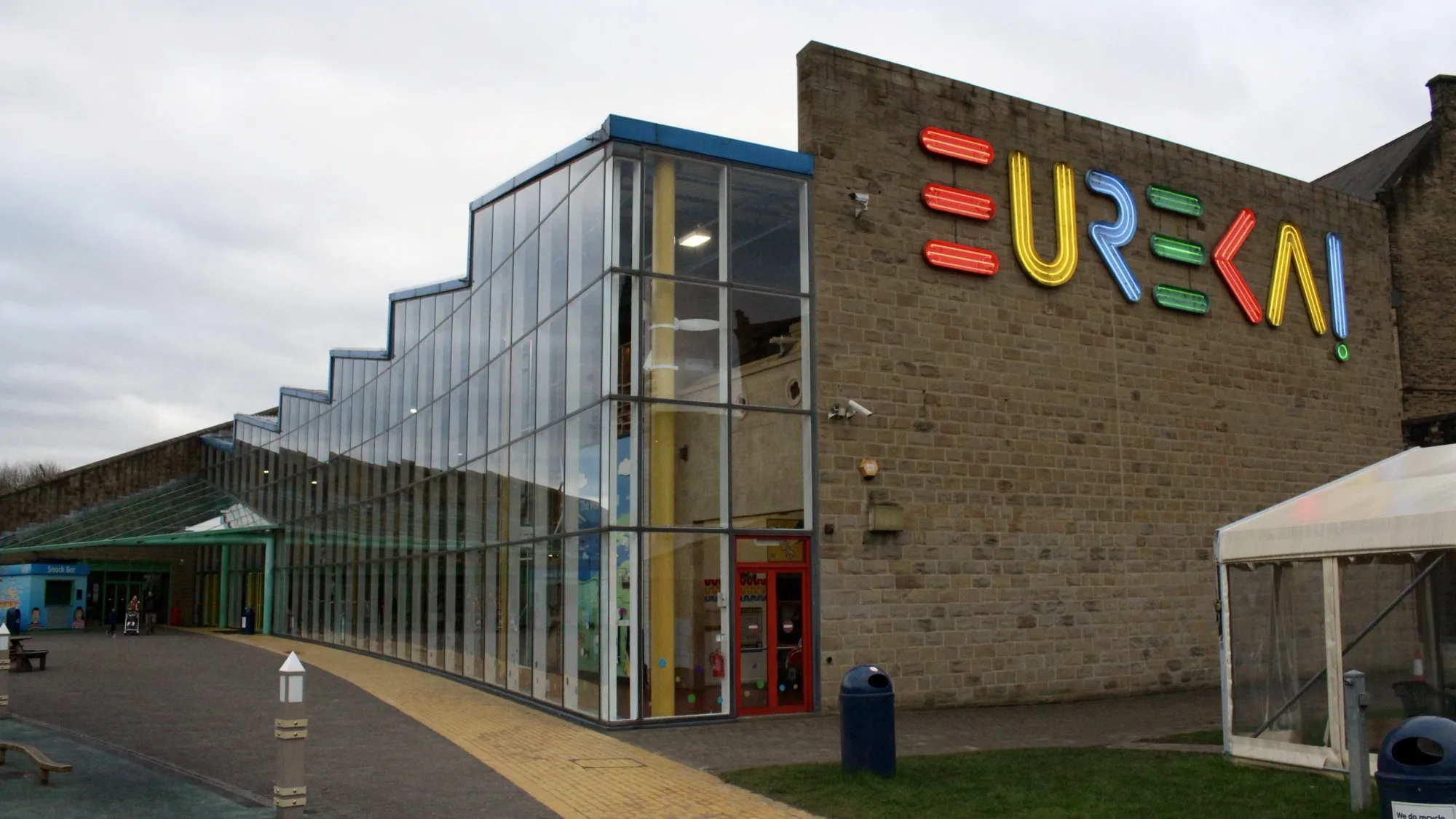
When I was a kid, I used to love going to Eureka, the national children’s museum in Halifax. I was eight years old when it opened in 1992, and so I was in the right age group to visit. I remember going with primary school at least once, and with my parents on other occasions.
Eureka turns 25 this year, and I took Lizzie along a few weeks ago. She’s been three times now – once with me, and twice with her mum. I took her because Christine was working that weekend, and we had a Tesco Clubcard Days Out voucher that was about to expire.
There are still quite a few bits of the museum there that I remember. I remember pedalling on a fixed bike, and seeing a skeleton appear doing the same motions. That’s still there, although the rest of the gallery around it is new. The SoundSpace gallery is new; Lizzie found this really stimulating with lots of sound and light. We also spent a little bit of time in Living and Working Together, and All About Me, but having arrived there after lunch on a Saturday there was only limited time.
When Eureka opened, it was almost unique in the level of interactivity offered. So many museums at the time locked their exhibits behind glass cases, and there would only be the occasional button to press. Eureka was different – you could play with just about everything. It was all about learning through play – a concept that it now applies to its nursery, which is consistently rated ‘Outstanding’ by Ofsted. Nowadays, many more museums have exhibits which are accessible to kids, but Eureka was pioneering in this respect.
Eureka entry prices
Although it’s a national museum, Eureka doesn’t receive any central government funding, hence the need to charge an entrance fee. Our local MP, Holly Lynch, has been campaigning to change this. Making it free would be fantastic for Halifax, as it could bring in many more visitors to the town. Work is already ongoing to better link the town centre and the Piece Hall with Eureka and the railway station.
As it stands, for a family of two adults and two children aged 3 or over, a day out at Eureka is almost £52. Whilst the tickets are then valid for unlimited repeat visits within the subsequent 12 months, it’s still a big initial outlay. And that doesn’t include food at the café, parking or travel. It would be great if the museum could become more accessible to those on lower incomes.
Eureka is still a fantastic museum for kids. Quite a lot has changed in 25 years and I’m pleased to see how it’s developed. But it was also nice to go back and see things that I remembered when I was younger. And now that we live nearby, we’ll be getting the most out of our annual passes.
Easter Monday, despite being a bank holiday, was quite a nice day. So, we went to Beningbrough Hall, near York, with my parents in tow.
I’ve been before, as it’s not far from my parents’ house, and it’s a National Trust property. My parents have been National Trust members for years, and I also joined some time ago. Unfortunately, there aren’t many properties near us in West Yorkshire. East Riddlesden Hall is the nearest to where we live, and so I don’t get many chances to use my membership. So it was nice to be able to get some return on my membership fees. Plus, Christine has never been.
We didn’t go inside the hall itself, although I later found out that there’s a children’s playroom inside – dammit! Beningbrough Hall is a northern outpost of the National Portrait Gallery, and so there are many paintings inside.
Instead, we strolled around the gardens. They’re not the biggest, but they’re pretty and well-kept. Being Easter, there was the usual Cadbury’s Egg Hunt taking place. Our one-year-old was a bit young for this, but I think they’ll enjoy it next year.
There’s also a good outdoor playground. Again, it’s better for bigger kids, but our one-year-old enjoyed the swings. During school holidays, there are opportunities to build dens in the wood, and various other activities to keep children entertained.
Yesterday I took our one-year-old to the National Coal Mining Museum for England, which is near Wakefield. Christine was working again and I’d heard that it was a good place to take kids of all ages. Plus, it had the advantage of it being free to enter.
The mining museum opened in the late 1980s, and became a national museum in 1995. You can read more about the history of the site on Wikipedia. However, this was my first ever visit. My parents never took me as a child, and I hadn’t been as an adult because we’ve not had a car until recently. It’s not very well-served by public transport – typically three buses an hour from Wakefield, 2 from Huddersfield and 1 from Dewsbury. But there is ample car parking, and it’s on the main A642 road.
The main attraction is the opportunity to go down the old Caphouse Colliery coal mine. Alas, you need to be at least five years old to do so. So, we’ll have to come back to do that sometime after 2020 when our one-year-old is old enough. Fortunately, there’s a playroom for the under-5s with a ball pit and soft play area. Collectively, this kept our one-year-old entertained for the best part of an hour.
Two coal mines
The mining museum actually spans two pits – Caphouse, and Hope Pit, which is at the other end of the site. A narrow-gauge railway runs between the two, and on weekends you can get on board a small battery-powered train. Alternatively, it’s a quarter of a mile walk.
You can’t go down Hope Pit, but most of the surface buildings are open to have a look inside, and there are some information panels and interactive exhibits. However, there were no staff on hand to talk about the exhibits – and this is something I noticed generally across the day. It’s a big museum, but I feel it could be brought more to life with more staff.
Living and working
The entrance to the mining museum includes a visitor centre, and galleries focussing on the human side of the mining industry. How people lived, and the impact of industrial action, with a particular focus on the Miners Strike of the 1980s. I was born during the strike, so was too young to remember it. The museum tries to take quite a neutral line on the dispute; though it covers the hardship that mining families faced, it explains the other side as well. As a national museum, I expect that it receives central government funding, so this perhaps isn’t so surprising. But it’s a different attitude to, say, the People’s History Museum in Manchester.
One thing I noticed about the other visitors was that I was one of the youngest adults there, despite being in my thirties. There were lots of kids there (including a birthday party group) but many were with their grandparents, whom I’m guessing may have worked down the mines in their heyday, or lived in mining communities. Coincidentally, Friday marked the first time that Britain’s energy needs were met without coal for 24 hours.
Stables
Outside, you can visit the stables where two pit ponies and a horse now live. Although horses were used in commercial mining right into the 1990s (something I learned on my visit), none of these three horses has ever worked down a mine. At one time, these would have pulled a Paddy Train up the side of the mining museum site. But said paddy train was lying rusting in a far corner of the site, along with its plaque commemorating its opening in 1990. Indeed, several parts of the site are part-derelict. Unfortunately, being a free museum means that it’s reliant on donations and public funding.
This aside, I think we both had a good day out. Discounting lunch in the café, which serves reasonable but expensive food, we spent about 3 hours there. Had we been able to go underground, I expect this would have been longer. I’m sure we’ll be back when Lizzie is older.
This week, we have no childcare. Our one-year-old normally spends weekdays with a childminder, to whom we pay quite a lot of money to every month. But, the childminder is on holiday this week, and so I’ve taken four days of annual leave to be a full-time parent.
I can’t remember if Christine and I discussed who would look after our one-year-old this week, but we presumably agreed that I was more likely to get the time off. It wouldn’t be fair if Christine was always the one to look after her; traditional gender roles be damned.
Additionally, Christine is working on Friday as well, despite it being a bank holiday. So I have the whole week to entertain a toddler.
Having spent the weekend doing fun things, Monday was spent partly at the supermarket doing boring things – namely, the weekly food shop. But we also went for a bit of a walk, and I took our one-year-old to one of the local parks for a play on the swings. This, of course, had nothing to do with it being a rare Pokémon nest in Pokémon Go, honest. We also dropped in to see my mother-in-law, who lives locally and whom we probably should see far more often than we actually do.
Yesterday, I arranged to meet a friend in Leeds for lunch, and afterwards we went to the Leeds City Museum. Christine and I had been before, which was probably a good thing; keeping my eye on a toddler the whole time meant that I didn’t get much of a chance to see many of the exhibits. It’s actually quite a good museum for kids; the basement is full of stuffed animals, but displayed in a themed way with some activity areas for kids. And upstairs there’s a soft play area, along with a special exhibition which is usually accessible to most ages. And it’s free, and there’s free Wi-Fi. Next time we’re in Leeds, we may drop in just to use the play area to let our one-year-old burn off some energy.
Today, I met up with another parent at another soft play gym. This one was just for the under-5s, so there are no big kids to push the little ones around. And, meeting up with other parents shares the load a bit.
Tomorrow, we’re meeting friends for breakfast, and then I’m taking our one-year-old to the newly-renamed National Science and Media Museum in Bradford. Afterwards, a quick drop into work to say hi, and then a meal out with colleagues.
As for Friday? Nothing major, other than packing to go to York for the Easter weekend.
Keeping a small person entertained is tiring. Not just for me, but for our one-year-old – indeed, the reason why I have a few spare minutes to write this blog post is because they’re fast asleep. Soft play isn’t just fun for them – it also buys you time later on when they need a nap. Hashtag: parenting hacks.
In a couple of months time, Christine, our one-year-old and I are off down to that there London for three nights. Typically, we go to London once or twice a year.
Travelling down
Our last visit was in October, and we travelled down by car for the first time. This was because we went via Oxford, but also because of the logistics of managing a 10-month old baby on a train for three hours each way was daunting. Especially when you add in all of the extra paraphernalia that you need to haul around with a small baby. Last time, we had to take plenty of food, changes of clothes, nappies etc.
This time, our toddler will be approaching 18 months old, and so we’re going to attempt the train. We’ll do without a pushchair, as our toddler should still be small enough to carry in a sling, and can walk short distances now. And, apart from a few snacks, our toddler doesn’t need their own food, as they’re happy eating from regular menus now.
It’ll also be cheaper. Fuel and parking cost us around £60 last time, plus the pressure of driving. Christine hasn’t passed her test yet and I can’t supervise her, so I have to do all of the driving. By contrast, two standard class adult returns with a Two Together Railcard booked last month cost us just £41. And, we’ve accumulated enough Nectar points to get two £20 Virgin Trains East Coast vouchers, so we actually only paid £1. That’s cheaper than the Megabus.
Staying over
Booking well in advance also ensured a cheap hotel stay. When booking accommodation, my usual tactic is to check the major budget hotel chains one by one, and then an aggregator like Expedia or Lastminute.com (which are often not the cheapest). Typically, we end up staying in a hotel in the IHG group, as I’m an IHG Rewards member, but they didn’t come out cheapest this time.
As usual, we’re not staying in central London. London’s public transport is really good, and the cost of travelling a bit further out is usually much less than the price of a more central hotel room. This time, we’re staying near Kew, in south-west London.
London attractions
The hotel is handy for the London Museum of Water & Steam, which I’ve not heard of before but it looks interesting. It’s in an old pumping station, and now tells the history of London’s water supply. This will be the second London pumping station that we’ve visited, after going to Crossness in 2015. It looks like it’ll be good for kids – especially if it’s a nice day where Lizzie can play outside.
The Musical Museum is also nearby and we may visit, depending on time.
Further away is the Museum of London Docklands. We popped in for about an hour on our last visit, but were only able to see the gallery on the top floor, about slavery and the history of the area. So we’d like the see the rest of the museum, but also the special exhibition on the archaeology of Crossrail that runs until November.
The Hunterian Museum has been on our to-do list for some time. Sadly, it closes next month for a three year refurbishment, so it’ll be shut when we visit.
Seeing friends
We try to make time to see friends when we’re in London, and so, in addition to the above, we’ll plan to meet up if we can. There’s a lot to fit in to a three night stay but we’ll do our best.
York, the city I was born in, now has yet another tourist attraction – the Askham Bryan Wildlife and Conservation Park. Located on the edge of the city by the ring road, it’s on the site of Askham Bryan College, one of the largest agricultural colleges in the UK. It’s been open just over a week, and I visited with Christine and Lizzie yesterday.
Fish and reptiles
The visit starts inside the visitor centre, with a look at fish and reptiles. Sadly the fish tank had broken already, and so was empty. To make up for it, visitors were allowed behind the scenes to one of the back rooms. Here, there were many more small aquatic and amphibious animals that were not normally on show to the public. Plus, students from the college were on-hand to answer questions.
It’s worth noting here that the wildlife park isn’t just a tourist attraction, but is part of Askham Bryan College itself. Many of the keepers are also students of the college, who are doing courses in animal management. The courses range right from basic level 1 qualifications in land-based studies all the way through to degrees. The wildlife park therefore gives the students practical experience as an integrated part of their course, without the need to go elsewhere.
After the reptiles, there’s a nocturnal animals section with dimmed lights. The animals here included a civet, a sugar glider, an armadillo and several chinchillas. All apart from the chinchillas were active when we first arrived in the morning, but were nowhere to be seen in the afternoon. The chinchillas seemed to be asleep the whole time.
The visitor centre also includes an ‘Education Pod’, and we went to two handling sessions during the day. One focused on reptiles, with the opportunity to stroke a snake, a bearded dragon and a tortoise, and the other on bugs – stick insects and cockroaches.
Meerkats and farm animals
Outside, there’s a meerkat and mongoose enclosure, with two gangs of meerkats in separate areas. The Yorkshire Wildlife Park, a few miles south near Doncaster, also mixes its meerkats and mongooses (not ‘mongeese’) and this is because the two species often share burrows in the wild. There were a couple of talks about the meerkats during the day, and we stayed for the second talk in the afternoon.
Next is a farm enclosure, home to seven goats, spanning three species, and three alpacas. Again, there was a ‘Meet a goat’ talk, where kids got chance to pet a large goat called Steve.
Arboretum
The rest of the site is in what used to be Askham Bryan College’s arboretum. There’s a wide variety of trees and plants, with the same information boards as the animals. Some of the trees, like the animals, are endangered, and so it was interesting to read about them.
The next set of enclosures housed lemurs, raccoons and skunks. The lemurs were quite active but we didn’t get to see a raccoon until the afternoon, and even then it was asleep. American readers may wonder why an animal that is considered a pest is in a zoo in Britain, but they’re not native here. Interestingly though, it will shortly become illegal in the EU to breed raccoons, as they’re classed as an invasive species.
As for the skunks, we only got to see them at feeding time in the afternoon. They’re nocturnal, so this isn’t so surprising.
Wallabies and birds
There are six wallabies at Askham Bryan, one of which is a joey. The joey is a few months old, but it doesn’t yet have a name as it’s still in its mother’s pouch. Next to that were two monkey enclosures, home to some marmosets and tamarins – the latter had only been at the zoo for a few weeks.
Further on is an aviary with a variety of parrots. Unfortunately, issues with avian flu meant that the aviary was closed, although you could hear the birds. Finally, visitors can access York Falconry at the far end of the site, for a small additional fee – £2 for adults, cash only. York Falconry is home to several birds of prey – owls, hawks, and some ferrets. When we went, there was an opportunity to hold a Little Owl. Despite the small extra cost, this end of the zoo was very quiet and we saw several groups turn back when they realised there was an additional charge, which is a shame.
Work in progress
The wildlife park is, of course, brand new, and so there were some areas that weren’t ready. There’s a wetland area with a pond that was open, but with nothing to see. And an enclosure for some Scottish wildcats was being finished, ready to open soon.
Without attending the talks, we could have done the park in less than two hours, as it’s not very big and certainly on a much smaller scale than many other zoos in the UK. The talks were good, although some of the students delivering the talks seemed a bit unsure of what they were saying. The cafe in the visitor centre was rather underwhelming, and just offered drinks, pre-packed sandwiches and cakes. The sole member of staff was clearly overworked with patrons, and it wasn’t even lunchtime. So there’s room to improve.
I also think it would be good to see more of the behind the scenes areas. We were lucky to be able to see one of them, but this won’t normally be open, which is a shame – it was good to see how the park was run, and could be a good recruitment tool for the college’s courses.
Opening times
Unlike most zoos, which are open almost every day of the year, Askham Bryan’s wildlife park is normally only open on weekends. Exceptions are school holidays, when it’s open throughout the week, and bank holidays. At £7 for adults and £5 for children, it is considerably cheaper than most other zoos. And, whilst there isn’t a lot to see right now, what they do have so far is good. It’s also worth mentioning that, at present, you have to pre-book your tickets online and print them out. You’ll also need to bring cash if you want to see the falconry. I hope that, in future, there’ll be an option to include the falconry in the entry tariff on the door, or at least a way of buying a voucher with a credit card.
Askham Bryan is very close to where my parents live, and I imagine that when Lizzie stays with them she’ll be a regular visitor. Certainly, had this existed 30 years ago, I think my parents would have taken me there regularly. And whilst York isn’t short of tourist attractions, it’s an interesting and unique addition.
Having visited last Valentines Day, we made a return visit to the Yorkshire Wildlife Park near Doncaster at the weekend. We really enjoyed it last time, but our visit was cut short when the weather turned. Saturday was a cold but dry day, so we headed over for another visit.
Getting there was a little easier this time, thanks to the opening of the Great Yorkshire Way. This links the M18 – the motorway that bypasses Doncaster to the south – with the A638, the road that feeds the wildlife park and nearby Robin Hood Airport. A second phase, due to start construction shortly, will see the road make it all of the way to the airport. But even the first phase cut our travelling time by at least 10 minutes each way.
The main attraction that we missed last time was the lions, so we went there first. The lions were rescued from a run-down zoo in Romania, and flown to the UK on a specially-adapted Jet2 plane. Their new enclosure is as big as the whole of the zoo that they called their home previously. Indeed, one thing I like about the Yorkshire Wildlife Park is that the enclosures are big, and designed so that visitors can see in over the fencing in many cases. On both visits, my Canon EOS 600D DSLR camera has seemed almost amateur compared to some of the specialist photography kit that other visitors have brought, and it’s easy to see why.
We also got to see one of the leopards; last time, none of them fancied making an appearance. And we saw a stoat – not one of the zoo’s animals, but it was on an area of rough ground near the polar bears that has yet to be developed.
Last month, Christine and I had a day out in Oxford. I have family who moved down to nearby Bicester from Yorkshire some years ago, and so we visited as a stopping-off point on the way to our week’s holiday in London.
My relatives kindly offered to look after our baby for an afternoon, giving Christine and I some time to ourselves, and the opportunity to visit the city. I’d last been there in the 1990s, coupled with a visit to Legoland Windsor, but Christine had never been before. She arranged to meet a friend for lunch, and then we hit the museums in the afternoon.
Oxford Museum of Natural History
Oxford’s Museum of Natural History isn’t as big as the one in London, but it is also free to get in. The museum is part of the University of Oxford, and is home to various stuffed animals and preserved skeletons. One of its more famous exhibits is the Oxford Dodo, an incomplete dodo skeleton. It’s accompanied by a model showing what we think a dodo may have looked like.
The building is also interesting. Many of the supporting columns are made with different minerals (with labels), making the building a museum piece in itself.
A number of the exhibits can be touched, which makes a change from seeing endless glass cases. There are also a number of activities for kids during school holidays.
Pitt Rivers Museum
Tagged onto the back of the Museum of Natural History is the Pitt Rivers Museum. We only had time to look around the ground floor but there was plenty to see. It houses a series of collections of objects, many of which were brought in from overseas and are sorted by theme. There are collections of pottery, death masks, shrunken heads (which were the inspiration for those used on the Knight Bus in the Harry Potter films), charms, weapons, musical instruments and lots more besides.
I’m sure you could visit multiple times and still see something new each time. This is despite the museum fitting into one, admittedly large, room.
As we were only in Oxford for one afternoon, we didn’t get chance to see much of the rest of the city centre. But we’ll probably go back again before long, especially for a return visit to G&D’s ice cream café.
Next week, Christine, our baby and I are off to London for a few days. It’ll be our first trip as a family of three there; I last went in January on my own when our baby was only a few weeks’ old. It’ll also be the first time I’ve ever driven to London, as we’ve always taken the train or coach in the past.
I’m driving because we’re also visiting family on the way, but also because of the amount of luggage we’ll need. Babies may be small, but they also need several days worth of food and nappies, a pram, travel cot, high chair and other things. So whilst Christine and I could do several days in London with a rucksack each, with a baby, we’ll need the car.
We’re staying in a hotel in north London that’s easily reached by car and has parking, but is also close to a tube station. Once we’re there, I have no intention of driving in central London – congestion charge aside, I’m not keen on driving in city centres. And whilst London Underground is not great for prams or wheelchairs, our baby thankfully tolerates being carried in a sling.
Part of the reason for our visit is so that I can go to the HE Show at Olympia – if you’re going as well, drop me a line. We’re also planning to go to the Tower of London, as it’s been many years since I visited, and Christine has never been. It’s expensive, unless you have lots of spare Tesco Clubcard tokens like we do.
I always look forward to trips to London, partly because we always make a point of seeing friends who live there when we go, but also because there is so much to do. It makes a change from a few years ago when I developed a general dislike of the place. Back then, I also had access to free train travel and so could visit London (or, indeed any British city) whenever I wanted to. Perhaps I like London more nowadays because I only get to go there once or twice each year, and it usually requires weeks of forward planning – I can’t just decide to go there on a whim like I used to.
I’m a bit behind with uploading photos to Flickr, and so it’s taken me until now to write about a day out to Hollingworth Lake. We went right at the beginning of May, on a scorchingly-hot Sunday afternoon.
Despite its name, Hollingworth Lake is actually a reservoir built by humans, and not a natural lake. Built at the end of the 18th century, it served as the main water source for the Rochdale Canal – the canal that runs from Manchester, across the Pennines to our home town of Sowerby Bridge. By the 1860s it had developed into an inland tourist resort, and nowadays, it’s part of a country park. It still has the feeling of an inland seaside resort, as it retains some its hotels, pubs and amusement arcades. There’s also a sailing club based there.
Christine had been a few times before but this was my first time. I’d passed it a few times; the bridge in the background of the photo carries the M62, and I’ve had driving lessons nearby. Most people drive to get there and there are several car parks by the lake. On busy days, it may take you quite a while to find a parking space. If you don’t want to drive, Smithy Bridge is the nearest railway station (with signs saying ‘Alight here for Hollingworth Lake’) and is a short walk away. There are regular buses from Rochdale.
There’s a footpath all the way around the lake. It’s around four kilometres (2 ½ miles in old money) and makes for a nice gentle stroll. There are a couple of cafés at various points, and on hot days the ice cream vans make an appearance. It’s a nice, varied walk, with a section of the park set aside as a nature reserve.