This weekend, Christine and I went to London to visit friends, and tick off a few places off our London to-do list. It’s quite a long list, as there’s lots to do in London and we only get to visit once or twice a year. Indeed, this was my first visit since February last year, although Christine managed a brief overnight trip last month for work.
I took quite a few photos, but as my computer at home is still boxed up (and likely to be until the weekend at the earliest) I’m only uploading a select few at this stage, and editing them using Aviary, the photo editor built-in to Flickr. It’s not as good as the tools I have on my Mac, but it’ll do for now. I will be posting about the things that we did over the next week or so.
It will probably be the last major trip we do this year. Christine is now entering her last trimester of pregnancy and so she is becoming less mobile as time goes on. Whilst she managed okay in London, I don’t think she will be able to do many big days out in future, so this was something of a ‘last hurrah’ for us before the baby is due early next year.
All in all, we had a good weekend, and it was nice to see our friends again.
Yesterday, as a birthday treat, Christine and I went to Tropical World. It’s effectively an indoor zoo, housed in a series of greenhouses in a corner of Roundhay Park, in the northeast corner of Leeds.
Whilst I’m not sure of the full history of the place, I get the impression that it was originally designed to house tropical plants (of which there are many – Tropical World has one of the largest collections outside Kew Gardens in London), and has later had butterflies and other animals added to it. These include a crocodile, various fish, frogs and snakes, bats, jerboas, a slow loris (allegedly – it was hiding when we went), a wide variety of birds and the ever popular meerkats. There’s a photo of one above; cute, but it didn’t offer me a great deal on my car insurance.
Tropical World is not a big place and we got around in a little under two hours, but it’s not expensive either: £5 each for adults, with discounts for children and local residents. It has also recently re-opened after a refurbishment, and now sports a much larger café and gift shop, along with a central American themed zone. With hindsight, yesterday wasn’t a great day to go, with it being a bank holiday and also the school half term holiday – consequently we had to queue for half an hour to get in. There were plenty of kids there – who were fine on the whole. Shame that couldn’t be said about some of the parents.
This was our second visit to Tropical World – the first time was three years ago, prior to the refurbishment. I’m sure we’ll be back again sometime – it’s a nice place to go, easily reached from Leeds city centre by the number 12 bus from outside the top entrance to Leeds market, and it’s not too expensive either. And it’s indoor, so great for even the most foul, cold winter days.
My dad reached the grand old age of 70 a few months back, which begged the question: what do you get for the person who has everything? So we clubbed together as a family and bought my dad a train driving experience at the Foxfield Railway, near Stoke on Trent in Staffordshire.
Like me, my Dad has a keen interest in the railways, although unlike me he actually worked for the railways for many years, as a civil engineer. Whilst he’s designed many structures for trains to use, he’d never actually driven one before, so this was to be a new experience for him. And, fortunately, we have family in Stoke so getting to the railway for 9:30am was not a problem.
The experience lasts all day, and the railway can accommodate up to 4 people at a time. The training is provided by the volunteers who run the railway, many of whom are retired from the mainline. The train for the day was W. G. Bagnall 0-6-0ST No. 2 “Florence”, and initially the ‘students’ took it in turn to practice driving the engine out of the station and back again. Later on, each of the participants got to take it in turn to drive the train all the way along the line, with passenger carriages. They also took the role of fireman, which included learning how to couple and uncouple the engine from the carriages, and got to use the levers in the signalbox.
Pleasingly, friends and family were also allowed to be part of the day – I was able to follow my dad around with my camera for almost the whole time, and consequently took over 100 photos. And we brought part of the extended family along with us to ride in the carriages whilst my dad drove us up and down the line.
The volunteers that run the driving training experiences were great – friendly and accommodating, and ensured that participants and their families all had a good day out. At the end of the day, those that took part are presented with a certificate and there were more photo opportunities to be had.
I had a great time, but, more importantly, so did my dad. It’s something that I’d definitely recommend for those with a similar interest in the railways. Foxfield are now booked up for the rest of 2015 so you may need to wait until later in the year for their 2016 dates, if you want to try it for yourself.
Last night, I went along to the opening night of the new Bradford Brewery. Once it’s fully up-and-running, it’ll be the first brewery in Bradford city centre since the last one closed in the 1950s.
Whilst the brewing equipment is still being assembled, the Bradford Brewery’s brewpub, The Brewfactory, opened yesterday. As well as various beers and ales from other local (and not so local) breweries, there is the first of the Bradford Brewery’s own beers available to purchase, called The Origin. It’s an IPA – smooth with a slightly spicy after-taste, although overall I found it a little bland. It’s being brewed at the Baildon Brewery for now until the on-site equipment is up and running, which should be within a couple of weeks.
The brewery is located in a small former factory building on the corner of Westgate and Rawson Road, behind the Oastler Centre, with the pub occupying most of the ground floor. As a factory, moisture meters were built there to measure moisture in wool (to discourage dampening the wool to increase its weight), and its industrial past is reflected in the decor. It’s a bit sparse at the moment, but then the place has only just opened after all.
North Parade
The Bradford Brewery is just around the corner from North Parade, home to Bradford’s independent quarter and an increasing number of bars. I wrote about the Record Café last year, which joined The Sparrow and Al’s Dime Bar on the same street. The Brewhouse is another bar due to open there shortly.
Good quality new bars are always welcome in Bradford and hopefully a sign that the trend for pub closures might be easing, at least in certain areas. The Brewfactory certainly has a great selection, with eight handpulls for cask beer, several more keg pumps and a variety of canned beers. It’s aiming towards the top end of the market – the only mainstream beer available on tap was Amstel with most of the rest coming from independent microbreweries.
Whilst The Brewfactory will be the home of the Bradford Brewery’s beers, the brewery has ambitious plans for production once its equipment is commissioned – with the aim to produce over 10,000 pints per week. So hopefully their beers will be widely available across the region, and maybe even further beyond. And conveniently, they’ve been able to start production (albeit offsite) just in time for next week’s Bradford Beer Festival in Saltaire.
I wish the team behind the Bradford Brewery the best of luck – their plans have been in the pipeline for a long time, and it’s great to see them finally coming to fruition. It was busy when we visited last night and I hope that it remains so.
After seeing Frisky & Mannish on Friday, Christine and I went to another comedy gig on Sunday. This time it was to see Susan Calman, a diminutive Scottish lesbian and stand-up comedian on her tour ‘Ladylike’, at the Trades Club in Hebden Bridge. Hebden Bridge is something of a lesbian capital and so it was not surprising that the gig had sold out a few weeks ago.
I’m familiar with Susan Calman through her work on BBC Radio 4 – she is a regular guest on the weekly panel show The News Quiz, and has presented two series of her own show Susan Calman is Convicted. On TV, she’s appeared on Have I Got News For You and a few other programmes, mainly in Scotland. She’s been top of my list of stand-up comedians whom I have yet to see live so last night was a chance to fix this.
And I’m pleased to say it was really worth waiting for. Calman is a fantastic observational comedian, with all of her material drawn from her own life and experiences. It helps that she has an interesting story to tell – about her height, her sexuality, her career change and her three cats, each of whom has its own theme song.
Her tour continues into next year and whilst a number of dates are already sold out, hopefully there will be a gig near you with tickets still available. If you want to hear someone who is charming, inspirational and, most of all, hilariously funny, then find the time to go and see her when you can. Tour dates are on her web site.
Now, to make time to see Bethany Black and Chris Addison, who make up the rest of my list of comedians to see live.
Whilst I spent Sunday wearing a top hat and too many cogs, on Saturday Christine and I went to Nottingham to meet up with some friends from university. In the past, the only bit of Nottingham that I’ve been to has been the marina; my grandparents had a narrowboat there for several years, but the last time I’d have visited would have been around 20 years ago. Until now I’d never been to the city centre.
We took the train, which from Sowerby Bridge was three hours each way; in all we spent more time getting to or going home from Nottingham than we did in the city. Nottingham’s rail connections going north aren’t that great, but it is served by regular trains going south to London and some cross-country services.
Nottingham has just the one central station nowadays, built in 1904 and recently restored with a new, glassed-in porte-cochère at the front. In fact the station has had a lot of work done recently, with changes to the track and platforms. It looks really nice and shows what can be done when a sympathetic restoration is carried out.
Sadly once you leave the station via the main entrance, no-one has really thought through how pedestrians should get into the city centre. You basically reach a huge concrete wall, with a tiny opening in it taking you into the Broadmarsh… sorry, intu Broadmarsh shopping centre. The Broadmarsh centre seems to be stuck in a 1980s timewarp (it was last refurbished in 1988) and doesn’t reflect well on the city – not at least because the name of it reminds me of Broadmoor. Thankfully its owners have plans to refurbish it again; whether these plans will go as far as turning into a more open space like Liverpool One or Leeds Trinity remains to be seen, as right now it comes across as a major barrier.
Public transport geeks (hello!) will like Nottingham for a few reasons – as well its large station, it has buses that are still run by a council-owned company, and an expanding tram network, called NET. NET opened a little over ten years ago, and unlike many other light rail schemes in Britain it has been very popular right from the start. So much so that it’s being extended and the fleet of trams increased from 15 to 37.
In our brief visit to the city the main thing we saw was the Old Market Square, and the Council House, which is the large imposing building pictured at the top of this blog post. It’s primarily home to council offices, as well as tourist information and a small shopping arcade called The Exchange. We also headed to the area around The Lace Market, which is now home to many small, independent shops including several that sell vintage clothing. Most of the city centre is pedestrianised.
When I said I was visiting Nottingham for the day most people I spoke to seemed a bit perplexed. At best, people perceive Nottingham as nothing special – whilst it doesn’t get the (unfair) bad rap that Bradford does, it’s not perceived as somewhere to go on a day out. Which is a shame because, apart from the aforementioned shopping centre issue, I quite like Nottingham. I’d be happy to go back there sometime, anyway.
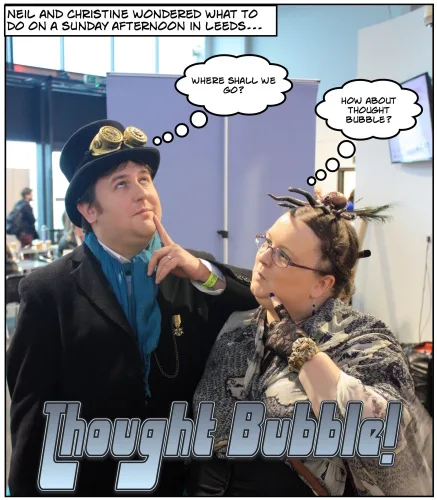
Yesterday Christine and I went to our first every comic convention, as part of this year’s Thought Bubble Festival in Leeds. It’s been running since 2007, and I’ve been aware of it since 2012 but this was the first time we’d been.
Running over two days, the comic con concludes the week-long Thought Bubble Festival which takes place across Leeds and celebrates comic art. It’s based at the Royal Armouries Museum, taking over the Royal Armouries Hall (recently renamed from the ‘Saville Hall’), the New Dock Hall, and a large marquee in the square outside, plus some small rooms for talks. There were hundreds of mainly independent comic book sellers, artists and all sorts across the three main venues.
One-day passes were £15, or two-day passes for both days – for die-hard comic fans who want to attend as many talks and panels as possible – were £24, and in both cases there was a £4 discount for cosplayers. So Christine and I dusted off our various steampunk paraphernalia and dressed up for the occasion. In doing so we spent more than the £8 that we saved on the entry price but we had a significant number of positive comments about our outfits – especially the octopus fascinator that Christine bought at a previousLeeds Steampunk Market. I’d say around 10-20% of attendees were in cosplay, some more elaborate than others. Kids under 12 had free entry so there were plenty of children around, many also dressed up. We saw a small Tardis, and a young, grumpy Hulk in a pushchair amongst others.
We followed the web site’s advice and made sure that we took out plenty of cash before we got there. The bigger stalls take cards but many of the exhibitors are regular people like you and me who just do this on the side, and the one cash machine nearby usually runs out of money on Saturday morning, apparently. And we spent most of the cash that we took.
Here’s the point where I’ll admit to not being an avid reader of comic books, but you don’t necessarily have to enjoy reading comics to have a good time at Thought Bubble. It did mean that we knew very few of the exhibitors – Moo and Keo being one of the only major exceptions, along with Dr Geof whose Tea Museum has recently returned from an exhibition at the Cutty Sark in London. However we did come across the official Professor Elemental comics, about the steampunk-themed ‘chap hop’ rhymer, and James Chapman whose Soundimals comics I’ve come across on Tumblr and Facebook. We bought their books, the latter signed, with a sloth illustration.
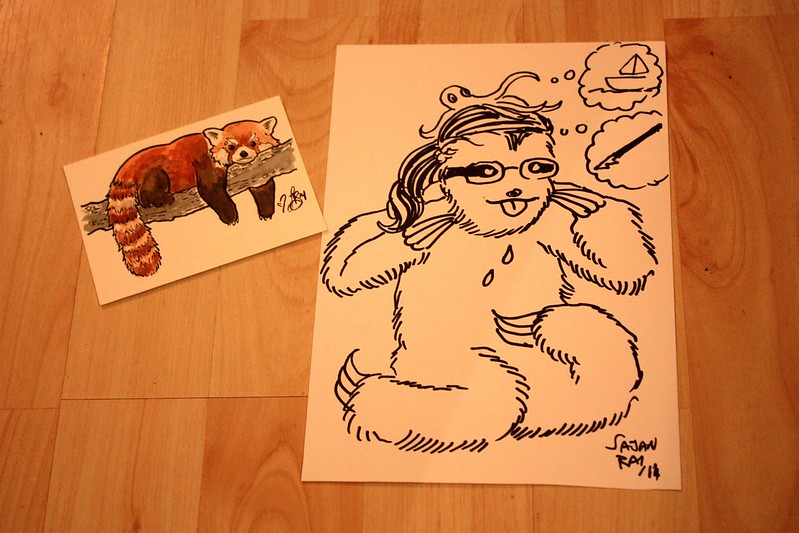
Speaking of sloths, we also had a couple of commissions, or pieces of art drawn for us. The first was by Sajan Rai, who offered to draw you as a sloth – Christine volunteered, hence the octopus. And Lucy Bellwood drew us the beautiful red panda, which we’re planning to get framed.
Part of the fun of Thought Bubble, for us, was simply people-watching. Obviously some of the cosplay outfits were amazing, although regrettably I only took one or two photos. But it was also fun looking at the bemused expressions of those who were on their way to the Royal Armouries Museum and weren’t aware that Thought Bubble was taking place – and were thoroughly confused by all the people dressed up. In Pizza Express, at lunch, we were one of two steampunk groups, with a girl on another table wearing a painted morphsuit showing all of the muscle groups in the style of a flayed corpse.
It was really good fun, and I can’t believe we’d never been before. We’ll be there next year.
I was on annual leave all of last week, and so on Wednesday I and a couple of friends went to Hawes in the Yorkshire Dales for a day out. Hawes, pronounced like ‘hoares’ (and yes, there are plenty of jokes based on its name) is a small market town in the famous valley of Wensleydale.
Of the three of us, none of us can drive or has access to a car, so this was a trip done by public transport.
Hawes does have a railway station, but no trains have called there since 1959, and it’ll be quite a while before the Wensleydale Railway reaches it. The next nearest station is at Garsdale, on the wonderful Settle-Carlisle Railway, which this year celebrated 25 years since it was saved from closure by British Rail. It’s still a few miles away, is only served by six trains a day in each direction, and like many stations on the line is in the middle of nowhere.
Thankfully it’s connected to Hawes by the Little White Bus, which charges a £3.50 per person flat fare each way. It’s timed to meet some of the trains at Garsdale, although be aware that some journeys don’t normally run on Tuesdays, Wednesdays or Thursdays – we made this mistake and nearly got stranded in Hawes coming back. Outside of these times it operates on a request basis, so if you do need to travel you can phone them in advance.
Hawes’ main attraction is the Wensleydale Creamery, which produces Yorkshire Wensleydale cheese (now an EU Protected Origin product). After closing in 1992, it was rescued in a management buyout, and now employs almost 200 people and supports 36 local farms. The creamery includes a small museum, charting its history and how the cheese is made – on Fridays, Saturdays and Sundays you can actually see cheese being made, but we went on Wednesday so we didn’t. There’s also a huge shop, selling all of the varieties of cheese produced there with ample free samples, a café and a restaurant. You can probably spend up to a couple of hours here, and then it’s just a short walk back into the town.
The town itself is lovely, with narrow cobbled streets and plenty of small, independent shops. And, like most Yorkshire towns, several pubs serving local ales. Elijah’s is a good food emporium, and there was an excellent quirky second-hand bookshop.
Other attractions include the Ropemakers – a rope manufacturer that allows you to walk through its workshops and see how their ropes are made (and buy some yourself), and the Dales Countryside Museum, which we didn’t visit.
Earlier this year the first stage of Tour de France passed through Hawes. Having descended from Buttertubs pass, the peleton rode south into Hawes and then took a sharp right heading off east. There are still plenty of cycling and tour-themed things in the town, even though it’s been several months since the race.
All in all we had a really nice visit, even though it took me three trains and a bus each way to get there, and cost me over £20 in bus and rail fares. It was worth it though and I’d happily go again – but probably by car next time. All the photos from my visit are on Flickr.
Yesterday, we took advantage of the nice weather and went to Brimham Rocks, near Harrogate. The site is owned by the National Trust and features large millstone grit rock formations that visitors are free to climb on. It’s free to visit, but those who are not members of the National Trust have to pay £6 to use the car park.
I’ve been many times over the years. My parents have been National Trust members for as long as I can remember and have taken me there several times, but I also seem to remember going with my primary school class at one point in the 1990s, when marbles were the playground craze of the time. The last time was in 2007, with the university hiking club and as part of an unwieldy-sized group of 19 mixed-ability hikers. This time was with a smaller group of 10 – myself, Christine, and 8 other former members of the hiking club and plus-ones.
Christine isn’t so confident with walking so whilst most of the group did a nine mile walk around the wider Nidderdale area, we just did a stroll around the edge of the site and took photos. Some of the rocks are really impressive, rising up to 30 metres in height, and many have been given names. The Blacksmith looks like an anvil, and the Druid’s Writing Table looks like… well, a table. There’s also The Smartie Tube which has a tunnel that small people can fit through – I’m not sure if Nestlé has authorised the use of its trademark though.
Unfortunately I was an idiot and didn’t check the settings on my camera before taking the photos, so everything was taken at 1600 ISO. Thankfully I shoot in RAW so I was able to improve the photos somewhat, but they do look like they’ve been taken on a much older camera. An inadvertent retro filter, if you will. A small selection of these images are available to view on Flickr.
I doubt this will be the last time we go to Brimham Rocks. It’s a great place to bring kids – provided that you keep them under observation, they will love being able to climb the rocks. I’m sure we’ll be back when we have children of our own. And, if we pick a day like yesterday, we’ll be in plenty of company – by the time we left in the mid-afternoon, both carparks were full.
In some respects its one of my favourite zoos. The keepers are very friendly, and it’s a manageable size – not huge, but enough to see to occupy a full day. We got there at 10am when it opened, and were still there at nearly 4pm. There are plenty of demonstrations to see and over the years we’ve seen most of them.
The sealions are always worth seeing as the keepers actually swim in the water with them. They have been taught to do tricks, but this partly because they can also be taught to lie still, or raise flippers, when they need to do medical inspections. They do the same with some of their birds, including a macaw who was able to place blocks in the right sized holes and open three nested metal tins to get food, during a demonstration.
A new feature for this year is bird of prey experiences. These cost £10 per head over and above the entry price (which is currently £16 for adults), and allow you to hold and do some basic falconry with a barn owl. Christine and I both did this, and I have the claw marks on my arm to prove it! It’s good fun, especially if you like owls, and the trainer is very friendly and patient. Plus, it means I get an interesting new Facebook and Twitter avatar.
We still have a few friends in Blackpool so I’m sure we’ll end up back at the zoo again at some point. Later this year a new orang-utan house opens, and their female amur tiger has recently had cubs. They’re not currently on display but hopefully will be there for all to see in a few weeks’ time. Amur (also known as Siberian) tigers are endangered so this is an important development.
Naturally, I took quite a few photos whilst we were there. The two above, and eighteen others, are in this Flickr set album.