Our 2026 holiday: Welsh Mountain Zoo

A photo of a zookeeper holding a kookaburra on her hand at the Welsh Mountain Zoo

Our second day out following our trip to the Llechwedd Slate Caverns was to the Welsh Mountain Zoo, located in the hills above Colwyn Bay and just a short drive from where we were staying in Conwy.

Despite the name, the Welsh Mountain Zoo isn’t atop a mountain; it’s actually on a hill that’s only around 100 metres above sea level. But, as it’s right by the sea, it feels like it’s atop a mountain. You certainly get some nice views across Colwyn Bay, and to the west towards Conwy.

The Welsh Mountain Zoo is actually the national zoo for Wales, and is run by the Zoological Society of Wales. I would have expected the Welsh national zoo to be on the south coast closer to Cardiff, but no, it’s on the north coast. It’s a medium-sized zoo, and similar to Dudley Zoo (which we visited in 2024) in size and layout as they’re both on hills. That means there’s no really big animals like elephants and giraffes, but you can see some big cats, great apes and larger mammals.

A photo of a pair of snow leopards, asleep, at the Welsh Mountain Zoo

Animal highlights at the Welsh Mountain Zoo

In 2021, the Welsh Mountain Zoo became home to some snow leopards, which are classed as vulnerable on the IUCN red list. When we visited, the snow leopards were asleep, but had the good manners to be asleep next to a window where visitors can see them.

There are also red pandas, pretty much next to the snow leopards, and Asian small-clawed otters next to them as well. That’s two of my favourite species of animal next to each other.

In terms of aquatic animals, there are sea-lions and Humboldt penguins. When we visited, the penguins were going through a catastrophic moult where they lose all of their feathers very quickly. It’s natural and happens annually, but means they’re nor waterproof until their feathers regrow after a couple of weeks. Consequently, most were sunbathing on land, rather than swimming.

There’s also a large Eurasian Brown Bear, which was awake when we visited. I think that’s the first time I’ve seen that species of bear in a zoo. New this year is a small butterfly house, the Papilio Forest, which also includes a new habitat for the ring-tailed lemurs.

Shows and talks

Like most zoos, there are shows and talks throughout the day. We only attended one: the birds of prey demonstration, which takes place in a grassy area in the middle of the zoo next to the penguins. I’ll be honest, I was slightly disappointed as there were only two birds on display, which were a Kookaburra and a Barn Owl, and where we were sat, we couldn’t hear the commentary very well. By comparison, Knowsley Safari Park (most recently visited last year) has a better birds of prey show.

The programme of talks changes throughout the year, but in peak season, some of the talks such as the sea-lion demonstration are repeated. The talks also often coincide with the animals being fed, so it’s a good opportunity to see the sleepier animals.

Breeding to release

One recurring criticism of zoos is that the animals should really be back in the wild where they belong. However, zoos have an important role in ensuring the survival of endangered species, especially those already extinct in the wild. If every zoo in the world was closed down and all the animals released into their native habitats, we would probably see several more species go extinct very quickly.

That being said, at the Welsh Mountain Zoo, there are a couple of species of animal which are bred there specifically for release into the wild in the UK: red squirrels and pine martens.

I’ve never seen a pine marten before, but there were four at the Welsh Mountain Zoo and they were very active when we saw them. They’re mustelids, so related to ferrets, stoats and otters, and are about the same size as ferrets. They were very endearing and we’re glad we went to see them in their quieter corner of the zoo.

We didn’t get to see the red squirrels, but these are released in Ynys Môn (Anglesey) where grey squirrels were eradicated about ten years ago.

Accessibility

As mentioned, the Welsh Mountain Zoo is atop a hill, and so there are slopes involved. Some paths have steps, but there should be step-free routes to see most (if not all) the animals, albeit with some steeper slopes in some cases. The main car park is a little walk from the entrance, so if you have a blue badge, follow the directions to the smaller car park next to the entrance. There are no electric car chargers nearby; there are some Standard AC chargers in Rhos-on-Sea and the nearest rapid chargers are in Llandudno Junction.

The Welsh Mountain Zoo isn’t particularly well-served by public transport either. There are regular bus and train services to Colwyn Bay and the railway station is about 1.5 miles away, but it’s a steep climb to the zoo entrance. Even though our accommodation in Conwy was only a 12 minute drive away, it would take almost two hours to walk there.

Standard disabled toilets are available on-site, but you’ll need to head back down the hill into Colwyn Bay for the nearest Changing Places toilet, which is at the local council offices and is open during office hours on weekdays.

If you can book online at least two days beforehand, prices are about 15% cheaper than on the gate. We had lunch at the Safari Restaurant, one of two eateries on site (the other is the Penguin Café), and the food is good by zoo standards. Christine and I had bao buns with salad, which were nice. Free Wi-Fi is available across the site.

Overall

Overall, we enjoyed our visit to the Welsh Mountain Zoo. Being smaller and a little more spread out meant that it was relatively quiet and peaceful, and there’s a good mix of animals. Some bits of the zoo looked a little run down, and I did note in my post visit survey that they should consider taller fencing to hide the closed off areas of the zoo. The tickets felt like good value for what was almost a full day out.

If you’re interested, the Welsh word for zoo is ‘sŵ‘ – the letter ‘w’ is a vowel in Welsh, pronounced like ‘oo’ in English, and the Welsh alphabet doesn’t have the letter ‘z’.

CSSC – the Civil Service Sports Council

Screenshot of the CSSC web site

If you work for the Civil Service, armed forces, or a whole range of public sector organisations, then you may be able to join the CSSC, and get access to discounted sports and leisure activities.

I joined the CSSC last month, primarily because one of its perks is free entry to all Cadw properties which would come in useful in Wales. Free entry is also available to properties run by English Heritage, Historic Scotland, National Trust for Scotland and Kew Gardens. And, in many cases, the free entry doesn’t just apply to you, but any kids as well and sometimes even an accompanying adult.

Trips and shows

However, it’s worth digging further into the CSSC’s membership offering, as there are other discounts available. I’m guessing the CSSC books group tickets for various shows and trips to then sell onto its members at a discount. For example, there were tickets for Operation Mincemeat (which we saw in Bradford in April) at the Leeds Grand Theatre for around £30 for members, compared to over £50 at the regular price. As well as saving money, you get to sit on a row with other public sector and civil service workers in your area, so it’s a good way of networking across organisations and industries.

Other trips include a ‘mini-cruise’ to Amsterdam or Rotterdam (like the ‘mini-cruise’ we took to Bruges in 2014) where 80 places were pre-booked for members of CSSC and offered at a big discount. However, it’s worth noting that these all sold out months in advance, and so it’s worth checking regularly to see what comes up. You can sign up for updates on new offers in your region – being as we are in the Pennines, I’ve signed up for both the Yorkshire & North East region, and the North West.

For other leisure activities and days out, CSSC can offer discount codes when booking online – you don’t always need to book to be part of a group.

Sport, Health and Wellbeing

CSSC tends not to use its full name anymore, but sports are a large part of their offering. All members get access to an app called CSSC Life that is supposed to help with your wellbeing – I haven’t tried it as yet as I’m currently using Fitbit and Google Health already. And the whole recovering from two broken arms and seizures thing.

CSSC also offers discounted rates on membership for several gym brands, such as Everlast, Puregym and Better. There are also various sports events that you can sign up for.

Everyday savings

CSSC offers discounted gift cards, for use at a wide range of shops including the major supermarkets. You pay the standard price for the gift card, but then a percentage is held back (typically 3-4%) which you can put towards future gift card purchases, or can withdraw into your bank account. I already get a similar perk through work, so I haven’t tried this myself.

There are also regular competitions and giveaways that you can enter.

Membership of CSSC costs £6 per month (so £72 per year), and they reckon that members can save up to £300 per year. Everything is done through the web site or CSSC’s apps, so there’s no physical membership card – instead, you get a barcode that you can add to Apple or Google Wallet. Indeed, I haven’t had anything through the post – everything has been by email. Based on our recent trip to Wales, I’, pretty sure I’ll get a good return on investment, but we’ll see. If you work in the civil service, public sector (including the NHS) or armed forces, or are retired from an occupation in those sectors, then joining CSSC may well be worth your while.

Our 2026 holiday: Llechwedd Slate Caverns

A photo of the inside of the Llechwedd Slate Caverns

Although we arrived in Wales on the Saturday, we had a slow day on the Sunday with just a little stroll around Conwy (which I wrote about last year). The first big thing we did was head to Zip World in Llechwedd, home to the Llechwedd Slate Caverns.

A brief history of the Llechwedd Slate Caverns

In the 19th century, a deep mine was dug at the Llechwedd slate quarry, to access slate deep underground. The mine expanded significantly over the years, and eventually reached 25 miles of tunnels with caverns hundreds of metres below the surface. By the 1970s, demand for Welsh slate was falling, and so it was converted into a tourist attraction.

To improve access to the deep mine, now known as the Llechwedd Slate Caverns, a cable-hauled narrow-gauge railway was built, on a 30º incline.

I last visited with my parents in 1999, when we stayed for a week in the area. Back then, the slate caverns were the only attraction at the Llechwedd site, but in recent years it has expanded. There are now two zip lines – one below ground, one above ground – the ‘Bounce Below’ which is an underground trampoline park, and an underground mini-golf course. We just went for the slate cavern tour; Christine had also been before but it was our ten-year-old’s first time.

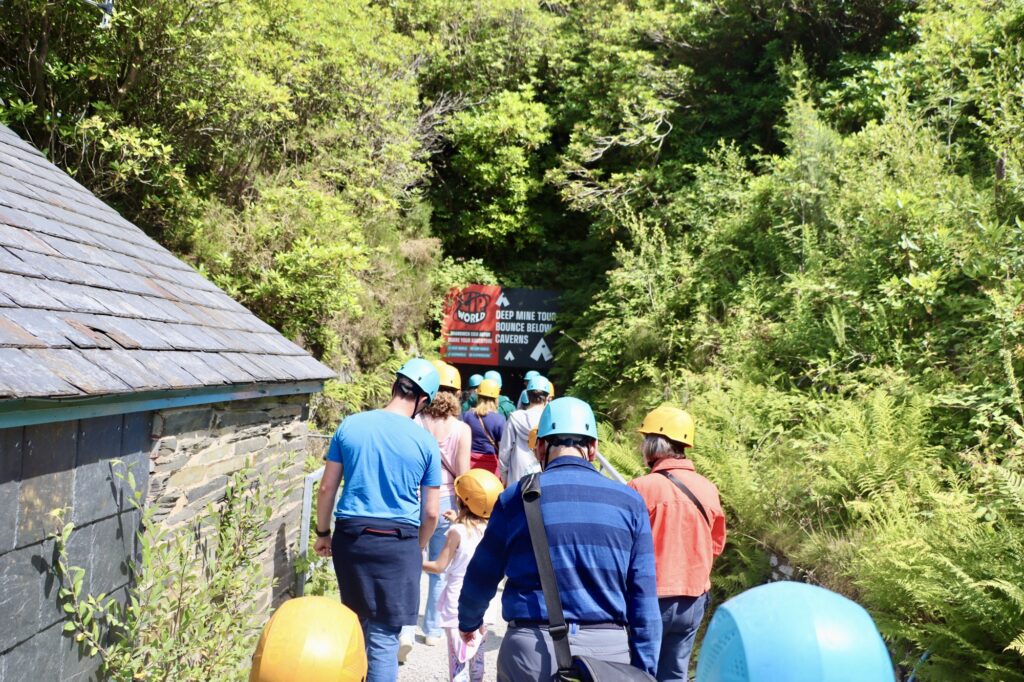
The entrance to the Llechwedd Slate Caverns

Down the mine

Some tours include a train ride up and down (and this is also how you access the mini-golf course); on our tour, we walked down and got the train back up at the end. Which, considering it’s a 150 metre (500 feet) climb back up, is very welcome. Your tour guide talks you through the history of the site, how slate was mined, and how the pieces of slate were broken up and shaped into roof tiles to be sold on. There are some audio-visual bits, and a demonstration of what it might have looked like when gunpowder was detonated to break the rocks apart.

A highlight is a cavern with an underwater lake, which is illuminated and looks amazing. It’s quite a different tour from what I remember from when I was 15, and is a good balance of history, education and entertainment. Whilst our guide wasn’t a miner himself, his ancestors worked in the mine, and he was able to tell us some of the stories.

The mine is located near Blaenau Ffestiniog, home to the northern terminus of the Ffestiniog Railway. This was partly built to transport the finished slate products to Porthmadog, for onward distribution by boat.

Accessibility

As you would expect from a 19th century mine, accessibility is restricted to people able to walk and handle low ceilings. And even on a warm July day like when we visited, the mine is cold so bring warm clothing. When you book, you’ll be asked to sign a waiver, and it highlights any medical conditions that would preclude you from entering, or that you need to make staff aware of. Some of the walking surfaces can be slippery and there are uneven steps in places.

There are disabled toilets, but no Changing Places toilet. In fact, the nearest Changing Places toilet is in Caernafon which is over 17 miles away. I suppose if you require a Changing Places toilet, then you’re not going to get much out of the activities at Zip World, but I was surprised that there wasn’t anywhere closer.

Car parking is available on site, at a cost of £3 per car – if you book in advance, you can pre-pay, or use the RingGo app on arrival. There aren’t any electric car chargers in the Zip World car parks, but there is an InstaVolt Rapid charger nearby with two CCS2 and one CHAdeMO plugs, just on the way in.

It’s a two mile uphill walk from Blaenau Ffestiniog railway station, which has trains every two hours from Llandudno Junction, or narrow-gauge heritage trains from Porthmadog. You can also get to Blaenau Ffestiniog on the T22 Transcymru bus service, but you’ll have the same two mile uphill walk.

Booking online is cheaper, and as it’s underground, it’s good for a rainy day. I was also able to get an additional 10% discount through one of my employee benefit schemes at work. There is a café which sells the sort of food you would expect from an outdoor activities centre. Above ground, music is played at a moderate volume across the site; I didn’t mind this as it was mostly 1990s and 2000s music which I listen to anyway, but my probably-but-undiagnosed autistic mother found it a bit much. There’s free Wi-Fi available across the site – handy if you need to pay for parking.

RHS Garden Harlow Carr

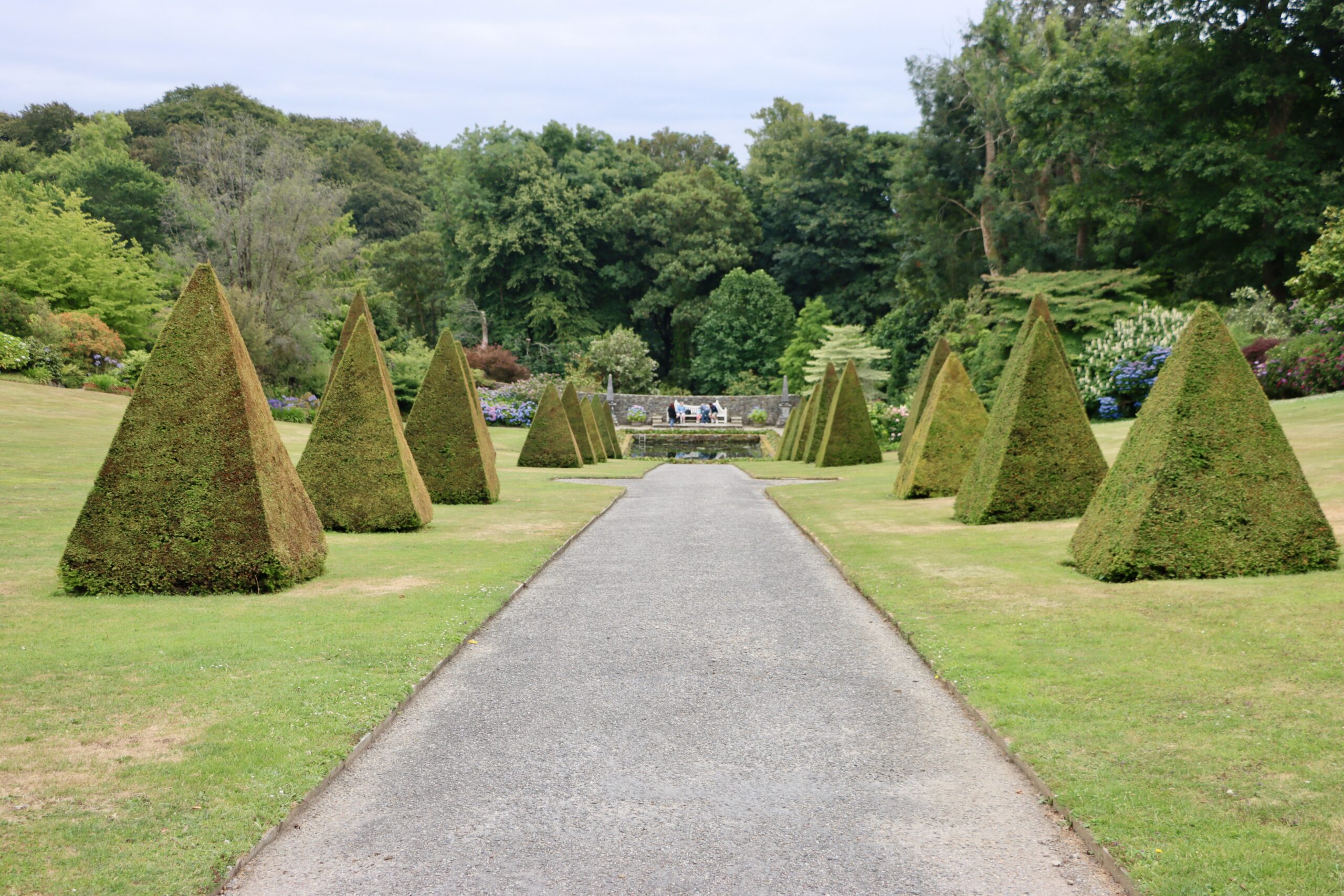
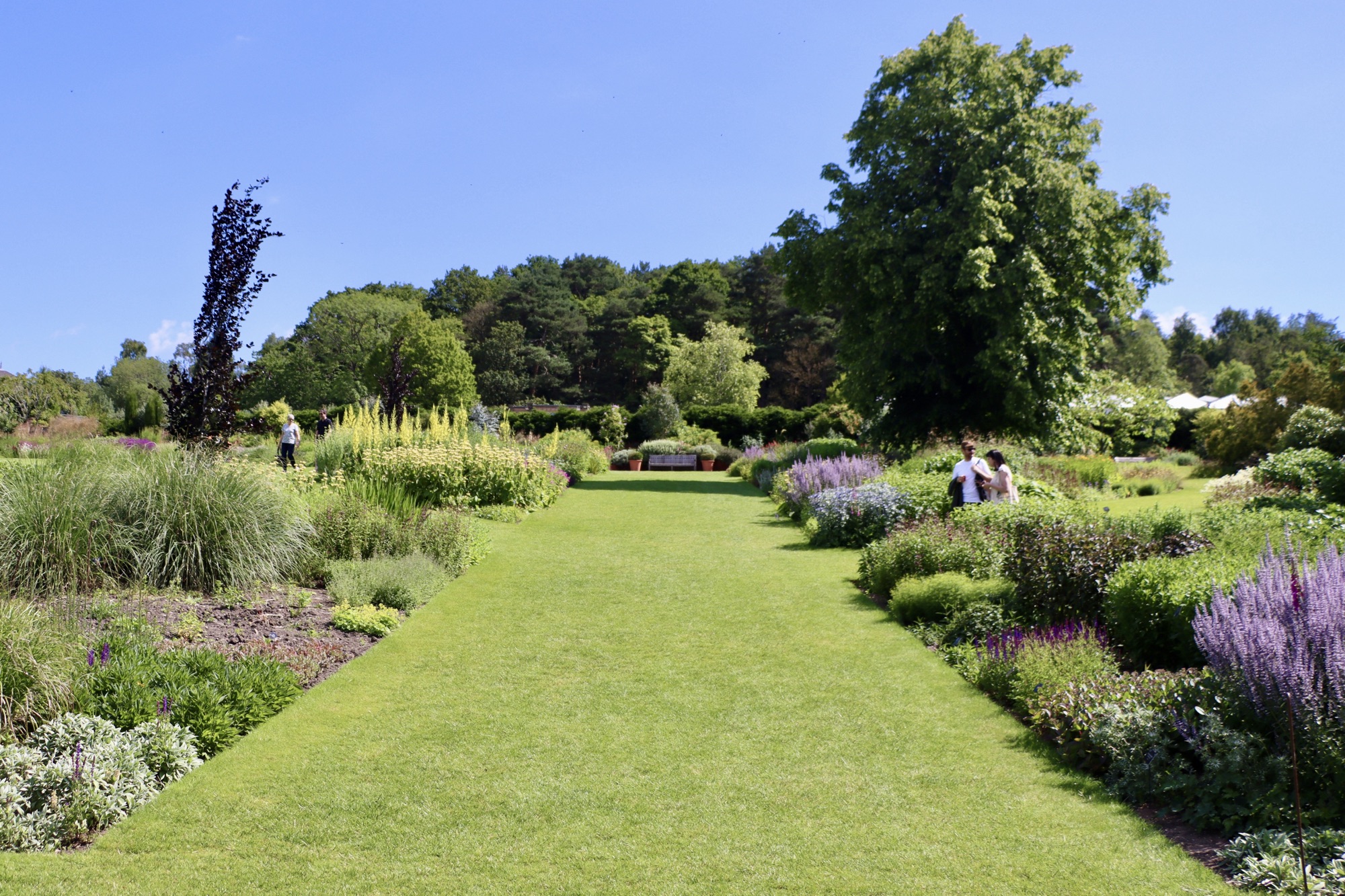
A photo of the main borders at the RHS garden at Harlow Carr

On Sunday, we took advantage of the lovely weather to visit the RHS Garden at Harlow Carr, near Harrogate. This was my first day out following last month’s fall, and was a family occasion as we met up with my parents there.

We’ve been to Harlow Carr before – we had membership of the Royal Horticultural Society (RHS) in 2023 and made a brief visit that June, and we’d also been in September 2012. We didn’t cover the whole garden this time and instead focussed on the areas that had changed since our last visit.

History of Harlow Carr

The RHS web site has a more detailed history, but it has been open as a visitor attraction since the 19th Century. Back then, it was a spa resort – Harrogate was well-known as a spa town and its history is detailed in the Royal Pump House Museum in the town centre. We visited in 2013. However, as Harlow Carr is about a mile and a half out of Harrogate town centre, it wasn’t as popular as other spas in the town and closed in the early 20th Century. However, its bath house remains and is now Grade II listed.

During the 1940s, the site was taken over by the Northern Horticultural Society, and re-opened to the public in 1950. This organisation merged with the RHS in 2001, and is now one of the five gardens operated by the RHS across England.

The Gardens

Compared to the flagship RHS garden in Wisley (which we visited in 2023), Harlow Carr is significantly smaller. You can probably spend slightly more than half a day here though.

The garden is split into several areas. On arrival, you enter the Main Borders, which are one of the garden’s original features, before dropping down to the stream at the bottom of the valley where more aquatic-friendly plants grow. A woodland area sits on the other side of the valley, and this includes a play area for kids.

In an area that wasn’t open when we first visited in 2013 is a kitchen garden, with edible plants, and there is a newer sub-tropical garden too. At the top is the Alpine House – an unheated greenhouse which is home to hardy plants that typically live above the tree line.

There’s certainly lots to see, and almost every plant is labelled should you wish to get ideas for your own garden.

Accessibility

As mentioned, Harlow Carr sits in a valley, so there are slopes. Whilst there are steps, there are usually alternative sloping routes, but not all paths are paved. Wheelchairs and mobility scooters are available to hire. There are accessible toilets, and one of the car parks features a Changing Places toilet.

There are three car parks; when we arrived at about half 10 on Sunday, one of these was already full and the second almost full. Two of these car parks offer electric car charging on the RAW charging network, and these are a mixture of ‘standard plus’ Type 2 AC chargers and rapid CCS2 DC chargers with plenty of chargers available.

If you’re able to arrive at Harlow Carr without a car, then there’s a 30% discount available on entry. The number 6 bus runs every 20 minutes from Harrogate bus station (hourly on Sundays), which is next to the railway station. Alternatively, there’s a mapped walk from Harrogate station to Harlow Carr which passes through the valley gardens and woodlands – it’s about 1.5 miles. Trains to Harrogate are normally half-hourly from Leeds and hourly from York, with an LNER service from London King’s Cross every two hours.

As the crow flies, Hornbeam Park station is closer, but it actually takes longer to walk from there to the garden so you’re better going to Harrogate.

Entry is free for RHS members, and there are a limited number of £1 tickets for those on certain benefits if booked in advance. We decided to re-join the RHS, for which you can use Tesco Clubcard points to part-pay. Tickets are cheaper mid-week, and in the winter, and are cheaper when booked online in advance.

Nearby

The main entrance to Harlow Carr is home to a branch of Betty’s, which is where we had lunch. Weetons Food Hall is about a 10 minute drive away, and has a good butchers and deli counter as well as plenty of nice foodie things to buy.

Cromwell Bottom nature reserve

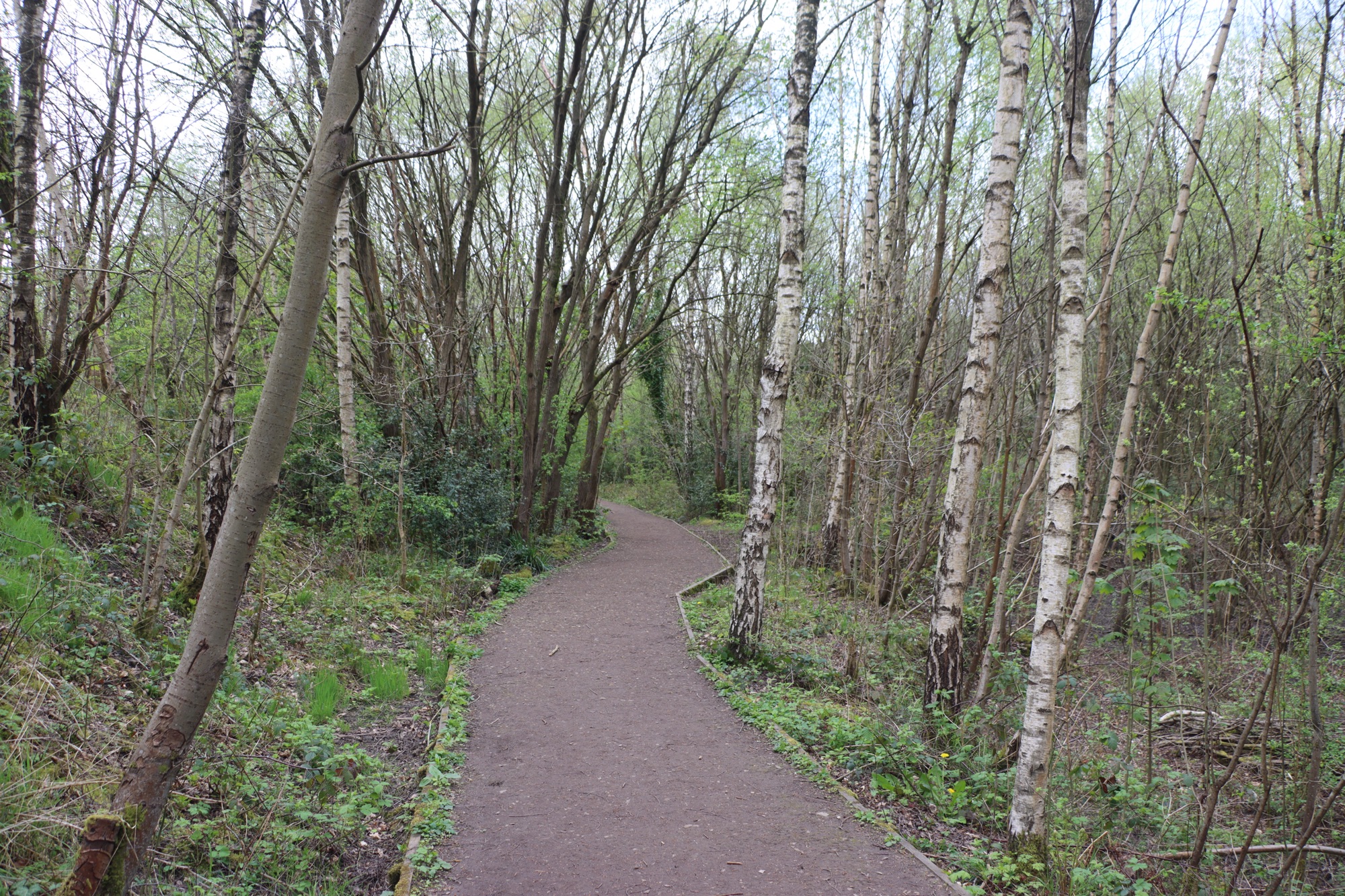
A photo of a footpath through some trees at Cromwell Bottom nature reserve

Last month, we had a nice, quiet Sunday afternoon strolling around Cromwell Bottom nature reserve. We’ve been a few times as it’s not far from us, and indeed it was one of the few places we could get out to during lockdown. However, it appears that this is the first time I have blogged about it.

History of Cromwell Bottom

There’s not much history online, but what is now the nature reserve was originally a quarry. Later, fly ash from Elland power station was dumped here, and then more recently it was used as a landfill site. In 2000, it was allowed to return to nature.

It’s a comparatively isolated site, being as it is squeezed in between the River Calder, the Calder and Hebble Navigation, and the lower section of the Calder Valley railway. As such, it has lent itself well to becoming a nature reserve, and is easily accessed from the canal towpath.

A coal tit and a great tit on a bird feeder at Cromwell Bottom nature reserve.

Different habitats

Different parts of Cromwell Bottom offer different habitats. There’s a large wooded area, mostly full of silver birch trees, but there’s also a meadow and some marshy wetland areas. As such, it’s possible to see quite a wide variety of wildlife.

Whilst Calderdale Council, the local authority, own and manage the nature reserve, there is an active volunteer organisation called Cromwell Bottom Wildlife Group. In particular, they look after an area of bird feeders, with a bird hide. We stopped there for around 20 minutes, and saw a number of different bird species. The largest was a hen pheasant, but we also saw chaffinches, robins, blue tits, coal tits, great tits and pigeons. On a previous visit, I also saw a nuthatch, and we heard a buzzard, confirmed by Merlin Bird ID.

Out on the river, I saw a heron and a goosander, the latter of which I don’t think I’ve previously seen before.

The Wildlife Group also publish several leaflets, with suggested walking routes around the site. You can download these as PDFs.

Accessibility

Most of the paths around the site are step-free, but there are some steep slopes. They are not paved and the ground can be uneven in places. There are gates on some of the paths which require a radar key to open for wheelchair access.

The Cromwell Bottom Wildlife Group runs a visitor centre, at the western end of the site just off the canal, and this includes disabled toilets. However, it’s operated by volunteers, and is only open on Tuesdays, Thursdays and Sundays between 10am and 4pm. The nearest Changing Places toilet is in Tesco in Brighouse.

Limited parking is available near the visitor centre. It’s on rough ground and often fills up. Buses stop on the main road – the E4 bus runs hourly between Elland and Brighouse on weekdays and every two hours on Saturdays. There’s no Sunday service, so if you need to get there by bus and may need the toilet, visit on a Tuesday or a Thursday.

If you’re reading this in 2029, then Elland railway station may be the closest, but as construction hasn’t started yet, Brighouse railway station is the closest. It’s then a sedate 45 minute walk along the canal towpath.

Nunnington Hall

A photo of the outside of Nunnington Hall

On Easter Monday, we took advantage of the nice weather on Easter Monday to visit Nunnington Hall. Yes, I am aware it has taken me a month to get this published. I’ve been to Nunnington Hall before, but it was many, many years ago. Such that I don’t really remember it, and certainly didn’t have any photos of it.

History of Nunnington Hall

Nunnington Hall gets its name from the village of Nunnington, itself named after a nunnery that once stood in the village. There has been a hall in Nunnington since the 13th Century and in the 14th Century, it passed to the Grene family. In 1499, Maud Grene, the lady-in-waiting to Queen Elizabeth of York (wife to King Henry VII) married Sir Thomas Parr, and so the property passed to him. He had a daughter, Catherine Parr, who followed in her mother’s footsteps by marrying Henry VII’s son, King Henry VIII. Catherine Parr was famously the last of Henry VIII’s six wives and outlived him.

In the 16th Century, the property passed to Catherine Parr’s brother, William, Marquess of Northampton. He started a trend of choosing the wrong side in royal conflicts, by favouring the succession of Lady Jane Grey over Mary Tudor. As such, he forfeited Nunnington Hall to the crown.

About a hundred years later, Ranald Graham bought Nunnington Hall for £9500 – around £2.5million in today’s money. He made many changes to the hall, which resulted in many of the historical features still seen today. Another member of the Graham family, Sir Richard Graham, was the second to get a bit of pickle with royalty, being a supporter of Catholic King James II when the Protestant William and Mary ascended to the throne. He was arrested, imprisoned, and only avoided the death penalty for high treason by being an informant for his accomplices. He was stripped of his land and titles and quietly retired to Nunnington Hall. The Graham family sold Nunnington Hall in 1839.

The buyers were the Rutson family, with whom it remained until 1952 when it was left to the National Trust. However, whilst the National Trust took ownership, family members remained living there as tenants until 1978, after which more rooms could be opened to the public.

The hall

Whilst much of the hall dates from Tudor times, it has been renovated several times over the years. Inside, it mostly appears as renovated in the 1920s in the Arts and Crafts style. This included the addition of indoor plumbing. Most of the hall is open to the public, including the main entertaining rooms and the bedrooms. The servants would have lived in the attic, and this has been opened up as an exhibition space. At present, it’s a series of nature pieces by a collective called Diverse Threads 2; later this month, you’ll be able to see entries from the British Wildlife Photography Awards.

Nunnington Hall is also home to the Carlisle Collection of miniature rooms. These are essentially small rooms, like those in a doll house, but not part of an overall house. Some are very intricate – there’s one of a music shop, where each miniature instrument can be played.

The gardens

Nunnington Hall’s gardens are modest; you can walk around the entirety in about half an hour. The National Trust switched to organic gardening at Nunnington Hall in 2002.

They are laid out mostly as they would have been in the 17th Century, with some nods to its 20th Century heyday. This includes a kitchen garden, and a new iris garden that was added last year. There is also a children’s play area, hidden away in the trees.

The house sits next to the River Rye, which gives its name to Ryedale which was the former name of the district council until it was abolished in 2023. Apparently, wild otters have been spotted on the river, but we didn’t see any.

Accessibility

As alluded to above, Nunnington Hall has been altered significantly over the years. And whilst it’s not as higgledy-piggledy as, for example, Little Moreton Hall or Bolling Hall, there is almost no step-free access inside the hall beyond the ground floor. The grounds are largely step-free, but not always on hard surfaces. A disabled toilet is available, but the nearest Changing Places toilets as several miles away in either Pickering or Malton.

Nunnington Hall is a mid-tier National Trust property, so entry prices are currently around £13 for adults. National Trust members get in free, as do RHS members and National Art Pass Holders.

There is a car park on the other side of the River Rye from the hall, linked by a footbridge, and this includes electric vehicle charging. There are four Standard (7kW AC, Type 2) chargers, although two were out of order when we visited. A £5 donation is requested if using the chargers. Additional charging is available in Nunnington village.

Bus services run on weekends and bank holidays only, from April to September. Two bus services run in each direction, setting off from Helmsley and heading to Castle Howard. Until the 1950s, Nunnington had a railway station, but it’s long gone now.

Making Waves at York Art Gallery

A print of 'The Great Wave off Kanagawa' on display at the Making Waves exhibition at the York Art Gallery

As we were staying with my parents at Easter, we popped into York city centre on Easter Sunday to see the Making Waves exhibition at York Art Gallery. The exhibition is all about the art of Japanese block printing, where printers would carve wooden blocks that were then painted, to reproduce artworks on a massive scale.

The name Making Waves comes from the painting The Great Wave off Kanagawa by Katsushika Hokusai, which is one of the most recognisable paintings from this method. There is one of the 111 surviving original prints of this on show in Making Waves, on loan from the Maidstone Museum.

Now I keep saying that I’m not really into art, despite visiting a Banksy exhibition and the V&A last month, and now this. I stand by this, and I found the information about how the prints are made more interesting than the prints themselves.

A modern print creating using Japanese Block Printing, with the blocks shown.

Making Waves starts with an explanation of the process; there’s a video as well as a step-by-step guide. It’s notable that the process generally results in the original painting being destroyed, and so there is usually no surviving ‘original’, just the first print run. I particularly appreciated the display of a modern print, made using the traditional method, on show with some of the wooden blocks that were used to make it.

You then proceed around the exhibition largely in chronological order. The exhibition ends in the modern day, with some newer commissions of block printed art featuring characters from Japanese video games. Also, in the final room, you can use a series of rubber stamps to create your own block print, which is a nice touch.

Japanese Zen Garden

Around the back of the art gallery is a small Zen Garden that has been created for the exhibition. This is connected to the Museum Gardens and leads around the back to the nearby Yorkshire Museum.

We visited York Art Gallery a couple of years ago, and so we didn’t go upstairs to the rest of the galleries this time. The Making Waves exhibition is open until the 30th August this year.

Accessibility

York Art Gallery offers step free access throughout the building, with lift access to the upper floors. Accessible toilets are available, and there is a Changing Places toilet around the corner at York Central Library when that is open.

Parking your car in York city centre is unwise, and many buses stop right outside the art gallery, including Park & Ride services from Rawcliffe Bar. York railway station is a short walk away.

Admission is currently £9 per adult, but there are many discounts available, including free entry for Art Pass and Max Card holders, and York residents aged 16 and under.

Queer Britain, the national LGBTQ+ museum

A photo inside the galleries at Queer Britain.

This is the sixth and final of my blog posts about last month’s trip to London. Following our trip to the Vagina Museum in the morning, we decided to continue the theme of ‘woke museums’ and visit Queer Britain, the national LGBTQ+ Museum.

I’ll be honest, our main reason for visiting was that it’s in King’s Cross, and was therefore close to where we needed to be for our train home that afternoon. But as someone who identifies as a member of the LGBTQ+ community, I decided it would be good to visit.

Queer Britain is a small museum – we were in and out within the hour – and despite having ‘national’ in its name, it’s very London-focussed. There’s not a lot about LGBTQ+ history in other parts of the UK; there was a bit about Justin Fashanu, a footballer who played for Norwich City and was Britain’s first openly gay professional player. But there was nothing about Manchester’s Gay Village, for example. Perhaps if the museum is able to expand in future, it will have more things to show that are from outside the capital.

There is also an events space, and if we hadn’t needed to catch a train, we would have stuck around for a panel discussion platforming LGBTQ+ migrants. We did, however, manage a quick selfie with the panel moderator, Tia Kofi, who you may know from Season 2 of RuPaul’s Drag Race UK. They’re very tall.

Accessibility

The museum is all on one floor, with a ramp to the main door; however, extra wide wheelchairs may present an issue. An accessible gender neutral toilet is available; Changing Places toilets are available a short walk away at Pancras Leisure and King’s Cross station.

Entry is a recommended fee of £10, or pay what you feel. As it stands, I broadly agree with Ian that £10 is a big ask for a relatively small museum. The gift shop is good though.

Queer Britain is in Granary Square, on the other side of the Regents Canal from King’s Cross and St Pancras stations (which are all step-free). If it still existed, York Road tube station on the Piccadilly Line would be closest, but it closed 94 years ago.

Operation Mincemeat, the musical

A photo of the inside of the Alhambra Theatre in Bradford showing the logo for Operation Mincemeat on the curtains whilst we were waiting for the show to start.

A couple of weeks ago, the hit musical Operation Mincemeat made its way to Bradford’s Alhambra Theatre, and so Christine and I went to see it. It’s very good.

The true story of Operation Mincemeat

Like Kinky Boots, which we saw last month, Operation Mincemeat is based on a true story. The actual Operation Mincemeat took place in 1943 and was a distraction strategy by allied forces during the Second World War. It involved planting the body of a street tramp, disguised as a high ranking military official, off the coast of Spain. The body contained important (but crucially faked) documents implying that the Allies planned to invade Sardinia. Instead, the actual plan was to invade Sicily, which, at the time, was heavily guarded by Nazi forces. Sure enough, forces were re-allocated from Sicily to Sardinia, allowing the Allies to liberate Sicily.

Two books have been written about Operation Mincemeat; a novel in 1950 called Operation Heartbreak, and a second book in 1953, The Man Who Never Was. This second book was written by Ewen Montagu, one of the intelligence officers involved, and it was adapted for a film in 1956. A later film followed in 2021, called Operation Mincemeat, and now there’s a musical adaption too.

The musical

The musical largely follows the actual events of Operation Mincemeat, with some artistic license. It’s performed with just five actors, who, through many rapid costume changes, play lots of different parts. The set is relatively simple, with lighting used to great effect throughout. The songs are all original, and number over 20 – much of the show takes place in song.

It’s a lot of fun to watch. The cast were all great singers and performers, and despite the many, many costume changes, it always felt slick and well-rehearsed. A nice touch comes towards the end, where there is a tribute to the street tramp, and a revealing of his actual identity.

Whilst not aimed at children, Operation Mincemeat is fine for families with children to watch. I don’t think our ten-year-old would have liked it, but teenagers may be interested.

The musical opened in London in 2019, and moved to the West End in 2023 where it’s still running. It’s therefore unusual for a musical to go on tour so soon afterwards, but it appears that the West End run is almost completely booked up for months. Indeed, there appears to be a ballot to get tickets now. As such, you have more chance of seeing it on tour. Whilst the Bradford Alhambra Theatre run is over now, as I write this it is coming to the end of a two week run in Sheffield, after which it is off to Stoke-on-Trent and then Chester. It makes it back to Halifax in October, and I’m highly tempted to see it again.

The Vagina Museum

A photo of the outside of the Vagina Museum in Bethnal Green.

This is one of those blog posts where I’m glad I don’t take advertising on this blog anymore, as I imagine this post would get demonetised. This is the fifth of my blog posts about last month’s trip to London; I’m aware that we’ve been back for a month now, and there’s still a sixth and final post to go live this week. Today’s post is all about The Vagina Museum.

A Vagina Museum‽

Yes, a museum all about vaginas. Well, and the wider reproductive organs of women and others with vaginas – the museum tries very hard to be inclusive of trans and non-binary people as well.

It’s not a very big museum, and occupies two railway arches under the Weaver Line of the London Overground. It’s made up of three small named exhibitions spaces, called Betsey, Lucy and Anarcha, named after three enslaved Black American women who were all experimented on, and from whom our modern understanding of gynaecology is derived. Betsey’s gallery, upstairs, is home to the permanent exhibition, where you can see a complete preserved uterus (Christine commented that it was smaller than expected, considering how much it hurts when she’s on her period) and many photos of different types of vulvas.

Also upstairs is Anarcha’s gallery, which has written pieces from migrant women about their first period, and the challenges that their status as refugees has caused.

Downstairs, as well as the excellent gift shop, is Lucy’s gallery, and the current temporary exhibition about menopause, including its history and how our understanding of it has changed over time.

In all, we spent about an hour in the museum. It’s quite text heavy, and I don’t think our ten-year-old would have got much out of it, but we both found it enlightening. I’d definitely recommend visiting if you have a vagina, or live with someone who does.

Accessibility

Accessibility is good – there is a lift to the upstairs galleries, and no steps. There’s a single, gender-neutral, accessible toilet available. If you need a Changing Places toilet, then there is one nearby at the Young V&A (which we visited in 2024).

Entry to the museum is free, but a £5 donation is strongly encouraged. And did I mention that the gift shop is excellent? Note that museum is closed on Mondays and Tuesdays.

The museum is very close to Cambridge Heath station on the London Overground, and a little further from Bethnal Green tube station on the Central Line. We got there on the 254 bus from outside Aldgate tube station, which is probably your best option for step-free transport; the nearest step-free station is Hoxton on the Windrush Line, which is a 20-25 minute walk.

I haven’t been noting about car parking or electric car charging in these London reviews, as we didn’t drive and I think you would be mad to drive in London, but there is a rapid Shell Recharge station around the corner.

Creative Commons License
Except where otherwise noted, the content on this site is licensed under a Creative Commons Attribution-ShareAlike 4.0 International License.