We spent a day of our holiday on the island of Anglesey, starting at the north east corner with Beaumaris Castle. You could be forgiven for thinking that Beaumaris Castle is now a ruin, but in reality it was never actually finished.
It was commissioned by Edward I of England in the late 13th Century, along with Conwy Castle, Caernarfon and Harlech, and was supposed to be the biggest and grandest of them all. However, the money ran out, and construction basically stopped in the 1320s. The towers were never as tall as planned, but what remains today is still a large castle with multiple fortified walls. Nowadays, as with Conwy, it’s in the care of Cadw. Despite being built by an English king in Wales, ‘Beaumaris’ is derived from the French ‘beaux marais’, or ‘fair marsh’.
Visitors can climb up onto the walls, and up some of the towers, to get a view across the Menai Strait and towards mainland Wales. There’s also a video history of the castle, and the chapel has been restored with new stained glass windows. The outer walls are enclosed by a proper water-filled moat, and whilst it was never completed, it’s still a formidable castle. It’s worth a 1-2 hour visit.
Accessibility
As you would expect from something built over 800 years ago, accessibility isn’t the best. Access to the walls and towers is by staircases only, but there’s flat access to many other parts of the castle, albeit mostly on grass or gravel surfaces.
The castle is in the centre of the town of Beaumaris, which doesn’t have a railway station (and indeed never has) but is served by regular bus services. There’s an official castle car park just to the north, but we parked in a pay and display car park at a nearby leisure centre, that was a similar distance walk away. The leisure centre car park has two medium-speed (7 kW AC) electric car chargers on the PodPoint network.
Nearby
We didn’t spend much time in the town of Beaumaris, but it looked quite nice for a bit of pottering around. There’s a pier, and a large sightseeing Ferris wheel was there when we visited.
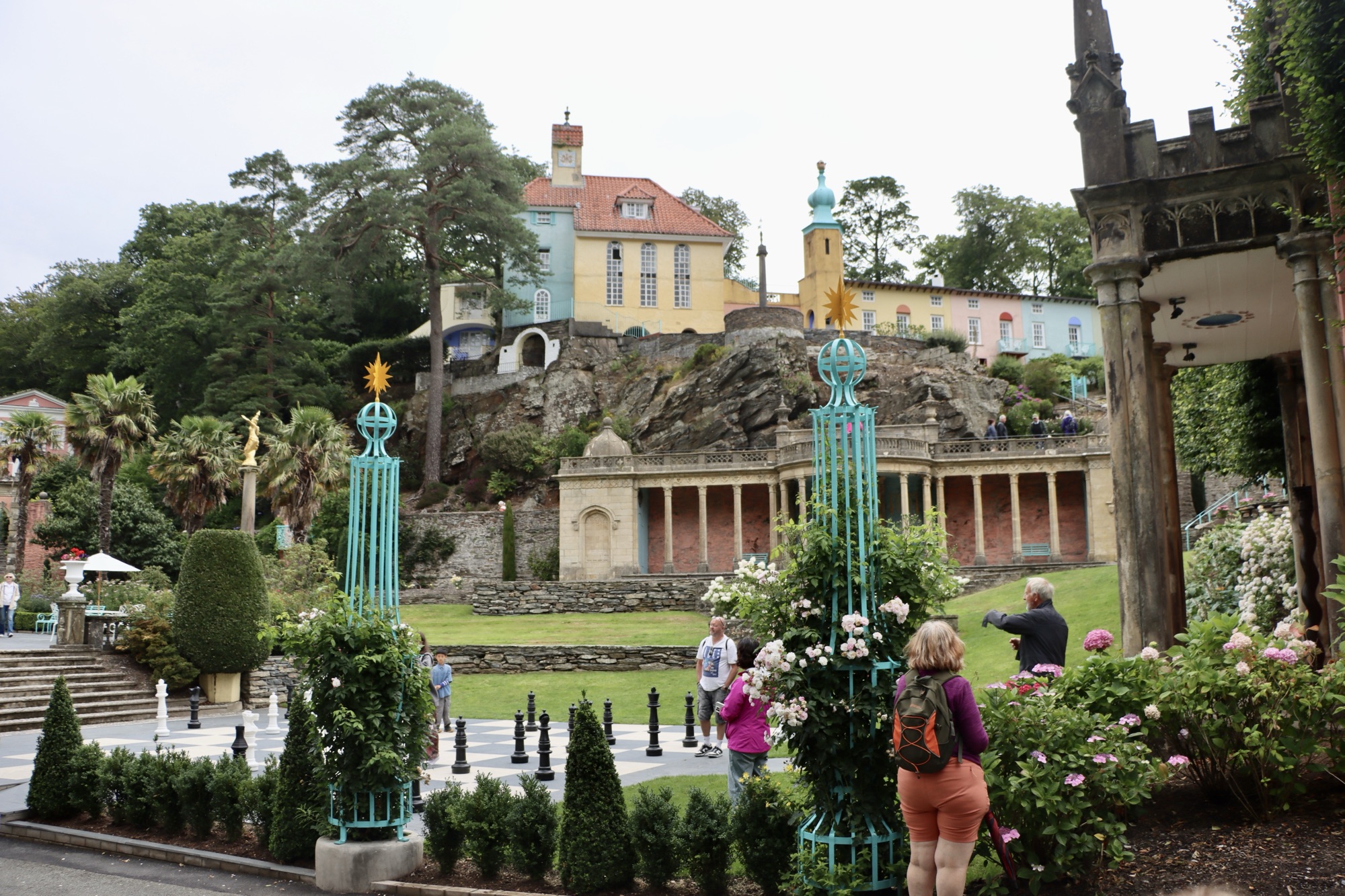
Our next day trip on holiday was to the village of Portmeirion. This was a little further away; though still in North Wales, it’s not along the north coast but instead further south, near Portmadog. The village was built gradually over 50 years between 1925 and 1975, and is designed to look like a Mediterrean port village, but on a small scale. So, unlike most of the local architecture, the buildings are brightly coloured, with lots of tropical planting.
All of us had been before, including our nine-year-old, although they were only two on their previous visit. I think they liked the smaller scale of it, and that there’s lots of little nooks and crannies to explore. Over the years, it’s been a popular filming location, and many of the buildings are now listed as heritage assets. The pottery brand Portmeirion takes its name from the village, and yes, there’s a pottery factory shop in the village.
Even though the weather was quite dull when we visited, I still took plenty of photos as it’s so picturesque.
Accessibility
Portmeirion is quite expensive, at £20 for an adult day ticket (at the time of writing). However, you can easily spend the whole day here – especially if you head off on the various walks. Being located on a hill side, with the car parks at the top, means it may be hard work for those with mobility issues. Whilst there are steps in places, there are usually alternative ramped routes available.
There is a large car park at the top, with 10 electric car charging points offering medium-speed 7kW AC output (Type 2), on the Monta network. At the time of our visit, we paid 60p per kWh to charge. Some of the charge points were out of order, however.
The nearest railway station is Minffordd, which is on the Cambrian Coast Line with trains from Birmingham, and the narrow-gauge Ffestiniog Steam Railway. This is also where the nearest bus stop is. There’s then a 1 1/2 mile walk to Portmeirion.
Also nearby
After visiting Portmeirion, we went to Porthmadog, which is the terminus for both the Ffestiniog and Welsh Highland narrow gauge steam railways. We didn’t have time for a journey – a return trip on the Welsh Highland Railway to Caernarfon and back takes most of the day – but we did watch a couple of trains departing and visited the shop.
Directly north of Conwy, where we were staying, is Llandudno, a seaside resort that was largely developed in the mid 19th Century. Much of the land that Llandudno stands on was marshlands, owned by Lord Mostyn, and many of the buildings were planned and designed around the same time. As such, particularly along the seafront, there’s an aesthetically pleasing uniformity across the town.
Away from the seafront, the main street is Mostyn Street, and many shops have glass overhangs like those in Harrogate. However, it’s clear that the decline of the high street has affected Llandudno and I noticed a number of empty shops, including what looked like a large M&S. It turns out M&S merely moved to a new store a little further out of town, rather than leave the town entirely as it has done with Bradford, Hull and Huddersfield in recent years.
Llandudno Pier
Stretching out into the Irish Sea is the Grade II listed Llandudno Pier, dating from 1877. It’s the longest in Wales, and remains privately owned. It was also voted Pier of the Year this year, despite it recovering from damage from Storm Darragh at the end of last year. As piers go, there’s a decent mixture of shops – our nine-year-old particularly appreciated the Lego minifigures shop. At various times in its history, it’s been possible to catch ferry services from the far end of the pier, but no such services are currently running.
The Great Orme
The Great Orme is the name given to the headland to the north of Llandudno. As mentioned, Llandudno itself is former marshland and so is very flat, and mostly at sea level. Meanwhile, the Great Orme rises to a height of just over 200 metres and is a prominent feature on the landscape. Because it’s surrounded by low-lying land, the Great Orme feels like a mountain, but it isn’t – parts of the village of Queensbury, near Bradford, are twice as high for example. It would need to be around three times taller – 610 metres – to be considered a proper mountain.
Across the Great Orme are plenty of sheep, and some Kashmir goats which are descended from a pair gifted to Queen Victoria. There’s also a species of shrub called the Wild Cotoneaster, which is critically endangered and only found on the Great Orme.
The Great Orme Mines
Inside the Great Orme are seams of malachite, a copper ore, mixed amongst the sandstone. These have been mined for over 4000 years, although mining activity ended in the late 19th Century. In 1987, ahead of the building of a new car park, an archaeological dig was ordered, and the mines were rediscovered. That car park never got built, as the dig is still ongoing, with part of it opened as the Great Orme Bronze Age Copper Mines.
The opening up of the mines changed our understanding of Bronze Age history; it was previously thought that bronze tools weren’t used in Britain until the arrival of the Romans. But tools were found in the mines, made using copper from the mine and tin imported from Cornwall.
Today, you can go into the first two levels of the mines, which go around 18 metres underground. This includes a huge cavern, which was excavated by hand and is now home to several stalagmites and stalactites. So far, nine levels have been excavated, with more likely to be found as the excavation continues. Our nine-year-old enjoyed it, and it was good to compare it with the 19th and 20th Century mines that we visited last year at Beamish and the National Coal Mining Museum for England.
The Great Orme tramway
There are a few ways up the Great Orme. If you’re feeling especially athletic, you can walk up, but it’s quite a steep climb. You can drive – there’s a car park at the summit – or catch a bus. Both standard public buses, and an open top minibus for tourists, run to the summit.
You can also travel by cable car, from just above the pier in Llandudno. But, for me, the best way up is on the Great Orme Tramway. Opened in 1902, this runs from Llandudno up to the summit, and is Britain’s last surviving cable-powered tramway. It’s actually two separate tramways; passengers have to alight at the halfway station to switch from one tram to the other. The halfway station, rebuilt in 2001, also doubles as the workshops, and there are large windows so that you can see the winding gear for the cables.
The tramcars are all original, although the 2001 upgrade did introduce some modern equipment. Whilst the tramcars were hauled using cables, they also previously used overhead cables for communication. The 2001 upgrade replaced this with a radio system, so whilst the tramcars retain short trolley poles at each end, they’re no longer used in service.
The lower section of the line runs along several streets, which is unusual for a cable-powered tramway. Both sections operate on the funicular principal, so as one tramcar goes up, another goes down. It’s mostly single track, with each section having a passing place in the middle.
Accessibility
Llandudno station is at the end of a short branch line from Llandudno Junction, and receives regular local services from Chester and Manchester. Less frequent services run to Cardiff; in the past, direct trains to London Euston have operated but not since 2008.
We parked at the Victoria Shopping Centre, which is central to the town and has a multi-storey car park. We didn’t need to charge our electric car there, but there are 12 Type 2 chargers offering up to 22 kW available, on the Roam network. As mentioned, there is also a car park at the top of the Great Orme.
The pier is all on one level. The Great Orme tramway has limited capacity for wheelchairs, which need to be folded whilst on board, and there are steps up to the tramcars.
We’re back from our 2025 summer holiday in North Wales. Actually, we’ve been back a week now but it’s taken me a little time to sort the photos. I’ll be writing about the places we visited over the next couple of weeks, and today I’m starting with Conwy.
Situated on the North Wales coast, at the mouth of the Conwy Estuary, Conwy is a small town with a big castle. It retains its walls, which still run around almost all of the town and have only been breached in one location. Indeed, many stretches of wall are available to walk along.
Our rented cottage was just outside the walls, but was within walking distance.
A short history of Conwy
The town of Conwy was built by the English as a fortified town in the 13th Century. However, they weren’t the first people to occupy the site; in the 12th Century, some monks had founded an abbey there, known as Aberconwy Abbey. When the English, led by King Edward I, came along, they forced to monks to build a new abbey further up the Conwy Valley to the south. The castle was built first, followed by the town, and all use the same hard local stone. It’s probably due to the hardness of the stone, that the castle and walls have survived so long.
In the 14th Century, Welsh forces managed to seize the castle and the town, and held it for 3-4 months before negotiating a surrender. Inside the town, Aberconwy House was built around this time and remains the oldest surviving building within the town. It’s owned by the National Trust is open four days a week (Wednesday to Saturday) as a second-hand bookshop.
Whilst accessible by sea, it wasn’t until the 19th Century that road and rail access to Conwy became viable, and with it its rise as a tourist destination. In the late 20th Century, the whole town and castle became a UNESCO World Heritage Site.
Conwy bridges and tubes
The first bridge to be built across the Conwy Estuary was the Conwy Suspension Bridge, which will be 200 years old next year. It was designed by Thomas Telford, who was responsible for the first roads along the North Wales coast. The bridge still stands, albeit only open to foot traffic nowadays, and is managed by the National Trust. It’s open as a permissive footpath, so you don’t need to pay to cross it.
Telford’s suspension bridge is the world’s oldest surviving ‘modern’ suspension bridge. It could be seen as a dry run for another bridge that Telford designed, the Menai Bridge, further along the North Wales coast and spanning the Menai Strait between the British mainland and Anglesey.
Later on in the 19th Century, Robert Stephenson designed the Conwy Railway Bridge, which was built alongside Telford’s suspension bridge. This brought the North Wales Main Line railway to Conwy, on its way to Holyhead on Anglesey. This bridge is a tubular bridge – a pair of big metal girders, which were erected off site and lifted into place. Each hollow girder carries one of the two railway tracks. Stephenson also designed a tubular bridge to cross the Menai Strait, resulting in the Britannia Bridge. However, the Britannia Bridge was badly damaged in a fire in 1970, and was rebuilt to have two decks, with the railway below and the A55 North Wales Expressway up top.
By the 1950s, Telford’s suspension bridge was becoming a bottleneck, and so a third bridge was opened in 1958, the Pont Conwy (Conwy Bridge). I believe that it was at this point that a gap in Conwy’s walls was made to fit the wider road through. This is a much more plain, low-lying bridge that sits alongside Telford’s suspension bridge, to the north, with Stephenson’s tubular bridge to the south.
Whilst the Pont Conwy relieved one bottleneck, Conwy itself remained a pinch point for traffic heading to the port of Holyhead, where ferries go onwards to Ireland. The streets, and the gateways in the town’s walls are only wide enough for one lane of traffic, and to this day there’s a one-way system around the town. So, in the 1990s, the A55 North Wales Expressway was diverted into a tunnel, which runs under the Conwy Estuary. This was built using a (at the time) pioneering method of immersed tubes, buried in the riverbed. Nowadays, the A55 is all dual carriageway from Chester in England, through to Holyhead, apart from the Britannia Bridge. In fact, the road through Conwy and Colwyn Bay is a ‘secret motorway’, with motorway restrictions but standard green signs for a primary ‘A’ road.
Conwy Castle
The castle and town walls are managed by Cadw, the Welsh counterpart to English Heritage. Whilst the walls are free to walk on, you’ll need to pay to enter the castle. There’s a shop and visitor centre next to the town’s main car park, and this leads to a bridge across the B5106 Llanwrst Road and into the castle. Originally, there would have been a set of steps and a drawbridge, but a mini roundabout sits where the steps were.
Since it was constructed in the 13th Century, it’s fallen into ruin and then been repaired several times, but it was taken out of military use in the 17th Century following the English Civil War, and later stripped of all of its iron and lead. It’s now a ruin, although a reasonably well-preserved one, and visitors can climb most of the towers and walk along the walls. The last major investment in 2012 saw the construction of the new visitor centre, new information boards and several sculptures installed.
As it’s a ruin, there’s not masses to see there, although I feel that Cadw have done a better job of presenting the castle than their English counterparts did at Warkworth Castle. You could probably spend 1-2 hours here, depending on how interested you are and how many steps you’re willing to climb.
Other things to see in Conwy
On the waterfront, there’s the Smallest House in Great Britain, as recognised by Guinness World Records. Our nine-year-old went in on their own – we didn’t, as you have to pay. There are various boat tours on offer, mainly up and down the Conwy Estuary.
As you’d expect from a town that has a reputation for tourism, there are plenty of small shops to look around. Opposite the castle is The Knight Shop, which as well as selling various imitation swords and armour, has a fantastic range of mead. Including sparking mead, which I’ve never previously come across. We bought a bottle to try later.
Accessibility
Conwy has a railway station, although it’s a request stop with short platforms and not all trains that pass through are scheduled to stop. That being said, it’s a relatively easy walk from the nearby Llandudno Junction station, which has more regular services.
There’s a small car park inside the town walls, but there’s a larger one off Llanwrst Road which is linked to the town by a foot tunnel under the railway. I’m not aware of any public electric car chargers in or around the town, but there’s a Tesco and a Lidl at Llandudno Junction that we used for charging. There are regular bus services, and an open-top tourist bus regularly runs between Conwy and Llandudno.
For the castle, it’s possible to enter the castle without needing to climb any steps, but once inside you won’t be able to go into any of the towers without using stairs. Cadw and English Heritage members get into the castle for free, and there are discounts for Blue Light card holders, and members of the armed forces. Foster families with a Max Card can also get a discount, but people with disabilities will need to show proof of receipt of DLA or similar.
Whilst the trip was primarily for work purposes, LanguageCert, our lovely hosts, also included a visit to the Acropolis on Sunday afternoon. Having travelled internationally for work before, this is something I really appreciated. When I went to Amman in 2015 for work, I didn’t get to see any of the nice bits of the city, and it was a shame to go all that way without seeing them. So, I made sure I packed some sturdy footwear and sun protection and off we went to tick another UNESCO World Heritage Site off my list.
The Acropolis
The city of Athens mostly sits within a basin, but with the Acropolis sitting on a raised rocky outcrop in the middle. The Acropolis itself contains several ruined buildings, including the Parthenon, the Propylaea, the Erechtheion and the Temple of Athena Nike. We had a tour guide who showed us all of these, including the ongoing restoration work. This isn’t to recreate them as they were when they were built over 2000 years ago, but to ensure that they don’t degrade further. The buildings were damaged in the 17th century by the Venetians, and this is the state that they remain today. In their heyday, these buildings must have been even more impressive – we were shown some of the few remaining marble roof tiles. Some sculptures have survived and are still on show.
Further down the outcrop are two theatres – the Theatre of Dionysus which was built by the ancient Greeks and is now a ruin, and the Odeon of Herodes Atticus which was built by the Romans and is still in use for events today – there was a show there on the Sunday that we visited. You can look down onto these from the Acropolis, and you get great views across the whole city of Athens.
Nearby is the Acropolis Museum – this is close but separate, and we didn’t go in. The current museum opened in 2008, and famously has an empty room to host the Parthenon Sculptures. Also known as the Elgin Marbles, these are controversially on display in the British Museum in London, but may be permanently loaned back to Greece soon. That part of the British Museum is due to close for refurbishment soon so returning them to Athens would make even more sense.
Accessibility
I always try to include an accessibility section in my Days Out posts, but I nearly didn’t bother with the Acropolis. It’s a World Heritage Site on top of a hill, so if you want to visit, you need to be able to handle steep slopes, uneven surfaces and lots of steps. If this isn’t for you, maybe stick to the Acropolis Museum rather than the Acropolis itself.
The good news is that the Acropolis has long opening hours, from 8am until 8pm – my advice would be to visit early or late as there’s very little shade available. We got there at about 5:30pm, by which time there were some shady spots to wait in. Even then, it was still very busy. All the signage is in both Greek and English.
I think, in my mind, UNESCO World Heritage Sites are relatively unusual, and that most people would have only visited one or two in their lifetimes. As it happens, there are well over a thousand UNESCO World Heritage Sites across the world, in over 160 countries. 35 of these are in the UK alone. So, with this in mind, here are all of those that I have visited, split by country.
Castles and Town Walls of King Edward in Gwynedd. These are specifically the castles at Beaumaris, Caernarfon, Conwy, and Harlech in North Wales, of which I’ve been to Caernarfon and Conwy (and will be re-visiting Conwy this summer).
Frontiers of the Roman Empire. This encompasses multiple sites, some of which are in Germany, but the bit I’ve been to is Hadrian’s Wall. This was when I was still at school and before my blogging days, so I don’t have any photos or blog posts to share.
Canterbury Cathedral. This was way back in 2000, when you could enter the Cathedral Close without having to pay anything. My last visit to Canterbury was in 2019 for work, and by then the entire Cathedral Close was pay-to-enter – as I only had a short amount of time before my train home, I didn’t.
The English Lake District. Apparently the entire national park was also designated a UNESCO World Heritage Site in 2017. My most recent visit was in 2012, albeit just for a day which was spent in Keswick and up Latrigg, so that one of my friends could bag her final Wainwright. So although it wasn’t a world heritage site when I visited, I’m counting it.
Ironbridge Gorge. Another one that I have memories of, but my last visit was when I was very young and so I don’t have any photos. Now that I live towards the western edge of West Yorkshire, rather than York, we’re quite a bit closer to Ironbridge and so we may need to plan a trip there.
Maritime Greenwich. Been through Greenwich a few times, most recently in November 2022 when we went to the National Maritime Museum. I had only recently re-started blogging at the time, so no blog post about it.
Old and New Towns of Edinburgh. Our last visit to Edinburgh was in 2011, although we passed through in 2015 on the way to St Andrews as mentioned above. Our nine-year-old hasn’t been to Scotland yet so we may need to consider a trip sometime.
Royal Botanic Gardens, Kew. We visited around the same time as our trip to the Lake District in 2012. Again, somewhere we need to take our nine-year-old in due course.
Saltaire. Our nearest UNESCO World Heritage Site, it being in the same county and neighbouring borough. Blogged about in 2013, but we’ve visited more recently than that.
The Slate Landscape of Northwest Wales. North Wales again! We passed through in 2019, on the way back from Sci-Fi Weekender in its final year in Pwllheli, however, it was only designated a UNESCO World Heritage Site in 2021. Again, we’ll be back there again this summer.
Studley Royal Park and Fountains Abbey (National Trust). Last visited in 2020, as it was a mostly outdoor place where we could see my parents in person for the first time since the beginning of lockdown earlier that year.
Tower of London. Last visited in 2016, when our nine-year-old was still a baby.
Liverpool – Maritime Mercantile City. I’m including this for the sake of completeness as a previous visit in 2010 was during its time as a UNESCO World Heritage Site. However, it was removed in 2021 due to new buildings being constructed that were ‘out of character’. Most recent visit was last year.
Barbados
Barbados has just the one UNESCO World Heritage Site, which is its capital, Bridgetown. I went on holiday with my parents in 2000, as I’d turned 16 and it was their 25th wedding anniversary. To date, it’s the only time I’ve been to the western side of the Atlantic Ocean.
Belgium
La Grand-Place, Brussels. I had a weekend in Brussels with my parents in the early 2000s. At the time, my mum worked for a charity that was applying for a six-figure sum of funding from the European Commission, and so it was decided that she would submit the funding bids in person so that there was no risk of it getting lost in the post. We therefore went as a family and made a weekend of it, travelling down on the Eurostar.
Historic Centre of Bruges. The whole of central Bruges is a UNESCO World Heritage Site, and it’s easy to see why as it’s lovely. Previously I’d been briefly with my parents in 1992, on our way back from a holiday in eastern France.
France
France is the country that I’ve visited the most after the UK, so it’s not surprising that I’ve visited several UNESCO World Heritage Sites over the years.
Arles, Roman and Romanesque Monuments. I’ve been to Arles more than once, with the most recent visit in 2003. It’s an amazing place – Arles retains its Roman amphitheatre.
Canal du Midi. I’ve been past bits of it. It’s a 150 mile long canal from Toulouse to the Mediterranean Sea at Agde, which I last visited in 2003.
Historical centre of Avignon. I’ve been to Avignon a few times, as we used to use Auto-Train (aka Motorail) quite a lot. My parents would take several days driving down, stopping off at places of interest on the way, but we’d put the car on the train and travel back overnight to save time on the return journey. Sadly, these services were discontinued in 2019.
Saint-Émilion. I’m pretty sure I have been here, but don’t ask me when.
Mont Saint-Michel. Last visited in 2018, in a holiday that I haven’t written about yet but probably will do later this year.
Nice. Last visited in 2001 when I went on a fly-drive holiday with my parents.
Greece
I have been to Crete, which is home to several UNESCO World Heritage Sites, but as I was only three years old at the time, I don’t really remember it.
Ireland
I have been to Ireland – well, Dublin. There are two UNESCO World Heritage Sites in the Republic of Ireland, but neither of them are in Dublin, so I haven’t been to them.
Italy
I have been to Italy twice – once to Venice, in 1999, which is a UNESCO World Heritage site, and once on a day trip in 2001 to Ventimiglia, a town known for its markets on the French border, which isn’t.
Jordan and Oman
I have been to Amman in Jordan, and Muscat and Salalah in Oman, but this was a work trip so I didn’t get to see any of the heritage sites whilst there.
I’ve been to the northern coast of Spain once, staying near Santander, but it was thirty years ago and so I can’t remember whether we visited any of the UNESCO World Heritage Sites there.
Switzerland
I’ve been to Geneva once, all the way back in 1992, but not to any of the UNESCO World Heritage Sites elsewhere in the country.
Where next
I’ve hinted at a few places that we may go back to in the UK. Next month, there’s a possibility I may check off another international UNESCO World Heritage Site, but I can’t be sure that it’ll happen yet.
The last time we went was, I believe, 2017, when our nine-year-old was only 2. I remember it not being a particularly enjoyable experience for them so we hadn’t been back since. But they seemed keen to go this year, and enjoyed it. The last time I blogged about it was in 2016, so maybe read that first.
Compared with previous years, I noted that most layouts now use Digital Command Control for operating the model trains. This allows modellers to control individual trains directly, rather than by selectively powering the tracks. It also allows the trains to have sound effects that react to their current operation (so sounds get faster as the train speeds up). Indeed, one layout seemed to be operated by tablet computers, rather than traditional handsets.
I also felt like there was more variety this year too. Certainly, there were more layouts set in modern times – it wasn’t steam engines all the way down. But it was also nice to see some non-British settings, including an interesting Chinese layout. China, apparently, was still using steam engines in revenue service as recently as the early 2000s, which seems hard to believe when you consider it’s now a world leader in high speed electric train services.
The other thing I noticed was the impact of 3D printing. Indeed, there was at least one 3D printing demonstration there. Being able to 3D print your own parts, model buildings and even model locomotives must be a big step forward.
The York Model Railway Show takes place every Easter at York Racecourse. Seeing as our nine-year-old enjoyed it this time, we may well be back next year.
One thing we’re not short of in England is ruined abbeys and monasteries – Henry VIII had a lot to answer for – and one that we visited a few years ago was Byland Abbey.
Byland Abbey is in North Yorkshire, a few miles due east of Ampleforth Abbey, and we visited on the same day in 2019. I say visited; we pulled up, I took a few photos, and then we carried on. Compared to other ruined abbeys like Fountains Abbey, there isn’t much of Byland Abbey left now. However, you can see from my photo that it would have a large rose window in its heyday, and this inspired the rose window at York Minster.
Nowadays, Byland Abbey is managed by English Heritage. It’s free to go in, and if you wanted you could probably spend 30 minutes to an hour there. In the summer months, you can see an interesting tiled floor in the old church.
Just be aware that there’s only a very small car park at the site, and bus services through Byland are very infrequent with just three per day from York. There’s no visitor centre, so if you need the toilet, you’ll need to ask nicely at the local pub.
The church is open every day, with regular services that are open to the public. There’s also a new visitor centre, which opened last year, giving the history of the site and offering some activities for children. There is, of course, a tea room.
Ampleforth Abbey Cider
Nowadays, Ampleforth Abbey is probably best known for its cider. The monks have been growing apples on site since the monastery was founded, and now has the largest commercial orchard in the north of England. The cider is produced on site, and is one of my favourites – the visitor centre includes a shop which sells it by the bottle. Alas, whilst tours of the cider mill and orchard used to be on offer, they’re not available at present.
If you’re not the cider-drinking type, non-alcoholic apple juice is also available, as is a beer that’s brewed over our neck of the woods by the Little Valley Brewery, near Hebden Bridge.
Whilst I wouldn’t make a special journey to Ampleforth Abbey, it’s worth stopping off if you’re passing.
On Easter Sunday, we went to the National Centre for Birds of Prey, in Helmsley, North Yorkshire. This was our third visit, and happened to be exactly six years to the day since our first.
The National Centre for Birds of Prey, as you would expect, has one of the UK’s largest collections of birds of prey, including many species owls, eagles, hawks, condors and vultures. Originally, there was a sister site in Gloucestershire, but this closed in 2022. Whilst there are plenty of birds of prey centres across the UK, there are far more on display here than I’ve seen anywhere else.
Birds of Prey shows
It’s all well and good looking at birds on their perches, or in their aviaries, but it’s always better to see them actually flying. There are three flying demonstrations each day (two in winter), each with five birds, and with a different set of birds in each show. Therefore, if you stay all day, you can see fifteen different birds flying. The staff who present the birds are all very knowledgable, not just about the species as a whole, but about the individual birds that they fly. Many of the birds have GPS trackers attached to them, so you can see how high they can fly, and it helps the staff retrieve them should they decide to fly off. Indeed, the last of the five birds in the morning session that we attended decided to have a little explore and didn’t come back until about half an hour after the show ended.
There are also wild red kites in the area, and one rudely interrupted a great horned owl’s flying time until it was offered some food to go away. Considering that as recently as 1990s, red kites were almost extinct in the UK, their reintroduction has been a success story. At the centre, you can see their close relatives, the black kite.
Experiences and events
It’s possible to spend a full day at the centre and see all three shows, but like most zoos, there are also experiences that you can pay extra for. These include hawk and owl walks for 1-2 hours.
The National Centre for Birds of Prey is located at Duncombe Park on the edge of Helmsley. Car parking is available on site, and it’s a 10-15 minute walk from the town centre. Buses from Scarborough and York call at Helmsley.
It’s open every day from early February until Christmas Eve. A Max Card discount is available.
Whilst there are no steps, there is some uneven ground and slopes around the centre. Disabled toilets are available, although I couldn’t find a Changing Places toilet anywhere nearby (the nearest being several miles away in Thirsk and Pickering).
Other things to see and do in Helmsley
Helmsley is a lovely little town, and it’s possible to make a weekend of it:
Duncombe Park has some gardens and shares a car park with the centre.
Helmsley Castle is an English Heritage property. Although mainly a ruin, thanks to the English Civil War, much of it still survives. We went in 2011.
Rievaulx Abbey is another ruined monastery (continuing a theme of Henry VIII having a lot to answer for) just outside the town.
Rievaulx Terrace, next door, is a National Trust property and home to some gardens.
The town itself is full of independent shops and is worth a visit on its own.