
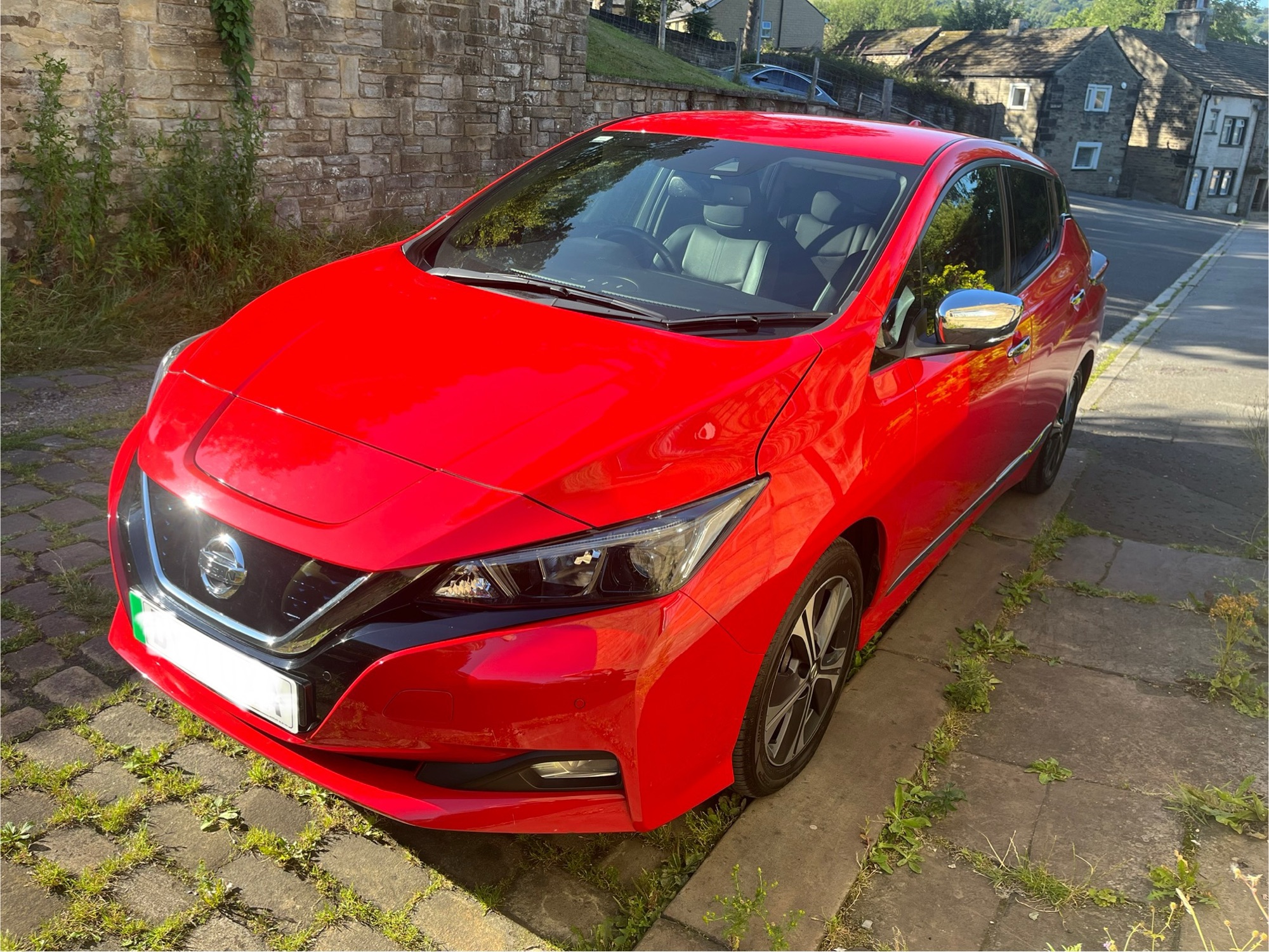
Our journey towards an electric car – part III

Time for part three of my series of posts about our journey towards buying an electric car. Part one, in May, introduced the series, and part two earlier this month answered the questions ‘why’ and ‘why now’.

Today, I’m going to focus more on point one from my ‘why’ post – being able to charge a car at home.

Granny chargers

When you buy an electric car, it’ll probably come with what is colloquially known as a ‘granny charger‘. This allows you to charge your car from a standard 3-pin socket, and gets its name for when you’re visiting your grandma’s house – the implication being that she doesn’t have a proper electric car charge at her house.

Granny chargers are okay to use occasionally when there’s no better option, but there are good reasons not to use them regularly:

  • The maximum power output is about 2.3 kW, which means your car will charge very slowly.
  • They must be plugged directly into a wall socket without using an extension lead, which may be awkward if you don’t have a plug within reach of your car. You may also need to have a window open to get the cable outside.
  • I’ve seen photos of plug sockets that have melted due to continual use with a granny charger.

Waterproof outdoor 3 pin sockets

You can alleviate some of these issues by having a waterproof outdoor 3 pin plug socket installed, which you can also then use for powering lawnmowers, for example. If installed correctly, and in the right place, there shouldn’t be any risks of melting/fire or the cables not being long enough. Indeed, my neighbour has chosen to go down this route for their hybrid car. Make sure that you get the socket professionally installed, of course.

However, this solution doesn’t alleviate the first issue, which is the slow charging. If you’re going to regularly charge an electric car at home, then you should invest in a dedicated electric car charging socket.

Electric car chargers

If you want to be able to charge your car more quickly and safely, then you’ll need to get an electric car charger socket installed. This is a box fitted to the outside of your home, that has a cable that you can plug into your car to charge it. Where it differs to a 3 pin socket is that it will have its own fuse in your consumer unit (fusebox) and will be rated for much higher energy use – up to around 7 kW. That means your car will charge more than three times faster with a dedicated home charger, than using a 3 pin socket. It’ll still be slower than some of the fast public chargers, but it will be cheaper.

Getting an electric car charger fitted can be quite expensive. When I’ve looked, the cheapest prices have been around £800, with £1000 to £1300 being the typical cost. This includes the cost of the charger unit and installation.

What to look for in an electric car charger

There are a number of different chargers available, from companies like Rolec, Ohme, Myenergi and Hypervolt that you may not have previously heard of. I’m not going to recommend one particular manufacturer, but here are a few points that I considered when choosing one:

Tethered or untethered

Some chargers are ‘tethered’ – in other words, they come with a permanently connected charger cable that you can coil up out of the way when not in use. The advantage of this is that the cable is included in the cost of the charger, and you don’t need to store it somewhere.

Untethered chargers have a socket for you to plug in your own cable, which typically isn’t provided and needs to be purchased at an extra cost. However, this does mean that you can put the cable away securely when not in use – I’ve heard of a couple of instances where tethered cables have been cut and stolen. If your charger will be in a more exposed place, maybe consider an untethered charger.

Wi-Fi or mobile data

Just about all electric car chargers include an app to manage charging. This allows you to monitor the charging process, and authenticate cars that are plugged in. After all, you probably don’t want any random car charging using your electricity that you pay for.

This means that the charger needs to connect to the internet. If your charger will be located some way away from your house, then you may wish to consider one that includes a mobile data SIM to connect to a cloud service. Otherwise, you can have one that connects to your home Wi-Fi network – but make sure that it’ll have a good signal before it’s installed. Some also come with Ethernet, if you have this available and want a physical network connection.

Some chargers also work via Bluetooth, which is fine over a short range, but not the most convenient.

OCPP compliance

I would recommend buying a charger that supports the Open Charge Point Protocol (OCPP). This is a common protocol for communicating between your charger and the cloud API. It’s an open standard, and means that you can potentially connect to different back-end servers if the one provided by your charger’s manufacturer is no longer available. Considering that chargers typically cost a low four figure sum and need to be professionally installed, you don’t want to be in a position where you have to replace a perfectly good charger simply because its manufacturer has gone bust.

You can, if you wish, host your own OCPP server – Home Assistant users can install one from HACS. That way, you’re not at all reliant on a cloud service for managing your charger.

Variable rate charging

I know I bang on about having solar panels, but it’s a key reason why we’re considering an electric car, as it’ll essentially allow us to charge for free at home. However, the maximum output of our solar panels is 4.8 kW, which is less than the maximum output of a typical charger. So ideally, you want one where you can set it to charge more slowly, so that you only use your own solar energy and not additional electricity from the grid that you have to pay for.

Some chargers will also use a CT clamp to measure home energy use and vary the rate of charging to match. If there are lots of high load devices running, such as ovens or electric showers, then the car charger can automatically lower the power draw and charge more slowly.

Chargers for on-street parking

If your house has a drive, where you can park your car away from a public road, then you shouldn’t have any issues getting a charger installed at home. If you don’t, and you park your car on a public road, then you’ll need to check with your local authority regarding their rules. Some may insist on a groove being cut in the pavement to fit the cable in, so that it isn’t a trip hazard. Others will flat out refuse, and insist that you use public charging points.

Companies like Edion will sell you a cable protector for around £50 which should ensure that your cable isn’t a trip hazard, and there are also plenty available from Amazon (sponsored link) too. As someone who is quite passionate about accessibility, I would urge you to consider one of these if you have to lay a cable across a public right of way.

Our journey towards an electric car – part II

Time for a second post in this series about our journey towards an electric car – part one was last week. This time I’m going to focus on the ‘why’ and the ‘why now’.

Why an electric car?

In less than five years, unless something changes, it won’t be possible to buy a new car solely powered by an internal combustion engine in the UK. From 2030, sales of new petrol and diesel cars will be phased out; there will then be a five year period where new cars must be fully electric, or hybrids. Then, from 2035, sales of hybrid cars will end too – so in ten years time, if you want to buy a new car, it will need to be electric. Or some other form of zero emissions vehicle that isn’t yet on the market.

Last year, around 20% of new UK car registrations were for electric cars. And, more and more public chargers are becoming available for electric car owners to use.

That’s the wider context. For us personally, an electric car makes sense for the following reasons:

  1. We’ll be able to charge it at home. Being able to charge an electric car from your own electricity supply is pretty cheap – especially if you have a tariff that gives you cheaper overnight charging for example. Currently, I work at home 2-3 days per week, and so we can have our car plugged in for long periods to charge up if needed. And we generate our own electricity from our solar panels.
  2. Most of our usage is short distance. Whilst we occasionally drive longer distances, most of our usage is for short journeys, and so we don’t necessarily need a car with a massive fuel tank or battery.
  3. It’ll be better for the environment. Electric cars aren’t totally emissions free – you still get particulate matter from the brakes and tyres emitted into the air. But you’re not burning a fossil fuel, and the UK electricity grid is become more sustainable all the time.
  4. It’ll be better for air quality. Where we live, in Sowerby Bridge, is a hotspot for poor air quality due to being in a narrow valley. By driving an electric car, we’d be no longer contributing to this.
  5. It’ll be quieter. Traffic noise isn’t a major issue for us, but just imagine how much quieter the roads would be without noisy engines. Also, as I have issues with hearing loss, less noise inside the car should make it a nicer driving experience.
  6. It’ll cost less to service. Compared to cars with an international combustion engine (whether on its own or as a hybrid vehicle), electric cars have fewer moving parts and consequently require fewer repairs.
  7. We won’t have to pay the ULEZ. I’m not planning to drive in or near London any time soon, but our current car would incur a charge under the Ultra Low Emissions Zone. Whilst many petrol cars are exempt, an electric car is likely to remain so if the criteria change. It used to be that electric cars were also exempt from vehicle tax, but that’s no longer the case.
  8. No gear changes. Compared to other nations, especially the US, us Brits have a weird obsession with buying new cars with a manual transmission, rather than automatic, and that trickles down to the used car market. Meanwhile, almost all electric cars only have one gear – electric motors work differently and so don’t need to have gears. Therefore, no gear changes. I think Christine was a bit cheesed off when she found out that she could’ve learnt to drive in an automatic instead, but at least it means she can drive our current car until we change it.

Why now?

As for why now, the key reason is that we need a new car soon. Our current car has lots of minor niggles that are starting to get annoying, and are likely to be costly to repair.

But also, more electric cars are starting become available on the used car market. We can’t really afford to buy a new car, but there’s a reasonable number of electric cars available in our price range. Whilst the capacity of the batteries does go down over time, we’re still happy to consider a used electric car.

Our journey towards an electric car – part I

Christine and I have decided that we’re going to get a new (or rather new to us) care in the next few months, and we’ve decided that it’ll most likely be an electric car.

Last March, I talked about how our current car was starting to get expensive. It had been in the garage four times in as many months, and April made it the fifth consecutive month to clear the particulate filter. Since then, it’s been behaving itself a little better – so far, it’s only been in the garage twice this year. But there are still some issues. There’s various squeaks and knocks that, whilst not seemingly affecting our ability to drive it, are starting to get annoying. The air conditioning system doesn’t work any more – on a hot day, it just emits hot air. And, throughout the whole six years we’ve owned it, the tyre pressure monitor hasn’t worked properly.

More recently, we’ve noticed a patch of rust on one of the doors. Getting that fixed is likely to be expensive, and it’s getting to the point where I don’t want to throw more money at the car. I’d rather save it, and use that money towards buying a newer car.

Going electric

I’ve deliberately made this ‘part one’ of a series, as I have a few blog posts in mind between now and after we finally get a new car. When I say ‘new’, I mean ‘new to us’ – I doubt we’ll be buying a brand new car. We also haven’t decided on a particular make and model, but what we have agreed is essentially the following:

  • It’ll be roughly the same size, or smaller than our current car.
  • It’ll be electric, or a plug-in hybrid.

We want a smaller car, because our current car (a first-generation Peugeot 3008) can be a pain to park sometimes. And 95% of the time, we don’t need such a big car – we’re just burning extra diesel to carry excess air around. For the times when we do need more space, we’ll look at buying a roof box instead.

We’ve also decided that it’s about time we made the jump to an electric vehicle. We have the ability to charge one at home (more in that in a future blog post in the series) and, as we have solar panels, we’ll be able to do so very cheaply. Plus, more electric vehicles are becoming available on the second-hand market, so we’re more likely to be able to afford to buy one.

Like I said, I’ll be posting more about this in future blog posts over the summer – especially once we’ve bought the car.

Six port car charger review

A photo of a six port car charger in my car

With us having guests in the car for a long journey, I’ve recently bought a new USB car charger to go in the back of our car. Unlike others that I’ve bought in the past, which offer 2 or 3 USB ports, this offers six.

It’s currently on sale on Amazon for £13 (sponsored link), but I picked mine up cheaper elsewhere. There are two USB-C ports with Power Delivery, and then four USB-A ports. Of these four, there are two standard ports which offer 3 amps, and then a green one and an orange one, which support various proprietary quick charge specifications. I’m already using one of the USB-C ports for my CarPlay unit in the front, on a long cable.

Above the ports is a three digit display, which shows the current voltage coming in to the charger. This should nominally be 12 volts, but as you can see in my photo it’s higher at 14.4 volts. Should it go higher than 14.8, or below 11.6, that would be a cause for concern. The whole thing also glows blue when the engine is on and it has power.

Apparently you can’t use all six ports at once – the maximum is five. However, it’s apparently capable of quite high wattages. Whilst I’ve always known it as a ‘cigarette lighter socket’, the official name is the Automobile auxiliary power outlet, and the maximum current can be as high as 10 Amps. As such, 120 Watts is possible, assuming a 12 volt supply (see, I remember what I learned in GCSE Science). In practice, the maximum power from any one port will be around 60 Watts, but that’s still enough to charge a laptop.

For what it’s worth, I haven’t found any chargers offering more than six ports, so this seems to be the maximum. In the front of our car, we have a much smaller two port USB car charger, with one USB-A and one USB-C port. The location of the auxiliary power outlet, which is right next to the gear stick on the driver’s side, means that I prefer a smaller, low profile charger that doesn’t get in the way. Still, this means we have 3 USB-C and five USB-A ports available in the car.

Our car dates from 2012 and so it only came with one USB-A port built-in – I haven’t included it as it’s a 0.5A port and therefore a bit useless for charging. Also, if I plug my iPhone into it, the car stereo instantly starts playing the first song in my iTunes library, which is ‘Nothing’ by A. More modern cars presumably have many more USB ports, and I can see the cigarette lighter sockets becoming less common. Not least because it’s illegal to smoke cigarettes in a car with children in it in the UK, and barely anyone smokes nowadays anyway.

Cheques, postal orders and the DVLA

If you want to change your name and photo on your GB driving license at the same time, then, as I write this in November 2024, you have to pay the DVLA by cheque or postal order. You can’t pay online using a credit or debit card.

Indeed, there’s a number of reasons that you may need to pay money to the DVLA, and can currently only do so by posting a cheque or postal order. You may have passed your driving test in another European country, and now want a GB driving license. Or, you may need to get your license back after being disqualified from driving (for the absolute avoidance of doubt, no, I have never been banned from driving and have a full clean license). In all of these situations, it’s not possible to pay online.

As I mentioned in my blog post a couple of months ago, frustratingly there’s still a need for paper bank statements, and, it seems, cheques. Sure, almost every bank, including online-only ones like Starling, Chase and Monzo let you pay in cheques by scanning them into their apps using your phone. But what if you need to write a cheque for someone else? Online-only accounts do not seem to offer any way for their customers to pay by cheque.

It’s not a much better situation even if you do bank with a ‘traditional’ high street bank. I switched to a new bank account earlier this year, and whilst I got a new debit card through the post, I wasn’t issued with a chequebook as standard. And that should be fine – the last time I remember writing a cheque myself was about nine years ago. Most places accept bank transfers by BACS if they don’t accept credit/debit cards or cash. Sure, I can request a chequebook, but then the bank will need to print and dispatch it to me by post.

Postal orders

Thankfully, the DVLA also accept postal orders. In my 22 years of adulthood, I have never needed to request or send a postal order, but they have been around for years. Originally, they were a way for people without bank accounts to send money by post, in a way that means that only the named payee can use it.

To get a postal order, you go along to a local post office, tell them who you are paying and how much the postal order is for, and then pay cash, plus a fee. For £10-£99, there’s a 12.5% fee, and a fixed fee of £12.50 for postal orders of £100-£250. They’ll then print you a postal order which you can pop in your envelope to the DVLA, or whoever else you need to pay.

It’s certainly a solution if you don’t have a chequebook, but, as mentioned, you have to pay an extra fee on top which you wouldn’t pay using a cheque. Plus there’s the cost of getting to a Post Office if one isn’t local to you.

Ideally, the DVLA will drag itself fully into the 21st century, and enable more tasks to be completed online with card payments. But until then, some of us are stuck using cheques and postal orders.

How many parking apps do you have?

A screenshot showing the icons for six different iOS apps used for parking.

I was chatting to a friend last week as he downloaded and installed yet another app to pay for parking his car. He already had eight different apps to pay for parking on his phone, and yet the one used by this car park wasn’t one of them. So now, he had nine different apps installed to pay for parking.

I had a look at my own phone and counted six parking apps: Connect Cashless Parking, PayByPhone, Trust, RingGo, YourParkingSpace and NCP. And, from memory, I’ve used five out of the six over the past month; NCP is the only one that I don’t use regularly.

Then there are those that I’ve uninstalled – Flowbird, AppyParking and APCOA Connect. APCOA Connect seems to use the same database as Connect Cashless Parking thankfully, and I’ve only had to use the Flowbird app once for one specific car park. AppyParking was used by our local authority for a while but has been replaced with APCOA Connect/Connect Cashless Parking, and I haven’t needed to re-install it.

The convenience of parking apps

A screenshot from the PayByPhone app offering additional insurance for £4.84 as an upsell.

Parking apps are a convenience. I tend to carry very little cash around, and frequently have no change for a ticket machine, so the apps allow me to make a card payment. They also remember your details, such as your car’s registration number, and so they can be quicker than using a machine.

Some apps, like Trust and MyParkingSpace, offer automatic payments in supported car parks. Automatic Numberplate Recognition (ANPR) cameras record entries and exits, and I get emailed a receipt based on the time spent there. It’s not widespread but it’s useful where it’s available.

Parking apps headaches

But the fact that there are so many of them, with different interfaces, is a faff. You have to register an account with each one, and not all of them support Apple Pay or Google Pay so you need to enter your card details each time. And there’s usually a ‘convenience fee’ thrown in; sometimes, as little as 8p but one car park I use regularly adds a 15% fee on top of the parking price for using the app.

There’s also the upsells – what Cory Doctorow may call ‘Enshittification‘. Every time I use the PayByPhone app, which is typically 2-3 times a week on the way to work, I have to decline additional insurance to cover my car whilst it’s parked. What’s worse is that the parking itself only costs £2 – the insurance is a 250% mark-up. I guess some people could find it useful as there’s no excess and it could avoid claiming on your own car insurance, but there’s no way to disable these prompts in the app. You have to opt out every time you park, and of course, the ‘not now’ button is smaller and less prominent. Meanwhile YourParkingSpace flogs a load of offers at you after you’ve parked.

And there’s the issue of how big these apps are. The Flowbird app is almost 200 MB, which could be 20% of someone’s monthly data allowance if they had to download it on mobile data.

Consolidation

I mentioned that Connect Cashless Parking and APCOA Connect use the same database and are therefore interchangeable, but every other app only works with certain car parks. Annoyingly, this is even the case where there’s a common parent company. Connect Cashless Parking, for example, is owned by PayByPhone, but you can’t use the PayByPhone app to pay for parking at APCOA Connect locations. Similarly, MyParkingSpace was taken over by Flowbird two years ago, but there’s been no integration of the databases and so you may need both apps.

This is why this blog post isn’t ‘which is the best parking app?’ because, as consumers, we don’t get to choose. The choice is made for us, by whoever owns or operates individual car parks. Right now, those owners and operators have plenty of parking apps to choose from, but whatever choice they make is then imposed on their users.

One parking app to rule them all?

Whilst I’m sure it would be very low down on the new government’s priorities, it would be great if there was just one, national app that we could all use. To encourage adoption, there could be new legislation mandating local authorities to use it once their existing contracts have finished. It could also offer onward travel options, such as bike hire, or even public transport to encourage park and ride schemes. And there could be an open API to allow some of the third party apps to continue to use it, with some kind of payment reconciliation for private car park owners.

That way, you could view all of your parking receipts in one place – great for people who may need to claim expenses – and not have to faff around with downloading a new app each time you park up. Hopefully, such an app would also be designed with best practice in mind, and not offer annoying upsells each time. I know this is very much a first-world problem, but we can dream, can’t we?

European motorway toll tag

An AI-generated image of a car passing through a motorway toll plaza

Today’s the first of a couple of blog posts about things that I’ve done to make our holidays a little easier. This blog post is about Emovis Tag, who sell a small electronic tag to pay for motorway toll plazas in France, Spain and Portugal.

Normally, we go to France on our summer holiday, and take our car with us. Unlike British motorways (with one exception), French motorways are usually privately owned and financed, and so most charge a toll for use. Since 2018, we’ve used a tag from Emovis Tag, which lets you drive through motorway toll plazas without having to stop and pay. Instead, your motorway toll charges are accumulated, and then taken from your UK bank account by direct debit each month.

A photo of a Liber-T tag in the windscreen of my car

For France, you get a standard ‘Liber-T’ tag, and there’s a separate tag that works for motorways in Spain and Portugal. That means that if you’re driving through France and either Spain, Portugal or both, you’ll need two tags. Emovis Tag will send you your tag(s) by post, and you fit them to the dotted area of your windscreen.

Then, once you’re in France, and come across a motorway toll plaza, you ensure that you’re in a lane with the ‘Liber-T’ icon (a lower-case ‘t’) and drive through at a walking pace. The tag should beep loudly at you, and the barrier in front should open to let you through. There’s usually no need to come to a complete stop.

Some motorway toll plazas have longer lanes where you can approach at 30 km/h (about 20mph) and so you don’t have to slow down as much.

Advantages

The key advantage of having one of these tags is that you don’t need to come to a complete stop, either to collect a ticket or pay a motorway toll charge. Whilst this may only save a few seconds, it adds up if you have a long journey.

It also overcomes an issue with British right-hand drive cars; most machines and booths at the motorway toll plazas are designed for left-hand drive vehicles. If you don’t have a front-seat passenger in the car, or they’re like my wife and have a tendency to sleep in cars, then you don’t need to reach over to pay. There’s also no risk of losing the paper ticket given to you when you join the motorway, so you won’t be overcharged if you do lose it. And you don’t have to worry about not having the correct change or having a foreign currency card declined.

Disadvantages

However, a key point to note is that this isn’t in any way cheaper. You have to pay for the tag, and there are annual and monthly account fees to pay (although the monthly fees are capped). There is a deposit for the tag which you can get back if you return it, which is worth considering if you don’t go abroad at least once a year. We’re staying in Britain for our holiday this year, and probably next year too, so I’m debating whether it’s worth returning the tag.

Therefore, you are paying more for an easier experience whilst on holiday. I think it’s worth it, but it’s up to you.

Something else to bear in mind is that, whilst the majority of French motorways have tolls, not all of them do. If you’re visiting Brittany and Normandy, then the main A84 autoroute is free throughout. On our 2022 France holiday, we didn’t encounter any toll-charging roads.

If you do decide to go ahead, you can sign up using this link to get a €5 credit on your account.

Is it worth using premium car fuel?

An AI-generated image of a superhero using a petrol pump with premium fuel.

Regular readers will know that I’ve been having some car issues of late, which has seen it spending a lot of time in the garage being fixed. So far, it’s been running okay for the past couple of weeks, and so I’m very hopeful that there’ll be no more expensive repairs due for a while at least.

At its most recent garage visit, to have the particulate filter cleaned, the mechanic asked whether I was using supermarket fuel. Because, in his view, this was why I was having problems with the filter. Premium fuels – the ones that you pay extra for – have additives which claim to help clean out your car’s fuel line. As well as preventing the filters getting full, they should – in theory – boost efficiency and result in you getting more miles per gallon of fuel. Once the car was fixed, I was therefore advised to stick to premium diesel for a few months.

This was a topic that the excellent BBC Sliced Bread podcast covered back in January last year. There’s also some information from Auto Express and Which? (for which you may need a Which? subscription to read). The consensus seems to be that premium fuels can help keep a car running better, but they only need to be used occasionally. Supermarket fuel – or at least, supermarket petrol – should be fine to use most of the time. And it is generally cheaper than even the basic fuel from branded petrol stations.

As instructed by the mechanic, I filled up with Shell’s ‘V-Power’ premium diesel earlier in the week. You pay quite a bit more – it was £1.76 per litre, as opposed to £1.58 per litre for their standard diesel. For context, £1.53 per litre is the current cheapest price locally for diesel, according to PetrolPrices.com. My tank was low – the fuel warning light had come on – so I paid almost £100 for a full tank. This was £12.65 more than if I’d filled up with regular diesel at the cheapest nearby petrol station.

We’ll see if it makes a difference. Although my car does track its fuel usage in miles per gallon, it doesn’t use a moving weighted average and so it’s prone to fluctuations, making it a bit useless. My car is over 11 years old, and so anything to clean out the fuel lines and injectors is welcome.

I’ve also used some engine cleaner from Halfords; you put this in once your tank is below a quarter full (i.e. three quarters empty) and then take it for a decent drive until the fuel warning light comes on. It recommends that you use it around four times a year, and this may be a better option. Theoretically, it does the same job as the premium fuel, but costs £10-20 each time. Overall, that works out cheaper than paying more for premium fuel.

So, in honour of Betteridge’s law of headlines, the answer to the question ‘is it worth using premium car fuels?’ is probably no. You can use supermarket fuels, but maybe pop some engine cleaner in now and again – especially if you have an older car. Or go electric – I’m sure our next car will either be a plug-in hybrid or a fully battery electric vehicle.

More car-related shenanigans

An AI-generated image using DALL-E 3 of a small car in a dog kennel in the rain

Last month, I wrote about how our car had been for repairs multiple times in recent weeks. Since then, it’s been back in the garage again.

This time, the engine would only run in safe mode and so it had limited power. We live in the Pennine Hills in England – the emphasis there being on hills – and so had a not particularly enjoyable week flooring the accelerator whilst trying to get up a steep slope at 20mph. I have small Bluetooth OBD-II adaptor (sponsored link) that allows me to read the car’s error codes on my phone using a free app, and this suggested a fault with one of the cylinders in the engine.

My usual local garage couldn’t fit us in, so I tried a different garage. Their ODB diagnostic system was a bit more thorough and identified that, in fact, the engine’s particulate filter was full. They cleaned this out, and also replaced the sensor (since it still reckoned it was full even when it wasn’t) and, for the most part, the car drives okay again now. But this has set us back another £150.

Our car is approaching 120,000 miles on the clock and so it’s not worth much. Whilst it probably cost tens of thousands of pounds new in 2012, the couple of quotes I have had are around the £1500 mark. Which is certainly less than we have spent on keeping it on the road just in the last few months.

Whilst we have been lucky that it wasn’t a more expensive repair, we certainly need to look more keenly at replacing the car in the next year or so. I hope there are no more expensive repair jobs required, but if there are, the car is at risk of becoming beyond economic repair.

The expense of keeping a car on the road

An AI generated image of a car being worked on by models of ancient Greek workers outside a Greek temple.

I write this at the weekend, after picking my car up from our local garage for the fourth time in as many months for repairs.

We’ve had our current car for almost five years, and it was seven years old when we got it. In that time, we’ve probably spent more money on repairs and servicing than we did buying it.

Its most recent visit was to replace two of the coil springs from the suspension, which failed in quick succession. The first went on the way back from Sci-Fi Weekender in Great Yarmouth on Sunday, and the second after going over a road hump on Wednesday. This resulted in a low grinding noise which prompted a call to our local garage.

Before that, we had both rear suspension arms and brake pads replaced, a new parking sensor, and a new wing mirror. My car has motorised wing mirrors which automatically tuck themselves in when the car is locked, but the motor seized up on one, and they’re sealed units, the whole wing mirror needed replacing.

I’m fortunate that there’s a good, independent garage within walking distance of home, that has been able to do all of these repairs. That means I can drop the car off in the morning, and then work from home. Having to fork out hundreds of pounds for car repairs, is even less fun when you also have to use a day of annual leave from work for it.

Earlier repairs have included replacement body work, a new timing belt, new front suspension, and the usual replacement tyres. I wouldn’t go so far as saying my car resembles the Ship of Theseus, but it’s certainly had a lot of work done on it over the years, and many parts are no longer original.

Whilst I would be tempted to cut our losses and get a new car, to get something similar in age and size to ours at time of purchase would set us back at least £7000. We just don’t have that kind of money right now, nor would we want to take on more debt to buy one. And I would rather keep this going until we can replace it with a used hybrid or battery electric model. Or somehow come into enough money to buy a new car outright.