A Minecraft Movie review

An image of the poster for A Minecraft Movie, showing the five main characters.

You’re probably aware that A Minecraft Movie is out, considering the absolute juggernaut of publicity behind it. And seeing as our nine-year-old is obsessed with Minecraft, we inevitably went to see it yesterday.

My verdict: it’s basically fine. Three stars out of five.

Our nine-year-old loved it. They have played some Minecraft at home, and watched many hours of other people playing Minecraft on YouTube. I guess you would get more out of this film if you are familiar with the game, judging by the cheers from fellow members of the audience every time some kind of iconic item from the game was featured in the film. We went to see it at our local Vue in Halifax, and the screen was pretty much full. I guess that’s something to do with it only having opened on Friday in the UK.

There’s a series of scenes before the opening credits where we’re introduced to Jack Black‘s character, Steve, and the ‘Overworld’ which is the blocky Minecraft world. Then we return to the real world to be introduced to Jason Momoa‘s character during the opening credits. Indeed, the first part of the film spends quite a bit of time in the ‘real world’ before we’re back into the blockiness. It’s probably a good thing that the Overworld is featured so early, as it doesn’t come up again for a little while.

The plot is, well, a bit meh. Jack Black is peak Jack Black in this, and Jason Mamoa (also a producer of the film) does well, but the rest of the characters could do with more depth. It’s perhaps ironic that a film about a world-building game, doesn’t itself have enough world-building, in my opinion.

Ultimately though, this film will do well because it’s about Minecraft, and there’s just enough fan service to get players of the game on board. If you’re not familiar with the game, and don’t have kids, then maybe wait for it to come out on streaming.

A highly subjective ranking of UK cinema chains

I’m writing this a couple of weeks in the past, the morning after watching Mickey 17 at the cinema (it’s a good film, you should watch it if you haven’t already). With us having lost a weekend to Sci-Fi Weekender, I wrote a whole batch of blog posts ahead of time, including this one.

I wouldn’t say that we’re regular cinema-goers – generally, we go to watch family films that are suitable for our nine-year-old. Mickey 17 is clearly not a kid-friendly film and deserves its 15 rating – we only managed to go because we were able to arrange childcare in the evening. Whilst Sowerby Bridge itself no longer has its own cinemas, there are a number of different cinemas within easy reach of home. This includes some independent cinemas – the Hebden Bridge Picture House, the Rex Cinema in Elland, and the National Science and Media Museum in Bradford. But they’re mostly single-screen cinemas with a limited number of films on offer.

So, generally, we go to one of the chains. We’ve been to most of the chain cinemas in recent years, so, this is my high subjective ranking of the different chains:

1. Everyman

Everyman cinemas are top-tier. Instead of individual seats, you get sofas, with cushions and plenty of legroom. Every cinema has a bar, serving cocktails as well as beer and wine, and the food menu goes well beyond the basics into burgers, pizzas and sharing plates.

If there was an Everyman closer to us, we would go there almost exclusively. Alas, the nearest is in Leeds city centre, at the top of the Trinity Leeds shopping centre, and so we’ve only been once in recent months.

2. The Light

Whilst not quite as upmarket as Everyman, The Light offers an above-average experience. You don’t get sofas in the screens, but you do get big, comfy seats that can recline as standard, and the legroom is generous. Similarly, the food menu isn’t as extensive as Everyman, but you can buy freshly made pizzas and alcoholic drinks to take in. The Light specialise in smaller screens, so it’s a more intimate experience than other cinemas – we went to the Bradford cinema where six screens are squeezed into a relatively small space.

The Light in Bradford was where we saw Mickey 17, and it’s worth noting that if you park next door in the Broadway shopping centre, you can get 5 hours free parking. Also local for us will be their new cinema opening later this year in Huddersfield town centre, which will also include a bowling alley and other entertainment besides showing films.

3. Showcase De Lux

Showcase is also one of the smaller cinema chains in the UK. In my experience, it’s the nicest of the large multiplex chains. Again, the seating is a step down from The Light and Everyman, but fine. The food is also standard for cinemas, with the usual popcorn, nachos and hotdogs. Our nearest is at Birstall on the edge of Leeds, where we can park for free and it’s just off the M62.

4. Vue

Our nearest multiplex is the Vue in Halifax. Of the three big chains, I tend to find Vue to be the best, but not by much. You can pay a little extra for premium seating, but otherwise it’s standard seats with standard legroom. Other things that I like about Vue are:

  • they still have some cinemas in town centres, which was great before we could drive.
  • some of their cinemas only charge £5 for any film, generally making them one of the cheapest cinemas

5. Odeon

I would broadly consider Odeon to be equivalent to Vue but ranked them lower as, during the late 1990s and early 2000s, they had a policy of moving their cinemas out of town centres. Our closest Odeon cinemas are on the outskirts of Huddersfield, and halfway between Leeds and Bradford. Their locations mean that they’re well away from a range places to eat, so it’s hard to have a meal and then a film. In Huddersfield, for example, there’s just a Pizza Hut and a pub nearby. We would have considered seeing Mickey 17 here as it was closer and showing at a similar time, but the lack of food options meant we chose The Light in Bradford instead.

The exception is the Odeon at the Trafford Centre, which we used to use because the Trafford Centre had a crèche (sadly closed during the pandemic and never re-opened), but it’s a bit far.

6. Cineworld

Finally, Cineworld. The company has been in a bit of pickle recently and it shows. Until The Light came along, Cineworld was the only multiplex in Bradford city centre, and so I used to go there quite a bit when I lived there. We recently went to Cineworld in Bradford again to see Wicked, and it’s clear that it needs some work doing on it. I’m not saying I would never go to Cineworld again, but unless it was the only cinema showing a film we wanted to watch at a reasonable time, I would give it a pass.

One last thing to mention: CinemaGuide is a useful site that lets you select your local cinemas (including all of the above chains and some independents) and then view a list of everything that’s on across all of them, sorted by film title. It’s handy when you want to see a particular film, and can travel to multiple different cinemas if needed.

Beetlejuice 1 and 2

The two posters for each of the Beetlejuice films.

Yesterday, Christine and I watched both Beetlejuice films – the 1988 original, and the 2024 sequel. The 1988 film is available on Netflix at present, and we watched the sequel at our local cinema.

Christine had seen the first Beetlejuice film before, but I hadn’t. It’s been one of those things where Christine has been trying to get me to watch it, but we’ve never found the time. Indeed, I had purchased a download of it to watch on a long train journey back in 2021, and I think it’s still downloaded to my iPad, but it remained unwatched.

In fact, my main memories are of the animated TV series; the late 1980s and early 1990s saw many blockbuster films (Ghostbusters, The Mask, Teenage Mutant Ninja Turtles) getting tie-in animated shows for younger viewers. But, like I said, I hadn’t seen the film until yesterday.

Beetlejuice (1988)

The film is very much of its time, and you can tell it was made on a smaller budget – around $15million, which would be in the ballpark of $40million today. The special effects are mostly done the old-fashioned way, with models and animatronics. I also thought it ended quite abruptly – without wanting to give away spoilers, I was expecting at least a couple more scenes. Also, the pacing is slower, but that’s probably true of most older films.

Overall, not bad – I would probably rate it three out of five.

Beetlejuice Beetlejuice (2024)

So, the sequel. It’s set quite a way in the future, but Michael Keaton, Winona Ryder and Catherine O’Hara reprise their roles from the first film. Absent is Jeffrey Jones; his character features in the film, but the actor doesn’t – he’s still alive but, well, you can look up what he did and why he’s not getting any more acting work. Jenna Ortega joins the cast in a new role for this film – you may recognise her from playing Wednesday Addams in the recent Netflix series.

This second film is a bigger budget affair – around $100million, which it’s already gained back and then some since its release last month. Whilst there’s still some animatronics, the bigger budget means better special effects. There’s a lot more going on, with several sub-plots coalescing at the end. Watch out for cameos by Danny DeVito and Burn Gorman (aka Owen from the first two series of Torchwood).

I much preferred the second film. Both are weird, but I found the second film more funny-weird rather than simply weird.

You can watch the second film on its own, without having seen the first one – a friend did this and enjoyed it. But there’s lots of subtle references in the second film that’ll make more sense if you’ve seen the first one.

A third film?

There were 36 years between the original Beetlejuice film and the sequel. If it takes another 36 years to release a third film, then Tim Burton and Catherine O’Hara will both be over 100 if they’re still alive. Still, you have to say Beetlejuice’s name three times to summon him, so making it a trilogy would make sense. Seeing as how the second film has done so well at the box office, I’m sure plans for a third film are being drawn up.

IF – a film about imaginary friends

At the weekend, we went to see IF at the cinema. You’ve probably seen the trailer, as it’s the latest film to star Ryan Reynolds.

It’s about a 12 year old girl, who is going through some hard times, and realises she can see the imaginary friends of others. Unfortunately, these ‘ifs’ can no longer be seen by their kids, and are looking for new kids to befriend. The BBFC rate it as a U, so it’s suitable for kids, but they do warn of ‘bereavement themes’.

I enjoyed it, and there definitely seems to be a split between the audience and critic scores. On RottenTomatoes, the critics score it 49% but audiences 88%. If you do go and see it, bring tissues; our eight-year-old has seen it twice now and teared-up both times. And maybe don’t think too hard about the plot; The Guardian’s review highlights a number of plot holes.

Delicious in Dungeon

A photo of the first book in the Delicious in Dungeon manga series.

My wife Christine recently introduced me to a new animé series on Netflix called Delicious in Dungeon. It’s based on a manga, of which we also recently picked up the first book.

If you like Dungeons & Dragons, and food, then you’ll probably like Delicious in Dungeon. It follows a small guild of explorers, who are trying to save their friend despite losing all their supplies. Hungry, they resort to eating the dungeon monsters they encounter. Early on, they meet a dwarf, who seems highly knowledgable about the best way to cook these monsters and end up eating delicious food of dubious origins.

The animé adaption of the manga is pretty good, with each dish presented like it would be on a cooking programme. In the manga books, the dishes even come with ingredients and nutritional information.

It took me a little while to get into the first episode, but I found it enjoyable and funny despite not being a big animé fan. The only animé I have watched more than a few episodes of is Pokémon, and that’s probably because I play Pokémon Go every day, and so am familiar with the species.

It’s a Netflix exclusive, and new episodes are being released weekly. There are currently 13 volumes of the manga, with a 14th due out this summer. We picked up our English translation from Travelling Man in Manchester.

Butterfly Tale

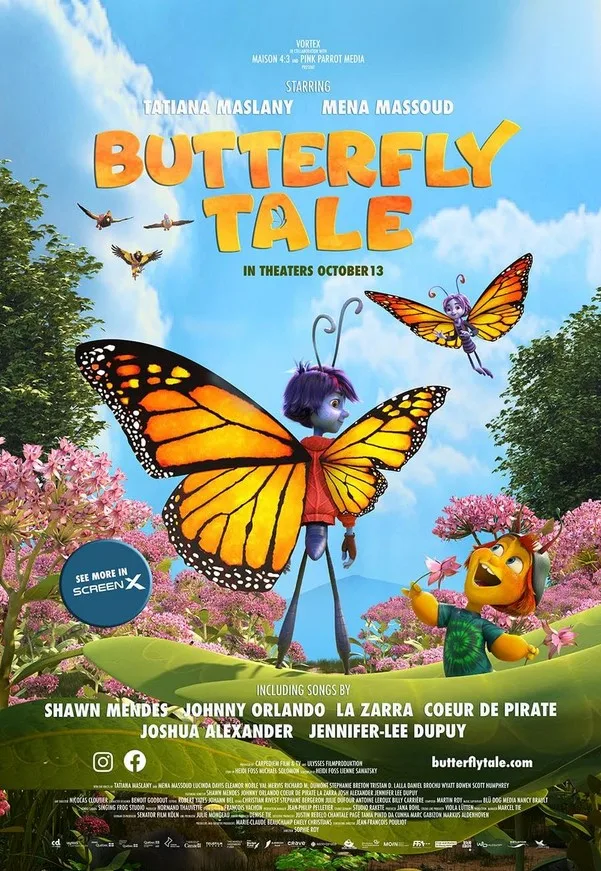
Film poster for Butterfly Tale

At the weekend, I took our 8-year-old to see Butterfly Tale at the cinema. It was only released in the UK on Friday, but has been on general release elsewhere as early as October. It’s a joint Germany and Canada production – indeed, the first minute of the film is just the various logos of producers, distributors and funders. I hadn’t heard of it before, and according to iMDB, it’s grossed less than a $1million so far.

The film is based on the migration of Monarch butterflies. The main characters are Patrick, a butterfly with mis-sized wings who can’t fly, and his friend Marty, who is still a caterpillar. Because they can’t fly, they have to come up with a plan to join the rest of the butterflies on their migration.

It is very much a film for kids. Indeed, our eight-year-old really enjoyed it. It’s not a ground-breaking piece of cinema, and I wouldn’t necessarily recommend seeing it at the cinema unless you have young kids. The animation and story are nothing special. It’s likely to be the sort of random film that you can let you kids watch on streaming if it’s a wet afternoon and you need some peace. Indeed, seeing as the UK is one of the last countries to see a cinema release, I imagine it’s already on streaming services elsewhere.

Most cinema chains seem to have at least a few showings of it right now. When we saw it, there were only around 10 people at the showing – despite it being at the biggest screen. I suspect it’ll have a rather limited run in cinemas.

Wonka and Wish

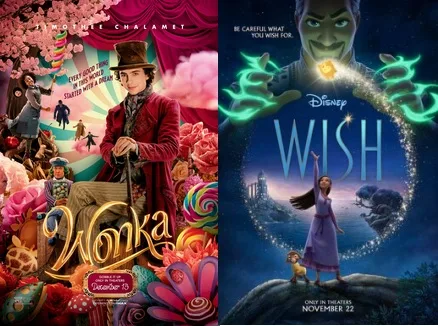
Posters for the films 'Wonka' and 'Wish'

Over the Christmas period, we watched a couple of films at the cinema – Wonka, and Wish.

Wonka

Wonka is set up as a prequel to the 1970s film Willy Wonka and the Chocolate Factory, and so has a broadly similar visual style. It’s not related to the 2005 adaptation with Johnny Depp, presumably because Depp isn’t much in favour nowadays.

As Roald Dahl passed away in 1990, the film has been made with the involvement of his estate, but was written by Simon Farnaby and Paul King. Farnaby has written for and starred in Horrible Histories, Yonderland and Ghosts, and King directed both of the recent critically acclaimed Paddington films. Their talent shows through, as does their respect for Dahl’s work; I imagine if Dahl himself had been involved in writing the screenplay for Wonka, it would be similar to this.

So it’s a good film. My only major criticism would be that it’s a bit twee in places. There’s also been some controversy over the casting of Hugh Grant as an Oompa Loompa, rather than someone like Peter Drinklage who would probably also do well in the role. However, I think Grant is excellent, and like with his role in the recent Dungeons and Dragons film, it’s good to see him playing roles that aren’t variations of a confused English gentlemen.

Wish

Wish is the latest animated Disney film, and the one that marks Disney’s 100th anniversary (which is why their first short film, Steamboat Willie, is now in the public domain). I’d like to say it’s as good as recent Disney animated films like Encanto and Frozen… but it isn’t.

It’s not bad, but we’ve seen better from Disney. To sum it up, it’s as if an AI was asked to generate a Disney film in a certain style. All the ingredients that would make a good film are there, but they just don’t seem to work together. As someone who generates AI artwork for my blog posts, I’m aware of their limitations and their tendency to not understand how things fit together. I’m not saying Disney used an AI here, but it feels like they’re trying too hard to imitate something without understanding what makes them great.

The soundtrack, for example, seems to be trying too hard to imitate films like The Greatest Showman. A case in point is the song “This Is the Thanks I Get?!”, sung by Chris Pine’s character. It’s supposed to be an angry song, but comes across as rather upbeat.

Wish came out in the UK in November so probably won’t be in cinemas much longer. However, given the choice, I would recommend Wonka over Wish.

Happy Valley

Rainbow

Last week we belatedly started watching the BBC One drama series Happy Valley. It stars Sarah Lancashire as Sergeant Catherine Cawood, a policewoman still coming to terms with the suicide of her daughter, when the boy she blames her death on is released from prison. A parallel story thread sees a businessman dabble with the criminal underworld to get enough money to send his daughter to a private school.

All six hour-long episodes of Happy Valley have now aired, but they are available on BBC iPlayer for a couple more days (and you can download the episodes to keep for 30 days). I also expect that it’ll be available on DVD and other digital download services before too long. Happy Valley has been a very well-received series and is tipped for a BAFTA, and there’s talk of a second series.

Happy Valley is shot, and indeed set, in the Calder Valley where Christine and I live. Indeed, the police station where the lead character is based is our local station in Sowerby Bridge, which I pass on the way to work every day. Earlier in the year there were frequently film crews outside, and the signs on the front had been changed from ‘West Yorkshire Police’ to simply ‘Yorkshire Police’, a fictional police force. Unlike its portrayal in the series, the police station is no longer open to the public – an issue that our local MP took up in parliament several years ago. Other scenes are filmed elsewhere in Sowerby Bridge, and also further up the valley in Hebden Bridge, Heptonstall, Todmorden and in the shadow of Stoodley Pike.

Despite the title of ‘Happy Valley’, the series is quite gritty and, though it’s fictional, focuses on some of the area’s social problems. As an example, whilst Hebden Bridge has a reputation for being a tourist-friendly hippie lesbian preservation area, it also has high rates of drug abuse and suicide. The steep sides of the valley, and gentrification, are frequently blamed for the area’s ills.

We’ve only watched episode one so far, so no spoilers please.

Sunday afternoon at the movies

On Sunday we had an afternoon at the cinema. We caught Frozen before it closes, and the previews of The Lego Movie.

Frozen

Frozen has been out for a while now in the UK, but Sunday was our first chance to watch it. We didn’t go to an earlier ‘sing-along’ screening but went to one mid-afternoon. Though it was in one of the smaller screens at our local multiplex, about half the seats were taken, and mostly by families with young girls. Because it’s a Disney princess film, of course.

I’ve been aware of its most popular song, Let It Go, for some time – as well as its covers and its parodies. It’s a great song but really you need to watch the film as well to make full sense of the lyrics. In particular, Let It Go isn’t sung by the main protagonist, as you might have expected.

Thankfully, the film really is worth watching – we both really enjoyed it. Yes, okay, it’s a kids film, but the characters are really relatable. Plus, there’s a surprising amount of innuendo to keep adults entertained; I had to tell Christine off for laughing out loud when Anna asks Kristoff to, ahem, ‘take her up the north mountain’. Fnar fnar.

Oh, and apparently it’s worth staying to the end of the credits. We found this out after leaving the cinema. Doh.

The Lego Movie

Conversely, we watched The Lego Movie before its official release in the UK, which is on Friday. I can foresee some ‘interesting’ Valentines Day visits to the cinema.

I think when The Lego Movie was first announced, a lot of people were expecting it to be rubbish. To be fair, there haven’t been many good film adaptations of toys or computer games. Thankfully, The Lego Movie breaks the mould and is actually good – funny, touching, and with an actual plot! For people like me who grew up with Lego in the 1980s, there’s a lot to like, and although it is computer animated it feels like it could have been made using actual Lego and stop-motion animation. Things like the references to Octan, the fictional petrol brand used by Lego, and the various mini-figures that have been released over the years.

There are, however, two scenes that stop the film from being near perfect. I don’t want to post spoilers, so read what Dave2 said about it. Obviously, anything below the spoiler warning on that blog post is a spoiler, so if you haven’t seen it, be careful.

I think this is the first time in many years that I’ve seen two films in a day – the last time was probably 2007ish. Generally, going to the cinema is something we do every other month, even though we now have a Vue cinema close by in Halifax and don’t have to go all the way to Bradford. Sadly it’s quite an expensive treat – tickets for the Lego Movie were over £10 each as we ended up seeing it in 3D, and Sunday is peak time. Nowadays we’re not so likely to go to the cinema unless it’s a film that we definitely want to see on a big screen, as even buying the DVD is often cheaper now, nevermind renting it from Lovefilm.

Cinemas and Sowerby Bridge

Rochdale Canal

When we moved to Sowerby Bridge almost 18 months ago (no, I can’t believe it has been that long either), one thing I moved away from was an easily accessible cinema. In Bradford, I was well catered for – the Cineworld multiplex by the Interchange shows all of the new releases, plus there’s the National Media Museum showing IMAX films as well as regular films in its Pictureville and Cubby Broccoli cinemas.

But Sowerby Bridge doesn’t have a cinema of its own; nor does neighbouring Halifax, although this will change this summer when a Vue multiplex opens opposite the bus station. The nearest big cinemas are back in Bradford, or the Odeon in Huddersfield, although its out of town location makes it awkward to get to without a car.

As the crow flies, the Rex Cinema in Elland is closest, although getting there by bus means changing at Halifax which is a bit of a pain (Elland’s railway station closed in 1962, and though there’s talk of building a new one, no plans have come to fruition). It’s a small, independent cinema which shows films every evening, but these aren’t usually the latest and tend not to be the big blockbusters. Same for the Hebden Bridge Picture House, further up the valley, which I wrote about in January.

But it wasn’t always like this. Sowerby Bridge, like many towns in days gone by, did have its own cinema. In fact, it had two – both on Wharf Street, the main road through the town.

Electric Cinema

A photo of the Roxy Bingo Hall in Sowerby Bridge
The Roxy Bingo Hall – Wharf Street  © Copyright Betty Longbottom and licensed for reuse under this Creative Commons Licence.

The first was the Electric Cinema. The building dates from 1915, although the exact date that it opened seems to be disputed by various web sites and may have been as late as 1917. It later became the Roxy Cinema, and was operated by Gaumont Cinemas until 1951, with an impressive capacity of over 800. It closed in 1962, where upon the building lay dormant until 1972, when it became a bingo hall. Sometime around 2009, the owners converted it into a bistro and late opening venue, which is how it survives today. [Credit: Malcolm Bull’s Calderdale Companion [1] [2], Bingo VG]

Essoldo Cinema

A photo of the former Essoldo Cinema in Sowerby Bridge
Former Essoldo Cinema, Wharf Street, Sowerby Bridge  © Copyright Humphrey Bolton and licensed for reuse under this Creative Commons Licence.

The other cinema, which was literally around 200 metres further down the high street was the Regent Cinema, opened in 1939. It became the Essoldo Cinema ten years later in 1949, before closing in 1967, again to become a bingo hall. More recently the bingo hall shut and the building was converted into shops, and now houses a charity pound shop and a newsagent. [Credit: Malcolm Bull: [1] [2]]

Although it’s good that both buildings survive and are in use (something that sadly can’t be said for Bradford’s 1930s former Odeon cinema), it’s a shame that the town hasn’t managed to retain a cinema despite having two at one point. Still, it will be nice for Halifax to have a cinema again, even though it will be a big multiplex run by a national firm, rather than the small, independent community cinemas in Elland and Hebden Bridge.