Catching up with Red Dwarf

Screenshot of Red Dwarf on BBC iPlayer

After I’d caught up with Doctor Who, the next series I focussed on was Red Dwarf – another long-running BBC sci-fi series. I have a very minor connection to Red Dwarf – my godmother’s husband, Mel Cross, was a camera operator on the first two series. Sadly, Mel passed away last year.

I own the DVDs for the first eight BBC series, and the Blu-Ray for Series X which was commissioned by UKTV (which in turn is owned by BBC Studios, the commercial wing of the BBC). After series X, there were two further series, and a film, The Promised Land. Every episode of Red Dwarf, including the film, is available on BBC iPlayer in the UK. Which is odd as UKTV has its own streaming service, U, where these episodes aren’t currently available. Still, iPlayer doesn’t have adverts so it’s a plus.

Series XI

I started with Series XI, as I thought I hadn’t seen it before. It was first broadcast 10 years ago in 2016, back when our 10-year-old was a baby. However, as I watched the series it became clear that I had watched it before. Still, I enjoyed watching it again, and whilst none of the episodes are all-time classics, there are some inventive ideas there.

Series XII

These two series were filmed essentially back-to-back, either side of Christmas 2015. There are some stronger episodes here, like Siliconia where the rest of the core cast get turned into Mechanoids along with Kryten.

The last episode, Skipper, certainly feels like it was written with closure in mind, with various old faces re-appearing in cameo roles.

The Promised Land

And finally the film, or rather the ‘feature length TV special’. It was produced in 2019, and broadcast early in lockdown in 2020. The film focuses on the Felis Sapiens species – i.e. Cat’s distant relatives. There had been plans for a Red Dwarf film following series 8 that never went anywhere, and although series 9 (Back to Earth) could be considered a film, it was broadcast as three episodes.

The Promised Land, like all series apart from 8 and 9, was filmed in front of a live audience, and so it feels more like an extended episode rather than something different and special. Certainly, unlike when many other TV shows get adapted for the big screen, there doesn’t appear to have been a big increase in budget. For the most part, the story is free-standing and you can watch it without having caught up with the rest of the episodes.

The Man In The Rubber Mask

As well as watching lots of TV and film, I did also do some reading during my recovery period, and this included The Man In The Rubber Mask by Robert Llewellyn. Llewellyn plays Kryten in Red Dwarf, and this book is his autobiography. It was originally published in the 1990s, but Llewellyn has updated it more than once (as per the cover, it contains “57.4% more smeg”). The latest edition is self-published, and available from Llewellyn’s web site, and comes signed as well.

The future of Red Dwarf?

I suspect we won’t see any more new episodes of Red Dwarf now. The first series was broadcast all the way back in 1988, and apart from the addition of Kryten in series three, has had the same cast throughout. And they’re getting old; Llewellyn turned 70 this year, and the other three are in their 60s. However, I do hope that there is something special commissioned for Red Dwarf’s 40th anniversary in 2028 – perhaps an update to Can’t Smeg, Won’t Smeg?

Catching up with Doctor Who

Screenshot of the Doctor Who series on BBC iPlayer

Since I’ve had a lot of time at home recovering, I’ve taken the opportunity to catch up on missed episodes of Doctor Who. From when the series restarted in 2005, until 2020, I watched every episode either at or shortly after broadcast, and own several of the series on DVD and Blu-Ray.

Alas, after series 12 (the second one with Jodie Whittaker as the thirteenth Doctor), I fell behind, and hadn’t found the time to catch up with the series. So, a period of enforced rest was a great excuse to catch up, and bring myself up-to-date with the three more recent series and specials.

Series 13 – Flux

This appears on BBC iPlayer as nine episodes, as it encompasses the six episodes in the Flux story, broadcast on 2021, and the three specials broadcast in 2022 that tie up the thirteenth Doctor’s story arc. I liked Flux – since Doctor Who resumed in 2005, I don’t think we’ve had such a prominent story arc across six episodes. I also enjoyed the specials, especially the feature length Power of the Doctor which managed to incorporate three of the Doctor’s most well-known foes well.

2023 Specials

These are the first episodes to appear on iPlayer in the current ‘third’ era (the first being ‘classic’ Doctor Who from 1963 to 1996 and the second from 2005 to 2022). The Doctor regenerates into the Tenth Doctor (also considered to be the Fourteenth Doctor), played by David Tennant, and is reunited with his old assistant Donna Noble, played by Catherine Tate. There’s also a brief cameo from Bernard Cribbins, in what would be his final acting role before his death, as Wilfrid Mott, Noble’s grandfather.

The reason for the change in era was because Doctor Who became a joint production between the BBC and Disney, with episodes being released internationally on Disney+. It also saw the original 2005-2009 showrunner, Russell T Davies, return to the role. The title music changes with most series and it was nice for it to be closer to the 2006-7 music, which I consider to be the best. It felt like the series was going back to what made it great in the 2000s.

These are also the first episodes of Doctor Who to be broadcast in 4K Ultra HD – specifically HLG HDR which is backwards-compatible with older TVs. We bought a 4K TV during lockdown in 2022 and the improved picture quality was noticeable.

Series 14

Wikipedia calls this series 14, so I’m sticking with it even though the BBC considers it to be series 1 of the third era. This is the first series with the Fifteenth Doctor, played by Ncuti Gatwa, and I liked how the series included some musical numbers which was a first. As you would expect from a Russell T Davies series, some episodes were very camp, but I enjoyed Millie Gibson as the Doctor’s companion, Ruby Sunday.

Series 15

Which brings me to the most recent series, broadcast last year. It’s a bit of an odd series, as although there’s a new companion (Belinda Chandra, played by Varada Sethu), Ruby Sunday also appears in several episodes.

I also felt that in the last episode, Ruby’s story isn’t tied up very well. I gather she’s not likely to be in the next series, so it would be nice to know what she ends up doing instead.

The next series

So now I’m up-to-date, and ready for the next episode which was expected to be a Christmas special this December. Except it’s been cancelled, and the next series is now up in the air.

We know that there will be a new Doctor, as he regenerates at the end of the episode, but we’re not sure who they will be. On the whole, I’ve enjoyed the new episodes, and it’s been good to get caught up.

I’ll be blogging about some of the other TV series and films that I’ve been catching up with in the coming weeks.

Letterboxd, the social film review site

Screenshot of my profile on Letterboxd

Seeing as how I have had a lot of time on my own recently whilst recovering, I decided to sign up for Letterboxd. It’s a site where you can log which films you have watched and when, review them, and see what your friends have watched and reviewed.

Letterboxd has been around for some time, and I have been aware of it, but as I don’t watch lots of films I hadn’t bothered signing up. In any case, when I have watched films and wanted to review them, I’ve usually done so on here. Still, I decided it would be useful to have a definitive log of every film I’ve watched, and when, and so here’s my profile.

Previously, I’ve used Flixster to log which films I have and haven’t seen, but it seems that Flixster is no more. I’ve also built out some lists on JustWatch, but it doesn’t have the social features of Letterboxd. Those films that I have seen at the cinema have also been logged on Swarm over the years, and so when building out my list of watched films on Letterboxd, I was able to add dates to these.

Importing

Whilst I built out my profile manually (did I mention I’ve had a lot of time on my own?), if you have built up lists already elsewhere, there are various import tools available. These include sites like iMDB, JustWatch, Rotten Tomatoes and Trakt, as well as apps like Plex.

Indeed, if you have your own list that you keep in your notes app, for example, you can simply convert this to a CSV file to import it.

Letterboxd Diary and Lists

One thing I particularly like about Letterboxd is the ‘diary’ view. I mentioned that you can log when you saw a film, as well as that you have watched it, and those dates all go into a calendar. You can therefore see month-by-month which films you have seen. That should mean that I can list how many films I’ve watched this year when I do my end-of-year quantified review.

You can also recruit films onto lists. These were really useful when first setting up – for example, I could search for ‘Marvel’ to get a list of all the Marvel films and be able to mark which of those I had already seen.

Social features

Letterboxd is designed to be a social network, so you can see what your friends think of films or what they have been watching recently. That being said, it’s a little difficult to find people you already know – it’s not possible to import your contacts, for example. I understand that Letterboxd has allowed you to import connections from Facebook and Twitter in the past, but changes to the APIs of these networks prevents this now. As it stands, Kevin is my only follower there, but you are welcome to follow me as well.

It’s worth noting that the range of ‘films’ is pretty wide. As well as the sort of productions you would see at a cinema, you’ll also find various direct to TV productions in there. Indeed, you may notice from the screenshot that this includes many of the recent Doctor Who specials – whilst the usual episodes aren’t there, the slightly longer specials which are not officially in a series are. By including all of these, I have apparently seen 378 films as I write this.

Once you have logged and marked some films as having liked them, Letterboxd can start recommending films to you, and you can then add these to a watchlist.

Premium accounts

Letterboxd is free to use, and free accounts can do most things. However, I decided to pay for a Pro account, as this hides all of the adverts for only around ÂŁ16 per year. You also get integration with JustWatch, a way of marking whether you own a copy of the film, and additional stats.

There’s another paid-for level where you can be a Patron, which includes all of the Pro features and some more.

On the whole, I like Letterboxd and plan to carry on logging the films I have watched there. If you are also a member, please feel free to follow me.

Super Mario and the Magic Faraway Tree

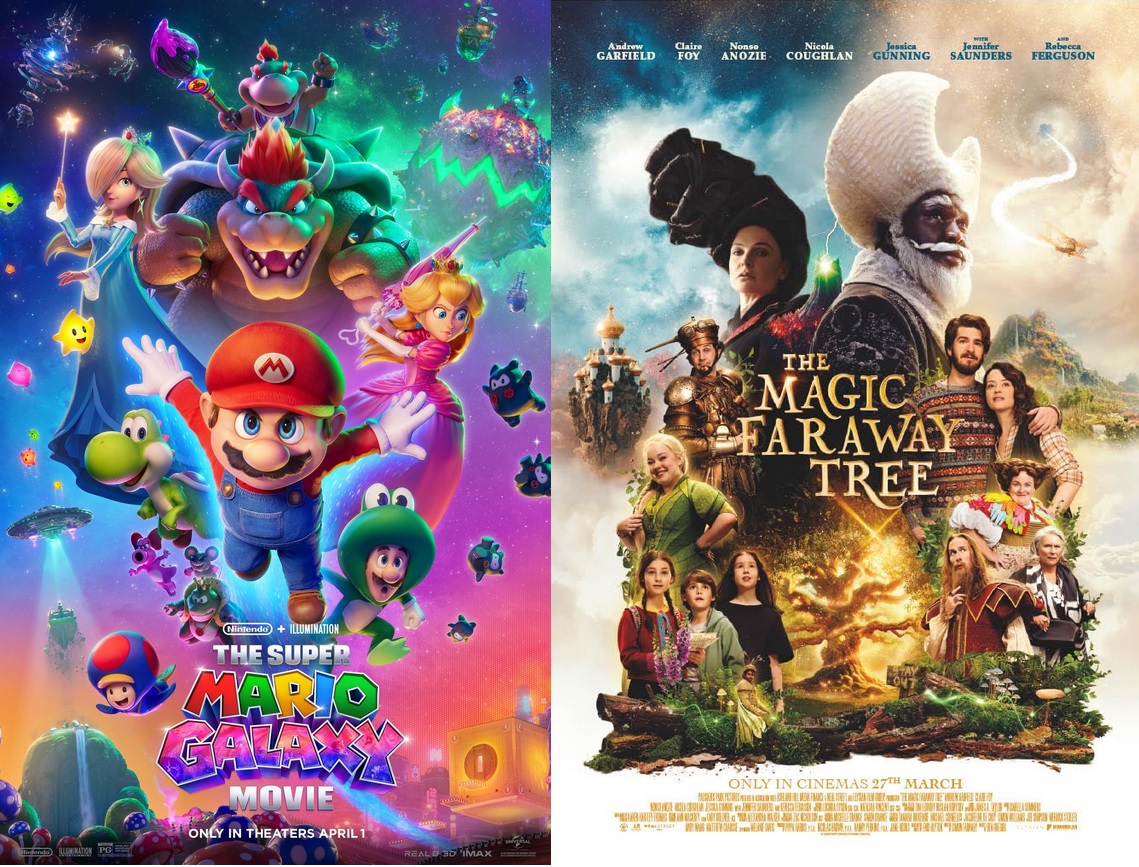
The film posters for the Super Mario Galaxy Movie and the Magic Faraway Tree

I’m breaking my self-imposed rule of posting every other day and bringing forward what would have gone into the ‘unblogged April’ post at the end of the month. I’ve taken our ten-year-old to see a couple of films this month, and as they’re both still showing at the cinema, here’s my reviews of the Super Mario Galaxy Movie, and The Magic Faraway Tree. Besides, the last time I reviewed two films together, Wish and Wonka, it was one of my most popular blog posts for a while.

The Super Mario Galaxy Movie

I mentioned that we’d probably go and see this on Good Friday, and indeed we did. We went to the Everyman Cinema in Leeds (top of my highly subjective ranking) which also permitted a bit of shopping on the side.

My review is probably broadly in line with what I wrote about A Minecraft Movie: it’s basically fine. I think Peter Bradshaw’s 1* review in the Guardian was a little harsh; it’s not terrible, nor was it aiming to be a cinematic masterpiece. As someone who doesn’t really play console games, a bit more explanation of who people are may have come in useful. For example, Fox McCloud appears in the second half of the film, with barely any introduction and I had no idea who he was or why he was important. I don’t mind fan service – it’s expected in films like this – but non-fans need a way in too.

The Magic Faraway Tree

We saw this today (yes, I’m posting about something I did the same day for once), albeit at our local Vue Cinema in Halifax as we had limited time. It’s been out in the UK for the duration of the Easter holidays, however, it has only just secured a distributor in the US and so won’t be out there until August. Knowing this, it’s therefore not surprising that it’s not a big Hollywood blockbuster; I don’t know what the budget was, but I wouldn’t be surprised if it was on the comparatively low side.

There are, of course, special effects – it would be hard to make a film about a magic tree without them – but I suspect much of the film uses good old-fashioned sets rather than lots of green screens. The screenplay is by Simon Farnaby, who also wrote the script for Wonka, and he has a cameo role in the film.

The film is based on The Enchanted Wood, the first of Enid Blyton’s four books in the series, but set in modern times. Indeed, I’m sure that Enid Blyton would probably be turning in her grave, but considering that she was a big old racist, that’s no bad thing. Like all good family films, this adaptation has some jokes for grown-ups as well as kids. The evil character Dame Snap pops up, with a cheeky reference to her being called Dame Slap in the first editions.

Which to choose

If you can only see one of these two films, pick The Magic Faraway Tree. It’s a great, relatively gentle family film. I can see it being a big hit on TV at Christmas time.

Like I said, the Super Mario Galaxy Movie isn’t bad, but it helps if you’re a player of the games.

Hoppers film review

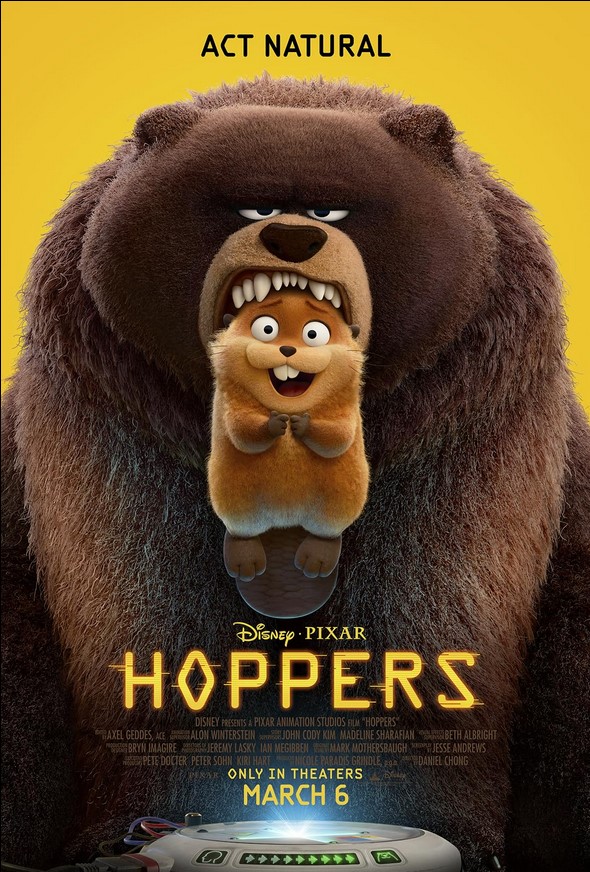
The film poster for Hoppers

Yesterday, we trooped off as a family to watch the latest Disney Pixar film, Hoppers. This is Pixar’s 30th feature film, and the 19th one I’ve seen. Generally, we look forward to Pixar films, and this one didn’t disappoint.

I’ll be honest: when I first saw the poster, I thought it was a film adaption of the French series Grizzy & the Lemmings. It’s not – for a start, the protagonist is a beaver, not a lemming.

Plot

The story focusses on a rebellious girl named Mabel, who wants to protect a picturesque glade in her home town of Beavertown. The town, led by Mayor Jerry Generazzo (voiced by Jon Hamm) has cleared the glade of animals, ahead of the construction of a new motorway. Mabel discovers that one of her university lecturers, Dr Sam Fairfax, has developed technology that allows people to ‘hop’ inside realistic animatronic animals. So, she steals an animatronic beaver in the hope that she can re-establish a beaver colony in the glade and stop the road. Along the way, she meets the King of the Mammals, the council of other animals, and sets herself up for a showdown with the mayor.

Besides Jon Hamm, Meryl Streep also has a cameo role, as do Alan Carr and Amanda Holden in the UK release.

My review of Hoppers

So, what did I think of Hoppers? Pretty good on the whole. I mean, it’s a Pixar film, and Pixar films are rarely bad. There’s a good mix of humour and sad bits, and the story isn’t wholly predictable. It’s not the emotional roller-coaster that a film like The Wild Robot was, but it’s fun. It’s certainly a good family film, and there’s a revelation at the end that made me laugh out loud (no spoilers). The three of us all enjoyed it.

We saw at The Light cinema in Bradford (my second favourite cinema chain), and with it having only opened fully in the UK on Friday, it was relatively busy. Thankfully, the days where Pixar films came out in the UK months after the US are gone.

If you are wondering, yes, there are scenes after the credits.

A Minecraft Movie review

An image of the poster for A Minecraft Movie, showing the five main characters.

You’re probably aware that A Minecraft Movie is out, considering the absolute juggernaut of publicity behind it. And seeing as our nine-year-old is obsessed with Minecraft, we inevitably went to see it yesterday.

My verdict: it’s basically fine. Three stars out of five.

Our nine-year-old loved it. They have played some Minecraft at home, and watched many hours of other people playing Minecraft on YouTube. I guess you would get more out of this film if you are familiar with the game, judging by the cheers from fellow members of the audience every time some kind of iconic item from the game was featured in the film. We went to see it at our local Vue in Halifax, and the screen was pretty much full. I guess that’s something to do with it only having opened on Friday in the UK.

There’s a series of scenes before the opening credits where we’re introduced to Jack Black‘s character, Steve, and the ‘Overworld’ which is the blocky Minecraft world. Then we return to the real world to be introduced to Jason Momoa‘s character during the opening credits. Indeed, the first part of the film spends quite a bit of time in the ‘real world’ before we’re back into the blockiness. It’s probably a good thing that the Overworld is featured so early, as it doesn’t come up again for a little while.

The plot is, well, a bit meh. Jack Black is peak Jack Black in this, and Jason Mamoa (also a producer of the film) does well, but the rest of the characters could do with more depth. It’s perhaps ironic that a film about a world-building game, doesn’t itself have enough world-building, in my opinion.

Ultimately though, this film will do well because it’s about Minecraft, and there’s just enough fan service to get players of the game on board. If you’re not familiar with the game, and don’t have kids, then maybe wait for it to come out on streaming.

A highly subjective ranking of UK cinema chains

I’m writing this a couple of weeks in the past, the morning after watching Mickey 17 at the cinema (it’s a good film, you should watch it if you haven’t already). With us having lost a weekend to Sci-Fi Weekender, I wrote a whole batch of blog posts ahead of time, including this one.

I wouldn’t say that we’re regular cinema-goers – generally, we go to watch family films that are suitable for our nine-year-old. Mickey 17 is clearly not a kid-friendly film and deserves its 15 rating – we only managed to go because we were able to arrange childcare in the evening. Whilst Sowerby Bridge itself no longer has its own cinemas, there are a number of different cinemas within easy reach of home. This includes some independent cinemas – the Hebden Bridge Picture House, the Rex Cinema in Elland, and the National Science and Media Museum in Bradford. But they’re mostly single-screen cinemas with a limited number of films on offer.

So, generally, we go to one of the chains. We’ve been to most of the chain cinemas in recent years, so, this is my high subjective ranking of the different chains:

1. Everyman

Everyman cinemas are top-tier. Instead of individual seats, you get sofas, with cushions and plenty of legroom. Every cinema has a bar, serving cocktails as well as beer and wine, and the food menu goes well beyond the basics into burgers, pizzas and sharing plates.

If there was an Everyman closer to us, we would go there almost exclusively. Alas, the nearest is in Leeds city centre, at the top of the Trinity Leeds shopping centre, and so we’ve only been once in recent months.

2. The Light

Whilst not quite as upmarket as Everyman, The Light offers an above-average experience. You don’t get sofas in the screens, but you do get big, comfy seats that can recline as standard, and the legroom is generous. Similarly, the food menu isn’t as extensive as Everyman, but you can buy freshly made pizzas and alcoholic drinks to take in. The Light specialise in smaller screens, so it’s a more intimate experience than other cinemas – we went to the Bradford cinema where six screens are squeezed into a relatively small space.

The Light in Bradford was where we saw Mickey 17, and it’s worth noting that if you park next door in the Broadway shopping centre, you can get 5 hours free parking. Also local for us will be their new cinema opening later this year in Huddersfield town centre, which will also include a bowling alley and other entertainment besides showing films.

3. Showcase De Lux

Showcase is also one of the smaller cinema chains in the UK. In my experience, it’s the nicest of the large multiplex chains. Again, the seating is a step down from The Light and Everyman, but fine. The food is also standard for cinemas, with the usual popcorn, nachos and hotdogs. Our nearest is at Birstall on the edge of Leeds, where we can park for free and it’s just off the M62.

4. Vue

Our nearest multiplex is the Vue in Halifax. Of the three big chains, I tend to find Vue to be the best, but not by much. You can pay a little extra for premium seating, but otherwise it’s standard seats with standard legroom. Other things that I like about Vue are:

  • they still have some cinemas in town centres, which was great before we could drive.
  • some of their cinemas only charge ÂŁ5 for any film, generally making them one of the cheapest cinemas

5. Odeon

I would broadly consider Odeon to be equivalent to Vue but ranked them lower as, during the late 1990s and early 2000s, they had a policy of moving their cinemas out of town centres. Our closest Odeon cinemas are on the outskirts of Huddersfield, and halfway between Leeds and Bradford. Their locations mean that they’re well away from a range places to eat, so it’s hard to have a meal and then a film. In Huddersfield, for example, there’s just a Pizza Hut and a pub nearby. We would have considered seeing Mickey 17 here as it was closer and showing at a similar time, but the lack of food options meant we chose The Light in Bradford instead.

The exception is the Odeon at the Trafford Centre, which we used to use because the Trafford Centre had a crèche (sadly closed during the pandemic and never re-opened), but it’s a bit far.

6. Cineworld

Finally, Cineworld. The company has been in a bit of pickle recently and it shows. Until The Light came along, Cineworld was the only multiplex in Bradford city centre, and so I used to go there quite a bit when I lived there. We recently went to Cineworld in Bradford again to see Wicked, and it’s clear that it needs some work doing on it. I’m not saying I would never go to Cineworld again, but unless it was the only cinema showing a film we wanted to watch at a reasonable time, I would give it a pass.

One last thing to mention: CinemaGuide is a useful site that lets you select your local cinemas (including all of the above chains and some independents) and then view a list of everything that’s on across all of them, sorted by film title. It’s handy when you want to see a particular film, and can travel to multiple different cinemas if needed.

Beetlejuice 1 and 2

The two posters for each of the Beetlejuice films.

Yesterday, Christine and I watched both Beetlejuice films – the 1988 original, and the 2024 sequel. The 1988 film is available on Netflix at present, and we watched the sequel at our local cinema.

Christine had seen the first Beetlejuice film before, but I hadn’t. It’s been one of those things where Christine has been trying to get me to watch it, but we’ve never found the time. Indeed, I had purchased a download of it to watch on a long train journey back in 2021, and I think it’s still downloaded to my iPad, but it remained unwatched.

In fact, my main memories are of the animated TV series; the late 1980s and early 1990s saw many blockbuster films (Ghostbusters, The Mask, Teenage Mutant Ninja Turtles) getting tie-in animated shows for younger viewers. But, like I said, I hadn’t seen the film until yesterday.

Beetlejuice (1988)

The film is very much of its time, and you can tell it was made on a smaller budget – around $15million, which would be in the ballpark of $40million today. The special effects are mostly done the old-fashioned way, with models and animatronics. I also thought it ended quite abruptly – without wanting to give away spoilers, I was expecting at least a couple more scenes. Also, the pacing is slower, but that’s probably true of most older films.

Overall, not bad – I would probably rate it three out of five.

Beetlejuice Beetlejuice (2024)

So, the sequel. It’s set quite a way in the future, but Michael Keaton, Winona Ryder and Catherine O’Hara reprise their roles from the first film. Absent is Jeffrey Jones; his character features in the film, but the actor doesn’t – he’s still alive but, well, you can look up what he did and why he’s not getting any more acting work. Jenna Ortega joins the cast in a new role for this film – you may recognise her from playing Wednesday Addams in the recent Netflix series.

This second film is a bigger budget affair – around $100million, which it’s already gained back and then some since its release last month. Whilst there’s still some animatronics, the bigger budget means better special effects. There’s a lot more going on, with several sub-plots coalescing at the end. Watch out for cameos by Danny DeVito and Burn Gorman (aka Owen from the first two series of Torchwood).

I much preferred the second film. Both are weird, but I found the second film more funny-weird rather than simply weird.

You can watch the second film on its own, without having seen the first one – a friend did this and enjoyed it. But there’s lots of subtle references in the second film that’ll make more sense if you’ve seen the first one.

A third film?

There were 36 years between the original Beetlejuice film and the sequel. If it takes another 36 years to release a third film, then Tim Burton and Catherine O’Hara will both be over 100 if they’re still alive. Still, you have to say Beetlejuice’s name three times to summon him, so making it a trilogy would make sense. Seeing as how the second film has done so well at the box office, I’m sure plans for a third film are being drawn up.

IF – a film about imaginary friends

At the weekend, we went to see IF at the cinema. You’ve probably seen the trailer, as it’s the latest film to star Ryan Reynolds.

It’s about a 12 year old girl, who is going through some hard times, and realises she can see the imaginary friends of others. Unfortunately, these ‘ifs’ can no longer be seen by their kids, and are looking for new kids to befriend. The BBFC rate it as a U, so it’s suitable for kids, but they do warn of ‘bereavement themes’.

I enjoyed it, and there definitely seems to be a split between the audience and critic scores. On RottenTomatoes, the critics score it 49% but audiences 88%. If you do go and see it, bring tissues; our eight-year-old has seen it twice now and teared-up both times. And maybe don’t think too hard about the plot; The Guardian’s review highlights a number of plot holes.

Delicious in Dungeon

A photo of the first book in the Delicious in Dungeon manga series.

My wife Christine recently introduced me to a new animĂ© series on Netflix called Delicious in Dungeon. It’s based on a manga, of which we also recently picked up the first book.

If you like Dungeons & Dragons, and food, then you’ll probably like Delicious in Dungeon. It follows a small guild of explorers, who are trying to save their friend despite losing all their supplies. Hungry, they resort to eating the dungeon monsters they encounter. Early on, they meet a dwarf, who seems highly knowledgable about the best way to cook these monsters and end up eating delicious food of dubious origins.

The animé adaption of the manga is pretty good, with each dish presented like it would be on a cooking programme. In the manga books, the dishes even come with ingredients and nutritional information.

It took me a little while to get into the first episode, but I found it enjoyable and funny despite not being a big animĂ© fan. The only animĂ© I have watched more than a few episodes of is PokĂ©mon, and that’s probably because I play PokĂ©mon Go every day, and so am familiar with the species.

It’s a Netflix exclusive, and new episodes are being released weekly. There are currently 13 volumes of the manga, with a 14th due out this summer. We picked up our English translation from Travelling Man in Manchester.

Creative Commons License
Except where otherwise noted, the content on this site is licensed under a Creative Commons Attribution-ShareAlike 4.0 International License.