Some predictions for 2026

As per the past couple of years, I try to channel my inner Mystic Meg, and come up with some predictions for the new year. Last year’s were mostly on target, although some were rather low-ball predictions.

Bradford City will win promotion

I don’t really follow football or support a team, but as my employer currently sponsors their stadium, I check up on how Bradford City AFC are doing on a regular basis. And at the moment, they’re doing quite well; I’m writing this ahead of time but they’re currently third in League One. If they managed to finish the season as one of the top two teams, or win the playoffs, then they’ll win promotion to the Championship, having only been promoted to League One last season. The last time they were in the second tier of English football was in 2003-4.

A big AI firm will go bust

There have been warning signs that the AI ‘bubble’ will burst soon. I certainly think that a ‘market correction’ is likely, and one of the big AI firms will go bust. Indeed, there’s a web site called Pop The Bubble which asks Google Gemini each day when the bubble will burst. At one point, on the 19th December, it predicted the bubble would burst the very next day, but more recently it has revised its projections to some time around September.

Certainly OpenAI, probably the best known AI company, is in trouble – its operating costs far exceed its income. So much so that answers may start including sponsored content. I wouldn’t be surprised that it reaches a point where it runs out of money and its investors get cold feet. That could happen this year, but we’ll see.

There will be some kind of ceasefire in Ukraine

The war in Ukraine will have been running for four years by next month, and both sides have suffered heavy losses. The BBC estimate that 160,000 Russians have been killed, and the real total may be double that. Overall, something like half a million people have lost their lives in the war across both sides.

What the ceasefire will look like remains to be seen. I see Russia as very much the aggressor here, and rewarding it with territory that was part of Ukraine doesn’t seem just, in my mind. Certainly, Ukraine hasn’t wanted to cede territory, but to stop the war it may have to – at least, for now.

The World Cup will be overshadowed by politics

Hosting of this year’s Men’s Association Football World Cup is split between Mexico, Canada and the USA this year, with the USA hosting the majority of games. However, I expect the USA’s new immigration rules for people applying for ESTA could backfire. I expect a tense political situation as various celebrities or politicians find themselves turned away at US airports or denied visas, and the diplomatic fallout that this could create.

I’m pleased that Scotland qualified as well as England this time, and Wales and the Republic of Ireland are potentially still in the running. I doubt I’ll be watching the matches – as mentioned, football isn’t really my thing and the time difference means that some of the matches are likely to be late at night UK time.

Rolled over predictions

I’m also going to roll over a couple of previous predictions:

  • Labour will do poorly in local elections
  • Twitter/X won’t become an ‘everything app’

As a member of the Labour party, I hope it turns a corner this year, but I doubt it’ll manage it in time for the local elections in late spring. As for Twitter/X, I expect it’ll stagnate and Elon Musk will continue to be a terrible person, but it’ll neither shut down, be sold off or launch any major new features.

Reviewing my 2025 predictions

Back in January, I made six predictions about events that would take place in 2025. So, seeing as there’s just a few days left in 2025, let’s see how I did:

Twitter/X won’t become an ‘everything app’

This was a 2024 prediction as well. And it’s been accurate again – X has basically stagnated under Musk. Whilst I no longer use X, I’m not really aware of any new features; just a continuing decline as more extreme voices are amplified. I hope that, in time, X will just become irrelevant.

Donald Trump will be terrible in ways we haven’t foreseen

I mean, this is an easy one, but I think one of the worst things he did this year was his comments about Rob Reiner. Reiner and his wife were tragically killed, probably by their son, and yet Trump decided to criticise him. I try very much not to speak ill of the dead (or at least, not the recently deceased).

Trump and Musk will have a public fall-out

Yes, this happened. They seemed like best buddies at the start of the year, but their respective massive egos got the best of them. It hasn’t ended as badly for Musk as it could have done though.

Labour will do poorly in local elections

Yes, although this was an easy prediction. I was still surprised (and saddened) that Reform managed to take control of several local authorities. That being said, their general mismanagement of Kent County Council shows that they may not be a long-term political force.

There won’t be a General Election in 2025

Again, I was phoning it in a bit here. With Labour not doing so well in national polls but still having a parliamentary majority, I expect they’ll stay for as long as they can.

The overall situation in the Middle East will improve

We finally got a ceasefire (of sorts) in Gaza, although I think it’s a case of things not getting any worse rather than necessarily improving. We’ll see what happens in the medium-term but there’s a lot of rebuilding to do.

I think that’s a reasonable success rate, although frankly some of these predictions were highly likely anyway. I’ve now got a few days to think up some predictions for 2026.

Bradford 2025 – UK City of Culture

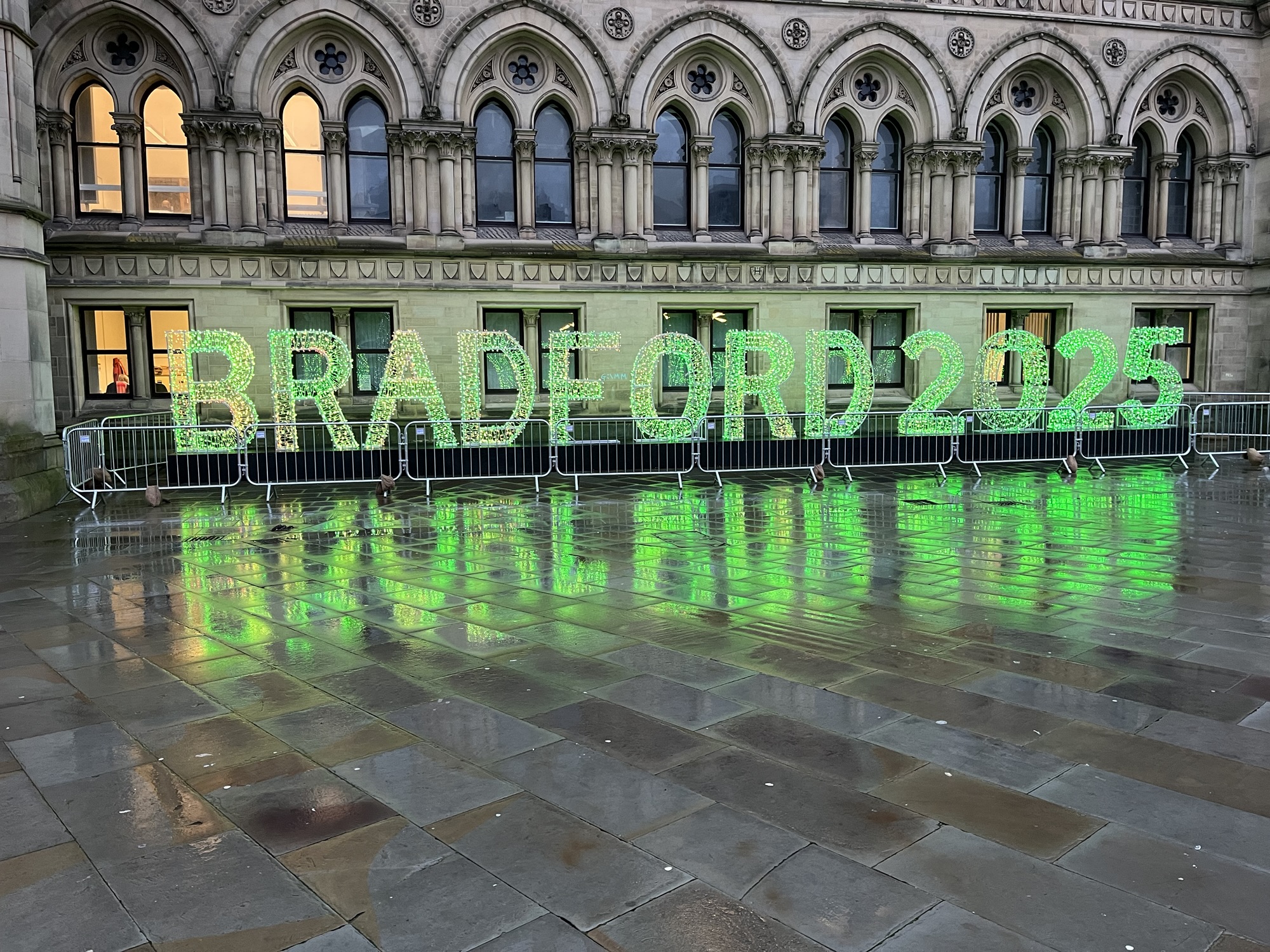
A photo of some large illuminated letters spelling out 'Bradford 2025' in green, outside Bradford City Hall

Every four years, a different UK city is designated a City of Culture for the year. And this year, it’s Bradford, the city where I work and used to live.

This isn’t Bradford’s first rodeo. Back when we were still an EU nation, it was decided that a British city would be the European Capital of Culture in 2008. Bradford put in a bid, but wasn’t shortlisted. Ultimately, Liverpool won the bid, but the success of Liverpool’s year as European Capital of Culture resulted in the creation of the UK City of Culture designation, to take place every four years. Derry/Londonderry, in Northern Ireland, won the first designation in 2013, followed by Hull in 2017, Coventry in 2021, and now Bradford in 2025.

Now, I’m biased; I spent eight years living in Bradford and still work there, and indeed my employer is a major Bradford 2025 partner. But I was genuinely delighted when it was announced that the Bradford bid had been successful. When the bid was being prepared, way back in 2019, it was claimed that Bradford has the youngest population of any city in Europe, with 29% of people aged 19 or under. Bradford is also well known for being very multi-cultural, with a large population of British Asians. And there are a number of interesting cultural places in Bradford, including the Theatre in the Mill, Kala Sangam, Impressions Gallery and Cartwright Hall. Bradford itself became the first UNESCO City of Film.

The Bradford 2025 bid includes the wider Bradford district as well, so there’s the Saltaire UNESCO World Heritage Site and Salts Mill, and Haworth, long-associated with the Brontë sisters.

There’s already a long list of events planned throughout 2025. These include the re-opening of the National Science & Media Museum, which has undergone a year-long refurbishment. Bradford 2025 kicked off with Rise, an outdoor event which attracted around 10,000 people on both nights, hosted by Bradford-born illusionist Steven Frayne (who previously went by the name Dynamo).

It’s not just the Media Museum that’s had a refit. If it’s your first time visiting Bradford city centre in a while, you’ll find that much of 2024 was spent pedestrianising many of the streets, making it a much more pleasant place to walk through. Whilst there is some work still to complete, it looks much nicer and the extra trees and shrubs are welcome.

When Hull was City of Culture in 2017, it resulted in the creation of almost 800 jobs in the city, and regeneration of some run down areas by the docks. I hope that Bradford 2025 will be similarly transformational.

Some predictions for 2025

Last January, I wrote a series of predictions for 2024, and had mixed success. So, I’m going to try again in 2025 – let’s see how these work out.

Twitter/X won’t become an ‘everything app’

I’m recycling this prediction from last year, as it didn’t happen then, and I doubt it’ll happen in 2025 either. Elon Musk is apparently going to co-lead Donald Trump’s ‘Department of Government Efficiency’ or ‘DOGE’, the name presumably chosen because Elon’s sense of humour hasn’t caught up with his age. So he’ll have more on his plate, and at a time when large numbers of people have left X which will affect advertising revenue. Remember that a lot of the money Elon used to buy Twitter (as-was) was loaned, and he’ll need to start paying those loans back at some point. Having briefly looked at Twitter again this morning, the adverts I saw were for mostly unknown companies, some of which had Community Notes attached to them basically stating they’re a scam. So that’s going well.

I still don’t think Elon will sell X this year, but I expect it’ll largely stagnate again.

Donald Trump will be terrible in ways we haven’t foreseen

Trump has already outlined what he plans to do when he’s back in office as US President. I expect some of those policies to be weakened or dropped entirely; even though the Republicans once again control both the Senate and House of Representatives, but the recent deal to avoid a government shutdown suggests they may not always vote as a contiguous block. And not necessarily in the way that Trump wants either.

But I also expect that there are things we don’t yet know about that Trump will react to in the worst way imaginable.

Trump and Musk will have a public fall-out

Musk’s control of X, and massive donations in the run-up to the election seemed to have allowed him to curry favour of Trump – hence Musk being allowed to co-lead DOGE. But I also expect that their egos will clash, and only one of these two people will be President. What the impact of this will be remains to be seen but I can’t help but see Elon as something of an Icarus character at present.

Labour will do poorly in local elections

There’s a likelihood of local elections on the 1st May 2025, although most of these are for county councils which the government is proposing to abolish, so some areas may have elections after all. Labour’s popularity has dive-bombed since winning the 2024 general election, as the government has introduced some unpopular policies. It’s a tactic that may pay off – the next general election may not be until 2029. But I imagine some people who voted Labour last time may be tempted to vote for other parties. And most of the council seats being defended are currently held by the Conservatives.

Reform UK, the party led by Nigel Farage, managed to return five MPs last year and is hoping to make gains in the local council elections too. And there’s a possibility of a massive cash injection from Musk to give them more resources to do this. I can see Reform putting up a strong challenge to Labour and the Conservatives in some seats. Whether they’ll win any, or just split the vote, remains to be seen.

There won’t be a General Election in 2025

Okay, this is a very easy prediction to make. General elections in the UK need to happen approximately every five years, and so the next one isn’t scheduled to 2029, as mentioned above. But governments can call early ones, and indeed this happened in 2017 and 2019.

The only reason why I’m including it here is because 3 million people have (apparently) signed a petition calling for a general election, and it’s currently the most popular petition. There will be a debate about this on Tuesday 6th January, apparently, but most likely in Westminster Hall and not the House of Commons.

The overall situation in the Middle East will improve

I don’t know if there will be a ceasefire in Gaza this year; I hoped for one last year, and it didn’t come to pass. But the situation in Syria is, at long last, encouraging, and I hope that the region as a whole stabilises.

Well, we’ll see what happens at the end of the year.

Reviewing my 2024 predictions

So, back in January, I made seven predictions about events that would take place in 2024. So, seeing as there’s just a few days left in 2024, let’s see how I did:

Twitter/X won’t become an ‘everything app’

Remember when Elon Musk took over Twitter in 2022 that it would become X, the ‘everything app’? I predicted that this wouldn’t happen in 2024, and, so far, it hasn’t. I don’t use X anymore, although I keep my account live, and upon logging in to write this, the only new things I could see were some kind of job search, and Grok, its AI ChatGPT competitor. This is a far cry from apps like WeChat.

One of the few things that Elon Musk is actually good at is over-promising and under-delivering, so this isn’t surprising. But X was supposed to be able to offer all sorts of new functionality, including financial services, if Musk were to be believed.

Labour will win the 2024 General Election

Yes, they did. But any other result was unlikely, to be fair. It has been a rocky ride since then, with Labour front-loading their time in power with unpopular policies like the limits on the Winter Fuel Payments. However, with the next general election not due until 2029, there’s time to re-build.

What I didn’t expect was how well the Liberal Democrats ended up doing in the election. Their tactics of concentrating on seats mainly in the south west massively paid off, with one of their best ever results.

There will be a ceasefire in Palestine

Nope, sadly. We’re over a year in now, and fighting continues. The recent regime change in Syria is a potential bright spot though.

But the war in Ukraine will continue

Yes, sadly. But it’s notable that things are not going well for Russia, with forces being drafted in from North Korea. That’s because Russia is rapidly running out of people fit to fight on the front in Ukraine, as shown by its massive fall in unemployment.

Energy prices in the UK will start to fall again

They did, and then they started going back up again in October, by around 10%. Overall, Brits are still paying significantly more for energy than we were a few years ago, although there are at least a wider range of tariffs available now.

The UK will do okay at Eurovision this year

No, we didn’t really. We came 18th out of 25th, with all the points coming from professional juries and none from the voting public. I was hoping we would do better, with Olly Alexander representing us, but I don’t think it was the best song.

Trump won’t win the US Presidential Election

Oh dear, a big no. Honestly, in the run-up to the election I though Kamala Harris had it in the bag, so I was surprised and disappointed that she didn’t win.

So, overall, half of my predictions were (mostly) correct. Which isn’t bad, although clearly there were some that I wanted to be correct but weren’t. Oh well.

Storm Bert

Yesterday, Storm Bert came to visit us, and delivered quite a lot of snow, followed by significantly more rain.

In some respects, we were lucky that temperatures rose as quickly as they did yesterday, as that later rain could have been more heavy snow. As it was, once the snow started to thaw and the gritters and snowploughs were able to get out, we were able to get on and do most of the things that we would normally do on a Saturday.

However, the rapid snow melt and heavy rain could cause some more problems. There’s flood alerts for the River Calder and River Ryburn in Sowerby Bridge. We’ve seen the Calder rise steadily over the day and are keeping our fingers crossed that it doesn’t result in a repeat of Storm Eva at the end of 2015. There’s been a lot of flood defence work that has taken place in the (almost) nine years since then, including Slow the Flow, a project to boost natural flood defences in upland areas to prevent the rivers from being inundated during storms. Alas, further up the valley, the new multi-million pound flood defences weren’t enough to stop flooding in Todmorden and Mytholmroyd, although it hasn’t been as bad as 2015 or 2020 so far.

It doesn’t help that we had snow earlier in the week, followed by persistent cold weather. There was a reasonable snow fall on Monday night, which by the time it snowed again on Thursday was still lingering on the ground. More snow fell yesterday but it’s almost all gone now. Meteorologically speaking, November is considered an autumn month in the northern hemisphere, so to have this much snow before winter has ‘officially’ started is concerning. And this is the second named storm of the year, too. This isn’t ‘normal’ weather by any existing definition, and I hope it doesn’t become the new ‘normal’.

At least, unlike with Storm Lillian in August, we didn’t get a power cut this time.

Oh, America, not again

I genuinely thought that Kamala Harris would be the next president of the USA. She was running a professional, positive campaign, and had showed that she was capable of doing the job.

So you can imagine it was a very unwelcome surprise to wake up on Wednesday to find that Trump had won the presidential election. I think much of what I wrote back in 2016 still stands, but with more weariness this time. Obviously, I live in the UK and am therefore somewhat removed from the situation. And thankfully we elected a centre-left government here back in July, although how that’ll be seen by the next world’s most powerful man remains to be seen.

Ultimately, I just feel like it’s really unfair. As I said, Harris ran a good campaign. Whereas Trump and the Republican party resorted to gerrymandering, purging voters from electoral rolls, lies, and outright vote-buying on behalf of Elon Musk in Pennsylvania. And the bad guys are supposed to lose. I was really looking forward to be able to point and laugh at Musk for ploughing millions or even billions of dollars into Trump’s re-election campaign for it not to work out.

Unlike last time, we know what the next four years will entail, and I’m not particularly looking forward to it. I suppose all I can do is live my life in a way that would annoy Trump and his cronies: be kind and welcoming, not be judgemental or prejudiced, be extremely queer, and work with and not against people from marginalised groups and different faiths.

Storm Lilian

On Friday, the UK was visited by Storm Lilian, the twelfth storm of the season (which runs until the end of this week). And it took out our electricity supply.

I was all ready to start my working day at home, when my screen went black. I use a laptop, so that was still running, but with no internet and a rapidly depleting battery. This was around 8:30am.

Thankfully, almost instantly a text from Northern Powergrid, the privatised company that runs the local electricity distribution network, informed me that they were aware of the problem. But a fix wasn’t likely until 10am, and August is my busiest month of the year at work. As rush hour had passed, I could be in my office in half an hour if I drove, so I got in the car and drove to work.

This turned out to be the right decision, as when I got to work, another text arrived, this time advising it would be 6pm before the power would be back on. As it was, everything was up and running again by 1pm, but it’s been a very long time since I’ve known a power cut last for over four hours. It turns out we were one of around 36,000 people without power in the Northern Powergrid area. Thankfully, nothing in our fridge or freezer spoiled.

Whilst we do have a massive battery in our cellar, linked to our solar panels, this doesn’t automatically kick in if there’s a power cut. Instead, we have two dedicated sockets that run off the battery. I did try running an extension cable from there to the fridge-freezer, but it didn’t seem to do anything, so I plugged the fridge-freezer back into the mains and left for work.

As mentioned, Storm Lilian is the twelfth named storm of the season, and it’s the first time since the storms were named in 2015 that we’ve reached the letter L. The season ends this Saturday and so we probably won’t experience Storm Minnie, but the fact that we’ve had this many storms over the past 12 months is rather worrying. Is this going to be the new normal with climate change, and are we going to experience more power cuts like this one?

Some 2029 election predictions

An AI-generated image of a fortune teller looking into a crystal ball which says 2029

Okay, so I appreciate that we’ve only just got the 2024 general election out of the way. It’s likely that the next general election will be in 2029, and so I’m going to make some predictions. Mainly because it’ll be interesting to look back on them in five years time, to see if I was right. So, here’s what I predict:

The Tories won’t win a majority

I suspect that the Conservative party will be out of power for at least the next two parliamentary terms, and so will lose the next election in 2029. We know that Rishi Sunak will step aside as leader, once a successor is found, and so there will be a leadership election soon. We also know that, to be eligible to stand, you have to be an elected MP – and there aren’t many left now. Penny Mordaunt, for example, was seen as a potential candidate, but she lost her seat. Jeremy Hunt has also ruled himself out, despite having narrowly retained his seat in the House of Commons. He has stood twice before for leader and lost both times.

The names that are being discussed are:

  • Suella Braverman
  • Priti Patel
  • Kemi Badenoch
  • James Cleverly
  • Robert Jenrick
  • Victoria Atkins

As we saw last time, the Conservative party membership, when faced with a choice between Rishi Sunak and Liz Truss, went for Truss and triggered the Truss-Kwarteng Budget Crisis. Rishi was then brought in as leader after the economy crashed and Truss was forced out. I mention this, because Rishi was arguably the better choice (though not much better) and yet the mostly white, mostly older party membership voted for Truss. This wouldn’t be good news for Patel, Braverman and Badenoch.

The 1922 Committee

There’s also the issue of the rules of the 1922 Committee of backbench Tory MPs. I don’t have a better source other than this thread on Bluesky, but to be a candidate in a Conservative Party leadership contest, you need the support of 100 MPs. This is regardless of how many Conservatives MPs there are – which is currently 121. Therefore, any potential candidates are going to have to get the support of more than 80% of sitting MPs, and MPs will be asked to back multiple candidates – assuming that’s even allowed. Oh, and once a leader is elected, if 15% of sitting MPs send a letter to the chair of the 1922 Committee, a vote of no confidence can be instigated. That’s only 19 MPs in the current Parliament, as opposed to over 60 before.

Of course, I wouldn’t be surprised if the 1922 Committee and/or the Conservative Party itself changes its constitution, to adapt to having a historically low number of MPs.

After the 2029 election, there will potentially be a new crop of MPs who have better leadership qualities, and who can’t as easily be blamed for the mess that the Tories have made until now.

Labour will win again in 2029, but with a smaller majority

Labour have a lot of work to do. Even though yesterday was a Saturday, the first cabinet meeting took place, as a sign that the new government wants to hit the ground running. Of course, it could have been mostly performative, but most government roles have already been filled.

Interestingly, there’s a couple of appointments to ministerial roles outside of the House of Commons:

  • James Timpson, boss of the Timpsons business, is Minister for Prisons, Parole and Probation. Timpsons employs many ex-prisoners to help their rehabilitation and reduce re-offending
  • Sir Patrick Vallance is the new Science Minister – you may remember him as Britain’s chief medical officer during the Covid pandemic and his regular appearances alongside Prof Sir Chris Whitty.

I’m guessing both will need to be appointed as members of the House of Lords, but it’s refreshing to see people with relevant knowledge and experience being appointed to suitable roles. It gives me hope that this will be a government that actually gets things done, and I hope that, by 2029, they’ll have done enough to warrant re-election.

Not all of Reform’s MPs will last

I suspect that Nigel Farage is the dog that caught the car. He’s succeeded at being elected as an MP on his eighth attempt, but when faced with the day-to-day reality of being an MP of a small party, I suspect he’ll get bored soon enough and quit, triggering a by-election. Depending on who wins the Tory leadership contest, they may end up joining the Conservative party, although that will prove controversial and may see others quit in protest.

The same may happen with the handful of independents who were elected; either they’ll quit, or join one of the major parties.

There may be another coalition government

If Labour doesn’t do so well next time and we end up with a hung parliament, then I can see Labour potentially going into coalition with the Liberal Democrats. The SNP and/or Green Party may join too, depending on how many MPs they have and how many are needed to get a majority. Turnout was low this time and Labour managed to get elected with a thumping majority despite winning fewer votes overall than in 2019. So, Labour will need to get more people out to vote for them next time, rather than rely on a combination of apathy and split votes among the opposition.

Before the election, Labour talked about automatic voter registration, which would ensure many more people are registered to vote. Whilst they haven’t committed themselves to completely abolishing voter ID (which stopped 14,000 people from voting in 2023’s local council elections), there are likely to be changes to what ID will be accepted. I’m against voter ID personally – it tries to fix a practically non-existent problem – but accepting a wider variety of ID would be an improvement. The Electoral Reform Society shows an example of two almost identical Oyster cards, one issued to a young person and one to someone over 60, but only the latter is accepted under the current rules.

I think that’ll do for predictions. They say that a week is a long time in politics, so five years is almost an epoch.

A General Election debrief

An AI-generated illustration of an elephant dressed as a politician standing in front of a podium, surrounded by supporters.

So, it’s been around 13 hours since the polls closed last night, and we have a new Prime Minister in Sir Keir Starmer. Obviously, as a Labour Party member, I’m delighted that Labour have won the election, and with a sizeable majority too.

This is a quick, stream-of-consciousness blog post reacting to the results, and what I think it means for each party. I’ll be referring to these statistics from the BBC throughout.

Labour

Obviously this is, for the most part, a fantastic result for Labour. Having had a dire outcome in the last General Election in 2019, to come back and win a sizeable majority of seats is an impressive turnaround.

It’s not a perfect result; some polls in the run-up to the election suggested an even bigger win, and Labour has only gained 1.6% of the total votes compared to last time. And some seats have been lost, notably two in Leicester and one in the new Batley and Dewsbury constituency (which covers part of the old constituency of Batley and Spen where Jo Cox was assassinated in 2016). These both have large Muslim populations who have not approved of Labour’s stance in relation to the war in Gaza.

The limited swing in the popular vote suggests that people have not voted enthusiastically for Labour, but are voting against the Conservatives. Whilst it could be 2029 before we have another election, Labour may need to do more to convince people to stick with them next time. I believe Labour’s strategy has deliberately been vague and uncontroversial to get elected, and marks a break from the Jeremy Corbyn era (who incidentally retained his seat as an independent candidate). Now that they’re in power, with a healthy majority, I hope that they will pursue a more progressive agenda. Labour could definitely do more to reward those on the left who have backed them, especially around LGBTQ+ issues. Kier Starmer wrote an op-ed piece for Attitude magazine, to which its editor has had to add clarification based on Starmer’s comments about Trans* people in recent weeks.

Conservatives

The Tories have taken a deserved battering. After winning a majority last time, we’ve had two changes of Prime Minister, and a government that has looked increasingly out of ideas. Big issues like the state of the NHS, failing school buildings, universities approaching bankruptcy, and thousands of refugees fleeing conflict risking their lives on small boats in the English Channel, have not been tackled. Instead, we’ve had ‘culture wars’ and inaction.

No wonder this became the worst defeat in the party’s history for what it calls itself ‘the natural party of government‘. It wasn’t as bad as some polls suggested – one had the Tories in third place behind the Liberal Democrats. But they have less than 1/5th of the seats in the Commons now, with a net loss of 250 – more than two-thirds of the seats they were defending. And whilst Rishi Sunak retained his seat, many of his government colleagues did not – nor did previous Prime Minister Liz Truss. It’s also notable that Wales now has no Tory MPs anymore.

Liberal Democrats

As mentioned, some pre-election polls predicted that the LibDems would win more seats than the Tories, making them the official opposition. It would be very funny if that had happened, with both the government and main opposition formed of centre-left parties. This didn’t come to pass – the Tories didn’t quite as terribly – but with 71 seats, the LibDems have more than they did in 2010 when they entered a coalition with the Tories.

Whilst Ed Davey has some skeletons in his closet from his time as a minister with responsibility for the Post Office during the Horizon scandal, he ran an entertaining and well-targeted campaign. His various stunts brightened up the pre-election period, and by focussing their campaign on a number of core target seats, they’ve pulled off a great result.

Reform UK

Urgh. If I have to say the phrase ‘The Right Honourable Nigel Farage MP’, it’ll be through gritted teeth. On his eighth attempt, he has finally become an MP, representing Clacton-on-sea in Essex. Reform’s popularity surged throughout the pre-election period, and even last night’s exit poll predicted that they would win 17 seats. Despite more than 4 million people voting for them (urgh again), they only picked up 4 seats – three of which are seaside constituencies: the aforementioned Clacton, along with Great Yarmouth and Boston & Skegness.

If we had some form of proportional representation, then Reform would have won more seats than the LibDems and become the third-largest party. As it is, by fielding a candidate in just about every constituency, arguably they spread themselves too thinly. At best, they split the right-wing vote and helped Labour into power.

Green Party/ies

The Green Party of England and Wales have held a single seat in Brighton for a few years, but never managed to capitalise on this elsewhere. Until now, having won 4 MPs this time, and almost 2 million votes. That puts them on a par with Reform, so, theoretically they should receive the same amount of airtime. This is a really good result for them.

Workers Party GB

George Galloway’s latest vehicle has run into a siding, again. Having won a by-election in Rochdale just four months ago, Galloway managed to lose his seat, and none of their other candidates did any better. Nationally, they picked up over 200,000 votes, which is more than Plaid Cymru achieved in Wales. No doubt Galloway will pop up again in another constituency by-election in time.

A new Prime Minister

So, we have our sixth Prime Minister since our eight-year-old was born in 2015. I’m hoping for a period of relative stability – for context, I was 32 when my sixth Prime Minister, Theresa May, took up the post in 2016. Keir Starmer has promised ‘change’ – let’s hope it’ll be effective change for the better.

As for the rest of the world? I hope that Britain’s ability to move on from having a right-wing populist government will give some hope to those in the USA and France, who have imminent elections.