Bradford’s Westfield shopping centre is finally happening

Work resumes on the Westfield Bradford development in January 2014

I expect the people of Bradford breathed a sigh of relief when workmen finally returned to the site of Westfield Bradford earlier this month. This will see a new Westfield shopping centre being built, which will be the only one in the north of England (we’ll place Derby in the Midlands).

The shopping centre is due to open in time for Christmas 2015, by which point it will have been almost 12 years in the making. Demolition of the existing buildings on the site started in 2004, and was done by 2006. There followed many months where the remaining rubble was piled up and no activity, but around 2007 preparatory works began to dig a large hole for the foundations.

But after the foundations were constructed, nothing. The credit crunch, and then the recession, put paid to any further progress. The whole project was effectively mothballed. The situation was so bad that in 2010, the local council, with a financial contribution from Westfield, turned part of the park into a ‘temporary urban garden’ as there was no prospect of work starting any time soon.

All this time, the rest of Bradford’s city centre suffered. The recession didn’t help, taking with it a number of shops, but the range and quality of shops in Bradford has declined over the past 10 years. There are a large number of vacant units, and many of those that are occupied are by pop-up shops on short-term lets. There’s also been an explosion of pawnbrokers, payday loan shops and betting shops.

Last year, Trinity Leeds opened in Leeds. Though it too was mothballed for some time during its construction, it’s now open and successful, and has no doubt made Leeds an even more compelling retail destination than Bradford.

Whilst I really hope the opening of Westfield Bradford will be a turning point, and help Bradford get back on its feet, I can’t help but feel that it’s perhaps too late. What if the decline of Bradford’s city centre is actually terminal?

I’m also concerned that Westfield will kill off other parts of the city. Bradford’s existing shopping centre, the Kirkgate Centre, has generally coped well over the years, but has lost a couple of major tenants as some of the larger chain stores went under. Now it too has more than its fair share of poorer quality stores, including a recently extended Poundland. It’s also home to River Island and WHSmith, two confirmed tenants of the new Westfield centre. Marks and Spencer is opposite the Kirkgate Centre and will be an ‘anchor’ tenant in Westfield.

Still, overall I hope that Westdfield is a success. It’s a shame that a once prosperous city like Bradford has fallen so far. Not only has it dropped behind Leeds, but the smaller nearby towns of Halifax and Huddersfield, both of which have (in my opinion) a better range of shops.

The Sowerby Bridge Geese

Geese

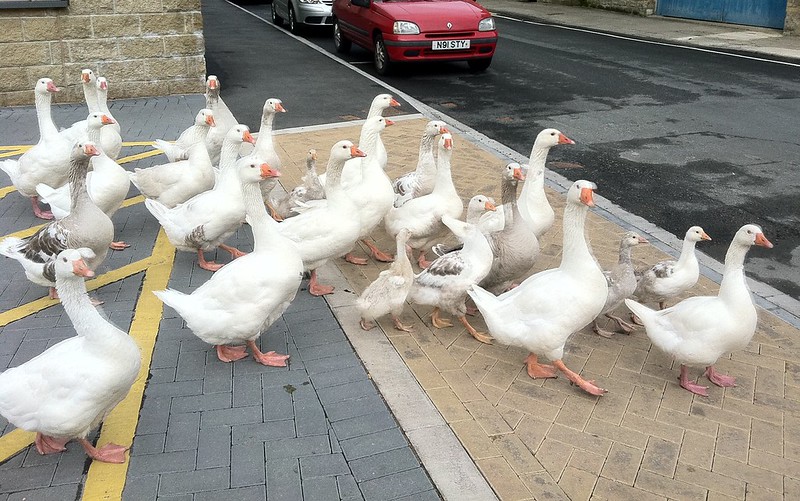
Pictured above are some of the geese that make up a gaggle in my home town of Sowerby Bridge. They nominally live on the River Ryburn, the smaller of Sowerby Bridge’s two rivers which joins the River Calder in the town. Usually they are found on the river outside the swimming pool, but occasionally they waddle a little further afield.

They never stray very far. I’ve never seen any of them fly – they will occasionally flap their wings but they don’t seem to be capable of using them. They just waddle or swim, and the furthest they get is a couple of streets away.

There are probably around 20 of them, and they tend to move together as one big gaggle. This helps when trying to cross the busy A58 road that runs through the town, which they often do, as this video shows. And frequently it’s at rush hour.

Their presence in the town is, unsurprisingly, controversial. Letters from concerned nearby residents have been sent to the local paper and local councillors. The local council have asked that the public do not feed them, and a sign stating this has appeared at one of their regular haunts. However it’s fair to say this sign is regularly ignored as I’ve often seen people throwing bread into the river for them.

I have to admit I’m mostly on the side of the geese (even if their honking occasionally wakes me up on weekend mornings). Whilst they can be a bit threatening to small children and have a habit of defecating a lot, I don’t think there are many humane ways of getting rid of them. And I think they add character to the town, especially in the spring when the newborn goslings hatch. There’s even a Facebook fan page with over 800 ‘likes’. They’ve been here longer than anyone can remember, and I don’t think the town would be the same without them.

Save the National Media Museum

National Media Museum
Photo by National Media Museum, CC licensed.

It’s not often that I ask you, dear readers of this blog, to sign a petition. But please can you take a few seconds of your time to sign a petition to Save the National Media Museum in Bradford.

The museum, along with the National Railway Museum in York, and the Museum of Science and Industry (MOSI) in Manchester, are threatened with closure. Their parent company, Science Museum Group, cannot afford to run all three in addition to the Science Museum in London, due to cuts in funding from central government. It is therefore said that one of these will have to go.

I really, really hope that none of them close. As a child, I loved going to visit them and have also been recently as an adult, and enjoyed them all. Putting the museums against each other in a fight for survival is therefore not helpful.

But, I’m particularly keen for the National Media Museum to stay open. It’s the one big visitor attraction in Bradford city centre, with a strong reputation. Closing it would be an absolute disaster for a city which has fallen on hard times over recent years. Racial tension fuelled riots in the summer of 2001. In 2003, demolition work started on a new shopping centre, to be built by Westfield, but ten years on and there’s just a big hole in the ground. Meanwhile the recession has caused many of Bradford’s other shops to close, leaving even bigger gaps in the city centre.

Last year’s opening of the City Park, with its excellent mirror pool and fountains (a magnet for kids on hot sunny afternoons), was a big step in the right direction and shows that the city does have positive momentum. And, hopefully, work will start on our long-awaited shopping centre this year. But all the good work could be undone if the National Media Museum closes. Because people will stop coming to Bradford, and then more local shops and business will go under. It’s a horrible thing to even contemplate.

So please, sign the petition. And if you’re free tomorrow (Saturday), why not visit the museum? There’ll be a mass ‘visit’ of the museum at around 12pm. It’s free to get in, and it’ll show the powers that be that this museum is important, not just to Bradford but for the country as a whole. It is, after all, part of our national collection.

HMV’s fall into administration

String Quintet

Last night, it was announced that HMV was to appoint administrators to run the business as it was no longer viable on its own, putting the jobs of over 4000 people who work there at risk. HMV is the last remaining music store in the UK, as over the years Tower Records, Track Records, MVC, Borders and, most recently, Zavvi and Woolworths (to name a few) have all met a similar fate.

Thinking back, the last time I went into HMV was over two years ago, ironically enough to buy some headphones for my iPod, so I could listen to all of the music that I’d bought online. Which is one of the major challenges that HMV faces – many people are now buying music downloads rather than physical CDs, and music downloads in the UK are dominated by Amazon and Apple’s iTunes.

Sure, HMV does sell music downloads and owns 50% of online retailer 7digital, although it’s not as popular as its rivals and tends to be more expensive. But then HMV actually does pay its fair share of taxes in the UK, unlike some other businesses, and its prices are probably higher as a result. Supermarket competition is also a big factor, as Tesco, Sainsbury’s, Morrisons and Asda all sell music and DVDs in their larger stores.

But people still buy CDs. It’s hard to give an MP3 to someone as a gift – especially at Christmas – and there will always be those who prefer to own physical objects. Downloads are great until you realise your in-car CD player doesn’t have an iPod adaptor, or your computer’s hard drive gets corrupted and you lose all of your music files.

How much of HMV will exist in future remains to be seen. It has around 35% of the UK’s CD market and quite a lot of its stores are profitable; hopefully once the failing stores are closed then the business will be able to continue trading, as happened to GAME recently. GAME is an interesting example; in Bradford, through its mergers with Gamestation and EB Games, it ended up with 3 shops within five minutes walk of each other. And this was a pattern repeated across many other towns and cities. Now it generally just has one store and seems to be doing okay. It’s sad news for the staff laid off from the stores that closed, of course, but at least it didn’t disappear forever.

But other recent high street failures haven’t had such a happy ending. Last week, camera retailer Jessops went into administration and within two days had closed all of shops for good. Unfortunately Jessops were in a hard market; few people buy compact cameras any more, as more and more people have smartphones which can take almost-as-good photos, and have the ability to share them on Facebook and Instagram straight-away, rather than waiting until you get home and empty your memory card. And independent camera shops seem to be holding up the top end of the market, especially with second-hand lenses and cameras. Jessops seems to have disappeared into the widening gap between the two.

Robert Peston, the BBC’s business editor, is quite philosophical about HMV’s collapse; in essence, it’s a sign that banks are letting almost-dead businesses fail, to free up money to lend to those that are doing well and growing. That’s not good news for the people working for these ‘zombie’ companies but a sign that, in time, things will get better.

Whilst changing shopping habits, with a move to digital downloads, are one of the reasons for HMV’s problems, another big problem for all retailers is that many people just don’t have much disposable income nowadays. We’re only just out of a double-dip recession, but last year our economy was bolstered by the Olympics and so it’s possible that Britain will be back in recession for a third time since the credit crunch later this year. Public sector pay is increasing at a measly 1% – less than the rate of inflation – and MPs voted to do the same to benefits. Unemployment isn’t as high as it could be but the fall of Jessops, and Comet just before Christmas, has resulted in thousands losing their jobs just recently. So to me, the economy is also to blame, and by extension those in charge of this country’s economic policy as well.

I’m near the end of this post, but before that I’ll come back to the topic of Bradford. In Bradford, HMV is on Broadway, a street that should, by now, lead into the new Westfield Shopping Centre, had it been built (construction will hopefully start later this year). It’s one of the few shops left there; GAME closed, as mentioned earlier, and children’s clothing retailer Adams closed down a couple of years ago. Jessops was around the corner until last weekend. What was once one of Bradford’s main shopping streets barely has anything left on it, as more and more struggling high street chain stores fall by the wayside.

I really hope that at least some of HMV’s stores stay open. It would be a shame to lose such a big name, especially as it’s the last of its kind.

Disclaimer: This site carries advertising via Amazon and Apple iTunes.

Aaron Swartz 1986-2013

Yesterday I read of the passing of Aaron Swartz, who took his own life on Friday at just 26 years old. This is a real shame as Aaron has contributed much in his very short life:

And that’s not a complete list.

Unfortunately Aaron has been in trouble with the law of late and faced criminal charges. He also suffered from depression, which is mentioned in this obituary by BoingBoing’s Cory Doctorow who was one of his friends.

Aaron Swartz was younger than me when he died and yet achieved so much. May he rest in peace, and may his legacy live on.

This post was edited several times before posting as I kept coming across more and more things that Aaron did.

Britain’s best high streets

Sowerby Bridge Rushbearing 2012

It’s not a paper that I would choose to read, but in the Daily Express last week was an article entitled ‘Britain’s best high streets‘, and, pleasingly, it mentioned Wharf Street in my adopted home town of Sowerby Bridge – pictured above during the Rushbearing festival.

Now, since it only features three towns, it’s not exactly an authoritative article and I’m sure there are many better high streets out there. But Wharf Street is pretty good as high streets go – we have an independent bakery, grocer, butchers, a post office, two banks and a wide range of specialist and boutique shops. There’s also a number of restaurants, including two good curry houses, and a bistro which is listed in the Good Food Guide. And there’s a market which is open most days of the week.

Sowerby Bridge’s high street has held up against two supermarkets. Lidl is just up the hill, and there’s a reasonably-sized Tesco at the western end of the town. It’s probably because the independent shops here tend to offer services that are better than, or different to, what the supermarkets can provide.

It’s not perfect though. Three of the pubs on Wharf Street are currently shut – two have closed recently and one has been shut for some time. And with it being the main road between Halifax and Rochdale it is very busy with traffic, making it a rather noisy place to be with rather narrow pavements. However, the variety and quality of shops is one of the things that drew us to the town and, two years after moving here, we’re still generally in love with the place.

The Equal Civil Marriage Consultation

99 Luftballoons

If you live in Britain, and have an opinion on the proposal to allow same-sex couples to have a civil marriage, please go to the Home Office web site and complete their consultation questionnaire. It shouldn’t take any longer than 10 minutes to do, and will ensure that the Home Office receives a large number of views.

If you don’t yet have an opinion on the matter, have a read of my views, and then make your own mind up.

It probably won’t surprise you that I am very much in favour of marriage equality – allowing couples to marry regardless of their sexual orientation. My reasons are:

  1. It’s achieving equality. Right now, depending on your sexual orientation, you can either have a marriage or a civil partnership. This isn’t fair – nobody chooses to be gay, straight or bisexual. It’s not a lifestyle choice. Having one set of rules for one type of people and another site for another type is discrimination, pure and simple. If, say, black people were banned from getting married and had to get civil partnerships instead, there would be outrage.
  2. It will save the marriages of transsexuals. At present, if a man and a woman are married, and the man wishes to undergo a sex change to become a woman, then by law the marriage must be dissolved – even if the couple still love each other. It doesn’t even convert to a civil partnership – the couple would have to acquire that later, at an extra cost. To me, that’s totally wrong.

Some people seem to think that allowing same-sex couples to have civil partnerships is good enough. Don’t get me wrong, I think civil partnerships are a great idea, and their introduction in 2005 was a massive step forward for gay rights. For the first time, same-sex couples could have the same legal rights as different-sex couples, including the right to a civil ceremony that is very similar to marriage. But it’s not the same – it’s still one set of rules for one group, and another set for another group. This consultation will remove that distinction, and provide one set of rules for everyone, regardless of gender.

I do, however, feel that this consultation could go further. As it stands, the Home Office are only consulting on civil marriage – i.e. non-religious ceremonies. Even if same-sex civil marriages become legal – and I hope they do – religious organisations won’t be able to conduct same-sex marriage ceremonies (although they can offer blessings as now). There are some religious groups out there, like the Quakers and Unitarians, who would like to conduct same-sex marriage ceremonies if legally allowed to do so. I don’t think all religious institutions should be forced to marry same-sex couples, but those institutions that want to do so should be allowed to do so. If you agree, note this in the comments on the consultation.

And a final word. As you know, Christine and I are getting married ourselves next year. We’re fortunate that we’re a different-sex couple who love each other. I really hope that, in the future, my same-sex friends who love each other will be able to do the same. Please, do your bit and fill out the consultation. Thank you.

Why I’ve voted Yes

Shark Statue

Today I sent off my postal vote, with a ‘Yes’ vote for the referendum on the voting system which takes place on the 5th May. I’d like to take a little bit of your time to explain why I voted yes, and why I hope you will do too.

Before I go into my own personal reasons, have a look at the Why Vote Yes? pages on the Yes to Fairer Votes campaign, and in particular the AV myths page.

I’ve had personal experience with the AV system whilst studying as a student, as we have used the system effectively for the student union elections for some years now. In particular, I’ve been involved with the counting of votes, and it really isn’t a difficult system. If you’ve watched the ‘No’ campaign’s referendum broadcast, they would have you think that it’s really complicated – trust me, it isn’t. It’s the No campaign telling you that you’re not intelligent enough to do simple maths, which is rather insulting. Jessica Hynes, the actress who appeared in that advert, should be ashamed of herself.

I also feel that the AV system is better than the First Past The Post (FPTP) system we have right now. At present, a candidate can be elected with less than half of the votes cast; in other words, a majority of the electorate did not support them but they were still elected. AV will mean that candidates will have to gain wider support in order to be elected.

It’ll also mean the end of tactical voting. Under FPTP, if you support a party that is likely to come third, you may wish to vote for a different party that you don’t really agree with (but has more support), to prevent a third party from being elected that you don’t want. This is because FPTP does not allow you to select second or third preferences; AV does, so you could put your favoured candidate first and then another candidate second if you wish, in case your first choice is eliminated.

It will hopefully spell the end for extremist parties like the BNP. Despite the ‘No’ campaign saying that AV will help the BNP (without really explaining how…), the BNP are actively campaigning for a ‘no’ vote themselves. Under FPTP, a candidate can win if a significant minority support them (which is true of the BNP), but under AV, a candidate needs to be able to appeal to a majority of voters. Most people find the BNP abhorrent, so under AV, their chances of being elected are further diminished.

And my final reason is because of the negativity and outright lies of the No campaign. There is a very good takedown of their leaflet here, for example their claim that AV will cost £250 million – it won’t. Part of that is the cost of the referendum which is happening anyway and will be spent regardless of the result, some of it is for electronic voting machines, which aren’t planned to be used, and at least £3 million of that isn’t even substantiated. Pure scaremongering and lies.

I care about this country and want our political leaders to put this country and its people – all of them – first. First Past The Post is not allowing enough people sufficient say in who gets elected to run our country and our local authorities. It may have suited us fine when we only had 2 major political parties – we have 3 now and parties like the Green Party, with its first MP, and UKIP are also on the rise. Our voting system therefore needs to change, so that more people can get more say in how our country is run.

Please vote ‘Yes’ to AV on May 5th.

All Your Base Are Belong To Serco

Train

Serco is, according to Guardian journalist Jane Martinson, “the biggest company you’ve never heard of“. Though the chances are that you’ve come across their services several times before, maybe without even knowing.

If you’ve ever been on the Docklands Light Railway, or most of the commuter trains in northern England, you’ve been on a train run by Serco. Together with Abellio, owned by the Dutch government, they operate Northern Rail and Merseyrail as a joint venture. Prefer to drive? Then you may have been caught by a Serco speed camera, or seen a message on a matrix display operated by Serco.

You may find that your local hospital’s facilities are managed by Serco, or that your local education authority (which looks after schools) is run by them – this was the case in Bradford until recently. And if you’ve been really naughty, you may have spent time in a Serco prison or young offender’s institute. Or you may have had to wear a Serco electronic tag as part of a curfew order.

Wikipedia has a big list of Serco’s operations, which include some businesses outside the UK. But many of the services that Serco provides are ones formerly provided by the state and civil servants.

Today, our prime minister David Cameron announced that more private companies should be allowed to run almost any kind of public service. I would suggest buying shares in Serco, if I were you.

In July 2013, The Guardian published another article about Serco and the in-roads that it is making to the NHS. In particular, there are some worrying allegations that the company is failing in its duties and yet still being rewarded bonuses for good performance.

I’m backing the Liberal Democrats

A note: this was written in 2010. As of 2017, I became a paid-up member of the Labour Party, and remain so as of the beginning of 2025.

I was intending to delay this announcement until closer to the election on May 5th, but recent events have inspired me to post this entry much earlier than planned.

It probably comes as only a minor surprise that I will be voting LibDem two weeks on Thursday. Thus far I have voted LibDem in every election since I reached 18, bar the previous general election when I voted for the Green Party due to dissatisfaction with the local LibDem parliamentary candidate. This time I have no such issue, and believe more than ever that voting for the LibDems is worth it.

There are several reasons why I will vote this way:

1. Policies

The party is the one I agree with the most (or, disagree with the least). As someone who works in higher education, I get to see first-hand some of the financial hardship that students have to go through to get a degree. Years ago, university was free for UK students; now, most students will borrow an average of over £20,000 to fund their education. It’s meant more students staying at home with their parents, rather than getting their first taste of independence at age 18. Further limits have meant that those with degrees already, who want to do a second degree in a new subject, have to pay eye-watering fees of at least £6,000 per year with many charging over £10,000 per year – and that just covers tuition; books, accommodation, printing, food etc. all have to be paid for as well, and you can’t get a student loan to cover it. This has stopped many people with degrees in less employable subjects going back to University to be tomorrow’s doctors, pharmacists, civil engineers, researchers and other professions where a relevant degree is necessary. This country needs graduates, yet only the LibDems are committed to abolishing tuition fees.

Not one Liberal Democrat MP voted in favour of the Digital Economy Act, which has now been passed into law and puts in place a number of potentially draconian new rules for dealing with illegal file sharing, and the party stated that it will repeal it if elected. As it happens, the act was passed due to support from the other two parties. It may just be one act, but for me this was a deciding issue for this election. While some high-profile Labour MPs did oppose it, such as Tom Watson, it was clear that the Labour whip was in favour of it.

The Liberal Democrats opposed the war in Iraq, which, admittedly, did free the country of the tyranny of Saddam Hussain but also lead to a war which was started without a United Nations mandate, probably illegal under UK law, has caused a significant amount of destabilisation in the country and the wider middle-east region and resulted in the deaths of a large number of our serving armed forces. The LibDems are also against the renewal of our Trident nuclear missile arsenal, which would be incredibly expensive and would come at a time when both the USA and Russia have agreed to reduce their stockpiles of nuclear weapons.
Vince Cable warned before the global economic meltdown started that the economy was in trouble and that banks were taking too much risk. While we’ll never know what could have happened if the LibDems were in power at the time, I trust Cable to manage the economy better than it has been.

I also respect Dr Evan Harris, the LibDem’s science spokesperson, who backs evidence-based approaches to science (i.e. what every other scientist does) rather than be guided by the media and public opinion. The recent spats between the government and its drugs advisory committee show that scientific evidence should drive policy, not political witch-hunts and media pressure.

2. People

The first leaders’ debate showed that Nick Clegg can stand above his rivals and not to stoop to their levels of back-biting. It was telling that ‘I agree with Nick’ was used by both other candidates several times during the debate, and Clegg was a much more confident speaker. There are also some people in Labour and the Conservatives that I really don’t like – Lord Mandleson, who just needs a black helmet and cape to complete the transformation into Darth Vader; and Chris Grayling, the shadow home secretary who recently said that discriminating against gay couples was fine in some circumstances. There’s Philip Davies, previously MP for Shipley and seeking re-election, who won’t be opposed by UKIP because he’s sufficiently far-right for them – this is an MP who voted against legislation to combat climate change and gay rights. And there’s the 3 Labour MPs who are claiming legal aid to defend themselves against allegations that they claimed illegitimate expenses using taxpayers’ money. And my local Labour MP hasn’t exactly done much to win my vote of late, having neither acknowledged nor responded to my communications regarding the Digital Economy Act. I could go on, but I trust the people in the Liberal Democrat party more than their opposition.
Oh, and they have an MP called Lembit Opik, who dated one of the Cheeky Girls. That’s awesome.

3. Profile

I would bet a small amount of money that there are a number of people who would have voted for the Liberal Democrats previously had they had a realistic chance of being elected, but have instead voted tactically. After Thursday’s debate, the Liberal Democrats shot up in the polls due to Clegg’s admirable performance and have stayed equal or above Labour for a few days now, and so are in with a chance of winning the election (or at least putting up a very good showing). For too long, they have been seen as the ‘other’ party, or an ‘also-ran’, covered in the news and satire programmes purely for balance. Thursday’s Have I Got News For You, which was broadcast at the same time as the debates, was a prime example of this. Suddenly the election has become a definite three-horse race, and I think people will be surprised at the level of support the Liberal Democrats actually have.

4. The third way

The political systems in many countries has become polarised and the United States is a good example – there’s the Republicans, the Democrats, and then a handful of minor parties that very few people know or care about. In the UK we’re lucky that we have 3 viable parties, giving a wider spectrum of policies and views, and this needs to be preserved.

5. Socking it to Murdoch

This is a personal thing but the power that media barons, like Rupert Murdoch, have over public opinion is sometimes quite frightening. Murdoch owns two of our largest newspapers – The Sun and The Times – and has a large stake in the Sky News TV channel (and his son is Sky’s chief executive). I understand that Labour and the Conservatives have often tried hard to lobby Murdoch and his cronies to back their candidates and it seems that he’s backing the Tories this time around, based on The Sun’s absolutely fair and reasoned support for the party (yeah right…). If the Liberal Democrats do well, it would show Murdoch and the media elite that their powers over the electorate aren’t as strong as they’d like to think (see also this comment piece).

6. Real change

The Conservative campaign has all been about change, but personally I don’t think they have changed a huge amount since they were ousted in 1997. I also hold things like Section 28, the disastrous privatisation of the railways and subsequent Hatfield rail crash and lack of public service investment against them from their previous time in power. While I do concede that Britain has been better off under Labour (minimum wage, human rights act, economic growth, equal opportunities), there’s so much more that could be done and I don’t think Labour are capable of doing it. The Liberal Democrats have not been in power at a national level before, so they’re the only major party that, in my mind, can bring real change.

May 6th is 16 days away and a lot could change, but unless something horrific and unexpected happens, I’ll be voting for the Liberal Democrats. And I hope many of you will join me.