This is relevant for me as we had a Nest thermostat installed nine years ago. Now, as far as I can tell, it’s not one of the models that’s being dropped. However, Google and Nest haven’t made it massively straightforward to check.
There is a ‘How to tell which Nest thermostat you have’ help page, but the information is different depending on where you are. Compare and contrast the UK and US versions:
“Heating systems in Europe are unique and have a variety of hardware and software requirements that make it challenging to build for the diverse set of homes”
However, when I’ve looked, I appear to have a third generation thermostat, but a second generation heat link. The heat link is the rounded-square white box that is wired up to your boiler. I’m hopeful, therefore, that I do indeed have a third generation thermostat. I haven’t had an email about it yet, that’s for sure.
If it does transpire that I have an older thermostat, then it’ll only work locally. That means that it’ll still control the boiler using the schedule set up on it, but users won’t be able to use either the Nest or Google Home apps to control their thermostat. And features like Home/Away assist will also stop working. In tandem with this, the old Nest app is being retired altogether, with all functionality moved to the Google Home app.
I assume that this will also apply to anything that uses Google’s APIs, so users won’t be able to use Home Assistant as a workaround, for example. The change takes place on the 25th October this year.
Compensation
As well as notifying affected users by email, Google is offering money off its newer thermostats for those who want to upgrade and keep their smart features. Of course, as Google is withdrawing its thermostats from Europe, European users are instead offered 50% off a smart thermostat from Tado, which costs €199 normally. The same kit is currently £149 from Amazon(sponsored link) but I’m guessing the discount code will only work for direct orders. Tado smart thermostats will work with Google Home, and with Home Assistant, but they’re still cloud-based like Nest’s thermostats are.
And this is the concern I have. I’ve trusted Nest, and later Google, to provide a cloud service, which they’re now taking away for some users. Whilst this (probably) doesn’t affect me now, further changes in a couple of years could mean that my thermostat becomes unsupported as well. And if Tado decides to do the same with their thermostats, users could be inconvenienced twice.
I think what’s worse about Google killing off its older thermostats is that they’re not so easy to replace. A thermostat needs to be professionally installed. It’s not like a phone, or a smoke alarm, or a smart speaker, where the old one can simply be unplugged and replaced. And they’re not cheap – I paid £250 for my Nest thermostat back in 2016. Even with the discounts, you would still have to find someone to install it for you.
In time, we’ll be replacing our gas boiler with a heat pump, and when that happens, I’ll look to replace to Nest thermostat with something else. It won’t be Tado, as outlined above. At the moment, I’m leaning towards Drayton Wiser. It works with both gas boilers and heat pumps, and supports smart thermostatic radiator valves. It can also work locally – indeed, the Home Assistant integration (installable via HACS) doesn’t require the cloud at all. Others who I’ve talked to in smart home communities recommend it, but I haven’t experienced it myself.
I suppose, knowing Google’s history, that I should have been more wary about relying on Google hardware for my heating.
We’ve had our solar panels for a couple of years now, and, as a thought experiment, I’ve wondered if it would be possible to go ‘off grid‘. This would mean having no connection to the electricity and gas networks, and potentially the water network too.
Now, I’m very much aware that this is a classic example of Betteridge’s Law of Headlines, and indeed, the short version of this is pretty much, ‘no’ when it comes to electricity and water. Especially if the person reading this is my wife, Christine (love you sweetheart). It is intended to be a thought experiment after all.
Getting off the gas grid
We’ll start with the easiest one – getting off the gas grid. This is actually a long-term of ours, and many homes are now getting disconnected from the gas grid.
When we bought our house, which will have been 10 years ago this summer, it was a very gas-reliant house. There were three gas fires, a gas central heating boiler and water tank, and a gas cooker. We got two of the gas fires out before we’d even moved in, and the remaining one followed when we had the very old gas boiler replaced with a more energy efficient condensing boiler in 2016. Next to go was the gas cooker, when we had the kitchen renovated in 2022, so now we only need gas for heating and hot water.
Now our boiler isn’t quite nine years old, but it’s likely to have a few years left in at least. When it’s due for replacement, our plan is to switch to an air source heat pump, which will be electrically powered. That will mean there’s no need for a gas connection to our home, and we can have it completely removed. As well as meaning that we don’t need to pay the daily gas standing charge, we’ll no longer have pipes carrying an invisible and highly flammable gas running into our home. And it’ll reduce our carbon footprint too.
Off-grid electricity
So that’s the easy one out of the way. Going off grid for electricity, however, is likely to be much harder.
We’ve made a start, at least, with our solar panels. In the summer months, with longer days and more sunlight, we generally generate enough to be self-sufficient. We also have a battery attached to the system, so the solar panels can charge the battery during the day, and then the house can run off the battery overnight.
However, at this time of year, we are very much not self-sufficient. This is especially true as I write this on a very dull Sunday afternoon, where our solar panels are contributing a mere 7 watts of power. That’s about enough to run a couple of LED light bulbs, but certainly not enough for our freezer, for example. We would therefore need other ways of generating electricity on dull days, or at night.
Ovo Energy have a useful guide here. Generally speaking, a roof-mounted turbine would be capable of generating 1-2 kW of electricity, which is less than half the peak capacity of our solar system. And that’s based on a lot of assumptions about wind speed that may or may not apply to your property.
As well as the installation cost, we would probably also need planning permission, as our house isn’t detached. We’re therefore looking at around £2000-3000, and it would probably take quite some time to recoup that investment.
Dull days with no wind
So, a solar system backed up with a wind turbine might cover our electricity needs. Unless it’s a dull day and there’s no wind.
I’m in a few Facebook groups for people who use Home Assistant and who have solar and battery systems, and quite a few other members have the Agile Octopus tariff. On this tariff, electricity prices change by the half hour, based on wholesale prices. If it’s forecast to be a particularly sunny and windy day, electricity prices can be very low. Indeed, they occasionally go negative – in other words, Octopus will actually pay you to take electricity out of the grid, rather than the other way round. It’s great for people who have battery systems that can charge from the grid, or who can plan their days to use more electricity at the times when it’s cheap.
Though we are Octopus Energy customers, we’re not on Agile Octopus, because prices can also shoot up on dull days with no wind. Our fixed tariff means we pay 21.10p/kWh, regardless of the weather, but on Agile Octopus, the electricity unit price can go up as high as £1 per kWh. And if you haven’t been able to charge up your home battery by then, it could get very costly.
As an aside, if you’re not already an Octopus Energy customer, here’s my referral link. You get £50 off your bill if you join, and their customer service is better than any other energy company that we’ve been with so far. There’s also an unofficial Home Assistant integration that uses their API.
Therefore, if we were to disconnect from the grid, we would need a third source of electricity. This is where it gets a bit more tricky. The options I have looked up so far include:
A wood burning stove, with a thermoelectric generator. However, in my research, I’ve yet to find anywhere in the UK that would sell such a system. And those that I have seen for home use would only be able to generate a few watts – not even enough for our house’s ‘base load’ (fridge, freezer, devices on standby etc). We have a chimney that we could use, but we would also need filters to stop particulate matter getting into the air.
Some form of hydro generation using water collected from rainfall on our roof. This would only really work when it rains; although we live in the Pennines where it rains quite a bit, I doubt this would power much more than a couple of light bulbs.
Therefore, we would probably have to fall back on a diesel generator, which would be noisy, smelly, and not good for local air quality or the environment.
No Smart Export Guarantee
The other benefit to being on the electricity grid is that you can be paid back for any excess electricity that you export. Even though it’s January, we’ve exported around £1 of electricity this month, and that’s only after our battery has been fully charged. In June last year, we were paid £46 for the electricity we exported, against £36 for the grid energy that we used. So that was a net payment to us that month. Indeed, over the whole of 2024, we were paid £227 for the excess electricity that we exported.
If we’re not on the grid, then we can’t export. So if our battery is full, that electricity is essentially being wasted. Of course, if I was serious about going off-grid, then I would probably invest in another battery to prevent this from happening, but then that’s another expense.
What about water?
Going off the water grid would be the most difficult. Although ironically, we’ve been inadvertently off the water grid four times so far this month, due to supply issues. I have an active complaint with Yorkshire Water about that, but let’s imagine that I want to willingly disconnect from the water grid for a moment.
Clearly, we would need some other way of getting clean water into the house. Rainwater is the most obvious, but we would then need somewhere to store it. In 2023, I read The Climate Change Garden(sponsored link) by Sally Morgan and Kim Stoddart, and the book shows you how you can store water in tanks underneath your garden to cope with water shortages. During the 2022 heatwave, we had a hosepipe ban for several months, and so I’m considering whether to get a water butt to store rain water for use in the garden. You may be eligible for a subsidised water butt from Save Water Save Money – you’ll need to pop in your postcode to see if your water company participates.
But even a butt, or huge tanks under our lawn, are unlikely to be sufficient. We would ideally need to have access to a constant flow of running water, such as a stream. And we would need the means to filter the water so that it’s fit for drinking.
And what about sewage? We don’t have a particularly big garden and so we probably wouldn’t have room for a septic tank, or any other means of storing and/or treating waste.
A case study: Gibson Mill
Up above Hebden Bridge is Hardcastle Crags, a National Trust property which is home to Gibson Mill. The Mill is off-grid, because of its remote location – it’s about a mile away from the nearest electricity cables, for example. So, electricity is instead generated on site, using solar panels and a hydro-electric generator. Mills were typically built next to watercourses and Gibson Mill is no exception, being served by Hebden Beck. Whilst this would have driven a waterwheel in years gone by, nowadays it drives a turbine to produce electricity. The solar panels have recently been replaced with newer, more efficient models, and there are huge batteries to store energy.
We last went back in 2023, and despite having more than one way of generating electricity on site, there was still a diesel generator at the back that was needed to top-up the electricity supply. Even then, they were unable to serve hot food in the café as a result of not having sufficient power.
Gibson Mill also has no connection to the sewerage system, so its toilets are composting toilets. Below the toilets are huge vats filled with worms, who digest our waste for us. It’s feasible at this scale because it’s a tourist attraction, and the alternative of laying pipes would be more expensive.
Conclusion – staying mostly on-grid
So, in summary: going totally off-grid would be difficult, although coming off the gas grid is achievable and something that we want to do eventually. We don’t live in a very remote area, and so going off-grid with electricity and/or water wouldn’t really make sense. Even if we could find the means to generate our own electricity, the upfront costs of installing the required equipment would probably outweigh the potential savings.
The recent cold snap, and corresponding increase in our heating bill, has meant that I’ve looked at using radiator reflectors at home. These are panels, made of reflective material, which go behind your radiators and reflect heat back into the room.
Unless you’re lucky enough to have under-floor heating, if you have central heating then your heat will most likely come from radiators hung on your walls. The heat from these radiators literally radiates out in all directions, which means that some of this heat will be going into the walls behind your radiator. Radiator reflectors redirect that heat back into your room, increasing the efficiency of the radiator.
Radiator reflectors are especially useful for radiators on external walls, as otherwise you’re potentially allowing heat to escape outside the home. Our house is around 100 years old, and we’ve been told that we can’t have cavity wall insulation, so heat loss is an issue for us.
Choosing radiator reflectors
The radiator reflectors that I bought are Radi Save from Must Have Ideas. Instead of individual panels, you get one five metre long strip of material, which you then cut down to size. Thankfully, the four radiators that I wanted to add reflectors to added up to 5.1m, so one pack was adequate; if I was to do the whole house, then two would have probably been sufficient. Each five metre pack normally costs £20, but they’re on offer for £15 each at present, plus postage.
The material is easily cut with regular scissors – you just need to measure the radiator’s width, knock maybe an inch off each end, and cut it to size. You also need to measure and cut out holes so that it can slide around the brackets. Then, just drop it in place behind the radiator, assuming your nine-year-old hasn’t filled the back of the radiator with various dropped toys. You can then attach them to the wall with double-sided tape, if you wish; I haven’t yet, as it gives us the option of storing them over summer when the radiators are off.
The market leader seems to be Radflek (sponsored link) – they will sell you panels and a kit to hang them from the radiator brackets. A pack of two panels costs £20, so they’re a little more expensive than Radi Save. However, as you would expect, there are many other radiator reflectors on sale from Amazon, including similar products to Radi Save.
Do they work?
As I write this, I have installed our radiator reflectors on two radiators – one in our bathroom, and the other in our dining room. Our bathroom radiator is small, and behind a door, and this is where we’ve seen the most benefit. The room doesn’t feel as cold as before, and there’s been less of an issue with condensation on the window since I fitted the radiator reflectors.
Also, I believe the previous owners of the house used to have a gas fire in the bathroom, where the radiator is now, however the old flue from the gas fire remains. As such, some of the heat from the radiator was being channelled out of the house through the flue. The radiator reflector seems to be preventing this now, which is great – indeed, the back of the reflector, facing the wall, was almost cold even when the radiator was on.
So yes, it feels like they’re working. I can’t back this up with my own solid data, but most product pages selling radiator reflectors seem to include images taken from thermal imaging cameras to show that they work.
Do they save money?
£15 for four radiators doesn’t seem like much, but it’s still an investment. Whether you will save money by using radiator reflectors will most likely depend on whether you have thermostatic radiator valves (TRV). These are valves on your radiator that open and close in response to how warm your radiator is; once your room is warm enough, the valves will close up and will reduce the flow of hot water into the radiator. As mentioned, radiator reflectors help by increasing the efficiency of the radiator, theoretically meaning that the radiator will warm up faster, and so that the TRV can close up sooner.
We have standard TRVs on our radiators, but it’s possible to get smart TRVs. These can be set to a specific temperature, using an app, and, if they’re from the same brand as your thermostat, can control your boiler or heat pump too. If not, then it’s possible to rig something up with Home Assistant.
If you don’t have TRVs, that doesn’t mean that you won’t save money – certainly, if you add a reflector to the radiator in the room where your thermostat is, you should still save some money. But hopefully you’ll find that your rooms are at least warmer than they were before, without burning more gas.
Can’t I just use kitchen foil?
I’ve long been aware of the suggestion that you just put some kitchen foil behind your radiators, rather than buying dedicated radiator reflectors. According to this web page, kitchen foil may work, but it isn’t likely to be as effective. It’s delicate, so tears easily, and isn’t as insulative as proper radiator reflectors.
We’ve now had our solar panels for two years, so it’s probably time to review how much money they have saved us, and how close we are to getting a return on investment.
We have a SolaX system, which includes twelve 400 Watt solar panels, an inverter and battery. I’m using SolaX’s app to estimate how much money this saves us, based on the electricity unit prices from the grid, and also the amount that we get paid for exporting surplus electricity under the Smart Export Guarantee.
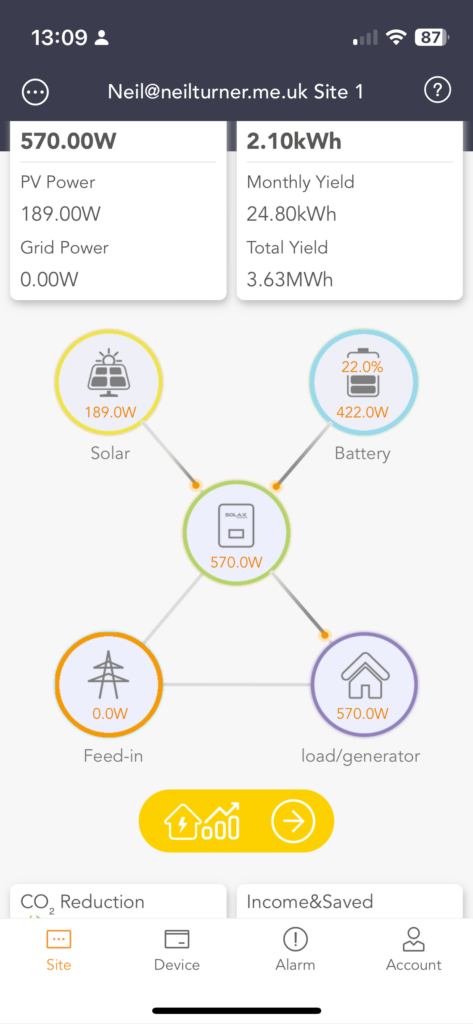
I’ve included a screenshot taken a couple of weeks ago. We only saved around five pence that day, as the solar panels spent most of the day under a thick blanket of snow. But you can see that, in total, we’ve saved around £1600 in two years.
I should note, however, that whilst this averages out at £800 per year, last year we actually saved closer to £900. Alas, 2024 was a less sunny year, on the whole, and so our solar panels couldn’t work as hard.
The total cost of the system was around £11,000, so after two years, we’ve recouped 14% of our outlay. Had 2024 been as sunny as 2023, then this would have been closed to 16%. Assuming that we have more years like 2023, then we should break even in around 10 years time. That’s a long way away, but we’ll still be paying the mortgage on the house then, and we have no plans to move.
Since we had our solar panels fitted, prices have dropped significantly, and so a comparable system to ours would probably cost closer to £9000. You could argue that we should have waited a little longer to get our system installed, but back in 2023, energy prices were at an all-time high. Still, it does mean that the economics of getting solar panels fitted now is even better than it was.
Most of the money that we used to pay for the solar panels was either savings, or money gifted to us by my parents. However, we did borrow around £4000 to cover the rest of the cost, and still have some of that to pay off. Provided that we don’t have any more major expenses (I’m glaring at our car as I write this), we should have this paid off this coming spring.
Until March 2020, I had never done a significant amount of home working in my current job role. But then the pandemic and lockdown happened, and I started a period of exclusive home working until September 2020. Since then, I’ve been a hybrid worker; typically I am in the office 2-3 days each week, but I still spend a significant amount of my working time at home.
First lockdown
During the first lockdown, I worked on our dining table. Though I had a desk, it was somewhat buried under piles of stuff and was set up for my Mac, even though I barely used it. Plus, I was at home with our then four-year-old, who I also had to parent alongside full-time work and part-time study. Let’s just say that this marked the point when I started getting grey hairs.
In my office, I always had two screens and so I replicated this as best as I could at home – a laptop, with an external screen plugged in. This screen was my LG Flatron W2353V, which I was sent to review back in 2009. We still have it, 15 years later; it’s no longer my principal screen, but our (now) eight-year-old uses it with their Raspberry Pi 400. With this, I had a cheap USB mouse and my Mac Mini’s keyboard. Everything would be cleared away at the end of each working day, so that we could have dinner.
Moving upstairs
September 2020 rolled around, and our then four-year-old started school, so no more need for supervision whilst working. I therefore moved to working upstairs, in our spare room. As it was starting to become clear that I would be working at home at least part of the week for the foreseeable future, I started investing in things that would make my home working environment better. This included a folding laptop stand(sponsored link), a new keyboard(sponsored link), a new Lenovo LED screen, and a succession of wireless mice, culminating in this Arteck mouse that I reviewed earlier this year. The laptop stand was probably the biggest game changer, as it allowed my screens to be at a similar height.
Not being on the dining table meant that I could keep everything out when not working, rather than having to unpack my workspace every morning and put it all away again each evening.
Later on, we splashed out on the single most expensive item – a new Markus office chair from Ikea. Over time, I also added a ring light, a better microphone(sponsored link), and a better webcam than the one built into the laptop, seeing as how many of our meetings are still online.
Back downstairs again
Although my workspace in our spare room was adequate, technically this was Christine’s craft and sowing space. Meanwhile, my desk downstairs in the dining room was still sat there under a pile of junk. So, I finally got around to clearing it out, and moved back downstairs to a new permanent home workspace. This gave me more space to work and in a room that was significant cooler over the summer. This is the workspace that is in the photo at the top of this blog post.
The most recent additions came from Ikea. I added a black Lånespelare mug holder, a white Skådis peg board to hide wires, and a Stubberget monitor bracket. The bracket clips on to the back of my desk, and attaches to the screen using a four screw VESA mount. That way, it’s easier to adjust the height (previously it sat on a rather stout book about pharmaceuticals), but also frees up more desk space and keeps the cables tidy. And whilst we don’t have a very young child any-more, having the screen fixed to the desk is much safer than a free-standing screen that could fall on them if pulled. We’ve had our various TVs fixed to the wall for the same reason.
I’m still working flexibly and so it’s likely that I’ll still need a good home working environment for some time to come. That might include an additional screen in future, although my current laptop only supports one additional screen and not two. I’m also looking at further ways to tidy up the cables.
I’m lucky enough to have grown up in a home that had a dishwasher, which in the 1980s and 1990s was much less common than nowadays. And since 2010, Christine and I have rented flats, or owned a house, that has had a dishwasher. We also made sure that a decent dishwasher was part of our new kitchen.
My own experience, along with this YouTube video embedded below and some guides from Which? are what I’m using to inform this blog post about what I’ve learned about running a dishwasher. And, more importantly, how to get the most out of it.
1. Some dishwashers are bad
Specifically, the dishwasher that was left behind in our house by the previous owner, which was manufactured by Indesit. It may have been age, or just bad design, but frequently the glassware in particular would come out dirtier than when we put it in. We tried giving it a thorough clean a few times but this never seemed to make much difference. So we were glad to see the back of it when we had the kitchen re-modelled.
Its replacement was manufactured by Bosch, which is one of the better quality appliance manufacturers. In the two years since, it’s done a very good job. If you’re in the market for a new dishwasher, check the professional reviews and maybe consider paying a bit more for at least a mid-tier model. We nearly went for a cheaper model – it was going to be built-in and so the ‘brand’ didn’t bother us – but I’m glad we didn’t.
2. A good dishwasher will clean just about anything
Because our old dishwasher was unreliable, we didn’t put anything too testing in it – just cutlery, crockery and glassware. Whereas we know we can rely on our new Bosch dishwasher, and so we put more challenging items in it. This includes pots and pans, and even oven trays with burnt-on food. Whilst it can’t always get rid of all burnt-on food, it does a pretty good job. As such, we run our dishwasher with a full load every day.
Not having to wash these things up manually saves a lot of time.
Just make sure that whatever you put in is dishwasher safe – many plastics are, but avoid putting anything wooden in like spoons or chopping boards. Knives can also lose their sharpness if they’re regularly put in a dishwasher – whilst this is fine for standard crockery, we tend not to put cook’s knives in the dishwasher.
3. You still need rinse aid and salt, even with all-in-one tablets
Most dishwasher tablets are ‘all-in-one’ nowadays, and include small amounts of rinse aid and salt. That should, theoretically, mean that you can ignore the low salt and rinse aid warnings in your dishwasher. But it doesn’t.
You should still fill these up, but many dishwashers will have some way of limiting how much is used. We use all-in-one dishwasher tablets from Smol(referral link) which are posted to us regularly. But I’ve also configured our dishwasher to use a smidgen of salt and rinse aid as well. As we have a smart dishwasher, I was able to do this using Bosch’s Home Connect app, but your dishwasher’s manual may have a way of doing it using some combination of buttons on the front.
4. You can just put the dishwasher tablet in the main body of the dishwasher, but you probably shouldn’t
Some experts say that you needn’t bother putting a dishwasher tablet in the dispensing tray. This is contradicted by the above YouTube video however, and I’m siding with that. The reason why you put the tablet in a dispensing unit is so that it’s released after the pre-wash cycle. The pre-wash is essentially a rinse to get rid of dirt on your plates before the main wash starts. If your tablet is in the main part of the dishwasher during this time, then the detergent will be partly consumed during the pre-wash, leaving less behind for the main wash.
The differences of opinion here suggest that the impact of not using the detergent dispenser is minimal. And, if your dishwasher has a broken dispenser, then you can still use it with the tablet in the main body of the dishwasher. One other suggestion is to consider putting the tablet in the dispenser, and some dishwasher powder in the bottom of the dishwasher. The powder will be used in the pre-wash, and then the tablet in the main wash.
5. The ‘auto’ or ‘standard’ programme is probably the best one
Most dishwashers offer a range of programmes, which optimise for either speed, cleaning or energy, or a balance of the three. For example:
Eco will prioritise energy efficiency over speed and cleaning. It’ll use the least amount of water and electricity, but won’t clean as effectively and will take a long time.
Intensive is the most powerful cleaning programme, which may be good for heavily soiled items or pans and oven trays with burned-on food. But it’ll use more energy and may take longer.
Rapid will be the quickest, but to do so it’ll use more energy and won’t give as good cleaning results.
Standard is a compromise of the above. It’ll offer the best balance of energy efficiency, cleaning and time.
If your dishwasher offers an ‘auto’ mode, then it should use its own logic to work out which programme is most appropriate. As long as you don’t mind some unpredictability about how long the dishwasher will take, this may be your best option.
Which? compares the various cycles and finds that the standard programme offers the best results overall, with the rapid programme the worst. But whilst the eco programme performs a little worse than standard, such programmes typically use significantly less energy – about 30%, and typically saving around £15 per year. There’s some hard data here, if you’re interested.. For the most part, we use Eco or Auto.
6. You need to clean your dishwasher regularly
Our Bosch dishwasher sends out an app notification via Home Connect when it decides it needs a clean – usually every couple of months. It also has a dedicated ‘Machine Clean’ programme. But if yours doesn’t, then you can still just run it empty on a standard programme with dishwasher cleaner in it.
However, just using dishwasher cleaner isn’t enough on its own. You also need to clean the filter regularly – Which? reckons weekly, but I tend to do it at the same time as the machine clean, so every couple of months. And, less often, it’s a good idea to clean the spray arms – they can get clogged up with bits of food which prevents them from working properly.
7. There’s no need to manually pre-rinse your crockery
If you have a good dishwasher, then you don’t need to pre-rinse your items before putting them in. That’s because your dishwasher will do this for you during the pre-wash cycle.
That being said, it’s best to scrape off any bits of food on your items before loading them in the dishwasher. We have a selection of silicone spatulas that we use for this, with any leftover food going in our food waste bin. Leaving lots of food on your items will clog up your dishwasher’s filter and spray arms more quickly.
8. Your dishwasher may work better if you run the hot tap first
This one depends on how your dishwasher is plumbed in. Generally speaking, in the UK and Europe, dishwashers are plumbed in with just a cold water feed, and then the dishwasher heats the water to the required temperature. But in the USA, there’s a higher likelihood that there’s a hot water feed as well.
This is worth bearing in mind. When you turn on a hot tap, the water is sometimes cold and takes a little while to warm up. So, if your dishwasher has a hot water feed, then it may initially be getting cold water at first. Therefore, if you run the hot tap before starting your dishwasher, the water that comes into the dishwasher will be warmer.
We’re in the UK, and our dishwasher and washing machine just have cold water feeds, so this doesn’t make a difference to us.
9. Use time delays to take advantage of cheap electricity
I know I drone on about our solar panels, but to make the most of them we tend to run things like the dishwasher during the day. Bosch’s Home Connect app lets you specify times when you get cheaper energy, and so it can default to running the dishwasher at those times. For us, this is during sunlight hours, but you may be on (for example) an Economy 7 tariff when it’s cheaper to run overnight.
The smart features of our dishwasher make this easier, but most should come with some kind of time delay programme. If not, you can make a regular dishwasher ‘smart’ using a ‘fingerbot’ and an energy monitoring plug.
It lets you quickly print labels from your phone, with text or emojis, using the Print Master app. It’s quick, as it uses thermal printing in the same way that receipts are printed in shops. The label printer itself is also quite compact – about the same height and width as a smartphone, but about twice the thickness. It comes with a built-in rechargeable battery, and a micro-USB port for charging. There’s a variety of colours to choose from – we have a ‘green’ one that’s more turquoise, but they come in pink, purple, grey and a cheaper all-white model.
The Print Master app is relatively easy to use. You select the size of label to match, type what you want and add any emojis. There are also templates that you can use, and a variety of fonts. When you’re ready to print, you can select the number of copies, and it’ll pop out of your printer in a couple of seconds.
We’ve used our label printer extensively since we bought it. It was especially useful in our new kitchen as it meant that we could label boxes of things in the cupboards. We also use it on a regular basis to label leftovers before they go in the freezer. It’s easier and neater than writing labels by hand.
One of the benefits of our kitchen renovation in 2022 was that it gave us space to install a tumble dryer in our cellar. Previously the cellar was inaccessible, and so our washing machine was in the kitchen; now both are in the cellar and out of the way.
Tumble dryer
We bought this Grundig heat pump tumble dryer at the end of 2022. Being a heat pump model, it’s very energy efficient; if you want to know how heat pumps work, this interactive guide from The Guardian is worth watching. Consequently, it’s cheap to run; whilst it cost more upfront than a regular condensing tumble dryer, over time, it works out cheaper. It’s not a ‘smart’ model but it’s simple enough to use, and at some point I may connect it to a smart plug with energy monitoring, so I get notified when it’s finished.
However, we can’t dry all of our laundry in a tumble dryer. About a third of our clothes aren’t suitable, due to either being handmade or having care labels advising against tumble drying.
Drying laundry outside
Ideally, we would dry as much laundry as possible outside. We have a small garden with washing lines, and there’s no cost involved when you let the sun and wind dry your clothes for you.
But we also live in the Pennines, which is one of the wetter areas of England, so we get fewer dry days than elsewhere. Indeed, it’s rare that we can dry our laundry outside at all in winter. When it is sunny and there’s a gentle breeze, drying laundry outside can be the quickest way, beating even the tumble dryer. But on a dull day with no wind, even after a full day outside, our laundry can still be damp.
Heated drying rack
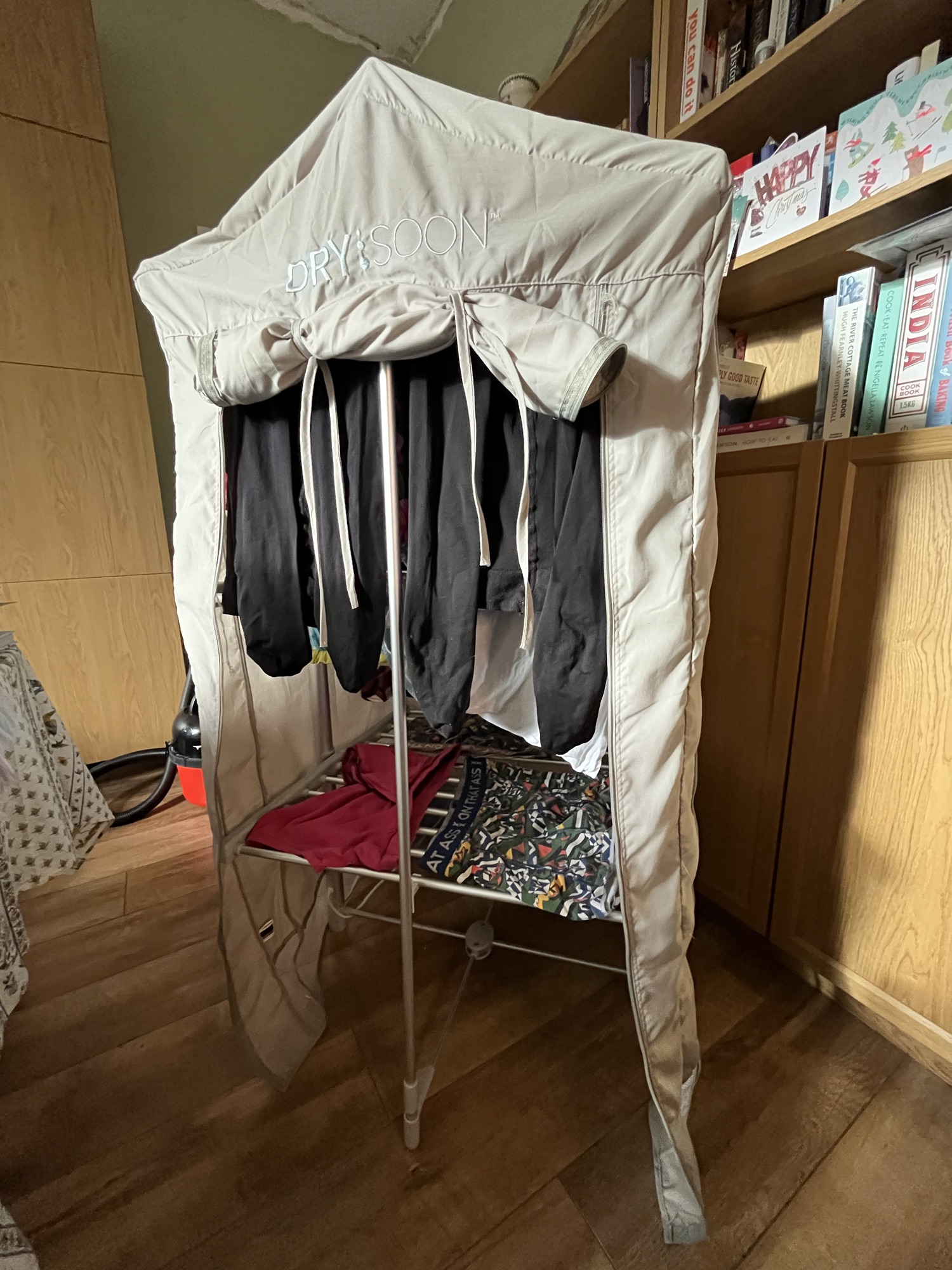
So we needed a way of drying our laundry indoors that doesn’t use the tumble dryer. For this, we bought a Dry:Soon heated airing rack from Lakeland. The rack gently heats your clothes to dry them, and there’s an optional cover to go over the rack to keep the heat in.
These became popular in 2022 when electricity prices started to rise, as a cheaper alternative to tumble dryers. Indeed, they are cheaper to run than older condenser dryers. However, they don’t save much energy compared with our heat pump dryer, and so we just use it for clothes that can’t go in the tumble dryer.
How long clothes take to dry depends on how full the rack is and what material they’re made of, but I typically found 18 hours is enough to get all clothes completely dry. Our model doesn’t have a timer or a moisture sensor – just a rocker switch to turn it on and off. So I have it connected to a smart plug, and an automation in Home Assistant that turns it off automatically after 18 hours.
Erm, no. Because even though we’re not yet at the end of January, we’ve used the last of our savings, some money from The Bank of Mum and Dad, and a small amount of new borrowing to pay for the installation of solar panels.
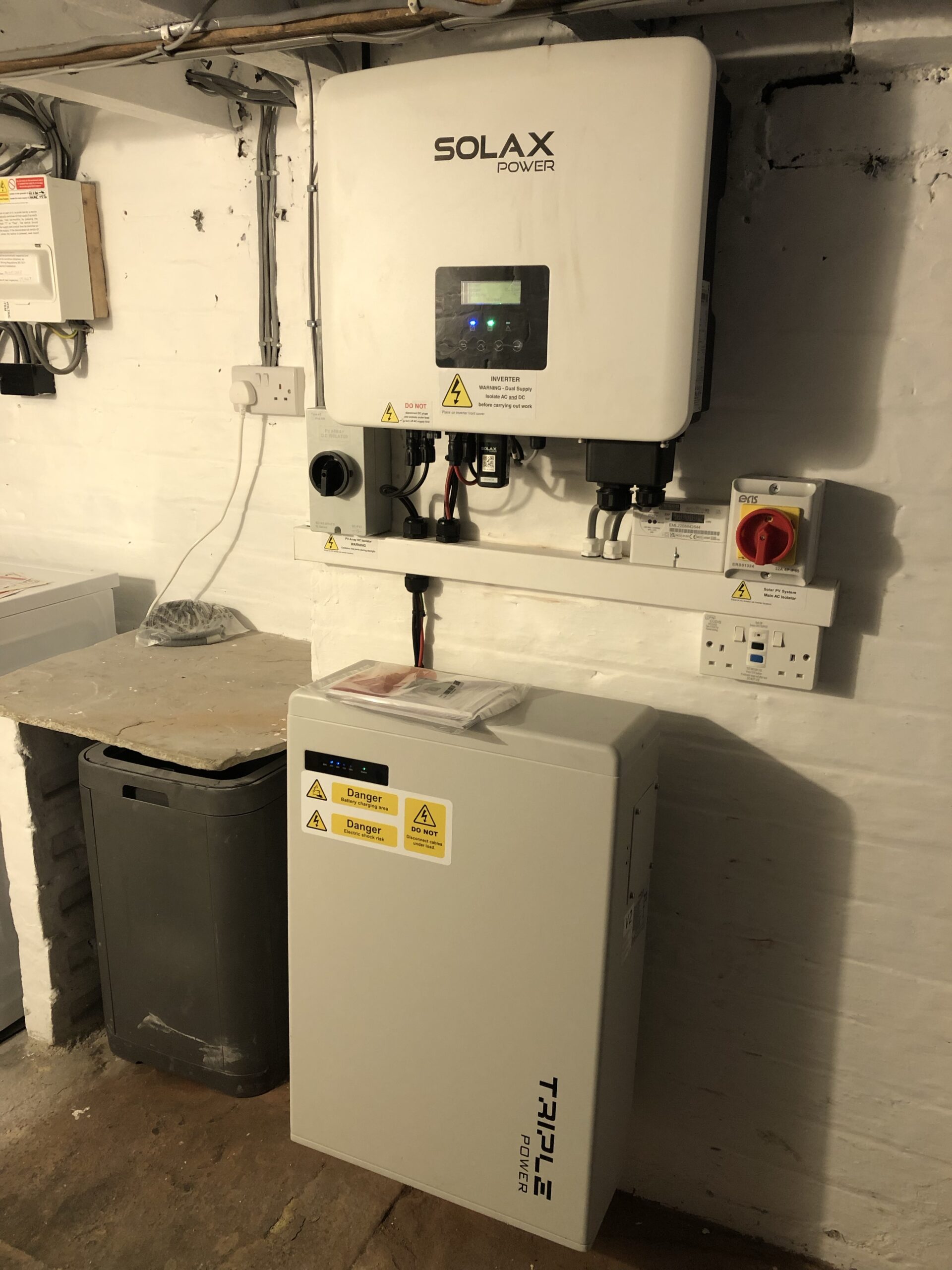
I would show you a photo of them, but that’s hard to do without also sharing a photo of our house, which I’m loathed to do publicly. Instead, here’s a photo of the interior kit – namely, the inverter and the battery.
The battery is an optional add-on to solar systems and is designed to offer additional off-grid power at the time when the solar panels aren’t working – i.e. dull days or at night. It can store up to 6 kWh of electricity, and there’s a pair of plug sockets that are attached to the battery, meaning that we have backup electricty in the event of a mains grid power cut.
Here are our reasons for having a solar panel installation:
Saving money
Energy prices have increased everywhere recently, but especially in the UK where many of our power stations work by burning natural gas. Gas prices were already on the rise when Russia declared war on the Ukraine, and pushed prices even higher as countries started to reduce their reliance on Russian gas. So, switching to a renewable source of power that doesn’t cost money to generate (once the panels are installed and paid for) seems like a good idea.
January is a bit of an odd time to have them installed, though. The days are short, and we only get about 6 hours of usable daylight for generating electricity as I write this – normally 9:30am until 3:30pm. Yes, it’s light from around 8am but the sun needs to have moved around sufficiently to be shining onto the panels to get more than just a few watts of power.
Last week was very, very cold but with clear, sunny afternoons. That was enough for the panels to generate around 2.5 kW – and normally, when I’m working at home without any appliances on (e.g. washing machine, dishwasher, cooker etc.) we only use about 250 W of power. So, that’s a lot of overflow to also charge the battery and there were several days where it was fully charged at sunset. That then gave us enough power for teatime and up until beyond bedtime, meaning that we weren’t paying for grid energy.
Right now, it’s saving us between £1 and £2 per day, depending on the weather and how much energy we’re using. Our savings will increase soon, once we have our Microgeneration Certification Scheme (MCS) certificate, which will allow us to be recompensed for the excess energy that we can sell back to the mains grid under the Smart Export Guarantee. Realistically it’ll be the end of next month before this is up and running, but it means that, once the battery is fully charged, we can make a bit of money back. Not much – at best, we can earn about 16p for kWh at present, which is less than half the 34 kWh we pay to use electricity – but we would already be a few pounds up by now if it had already been in place.
The app which links to the inverter can be configured to calculate your savings, so we have an idea of how much money we’re saving.
Doing our bit for the environment
You may choose to believe that climate change isn’t real, but I’m convinced, along with something like 99% of climate scientists that it is happening. So having solar panels means that we can actually do something tangible about it. Whilst renewable energy sources are forming an increasing proportion of Britain’s mains grid energy mix, burning natural gas is still the source of the majority of our electricity, and there are CO2 emissions involved. Also, gas supplies are finite, and so regardless of whether you believe in climate change, there will come a point when we run out of gas, or have to go to greater lengths to access it. Again, the inverter’s app approximates how much CO2 we’re saving, which is over 50kg in just over a week. I reckon that’ll be half a tonne by the end of the year, which seems like a staggering amount for just one household.
We are, of course, parents, and so by doing our bit, we can show our seven-year-old that we care about the planet that they’ll inherit.
International Geopolitics
I’ve mentioned Russia’s invasion of Ukraine, and I suppose this could be a small act of solidarity with the Ukrainian people. Whilst Britain only sources a small amount of its gas from Russia, if that could be reduced to zero then that’s a lot of money that Russia isn’t getting to fuel its war machine. I’d like to think we’re helping, even if it’s only a tiny contribution.
Resilience
I mentioned above that, attached to the battery, are a pair of plug sockets which draw power only from the battery. If there’s a power cut, then these sockets will still provide power, so long as there’s some charge left in the battery. Indeed, the inverter normally avoids depleting the battery completely – typically it’ll leave 10-20% charge behind.
Even it’s sunny and the panels are generating, should the mains grid go offline (i.e. we get a power cut), then unfortunately all the regular sockets and lights in our house will go off too. But this extra pair of sockets will keep going, and so we could, for example, run a long extension cable up from the cellar to the freezer, to keep that going. We’ve had a couple of short power cuts in recent months, but these have been no more than 10 minutes at a time thankfully.
What to consider if you want solar panels
Our system cost a low five figure sum to install, and was done by a local firm. We got three quotes and all were almost exactly the same, so this seemed to be the going rate. There’s a great guide on MoneySavingExpert about whether they’re worth it, and I suggest that you also read that, as well as my own experiences.
These are things you need to consider:
You need a pro-dominantly south-facing roof; ours faces south-west, which is okay but not perfect. If your roofs point east or west, then solar panels probably aren’t for you.
You will get more out of solar panels if you can use the energy whilst it’s sunny. So, you’ll need to use the delayed start on power hungry devices like tumble dryers and dishwashers, so that you’re using them when the panels are working. If you work at home, you may benefit more, and especially if you have an electric or plug-in hybrid car that you can charge at home during daylight hours.
Solar panels will help with electricity, but not with your gas bill. So, you’ll get less of a benefit if you have a gas oven, or if you don’t have an immersion heater in your hot water tank. Annoyingly, in hindsight, we ripped out our hot water tank in 2016 and replaced it with a combi gas boiler, although as part of our kitchen renovations, we bought new electric hobs and ovens. Conversely, if your heating and hot water is electrically-powered, perhaps using a heat pump rather than a gas boiler, you could benefit more from solar panels.
In a similar vein, to maximise your savings, you may consider boiling an electric kettle for hot water for washing up, or using an electric shower to fill a bath. Using a slow cooker during daylight hours may be more economical than a cooker in the evening.
The return on investment period for solar panels is about 11 years, so it’s probably best to install them in a house where you don’t plan to move any time soon.
It’s probably best not to borrow all of the money for solar panels. Whilst you can save hundreds of pounds per year, through less usage and selling back your excess to the grid, the interest payments on any borrowings will extend the return on investment period. We’re borrowing around £4000 to fund the panels, which I’m funding using a credit card balance transfer to keep the interest down, but the rest was savings and a parental gift.
You probably won’t need planning permission, unless your house is a listed building or you live in a conservation area.
I’ll aim to post again in the summer, once our Smart Export Guarantee is set up and we have some sunnier weather, to indicate how much we’re saving.
Back in 2019, my grandfather passed away, a few weeks shy of his 99th birthday. Whilst he had generally been in good health, considering his age, he had been taken to hospital with an infection. My grandmother had died 10 years earlier and we think he decided that it was his time to go.
This might seem like a rather sad and confusing way to start a blog post about a new kitchen, but his passing meant that I inherited a sizeable sum of money once all of his affairs had been sorted. We used some of this money to renovate our child’s room, a small amount was invested and I used some to fund a postgraduate university course.
The rest was used to renovate our kitchen. We moved to our current house in 2015, which is an early twentieth century property that’s needed quite a bit of work over the past 7 years. We renovated all of the rest of the downstairs before we moved in – mainly out of necessity due to damp issues – but had only made minor changes to the kitchen at the time. These were limited to a new washing machine, new power sockets and a new laminate floor.
The old kitchen mostly dated from the 1950s, when what was presumably a Yorkshire Range was removed and the chimney breast covered up. It had some new units and work surface in the 1980s/90s, when the previous owners also blocked up the access to the cellar underneath. So in all it was very dated, and once the money and opportunity came to renovate it all, we decided it needed updating.
We actually started the process over a year ago, although it wasn’t until February that we paid the deposit, and work started in May. During May we had a makeshift kitchenette in our dining room – we moved the existing fridge and freezer out, and purchased an Ikea Tillreda portable induction hob for cooking, in addition to our existing Instant Pot, microwave and kettle. Between these, we could cook most things that didn’t require an oven.
By early June the kitchen was substantially finished, but some small jobs weren’t complete until September and our decorators only finished painting it last week. As it stands, we don’t yet have the replacement fridge-freezer but it’s on order and should be here by Christmas.
Here’s an overview of what we changed:
Opened up access to the cellar. We removed the kitchen cupboards and work surface that were built over the steps down to the cellar, and installed a new bannister. We could then move our washing machine out of the kitchen and into the cellar, where it’ll soon by joined by a tumble dryer which we’ve not had before. This also gives easier access to our gas and electric meters, which we also had replaced with smart models, and gives us more storage space. As part of this, we had the cellar window replaced (the old one was broken and not watertight) and a radiator installed, along with plumbing and electrics for the washing machine.
Opened up the chimney breast. Previously there were some small but deep cupboards that were where the range presumably used to be, but these were awkward to access. Instead, we’ve got two wide draws for cookware and utensils, along with the hob and recirculation unit.
Induction hob. Speaking of these, we ditched our gas-powered oven and hob unit, and replaced it with an induction hob and two electric fan ovens. The old cooker unit was small and only had four rings; it was actually smaller than the space allocated for it and so we must have dropped all sorts down the side of it over the years. The replacement induction hob is twice the width and has five zones. It also heats up pans much quicker, although we had to replace the majority of our cookware as many of our older pans were not induction-compatible (i.e. they didn’t have any magnetic material in them). Not that this was a bad thing – many of our pans were cheap ones bought when we were students, whereas we could afford better ones this time. Switching away from gas to electric is also safer (no naked flames) and better for the environment, although we still have a gas boiler for heating and hot water.
Ovens. We opted for two identical large Bosch ovens, each with a grill, rather than a unit with a large oven and a smaller combination oven/grill (I believe Americans would call the grill a ‘broiler’). These are built-in and mounted off the wall with drawers underneath, making it easier to get food in and out of them. The ovens perform significantly better than our gas oven did – much shorter cooking time, and we particularly appreciate the pizza mode.
Recirculation unit. Above the hobs is an air recirculation unit, which sucks up cooking fumes, filters them and then has an exhaust back into the kitchen. Ideally we would have the outlet leading outside but this is still better than before: previously, we had an extractor fan that was on one window, well away from the cooker, and it hadn’t worked for a couple of years anyway.
New fridge-freezer. This hasn’t arrived yet – we only ordered it last weekend – but we decided to have one large unit that would replace the existing under-counter separate fridge and freezer. Both have seen better days; the brackets holding the bottle shelf in the fridge have broken off and the plastic drawers in the freezer are cracked. Plus, it’s not great having to constantly bend down to access the fridge, so we’ve gone with a wider, American-style fridge-freezer with the fridge compartment above. It’ll also have a cold water dispenser, which will be useful for me when working at home on hot summer days. It’s a Hisense model which seems to score well in independent testing.
More storage. One major issue with our previous kitchen was small cupboards, which we filled before we’d even unpacked all of our cookware, crockery and food. This time we’ve gone for more storage; the centrepiece being a full height larder where we can store (just about) all of our food and drink. We also have more, bigger drawers; like with the fridge-freezer, this should reduce the amount of bending down required. The major benefit of having more storage is that we can put more things away and keep our work surfaces clear – before, we had to keep all sorts out due to a lack of space and so often our utensils would get covered in grease.
Easier to clean. By being able to put more things away the whole kitchen should be easier to keep clean, and we’ve gone for relatively simple fixtures to facilitate this. We’ve also gone for painted walls; before, the walls were covered in wallpaper which over time had absorbed grease and all sorts.
Better lighting. Previously the kitchen had two long fluorescent strip lights, although I replaced these strips with LED bulbs a couple of years ago. Unfortunately one strip stopped working, and so we had a small Ikea clip-on light to illuminate the main working area, which helped but also meant we couldn’t close the cupboard door it was clipped to. In the new kitchen, we have under-shelf lighting for all of the worksurfaces, and seven spotlights in the ceiling.
Two radiators. When we moved in, there was just a small electric fire to heat the kitchen; when we had the new boiler installed in 2016, we had this replaced with a standard radiator but it had to be small to fit the space. That radiator is now in the cellar; whilst its replacement is also small, we have a much larger tall radiator at the top of the stairs down to the cellar. Apart from when the oven was on, the kitchen was one of the coldest rooms in the house before.
New smart dishwasher. The old dishwasher that was there when we bought the house was terrible; sometimes, our crockery would come out more dirty than when it went in, despite our efforts to clean it out. We didn’t specifically ask for a smart dishwasher but our kitchen company provided one – I understand that earlier this year there was a worldwide dishwasher shortage and that’s what they could get. As with the other built-in appliances, it’s Bosch, and uses Home Connect, which is fully compatible with Alexa, Google Assistant and IFTTT. Mainly it’s useful for getting a phone notification for when it’s finished, or when the salt or rinse aid needs re-filling, and you can ask Google how long it has left. Most importantly, it works really well as a dishwasher, and we’re able to use it more extensively than the old one, including washing cookware.
Tumble dryer. This is actually going in the cellar, but previously we had to use a ceiling mounted drying rack for drying clothes – which inevitably ended up smelling of bacon or whatever else we were cooking as well as getting in the way. Whilst we have also bought a heated drying rack, it takes around 24 hours to dry a full load, and having a tumble dryer will help for bulkier items like bedsheets and towels. It will use more energy, but we’re using the last of our savings to have solar panels and a battery installed next month; this was another reason for switching from gas to electric for cooking. We’ve opted for a Grundig dryer which is a heat pump model, and therefore has much lower running costs than condenser models.
We have had to make some compromises with the new kitchen, which is namely work surface space. To be able to fit in access to cellar and the larder, we have significantly less work surface available, but the extra storage means that we can actually keep what we have clear and so the amount of useable space is about the same as before. And as mentioned, we had to buy new pans from ProCook, but those that we’ve bought are a significant improvement over our old pans anyway.
It’s been a long journey, but by Christmas it should all be finished. Back in March I actually made a short video listing all the things that we hated about the old kitchen and how we’re addressing them, which informed this blog post. We’re very lucky that we inherited enough money to be able to get a kitchen which better suits our needs; it not only looks good but also works for us. I hope my grandfather will be happy with what his inheritance has allowed us to get.
We still have more work to do on the house; the downstairs is almost done but two of the three bedrooms need work in time, as does the stairwell and upstairs landing. We’ve done some redecorating in the bathroom which has made it look less 1980s but eventually it’ll need replacing. I’m hoping that we’ll be able to save some money once the solar panels and battery are installed next month.