So, now that I’m sending out email newsletters, I need to be sure that people will actually receive the emails. Because email spam is still a problem after all these years, the big webmail providers have strict requirements to ensure that email reaches their user inboxes, and AboutMy.email is a really simple testing tool.
When you open the web page, you’ll be given an automatically generated unique email address. All you need to do is send an email to this address, preferably by adding it to your email list. Once the email comes through, AboutMy.email will analyse it, and let you know what you need to improve.
I had already set up DMARC, DKIM and SPF on my domain, and so, as you can see from the screenshot, it scored quite well. Other things that I’ve gained points for are my site having an IPv6 address, and using TLS for email connections.
To improve the score further, I’ve subsequently added a BIMI record, and need to look into adding unsubscribe headers from my emails. But it’s a very good start, and should reduce the chances of my emails ending up in user’s spam folders. I like how simple AboutMy.email is – you don’t need to register an account, and there’s no spam follow-ups afterwards (which would be ironic I suppose).
If you’re lucky enough to own your own home, and are paying off a mortgage on it, then you may want to consider signing up to Sprive.
Sprive is an app for iOS and Android, that lets you easily make over-payments on your mortgage. Once you’ve registered, it’ll ask to link to your bank account using Open Banking, and you can then set a minimum and maximum amount to over-pay each month.
The minimum payment can go out on a date that you set, and then Sprive will monitor your current account balance and suggest further payments if you have sufficient money left. Sprive normally gives you a notification a few days before it talks a payment and they’re easy to cancel.
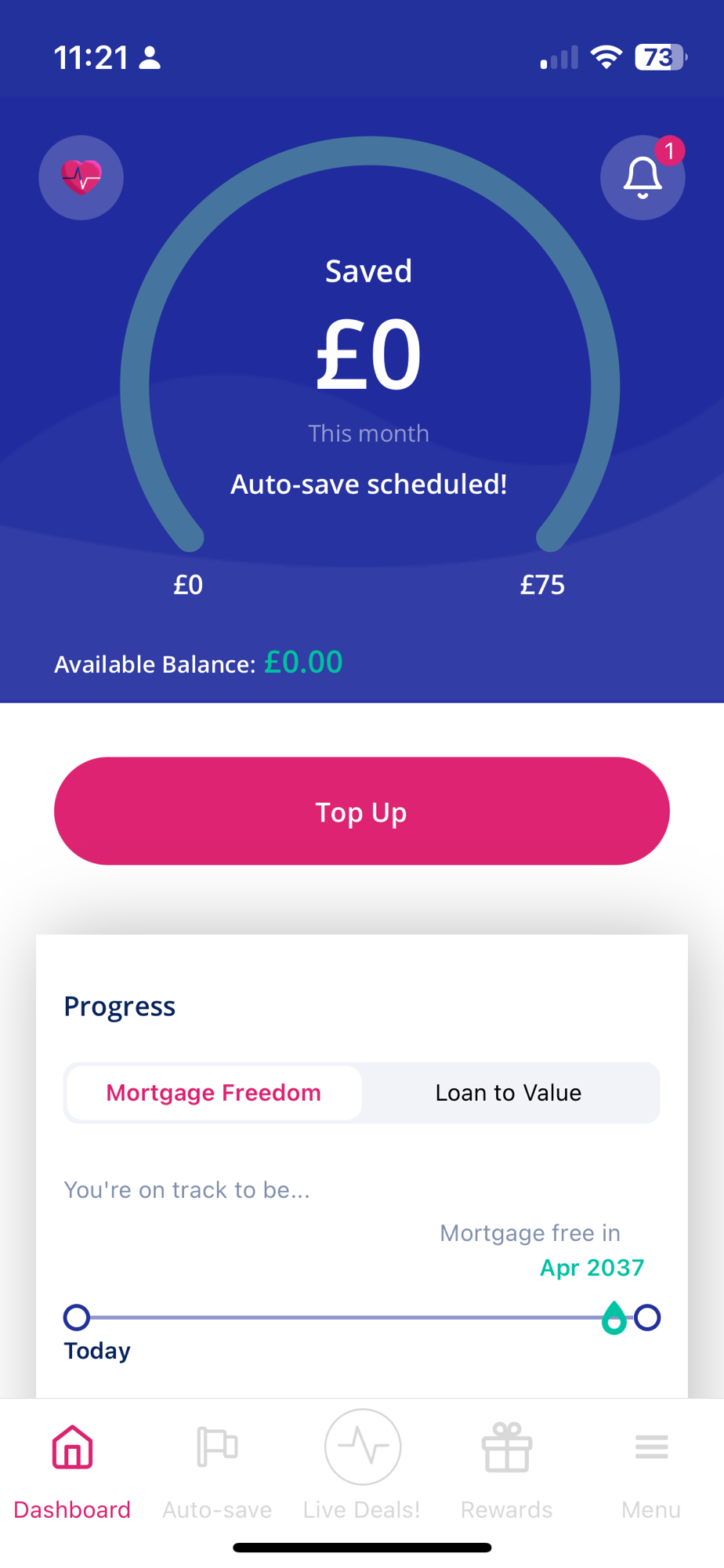
I’m using the absolute minimum amounts – £25 per month, and a maximum of £75 per month. However, even such small additional contributions should mean that we pay off our mortgage earlier. The Sprive app visualises this, and reckons we’re on track to be mortgage-free about 18 months earlier than we would be without over-payments. That translates to around £2000 less interest that we would have to pay otherwise. It’ll also show you what loan-to-value rate you are eligible for, and how much of your house you own. Having bought our house not quite 9 years ago, we now own 55% of it, although this is more due to the house increasing in value rather than our repayments.
Sprive Rewards
As well as siphoning off money from your bank account, there’s Sprive Rewards. This allows you to buy gift cards for many retailers (including all the major supermarkets) where a percentage is then used as a mortgage over-payment. For example, you could buy a £50 Tesco gift card, and have 3% (£1.50) used as an over-payment. You can, of course, use these gift cards for your own shopping, so whilst the savings may not seem like much, they can add up. You can even save 1% with Amazon; when I spent £75 there recently, that 75p has the potential to save me as much as £16 down the line in mortgage interest. I’m not a fan of gift cards, but this is where they can be used to save money.
MoneySavingExpert has a useful mortgage overpayment guide, including what you need to bear in mind. Most mortgage providers do let you overpay up to 10% of your mortgage each year, but it’s worth checking your paperwork. If you over-pay too much, you may pay a penalty for doing so.
If you like what you’ve read, and want to sign up to Sprive, you can use my referral code which is HTWH65PM. This will give you an additional £5 head start – so it’s basically free money, albeit not much and only redeemable as an over-payment on your mortgage.
I hope you’re having a restful Easter break. We’re staying with my parents in York for a couple of days, as per usual (barring 2020 and 2021) and I will no doubt consist of at least 40% chocolate by the end of the day.
Easter has come comparatively early this year. Not as early as 2008 (23rd March), and the absolute earliest it can be in the Gregorian Calendar is the 22nd March. The last time it was that early was in 1818, and it won’t happen again until 2285. Still, the last time Easter Sunday fell in March was 2016, and next year it’ll be very late – the 20th April.
Despite Easter falling early, it’s still felt like a long time since the Christmas break, and I’m appreciating an extended weekend off work. As well as the Good Friday and Easter Monday bank holidays, we get Tuesday off work too, every year.
When you need to buy a present for someone, and aren’t sure what to get them, gift cards seem like a good idea. With Christmas coming up, I’m going to explain why they’re not always the best idea.
They’re less flexible than cash
If you spend £10 to buy a £10 gift card, all you have done is taken £10 of cash, which can be spent anywhere, and converted it into a sort of pseudo-currency that can only be used at one shop. You can’t use a gift voucher for John Lewis at M&S for example.
Whilst multi-retailer gift cards like Love2Shop and One4All exist, they still limit you to a small range of retailers. And you can usually only spend them at large chain stores, so your recipient won’t be able to spend them at a local, independent shops. Let’s face it, Amazon is likely to be around for a long time, but independent shops would probably appreciate your custom.
For someone who may be drowning in credit card debt, receiving some money that they can use to pay that off may be more meaningful. At worst, you could end up spending your money on a gift card that can only be used to buy something at a shop where the cost of getting there is higher than the value of the card.
They could also be worthless. If you’re an Android phone user, then you’re not going to get much out of an iTunes gift card, for example. You could try a web site that exchanges gift cards, where you can sell an unwanted gift card for cash. However, you’ll probably get less than its value back, and obscure gift cards may not sell for much.
They expire
Most gift cards expire after 12 months. We’ve had this problem before; a relative bought our (now) seven-year-old a gift card for a well-known toy shop chain. As their birthday is close to Christmas, we saved it to buy a gift the following year, but by the time we came to use it, it had expired. Meanwhile, cash never expires.
If the retailer goes bust, they may become worthless
We’ve recently seen the demise of Wilko in the UK, and other large chain stores like Debenhams, Jessops, Comet, Woolworths, Burtons have all disappeared in recent years. Usually, when these companies go bankrupt and call in administrators, their gift cards immediately become worthless. At best, you can sign up as a creditor of the company in the hope that you may get a fraction of the value of the gift card back.
Some people have lost serious money because of this in the past. Debenhams used to offer a wedding list service, and so those that had people buy them Debenhams gift cards as wedding presents may have lost out on hundreds of pounds.
What to do instead
Buying presents can be tricky, and I don’t think anyone wants to buy something that’ll just end up listed on eBay on Boxing Day. But maybe have a conversation with the person who you are buying a gift for first. Surprises can be nice, but so can knowing that you’re getting a thing that you actually want for Christmas. Christmas lists for Santa needn’t just be for children; you could keep a list in a note-taking app, for example, so that if anyone asks you what you want, you can tell them straight-away.
Or you could just give people cash. If all you are doing is swapping the same amount of money for a card which is restricted to one retailer and expires, then you’re taking choice away from your recipient. With cash, your recipient could use that money for:
the weekly food shop
to pay off a credit card
buy something nice from a small independent shop.
An Amazon gift card won’t allow the recipient to do any of those things.
If you don’t want to put bank notes or coins in the post, you can send a cheque. Despite rumblings from the banking industry a few years ago, most banks will still let you send and receive cheques. Indeed, most banking apps will let you scan cheques, so you can scan them on Christmas Day without waiting for a branch to open. Alternatively, you could send an IOU in a card, and then do a BACS transfer on Christmas Day. That’s if you already know their bank details, of course.
When is it appropriate to send gift cards?
So, now that I have written this, you may be surprised to hear that I am planning to send gift cards to some relatives this Christmas. But this is only because said relatives have specifically asked for them. And that’s fine – you could ask for gift cards as a contribution to a big purchase, for example. Just be careful that you choose a retailer that isn’t at imminent risk of bankruptcy. Money Saving Expert News is usually a good place to get news about retailers that are, or are at risk of entering administration, and their policy on accepting gift cards.
You can also sometimes buy gift cards at a discount. My employer offers Pluxee as an employee benefit, which sells gift cards at a typical 4% discount – but sometimes more. M&S is 6.5%, which means that you can buy a £25 gift card for £23.38.
If your employer doesn’t offer something similar, but you have a mortgage, then Sprive is worth considering. With Sprive, the discounts are smaller (about 3%) but the money you save is taken off your mortgage. If you decide to sign up to Sprive, use my referral code ‘HTWH65PM’ to get an additional £5 off your mortgage.
Christmas Day is three weeks today. If you haven’t already finished your Christmas shopping, maybe reach out to your gift recipients to find out what they want. Just be aware of the last posting days for gifts.
So today’s my birthday. I’m 32, which isn’t a particularly notable age, other than the realisation that my GCSE exams were half a lifetime ago. So rather than ramble on about how I’m feeling old, I thought I’d look back at what I’ve written on my birthday in previous years:
I’m actually surprised that several years went by where I didn’t think to write anything on my birthday. That may have something to do with not having the ability to schedule blog posts in advance back in ye olden days. 2005 was a particular surprise, as back then I often posted new entries multiple times a day – this was in the days before Twitter and the like.
As for 2017? Well, I have a whole year to think of something to write, I suppose.
We’re not doing much for my birthday – I’m at work as normal today (and have a two hour afternoon meeting!) but we’ll probably go out for dinner tonight.
The Guilty Feminist is a relatively new podcast with the sixth episode due to be posted this week. Each episode is recorded in front of a live, fee-paying audience, and focusses on a particular topic. Last week was advertising, and this week will be about exercise. Last night’s recording, at the Waterside Arts Centre in Sale, near Manchester, was for two episodes, on womens’ magazines and on self-worth. There’s always a special guest and Sarah Millican, one of my favourite stand-up comedians, was at the recording I went to. She founded an online womens’ magazine called Standard Issue (which I read from time to time) and she explained her reasons for setting it up on the show.
I’ve been listening to The Guilty Feminist since it started, having been aware of Sofie Hagen from some other projects – she has her own podcast called Comedians Telling Stuff and she’s won a couple of prestigious best newcomer awards over the past couple of years. It’s a good show – around 45 minutes, with a mixture of stand-up and discussion around the topic of the week with the special guest. Because the audience pays to see the recordings, there’s no advertising or plugs for Audible or Squarespace, or requests for donations, which is refreshing. And there were free macaroons for the audience too, but you’ll have to listen to the podcast to find out why.
Unfortunately I wasn’t able to bring Christine with me to the recording. We weren’t able to arrange any childcare, and, as the show was being recorded, it wouldn’t have been appropriate to bring a baby with us in case they became disruptive. So, it was just me, on my own, in a predominantly female audience. Still, I had a good time and was really pleased that I went.
The shows that were recorded yesterday will go out at different times – the first in a few weeks and the second in the summer. I’ll tweet about them when they’re up, but in the meantime, you can listen to the other episodes on iTunes. There are further recordings coming up – one tonight in London, and then some in Denmark and Australia – and I’d recommend checking them out.
2016 is a leap year, and it’s the last day in February, so today is the rare occasion where you can enter the date as the 29th February into a computer and it won’t reject it. We don’t have anything much planned specially – I’m having an eye test for the first time in… um… longer than I care to admit, and Christine will be at home looking after our baby.
The last time it was the 29th February, back in 2012, it was me that was at home all day. That’s because I was ill with a stomach bug. It was enough to keep me off work for a couple of days, which is impressive as I very rarely have to take sick leave from work.
Going further back to 2008, I went on a walking weekend on the east coast. We stayed at a youth hostel north of Scarborough, and walked along the coastal path towards Robin Hood’s Bay.
And in 2004, I didn’t really write anything interesting, but that’s because we didn’t have Twitter or Facebook in those days and so my blog was home to more inane ramblings.
As I ‘only’ started blogging in 2002, I can’t quite remember what I would have done on February 29th 2000, but it was a Tuesday. So I was probably at school, preparing to take my GCSEs. Scarily, 2000 was half a lifetime ago for me.
Do you get the impression that I always aim to write something on the 29th February, no matter how pointless it is? It’s an opportunity that only comes around every four years I suppose. Maybe something interesting will happen on this day in 2020, but you’ll have to wait another four years to find out, I’m afraid.
We finally unpacked the Christmas tree yesterday evening, along with the TV and its various set-top boxes. We’ve been without a TV set since we moved at the back end of September, and it has spent its time sat in the baby cot until now. Our living room still has some way to go before it’s finished – quite a bit more painting, along with some work to fix an incoming damp problem – but we’ve made a snug corner for watching Christmas telly.
It’ll be a quiet Christmas day for the two of us, as it’ll be our last Christmas solely as a couple, what with the imminent arrival of our future child. So we’re spending time together without anyone else today.
Because humans are awful, after you’ve undergone ‘the miracle of birth’, you or your partner will have some paperwork to do. Whilst living in the UK means that we don’t have to go through any health insurance paperwork, there are some formalities that have to be completed after your baby is born.
Although our bundle of joy isn’t quite here yet, I have spent some time looking into what we need to do after he/she/they decides to arrive in the world.
1. Register the birth
Once the baby has been born, you or your partner has 42 days to formally register the birth. This makes sure that the child ‘exists’ from a legal perspective (I think – I’m not a lawyer). It should be done in the district where the child is born, at a register office run by the local council. For us, that’s with Calderdale Council in Halifax, provided that our child is born as planned in our local hospital.
Each council will handle things differently, but you’ll probably need to make an appointment, rather than just dropping in. I’d suggest looking on your local council’s web site to see what their arrangements are.
Traditionally, registering the birth has been the job of the father of the child, but in this enlightened age, either the mother or her partner can do so. Before you go, you’ll need to have chosen and agreed a name for the child. Don’t do what my grandfather did: he forgot the name on the way to the register office, and as this was the age before mobile phones, he just put down what he thought was correct. So my aunt ended up with a different name.
You’ll also need to wait until the child has been born – you can’t register a birth if the birth hasn’t actually happened yet. However, you don’t need to wait until a child has left hospital; indeed, if your baby needs special care, it may need to spend more than 42 days in hospital.
Once the registration is done, you will receive a short-from copy of your child’s birth certificate, which you’ll need for the next step. However, you’ll also have the option to buy a full certificate, which includes your details (and those of your partner, if applicable). I would recommend buying the full certificate, for reasons that will become apparent later on in this blog post.
2. Claiming child benefit
Currently, the British government will pay you £20.70 per week to look after one child, plus an additional £13.70 per additional child. Nowadays, this benefit is paid every four weeks into your bank account. The amount you get is fixed at one of these two amounts – it’s not income-assessed, so you will receive the same money regardless of how much you or your partner earns.
You can download the form from the gov.uk website. When you’re in hospital, you may get accosted by a representative from a company called Bounty who will offer the forms as part of a pack, in return for your (and your baby’s) personal details. I’d suggest asking the Bounty rep to live you alone, to give you time to bond with your new baby in peace, and then print off and complete the form yourself. The completed form then needs to be sent by post with your child’s birth certificate – this has to be the original, so photocopy it first before you post it.
If you’re well off, you can choose not to claim the benefit, but you should still send the form off. This will benefit you as a parent, as it will ensure that you get National Insurance credits during any time off work, thus avoiding any shortfalls when calculating your state pension entitlements at retirement. It will also benefit your child; completion of the form will mean that he/she/they will get a National Insurance number at age 16.
Although Christine and I are reasonably well off, an extra £89 per month will be very welcome. It doesn’t sound like much, but it’s effectively a small pay rise for you.
3. Informing your employer
If you’re working and taking maternity or paternity leave, you should have informed your employer long before the birth of your intention to take leave. And, if your baby arrives on time, you probably won’t need to do anything. However, if you give birth early – i.e. before the start of your agreed maternity leave, you’ll need to speak to your employer to get them to move your maternity leave forward.
4. Getting a passport
This third step is optional, and only necessary if you plan to go on an overseas holiday with your baby.
In ye olden days, children could travel on their mother’s passport. Nowadays, every travelling person must have their own passport, even if that person is tiny and very new to this world. Instructions for how to apply for a child passport are on gov.uk. You will need that full birth certificate that you should have paid for when registering your child’s birth at the council register office. You’ll also need to get your child to stay still long enough with their eyes open to get a photograph. Unlike adult passports, child passports are only valid for five years.
5. Do a benefits check-up
The arrival of a child into your household, especially your first, can affect your eligibility for various benefits. Some, like Child tax Credits, may become available to you for you for the first time, but your eligibility for others may cease. When you register the birth, your registrar may mention a service called ‘Tell Us Once’, which allows the council to pass your details to various other government agencies, to re-calculate any benefits payments. If not, you may need to speak to your local Job Centre, and HM Revenue & Customs.
If you’re on a lower income or already receiving some benefits, you may be entitled to a £500 Sure Start Maternity Grant to help with the costs of buying equipment for your baby. It’s a one-off grant that doesn’t have to be paid back. You can download the form, print it off, complete it, and then return it by post, or to your local Job Centre. If you need any more help with the cost of parenting, I would recommend booking an appointment at your local Citizens Advice Bureau.
Becoming a parent seems to be a rather daunting thing, and when faced with the prospect of looking after a tiny, helpless human child, the thought of completing paperwork is probably the last thing on your mind. Sadly, in the modern world, it’s something all new parents have to do, and that’ll include us soon.
Wednesday last week marked 30 months of marriage for Christine and I. Co-incidentally, the Irish comic Dara Ó Briain was performing his latest show Crowd Tickler in Halifax on the same day, and a handful of tickets were still available the week before, so we went to see him.
This was the second time we’d seen Dara in Halifax; we also saw his previous show, Craic Dealer, a few years ago. If I’m honest, I was a bit disappointed with Craic Dealer, having not found it as funny as some of Dara’s other material. We’d seen This is the Show (or ‘TITS’ for short) broadcast on TV, which is worth watching as and when it’s available, and we always make time to watch Mock the Week when it’s on.
Fortunately, Crowd Tickler is a great show. It’s part-improvised, based on interactions with the audience and some local factual knowledge that Dara has gleamed either through research or previous visits. If you get front row seats to one of Dara’s gigs, expect to be asked a number of questions throughout the show. Thankfully, Dara isn’t the sort of comedian to utterly ridicule you but there may be a few laughs at your expense.
My favourite routine was about TV dramas, particularly on streaming services like Netflix, and how there are so many and that they can sometimes tend towards the utterly ridiculous – ‘a Scandinavian crime drama about a detective who smells crime scenes!’. Which was funny in itself, until Dara pointed out that this is basically the plot of Marvel’s Daredevil.
And then he went about improvising our own crime drama, based on audience suggestions. So we ended up with a detective with Tourette’s who used to be a taxidermist, investigating a ping pong player who killed someone with a rollerskate.
Another of my favourite routines of his was about tunnel boring machines. Doesn’t sound like the most interesting subject but if you see people tweeting him ‘Poor Chuggy!’ after a gig, then you’ll know why.
Crowd Tickler is almost at the end of its run with only a few more shows left – Dara has been touring it for over a year now. There’s just a couple of UK dates, a few nights in Dublin, and then he’ll be off to tickle various European nations in the new year. Fortunately, a DVD of the show is due out in a little over a week(sponsored link), and based on what we saw, it should be a very good show to watch.