Yesterday, clocks in Britain went back an hour, marking the end of British Summer Time. We’re now following Greenwich Mean Time, through the winter until the 27th March 2016.
It used to be that people would have to change every clock manually, when daylight savings time started or ended. But as computers and devices got smarter, they could be pre-programmed to change the time automatically.
My parents’ first PC originally didn’t change the time by itself, as it wasn’t supported in Windows 3.11. But we later upgraded to Windows 95, and I was pleasantly surprised to see a message one morning on the screen, telling me that Windows had automagically changed the clock for us. Later versions of Windows just did the time change on the quiet, and most other operating systems do the same nowadays.
We’re now in that stage of technological innovation where some of our devices can change the time automatically, but not all. Our phones, computers and tablets are all capable of it. Our Freesat satellite TV set-top box just needed turning off and on again to update the time. Even my Fitbit Charge changed automatically too, which was nice.
I still had to manually change the central heating controls, though. We’re planning to get a new central heating system sometime in the next couple of years and I expect we’ll get a smart thermostat which will have daylight savings capability, so changing the time for heating won’t be an issue in future.
The only other device that I had to change was our basic analogue clock in the kitchen. Short of wiring up some kind of Arduino device to it, I doubt I’d ever be able to make it change automatically.
Still, it’s nice not having to spend all morning re-programming things like we did in the past.
On Wednesday, we will finally give back the keys to the flat that we’ve rented for the past four-and-a-half years. As with most tenancy agreements, we’re required to give the flat back in a clean, tidy state, and so we spent most of Saturday cleaning.
Whilst we had vacuumed the carpets… occasionally in that time, at no point had they been properly cleaned since we moved in. So, we hired a carpet cleaning machine.
Hiring a Rug Doctor
Our local Tesco allows you to rent Rug Doctor machines: £23 for 24 hours, or £29 for 48 hours. You have to book in advance, although the night before is fine, and you can do it online or by phone. The rental charge is paid upfront, and in return for your fee you get an email with a code and locker number at the location selected.
When you go to pick up the machine, you find the Rug Doctor display, open the locker with the code given, and collect the machine, a handheld tool for stairs and corners, and an instruction book. You also need to buy the detergent at this point which you pay for at the checkouts; it’s £10 for a bottle that does 1-2 rooms, £15 for a bottle that does 3-4 rooms, and a larger £20 bottle.
Using the Rug Doctor
The Rug Doctor machine is quite heavy and bulky, and although it’s quite easier to move on flat surfaces, good luck getting it up stairs. However, it does the job well – you can see the difference in the photo (the light-coloured bits have been treated). It works by spraying the detergent, mixed with water, on the carpet and then brushing it. It also incorporates a vacuum to suck up the dirt. You end up with a tank full of dirty water to flush away.
It’s quite quick – you can probably do most rooms in about 20 minutes, although we found that our carpets needed two treatments as they were particularly mucky. And you will need a lot of warm water – the Rug Doctor machine requires regular top-ups and we probably went through at least 20 litres of water.
Because we had the machine for 24 hours, we also had time yesterday to clean some of the carpets in the new house. These were cleaned in the summer by the previous owner before we moved in, but they’ve ended up mucky thanks to all of the disruptive renovation work we’ve had done since. Although the carpets have been vacuumed several times, I was surprised just how much muck came out after just a few months. As an asthmatic, I’m supposed to minimise my exposure to dust and yet there was still plenty in the carpets that our vacuum cleaner couldn’t remove.
Being able to get the machine from a local supermarket was really helpful, as supermarkets tend to be open long hours and at weekends. Our local hire centre, for example, is only open until 5pm (no good for us as we’re not home by then) and is shut at weekends, so we’d have to rent their machines for longer. Although we rented ours from Tesco, it looks like they’re available at some Asda supermarkets as well.
I was impressed by the Rug Doctor – it was quick, and the results were great. Hopefully the landlord will agree when we give the keys back this week.
For those who don’t get the reference in this blog post’s title, have a YouTube video.
Now that we live in a house, rather than a block of flats, Christine and I are back to regular collections of waste in recycling. In the flats, we had access to a bin store where we could dump rubbish at any time, and this was collected by the council at regular intervals. For a time, we also had recycling bins for glass, paper, metals and plastics, although these were removed. Sadly our fellow residents were not so good at sorting their waste and our local council took the bins away due to contamination with non-recyclables. In the meantime I had to take our recyclables to our local supermarket to dispose of.
For waste from our house, our local council collects our wheelie bin every two weeks. Historically all councils have collected waste weekly but many have switched to fortnightly collections – a controversial stance that central government were opposed to. However, we still have a weekly recycling collection; in other words, one week only recyclable will be collected, and the next week all waste will be collected.
This suits us quite well, as a lot of our waste can be recycled. We’ve got into the habit of separating our waste before we dispose of it and so it only takes a few minutes each week to put these into the relevant bags or boxes and put them out for collection. As well as metals, paper, glass and plastic bottles, our council will collect food waste and textiles each week.
Separating food waste from regular waste, to me, is really important. Food waste can usually be composted, and it’s the main cause of bad smells and flies in regular waste, so it’s good that this can be collected weekly. We get a small caddy for the kitchen, and then a larger box to put out to collect, along with a series of green biodegradable bags.
Whilst we’re just a household of two people, for now at least, because we can recycle most of our waste, we manage not to fill our wheelie bin, even after two weeks. And, as an extra incentive, our local council offers entries to a monthly prize draw to those who put out their recycling every week, via a sticker with a QR code on our recycling box.
Recycling and sustainability are key at my workplace as well and we’re actively encouraged to recycle as much as possible, rather than simply chucking things in the bin. To this end, all offices have recycling bins within easy reach; you just have to think for an extra moment about which bin is appropriate for any given item.
It’s with this in mind that I read this piece on recycling in the New York Times. It makes some interesting points, but is very much focussed on the situation in the US, and not here in the UK. The US is a much bigger nation with more landmass available for landfill sites, and no tax on landfill. Here in the UK, we’re a significantly smaller island with a much higher population density, and more opposition to landfill sites which are more likely to be in someone’s back yard. Consequently, we have landfill tax to make recycling more attractive and cost-effective than simply dumping waste in big holes in the ground.
I’m happy to do my bit to reduce our household’s waste and footprint, and I’m pleased that my local council gives me this opportunity.
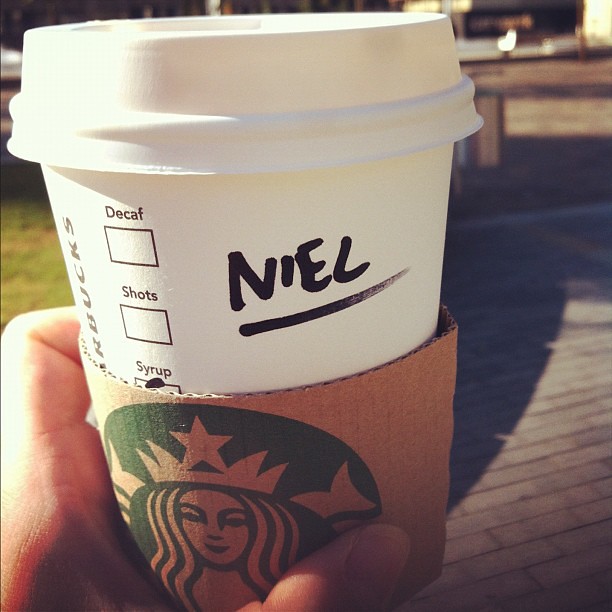
Many frequent Starbucks visitors know that its coffee comes in three sizes:
‘Tall’, which is the small size, at around 350 millilitres (12 US fluid ounces), or about the size of a standard drinks can.
‘Grande’, which is the medium size at 470 ml (16 US fl oz) and a bit less than an average drinks bottle.
‘Venti’, which is their largest size at 590 ml or 20 US fl oz. ‘Venti’ means 20 in Italian, hence the name.
Quite why they can’t use ‘small’, ‘medium’ and ‘large’ is beyond me, but never mind.
But actually, there are seven sizes in total. They’re not widely advertised, but here they are:
Short
If you look more closely at the menu the next time you’re in Starbucks, you’ll see there’s a kid’s hot chocolate on there, which comes in a ‘Short’ serving size – smaller than ‘Tall’. However, your Starbucks barista may be able to make you any hot drink in the ‘Short’ size, which will cost a bit less than ‘Tall’. I don’t think cold drinks like Frappuccinnos are available in the ‘Short’ size in the UK, but you can ask. ‘Short’ is 240 millilitres (8 US fl oz) and should be available in most outlets.
Mini
This one is US-only, and is a limited-time offer for this summer. It’s only for Frappuccinos, and is 10 US fl oz (300 ml) – halfway between short and tall.
Demi
Demi is the smallest size of them all, at just 89 millilitres (3 US fl oz). It’s basically a single espresso shot, and should be available in most Starbucks outlets.
Trenta
Finally, if you want a drink that’s larger than ‘Venti’, then try asking for a ‘Trenta’ size. It was announced four years ago in the US, but was primarily for the Refresha range of light cold drinks. However, theoretically, it may be possible to have any other cold drink in this size. At over 900 millilitres (31 US fluid ounces), this is a big drink – almost three times the size of a ‘Tall’ drink. As far as I am aware it was only ever available in certain outlets in the US, and as the Refresha range has seemingly been phased out, it’s probably no longer an option. ‘Trenta’ means 30 in Italian.
Starbucks ‘secret menu’
If you want to know more about ‘off the menu’ drinks that may or may not be available at your local Starbucks, Starbucks Secret Menu and Hack the Menu were two web sites that I found during my searches. Not all of the items on these sites are official, but if you’re in a Starbucks outlet and it’s not busy, you can probably ask the barista to vary the drink based on the recipes listed. You can also sometimes get seasonal drinks like the infamous Pumpkin Spice Latte out of season if the outlet has stock left over, and sometimes new drinks are available to Starbucks Rewards customers before they appear on the menu.
I go to Starbucks quite a lot nowadays, as I pass one of their outlets on the way to work. So much so that I’m a gold member of Starbucks Rewards. Considering that, four years ago, I didn’t drink coffee at all, it’s quite a turnaround.
If you’re like me, then this may be the first time you’ve heard of a musical theatre adaptation of Herman Melville’s famous book. The musical version dates from the early 1990s – it had a brief run in London’s West End at the Piccadilly Theatre, but closed after a four month run due to poor reviews. Don’t let that put you off though.
Moby Dick! The Musical is essentially a meta-play – a play within a play. It follows the girls of St Godley’s School – faced with closure, they put on a performance of Moby Dick to raise money to save the school. Whilst the cast is predominantly female, the role of the headmistress/Captain Ahab is usually played by a male actor in drag.
Christine has been working on the show for months now and it’s been great to see it come together. There’s just a few more rehearsals before it opens on Thursday night, with further showings on Friday and Saturday.
You can buy tickets online – they’re £10 each, or £8 for concessions. If you’re local to Bradford, it would be great if you can come along and support the students who have worked so hard to put on this show. I hope I’ll see you there!
Last month a new garden was officially opened at Sowerby Bridge railway station. It’s called the Brontë Garden, and is maintained by volunteers from the Friends of Sowerby Bridge Railway Station. It sits on a small parcel of land next to the car park, opposite platform one.
The name comes from the station’s slightly tenuous link with the Brontë family. The Brontës hail from over the hills in Haworth, in the Worth Valley, but one of the Brontë siblings was employed at Sowerby Bridge station at its time of opening in the 1840s. He was Branwell Brontë, brother of the three famous sisters Emily, Anne and Charlotte. He was later appointed at another station further up the line at Luddendenfoot – this station succumbed to the rationalisation of the railways in the 1960s and no longer exists.
The garden isn’t particularly big but does house a bench and small gravelled area, along with some planters built using old railway sleepers. There’s also a restored luggage trolley, with opened suitcases serving as planters.
As well as the garden, the Friends of Sowerby Bridge Railway Station look after various other planters on the platforms, many of which are sponsored by local businesses. It’s a relatively young group, having only been formed in November 2010 (co-incidentally about the same time I moved to Sowerby Bridge). Whilst they are a voluntary group, they’ve done quite a bit to make the station look nicer – a hard ask, thanks to its brutal concrete architectural style.
One of my lovely friends nominated me for the ice bucket challenge earlier this week. You probably know the score by now, but the idea is to raise awareness of amyotrophic lateral sclerosis, or ALS – more commonly known as Motor Neurone Disease (MND) in Britain. Throwing a bucket of ice water over yourself is supposed to simulate the effects of the condition, which is terminal and normally kills its sufferers within a few years of diagnosis. There is no cure. One of my colleagues died as a result of MND a couple of years ago.
Whilst the idea is that, after being nominated, you have 24 hours to donate or be drenched in ice cold water, thankfully most of my friends have been doing both. I’ve donated £5 to Motor Neurone Disease Association. I’ve also donated £5 to WaterAid; whilst us westerners can chuck water around as it’s in plentiful supply, there are many in the world who can’t because there isn’t enough to go around. And donations to WaterAid made in the next week or so will be matched by UKAid, so they’re worth double.
Originally I planned to do this outside – however, as we’re four floors up in our flat it would have been a long, cold walk back so I did it in the shower. My wife Christine, whose laughter you can hear in the video, filmed it on my iPhone 5 using the stock camera app. It really was very, very cold – hence why I got the name of the MND Association wrong.
This was the first time I’ve ever edited a video. I used iMovie ’09 as it was already on my Mac, and apart from one tutorial to do the silly bonus replay at the end, all the editing was done just by exploring the app. It’s reasonably intuitive. The music was from Free Music Archive. I edited out the bit about nominations, but those of you who are friends with me on Facebook can see the uncut footage on there.
When we went to Dublin, Christine and I flew with Ryanair, the airline everybody loves to hate. This is mainly because Ryanair has unbundled just about anything that can be considered optional from its fares. Which means that the basic fare is cheap, but you may end up having to pay more for things that other airlines include. For example, the ability to check in luggage to be carried in the plane’s cargo hold.
Ryanair’s carry-on baggage allowance isn’t as bad as it once was, thankfully. For each passenger, two bags – a large one and a small one – are permitted, with the largest bag limited to 10 kilograms. That’s enough for a rucksack and a camera bag, for example. If you want to check in a bag, then there’s a £20 charge per person per flight for up to 15 kilograms, so that would be £40 if we wanted to take a larger case to Dublin and back. We decided, therefore, not to check in a bag.
We found that there are several advantages and disadvantages to not checking in luggage, some of which are listed below.
It may be cheaper
I’m sure Ryanair isn’t the only airline that offers cheaper fares for those that don’t need to check in their luggage. It saves the airlines quite a bit of time and money, so whilst it’s nice to find it included in your fare, you may find that if you can cope without it, savings can be made.
You may not need to check-in in person
Most airlines allow you to check-in online, and some, like Ryanair, pretty much mandate this. Not printing your own boarding passes on such airlines can cost quite a bit of money. Consequently, the ‘check-in’ desks for low-cost airlines essentially just become ‘baggage drop’ desks, where you can check-in your luggage to go into the hold. If you’ve no luggage to check-in, then you can just head straight for the security screening area. Unless you need a visa to travel and are required to have this checked by someone from the airline, in which case you will need to go to the check-in desk first.
You can’t carry liquids in containers larger than 100ml
Liquids in carry-on bags must be in containers of 100 millilitres or less, including any shampoo for example. So for our Dublin trip we bought travel size bottles of shampoo, deodorant and the like. These cost more per millilitre than regular-sized bottles so it’s another expense to consider. Alternatively, you could buy such things after passing through security (even a small airport like Leeds-Bradford had a Superdrug airside), or once you’ve arrived at your destination. And most hotels offer complementary shampoo and soap.
There’s no need to wait for baggage reclaim
If you carry your bags with you, then once you’re off the plane you already have all of your luggage. So there’s no need to wait at baggage reclaim – you can head straight out of the airport and onwards to your destination. Considering it can take some time for your luggage to make it off the aircraft and onto the carousels, especially at larger airports, this may save you quite a bit of time.
That being said, on the return flight from Dublin to Leeds-Bradford, practically no-one had checked in any luggage. Ours was the only flight landing at that time, so reclaim was a relatively quick and easy process for those that had checked in bags. I guess it’s a sign that Ryanair’s policy is working.
No risk of your luggage getting lost
You know where your bags are at all times. After all, you’re the one who brought them on the plane, put them in the lockers, retrieved them again and took them off the plane. So they can’t be left behind, put on the wrong plane, or picked off the carousel accidentally by somebody else. Plus, any fragile items are less likely to get broken if you’re careful with your bags, since you’re not at the mercy of the baggage handlers.
You may be limited to what you can take
Whilst we managed to fit in everything that we needed for our four night stay into two rucksacks and two shoulder bags, with room to spare, we may not have been able to manage this for longer trips. Indeed, we were somewhat conservative in what we took – I only had one pair of shoes, which I wore, and had a coat and jumper wrapped around my waist. We also had the benefit of travelling in summer – had we gone in January, for example, or to a cold country, we’d have needed more warm clothes which would have taken up more space.
You may need an iron
If you’re bringing smart clothes then you may have to crumple them up in your bags to make them fit. So it may be worth checking that your accommodation at your destination offers access to an iron or trouser press. Or, if you have space, take a travel iron, but make sure it’s drained of water and doesn’t push you over any weight allowances.
Buy yourself a luggage scale
We bought a luggage scale for less than £2, from which we could weigh our bags to ensure they were under the 10 kilogram limit. The scale itself was quite small and light, so we could also take it with us to make sure that our luggage was compliant on the way back as well. As it happens, at no point were we asked to weigh our bags but it was best to be on the safe side in case it happened.
Christine’s handbag was too large to be her ‘small bag’ under Ryanair’s rules, so she used this as an excuse to buy a new, smaller handbag. Thankfully, not an expensive one, so it was still cheaper than it would have been to check in her larger bag. Similarly if you only have small bags, you may need to buy a slightly larger one. Ryanair has a range of bags it recommends, that fit within its dimensions, but at quite a high price.
I wasn’t able to use my normal rucksack, which is designed to be comfortable when hiking. It fit the dimensions, but is curved to keep my back cool, at the expense of internal space. Instead, I used a less ergonomic bag which had a larger capacity, but at least it was one that I already owned. If you don’t own a suitable bag, then you need to consider the cost of buying one versus checking in a bag that you already have.
If you want to take this to an extreme, buy a wearable luggage jacket that lets you keep many items on your person, to maximise the space in your luggage. The cheapest ones are about £30 and have plenty of pockets.
Following advice from the guidebook, we took the 747 Airlink bus from Dublin airport into the city centre. It’s a bit pricey, at €6 one way, but the €10 return ticket is valid for over 12 months. It’s probably the best compromise between price, speed and comfort, as it uses the Dublin Tunnel to get into the city centre quickly. There are more expensive, but probably more comfortable coaches operated by First, as well as some slower but cheaper buses. A taxi will set you back at least €20 each way for up to four people, although if there are four of you that means it’s the same return price as the Airlink so may be worth bearing in mind. The airport isn’t connected to the local rail or tram networks, sadly.
Open top tour buses
There are two open top tour bus companies operating in Dublin – one operated by Dublin Bus (the municipal operator) and another is a CitySightseeing franchise. The latter is cheaper overall, as its €22 ticket is valid for two days, whereas the €19 ticket offered by Dublin Bus is for a single day. Both offer small discounts for some of the attractions.
Whilst they are a good way to see lots of attractions from the outside, be aware that most of the buses have an open top deck and it rains a lot in Ireland. And there are cheaper ways to get around the city, using regular buses or the trams. We therefore didn’t bother with the tour buses.
Dublin Pass
If you’re going to do a lot of attractions whilst visiting Dublin, then the Dublin Pass may be worth considering. Once you’ve bought the pass, you get free entry to all of the participating attractions for the duration of the card. However, personally I feel it’s a bit of a rip-off as you’ll need to visit at least three attractions in a day for it to worth the €39 cost. For some places, this may mean cutting visits short. We didn’t bother with the pass.
The Luas tram system
The aforementioned tram service is a quick and relatively cheap way of getting around the city – particularly to places like Dublin Zoo and Kilmainham Gaol which are some way out of the city (although you will still have quite a walk once you get off the tram in both cases). The trams are very frequent – as often as every three minutes – and the system only opened in 2004 so it’s modern and comfortable. There are two lines – the Red Line goes east-west to the north of the river, and the Green Line goes north-south to the south of the river. However, presently the two lines do not meet and so the north of the city isn’t served yet – a cross-city line is presently under construction.
Mobile phones
Ireland has three of the same mobile networks as the United Kingdom – O2, Three and Vodafone. There’s no EE but their fourth network is called Meteor, owned by the Irish national phone company Eircom. If, like me, you use Three then you’ll be pleased to know that Ireland is a ‘Feel at Home’ country, so you can use your inclusive minutes, texts and data allowance as you would in Britain at no extra cost. Vodafone charged £2 a day for internet roaming, by comparison.
I had a 3G signal everywhere in Dublin – in fact, it was better than some parts of Leeds or London – but no 4G on Three as yet, it seems.
Free Wi-fi
It seemed like just about everywhere offered free wifi (or at least a wifi service that was free for a short time). This included our hotel, most cafés and restaurants, and most of the tourist attractions too. It was certainly more prevalent than what I’m used to in Britain.
My theory is to do with Ireland’s mobile phone networks. They all use GSM and UMTS, like in Britain and most of Europe. But Verizon and Sprint in the USA don’t use GSM or UMTS and so phones on these networks won’t work in Ireland. Ireland receives a lot of tourism from America, hence the need to provide Wifi (AT&T phones should work fine, and T-Mobile phones may work).
In any case, Christine, who is on Vodafone in the UK, decided not to pay the £2 a day for internet, and just use the free wifi hotspots. And rely on me.
The weather
It rains a lot in Ireland. We Brits may think we get a lot of rain, but Ireland gets even more. Make sure that you pack a waterproof jacket, and/or an umbrella to take with you. Many shops in Dublin also sold plastic ponchos for days when it gets really bad.
Security and crime
Crime levels in Dublin are, apparently, similar to any other large city. Sadly, Christine almost got pickpocketed by someone on O’Connoll Street, not far from our hotel. A young bloke sneaked up behind her and tried to open her handbag; thankfully, she felt the tug and very quickly had the miscreant pinned up against some railings and on the receiving end of a large amount of angry shouting. He didn’t manage to take anything but he did run off very quickly afterwards. After that, we put our passports, which had been in her handbag, into the hotel safe, just in case.
We also noticed that there were a lot of rough sleepers and beggars in the city, especially in the area around Trinity College.
Language and signage
The official language of Ireland is Irish Gaelic, with English as the second language. This means that on most signs, you’ll see both languages, with the Gaelic text in italics and the English text in capitals. That being said, in our experience I don’t think anyone used Gaelic conversationally and so you’re highly unlikely to find anyone who doesn’t speak English.
Road signs are somewhat different to British and Europeans ones, and they more closely resemble American designs. However, the font is the same.
Prices
Dublin has a reputation of being an expensive city and this was partly true in our experience. In other words, there are many ways that you can spend lots of money unnecessarily, as I’ve mentioned above. Drinks in particular were often on the pricey side, with a pint of beer coming in at around €5 – £4, or almost double what I’d expect to pay in my local pubs here in Yorkshire. But there were cheaper places – for lunch, I can recommend KC Peaches on Nassau Street, opposite Trinity College, where you can fill a plate from a buffet and get a drink for less than €10.
Familiar brands like Subway are everywhere in Dublin, with many Londis franchises having a Subway concession inside, but they are slightly more expensive than Britain. The £3 Subway and drink deal is €4 for example. Also remember that shops in Ireland have to charge you extra for plastic carrier bags – 22¢ I think.
One potential way to save money is to book tickets for attractions in advance online. We didn’t do this because our British debit and credit cards charge extra for non-Sterling transactions, so any potential savings would be wiped out. But if you have an overseas spending credit card then you may be able to save 10-15% off entry for attractions this way.