After a recent incident involving a colleague’s hand, a door, and their subsequent trip to the local accident and emergency department, I realised that the answer to that question was the latter in my case. I’m pretty sure that I’d not had a booster vaccination for tetanus since before leaving York to go to university in 2002, so I was overdue.
Thankfully, the vaccine is free to everyone in the UK (thank you, NHS). As I already had an appointment with the practice nurse for an asthma checkup yesterday, I just asked in advance if I could be given the vaccination at the same time. It’s mostly like any other vaccine but can make your arm hurt for up to 48 hours afterwards apparently.
Tetanus is actually pretty rare in the UK, with only three people contracting the disease in England and Wales in the whole of 2011. But that doesn’t mean that you shouldn’t have the vaccine, as though it is rare, it can be fatal. The symptoms can include lockjaw, followed by muscle spasms and stiffness, a fever, high blood pressure and an increased heartbeat. If left untreated, it can result in heart failure, and indeed 11% of those who contract the disease die. The disease is usually contracted through wounds on the skin, which is why you may be asked if you have had the vaccine recently if you present at casualty with an injury.
Some younger people may have lifelong immunity to tetanus, thanks to changes in the vaccination programme, but if you’re approaching middle age like me then you will probably need a booster vaccine every ten years. Either way, speak to your GP or practice nurse, as he/she will be able to advise you whether you need the vaccine.
As more and more people use their mobile phones as their main phone, instead of landlines, it’s becoming more of a scandal that ‘freephone’ 0800 and 0808 numbers are usually not free on mobiles. Not only that, but users with contracts that have inclusive minutes (which is most people), will find that calls to freephone numbers aren’t included. My network, Three, charges me 15.3 pence per minute to call freephone numbers, and my allowance of 300 minutes per month won’t cover it. EE charges its customers 40p per minute.
If you have a smartphone with Skype installed, and have enabled SkypeOut which lets you call regular phone numbers, then you’ll be pleased to know that freephone numbers are completely free. You’ll also probably find that calls made through Skype to 0845 and 0870 numbers are also cheaper than on your mobile.
The downside is that you need to have access to a reasonable internet connection for this to work – 3G or Wifi is usually okay but you will struggle on anything slower. And this might not be a good option if you don’t have a very high data usage allowance.
2. Find the geographical equivalent
Freephone numbers like 0800 numbers, and the chargeable 0870 and 0845 numbers, all point to regular geographical numbers – ones starting with 01 or o2. So if you can find out that geographical number behind the 0800 number, you can call that instead, and make use of your inclusive minutes. SayNoTo0870.com is a rather dated web site that lists many of these numbers, and you can search both by company and by phone number.
3. Use a geographical call forwarding number
Instead of calling the freephone number directly, you can call a third party service using a geographical number, and then have your call forwarded. The call is billed as a geographical number and so will therefore be included in your call allowance. There’s a couple of services to try – 0800 Buster and 0800 Wizard. With 0800 Buster you can actually dial both numbers at once, by inserting a pause character between them, so you can save them to your contacts.
4. Use an app
The aforementioned 0800 Wizard service also has a series of smartphone apps – here’s a link to the iOS app, and it’s also on Android, Blackberry and Windows Phone. You open the app, dial the 0800 number as normal, and the app will automatically route it through a forwarding number as above.
I’m not aware of any privacy issues with using these services – although they forward your calls, I don’t think they’re able to somehow eavesdrop on your conversations.
Next year, none of this will be necessary, and freephone calls will actually be free for everyone. But in the meantime you can stop wasting money on calls that should be free.
Yesterday, I reluctantly opted out of having my medical records shared with third parties. I’ll explain why, and how to do this yourself.
NHS England are compiling a new database called ‘care.data’, which will be available for health professionals, universities, drug companies and insurers to use. The main aim is for medical research, which could be ethnographic, or to look at individual cases for the advancement of healthcare and treatments. The NHS, being a mostly-integrated system which is used by a vast majority of the population, means that it is almost unique amongst healthcare systems in the world in providing cradle-to-grave care. The data produced by the NHS could be really valuable and lead to better health and wellbeing for everyone. Further information is on the NHS Choices web site, and this article in Nature explains why it is a good idea.
On this basis, it seems like a good idea. But whilst the idea is good, the execution isn’t.
The major issue is privacy. To compile this database, the full medical records of everybody who is registered with a GP in England will be imported into this database. You would expect, therefore, for this data to be anonymised; it is, but only slightly. Your name will be removed, but your date of birth, full postcode, NHS number and gender will still be included. That will still make just about everyone in the database uniquely identifiable.
For example, I work at a university – indeed, one where the data from such a database could be really useful, as we do medical research. In fact, I’ll make a shameless plug for our Crocus Cancer Appeal whilst I’m here. Anyway, we have a student database, and, given someone’s’ postcode and date of birth from their pseudo-anonymised medical record, I reckon we could match 99% of those records with our student records. So it’s not at all anonymous. And there’s a particular worry that insurance companies will be able to access records, which could make it very difficult for some people to obtain life insurance.
To make matters worse, this is an ‘opt-out’ scheme rather than opt-in. If you do nothing, then in just a few weeks your data will be irrevocably added to this database, at which point, you will not be able to opt out if you change your mind.
So, although I’m in favour of the general idea, and agree with the spirit behind the database, I have contacted my GP surgery asking for my medical records to not be included in the care.data database. Because I’m worried that my medical records could be abused or used in a way that would not be in my best interests, and because this is my only chance to opt out. I can’t just wait and see what happens, and try to opt out later, as it’ll be too late.
I hope that changes will be made, which will maintain the usefulness of the data whilst respecting the privacy of the people whose data is being used. In particular, a greater level of anonymity, perhaps with more vague dates of birth (month and year only) and less accurate postcodes (sub-districts rather than exact areas). And people should be able to opt out at any time, not just at the start of the project. If these changes are made, then I may consider opting back in.
So, if having read this, you also want to opt out, then the easiest way is using FaxYourGP, which will send a template fax to your GP. Alternatively, medConfidential has a form and covering letter which you can use. Whilst you can write your own letter, there are certain codes that you will need to include in your letter which is why I’d suggest using one of the two methods.
It’s sad that I feel like I need to opt out from what could be a great resource, and I’m angry that it has been managed so poorly.
Christine, my dear wife of nine months, has recently discovered that she likes gin. I’m sure most of you have heard of gin, but essentially it’s an alcoholic spirit, usually made with juniper berries, that is commonly consumed with tonic water. It can also be served with lime, bergamots or cucumber.
Gin used to be incredibly popular in England, in a period during the early 18th century called the ‘Gin Craze‘. Back then, even the average person would consume 10 litres of gin each year – roughly equivalent to six single gin and tonics a week. This was partly due to the fact that gin was safer than water, which was frequently contaminated. It had a renaissance in the 19th century, when ‘Gin palaces‘ started appearing, but nowadays it isn’t so popular.
Certainly if you were to go to a typical pub today, your choice of gin would be rather limited. In Britain, Gordon’s is the biggest selling brand, and frequently is the only one available. Though I don’t really like gin myself, Christine informs me that Gordon’s isn’t particularly good – i.e. Gordon’s is to gin like Foster’s is to beer.
A number of places will also sell Bombay Sapphire, which is distilled in England despite its name. Better pubs may have Hendricks or Beefeater. But if you’re lucky enough to happen across a bar with a bigger range of gin brands, then there are a large number to choose from. In fact, if you have around £100 to spare, then you can buy the Ginvent Calendar – an advent calendar with 24 drams of gin, each one a different variety. My cousin has bought this for two years’ running.
For those with a passion for gin, then there are gin festivals where you can try different varieties – like at a beer festival. Leeds played host to one last year, and the Manchester Gin Festival is on the 5th April.
I’m afraid I find gin a bit too bitter, although I recently tried Hendricks and tonic and it was quite nice. And I quite like damson gin. But unlike my wife, I can’t see myself drinking it regularly.
Tomorrow, the 23rd November, is the 50th anniversary of the first episode of Doctor Who. A special extended episode, called The Day of the Doctor, will be broadcast simultaneously across the world, and in 3D at selected cinemas.
Sadly I will be out at a friend’s birthday tomorrow and so will have to avoid any spoilers until I get to watch it on BBC iPlayer on Sunday.
The build-up to the 50th anniversary has been huge – doctorwhosavetheday.com has been unlocking short clips once a certain number of tweets and status updates with the #savetheday hashtag have been posted. There have been a number of specially-commissioned TV shows, such as last week’s The Science of Doctor Who with Professor Brian Cox, and a documentary drama called An Adventure in Space and Time (iPlayer link). And miniature TARDISes have been popping up in other BBC programmes such as Eastenders and Holby City.
The biggest surprise of all was the release of the prequel to The Day of the Doctor, conveniently called The Night of the Doctor:
Without wanting to reveal too many spoilers, the mini-episode fills in some gaps in the Doctor’s timeline.
It’s a very different situation to ten years ago, at the fortieth anniversary in 2003. Back then, Doctor Who had been off our screens for several years, and had a reputation of being a low budget show with wobbly sets and cheesy special effects. Nowadays, the announcement of the new Doctor warrants a half hour special TV show, as happened earlier this year when Peter Capaldi was confirmed as the twelfth Doctor.
I was a bit too young to watch Doctor Who the first time around, so I picked it up with the revived series in 2005, and the ninth Doctor, Christopher Eccleston. And since then I’ve been hooked – never missing an episode and owning many of them on DVD and Blu-Ray. I even read up on some of the background information on the characters, on sites such as the TARDIS Data Core. And I’m not the only one, as many of my friends are fans of the show.
I’m really pleased that such a classic British show is still popular, and, if you excuse the pun, constantly ‘regenerating’ for new generations to enjoy. Let’s hope it’s still going in another fifty years. You never know, time travel may even be science fact in 2063, and not just science fiction… 🙂
Christine and I are back from a lovely weekend in London. We decided to try out lastminute.com‘s ‘Top Secret Hotels’ for one of the nights. This is where the web site offers a deep discount at a (usually) four or five star hotel, but it doesn’t show you the name or any specific information about the hotel until you have booked. This means that premium hotels can fill spare rooms without damaging their reputation by lowering prices.
The hotel we booked was listed as having four stars, four out of five on TripAdvisor, and was located somewhere between Kensington and Fulham. Once the email came through, it was revealed to be the Millennium and Copthorne Hotels, located at Stamford Bridge, the ground for Chelsea Football Club. Apparently, we saved around £45 on the cost of the room.
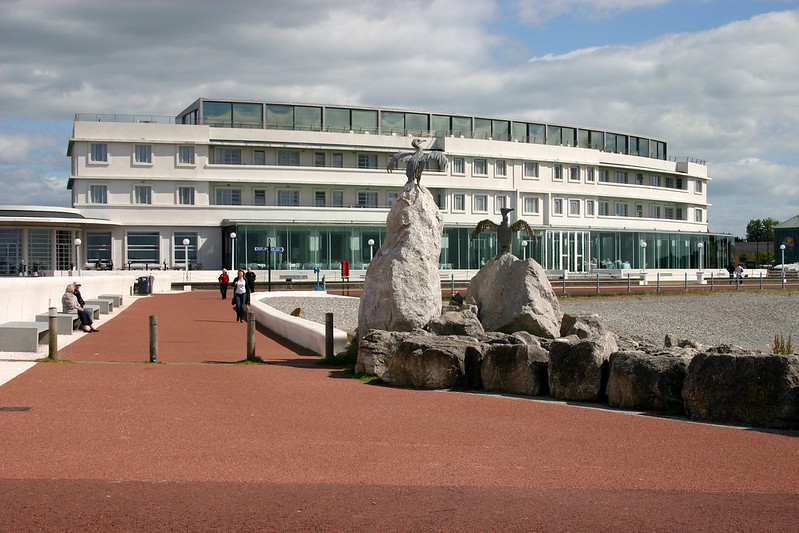
Note that the hotel pictured above is The Midland Hotel in Morecambe, Lancashire. I didn’t take a picture of the hotel we stayed at this time.
Unfortunately the hotel was a bit disappointing. I’ve gone into more detail on a TripAdvisor review (awaiting moderation) but I would give the hotel three out of five, based on the price we paid; at full price, probably two out of five. There were a few things wrong with the room, but also, when booking a secret hotel, the bed layout cannot be guaranteed. So whilst we were hoping for a double room, we actually got a twin room. It does clearly state that this could happen when you book, but it’s worth knowing about.
Frankly, I’ve stayed at much nicer budget hotels, like Premier Inn and Holiday Inn Express, and paid less for the privilege. Whilst it was interesting to try somewhere a bit mysterious, I think we’ll stick with the hotel brands that we know and feel comfortable with next time.
I’ve recently volunteered to part of the INTERVAL study, which will look into how frequently blood donors can give blood.
At present, the guidelines are very rigid: men can give every twelve weeks and women can give every sixteen weeks. What the interval study aims to do is allow some people to donate more frequently, whilst monitoring samples of blood taken at the donation. The hope is that, in future, regular donors will be able to give blood more often than at present, boosting blood stocks.
The NHS Blood Service is already facing challenges. The recent heatwave in the UK has led to fewer people giving blood and current stocks of O- and B- blood groups are critically low (less than four days’ worth). The UK also has an ageing population with people living longer, and more blood will be needed to support the very young and very old who can’t donate themselves. And despite recent drives to recruit more donors, only around 4% of people give blood.
Some other EU countries already allow people to donate more frequently. In Austria, it’s eight for men and ten for women. However, there may be factors that affect how regularly individual people can donate, which is why samples will be taken at each donation. This may mean that, following the outcomes of the study, some people will be able to donate more frequently than others. What is most interesting about the study is its size: in total, 50,000 regular donors are needed – 25,000 men and 25,000 women.
I’ll admit that it took me until last year to give my first pint of blood, but I’ve donated twice since then, and agreed to be part of the interval study. Of course, with my luck being as it is, I’m in the control group and can therefore still only give blood every twelve weeks. But some men will be selected to give every ten weeks or even every eight weeks. Women will be able to donate every sixteen weeks (the control group), fourteen or twelve weeks.
There are a few caveats with the interval study. Firstly, you will have to, as far as possible, keep to the regular donation cycle that you have been placed onto with minimal variations. Secondly, the study is for two years, so you will need to sustain the regular donations for this period. Finally, the donations you make will need to be at one of the 24 dedicated blood centres in England; thankfully there’s one in Bradford which is within walking distance from work. But my friends in York would have to go to Leeds, for example.
Hopefully the results of the interval study will confirm that it is safe for people to donate more frequently. Until such a time comes when we can safely and efficiently manufacture replacement blood, our hospitals are reliant on a regular supply of blood from donors. Being able to make optimal use of the small minority who do give blood regularly will benefit so many more patients in urgent need of a transfusion.
We’re back from our Parisian honeymoon. We had a great time and I have over 200 photos to sort and upload to Flickr at some point.
Whilst I could write a detailed review of everything we did whilst in Paris, instead I’ll just cover the things that I found interesting and different. A mixture of advice and observations, if you will.
General observations about Paris and France
Unlike in the UK, where the green man means it’s usually safe to cross, in France it ‘may’ be safe to cross as traffic may still turn whilst you are crossing.
VE Day is a public holiday each year, on the 8th of May.
A service charge is included in all restaurant bills, so tipping isn’t strictly necessary. Rounding to the nearest €5 or €10 is considered polite for good service though.
Raisin swirl pastries are known as ‘Escargots aux raisins’, literally ‘snails of raisins’.
Around the Sacré-Cœur in Montmatre (but elsewhere as well) you may see the ‘String Men’, who have pieces of string in their hands. It’s a scam and you should walk away and ignore them. They are very persistent though.
Unlicensed street vendors are very prevalent in the tourist areas of Paris, and like the string men can be very persistent. Don’t buy from them.
Wifi hotspots called ‘Free Wifi’ aren’t free. ‘Free’ is a French ISP – you need to look for ‘Wifi Gratuit’ for hotspots that do not cost money to use.
Chartier is well worth visiting – it’s a late 19th-century dining hall that serves very good and very cheap (by Paris standards) food. We walked straight in on a Tuesday night but the queues can be 100 people deep at other times.
You now have to pay to get onto the roundabout where the Arc de Triomphe is.
The Moulin Rouge is not as interesting as it’s depiction in the Baz Luhrmann film. It’s also surrounded by sex clubs, adult shops, and the actually quite interesting Musée de l’Érotisme.
The original model for the Statue of Liberty is in a corner of the Jardin de Luxembourg. It’s a lot smaller than the one in New York.
The Louvre
It’s closed on Tuesdays.
The audio guides use Nintendo DS handheld consoles.
But rather than hiring an audio guide, you can download a smartphone app and use your own phone instead, if you prefer. There’s no wifi on-site though, so best to do it before you set off.
If it’s raining, rather than queue outside to get in, you’re better off going into the Carousel de Louvre shopping centre which is under the Arc de Triomphe de Carousel. It’s also connected to the Palais Royale – Musée de Louvre Métro station, so you can get from the Métro to the Louvre without needing to go outside.
Good luck with getting a good photo of the Mona Lisa – it’s a small painting and we had at least 100 other people jostling to get a picture. It’s pretty much in its own room now.
The museum was recently closed for a day after staff went on strike over pickpockets. As such, be careful with your valuables. Also, the French don’t have a separate word for ‘pickpocket’ so they just use the English word.
The Musée d’Orsay
It used to be a railway station. There’s still an RER station underneath but the nearest Métro station is about 200 metres away.
Many of the audio guides are iPod Touch devices, albeit ones that have been inserted inside a cheap, tacky-looking plastic case which covers the home button.
The café on the top floor is good and is located behind one of the two huge clocks. It is pricey but the mille-feuile is to die for.
There are a small number of Vincent Van Gogh paintings on level 2. ‘Exploding TARDIS‘ sadly isn’t one of them.
Paris Metro
There are very few escalators and lifts at stations. You’ll be going up and down stairs most of the time.
The Navigo card is the Parisian equivalent of London’s Oyster Card, but it isn’t promoted to tourists. We decided to stick with buying a ‘carnet’ of 10 tickets at a time, which is slightly cheaper than buying them individually.
Mobile phone coverage is available at most stations and even on the trains, although frequently it’s only 2G and not 3G.
Some lines, like 1 and 14, have modern, fully-automated trains, and platform edge doors like on London’s Jubilee Line, but some lines have trains that date from the 1960s and require you to turn a handle to open the doors. And on many of the older trains, the doors unlock a couple of seconds before the train has come to a halt, so it’s possible to alight from a moving train.
Line 6 of the Metro runs on an elevated section down the middle of a wide street to the west of Paris, near the Eiffel Tower. I gather this happens on the New York Subway from time to time as well.
Generally the ticket barriers only scan your ticket to enter the Metro, not to leave.
The RER is a bit like Thameslink (and Crossrail when that opens in London), in that it’s actually a full rail service that happens to pass through the centre of Paris. Some of the trains are double-deckers. Ticketing is fully-integrated with the Metro.
Some Metro trains run on rubber tyres, rather than metal wheels. It gives a smoother ride.
Note: This post is pre-recorded as Neil is on honeymoon.
There’s a quote by Irish comedian Ed Byrne on the lines of “The best thing about being married is that you don’t have to plan a wedding”. Whilst our experience was probably not as bad as his, your typical wedding will have several elements, all of which need organising separately, and it can be a big thing to take on.
Therefore, based on mine and Christine’s experience as a recently married couple, here are 10 things that we were advised or found out during the planning of ours.
Tip 1: Silk flowers are better than real ones
Almost all of our flowers were actually silk (or plastic). We bought them from Silk Floral Art near York, which meant that we could pick them up several days before the wedding. We also weren’t limited to using flowers which were in season – we could have any that we wanted that matched the colour scheme. For the table decorations there was a deposit for their return, and we have the option of converting Christine’s bouquet into a permanent decoration to keep. And, of course, silk flowers don’t wilt so they will always look good in your photographs, and even up close it’s hard to tell that they’re not real.
Tip 2: Think about what could go wrong
I’m not suggesting that you need to do a complete risk assessment, but it’s worth thinking about any problems that could arise, and, if so, what you could do about them. In our case, when we went to collect our flowers, it turned out that we hadn’t ordered enough for all of the tables; thankfully, we were collecting them four days before the wedding and so there was time for more to be made up for the day.
We also ensured that both myself and Christine were at the wedding venue (but in separate parts of the hotel) a couple of hours before the ceremony, so that we didn’t start late. And the cake was delivered to us by the bakery, rather than us collecting it and then potentially dropping and ruining it.
You may also want to consider wedding insurance, but we didn’t bother and wouldn’t have needed it anyway. We did, however, use credit cards for the expensive things, so there would have been the possibility of using Section 75 if things went wrong.
Tip 3: Your wedding needn’t cost the earth
On average, weddings in the UK cost £20,000, apparently. I find that hard to believe as ours cost less than half of that. They are expensive (and consequently we’re a bit broke at the moment) but you can avoid a lot of unnecessary expenses. As ever, MoneySavingExpert.com has a guide – 50 cheap wedding tips – and whilst some are extreme we did make a number of savings. With the help of Christine’s chief bridesmaid, we designed and printed our own wedding invitations on VistaPrint(sponsored link), which looked great and worked out at about 50p per invite – far less than some companies charged.
Also, when using some suppliers it’s sometimes worth not mentioning that it’s for a wedding, as some companies will want to charge you more because it’s your ‘special day’.
Tip 4: All-in-one packages are easier
We went for a big, all-in-one package with our hotel, the Best Western Monk Bar Hotel in York(Now known as the York DoubleTree by Hilton). The package was the single largest wedding purchase and cost almost half of our total budget, but it included lots of things that we would have otherwise had to organise separately. These included use of a room for the ceremony, along with some flowers (these were real but matched our silk flowers), the wedding reception with food and some drinks, plus placecards, and a DJ for the disco in the evening.
It may have been cheaper to hire a hall, caterers, and a DJ, and then buy in drinks and our own stationery, but more hassle. Considering all of the other things we’ve had to organise, having these things together was a big weight off our minds.
Tip 5: Get help from friends and family
Christine’s chief bridesmaid helped us with the invites, as already mentioned, and my mum also helped us make the wedding favours (which again cost around £1 each in the end), as well as some legwork last year looking for suitable venues.
But you could go further – if you have a friend with a decent camera who takes good photos, it may be worth approaching them to take your pictures on the day rather than hiring a professional photographer. Ditto if you have a friend who makes nice cakes. In the end we didn’t have any friends helping us on the day – we wanted our friends and family to enjoy the wedding as well – but it may be worth asking.
Tip 6: Get some ‘you time’ on the day
I’m saying this because we didn’t. We got married at 2pm and it was after midnight before Christine and I had any time alone with each other to sit down and relax. Ideally we would have taken some time out after the reception had finished to put our feet up, but we ended up spending some time with the photographers instead.
Tip 7: Go to wedding fairs, but get recommendations as well
Wedding fairs are a good way to find out about photographers, cake makers, florists and the like, but a personal recommendation is always better. The hotel and the bakery that we went for – 3 Tier Cakes in Halifax – both came recommended by several people and we weren’t disappointed. The hotel were fantastic and went out of their way several times to help us, and the cake looked and tasted fantastic.
However, we also found our flowers and our photographer – Michelle Heseltine – at separate wedding fairs and we very pleased with both. In all, we went to three wedding fairs in Leeds, Bradford and Manchester; the latter wasn’t so much use as it was so far away from York where we got married in the end, so I would recommend going to fairs closer to where you plan to get married. There are plenty of them and you can usually come away with a lot of freebies, but don’t feel pressurised to sign up to anything on the spot.
And I’d suggest setting up a throwaway email account for use at wedding fairs, as you’ll get asked for your contact details by lost of people which will result in a lot of junk email. Once you’ve got everything arranged then you can just close the account.
Tip 8: Think how long you want your photographer for
We’ve been to a number of weddings where the photographer turns up just as the bride finishes getting ready, stays for the ceremony and official photographs, then grabs a couple of shots of the newly-married couple pretending to cut the cake before disappearing. That means that you’re reliant on friends and family taking pictures during the reception and the disco.
We decided to pay a bit more and have two photographers all day. They were there about an hour before the ceremony to separately photograph Christine and I getting ready, and were there right through the ceremony, the reception and for the first hour of the disco. Therefore they were able to photograph the actual cake-cutting and also the guests who were only here in the evening. That way our photo album will record the events of the whole day.
Also, when choosing a photographer, make sure you sign a contract so you know exactly what services to expect, and whether you can buy the copyright for the photos (we didn’t do this, but we’re not too bothered about it). And make sure that the photographer is insured, and therefore able to provide a replacement photographer in case of illness. You don’t want to receive a phone call on the morning of your wedding saying the photographer can’t make it, leaving you high and dry.
Equipment isn’t everything. You absolutely should ensure that your photographers are using good quality kit, but make sure you see plenty of sample photos that they have taken as well. Ideally, you’ll be able to find someone who can take great pictures, and has top-end cameras, flashes and lenses so that you get plenty of quality and detail in your pictures.
Finally, always look at the photographer you’ve paid for. Your friends and family will have their own cameras too, and feel free to pose for those when your official photographer doesn’t need you looking at them.
Tip 9: Drink plenty of water
The abundance of alcohol at most weddings, combined with big wedding dresses or suits with waistcoats and shirts, and lots of dancing, means that you can get dehydrated. Make sure you drink plenty of water throughout the day, and alternate alcoholic drinks with non-alcoholic ones. Dehydration will be the main cause of a hangover the following morning, which makes things difficult when you need to tidy up and vacate the premises before lunchtime.
We were offered a lot of free drinks and ended up turning some down; not at least because I wanted to be able to do my speech without slurring.
If you’re planning on wearing a big dress, think about toilet breaks as well.
Tip 10: Relax and enjoy the day
I suppose this is a re-hash of tips 2 and 6, but with good planning, everything will work out fine on the day, and you won’t be overwhelmed and stressed. And try to relax – you are the focus of the day and people will always be there to help you.
Everything went well for us, and we had a fabulous day that we will want to remember for the rest of our married lives.