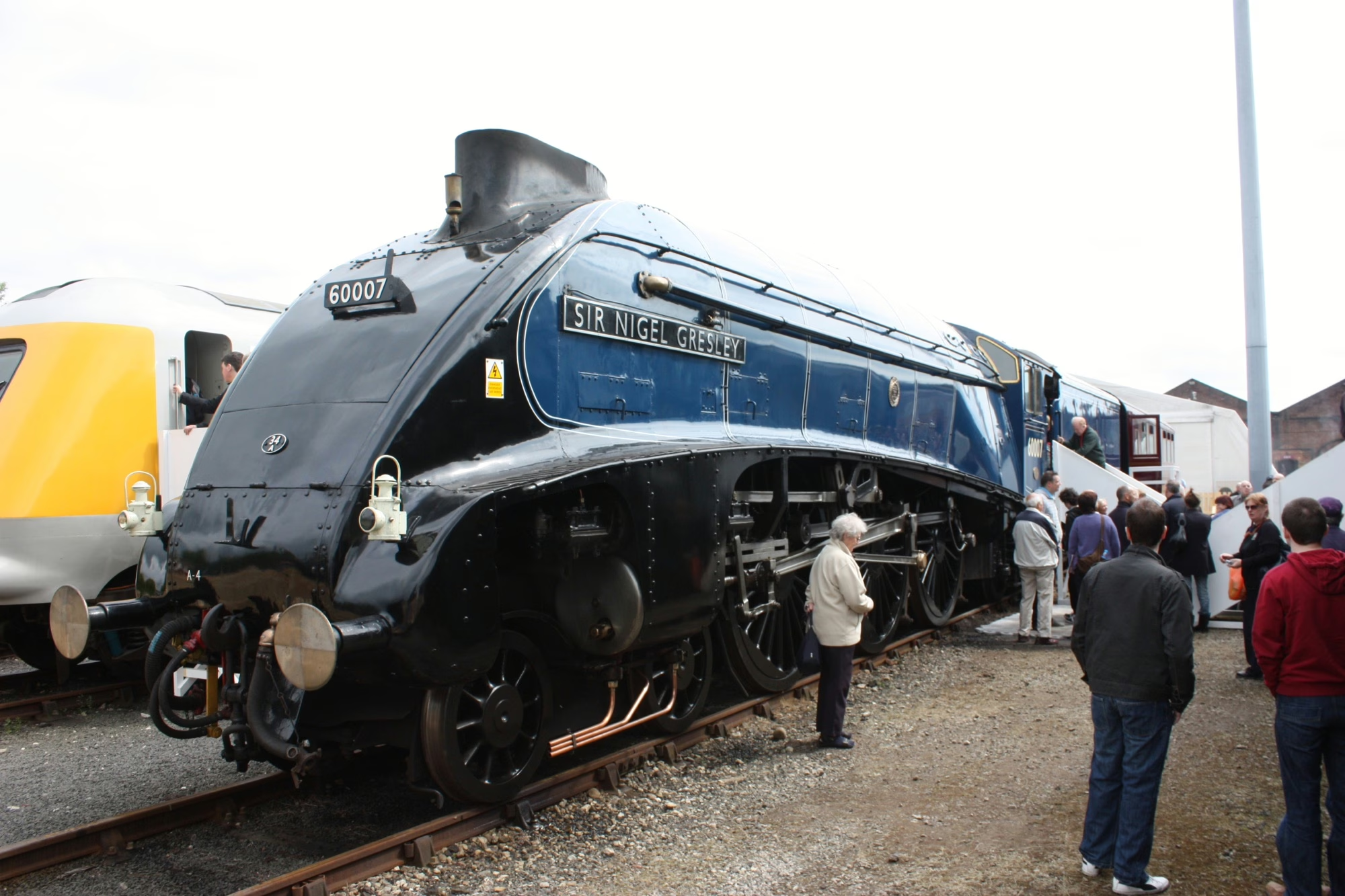
Compared with the average young person in 1980s Yorkshire, I probably got more exposure to trains than other kids my age. This was because my dad worked for British Rail, in their civil engineering department. As such, we got employee travel benefits, meaning 20 days free travel per year and a steep discount on all other rail travel beyond that. As such, we travelled by train a lot; despite living in York, we would have regular day trips to London which was only a couple of hours away.
My parents still have their staff travel privileges, even though my dad retired from the railway over a decade ago. I unfortunately don’t, as I’m no longer dependent on them, but I was able to keep it through my time at university, which was nice.
I could see trains from my bedroom window
The window in my childhood bedroom overlooked mainly fields, but in the distance, I could also see trains on the East Coast Main Line. Our house overlooked one of the busier four-tracked sections, and so as well as London-Scotland Intercity trains, I could also see Transpennine and Crosscountry services, and a few freight trains. We were close enough to be able to make out train liveries and types, but not individual train numbers.
I have vague memories of seeing the engineering trains that were involved in the electrification of the line, which took place in the late 1980s, and experiencing the then new electric Intercity 225 trains that are now in their twilight years.
I grew up in York
York is an important junction on Britain’s railways, largely thanks to George Hudson (although he has a rather complicated legacy thanks to some dodgy financing). It has a much bigger station than many places of a similar size, and is where the East Coast Main Line meets branches from Harrogate and Scarborough to the north, and Hull and Leeds from the south. There are lots of places that you can get to from York without changing trains. So, the combination of easy journeys and free/discounted travel meant that I was able to go on lots of trips by train whilst growing up.
York is also home to the National Railway Museum, which I used to visit regularly as a child. As an adult, I haven’t been in a few years but we’ve taken our nine-year-old there at least a couple of times.
However, that meant that I spent the first 13 years of my adult life largely reliant on public transport. In 2010, I moved out of Bradford, where I was working, to Sowerby Bridge, and this meant that I spent subsequent years commuting to work by train. And even now, I tend to prefer commuting by train – it’s rare that I drive to work, even though I have the option.
Also, in 2009 and 2010, when Christine and I were dating but not living together, one of us would get the train across the Pennines to see each other almost every weekend.
I read magazines about trains
Ever since I could read confidently on my own, I’ve been reading Rail Magazine. Indeed, I’ve had a subscription and/or read it through Readly or Pressreader for many years now, not missing an issue. Which, as it’s published every fortnight, is a lot of content.
For a time, I also read Modern Railways every month, although I stopped when it was no longer included with Readly. I haven’t subscribed because, whilst I appreciated the analysis in it, I just don’t have the time to read that as well. Indeed, recently I was six issues behind with Rail Magazine and only really caught up due to being ill at the end of October.
Consequently, my knowledge of British rolling stock is pretty good. Give me a photo of a passenger unit or locomotive that has run within the past 20 years in Britain, and I’ll probably be able to tell you its class number, when it was introduced, which company built it and where. Granted, it’s not the most useful superpower, although it did come in useful when advising a friend with sensory issues about which trains would be nosiest on a long journey.
I’m also not a trainspotter – I don’t note down individual unit numbers and I don’t actively spend time hunting out particular types of trains. Not that there’s anything wrong with having a hobby like that, if that’s something you enjoy. It’s just not for me.
So, I think, in a nutshell, that’s why I’m interested in trains.
I like a good Park and Ride system. You park your car somewhere on the edge of a city, usually for free, and then switch to a more sustainable mode of transport to get to the city centre.
Most other cities in the north of England have some kind of Park and Ride scheme, and this is my attempt at summarising them. I’m including every settlement in the North East, North West and Yorkshire that has official city status.
Bradford
In a way, it’s a shame to start with Bradford, as there isn’t an official Park and Ride scheme there yet. Bradford definitely needs one – I think part of the reason why Bradford has such a reputation for bad driving is that congestion is a major issue, and you almost have to drive aggressively to be able to get anywhere because otherwise no-one will let you in. One was proposed for south Bradford, near the northern end of the M606, but it seems that a majority of respondents to a consultation opposed it, and nothing has come of it since.
There is also Low Moor railway station, which opened in 2017 and is located a short drive from the M62. If you time it right, you can park there and commute by train to Bradford. However, there’s only a couple of trains per hour, so it’s not a ‘turn up and go’ service, and only around 100 car parking spaces.
Carlisle
I’ve only been into Carlisle once, in 2012, and I apparently didn’t see fit to write much about it. We were there just for an afternoon and, it being January, it was pouring with rain.
From what I can tell, Carlisle does not have a formal Park and Ride scheme.
Chester
Chester, however, does have a formal Park and Ride scheme. At present, there are three services, located in the north, south and east of the city. A fourth site, to the west, is closed at the time of writing. These are all bus-based services, and the northern site is next to Chester Zoo.
Back in 2011, Christine and I used the Park and Ride service in reverse, to get from Chester city centre, where we were staying, to the zoo. At the time, the Park and Ride called at Chester railway station and so we actually had ‘train’ tickets to use the bus. However, none of the current Park and Ride services call at Chester station and so zoo visitors are instead advised to catch the Chester-Liverpool X1 service; this also drops you at the zoo entrance, rather than the Park and Ride site which is a 5-10 minute walk.
Hull just has the one Park and Ride service, and unlike most others, it looks like it’s purely a commercial service operated by Stagecoach. It’s for traffic approaching from the west, which is where most of the traffic to Hull comes from to be fair, with it being on the East Coast. It’s located at Priory Park, which is the next junction on the A63 after the Humber Bridge as you head east.
Lancaster
Like Hull, Lancaster has one site, located by junction 34 of the M6 to the north of the city. It’s a bus service.
Leeds
Leeds has three Park and Ride sites: one at Elland Road, the Leeds United Stadium, serving the west of the city, one at Stourton, to the south, and a third at Temple Green, serving the east. There isn’t currently a northern site. We use the Elland Road service quite frequently, as it’s cheaper than parking in Leeds city centre and has recently started running on Saturdays again. It’s a bus service, with buses every 10-15 minutes. We’ve used the Temple Green service once, which is the header image for this post.
If the West Yorkshire Rapid Transit System goes ahead, then you may also be able to catch a tram from the White Rose Centre into Leeds in a decade’s time.
Liverpool
There’s no formal Park and Ride service in Liverpool, but Merseyrail has information about car parking at its stations. Of these, Headbolt Lane, Liverpool South Parkway, Maghull, Southport, Bidston, Birkenhead North, Hooton and Leasowe all have 200 or more car parking spaces. Generally, trains on Merseyrail run every 15 minutes.
Manchester and Salford
Salford is a city in its own right, but I’ve grouped it with its larger neighbour as it shares a transport authority. The Bee Network lists a staggering 41 Park and Ride sites, using a combination of rail, bus and tram. Not all of them have lots of spaces, but many have 200+. For some, you may have to pay for parking as well as your travel. Helpfully, the Bee Network page also lists those that have electric car charging facilities.
We tend to use Hollinwood Metrolink, which is just off the eastern side of the M60, and has a modest multi-storey car park with 178 spaces. You can tell that it’s well-used but we’ve also always managed to find a space when we’ve used it. Metrolink services are normally every 12 minutes.
Newcastle upon Tyne and Sunderland
I’m also grouping these two local rivals for the same reason as Manchester and Sunderland. Nexus list the stations on the Tyne and Wear Metro with parking, rather than offering a formal park and ride scheme. Again, you may need to pay to park at some of these stations. Trains are typically every 12-15 minutes.
Preston
There are two Park and Ride sites in Preston; one at Walton-le-Dale, to the south-east of the city near the M6, and a second at Portway, to the west. Whilst the Walton-le-Dale site is run by the county council, the Portway site is a commercial one, run by a local operator.
There’s been a long-standing proposal for a privately-funded tram line running to Preston city centre from a potential park and ride site at Junction 31A of the M6, but nothing seems to have come of it.
As with Doncaster, Travel South Yorkshire offer a list for Sheffield. Unlike Doncaster, the majority of these are tram services, and each has a decent number of car parking spaces. Trams typically operate every 12 minutes.
Wakefield
No formal scheme here either. You could park at Outwood, or Sandal & Agbrigg railway stations, I suppose.
York
And we’re back to York. York wasn’t the first city in the UK to adopt a Park and Ride – services in Oxford date back to the 1960s. But it’s one of the biggest and has a dedicated fleet of all-electric buses. As it’s a dedicated service, the buses are limited-stop services that skip stops in the suburbs.
It makes sense that York was an early adopter of Park and Ride services, being an ancient city with roads that weren’t designed for cars and therefore limited capacity for car parking.

I think most Brits are award of LlanfairÂpwllgwyngyllÂgogeryÂchwyrnÂdrobwllÂllanÂtysilioÂgogoÂgoch station’s claim of being the station with the longest name on the British Rail network. However, it’s more commonly known as ‘Llanfairpwll station’ and this is what appears on train destination boards. Indeed, its unnecessarily long name was a contrivance thought up by the railway company that originally built it in the 19th Century as a way of encouraging people to visit it by train. It roughly translates into English as ‘The church of St. Mary of the pool of the white hazels near to the fierce whirlpool and the church of St. Tysilio of the red cave’.
Llanfairpwll station today
Llanfairpwll station (as I will call it for the rest of this post) isn’t much of a station. It survived the Beeching cuts in the 1960s, but nowadays it gets a rather infrequent service. Going back towards the mainland, there was a wait of over an hour for the next train whilst we were there. And it’s a ‘request stop’ – if you want to get on a train, you need to make a clear signal to the driver of the train, as otherwise services will pass through at low speed. Similarly, if you’re on a train and want to get off there, you need to tell the guard that you want to do so, so that he/she/they can tell the driver to stop.
There are two short platforms – indeed, some trains that do stop there need to use selective door opening as they’re longer than the platforms – and a footbridge. Only platform one, for trains back towards the mainland, is accessible from the car park as there are no ramps or lifts on the footbridge. There is a gate leading from platform two, for trains towards Holyhead, but it would be a very long walk/wheel back into the town.
As well as being a request stop, Llanfairpwll station is unstaffed. The old station master’s house has been restored, but isn’t in use as far as I can tell. There aren’t even any facilities to buy a ticket here. I think Transport for Wales is missing a trick here, as tickets purchased from here could be collectors items. A machine could be installed that even just sells ceremonial platform tickets.
Tourist trap
The reality is that most people who go to Llanfairpwll station arrive and depart by road. The station retains a large car park, and the fact that this car park has bays for coaches tells you a lot. Next to the station is a large shop, run by James Pringle Weavers (in reality a subsidiary of Edinburgh Woollen Mill) which sells a range of merchandise with LlanfairÂpwllgwyngyllÂgogeryÂchwyrnÂdrobwllÂllanÂtysilioÂgogoÂgoch branded on it, amongst other things. I’m sure most people grab a couple of photos on the station platforms before going to the shop, and then moving on, without setting foot on a train. And yes, that’s exactly what we did too.
It’s nice that quirks like this still exist in places in the UK, but I feel like the station itself could be more front and centre. Perhaps, with longer platforms, better access, a more frequent service and some ticket machines, more people might actually visit Llanfairpwll station by rail.
Last summer, I blogged about previous un-blogged holidays in 2019, 2021, 2022 and 2023. As I’m away on this year’s holiday at present, I’m going to write about our 2018 holiday. Although our holiday fell before my blogging hiatus, it only got a brief mention at the time.
This particular holiday was our nine-year-old’s first trip outside England, although as it was seven years ago they were two at the time, as that’s how maths works. Nominally, our holiday was in the Loire valley in France – yes, the same place as 2023 – but we fitted some other places in too.
Cadbury World
I suppose our holiday ‘started’ in the West Midlands, at Cadbury World. This was one of several places that we called at on our journey down. I’d been before with Hari – her family is from Worcestershire – but this was the first time we’d been as a family.
Cadbury World is adjacent to the Cadbury’s factory in Bourneville, a model village built by Cadbury’s for its workers that now forms a suburb of Birmingham. It tells the story about Cadbury’s – the history of the company and how chocolate is made. So whilst it’s a museum, it’s also very much a tourist attraction, with indoor rides and a chance to watch professionals make chocolate. During my earlier visit in the 2000s, you were able to see some of the actual Cadbury production lines in the factory, but I don’t remember seeing them on this visit.
It’s not quite a full day out, which suited us as we’d arrived there having set off from home – it was over two hours’ drive, and we had further to go afterwards. The attraction is run by Merlin (the Alton Towers and Sealife Centre people) so whilst it can be quite pricey, there are various discounts available if you can book in advance.
We stayed overnight near Oxford, where we met up with my parents and had a meal for Father’s Day.
Portsmouth Historic Dockyard
As per usual, we entered France by ferry from Portsmouth. Having driven down from Oxford in plenty of time, we spent the afternoon visit the Portsmouth Historic Dockyard, home to a museum and various boats such as HMS Warrior (pictured) and HMS Victory. The museum is huge, and is actually split across three sites with a shuttle boat between them. We were only there for the afternoon, and so we only saw about half of the museum. It’s also home to the wreck of the Mary Rose – again, we didn’t have time to see it.
We did, however, have a late evening stroll around Gunwharf Quays in Portsmouth.
Our ferry was the overnight Portsmouth to Ouistreham (for Caen) service. In subsequent years, we’ve taken the longer Portsmouth to St Malo service, which leaves earlier and arrives later, giving you a better night’s sleep. The Caen ferry leaves Portsmouth at 11pm UK time, and arrives at 7:30am French time (6:30am UK time). I wouldn’t recommend it, especially if you then have to drive once you’ve arrived.
Blois
We called briefly in Blois on the way to our campsite to have some lunch. It’s a city with a large, well-preserved château in the centre – bits of the château date as early as the 13th Century, but it was substantially complete by the 17th Century. We had a quick look around, but didn’t go in.
Château de Chambord
One thing the Loire is not short of is châteaux, and Chambord is the chonkiest. It’s an absolute unit.
It was built in the 16th Century as a hunting lodge, and so as you would expect, the surrounding parkland is huge. Following the French Revolution in the 18th Century, it was abandoned with its furnishings removed. During the Second World War, it was used to store works of art normally displayed in the Louvre in Paris, and later on the 20th Century it was restored and opened to the public.
Inside, many of the rooms remain unfurnished. Most notable is a double spiral staircase.
Zoo Parc de Beauval
As mentioned, we stayed in the same area in 2023 and made a return visit to this zoo, so I won’t go into much detail here. It’s a fantastic zoo and arguably one of the best in the world.
Château de Chenonceau
Chenonceau is the château that is also a bridge, spanning the River Cher (which then flows into the Loire further downstream). You can indeed hire a rowing boat to go under the château, should you wish – we didn’t. And whilst it spans both sides of the river, you can’t exit on the other side.
Most of the château dates from the 16th Century. In the 20th Century, the château had roles in both World Wars – in the first, it was used a hospital, and for a time during the second, it was a way to smuggle people out of occupied France. It was then occupied by the Nazis, leading to the Allies bombing it in 1944. Thankfully, it was restored in the 1950s and remains one of the most popular Loire châteaux for visitors.
Parc Floral de la Source
This was somewhere that we hadn’t originally planned to visit ahead of time, but decided to visit on a whim. And it was lovely.
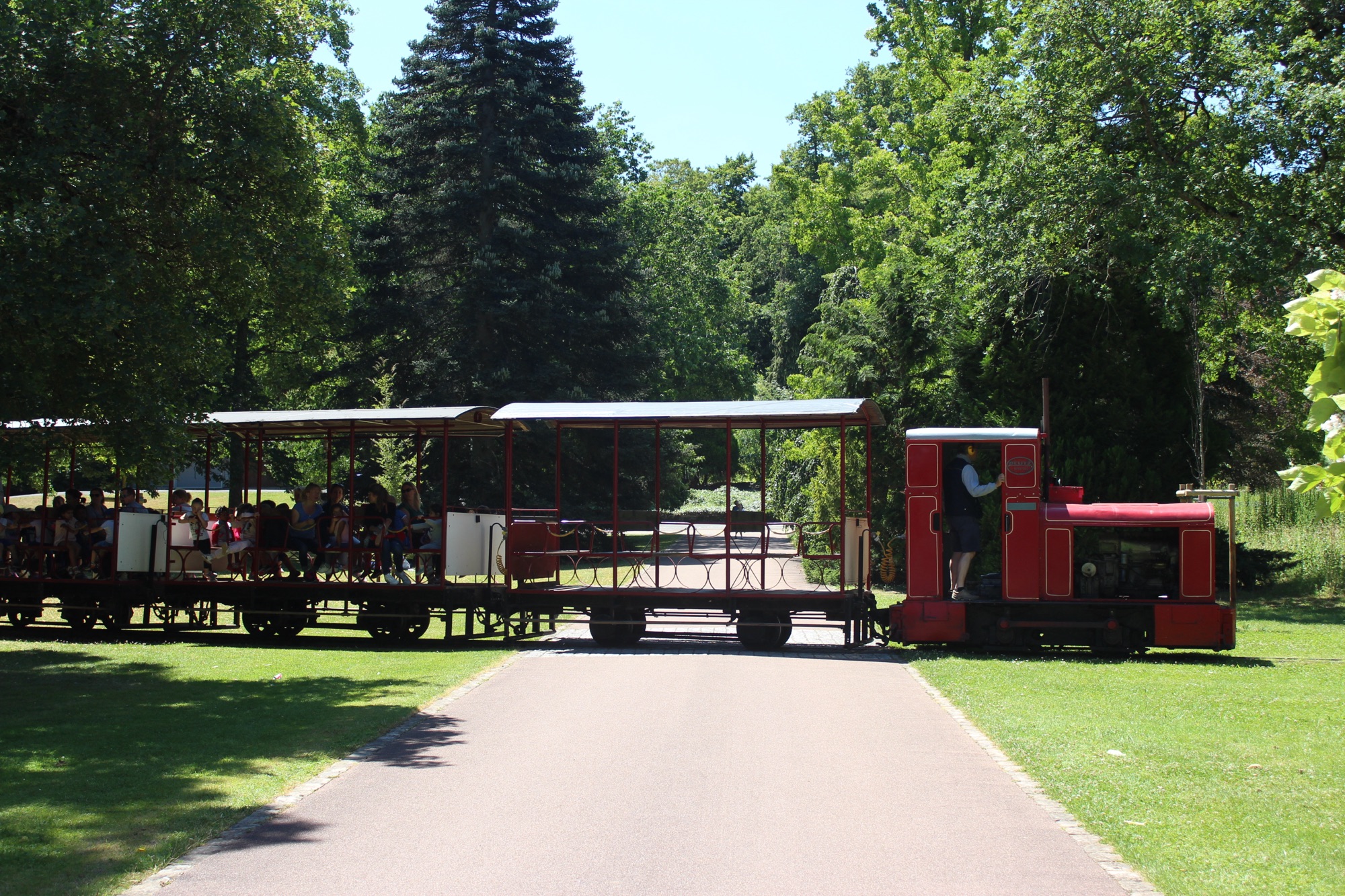
It’s a huge garden, with several different themed areas. Indeed, it’s big enough for there to be a little train that runs around the park – we saw it running (and it’s the header image of this post) but it was only open to a pre-booked school group. As well as a wide variety of plants and trees, there are animals too – some birds, a butterfly house, and some farm animals. I think we spent most of the day here, before we hit Auchan in nearby Orleans – Christine’s first time in giant a French hypermarket.
Le Mont-Saint-Michel
On the way back now, and we called off at Le Mont-Saint-Michel. It’s a small island, accessed via a causeway from the mainland, and it’s very photogenic. I’ve been before, and on a previous visit you could park your car on the causeway and then walk up. Nowadays, you park on the mainland, and a double-ended shuttle bus takes you across the causeway.
As well as the abbey at the top, there are lots of little windy streets selling everything a tourist could want. Indeed, it’s a UNESCO World Heritage Site, and the most-visited bit of France outside of Paris.
Matlock
Back across the channel now, and we called in at Matlock in Derbyshire for a couple of hours on the way home. It’s a picturesque inland spa town on the edge of the Peak District, and we had a wander around the town and the park. Nearby is the Heights of Abraham – we didn’t go, but it’s on my long list of places to visit in future.
Later today, we’re off on our annual summer holiday. This year, it’s a week in North Wales, where we’ll be staying in a rented holiday cottage.
As usual, we’re going with my parents, who have kindly paid for the accommodation for all five of us. It also gives our nine-year-old chance to spend time with their paternal grandparents – as my parents live in York, they’re just a little too far to see on a regular basis.
Like last year’s holiday to Northumberland, this holiday is a domestic holiday; although Wales is a separate country from England, it’s not a separate nation state and so we don’t need to worry about having different currency, passports, plug adaptors and the like. And there’s no biosecurity restrictions, so we can bring and take back as much cheese as we’d like.
We are driving there, and it’ll be in our new electric car. Naturally, I’ve spent some time before we leave scoping out where we can charge the car whilst we’re there, but it’ll be its first distance test. A full charge should be enough to get us all the way there.
We’ve already started a list of where we’d like to go. This may well include Portmeiron, as pictured in the header image. That photo was taken the last time we were in North Wales, back in 2018. What we actually end up doing will, of course, depend on the weather.
I’ve written more than a week’s worth of blog posts in advance, so there’ll be no gap in blogging whilst I’m away.
This is the fifth and final blog post about my trip to Athens – bearing in mind that my trip was only for three and a half days. This is where I want to write about everything else that happened whilst not in Athens – i.e. the journey there and back. Here are the links to part one, part two, part three and part four.
Ibis Budget hotel at Manchester Airport
As I mentioned last Monday, my flight was a 6:30am departure from Manchester on a Sunday morning. With this in mind, I booked myself a room in the Ibis Budget hotel at the airport, and then got a train over on the Saturday night.
Now, if you’re staying in a hotel with the word ‘budget’ in its name, you need to manage your expectations. The rooms are small – there’s space for a double bed, but no bedside tables. There’s a small and narrow desk, a blind instead of curtains, and quite a thin mattress. But as I only needed the room for about seven hours, it was fine. There was free Wi-Fi, and most importantly it was in very easy walking distance of Terminal 2, where I needed to be for my flight. I didn’t want to stay somewhere that required a shuttle bus transfer which may or may not turn up at stupid o’clock in the morning. And the room was significantly cheaper than almost all other hotels at the airport.
Manchester Airport at 5am on a Sunday
Speaking of an early start, you would not know that it was only 5am on a Sunday once you were through security and in to the duty free bit before the gates. It was like the Trafford Centre on a Saturday afternoon – all the shops were open, all the lights were on, and it was heaving. There was a lack of seating, although Terminal 2 is being renovated at present which may explain the lack of capacity.
Judging by the airlines and destinations, it was mostly package holiday flights taking advantage of off-peak slots.
Flying with Jet2
Indeed, my flight to Athens was with Jet2. Jet2’s selling point is that they’re a budget airline, but they’re not as stingy as some of their rivals *cough*Ryanair*cough*. You’re allowed one standard cabin bag, and one small bag as standard, although you can pay extra to ‘guarantee’ space for your cabin bag in the overhead locker. My carry-on case was quite a bit smaller than the maximum permitted size and so I didn’t bother, and indeed had no issues with space. As with my trip to Dublin, I only took carry-on luggage with me.
If you want a meal on the flight, you have to pre-order it when checking in online. It is, of course, extortionately expensive for what it is, but the food was fine and rather welcome considering my early start. If you don’t pre-order food, the cabin crew may be able to offer any food that is left over after the pre-orders have been given out.
On more than one occasion, staff wished me a good holiday. I didn’t have the heart to tell them I was travelling for work.
Flying with KLM
My flights back were with KLM, the Dutch flag carrier, and so this meant a connection at Amsterdam. I honestly expected more from KLM – after all, Jet2 is a budget airline and so I didn’t expect any niceties like in-flight entertainment or Wi-Fi. But I didn’t have those with KLM either, and both planes were also a bit shabbier and care-warn than Jet2’s plane. They were all variants of Boeing 737 planes, if you’re interested.
KLM did include a ‘snack’ on each flight though. From Athens to Amsterdam, we were all offered a Beemster cheese sandwich with a honey and mustard dressing, which was actually quite nice, and a small piece of cake. Drinks were also offered. Meanwhile, for the much shorter flight from Amsterdam to Manchester, we just got a packet of Mini Cheddars and a more limited range of drinks.
My flight back to Manchester also appeared to be a late aircraft swap. When I checked in at the gate, I was given a new boarding pass with a different seat number, having been moved from row 29 to row 22. Indeed, there was no row 29 on this plane. Amsterdam Schiphol Airport is KLM’s hub, and so they must’ve decided to swap the planes as the flight was under-booked.
Amsterdam Schiphol Airport
After Dubai, Schiphol is the second busiest airport that I’ve been to. My brief layover there on Tuesday is, to date, the only time I have been in the Netherlands, and I don’t think it really counts as I spent my entire time ‘airside’. Unlike other big airports, Schiphol has just one massive terminal, arranged in a horseshoe shape. Thankfully, my arrival and departure gates were relatively close to each other and so I didn’t have to walk too far. Like in Athens, there were lots of food and shopping brands familiar to Brits. Although, unlike 5am in Manchester, by the time I got to Amsterdam at close to 9pm local time, many of the places to eat were closed. I ended up spending €10 on a WHSmith meal deal for some sustenance.
Getting home
I think some colleagues at the summit were a little concerned that my journey home to Sowerby Bridge consisted of two flights and then three trains. As it was, both flights were only delayed very slightly, and all my trains were on time – a relief as I had to change at both Manchester Oxford Road and Victoria, and the connections were both around five minutes. Not only that, but my train from Victoria to Sowerby Bridge was the last train of the night, so I was very relieved to make that connection.
Whilst this wasn’t my first visit to Greece – I went to the Greek island of Crete when I was three, but don’t remember much about it – this was my first time in the Greek capital. As per previous trips to Paris and Dublin, here are some assorted notes about my time in Athens.
Athens Airport
My flights were to and from Athens International Airport “Eleftherios Venizelos”, which was opened in 2001 in readiness for Athens to host the 2004 Olympic and Paralympic Games. As such, it’s relatively modern, but it’s clear that passenger numbers have grown since it was opened. We were bussed between the plane and terminal both times, as there’s not enough airbridges to allow direct boarding. On arrival, we had to sit on the tarmac for a while to get a parking space and again to wait for the buses to arrive – the pilot commented that it was like they weren’t expecting us.
Inside the terminal, I was a little surprised at just how many British/global brands were there – the shops were all WHSmith, and there was a Burger King and Pret a Manger. It turns out they’re all operated by SSP, a British multinational which runs many franchised outlets in airports and railway stations. There were plenty of Greek options though too. Oh, and lots of adverts, in English, for Lidl, advising people that they can still use the Lidl Plus app in Greece.
Whilst our departure was from the main terminal, when I first arrived we were bussed to the satellite terminal. There followed a ten minute underground walk to the main terminal. According to Wikipedia, the airport was built with room to expand, and it looks like it needs it. It has two runways, either side of the A6 motorway, and on the return flight the plane taxied over the motorway to take off. Hopefully they will open another satellite terminal soon, and consider some kind of people mover to get people around more quickly.
The city of Athens
We arrived in Athens on a Sunday, and then Monday was Whit Monday, which in Greece is celebrated as the ‘Day of the Holy Spirit’ and is therefore a public holiday. As such, the city seemed rather closed up and deserted until Tuesday, which for me was just a half day. However, lots of shops seemed to be open late on Monday night, presumably because it’s cooler.
Athens also has a graffiti problem – much more so than Paris which I thought was bad. There were also more buildings in a state of disrepair, with some older buildings looking like they’d had scaffolding around them for years. However, this certainly wasn’t the majority and not reflective of the whole city.
Transport
In terms of transport, Athens has a variety of modes on offer. There’s an underground metro, trams, and trolleybuses, as well as the usual buses – some of which are zero-emission battery electric buses. As befits an ancient city, lots of the streets are quite narrow and there are one-way systems in lieu of dual carriageways in places. Coming from Bradford, which was the last UK city to get rid of its trolleybuses in 1972, it was good to see them still in use in Greece. After all, Greece is not short of sunlight for solar power, and I saw plenty of solar panels whilst there.
I was provided taxi transport to and from the airport, which took around half an hour, but the metro and suburban rail services also connect to the airport, using overhead electrified lines. That being said, I only saw a couple of trains in each direction – the railway is in the central reservation of the motorway links to the airport. Had I needed to take the metro, I would have been able to get very close to my hotel without any changes.
Speaking of motorways, these seemed relatively new and were tolled. Our driver had a toll tag, similar to the one we use when in France. Some of the motorways were quite twisty, with sharper bends that I would expect to see in the UK, but I suspect that this is due to the terrain – we also went through several tunnels.
Almost all signage that I saw was in both Greek and English.
My hotel
I stayed at the NYX Esperia Palace Hotel, which is part of the Leonardo Hotels group. It’s quite new, and way outside my normal budget for a hotel. There are two swimming pools – one in the basement, and a smaller one on the roof. The restaurant is also up on the roof, with a view of the Acropolis – I really enjoyed being able to sit outside at breakfast time with a stunning view across the city.
As a smart home geek, I was particularly drawn to the controls in the rooms. There were several human presence sensors to turn on the lights automatically, and several touchscreen panels to control the lights, air conditioning and even open and close the curtains. For coffee making, there was a Nespresso machine in the room – indeed, it appears that pod coffee machines are really popular in Greece based on my experience.
The hotel was also just on the next block over from LanguageCert’s headquarters. The Wi-Fi was free and worked well.
Mobile phones
I bought a 1 GB eSIM before setting off for £4 on Airalo, rather than relying on roaming. Greece has three main networks:
Vodafone, which Brits will be familiar with. Indeed, at Athens airport, there was a vending machine selling Vodafone SIM cards which was clearly aimed at Brits.
Cosmote, which is the state operator but is majority owned by Deutsche Telekom. As such, there’s a lot of T-Mobile co-branding. Brits may be surprised to see T-Mobile still in existence as in the UK it merged with Orange, became EE and was then bought by BT.
Nova, which is what both my UK SIM on 3 connected to, and the network used by my Meraki Mobile eSIM from Airalo.
Across Athens, 5G internet was widely available. Indeed, it may be that Nova has already turned off its 3G network (as all but O2 in the UK have already done) as when I couldn’t get a 5G or 4G signal, it dropped down to EDGE.
I realised after reviewing this that it sounds like I’m surprised that Greece has similar level of connectivity to the UK, as if my perception is that Greece is somehow less developed than the UK. This was not my intention – I think as someone who would feel very isolated without internet access, I was reassuring myself that I would have good access to services whilst travelling.
Food
The food we had during our stay was nothing short of excellent. Christine and I are both foodies and we cook a lot of Persian food at home, of which Greek food has some similarities. The organisers of the summit took us to a couple of excellent Greek restaurants for our evening meals – again, both with a view of the Acropolis. I ate very well whilst I was away.
If you play Pokemon Go, then there’s a Pokemon to catch which is exclusive to Greece and Egypt (and parts of Albania bordering Greece): Sigilyph. They’re not very common – it took me until the morning of my departure on Tuesday to track one down – but they often appeared on my radar. I later caught another at the airport whilst waiting for my flight.
I have one more blog post to follow, which will be another miscellaneous blog post about everything else that happened whilst I was away.
So, last weekend I teased that I would be travelling for work. Well, I flew out of Manchester very early yesterday morning – there should be a law against 6:30am flights on a Sunday morning – and have safely arrived in Athens in Greece.
I’m here to attend a Higher Education Summit by LanguageCert, who are very kindly paying for my flights and accommodation. LanguageCert are part of PeopleCert, and offer English language tests for non-native speakers wanting to live, work or study in English speaking countries. PeopleCert, meanwhile, offer professional certifications, including PRINCE2 which I achieved in 2018.
I’m only here for a relatively short time and will be flying back tomorrow.
Something that seemed popular on Bluesky last week was Sophie Stone’s UK Travel Visualiser. There’s a map of the UK (plus the Isle of Man) showing each county, and you can select each one to mark whether you’ve lived there, stayed over, visited, stopped or passed through. I’ve uploaded an excerpt of mine above, and included the full image below (converted from SVG to PNG because I can’t be bothered amending the WordPress config file to enable SVG uploads).
Here’s a text based breakdown for the counties I have visited:
Counties I have lived in
Just two: North Yorkshire and West Yorkshire. I was born in York, in North Yorkshire, and then moved to Bradford in West Yorkshire when I was 18. Then, when Christine and I decided to move in together in 2010, we moved to Sowerby Bridge, also in West Yorkshire, where we still live now. Christine meanwhile has also lived in Lancashire and Derbyshire.
Counties I have stayed in
I’ve interpreted this as ‘counties where I have stayed overnight for at least one night’. There are a lot more of these:
Berkshire – last visited in 2021 when we stayed in Slough, ahead of a trip to Legoland Windsor.
Bristol – I last visited for work in 2014, which involved a couple of overnight stays.
Cheshire – an overnight stay in Chester in 2012 with Christine, marking a year since we got engaged.
Cumbria – lots of hiking trips to the Lake District, but I think our most recent stay was with a friend from university who has now settled in Kirkby Lonsdale.
Derbyshire – another hiking trip, this time to Dovedale in 2009.
Durham – we stayed overnight to attend a wedding in 2016.
East Riding of Yorkshire – my grandparents lived in the East Riding and so stayed over many times in the past.
East Sussex – on holiday in 2021.
Greater London – I last stayed over last year, however Christine has been more recently.
Greater Manchester – before I could drive, we used to stay over in Manchester after various music gigs. The last time was in 2014, when we saw Delain and Within Temptation at the O2 Apollo. Also spent a couple of nights there for a stag do in 2015.
Hampshire – we’ve stayed over at the Travelodge by Portsmouth Ferry Terminal a few times on the way back from France, most recently in 2023. Also that year, we spent an afternoon in Southsea.
Herefordshire – way back in the late 1990s, I went on a week-long PGL holiday near Ross-on-Wye.
Hertfordshire – another overnight stay for a wedding, this time in 2013, in Stevenage.
Kent – though we visited Kent in 2021, we stayed in East Sussex. The last time I stayed overnight in Kent was in 2000, on a short break ahead of a few days in the Pas-de-Calais region of France.
Lancashire – Christine lived here when I met her, and so I stayed overnight a few times during 2009 and 2010 before we moved in together.
Leicestershire – another overnight stay for a wedding, this time in 2018. The wedding was at the National Space Centre in Leicester, incidentally.
Lincolnshire – I had a few days in Lincoln with my parents in 2001.
Tyne and Wear – our most recent trip away was last weekend, when we stayed overnight in Gateshead to visit Beamish. Even though Beamish itself is in County Durham.
Fife – one of my mum’s university friends lives in Fife and so I’ve been a few times. Our most recent visit was in 2015, and, in what is becoming a theme, it was for a wedding.
Perth and Kinross – very early in our relationship, Christine and I joined two other couples on a long weekend near Callander in Perthshire, in early 2010.
Counties I have visited
This is a much smaller list of places where I have intentionally gone to on a day trip:
Cambridgeshire – I’ve been to Cambridge once, for a meetup with other editors at the Open Directory Project, back in 2003.
Shropshire and Powys – as mentioned, I have family in Staffordshire and so I’ve been to Shropshire and Powys before on day trips – just not very recently.
Lanarkshire – I’ve also only made it to Glasgow once, in November 2009. I met up with several people in my World of Warcraft guild, including Hari – we had split up earlier that year and this was the first time we’d seen each other since. I’d first met Christine a few weeks before.
Counties I have stopped off in
Essex – literally just at Birchanger Green services on the M11.
East Sussex – part of Gatwick Airport is in East Sussex and so I would have been there very briefly in 1999.
Counties I have passed through
Devon, Somerset and Dorset – in the 1990s, when on holiday with my parents, we came back via Poole and Plymouth on occasion and so will have passed through these counties. But I haven’t visited them properly.
Gwent – on the way to Cardiff in 2004.
Rutland, Northamptonshire, Bedfordshire, Buckinghamshire – these are places I have driven through, but never visited. Christine has recently reconnected with some of her family in Milton Keynes, so Buckinghamshire may rise up the list in future.
Berwickshire, West Lothian, Midlothian, East Lothian. These are all counties that we passed through on our way to Fife in 2015.
Dumfries, Dumbartonshire, Stirling & Falkirk. Similarly, we passed through these in 2010 on the way to Callander.
Counties I’ve never been to
I’m not going to list them all, but this includes large parts of Scotland, mid Wales, and the whole of Northern Ireland. We’d like to go to Cornwall at some point, but it’s a very long way from where we are in Northern England. There’s a reason why there’s still a sleeper train from London to Penzance. Our nine-year-old has also expressed an interest in seeing the Giant’s Causeway in Northern Ireland at some point.
How many points?
The UK Travel Visualiser also awards points – the longer you’ve spent in a county, the more points you get. I managed 184 points – not bad, but it would have been higher if I had lived in more places. Diamond Geezer managed 241, by virtue of having lived in more places, and being 19 years my senior.
Yes, I’m writing about transport in London again, even though I live the best part of 200 miles away. This time, it’s about the ongoing efforts to get diesel trains out of the capital, and what progress is being made. I’m going to look at each of London’s rail termini in turn, and see what proportion of trains are running on electric power.
Background: London’s air quality problem
London, like many cities, has had an air quality problem for centuries. There was the Great Stink in 1858, the rise of pollution during the Industrial Revolution, and more recently, emissions from transport. Though I’ve never lived in London, I’ve made regular visits over the years, and still remember having black snot from the poor air quality.
The good news is that air quality in London is improving. Over the years, the Ultra-Low Emission Zone has expanded to cover just about all of London, and reduced the number of polluting vehicles on the road. Improving air quality has been a particular aim of mayor Sir Sadiq Khan, who has even written a book about it(sponsored link). It’s worth a read – it’s relatively short but gets the message across.
But the ULEZ is just about road transport. Today, I’m focussing on rail transport, and specifically looking at the twelve key London termini. Long-distance rail travel in Great Britain is generally focussed on London, and so if you get rid of diesel trains from London, you also get rid of them from other parts of the country too.
Cannon Street
Starting alphabetically, Cannon Street is the first terminus, and one that I personally have never been to. For many years, it was never open on Sundays, although it has operated seven days a week since 2015. All the trains to Cannon Street are operated by Southeastern, who only operate electric trains. So, Cannon Street is fully electrified – probably a good thing, as it’s an enclosed station with low ceilings.
Charing Cross
A little further west along the River Thames is Charing Cross. Like Cannon Street, it too has low ceilings due to over-site development, and is also only served by Southeastern. So, no dirty diesel trains here either.
Euston
Euston was controversially rebuilt in the 1960s as part of the then British Rail’s upgrade of the West Coast Main Line. This included electrification, and so nowadays almost all of the trains which operate from Euston are electric. Avanti West Coast operated a few diesel services to Chester and onwards to North Wales, but are being replaced with new Hitachi bi-mode trains that can operate on electric power as far as Crewe in Cheshire.
There may be some diesel visitors to Euston on occasion, as services that would normally call at Paddington are diverted to Euston during construction work at Old Oak Common. This includes the Night Riveria Sleeper, and some of GWR’s Hitachi bi-mode trains that may have to run on diesel power as they navigate through their diversionary routes.
Fenchurch Street
Fenchurch Street is the smallest of London’s rail termini, with just four platforms. It’s another one that I’ve never been to, as I’ve never needed to go to places like Tilbury or Southend. If I did, I would be able to catch an electric train there courtesy of c2c, whose entire fleet is electric. Indeed, the lines out of Fenchurch Street were some of the first to be electrified using overhead cables in the late 1950s.
King’s Cross
Being from Yorkshire, King’s Cross is the London terminal I’m most familiar with. Most (but not all) of my rail journeys to and from London include King’s Cross.
Though overhead electric wires were strung up for commuter services in the 1970s, the wires didn’t go north of Peterborough until the 1990s. Even then, British Rail still operated a mixture of electric and diesel trains (the venerable High Speed Train) and this persisted until very recently. Their replacement came in the form of more of Hitachi’s bi-mode trains, introduced by LNER. Such trains are also operated by open access operators Hull Trains and Lumo (although Lumo’s trains are all electric).
The outlier is another open access operator, Grand Central. Whilst they operate a small fraction of the services from King’s Cross, at present, they’re all still diesel-powered. That’s due to change, once again thanks to Hitachi who are building some tri-mode trains that can run on electric wires, batteries and diesel. The order for these was only announced a few weeks ago, so it’ll be 2-4 years before we see the back of the last purely diesel trains from King’s Cross, but there’s good progress being made.
Liverpool Street
I’ve only ever been to Liverpool Street mainline station once, which was to use the Stansted Express back in 2009. That was, and still is, an electric train, and indeed all the trains that operate from Liverpool Street are electric. Well, almost: Greater Anglia has a small fleet of bi-mode trains, which for once are not made by Hitachi but by Stadler. Occasionally these run to Liverpool Street, although their main stomping grounds are across Norfolk and Suffolk running regional services. In any case, they should run on electric power when available, so we can tick off Liverpool Street as being electric.
London Bridge
London Bridge underwent a stunning rebuild in the 2010s. I used the old station a bit pre-rebuild and it was awful – the new station is much better.
In the 1930s, the then Southern Railway invested in extensive electrification of its lines, using the third rail principle. Instead of overhead wires, a third metal rail is added to the outside of the two running rails and trains pick up power that way. As such, almost all of the railways in the south-east of England are electrified. Indeed, many have never routinely hosted diesel trains, having gone straight from steam to electric.
However, a handful of lines didn’t get electrified, including services to Uckfield along the Oxted Line. Therefore, there’s a small fleet of diesel trains that serve London Bridge.
Marylebone
Oh dear.
We were doing so well, weren’t we? Seven stations in, and all were either completely electrified, getting there, or had just a handful of diesel services. And then Marylebone has to ruin everything for us.
Okay, so Marylebone is quite a nice London terminus. Whilst not as small as Fenchurch Street, it’s still quite dinky and less overwhelming than some others. It survived closure in the 1980s, and Chiltern Railways has been one of rail privatisation’s few success stories, with new services, new stations and improvements to infrastructure. Indeed, if you want to get a train between London and Birmingham, and don’t mind it being a bit slower, it’s much nicer going from Marylebone to Birmingham Moor Street.
But Marylebone isn’t electrified – at all. Every service that terminates there is a diesel train. And it shows – the last time I was there, there were advertising boards proudly telling us that they had air purification technology built into them. But this wouldn’t be necessary, if the trains that were calling there didn’t spout diesel fumes.
There have been some lacklustre efforts to improve the situation – one of Chiltern Railways’ trains was modified to be a diesel-battery hybrid, and it could use its battery at low speed and in stations. Alas, this was never rolled out to other trains in the fleet. Also, the oldest of Chilterns’ trains are now around 30 years old and need replacing, so putting up electric wires would be timely to prevent a new order of diesel trains.
One issue is that trains from Marylebone to Aylesbury share track with London Underground’s Metropolitan Line services (a relic from when the Metropolitan Line went all the way to Aylesbury). These lines are owned by Transport for London, and electrified using a unique four-rail system. Any electrification scheme would need to take this into account, especially as TfL probably won’t want overhead wires stringing up over their infrastructure. Dual-voltage trains, which can run on both overhead and third-rail electrified lines, are a thing and are used daily on Thameslink services, for example, but this would need careful planning to work out.
Moorgate
Moorgate is a London terminus, albeit of just one line nowadays – the Northern City Line. Historically, this line was considered part of London Underground and was grouped with the Northern Line, and so it’s electrified.
Until the 2010s, some Thameslink services terminated here too, but these were axed to allow platform extensions at Farringdon station. They too were electric though.
Paddington
Paddington was a latecomer to the electrification party (which sounds like a round from I’m Sorry I Haven’t A Clue). The first electric trains started in the late 1990s, and even then, it was just the new Heathrow Express service. However, the announcement of the Great Western Main Line Electrification project allowed it to catch up, with electric wires extended all the way from Airport Junction in West London across the Welsh border into Cardiff. However, that project also went massively over budget, and as such, lines to Bristol and Oxford never received their wires.
Whilst some electric trains run from Paddington, the majority are those Hitachi bi-modes again, which can run on electric power where available and switch to diesel if needed. This has meant that Paddington has moved from having only a handful of electric trains in the 2000s, to being almost entirely electric now. There’s just a handful of commuter trains at peak times that use diesel Networker Turbo units, and the Night Riveria Sleeper train, which uses diesel locomotives. Perhaps, in future, the Night Riveria will be hauled by bi-mode locomotives, such as the new Class 93 and Class 99 locomotives under construction.
See Marylebone? It can be done.
St Pancras
The rebuild of St Pancras for High Speed One services was excellent. I have vague memories of the tired old station, and now it’s much better.
However, there are still a few diesel trains plying their trade at St Pancras. These are the trains which take the Midland Main Line up to Sheffield and Nottingham. This line should have been electrified in its entirety by now; instead, it’s being done on a piecemeal basis and currently the wires are projected to stop just south of Leicester.
The good news is that new trains are on order – and yes, they’re yet more bi-mode trains from Hitachi, although they’ll be slightly different than the units used by other operators. And East Midlands Railway has introduced electric trains from Corby into St Pancras – impressive as Corby station only re-opened in 2009.
Victoria
Victoria is big and confusing. I’ve used it a few times and can’t say I’m a fan. But all the trains that run from Victoria are electric, so that’s good.
Waterloo
Until the Elizabeth Line came along, Waterloo, with its 24 platforms, was the busiest station in the UK. Now it’s third, but still very busy.
It’s also a bit like London Bridge, in that the vast majority of trains are electric, but a handful of diesel services limp on to serve places beyond the reach of the third rail network. Doing something about these services is more pressing than those from London Bridge to Uckfield, as the trains are older and due for replacement. Various ideas have been floated around, but it seems probable that we’ll see existing electric trains getting batteries bolted onto them, and some discontinuous electrification to charge them up. That could be some of the new Class 701s, which have had one of the most protracted entries into service of any new train, or some Class 350s which are about to go off-lease from London Northwestern.
Conclusion
Overall, the majority of train services into London are already electric, including all services to seven of the twelve stations. Of the remaining five, diesel trains make up a small number of services at three of them, and we’ll likely see the back of the last remaining diesel trains at King’s Cross and St Pancras by the end of the decade. The lack of any sort of electrification at Marylebone is a bigger problem to tackle, but then Paddington has gone from being all diesel to almost all electric within 30 years; indeed much of that progress has been within the last 10-15 years. It’s also clear that bi-mode trains have a future until further electrification outside the capital takes place.