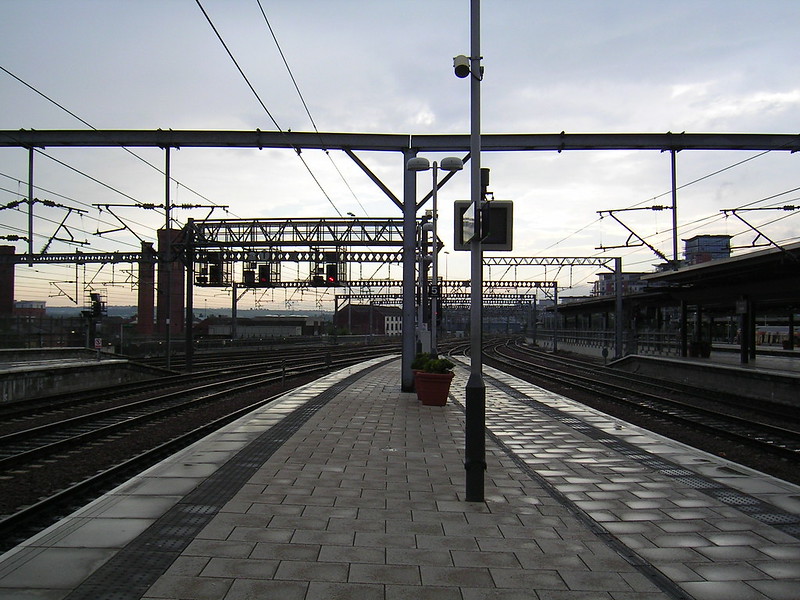
MET#3: Bahrain (or at least its airport)

Bahrain Airport overview
Bahrain Airport overview by Franz Zwart, CC-licensed.

After spending less than 48 hours in Amman, I was back to at Queen Alia International Airport to make my way to Oman. To fit my schedule, I had to fly overnight, and the only airline with flights that suited was Gulf Air, the Bahrain flag carrier. And this meant a stop at Bahrain airport.

Gulf Air’s history is actually quite interesting, as various Arabian Gulf countries owned parts of it in the past. Nowadays, it is wholly owned by the government on Bahrain, and based out of Bahrain international airport. The flights I took were on its smaller Airbus A320 aircraft, and neither flight was particularly well-loaded. I think I was one of of only 20 passengers on the second leg from Bahrain to Muscat.

Despite being a hub airport, Bahrain International isn’t all that big. It sits on an island off the cost of mainland Bahrain (itself an island), and has just one terminal. Naturally, Gulf Air operate the vast majority of flights. But, there are a number of other operators, including British Airways who fly from Heathrow.

As I was travelling overnight after two long days, I didn’t really take much time to explore the terminal. Instead, I went straight to the gate for my flight and made use of the free Wi-Fi for an hour or so. The time difference meant that Christine was still awake at home, despite it being the small hours of the morning where I was. The previous flight from my gate was a busy flight to Mumbai in India, which departed late as a large group of elderly passengers turned up to the gate well after the scheduled departure time. Even though I fly rarely, I’d like to think that I’m a considerate traveller, and so I aim to be at the gate well in advance of the departure.

The flight departed from a small extension to the terminal, right at the far end. It was barely more than a shed, with a small coffee shop and duty-free stand. Naturally, the coffee shop was a Costa Coffee – it and Starbucks were available throughout the Middle East. Both offered pretty much exactly the same experience as at home. Whereas the gates in the main terminal had air-bridges, we were loaded onto those super wide buses with minimal seats that you only see at airports, for the short drive to the plane.

It was while I was waiting for my flight that Christine started checking the Foreign & Commonwealth Office travel advice for the countries I was visiting. I’d already checked it, as a requirement for work, but I think this rather upset her. Whilst I stayed entirely airside in Bahrain, there was a major uprising in 2011 as part of the Arab Spring and there is still an undercurrent of unrest.

I left Bahrain at 1:35am local time, and arrived in Muscat 90 minutes later. More on Muscat in the next instalment.

MET#2: Amman

Amman

This is post number two in my series about my recent trip to the Middle East. Here’s yesterday’s introductory post.

The first stop on my trip was to Amman, the capital city of Jordan. My time there was brief – less than 48 hours in total, as I arrived in the early hours of Saturday morning local time and departed on Sunday evening.

Rather than obtain a visa ahead of time, I acquired a visa on arrival. As well as an ink stamp in my passport, I also got two 20 dinar Jordanian postage stamps, which reflected the cost of the visa. A nice addition to my previously blank passport.

The security situation in Jordan is worth mentioning. Jordan has a land border with Syria, which is in the midst of a civil war between the government, Islamic State and other rebel groups. Amman is around 80 kilometres, or an hour’s drive from the Syrian border.

Al Jordanian plane

Consequently, on leaving the airport (which is around 25 minutes’ drive south of Amman) we had to pass through a military checkpoint, and to enter the hotel we had to go through a metal detector and have all of our bags x-rayed. Part of my visit involved going to schools, to recruit students, and these were all within secure compounds with gates and security guards. I was also advised to keep my passport on me at all times for identification.

Whilst we did travel around Amman and its environs, visiting 5 schools, unfortunately I didn’t have much spare time to actually explore the city. The hotel I stayed in, the Crowne Plaza, was some way out of the centre of the city – and it’s a big city. Around 4 million people call it home, making it not much smaller than London.

What I did see of Amman seemed rather run-down – a bit like Burnley, I suppose, but much bigger and with better weather. I gather that Amman has some really nice parts though, and if I’d had the opportunity to fly out earlier and spend a day exploring then I’d have been able to see more. Sadly work commitments made this impossible.

I did notice a lack of traffic lights. Most road junctions are roundabouts, or grade-separated junctions with slip-roads (on-ramps to Americans). I don’t think I saw a single set of traffic lights, which means that drivers tend to use up any bit of available road space when waiting in stationary traffic. And seemingly everyone drives – there were very few pedestrian crossings and I wouldn’t like to try my luck with them.

Immigration in Jordan is something of an issue. Recent years have seen a lot of conflict in the Middle East region and Jordan’s open border policy has seen around 5 million people seek refuge from countries like Iraq and Syria. As Jordan’s population wasn’t that large to start with, it’s resulted in a massive, fast growth in the number of people living there, and, from what I saw on my brief visit, is struggling to adapt somewhat.

The internet connection in the hotel was very good though – they advertised that they had a 150 Mbps line which suggests that the telephony infrastructure in Amman is generally good. This came in useful when needing to do a Skype call with someone.

I’d maybe like to go back to Jordan in future to actually see the nice bits of Amman, and visit the Dead Sea which isn’t far away. But I’d prefer to wait until the situation in Syria dies down first.

MET#1: Getting around to writing about it

It’s been three months since I returned from my trip to the Middle East for work, and despite promising to write something about it upon my return, I never got around to it.

So, rather belatedly, this is the first of a series of blog posts about my trip. For security reasons, I didn’t write publicly about my destinations ahead of time, but here are the places that I visited:

  • Amman, the capital of Jordan
  • Muscat, the capital of Oman
  • Salalah, another city in the south of Oman

I also passed through airports in Dubai and Bahrain on the way. My flights to and from Manchester were with Emirates, and the flights between Amman and Muscat were with Gulf Air who is Bahrain’s flag carrier.

Tomorrow, I’ll be writing about Amman and Jordan.

Combining travel discounts

57309 and 56312

Tomorrow we’re off to the Trafford Centre to buy a washing machine. You may wonder why we’re travelling all the way to the far side of Manchester for something that we could buy more easily locally. As it happens, we have loads of John Lewis gift vouchers left over from our wedding, plus some more from completing online surveys from Valued Opinions and Ipsos i-Say, so in all it’ll work out cheaper. And we’ll be making a day of it.

Because we don’t drive, we’ll be taking public transport – a train to Manchester, and then a bus, as the trams haven’t made it that far yet. In all, this would normally cost around £30 – £21 for return train tickets and around £8-10 for the bus tickets. But, by combining discounts, we got the lot for £12. Here’s how:

Two Together Railcard

Because Christine and I travel together by train a lot, we have a Two Together railcard, which means we get a third off almost all train fares provided we buy the tickets at the same time and travel together. It costs £30 a year, although there are plenty of discount codes bringing it down to £27, and you can exchange Tesco Clubcard vouchers for one as well.

It’s one of the newer railcards, having been launched last year, and we’re on our second card. We got our money’s worth on one journey alone, when we went to Nottingham, and use it regularly.

Advance purchase tickets

Northern Rail, who operate the trains between us and Manchester, have only recently introduced discounted advanced purchase tickets on some routes. If bought before 6pm the previous day, you can get a significant discount on the cost of tickets versus buying them on the day. By buying advanced purchase tickets with our railcard, we got the price of our train travel down from £21 to £8 – not bad.

Plusbus

Plusbus is a not particularly well-known add-on for train tickets, that allows you to purchase discounted bus travel at your destination. You buy it as part as of the same transaction as your train tickets, and it essentially gives you unlimited bus travel at your destination for one day, on participating routes and operators.

I’ll be honest – this weekend will be the first time we’ll be using it, and I’m still not 100% convinced that it will be accepted on the buses that run between Manchester city centre and the Trafford Centre. But, it only cost an additional £2 per ticket, thanks to a special offer that is only running this month, so if it doesn’t then we’re only out of pocket by £4.

Additional discounts

We bought the tickets online at First Transpennine Express, even though we won’t actually be travelling with them at all. I chose them for three reasons:

  1. They offer Nectar points at a rate of 2 points for every pound spent on train travel, so I earned 16 points for the £8 spent on the train tickets. I can then use these points for money off cinema tickets or shopping, for example.
  2. They offer cashback via Quidco (referral link) – it’s only 1%, but that effectively saves a further 12p off the cost.
  3. There are no additional booking, card or postage fees – you just pay for travel.

Disadvantages

The only downside to choosing an advanced purchase ticket is that it restricts us to travelling on certain trains. If we miss these trains, or want to vary our travel plans, then the tickets will no longer be valid and we’d need to buy new ones, probably at full price. Buying on the day costs more, but at least the tickets are fully flexible.

Normally one advantage of buying an advanced purchase ticket is that you also get a confirmed seat reservation as well. Northern Rail don’t offer seat reservations (despite running some long distance services) so the only real advantage of buying tickets in advance is the lower cost. Other operators do include seat reservations, so you could have two passengers: one who paid, say, £12 and got a guaranteed seat, and another who paid £80 on the day and who may have to stand.

And finally, before you ask – we’ll be having the washing machine delivered. I don’t think we’d get it home on public transport.

Off to foreign lands

Bay of Villefranche-sur-Mer

This morning, I’ll be flying off on my first overseas trip abroad for work. I’ll be visiting various middle eastern countries in order to recruit students for the university where I work.

It will actually be a number of firsts for me. First overseas trip for work. First overseas trip on my own – every time I’ve left the country before, I’ve been with a friend, family member or partner. First time in the middle east. First time that I’ve been away from Christine for more than two nights since we moved in together in November 2010.

It will be a busy week whilst I’m there – this isn’t some overseas jolly; I’ll be working every day without a break and with some overnight air travel. In all I’ll be taking 8 flights over the 8 days, with the longest at around 7 hours.

The countries I’m going to are significantly less liberal than Britain, with a very different culture. I’m hoping to spend part of the long flight over there reading about customs and things to do and not to do whilst out there.

I’ve been making use of TripIt to help with planning my itinerary (which runs to eight pages when printed – told you I’d be busy). I’ll do a full review later but being able to forward confirmation emails to have it build out your plans really helps.

I’m hoping that it’ll be a good experience, and, if it goes well, this will be the first of a number of overseas trips that I’ll get to make for work. I’m excited to go, but also a little daunted at just how much work I’ll have to do whilst there. That being said, my iPad is loaded up with books, magazines and Pocket articles to read as and when I’m stuck without internet access and need something to pass the time.

I’ve got a couple of blog posts queued up to appear whilst I’m gone, but I doubt I’ll have much spare time to post anything new whilst away. I’m hoping that I’ll have plenty to talk about on my return, next Friday. See you then.

Northern Rail’s “Intercity” services

144 Crossing the River Calder

I’m a northerner, and I travel by train a lot. At least 95% of my journeys are with Northern Rail, a franchise run jointly by Serco (to whom all your base are belong to) and Abellio, which is owned by the Dutch government. The franchise was let in 2004 on a ‘no growth’ basis – the assumption being that passenger levels wouldn’t grow significantly during the franchise period, and so there was no real requirement for any extra trains or to increase service levels.

In reality there has been a huge growth in passenger levels in the north over the past ten years. Thankfully Northern has invested in some extra trains, although these are mostly old trains that other operators no longer need, and some services have been improved. But there haven’t been any brand new trains ordered, and whilst most have been ‘refreshed’ with a coat of paint, new flooring and seat covers, internally most of Northern’s fleet retains their original fixtures.

Around the time that the rail franchises in the north were re-jigged in 2004, the intercity services that Northern’s predecessor (Arriva Trains Northern) operated were mostly split off into a different franchise – First Transpennine Express. These services received new trains. Northern was left with mainly commuter and rural services, and the internal layout of its trains reflect this. But it still operates a few intercity services that I’ll get onto.

Grand Central train

What makes a service ‘intercity’ anyway?

Simply put it’s a train service that connects two or more cities together, although I’d also state that the end-to-end journey time is over an hour, and it only calls at larger stations. Unlike short-hop commuter trains, where fitting on as many passengers as possible is the main goal, with intercity services you want to provide a more comfortable experience for longer journeys. To me, this means providing:

  • Refreshments, such as a trolley service or buffet car
  • First class accommodation
  • Wifi (free or paid-for)
  • Plug sockets
  • Seat reservations

Almost none of Northern’s services meet the above criteria, and yet some of its trains probably should. Here’s my list of “intercity” services that Northern runs.

Leeds Station

Leeds – Nottingham

This is fresh in my mind as we took this train on Saturday. It’s actually a relatively new service that was first introduced in 2008. The full journey takes almost exactly two hours, taking in the cities of Wakefield and Sheffield, and the large town of Barnsley on the way. It’s actually not the quickest way between the two cities, as we found out coming back – taking an East Midlands Trains service to Sheffield and then a Crosscountry service to Leeds took marginally less time, even allowing for 20 minutes in Sheffield. This is probably because the direct train goes via Wakefield Kirkgate and the Erewash Valley Line, so whilst it is an express service that skips many intermediate stations, it still takes a long time.

Our mid-morning Saturday departure was on a two-carriage class 158 train, which had ample seats for the number of people using it. And whilst the 158s are the newest of Northern’s diesel fleet, they are showing their age somewhat. Case in point – I had to use the toilet and it took several attempts to get the door to close because we were going around a bend and its motor wasn’t powerful enough to cope.

Garsdale railway station

Leeds – Carlisle

The service from Leeds to Carlisle was under threat of closure until around 25 years ago, when the line was reprieved. Nowadays there’s a train roughly every two hours, and each one takes a little under three hours to complete the journey. You could argue that this doesn’t qualify as being “intercity”; Carlisle isn’t a very big city, and it doesn’t pass through any other cities on the way. But it’s also the only one of the services that I’m writing about today which meets one of the five criteria I mentioned earlier.

Thanks to the Settle-Carlisle Partnership there is a trolley service on the train, between those two stations. It’s the only Northern-operated service where this happens though, because it’s provided by the Settle-Carlisle Development Company and not Northern themselves. Again, for the most part Northern operate class 158 trains on this service but not always.

Tram

York-Blackpool North

I used to catch this service from Bradford quite regularly when I lived there and Christine lived in Blackpool; later when we moved to Sowerby Bridge I also used to commute in on it on a morning, until the timetable change in May this year. It connects the cities of York, Leeds, Bradford, and Preston, which was granted city status in 2000, but also calls at Burnley, Blackburn, Halifax and Blackpool which are large towns. Travelling the full length of this service takes almost three hours.

Northern usually puts its class 158s on this service but I’ve also endured its older class 150 trains, which have narrower seats, no air-conditioning and only one toilet, on this route. Whilst the former is reasonably acceptable, the latter does not make for a good journey experience, especially for such a long period of time. I suppose it could be worse – it could be a Pacer, a train made of 1980s bus parts bolted onto a two-axeled freight wagon, which are sadly still common on many of Northern’s services.

Spending three hours on a train with no opportunity to buy refreshments on board, no wifi or sockets to plug in a laptop to do work on, and no guarantee of a seat, does not make for a good travel experience. And yet, passengers put up with this every day.

Next year the government will announce a new franchisee for the Northern franchise. Shortlisted are Abellio (on their own this time), Arriva and Govia, and the winner will take over in early 2016. I really hope that whoever wins puts some effort into improving the rail service in the north – but especially these services. Offering a decent intercity-standard service between the north’s major cities will hopefully encourage more people to travel, and allow them to make the best use of their time on board.

528 bus from Halifax to Rochdale

Blackstone Edge Reservoir

Today’s blog post is about a bus service. You may be wondering if I’m scraping the barrel here – surely there’s nothing interesting about a bus service? But Diamond Geezer blogs about buses and makes them interesting, and I think that this particular bus service qualifies.

The 528 bus service

The 528 bus runs once every hour from Halifax to Rochdale, via my home town of Sowerby Bridge, Ripponden, Blackstone Edge, Littleborough and Smallbridge. Drawn on a map, it operates on a near direct south-westerly line, taking around an hour to complete the journey. And it’s quite a scenic route – the photo above is of Blackstone Edge reservoir, as between Ripponden and Littleborough the bus runs through open moorland. On a nice day it can be quite spectacular. I’ve used it a couple of times, once when I needed to get to Bury for work, and another time when the trains weren’t running because of engineering work.

It isn’t the only way of getting between Halifax and Rochdale though. It’s quicker by train, with the fastest services taking around half an hour. Plus the trains run twice an hour during the daytime whereas the 528 is hourly.

There’s also another bus service, the 590, which also runs hourly. The 590 runs via Luddendenfoot, Mytholmroyd, Hebden Bridge, Todmorden, Walsden before rejoining the 528’s route at Littleborough. It takes longer – about an hour and a half – but passes through more populous settlements.

First 66783 YK05 FJF
P927949 by Ingy the Wingy on Flickr, CC-licensed.

Change of operator

At one time, both the 528 and 590 bus services were operated by First, the Scottish-owned large national bus and train company that operates the majority of buses in West Yorkshire. First still operate the 590 service, but several years ago the 528 was taken over by a company called Centrebus Holdings. This was a joint venture between the managers of Centrebus, a bus company in the Midlands, and Arriva, the large national bus and train company owned by the German state railway company Deutsche Bahn. Last year, the managers of Centrebus sold their stake to Arriva. This allowed Arriva to take full ownership of the company, which is now branded Yorkshire Tiger. Their buses retain Centrebus’ orange livery but with black tiger prints on the side. It makes me smile that a bus operated by Yorkshire Tiger crosses the border into Greater Manchester.

The reason for the change in operator is because the 528 bus is a subsidised service. It’s not commercially viable without taxpayer support, which comes from Metro (part of the West Yorkshire Combined Authority). Over recent years, First have pulled out of a number of subsidised services in West Yorkshire which run more as a public service than for profit. When these services have been put out to tender, Centrebus have often won.

Centrebus 775 YJ10 EZH
Huddersfield Bus Company 775 YJ10 EZH by Ingy the Wingy on Flickr, all rights reserved

Cuts

The weak economy and austerity cuts being imposed by central government led Metro to review the services it was subsidising earlier this year. In some cases it was supporting services that were used by just a handful of people. This wasn’t providing value for money, and so a consultation process was held. And one of the proposed service cuts was the 528. Not just cut, but cancelled completely with some replacement buses running only as far as Ripponden as bus number 560. There would be no bus links between Ripponden and Rochdale, and those wanting to use the bus between Halifax and Rochdale would have to use the slower 590 service.

Whilst a large number of other cuts were proposed, the cut to the 528 received the most vocal opposition. In particular, the consultation was only held in West Yorkshire; residents of Littleborough and Rochdale were not asked for their views. Meanwhile the buses used on the 528 route were downsized from large single-decker Optare Tempo buses to smaller Optare Solos.

Redemption, of sorts

The outcome of the consultation was published a couple of weeks ago, and like many consultations that propose cuts, the end result was something in the middle. The 528 will still cease to exist when the changes take effect early next year, but it will be replaced with a new service called the X58 which will operate the same route. ‘X’ services are express services and this will hopefully reinforce the fact that it offers quicker journeys between Halifax and Rochdale than the 590, with the potential that more people will use it. It’ll retain the same hourly service interval as the 528 bus service, although it will not run late into the evening and its frequency will be reduced on Sundays.

I’m pleased that the bus service will be kept, even if I personally don’t use it very often. Whilst some buses can be run at a profit, it shouldn’t mean that those that aren’t profitable are withdrawn, provided that they serve a useful public service. Serving small outlying villages may not make much money for the bus companies but it can be a lifeline for the residents who rely on these services.

Update: The X58 bus service began on the 25th January – you can download the timetable here.

Update 2: As of 2025, the 528 bus has been replaced again, and is now the 587.

Bruges

Bruges

A little later than planned, but here it is – what we did in Bruges. I’ve covered how we got to Zeebrugge (‘Bruges-on-sea’) in a post about the P&O Ferries ‘mini-cruise’ posted on Tuesday, so this picks up where that left off.

After alighting from the ferry we got onto one of several coaches for the half hour journey from Zeebrugge to Bruges. It’s actually not that far as the crow flies but we were slowed down by roadworks and the coach drop-off point being to the south of Bruges city centre – Zeebrugge is on the coast to the north, so we had to go around the Bruges western bypass.

We were duly dropped off at a small island off the southern tip of the city centre – this is presumably the main coach drop off point for all visiting coaches as there were plenty of ‘Welcome to Bruges’ signs in four languages and a rather grand modern red bridge taking you over one of Bruges’ many canals. This leads into the Minnewaterpark, a nice public park that we should have walked through, it being the quickest route into the centre. Instead we got confused by a sign aimed at cyclists and took a longer and less interesting route.

The Markt

We aimed for The Markt first of all, which is one of Bruges’ two large public squares. It sits in the shadow of the Belfort, a belltower with over 40 bells that you can climb up for views of the city (we didn’t). From here you can pay €39 for a tour of the city by horse and cart (the price is set by the city council) or visit one of the many overpriced brasseries around the edge. Seriously, these places are expensive; we ended up having lunch here as we struggled to find anywhere cheaper in the limited time that we had, and I paid €22.50 for Moules Frites (mussels and chips). At almost £18 that would buy me a decent three course meal back home. Fortunately we did find some cheaper places away from the main tourist areas later on and so our afternoon tea wasn’t quite so eye-wateringly expensive.

Bruges has a number of museums and had we stayed overnight we would have had the opportunity to visit more than one. As it was, we settled on Sint-Janshospitaal, an 11th-century hospital that treated patients well into the 20th century. It’s a big building, but there’s not a lot inside – some paintings and a few old fashioned medical tools for outdated practices like trepanning. Next to Sint-Janshospitaal is the Apothek, which is the pharmacy dispensary that served the hospital. Its opening hours are more restricted than the main hospital museum but you get entry for both in the ticket price.

Belgian Beer

Afterwards we had a general wander around the city. Belgium is well-known for its chocolate and its beer, and, as you might expect, Bruges has a chocolate museum and a beer museum. We didn’t visit either – the chocolate museum had some very mixed reviews on Foursquare and Christine doesn’t like beer, and I still feel guilty for dragging her around the Guinness Storehouse in Dublin. We did, however, visit a number of chocolate and beer shops. We bought quite a bit of the former but ended up not buying any of the latter. Many of the chocolatiers produce their chocolate on the premises and you can sometimes see it being made.

A note on language in Bruges. Belgium’s official languages are French, Flemish (a dialect of Dutch), and German. Bruges is in Flanders, the Flemish-speaking part of Belgium, and so most signs are just in Flemish – unlike in Brussels, the capital, where signs are generally in both Flemish and French. So whilst Flemish is the primary language used, English is a close second. The guidebook we bought even suggested that you are better speaking English than attempting French, and we encountered a couple of situations where Flemish bar staff didn’t speak French (but their English was almost perfect). Whilst it feels odd using English in a country where it isn’t a first language, it was a bit of a relief that I didn’t need to use my rather rusty French vocabulary.

Another thing that we didn’t expect in Bruges was the lack of pigeons. They’re the scourge of most cities, but we didn’t see any in Bruges. There were crows, ducks, swans and a few collared doves, but no pigeons. Whether this is deliberate or not, I don’t know.

Minnewater Park

All in all we had a lovely time. Bruges is a really nice place – it is to Brussels what York or Chester is to London, in that it’s much smaller and more manageable, but still full of history and interesting attractions. It was Christine’s first visit and my second, but my first time was over 20 years’ ago when I was only eight years old and so I don’t remember much about it.  If I were to go back I’d like to stay there a bit longer and do the bits that we didn’t have time to see this time, possibly as a wider visit to other parts of Belgium as well. Despite what Nigel Farage says, Belgium is far from being a ‘non-country’.

Going on a P&O ‘mini-cruise’ to Bruges

P&O Ferry 'Pride of Bruges' docked at Zeebrugge

Last weekend Christine and I went on a ‘mini-cruise’ to Bruges with P&O Ferries. The ‘mini-cruise’ is a package that includes return overnight ferry journeys for two people from Hull to Zeebrugge or Rotterdam, and return coach transfer to Bruges or Amsterdam respectively. This can be taken over two consecutive nights there and back, or over three nights with an overnight stop at your destination.

We did the two night option, which gave us around 8 hours to spend in Bruges. I’ll write more about what we got up to in Bruges later this week but today I’ll focus on the ‘mini-cruise’ experience.

‘Mini-cruise’

I keep using ‘mini-cruise’ in quote marks because this is most definitely not a cruise. You travel on a standard cross-channel ferry – for the Hull-Zeebrugge crossing this is either the Pride of Bruges or Pride of York which are comparatively small ships (around eight decks) but the Hull-Rotterdam ferries are somewhat bigger. The on-board facilities are therefore not like you would expect on a large cruise ship, and are limited to a couple of restaurants and bars, a shop, café and small cinema.

We were on the Pride of Bruges which was introduced into service in 1987 – and it shows. There hasn’t been much done to the ship since then and it retains its 1980s feel in many parts despite some effort in refurbishing it. This includes the cabins.

The cabins sit somewhere between ‘sleeper train’ and ‘budget hotel’. They are en-suite so a shower, basin and toilet are squeezed into a tiny wetroom with each cabin. The beds are bunkbeds, and are rather narrow too – I can’t imagine many children will be conceived out at sea. And you get one unearthed plug socket, about 7 foot off the ground above the mirror, which uses the European standard connector. The walls were also not particularly thick and so the rowdy hen party (bachelorette party for the Americans amongst you) in the next cabin kept Christine awake for most of the night; I slept through it. You have to pay around £10 extra if you want a window in your cabin – we didn’t, so our cabin was in the middle of the boat rather than at the edge. In any case, it’s late October and it gets dark early, so there wouldn’t have been much to see.

Staying connected

There were some signs of modernisation elsewhere on board. Wifi is available, charged at £3 for 90 minutes, which is actually quite reasonable considering you’re out at sea. I didn’t test it so I can’t say how fast or reliable it was, although it seemed to be only available in the public areas and not the cabins. Mobile phone reception seems to also be available at sea, but only for calls and texts, not for data – again, I didn’t test this nor find out how much extra it costs to use. In any case, when leaving Hull I still had phone reception on my own network, 3, for quite some time after departing.

Eating and drinking

Of the two bars, the Sunset Show Bar is the biggest with live entertainment and a casino table, with another smaller and quieter bar next door. The drinks selection is reasonable and not whilst not cheap it wasn’t ridiculously expensive either. The café serves Starbucks coffee, but not the full range – no pumpkin spiced lattes here – and no soya milk. Then there are the two restaurants – The Kitchen and The Brasserie.

The Kitchen is a buffet. We didn’t go there at any point because of the queues – instead we booked into The Brasserie each time, for both evening meals and breakfasts. You do have to book but it’s worth it – it’s a full waiter service restaurant and the food is reasonably good. Not outstanding but I’ve paid far more for worse. The best thing is that it’s also reasonably quiet in there, whereas we could hear the noise from The Kitchen out in the foyer.

When you book your ‘mini-cruise’ tickets online you have the option of pre-paying for your meals – for two people this adds £88 to the cost but at £11 per person per meal it’s not bad overall. It’s enough to cover The Kitchen, and in The Brasserie it will get you £16.50 per person for dinner – anything over that just has to be paid by cash or credit card. We only went over by about £5 between the two of us for our meals – two courses and non-alcoholic drinks. I imagine we would have spent more overall had we paid for each meal individually rather than pre-paying, and because you have to check-in before 5:30pm it’s not really feasible to have a meal before you travel.

If you do the two night ‘mini-cruise’, then, where possible, P&O will try to ensure that you get the same cabin in each direction, so you can leave your luggage there. This isn’t always available, and won’t be an option for the three night option as you’ll go out and come back on two different ferries.

The clientele on board was a mix – some couples like us, presumably on the ‘mini-cruise’ deal, but also a few families, a couple of stag and hen parties, a few school groups and some lorry drivers. Because it’s a ferry you can bring your car, coach or lorry with you, although we went as foot passengers.

Getting there

Speaking of which, if you are travelling by train to Hull, I would strongly advise getting a taxi from the railway station to the ferry terminal. The Zeebrugge ferries leave from Terminal 2 at the ferry port, which is up the arse end of nowhere. According to Google Maps it’s a good 15 minute walk from Terminal 1, used by the Rotterdam ferries, where there is a regular bus service to the railway station. So if you’re going to Rotterdam then consider the bus but a taxi is a must for Zeebrugge. It’ll cost you less than a tenner each way, and on the return there will be a number of taxis waiting at the terminal when you arrive.

The foot passenger terminal at Hull mirrors the ferry in being very 1980s. It’s not like an airport with lounges and shops and so forth – the facilities are pretty basic. Think ‘small regional railway station’ rather than ‘international travel hub’. That being said all of the facilities you’d normally see in an airport are on the ferry anyway. The Zeebrugge terminal was a bit more modern and was full of adverts (in English) selling Hull and East Yorkshire as a tourist destination – I get the impression that Brits going abroad makes up a higher proportion of their customer base than Europeans visiting Britain.

The weather wasn’t too bad for our journey although the sea was rather choppy on the return. When you’re in bed you only notice it a bit though and neither of us got seasick. The ferries lumber across the seas at around 20 miles per hour so they’re reasonably steady, and tend only to be cancelled in the worst of conditions.

In a world where low cost airlines zip you from place to place and international trains carry you under the English Channel at high speeds, it’s perhaps a little odd that we still use these huge ferries to get around. But would you rather spend the whole day travelling, or have the travelling done for you whilst you’re asleep? Sometimes it’s nice to go to sleep in one place and wake up at your destination.

Museum of Transport, Greater Manchester

Museum of Transport, Greater Manchester

On Saturday, whilst Christine was working, I took myself off to the Museum of Transport, Greater Manchester. I’ve been meaning to go for a while, but the recent opening of Queens Road Metrolink station nearby has made it somewhat easier to get to. Although railway engineering works, and the temporary closure of the Metrolink platforms at Victoria station, meant that it was still something of a trek taking a couple of hours each way from Sowerby Bridge. Normally, it’d take around an hour.

Anyway, the museum. It’s in the Cheetham Hill area of Manchester, to the north of the city centre, and is housed in the back of what was the Queens Road tramshed for Manchester Corportation Tramways – now used by First buses as a bus depot. It’s home to a wide variety of buses that operated in or are linked with Greater Manchester, plus a few other bits and bobs. But mostly buses – other forms of transport were not very well represented.

There are three trams, only one of which is complete (a horse tram). Of the others, one is Metrolink 1000, a half-tram mock-up of what would become the production T68 tram series. The T68s have only recently been retired from revenue service in Manchester and I imagine that a production model may enter the collection when one is preserved. The other bit of tram is the lower passenger compartment of what was originally a double decker tram, in the process of being restored.

There are also re-created transport offices, as well as an extensive collection of bus tickets, roller blinds and old signs. But, buses form the main attraction here.

On the whole I found it interesting but it’s not as good as other transport museums – particularly the excellent London Transport Museum. You definitely need to be more of a transport geek to enjoy it, and I’m sure Christine would have been bored stiff by it had I dragged her along. (I very nearly did last summer, but we ended up going bra shopping instead.)

The museum is open three days a week – Wednesdays, Saturdays and Sundays, or all week in August. Entry is only £4 for adults, and free for accompanied under-16s, which is good value for a museum that can keep your average transport geek occupied for a couple of hours.

Photos from my visit are available on Flickr.