The Calder Valley Line

A Grand Central and a Northern train side-by-side at Bradford Interchange, on the Calder Valley line

This is an entry about the Calder Valley Line (also known as the Caldervale Line), which takes trains from my home town of York, through to Bradford where I currently reside, and onto Manchester and Blackpool, where Christine lives. As you can imagine, I use this railway line a lot.

Technically speaking it’s a ‘route’ rather than a ‘line’, as the sections of track were built at different times by different companies and it shares tracks with other services for a number of sections, but it’s known as the Calder Valley Line. This is because it passes through the upper Calder Valley.

Bradford and Blackpool are on roughly the same latitude, so in an ideal world there would be almost a straight line between them. Alas, the Pennine Hills are in the way, and so the railways tend to follow the valleys and serve the communities in them. Indeed, on leaving Bradford the trains head almost due south, before then curving around to face south-west to reach Halifax.

The line certainly isn’t the most modern in the country. It saw quite a bit of attention in the 1980s, when a number of stations closed in the 1960s were re-opened, and new trains were introduced for some services in the early 1990s. But apart from a new junction outside Bradford there hasn’t been much significant investment in the line of late. Some sections, such as the 9 miles between Burnley and Todmorden, have very slow line speeds of around 45 mph, compared with the usual minimum of 60 mph elsewhere. Consequently, the train from Bradford to Blackpool takes 1 hour and 50 minutes, which is slower than it would be to drive (around 1 hour 35 minutes) despite the driving route taking you via Manchester and being much further in distance.

But some changes are afoot. South of Bradford, a new railway station at Low Moor should be open by the end of 2012, again to replace one closed in the 1960s. Blackpool trains, which skip many intermediate stops elsewhere, won’t stop there but it will be served by a number of local services, and its location close to the M606 on the site previously occupied by Transperience means it will be suited for park-and-ride facilities. Manchester Victoria station is due for a major refurbishment and by 2017 there should be more frequent services to Bradford, as well as new direct services to Manchester Airport and Liverpool from Bradford. A new section of track will allow trains from Burnley to reach Manchester via Todmorden, although this plan is presently unfunded, And the line connecting Blackpool to Preston is due to be electrified later this decade, although that will largely benefit local services and not trains from Yorkshire.

A faster service to Blackpool from Bradford would be most welcome – obviously it would be nice for me but if it becomes faster than travelling by car then it will be more likely to pull in extra passengers. New or refurbished trains would be nice; while the Express Sprinter trains that usually run on the line aren’t too bad, they’re in need of a refit as many carry most of their original fixtures and fittings which have become well-worn over the past 20 years.

The Calder Valley Line is a useful route, covering a long distance and linking many northern towns together, but it could really do with some more TLC. Hopefully in 10 years time I won’t have to use it so much, but I can hope that if I do it’ll be a quicker and more comfortable experience.

Transperience, Bradford’s forgotten transport museum

A photo of the former auditorium at Transperience

At the weekend I wrote a new Wikipedia article about Transperience.

The Transperience Museum

Transperience was a museum that I was aware of when I was younger, and I remember seeing leaflets about it. But neither I, nor my parents, had never had the chance to visit it during the short time that it was open.

It was essentially an open-air museum of passenger transport. There were some transport simulators, as well as a working one kilometre tram line and a couple of trolleybuses. In addition, there was an auditorium and some workshops were its preserved vehicles were maintained.

The museum was built on the site of Low Moor station, south of Bradford. The station used to be at the junction of the Caldervale Line, between Bradford and Manchester, with the Spen Valley Line which ran through Cleckheaton, Heckmondwike and Liversedge. The station, and the whole Spen Valley Line, were closed in the 1960s, but the Caldervale Line thankfully remains. Otherwise, my regular trips to Blackpool would be far more difficult.

Closure

Despite being right next to junction 2 of the M606 and easy reach of the M62, and costing £11.5 million to build, the park closed in 1997. It had only been open for a little over 2 years. Unfortunately, it couldn’t attract enough visitors to be viable, and was £1 million in the red by the time it was taken over by administrators. The land was mostly sold off to a private developer and is now an industrial estate. The route of the tram line now forms the first part of the Spen Valley Greenway, a footpath and cycle route which follows the route of the Spen Valley Line. Some buildings, like the auditorium remain, but overgrown and derelict.

Interestingly, the site is likely to go full circle. Metro, the public body which manages passenger transport in West Yorkshire, has plans to re-open Low Moor station. Its location close to the M606 means it would make a good parkway station. Plus, it will allow residents of Low Moor and towns in the Spen Valley to catch the train without having to travel into central Bradford or Leeds. It’s likely that the few remaining relics of Transperience will be tarmacked over by the new station’s car park. The station is proposed for 2012, subject to planning permission and funding.

It’s a shame that I never had chance to visit Transperience, as it seemed like an interesting museum that suffered from poor marketing and a lack of focus. Thankfully, museums such as the Crich Tramway Village have succeeded where Transperience failed.

Update (Dec 2016): Work on the new Low Moor railway station is underway, with a likely opening date in 2017. Most of the Transperience infrastructure that remained by 2010 is still there, albeit still abandoned.

The header image for this post is Copyright Humphrey Bolton and licensed for reuse under this Creative Commons Licence

Rovers returning to Denton?

A screenshot of the advice on the National Rail Enquiries web site advising people to catch a replacement bus service from outside the Rovers Return Inn on Coronation Street

This is a screenshot of the National Rail Enquiries website, specifically the ‘transport links’ section of the information page for Denton station in South Manchester. If you can’t read the screenshot, or if the page gets changed, it says the following:

Location for Rail Replacement Services: Outside the Rovers Return on Coronation Street

For those who are not familiar with British TV shows, the Rovers Return Inn is a fictional pub in the soap Coronation Street. Though the soap is set and filmed in Manchester, there is no such street anywhere near Denton station.

It’s therefore likely that someone at National Rail Enquiries, or whoever supplies the data, had a little joke, because it’s highly unlikely Denton will ever have replacement bus services (or at least, not in the near future). Denton station is currently only served by one train per week, currently running during the daytime on Fridays, on a service between Stalybridge and Stockport. The station itself has just one platform, and there aren’t even any signs there – just a bench and some lights.

Denton Railway Station © Copyright Eifion Bedford and licensed for reuse under this Creative Commons Licence.

Stockport to Stalybridge Line

It was never always like this. Back in the early 1990s, the Stockport to Stalybridge line saw a regular service. This was because trans-pennine trains from Leeds would call at Manchester Victoria, which only serves other local and regional services. Mainline services to London and Scotland instead departed from the bigger Manchester Piccadilly, and so this service allowed those wanting to travel from Leeds to destinations south of Manchester to bypass the city and connect with mainline services at Stockport.

But the trans-pennine trains were diverted to Manchester Piccadilly in the 1990s and Metrolink started operating in 1992, and so this service was seen as largely unnecessary. But because the trains on this route were the only ones that called at Denton, and Reddish South further along the line, the decision was taken to keep a minimum service running to avoid the legal processes of formally closing the stations. Thus, the service that now runs is a ‘Parliamentary train‘, to maintain the ‘legal fiction‘ that the station is open when in fact it is all-but closed.

There are at least 10 stations in the UK which are served by one service per week to keep them open. Some others have been closed ‘temporarily’, which means that no trains need call there but a designated rail replacement bus operates. A recent example was the Watford and Rickmansworth railway in North London – closed in 1996 but it was still possible to buy train tickets to it nearly 10 years later. Thankfully, that line may have a future as the proposed Croxley Rail Link.

Bradford good for transport links?

According to this article, Bradford is the best British city for business due to its transport links. It’s a little scant on details, but it claims Bradford has good transport links and low levels of congestion.

Now I live in Bradford, and this surprises me. To start with, here’s what is good about transport in Bradford:

  • Roads – Bradford has good links with the M62, via the M606 and the A650/A641, and the bits of the central ring road that have been completed make for a good bypass of the city centre. The signposting is generally good and even at peak times traffic generally keeps moving.
  • Buses – Bradford Interchange is a large, modern bus station with both short and mid-distance bus services and long distance coach services serving a wide variety of destinations, including many airports. It’s also connected to the railway station. Bus services are frequent and reasonably cheap.
  • Trains – Bradford has two railway stations, with trains at least every 15 minutes to Leeds all day and regular local services. A couple of trains run direct to London each day.

But there’s a lot that needs improving.

Roads

The central ring road isn’t finished, and probably never will be. Part of the missing bit requires demolishing listed buildings around the university, or tunnelling underneath it, which would be prohibitively expensive. The missing section therefore uses older roads in the city centre, which makes for a confusing one-way system on roads not designed for the level of traffic they now take.

And while the road connections to the south and to Leeds are adequate, to the north the road quality falls sharply. Anyone who’s ever wanted to drive from Bradford to north Lancashire would testify to this, as you crawl through places like Saltaire and Keighley. Leeds Bradford Airport, for example, is only accessible via a single carriageway A-road, which passes through suburbs and villages on the way. And the outer ring road is mostly a joke – it’s a series of existing roads roughly forming a ring around the city that were designated a number. Most sections are not designed for the amount of traffic they now carry, and so it’s often quicker to use the central ring road rather than try to avoid the city altogether.

Buses

To be honest I don’t have a lot to fault Bradford’s bus services on – compared to other cities they’re pretty good.

Trains

One of the local sayings here is on the lines of ‘Bradford may have 2 railway stations, but you still need to change at Leeds to go anywhere’. Unfortunately this is quite true – the direct service to London is only twice a day, and there are no long distance services, just hourly mid-distance trains which stretch out to York, Manchester, Wakefield, Blackpool and Preston.

To go anywhere else, and you have to change at Leeds or Manchester, and since the trains call at Manchester Victoria and not Piccadilly, you might as well just go via Leeds. Leeds Bradford Airport is one of the few airports in the country that doesn’t have a railway station or concrete plans for one, despite its proximity to the Leeds-Harrogate railway line. Most of the trains which run into Bradford Interchange are at least 15 years old and tend to be handed down from other companies when they get new trains – the only ‘new’ trains running into Bradford are those which serve Ilkley, Skipton and Leeds from Bradford Forster Square.

Bradford’s transport links aren’t bad on the whole, but to call them the best is laughable. There is so much that can be done to improve transport here, especially the railways.

Holiday write-up: Part II

Four more days in the life of me while on holiday. I’ll write more as I have time, but at least now the first week is done.

Monday 30th June

A photo of Le Grau de Roi

Le Grau du Roi

The plan for today was to visit Aigues-Mortes in the Carmague (about an hour and a half driving from where we were staying) and then have a look at le Grande Motte which was just down the road. But on the way we passed this coastal town called Le Grau du Roi, and thought we’d take a look.

It’s not particularly big and isn’t exactly a world heritage site, but it does have an old lighthouse and is full of seafood restaurants – as you’d expect for a major fishing port. There’s a few old buildings, and a swing bridge in the centre of the town over the canal. If anything, it’s a bit like Sète, albeit less posh.

A photo of the exterior of Aiges-Mortes

Aigues-Mortes

We probably spent about an hour there before heading on to Aigues-Mortes itself. We’d been here 12 years ago (when I was a mere 7 years old), and indeed, I have a near identical photo to the one shown that I took way back then in one of my older holiday photo albums.

Since we spent quite a bit of time in Le Grau du Roi, by the time we’d got here it was heading towards lunchtime, so most of the shops were closing for lunch. Down here, it gets very hot in the early afternoon sun, so most shops close at around 1pm and remain shut until 4pm, though typically they are open later into the evening than in Britain, where everything shuts at 5pm.

Fortunately, the ramparts, which stretch around the entire old town, were open all day, so we could pass the time strolling along these. They give great views of the town and the surrounding area, which is largely flat since it’s in the delta of the Rhône river. The big white piles are of salt – the seawater is pumped into salt pans and drained, and the area is one of the largest sea salt producers in Europe, apparently. Camargue rice, which is my favourite type, also originates from this area.

A photo of the inside of the walls at Aigues-Mortes

So, back to the ramparts (walls, if you must). When we last visited, they were free, but large areas were closed off so you couldn’t walk on them. Now, although you have to pay to get onto them, they form a complete circuit around the town, spanning for 1.63 metres, which is only a few metres longer than a mile. Lifts and ramps have also been added in some parts to allow disabled access – something that I couldn’t see happening in York, although admittedly the way the walls were constructed means that one section is accessible to those in wheelchairs.

After wandering around the walls and climbing up the towers, we strolled along the largely empty streets (the only places that were open were the bars and restaurants) before returning to the car and having lunch. Fortunately, the large amount of flat land around the edge of the town means there is plenty of room for car parks.

le Grande-Motte

Our intention was to visit this town, which is very much like Cap d’Agde in that it’s a seaside resort that was built in the 60s. Apparently a lot of thought was put into the design of the town, so that it didn’t end up like some of the Spanish Costas. Except that one thing they didn’t plan very well was signs for car parking.

We headed for the town centre, to find no spaces. And, as we headed out, the signs weren’t very well positioned, and we ended up going into a suburb of the town, effectively getting lost. And after it took 15 minutes to get back on the right road, we gave up. Of course, as we left the town we spotted a huge sign saying where all the car parks were, but of course it looked completely different to all of the other signs so we didn’t notice it.

Still, the town was twinned with Hornsea, a coastal town in East Yorkshire that I used to visit often with my grandparents when I was younger.

A building in Pezenas

Pézenas

Since it was mid-afternoon when we gave up on le Grande-Motte, we quickly raided the guide book for other places to visit. Pézenas came up – after all, it was only a slight detour from the route home, and it was recommended, so we gave it a try.

Most of the buildings date from the 17th century, and there’s a nice church there, along with a few pretty squares. My parents were more interested in the architecture, dragging me around various old buildings that had the odd carving on them. Not really my kind of thing, but they seemed to find it interesting.

Tuesday 1st July

A photo of the black granite church at Agde

Agde

Now would be a good time to explain about the Commne of Agde. The Commune consists of four localities: Agde (also known as La Cité d’Agde), Le Cap d’Agde, Le Grau d’Agde and La Tammarisière. They’re basically four towns/villages located near each other, run by the same council, which is good because the tourist office can encourage those visiting the Cap into visiting the other places.

Agde itself is considerably older than the Cap. Whereas the latter was built in the 60s, the main town has been around for over 2500 years, making it older than many places in the UK (even York is only 1932 years old, founded in AD71). That said, much of the town is considerably newer.

Photo of a sculpture in Agde

Most of the buildings are made out of local stone, which is basalt. The nearby Mont St-Loup, which overshadows the commune, is an extinct volcano, so the rock is all volcanic, hence the dark colour of most buildings. In fact, the cathedral looks like it’s been made out of glorified breeze-blocks, although it did have some nice stained glass windows to make up for it.

Like Sète, Agde has jousting competitions, and in fact during the time we were there the local jousting association was celebrating its 100th anniversary. The boats they used were out on the River H�rault, which is where the area gets its name.

A photo of le Grau d'Agde

Le Grau d’Agde

Another Grau, just down the road from Agde itself (‘grau’ indecently means the mouth of a river, or something like that). It’s similar to Le Grau du Roi in that it is also a fishing village, although it has more of a tourist trade. We hit the town during the market just before lunchtime, which was a mistake because seeing all the food out made me very hungry indeed. The town is also home to a number of very nice restaurants, with seating built out over the river.

To the other side of the river is La Tamarissière, a smaller village that is also part of the commune and linked by a ferry (the nearest bridge is further inland). It’s quite pretty but we didn’t get around to visiting it.

Wednesday 2nd July

A photo of the outer wall of Carcassone

Carcassonne

Last time I went to Carcassonne was in 1996, at the age of 12, so I still remember this place quite well. Like Aigues-Mortes, it is a walled city, although Carcassonne is much older. It is up on a hill-top, and very well preserved (dating back to Medieval times), and is a tourist magnet.

So, as you’d expect, even outside full season it was quite busy, not helped by the fact that the streets were very narrow and twisted. It was also full of shops selling tacky souvenirs like plastic swords, but also had many restaurants, which were actually surprisingly cheap. But then that’s probably the result of competition.

There is a castle in the very centre but there was a queue to get in, and I seem to remember we went there last time anyway, so we gave it a miss. Still, it was very nice to visit the place again. I’d love to show you more photos but I’m a little lacking on disk space.

Thursday 3rd July

Today we visited the thing that gave Le Cap d’Agde its name – The Cap. It’s outcrop of hard volcanic rock that stretches out into the sea, and the town has since been built around it. The town’s war memorial is built here, for example. Not hugely interesting but it did give us a chance to explore this end of the town.

Holiday write-up: Part I

This is the first of several posts about what I did on my holidays, initially covering the first four days, with photos. Future posts will have the rest of write-up.

Thursday 26th June

Photo of a fountain in Reims

Reims

Reims (pronounced ‘remm’ but most English people say ‘reams’) was the first of our two overnight stops on the way down to the south coast. Having overestimated the delays on the roads (despite heavy traffic on the M11 and A14), we turned up at the motel at 4pm, giving us a whole 3 hours before dinner was served at the restaurant. Instead of vegetating in the hotel room, we went into the centre of the city, since it’s been a while since we last visited, apparently (I have no recollection of ever visiting it, but there you go).

Photo of the cathedral in Reims

Reims is regarded as being the capital of the Champagne region of France, home to that expensive fizzy alcoholic drink of the same name, so obviously there were a few champagne shops around. However the prices were about the same as we’d pay in England (and probably more than the Calais hypermarkets and wine warehouses would charge) so we passed on the opportunity to stock up. The city itself is nice, with many of the streets in the centre having been pedestrianised partially or entirely, so you don’t spend the whole time dodging traffic. The main square is quite pretty, and includes a fountain and a statue, along with shops and bars, most of which had tables out on the street as is customary in France (and increasingly over here too). It’s here that we stopped for a biere pression (beer from the tap) to recharge our batteries.

Reims is also home to a cathedral and various large department stores, which I had a brief dabble in, however I didn’t buy anything.

Friday 27th June

A photo of a giant steel chicken at le Poulet de Bresse service station in France

Touron and Tain l’Hermitage

Having left the motel in Reims, we headed down the motorways towards Valence, calling off at the amusingly named le Poulet de Bresse service area on the way – literally translated it means ‘the chicken of Bresse’ and this fact was reinforced by a large steel sculpture of a hen overlooking the picnic area. Bresse, by the way, referred to the nearby town of Bourg-en-Bresse.

Photo of Tournon and the bridge across the river Rhône

After lunch, we pulled off the motorway (having sneakily avoided Lyon on a new motorway that had only been open 6 days), we arrived at Tain l’Hermitage and its sister twon Touron. These two towns are located either side of the river Rhône, one of the widest in Europe and one of only a few to end in a delta. Tain l’Hermitage is the smaller of the two, and is home to the Crozes Hermitage wine variety. Stocking up with 6 bottles of the stuff from the Cave Cooperative is the main reason for stopping here, but Touron is a nice town to spend a short amount of time in. There is a wooden footbridge linking the two towns, and Touron has a castle and a few older timber framed buildings. Again, we made use of the bar facilities, before heading south to Valence for our second overnight stop.

Saturday 28th June

A photo of the town of Sète in France

Sète

We ended up at Sète after visiting probably the largest hypermarket I’ve ever seen in Avignon. We didn’t intend to go to Sète today but we got fed up of the slow-moving traffic on the motorway around Montpellier and pulled off onto the older coast road, which happens to pass through the town.

Sète can be best described as the French equivalent of Scarborough, a rather jolly British seaside town just up the road from my home town of York. Except Sète has nicer weather and a canal running through it, and it has water jousting.

A photo of some water jousting at Sète

Now, anyone who has seen films about Camelot, or has been to the British theme park with the same name (I haven’t), will know that jousting is usually two knights in armour on horseback with long poles and shields, and the aim is to ‘poke’ the other knight off his horse as the two approach each other. Now apply the same principle, but remove the armour, change the horse into a boat and slow the whole process down somewhat, and you have water jousting. And being a Saturday afternoon during the early part of the tourist season, the locals were out doing it. It’s quite fun to watch, particularly when one of the jousters falls off in a ridiculous way, or, as sometimes happens, they both lose. The activity is obviously part of the town’s heritage as there’s even a prominent statue up in the middle of the town heralding the sport.

While this occupied most of our time here, we did have a brief wander around the rest of the town, which is mostly home to posh holiday flats and seafood restaurants. And some very large seaward pleasure boats.

A photo of the sea view from our apartment window in Cap d'Agde

Cap d’Agde

And, finally, we had arrived. It took us some time to actually find the apartment block that we were booked into as, in the typical French tradition, the signs for it disappeared just as we started to get close. Well, okay, they didn’t disappear but were positioned such that you only saw them once you’d turned to go in the wrong direction. But, anyway, we arrived.

Photo of the Mail de Rochelongue

The ‘residence’, as it is known, was called Les Rivages de Rochelongue (Rochelongue being the ‘suburb’ of Cap d’Agde that we were staying in), and to be honest, we’d have been hard-pressed to find a better place. The photo I’ve included here is the actual view from our balcony, which is certainly a par with the view we got when we were in Barbados three years ago. As you can tell, the beach is within staggering distance and the pool is even closer. There’s also a good variety of shops, bars and restaurants literally next door in the Mail de Rochelongue, which is the main street in the area. It also has a most superb ice cream stall, with something like 90 different flavours on offer, including a very nice lavender flavour which I’d never seen anywhere before.

Sunday 29th June

Not wishing to exert ourselves too much after such a long drive down, we spent the morning exploring the town and the afternoon slouched out on the beach.

Going Away

This will probably be my last entry before I go away on my holidays. Just about everything is packed up now (and in fact it all fits in the car remarkably well), so we’re all set for an early start tomorrow morning. We’re due to leave here at about 4:30am so that we can be in Folkestone for a 11am crossing through the Channel Tunnel. The AA reckons it’ll take us 4 hours and 23 minutes, but bearing in mind we’ll be travelling through rush hour, and will probably need to stop off for breakfast (usually at Bishop’s Stortford on the M11), we’re leaving some extra time. Admittedly we’ll hit rush hour while travelling on some rural stretches of the A1, but still, there’s the M25 and the Dartford Crossing to negotiate. Glad it’s not me that’s driving, but then I can’t drive, so that really is a good thing 🙂 .

Andy will hopefully pop in occasionally to review and publish any comments you guys leave. All that’s left to say is: see you in 2 weeks!

Back from Brussels

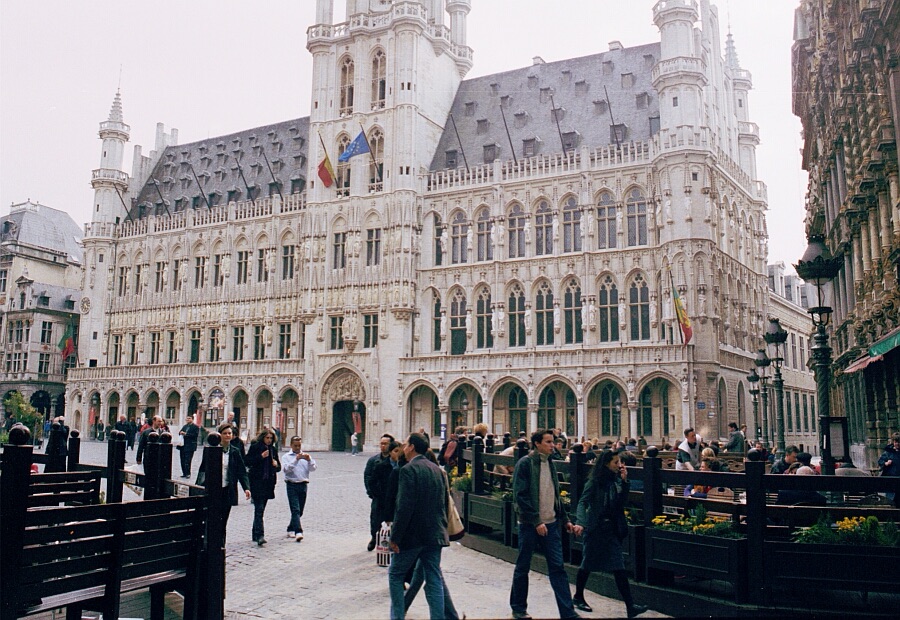
A photo of the main square in Brussels

Hiya! Yup, I’m back from my weekend in Brussels – I had a great time.

Friday

We set off very early – the train we were talking was a 6am train out of York. The journey down was okay – since it was still early it wasn’t busy, though once we got to King’s Cross it was a bit of a hustle getting onto the Tube since it was rush hour. Handily there was a sign that gave a suggested route to London Waterloo – we would have taken the Victoria to Euston and then the Northern to Waterloo, but actually it recommended the Victoria to Oxford Circus and then the Bakerloo, since there were no stairs or escalators to climb to change platforms. And when you’re carrying heavy cases, it sure is useful.

We arrived at Waterloo much earlier than anticipated – we actually had to wait for check-in to open at 9am. We then passed through the airport-style security checks without problems (as we wouldn’t :)) and then had an hour and a half to wait for the train to arrive – I spent most of the time drinking Tango and reading the Guardian. Because there were trains to Brussels and Paris leading at roughly the same time, there was quite a rush for the platforms, but we got on in good time. The train was about 40 minutes late on arrival – we were delayed slightly in Kent, which then meant we missed our slot for the Channel Tunnel, and then in Lille, one of the passengers had to be treated after falling ill. And then we were stuck again in Belgium. But once we got to Brussels-Midi station, it was just a case of going through Passport control, finding the taxi rank and jumping into a taxi. Because mum had to drop a report off at the European Commission (the reason for our visit) this was our first priority. Although our driver drove like a Formula 1 driver (I did have to cover my eyes on a couple of occasions), he was able to get us to where we wanted to be, and even waited for us at the EC before taking us to the hotel. That said, I think most of the drivers there were driving equally as recklessly, so it was a good thing someone else was behind the wheel.

The hotel was very posh, arguably the poshest I’ve ever stayed in. It was a five star place – all the rooms were ensuite, and the TVs had 40 channels with a PlayStation and internet access, as well as a minibar, safe and kettle. After dropping our luggage there (which was kindly brought up by one of the porters) we did a little sightseeing and window shopping in the centre, before encountering the Lop Lop Café. This was a pub that served 150 different beers, most of which were Belgian. They even had a list of all of the beers available, which was promptly handed to my father when he used his “Pigeon French” to ask for ‘un biere’. Most of the people there seemed to be British or Canadian, and the TV was showing BBC One, which gives you an idea of the clientele. Another, to use the American term, ‘quaint’ aspect of the pub was that many of the beers came with their own glasses, so for example if you ordered Leffe you got it in a Leffe glass. That may have not been such a big deal if it weren’t for the fact that each glass was profoundly different from the others, including the interesting-looking Kwak glass (for Kwak beer) which looked like some kind of test-tube and came with its own wooden stand. Me? I just had a Pepsi. Call me unoriginal, but I needed a drink and having spent the equivalent of 6 hours on trains I wasn’t in the mood to be adventurous.

I also got the chance to buy a new CD – a record shop that looks like a former Virgin Megastore was selling the Belgian release of ‘Underwater (Rank 1 Remixes)’ by Delerium for €2.50, or £1.79. I wouldn’t have been able to get it at that price back home.

We then set about finding dinner. Like in Paris, many of the restaurants are congregated around a small area, so finding one was no problem. We only spent about 10 minutes in the first – there were some rather grim sounding noises coming from the kitchen, and then the owner told us to leave before the police arrived. Ho hum…

Anyway, every cloud has a silver lining, and so the restaurant we actually ate in was actually better than the first – I had a fillet of Scottish smoked salmon for starters, followed by moules marinière (one of my all-time favourite dishes) and then chocolate mousse for desert (hey, I couldn’t come to Belgium without having some of the chocolate, now could I?). The mussels were a little rubbery, but the salmon was nice, and the chocolate mousse was sublime.

Although it was only getting on for 9pm, we then headed back to the hotel (you would do too, if you’d been up as early at 4:45am).

Saturday

Breakfast isn’t one of my favourite meals of the day, mainly because I hate the traditional English breakfast that most hotels over here serve. But, remember, we’re at a five star hotel here, so the choice was immense. I could have had my bacon, eggs, sausage, mushrooms, baked beans and tomato if I wanted to, but instead I could have had cold meat, pineapple, grapefruit, peaches, yoghurt, cereal, croissants… The hot chocolate was also nice – I’m not a tea or coffee drinker (I sleep instead), and there was plenty of fruit juice available too.

That morning we went to see an exhibition of paintings by Breughel at the Belgian Museum of Fine Arts. Normally I’m not really one for art, but this was interesting because it showed the originals among copies made by members of the Breughel family, and how the copies differed – for example, in one a man had a red coat, then he’d have a grey one, then a blue one, and so on.

After descending on an Italian restaurant for lunch, where I had a very nice pizza with Parma ham as the topping, we did a spot of shopping. My mum bought my uncle a T-shirt – about drinking beer, no less (it’s one of his favourite pastimes) – and I went into Fnac, where I bought another Delerium album (“Odyssey” – a double CD of remixes) and a new mouse – I’ll come onto that later.

We then returned to the Lop Lop Café, where my dad was able to watch the rugby game on the BBC while drinking Kwak – he later bought a bottle of the stuff to take home, but fell short of buying the presentation pack with the weird glass in it, mainly because it weighed a tonne. By then it had started raining, so we made a beeline for the hotel and put our feet up for a couple of hours, before heading out for dinner.

My mum walked out of the first restaurant we went to, since it was too warm and stuffy – we’d been put upstairs since there was no room on the ground floor. Like in Paris, the restaurant owners are very keen to get you in, so it was perhaps ironic that we went to one where there was no-one outside trying to push us in. Although I had the same starter as before, I went for steak and chips for my main course, which came in a green pepper sauce, and was very nice. For desert we all got crème caramel, which was also very tasty.

We then had a brief walk around the centre of the city, taking night photos of some of the buildings – I was the only one with a camera, so my dad borrowed it for taking photos – his is somewhat larger and heavier (though much better).

Sunday

After breakfast, we took a taxi from the hotel to the station, where we put our luggage into the Left Luggage section, then took a metro back into the town. I have to say that the metro system wasn’t as good as the systems in Paris or London – there are only two lines, though Brussels does have street trams that serve much of the city, so that is perhaps why. The escalators actually require a button press to work them – though I think this is for saving energy and not because they are old.

We actually took the wrong line and ended up in a different part of the city than expected, though we still got chance to take photos and see things. We then headed back to the station, where we picked up our luggage and bought some lunch, as well as an English paper to read, plus a French computer magazine (Windows News – I buy a copy every time I’m in France/Belgium) and a French newspaper, as requested by my French teacher.

We didn’t have quite so long to wait around this time – only about half an hour, and we arrived in Waterloo on time at about 2pm. We then took the tube back to London King’s Cross, where we met the 3:30pm train back to York.

All in all, it was a very enjoyable holiday – Brussels was a city that I haven’t visited before, and it has been almost 10 years since I last visited Belgium properly – I can’t really call changing at Brussels airport a visit to the country. I found it interesting how the two official languages (French and Flemish – like Dutch but with more similarities to German) co-exist – all signs are in the two languages, and even some of the streets have different names – ‘Rue d’Argent’ (Silver Street) was also called ‘Zilverstraat’. Although this exists in Wales, where English and Welsh are both official languages and therefore both appear on signs, only a handful of the population speaks Welsh as their first language and almost everyone understands English. While I think most people in Belgium speak both languages, it was interesting how in one shop I was served in Flemish and others I was served in French – these were all high street stores in the same city.

English is also a third language – many shops had English names and a lot of the people spoke English when one of us struggled with vocabulary. I guess that is simply the dominance of the language – I think if someone where to choose a ‘global language’ it would probably be English (even though the largest proportion of the world’s population speaks Chinese).

I was also surprised how Europhillic the country is. I obviously live in the UK, where there is a lot of silly opposition to European matters such as the Euro. Yet in Brussels (which does happen to the main home of the European Parliament), I counted at least 4 ‘Euroshops’ which sold gifts and souvenirs with the 12 stars and the € symbol on them. Statistically, the country is the most Europhillic behind Luxembourg, and has one of the largest proportions of people who are happy with using the Euro as their currency, instead of the Belgian Franc. If only the UK was similar…

I also noticed a lot of beggars around on the street. While no major town is without them, they seemed to stand out more there – they open doors for you at churches for example. Although I am in support of helping homeless people (the postcoded park bench in Bristol was a very good idea, for example), I don’t give money to beggars since you can’t be sure they’re for real – having a mother as a magistrate means I’m aware of the cases where beggars travel in from other towns, get changed in the toilets of the station, beg on the streets and then go home to their families while claiming job seekers allowances…

I also found a little difficult to take the city seriously after seeing one of its popular attractions – the ‘Manequin Pis’. Well, you would have a doubts about somewhere that had a urinating cherub as its emblem, wouldn’t you?