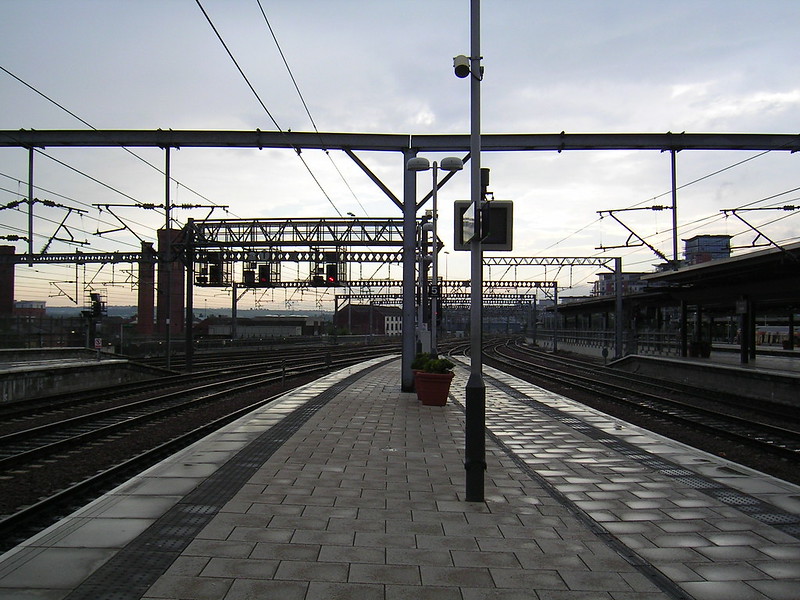
Low Moor is technically a re-opening of a station that was closed in the 1960s, following the Beeching report. It used to be a junction station, with a branch line heading down the Spen Valley through Cleckheaton and Heckmondwyke. That branch line was closed, and is now the Spen Valley Greenway, a segregated footpath that I’ve walked a few times (but curiously never blogged about). Low Moor station has an exit onto the Greenway, improving access to it.
For a couple of years in the 1990s, the land once occupied by the old Low Moor station was used for Transperience, a public transport museum. I wrote about it a few years ago despite having never been; it closed due to a lack of visitors, and therefore money.
The new Low Moor station has been quite a long time coming; plans have existed for some time. Its construction has also taken far longer than planned. The local area was a major coalfield, and, during work to build a lift shaft, an uncapped mining shaft was found that didn’t exist on any plans. The station should have therefore opened in 2016, but, hey, better late than never.
The start of construction was also held up due to the need to get a standards derogation for the curved platforms. Modern stations have dead straight platforms, to minimise the gap between trains and the platform edge. Low Moor station is on a curve, and so there are a number of ‘Mind the Gap’ warnings around.
The new Low Moor station
So what did I find when I visited? Well, it’s very similar to most new stations that have opened of late. As you’d expect, it is (almost) fully wheelchair accessible; the only exception being the steps down to the Greenway. A ramp for cycles has been provided (but was fenced off) – this seems like a curious omission. Lifts provide access to the two platforms, which surprised me slightly. The station is unstaffed, so if the lifts break down, there’s no assistance for wheelchair users. I’m guessing large ramps would have added to the cost; the station already cost over £10million to build.
As mentioned, Low Moor station is unstaffed, so there’s no ticket office. There is a machine by the car park, however, which has around 100 spaces. When I visited today, there were around 20 cars parked up. Which isn’t a lot, but the station has been open less than a fortnight, and there are almost no road signs to it. I expect that, in time, it’ll be signposted from the nearby M62 as a park-and-ride facility for those travelling into Leeds and Bradford.
Services
Which brings me to the train services. There aren’t many of them.
After spending a lot of money on a new station, you might expect there to be a regular train service. But the majority of train services on the Calder Valley line whizz through Low Moor station without stopping. There’s a basic hourly service in each direction: one northbound to Bradford and thence onto Leeds, and one southbound to Halifax and Huddersfield. There’s no direct service to Manchester Victoria.
Grand Central, the open access operator which runs trains between Bradford and London King’s Cross, stop most of their trains at Low Moor, so there is a link to the capital. But these trains only run four times a day in each direction.
It’s a shame that Low Moor hasn’t got a great service, especially considering the money spent. Improvements should, however, come with time. The Calder Valley line is undergoing a multi-million pound upgrade this year, which should see more and faster trains. At present, only 4 trains per hour can use the line in each direction; the upgrade will add a fifth path and hopefully more. This should mean that more trains can stop at Low Moor without existing services having to slow down.
The poor service frequency was part of the reason why I made my visit to Low Moor by car, rather than by train. I’m hoping that getting there by train will be easier in the not too distant future.
Earlier this summer, Yorkshire gained a new railway station on the outskirts of Leeds. Called Kirkstall Forge, it’s located on the Airedale and Wharfedale lines which offer commuter services from the Aire and Wharfe valleys into Leeds and Bradford. And on Wednesday, I went to have a look at it.
Kirkstall Forge gets its name from a large forge that used to exist on the site. It was demolished, leaving a huge area of brownfield land, ripe for development. And it happened to be right next to a railway line. So the site’s developers contributed a sizeable amount of money to ensure that a station could be built. After all, houses near railway stations tend to command higher prices.
The station has been a long time coming; plans were first drawn up 17 years ago in 1999, but it wasn’t until 2014 that all of the funding became available. Construction started later that year, although its location on the River Aire’s flood plain put its opening back to June.
As it was a nice day on Wednesday, I walked to the station from Leeds, along the Leeds-Liverpool Canal. It’s about five miles and took me a bit over an hour to get there. Of course, I was about a third of the way there before I realised that Google Maps wasn’t showing a footpath from the canal towpath to the station. Thankfully, a quick Google search verified that there was indeed a path to link the station to the canal. Indeed, thanks to the footbridge at the station, access to the canal in this area is now greatly improved.
The station itself is nothing special. Two platforms, a footbridge with lifts, a couple of waiting shelters, some seats, a ticket machine and a passenger information system. The latter two of these were out of order, showing a scrolling message about checking the paper timetables. Welcome to 2016, everyone.
Considering that a train passes through the station every 10 minutes in each direction, surprisingly few actually stop there. The basic service seems to be hourly in each direction, to either Leeds or Shipley and Bradford Forster Square. A handful of services instead go to Ilkley or Skipton, but these seem to be limited to peak times.
It might seem a bit of a waste then, to spend millions on a station with such a basic service. But then, there isn’t yet much to serve here. Whilst I’m sure that the forge site will be covered with hundreds of new houses in a few years, right now there was only a little construction taking place. Still, I was not the only person to catch the train towards Bradford, at around 4pm.
Kirkstall Forge, for now, retains the crown of Yorkshire’s newest station, but not for too much longer. South of Bradford, Low Moor station is under construction, on the site of the ill-fated Transperience museum, and is due to open next year. Well, hopefully – it’s already behind schedule after an uncapped mine shaft was found right where one of the lifts was due to be installed. There’s still a big gap in the Bradford-bound platform, at time of writing.
Scott managed to visit Kirkstall Forge before me and wrote about it – and I largely agree. Maybe in a few years, the station will be able to better justify its existence.
Today is April 1st – and whilst that’s normally an excuse for news outlets to publish satirical articles to wind up their audiences, today it marks a new chapter for train services in the North of England. The two key rail franchises – Northern, and TransPennine Express – both change hands today, with promises of major improvements to trains, track and stations.
‘No growth’
The previous Northern Rail franchise started in 2004, and was awarded to a consortium of Serco (to whom all your base are belong to) and Abellio, a subsidiary of Dutch state railways. Controversially, this was a ‘no growth’ franchise, awarded on the basis that there would be no expected growth in passenger numbers over the original seven year period of the franchise. As such, the franchisee was not required to make any investments in new or additional trains, or run extra services.
As it happened, passenger numbers did grow, year on year, even during the 2008-2009 financial crash. In ten years, passenger numbers at Northern Rail stations (including my home station of Sowerby Bridge) have near doubled, and services have become increasingly overcrowded. To Northern Rail’s credit, whilst no brand new trains have been introduced, some additional trains have been brought in from elsewhere in the country where they had become surplus to requirement. Northern Rail has also held onto older trains, rather than scrapping them, to maintain capacity. Consequently, train services have more carriages, more seats, and in most cases run more frequently now than in 2004.
So whilst Northern Rail has managed to go above and beyond its minimum requirements, I think it’s fair to say that it has merely been ‘coping’ with increased demand, rather than making an effort to generate new demand. And it’s not done much for its reputation for running old, increasingly-tired looking trains – many of which, bar a change in seat covers, still sport their original, 30-year-old interiors.
In particular, Northern Rail has been well-known for having a large number of Pacer trains. These were introduced as a mostly temporary measure in the 1980s, by taking Leyland bus components and bolting them onto single-axled freight wagons. 30 years on, and they still make up around a third of Northern’s fleet, despite having shorter carriages and poor ride quality.
TransPennine Express
Earlier in 2004, another of the north’s rail franchises was awarded to a consortium of First Group (based in Scotland), and Keolis, a French transport company partly-owned by SNCF (French state railways). Keolis was a minority partner in the joint venture and so the franchise was known as ‘First TransPennine Express‘ (FTPE), even though First Group operated its other franchises on its own (First’s Hull Trains is a joint venture, but it’s an open access service, not a franchised operator). Unlike Northern Rail, this was a growth franchise, and saw the introduction of 51 brand new Class 185 diesel trains, built by Siemens in Germany. Some nearly-new Class 170 trains were also brought in, and so within a few years the entire FTPE fleet was made up of modern trains.
Whilst some growth was accounted for, actual growth turned out to be much higher. FTPE was controversially denied permission to add a fourth carriage to its new Class 185 trains, nor was it able to procure any additional trains, and so overcrowding became a problem. This was eased somewhat recently, when 10 new Class 350 electric trains were introduced for its services on the West Coast Main Line between Manchester and Scotland following electrification work west of Manchester.
Northern administration
Whilst both franchises were extended beyond their original periods, ultimately the time would come to hold new open franchise competitions to choose new operators. Most franchises in the UK are awarded by the government’s Department for Transport (DfT), with the exception of Scotrail and the Caledonian Sleeper (awarded by the Scottish Government), Merseyrail (awarded by Merseytravel) and London Overground (awarded by Transport for London). The various metropolitan, district, city and county councils of the north clubbed together to form a new organisation called Rail North, and successful lobbying has meant that the new replacement franchises have been awarded jointly by Rail North and a new DfT office in Leeds. This means that control of the new franchises happens in the north of England, by staff who actually use the services, and not by ministers and civil servants based in London. Crucially, both new franchises will anticipate growth in passenger numbers, and reflect changes in passengers’ expectations.
Arriva Rail North
The Northern franchise was won by Arriva – originally a British bus company that now operates several other rail franchises (CrossCountry, Arriva Trains Wales, Chiltern Railways, London Overground and the Grand Central open access service) and was taken over by Deutsche Bahn (German state railways) a few years ago. Arriva operated one of the predecessor franchises to Northern Rail – Arriva Trains Northern – but this new franchise will not resurrect the old brand. Whilst the franchise will still be called ‘Northern’, there’s a new logo and I expect that trains will get new liveries in due course.
As part of the new franchise, there’s a commitment to withdraw the old Pacer trains by the end of 2019. They can’t be disposed of straight-away, as it will take time for replacement trains to be brought into service, but December 2019 is a practical deadline as well as a tactical one. From the 1st January 2020, all revenue-earning passenger trains in the UK must meet accessibility regulations; the Pacers don’t, and the cost of modifying them is likely to be prohibitive. Whilst withdrawing them from the Northern network is a franchise commitment, if some vehicles can be modified, they could end up elsewhere in the country.
To compensate for the loss of Pacers, some additional trains will be transferred from the TransPennine Express, Great Western and Scotrail franchises, but there will also be over 90 brand-new trains introduced. A contract for these was given to Spanish manufacturer CAF, and will see new 2 or 3 carriage Class 195 diesel trains, and new 3 or4 carriage Class 331 electric trains being introduced from 2018 onwards. CAF built Northern’s existing Class 333 trains in a joint venture with Siemens, as well as the Class 332 trains used on the Heathrow Express services. The trains will be built in Spain, rather than Britain, but Britain’s two trainbuilders (Bombardier in Derby and Hitachi in County Durham) have nearly-full order books and so there’s little spare capacity for them to be built here, even if this might help Britain’s beleaguered steel industry.
Arriva Northern’s remaining trains will be deep-cleaned and refurbished, with free wifi available on all trains once the equipment has been installed. Currently, just a handful of Northern’s trains offer wifi, and these all operate on electric commuter services in the Leeds area. Some services will be branded ‘Northern Connect’ – these will be the ‘intercity’ services and will offer seat reservations and the newest trains – something I hoped for in a blog post back in 2014.
Same old brand new you
The TransPennine Express (TPE) franchise was won by First Group outright this time, rather than as a joint venture. I expected there to be very little change from day one, but there’s a new logo and livery being launched today. The first two trains have already had the new look applied to them overnight. Interestingly, despite the franchise being awarded to First outright, the ‘First’ branding has been dropped, although this is in line with Great Western Railway (another First franchise) and Hull Trains, where the overt First branding has also disappeared.
Whilst FTPE invested in new trains around a decade ago, this new franchise will also see new trains, in the form of 19 Hitachi AT300 bi-mode trains (which will probably be Class 802 when delivered). Sporting five carriages, these will be much longer than TPE’s existing trains, and have a faster top speed of 125 mph (200 km/h). As bi-mode trains, they will use electric overhead wires where available, but will be able to fall back to diesel engines on lines which have yet to be electrified. These should arrive by the end of 2019, and will be built at Hitachi’s Newton Aycliffe plant in County Durham.
Whilst TPE have only ordered 19 new trains for now, they will have the ability to order extra trains should the need arise, as long as there is a business case for them. This should avoid the issue with the previous franchise, where FTPE were not able to order extra carriages despite issues with overcrowding.
New stations and infrastructure
Infrastructure like stations, track and signalling aren’t in the remit of train operating companies like First and Arriva, but changes to these will have an effect on the new franchises. In West Yorkshire, two new stations are under construction – one at Kirkstall Forge near Leeds, due to open imminently, and another at Low Moor, south of Bradford and just off the M606 motorway which will open this summer. Further new stations are likely, including one at Elland, one of the largest towns in the region without its own railway station.
Over in Manchester, work has started on the Ordsall Chord, a new link that will allow trains heading west from Manchester Victoria and Salford Central stations to loop back towards Deansgate, Manchester Oxford Road and Manchester Piccadilly. This will allow services from the Calder Valley to continue to Manchester Airport for the first time, and link Manchester’s two major railway stations. The Calder Valley line will also receive capacity improvements, allowing trains to run more frequently, and the TransPennine route via Huddersfield and Stalybridge to Leeds is due to be upgraded and electrified over the next 8-10 years.
High Speed 2 and High Speed 3 are also due to come into play over the next few years, although plans are not as progressed as the other upgrades.
No Subsidy
Some explanation as to why the previous franchises had lower levels of investment (or none at all) are to do with taxpayer subsidies. Northern Rail was one of the most heavily subsidised franchises in Britain, and FTPE was also in receipt of a small level of subsidy. The subsidies were required as income from fares (i.e. passengers buying tickets) would not be sufficient to cover the costs of running the trains. Whilst there’s an argument for withdrawing services that are not commercially viable, there’s also an argument that some services are important even if they lose money, and in any case, withdrawing train services has been very controversial ever since the 1960s.
Government policy is to try to shift more of the burden of train running costs to passengers, rather than taxpayers, and the aim with the two new franchises is that, by the time they both end, neither franchise will need a subsidy. In TPE’s case, the opposite is expected to happen, and so First will have to pay a premium to the government, rather than receive a subsidy. With Arriva, it should roughly break even, or receive a drastically reduced subsidy.
This is where Rail North’s lobbying has been effective. Their aim is to break the subsidy cycle – train services have been subsidised because they can’t attract enough passengers to be commercially viable, but there hasn’t been enough investment to make them commercially viable. I hope they’re right, and that investment in services will unlock latent demand. That way, both passengers and taxpayers will benefit, especially if there are no major rises in train fares.
Driver-only operation
An appropriately-timed press release by trade unions suggests that there are plans for some of Arriva’s trains to lose their guard. Currently, guards are responsible for opening and closing train doors, ensuring that the train is safe to depart stations, and for checking and selling tickets. It’s possible that, to cut costs, some services will move to ‘Driver-only operation’, where the driver takes over the safety and door operations. This will require trains and stations to be modified, with door controls installed in drivers’ cabs and CCTV cameras on trains and stations so that the driver can see the doors. But it means that guards can be replaced by less-qualified (and therefore cheaper) revenue protection officers on trains, who are freed up to just sell and check tickets. Some trains may not even have anyone else on board other than the driver.
Driver-only operation is widespread on commuter services in the south-east, and, as well as being cheaper to run, it’s arguably better for train reliability. I’ve experienced trains being stuck at stations with the doors shut for some time (up to 30 seconds) because the guard has been busy selling a ticket when the train has arrived; if that happens at multiple stations, then it can add up. But, trade unions are right to lobby to protect their members jobs (and I speak as a trade union member myself), and there are benefits to having a member of staff available to help with passenger concerns. It’s an issue that I feel neutral about.
Day 1
So, today was day 1 of the new franchises. Whilst TPE are rolling out their new brand very quickly, I gather that Northern are taking a steadier approach. It’ll be a couple of years before the major changes in Northern’s train fleet take effect, so in the meantime it’s likely that the trains will retain their current liveries (but with the new operator logo). The old ‘Northern Rail’ logos have already been removed from trains and stations, but staff will still wear their existing uniforms for the time being.
Travelling to work this morning, there was very little to show for the change in franchise, apart from the guard having a name badge in the new brand, and drawing attention to the new Low Moor station as we passed it at speed. As old trains get refurbished, and new trains arrive, I expect that the rebranding exercise will ramp up.
After being neglected for so long, it’s good that Northern rail users will finally see some decent, large scale investment in their railways. My only worry is that these improvements may not be enough – whilst the new trains are welcome, by the end of this franchise, Arriva Northern will have only made a net gain of around 16 trains, unless more are sourced from elsewhere. We shall see what happens.
This is the third in a series of posts about what we did on our recent trip to London.
After lunch, we decided to head back towards central London. We could have caught the DLR from Cutty Sark and gone back the way we came, but instead, we caught a Thames Clipper waterbus from Greenwich Pier. The Thames Clippers are a fleet of catamarans that run up and down the River Thames in central London, and are currently sponsored by MBNA. Recently, they have started accepting Oyster cards as payment, and so we thought we’d give them a try, seeing as none of us had been on one before.
Although they operate on water, as they are catamarans rather than regular boats, they’re actually very quick. Certainly quicker than catching a bus, and probably competitive with the Tube – worth knowing the next time there’s a strike or signalling problems. You can sit outside at the back, but there’s a large amount of indoor seating too, and the seats are very comfortable – far better than most other forms of public transport. There’s even on board bar serving coffee, snacks and alcohol. And whilst I’m not usually one for getting sea sick, the Thames Clippers are pretty smooth and so even if you normally get queasy on a ferry, you shouldn’t have issues with these.
As well as being quick, you can get a very different view of London’s landmarks. We travelled from Greenwich to London Bridge Pier, which took us under Tower Bridge and offered a square on view. It was worth it to take photos.
The two main downsides of the Thames Clippers are waiting times and cost. Although they are regular, we just missed one at Greenwich and it was around 15 minutes until the next one. Whilst that’s more frequent than many bus and rail services outside the capital, it doesn’t compare so favourably with buses or the Tube.
It’s also rather on the pricey side. I think we paid £8 for our journey on our Oyster cards, which is significantly more expensive than other forms of public transport. Whilst people can and do commute to work on the Thames Clippers services, they’re really aimed at tourists who are happier to pay a higher price. Still, you get a comfy seat, a fast journey, and get to see parts of London from new angles, so it’s worth the extra cost.
Manchester Victoria station has had a rather large makeover. It’s not the dark, dreary place that it once was, and now sports a new roof that lets in far more light. And not before time, too.
One of the worst
Back in 2009, Victoria was named as one of the worst railway stations in Britain. The roof over platforms 1 and 2 and the Metrolink platforms was in a poor state of repair, following damage sustained in the 1996 IRA bomb attack that was never fixed. It leaked, and was partially covered in tarpaulins which made the station seem dark. To prevent fare evasion, ticket inspectors had erected temporary barriers around the platforms with confusing one way systems. Platforms 3-6 were now underneath the Manchester Arena, and were poorly-lit with a confusing layout for the footbridge.
It wasn’t a very inviting station to spend any time in, especially at night.
Management
To understand why the situation at Victoria got so bad, it may be worth looking at the management of the station over the years.
When the railways were privatised in the 1990s, the running of most smaller and medium sized stations was taken over by the largest train operating company (TOC) that called there. Control of major stations was passed to Railtrack, and then Network Rail when Railtrack went bust in 2002. Many of these major stations underwent major regeneration work, which usually involved massive expansion of retail space to bring in more rental income.
Manchester Piccadilly is the biggest station in Manchester and so Railtrack managed it, but management of Victoria has always been with a train operating company: since 2004, this has been Northern Rail. Northern Rail’s franchise was let on a ‘no growth’ basis and so very little investment has been made in either trains or infrastructure, despite Victoria being a major hub for Northern Rail.
Capacity
Victoria was once a much bigger station than Piccadilly, with 17 platforms at its peak. But in the early 1990s, the decision was made to re-route most trans-pennine services away from Victoria to Piccadilly, which is on the West Coast Main Line. Previously, passengers travelling from, say, Leeds to Stoke would have to take a short shuttle service between Stalybridge and Stockport – now they could simply make one change at Manchester Piccadilly. This shuttle still runs, albeit only once a week.
Victoria was subsequently downsized to 6 rail platforms, and 2 platforms for the then new Manchester Metrolink tram system. The now disused platforms on the north side of the station were demolished and the land sold off to build the Manchester Arena which sits above part of the station.
At the time, re-routing services to Piccadilly made sense, as the railways were in a period of managed decline. But following privatisation, passenger numbers have rocketed to record levels, and now capacity at Piccadilly is becoming an issue. Those trans-pennine services have to cross the paths of mainline trains from London on flat junctions, which limits the number of trains that can depart and arrive from Piccadilly station. And of Piccadilly’s 14 platforms, 12 of them are bay, or terminating platforms. Any train that needs to pass through Manchester has to use the two through platforms, numbered 13 and 14, which are now full to capacity. Work is planned to add an additional two through platforms, but in the meantime there can’t be any additional services that cross Manchester city centre via Piccadilly.
The Northern Hub
The Northern Hub project is a Network Rail initiative to improve rail capacity in the north of England, and it’s focussed on Manchester. Part of this will involve a new section of track, called the Ordsall Chord, which will allow trains to leave Victoria going west, and then loop around to Piccadilly. At the moment, most trains that call at Victoria terminate there, even though 4 of its 6 rail platforms are through platforms, which is a poor use of capacity. Upgrades at stations such as Rochdale and Stalybridge will allow trains that currently terminate at Victoria to continue, in turn allowing more trains to stop there. Last year, a new direct Liverpool to Newcastle service started calling at Victoria, and this is likely to be the first of several new long-distance services that will call at Victoria, rather than Piccadilly.
Making Victoria Posh
Eventually, money was found to refurbish Victoria and bring it up to the same sort of standard of other major stations. The old roof is gone, and has been replaced with a new ETFE roof. New flooring has been lain on the concourse, automatic ticket barriers have been installed, and a new footbridge has been erected to improve access to the Manchester Arena. New shop units have been opened and the existing ones refurbished – the old first class refreshment room is now a Starbucks, but retains its original tiled interior.
Meanwhile the Metrolink platforms have also been rebuilt, and expanded from two to four, albeit with only three tracks. Some trams will call at both platforms B and C – they’re lettered to avoid confusion with the rail platforms.
Together, these projects have been branded as ‘Making Victoria Posh’ a pun presumably inspired by Victoria “Posh Spice” Beckham.
A separate project has seen the lines coming into Victoria from the west electrified for the first time. This means that electric trains can run from Victoria to Liverpool Lime Street – these services started earlier this year. Eventually electrification will extended eastwards towards Stalybridge.
The works still aren’t quite complete – there’s a little bit left to do, and only a couple of the retail units are occupied (both of which are coffee shops). But the station already looks so much better than before. No longer will it be an embarrassment to the city.
Tomorrow we’re off to the Trafford Centre to buy a washing machine. You may wonder why we’re travelling all the way to the far side of Manchester for something that we could buy more easily locally. As it happens, we have loads of John Lewis gift vouchers left over from our wedding, plus some more from completing online surveys from Valued Opinions and Ipsos i-Say, so in all it’ll work out cheaper. And we’ll be making a day of it.
Because we don’t drive, we’ll be taking public transport – a train to Manchester, and then a bus, as the trams haven’t made it that far yet. In all, this would normally cost around £30 – £21 for return train tickets and around £8-10 for the bus tickets. But, by combining discounts, we got the lot for £12. Here’s how:
Two Together Railcard
Because Christine and I travel together by train a lot, we have a Two Together railcard, which means we get a third off almost all train fares provided we buy the tickets at the same time and travel together. It costs £30 a year, although there are plenty of discount codes bringing it down to £27, and you can exchange Tesco Clubcard vouchers for one as well.
It’s one of the newer railcards, having been launched last year, and we’re on our second card. We got our money’s worth on one journey alone, when we went to Nottingham, and use it regularly.
Advance purchase tickets
Northern Rail, who operate the trains between us and Manchester, have only recently introduced discounted advanced purchase tickets on some routes. If bought before 6pm the previous day, you can get a significant discount on the cost of tickets versus buying them on the day. By buying advanced purchase tickets with our railcard, we got the price of our train travel down from £21 to £8 – not bad.
Plusbus
Plusbus is a not particularly well-known add-on for train tickets, that allows you to purchase discounted bus travel at your destination. You buy it as part as of the same transaction as your train tickets, and it essentially gives you unlimited bus travel at your destination for one day, on participating routes and operators.
I’ll be honest – this weekend will be the first time we’ll be using it, and I’m still not 100% convinced that it will be accepted on the buses that run between Manchester city centre and the Trafford Centre. But, it only cost an additional £2 per ticket, thanks to a special offer that is only running this month, so if it doesn’t then we’re only out of pocket by £4.
Additional discounts
We bought the tickets online at First Transpennine Express, even though we won’t actually be travelling with them at all. I chose them for three reasons:
They offer Nectar points at a rate of 2 points for every pound spent on train travel, so I earned 16 points for the £8 spent on the train tickets. I can then use these points for money off cinema tickets or shopping, for example.
They offer cashback via Quidco (referral link) – it’s only 1%, but that effectively saves a further 12p off the cost.
There are no additional booking, card or postage fees – you just pay for travel.
Disadvantages
The only downside to choosing an advanced purchase ticket is that it restricts us to travelling on certain trains. If we miss these trains, or want to vary our travel plans, then the tickets will no longer be valid and we’d need to buy new ones, probably at full price. Buying on the day costs more, but at least the tickets are fully flexible.
Normally one advantage of buying an advanced purchase ticket is that you also get a confirmed seat reservation as well. Northern Rail don’t offer seat reservations (despite running some long distance services) so the only real advantage of buying tickets in advance is the lower cost. Other operators do include seat reservations, so you could have two passengers: one who paid, say, £12 and got a guaranteed seat, and another who paid £80 on the day and who may have to stand.
And finally, before you ask – we’ll be having the washing machine delivered. I don’t think we’d get it home on public transport.
I’m a northerner, and I travel by train a lot. At least 95% of my journeys are with Northern Rail, a franchise run jointly by Serco (to whom all your base are belong to) and Abellio, which is owned by the Dutch government. The franchise was let in 2004 on a ‘no growth’ basis – the assumption being that passenger levels wouldn’t grow significantly during the franchise period, and so there was no real requirement for any extra trains or to increase service levels.
In reality there has been a huge growth in passenger levels in the north over the past ten years. Thankfully Northern has invested in some extra trains, although these are mostly old trains that other operators no longer need, and some services have been improved. But there haven’t been any brand new trains ordered, and whilst most have been ‘refreshed’ with a coat of paint, new flooring and seat covers, internally most of Northern’s fleet retains their original fixtures.
Around the time that the rail franchises in the north were re-jigged in 2004, the intercity services that Northern’s predecessor (Arriva Trains Northern) operated were mostly split off into a different franchise – First Transpennine Express. These services received new trains. Northern was left with mainly commuter and rural services, and the internal layout of its trains reflect this. But it still operates a few intercity services that I’ll get onto.
What makes a service ‘intercity’ anyway?
Simply put it’s a train service that connects two or more cities together, although I’d also state that the end-to-end journey time is over an hour, and it only calls at larger stations. Unlike short-hop commuter trains, where fitting on as many passengers as possible is the main goal, with intercity services you want to provide a more comfortable experience for longer journeys. To me, this means providing:
Refreshments, such as a trolley service or buffet car
First class accommodation
Wifi (free or paid-for)
Plug sockets
Seat reservations
Almost none of Northern’s services meet the above criteria, and yet some of its trains probably should. Here’s my list of “intercity” services that Northern runs.
Leeds – Nottingham
This is fresh in my mind as we took this train on Saturday. It’s actually a relatively new service that was first introduced in 2008. The full journey takes almost exactly two hours, taking in the cities of Wakefield and Sheffield, and the large town of Barnsley on the way. It’s actually not the quickest way between the two cities, as we found out coming back – taking an East Midlands Trains service to Sheffield and then a Crosscountry service to Leeds took marginally less time, even allowing for 20 minutes in Sheffield. This is probably because the direct train goes via Wakefield Kirkgate and the Erewash Valley Line, so whilst it is an express service that skips many intermediate stations, it still takes a long time.
Our mid-morning Saturday departure was on a two-carriage class 158 train, which had ample seats for the number of people using it. And whilst the 158s are the newest of Northern’s diesel fleet, they are showing their age somewhat. Case in point – I had to use the toilet and it took several attempts to get the door to close because we were going around a bend and its motor wasn’t powerful enough to cope.
Leeds – Carlisle
The service from Leeds to Carlisle was under threat of closure until around 25 years ago, when the line was reprieved. Nowadays there’s a train roughly every two hours, and each one takes a little under three hours to complete the journey. You could argue that this doesn’t qualify as being “intercity”; Carlisle isn’t a very big city, and it doesn’t pass through any other cities on the way. But it’s also the only one of the services that I’m writing about today which meets one of the five criteria I mentioned earlier.
Thanks to the Settle-Carlisle Partnership there is a trolley service on the train, between those two stations. It’s the only Northern-operated service where this happens though, because it’s provided by the Settle-Carlisle Development Company and not Northern themselves. Again, for the most part Northern operate class 158 trains on this service but not always.
York-Blackpool North
I used to catch this service from Bradford quite regularly when I lived there and Christine lived in Blackpool; later when we moved to Sowerby Bridge I also used to commute in on it on a morning, until the timetable change in May this year. It connects the cities of York, Leeds, Bradford, and Preston, which was granted city status in 2000, but also calls at Burnley, Blackburn, Halifax and Blackpool which are large towns. Travelling the full length of this service takes almost three hours.
Northern usually puts its class 158s on this service but I’ve also endured its older class 150 trains, which have narrower seats, no air-conditioning and only one toilet, on this route. Whilst the former is reasonably acceptable, the latter does not make for a good journey experience, especially for such a long period of time. I suppose it could be worse – it could be a Pacer, a train made of 1980s bus parts bolted onto a two-axeled freight wagon, which are sadly still common on many of Northern’s services.
Spending three hours on a train with no opportunity to buy refreshments on board, no wifi or sockets to plug in a laptop to do work on, and no guarantee of a seat, does not make for a good travel experience. And yet, passengers put up with this every day.
Next year the government will announce a new franchisee for the Northern franchise. Shortlisted are Abellio (on their own this time), Arriva and Govia, and the winner will take over in early 2016. I really hope that whoever wins puts some effort into improving the rail service in the north – but especially these services. Offering a decent intercity-standard service between the north’s major cities will hopefully encourage more people to travel, and allow them to make the best use of their time on board.
Today’s blog post is about a bus service. You may be wondering if I’m scraping the barrel here – surely there’s nothing interesting about a bus service? But Diamond Geezer blogs about buses and makes them interesting, and I think that this particular bus service qualifies.
The 528 bus service
The 528 bus runs once every hour from Halifax to Rochdale, via my home town of Sowerby Bridge, Ripponden, Blackstone Edge, Littleborough and Smallbridge. Drawn on a map, it operates on a near direct south-westerly line, taking around an hour to complete the journey. And it’s quite a scenic route – the photo above is of Blackstone Edge reservoir, as between Ripponden and Littleborough the bus runs through open moorland. On a nice day it can be quite spectacular. I’ve used it a couple of times, once when I needed to get to Bury for work, and another time when the trains weren’t running because of engineering work.
It isn’t the only way of getting between Halifax and Rochdale though. It’s quicker by train, with the fastest services taking around half an hour. Plus the trains run twice an hour during the daytime whereas the 528 is hourly.
There’s also another bus service, the 590, which also runs hourly. The 590 runs via Luddendenfoot, Mytholmroyd, Hebden Bridge, Todmorden, Walsden before rejoining the 528’s route at Littleborough. It takes longer – about an hour and a half – but passes through more populous settlements.
At one time, both the 528 and 590 bus services were operated by First, the Scottish-owned large national bus and train company that operates the majority of buses in West Yorkshire. First still operate the 590 service, but several years ago the 528 was taken over by a company called Centrebus Holdings. This was a joint venture between the managers of Centrebus, a bus company in the Midlands, and Arriva, the large national bus and train company owned by the German state railway company Deutsche Bahn. Last year, the managers of Centrebus sold their stake to Arriva. This allowed Arriva to take full ownership of the company, which is now branded Yorkshire Tiger. Their buses retain Centrebus’ orange livery but with black tiger prints on the side. It makes me smile that a bus operated by Yorkshire Tiger crosses the border into Greater Manchester.
The reason for the change in operator is because the 528 bus is a subsidised service. It’s not commercially viable without taxpayer support, which comes from Metro (part of the West Yorkshire Combined Authority). Over recent years, First have pulled out of a number of subsidised services in West Yorkshire which run more as a public service than for profit. When these services have been put out to tender, Centrebus have often won.
The weak economy and austerity cuts being imposed by central government led Metro to review the services it was subsidising earlier this year. In some cases it was supporting services that were used by just a handful of people. This wasn’t providing value for money, and so a consultation process was held. And one of the proposed service cuts was the 528. Not just cut, but cancelled completely with some replacement buses running only as far as Ripponden as bus number 560. There would be no bus links between Ripponden and Rochdale, and those wanting to use the bus between Halifax and Rochdale would have to use the slower 590 service.
Whilst a large number of other cuts were proposed, the cut to the 528 received the most vocal opposition. In particular, the consultation was only held in West Yorkshire; residents of Littleborough and Rochdale were not asked for their views. Meanwhile the buses used on the 528 route were downsized from large single-decker Optare Tempo buses to smaller Optare Solos.
Redemption, of sorts
The outcome of the consultation was published a couple of weeks ago, and like many consultations that propose cuts, the end result was something in the middle. The 528 will still cease to exist when the changes take effect early next year, but it will be replaced with a new service called the X58 which will operate the same route. ‘X’ services are express services and this will hopefully reinforce the fact that it offers quicker journeys between Halifax and Rochdale than the 590, with the potential that more people will use it. It’ll retain the same hourly service interval as the 528 bus service, although it will not run late into the evening and its frequency will be reduced on Sundays.
I’m pleased that the bus service will be kept, even if I personally don’t use it very often. Whilst some buses can be run at a profit, it shouldn’t mean that those that aren’t profitable are withdrawn, provided that they serve a useful public service. Serving small outlying villages may not make much money for the bus companies but it can be a lifeline for the residents who rely on these services.
On Saturday, whilst Christine was working, I took myself off to the Museum of Transport, Greater Manchester. I’ve been meaning to go for a while, but the recent opening of Queens Road Metrolink station nearby has made it somewhat easier to get to. Although railway engineering works, and the temporary closure of the Metrolink platforms at Victoria station, meant that it was still something of a trek taking a couple of hours each way from Sowerby Bridge. Normally, it’d take around an hour.
Anyway, the museum. It’s in the Cheetham Hill area of Manchester, to the north of the city centre, and is housed in the back of what was the Queens Road tramshed for Manchester Corportation Tramways – now used by First buses as a bus depot. It’s home to a wide variety of buses that operated in or are linked with Greater Manchester, plus a few other bits and bobs. But mostly buses – other forms of transport were not very well represented.
There are three trams, only one of which is complete (a horse tram). Of the others, one is Metrolink 1000, a half-tram mock-up of what would become the production T68 tram series. The T68s have only recently been retired from revenue service in Manchester and I imagine that a production model may enter the collection when one is preserved. The other bit of tram is the lower passenger compartment of what was originally a double decker tram, in the process of being restored.
There are also re-created transport offices, as well as an extensive collection of bus tickets, roller blinds and old signs. But, buses form the main attraction here.
On the whole I found it interesting but it’s not as good as other transport museums – particularly the excellent London Transport Museum. You definitely need to be more of a transport geek to enjoy it, and I’m sure Christine would have been bored stiff by it had I dragged her along. (I very nearly did last summer, but we ended up going bra shopping instead.)
The museum is open three days a week – Wednesdays, Saturdays and Sundays, or all week in August. Entry is only £4 for adults, and free for accompanied under-16s, which is good value for a museum that can keep your average transport geek occupied for a couple of hours.
Leading on from yesterday’s post about our trip to London, here’s a little more about the Megabusplus service that we used. I’ve taken it before, when I needed to get down to London to fly to France for a holiday in 2009, but this was Christine’s first time, and also my first return trip.
Like the regular Megabus, it is run by the Stagecoach Group, and takes advantage of the fact that Stagecoach is also the current East Midlands Trains franchisee. So rather than getting a coach all of the way, time-wise roughly half of the journey is by coach and the reminder by train, with the switchover talking place at East Midlands Parkway railway station.
This is significantly quicker than taking a coach all of the way. Taking Halifax-London as the example, to do this by coach takes almost 6 hours in total. Megabusplus knocks this down to a little over four hours. You also arrive into London St Pancras railway station, which has much better onward transport links, than Victoria coach station. And I find that I can’t read on coaches (I get travel sick), so for me there’s less ‘downtime’ than a regular coach.
However, compared with a direct train Megabusplus is still slower – the 08:06 Grand Central train from Halifax left a few minutes after our coach and would have reached King’s Cross a full hour before we did.
The prices are about the same as regular Megabus, with fares starting at £1 one way, plus a 50p booking fee. I was too late to get it this cheap, but it was still much more affordable than the train at the last minute. Your ‘ticket’ is the reference number that you get by email when you pay – most people print this out but you can just show it on your phone to the driver, like I did.
The Halifax service actually starts from Bradford, then calls at Halifax and onto Huddersfield, before running direct to East Midlands Parkway. I say ‘direct’ – Huddersfield’s links with the southbound M1 are pretty poor and so we went on some very narrow and windy roads to get there. On the way down we briefly called at a service station, but this was only to change to a different driver and customers were not allowed to alight. East Midlands Parkway is effectively a service station though, with a café, toilets and a vending machine.
The Megabusplus coaches themselves are reasonably bog-standard – single-decker, space below for luggage, and a toilet. There’s no on-board catering, and seats aren’t allocated. Most of the people on the two journeys we made were travelling on their own, so if the coach is busy you’ll have to sit next to a stranger. Pre-booking is mandatory – there’s no facility to turn up and pay, although you can book up until the night before, as I did. On the other hand, this means that if everyone arrives early, then the coach can leave early – as happened on the return leg.
I would definitely recommend bringing a music player. Unlike trains, there’s no quiet coach, or any way of moving to another carriage if it’s too noisy. On the way back there was a very restless baby, so I was glad I had some music to listen to.
If you need to get to London cheaply, and don’t want it to take all day, then Megabusplus is worth it. But if you’re able to get a cheaper train ticket, then the train is a quicker and better experience.