Some predictions for 2026

As per the past couple of years, I try to channel my inner Mystic Meg, and come up with some predictions for the new year. Last year’s were mostly on target, although some were rather low-ball predictions.

Bradford City will win promotion

I don’t really follow football or support a team, but as my employer currently sponsors their stadium, I check up on how Bradford City AFC are doing on a regular basis. And at the moment, they’re doing quite well; I’m writing this ahead of time but they’re currently third in League One. If they managed to finish the season as one of the top two teams, or win the playoffs, then they’ll win promotion to the Championship, having only been promoted to League One last season. The last time they were in the second tier of English football was in 2003-4.

A big AI firm will go bust

There have been warning signs that the AI ‘bubble’ will burst soon. I certainly think that a ‘market correction’ is likely, and one of the big AI firms will go bust. Indeed, there’s a web site called Pop The Bubble which asks Google Gemini each day when the bubble will burst. At one point, on the 19th December, it predicted the bubble would burst the very next day, but more recently it has revised its projections to some time around September.

Certainly OpenAI, probably the best known AI company, is in trouble – its operating costs far exceed its income. So much so that answers may start including sponsored content. I wouldn’t be surprised that it reaches a point where it runs out of money and its investors get cold feet. That could happen this year, but we’ll see.

There will be some kind of ceasefire in Ukraine

The war in Ukraine will have been running for four years by next month, and both sides have suffered heavy losses. The BBC estimate that 160,000 Russians have been killed, and the real total may be double that. Overall, something like half a million people have lost their lives in the war across both sides.

What the ceasefire will look like remains to be seen. I see Russia as very much the aggressor here, and rewarding it with territory that was part of Ukraine doesn’t seem just, in my mind. Certainly, Ukraine hasn’t wanted to cede territory, but to stop the war it may have to – at least, for now.

The World Cup will be overshadowed by politics

Hosting of this year’s Men’s Association Football World Cup is split between Mexico, Canada and the USA this year, with the USA hosting the majority of games. However, I expect the USA’s new immigration rules for people applying for ESTA could backfire. I expect a tense political situation as various celebrities or politicians find themselves turned away at US airports or denied visas, and the diplomatic fallout that this could create.

I’m pleased that Scotland qualified as well as England this time, and Wales and the Republic of Ireland are potentially still in the running. I doubt I’ll be watching the matches – as mentioned, football isn’t really my thing and the time difference means that some of the matches are likely to be late at night UK time.

Rolled over predictions

I’m also going to roll over a couple of previous predictions:

  • Labour will do poorly in local elections
  • Twitter/X won’t become an ‘everything app’

As a member of the Labour party, I hope it turns a corner this year, but I doubt it’ll manage it in time for the local elections in late spring. As for Twitter/X, I expect it’ll stagnate and Elon Musk will continue to be a terrible person, but it’ll neither shut down, be sold off or launch any major new features.

Blocking AI crawlers

An AI generated image of a robot ant and a stop sign

I’ve recently updated my robots.txt file to block crawler bots used to train AI systems. It uses a master list from here, which I found thanks to Kevin. The idea is that I am asking for my content not to be used to train large language models such as ChatGPT.

I don’t mind my content being re-used – all of my blog posts carry a Creative Commons license, after all. But it’s the Attribution, Share Alike license, and this is important to note. If an AI was to generate a derivative work based on one of my blog posts, then to comply with the license, it must:

  1. Include an attribution or citation, stating that I wrote it.
  2. Ensure that the derivative work is also made available under the same license.

AI models don’t do really this – at least not at present. Any text is just hoovered up and combined with all the billions of other sources. Until such a time that these AI models can respect the terms of the license that my content is published under, they’ll be told to go away in the robots.txt file.

I haven’t yet gone as far as blocking these bots entirely. After all, robots.txt is essentially asking nicely; it’s not enforcement, and many bots ignore it. I used to use a WordPress plugin called Bad Behavior to block such bots, but it seems to have been abandoned.

Incidentally, my robots.txt file isn’t a flat file – I’m using the DB robots.txt WordPress plugin to generate it dynamically. This is why it has many other lines in it, instructing other crawlers about what they can and can’t access.

GoblinTools

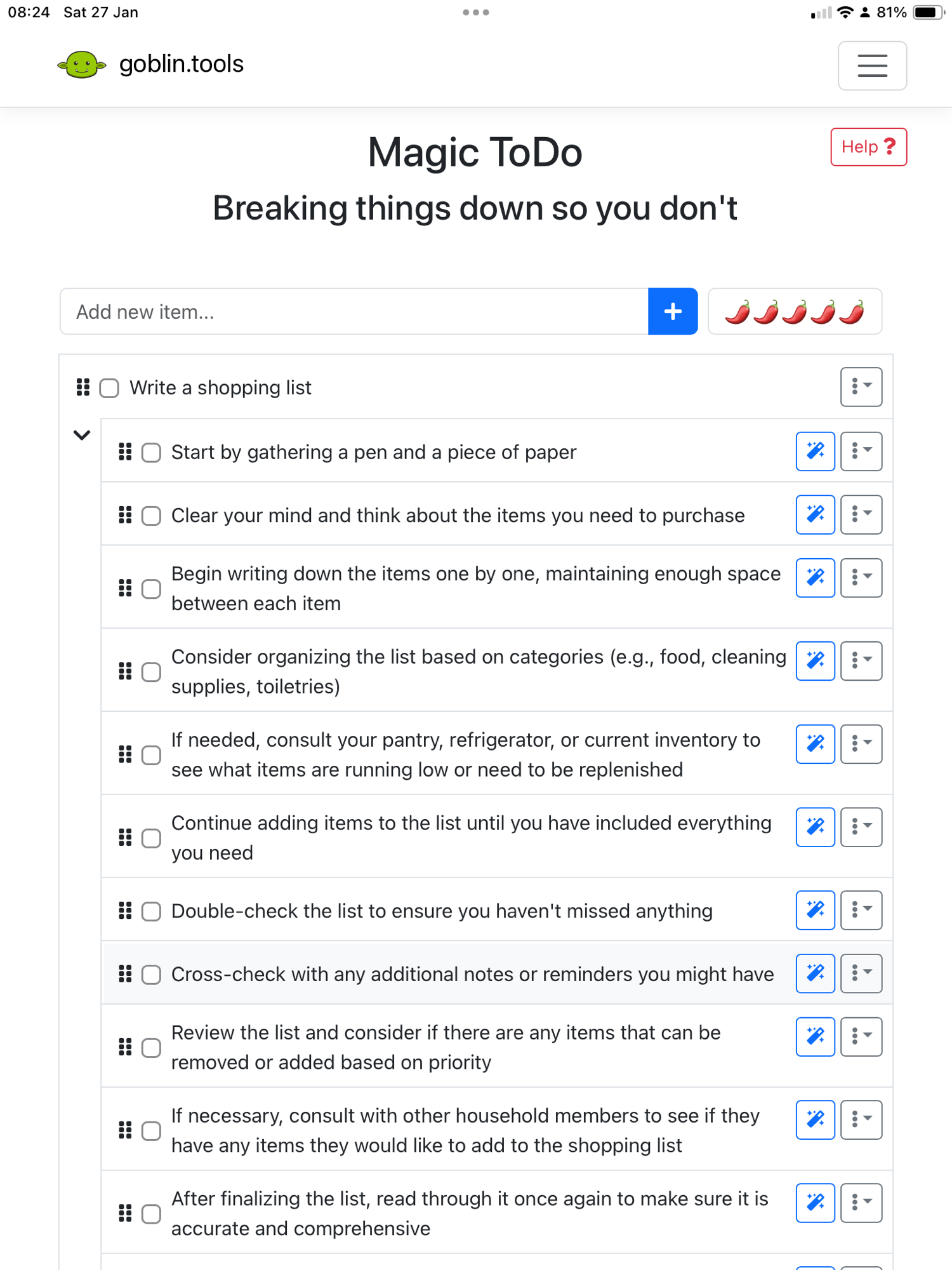
A screenshot of GoblinTools that has taken the task of 'writing a shopping list' and broken it down into easier subtasks

If you sometimes find doing things overwhelming, or need help converting some disparate thoughts into something coherent, then GoblinTools may help you. It was recommended to me by someone on Mastodon some time ago; sadly I’ve lost track of who tooted or boosted it onto my timeline because it was a while ago and I’ve been procrastinating about writing about it. Which is highly ironic for a productivity tool that is designed for neurospicy people.

GoblinTools is an AI-powered tool. The web version is free, with no ads, or you can pay a single solitary US dollar for the apps on iOS and Android. The tools it offers are:

Magic To-do

This is the first tool that appears on the home page. Type in a task, and the AI will try to break it down into smaller sub-tasks. In the screenshot, I’ve written ‘write a shopping list’, and it’s been split into 11 more simple tasks. These include ‘gather a pen and a piece of paper’, ‘checking your fridge’ and ‘asking housemates for anything they need’. The idea is that you put in a task that you know you must do, but are finding overwhelming. There’s also a slider for ‘spiciness level’ – if you are having big issues with executive function, then you can push this up further to break down tasks even more.

Formaliser and Judge

The Formaliser tool takes some text that you write, and tries to re-format it in a more formal way. For example, it can take the text ‘tell the boss to go fellate himself if he thinks I’m coming in tomorrow’, and replace it with ‘Please inform the boss that I will not be able to come in tomorrow.’. You can also make text less formal, more passionate, more sarcastic and so forth. As someone who tends to write very concise emails, the ‘more sociable’ option may be helpful for me to sound less cold.

The Judge tool is a tone analyser. Type in some text, for example from an email, and it’ll give you an interpretation of the tone. Here’s an example

Based on the given text, “No, I regret that this would not be possible,” it appears to come across as straightforward and polite. The tone seems slightly regretful or apologetic due to the use of the word “regret.” It suggests that the speaker is declining a request or denying a possibility in a respectful and considerate manner. Overall, the emotional tone is one of reservation and disappointment about the situation.

Estimator and Compiler

Estimator is a tool which offers an estimate of how long a given task will take. Although the example I offered was ‘Write a 300 word blog post whilst feeling very tired and with very little inspiration’ which it suggested 1-2 hours, which for me is overly pessimistic. This blog post took about half an hour with breaks to write.

Compiler is designed to accept an unordered brain dump and convert this into a list of tasks, which can then go into GoblinTools’ Magic To-do tool.

Chef

The Chef tool is designed to take a list of ingredients and cooking utensils that you have, and come up with a recipe that you can cook. It gave me this based on some random ingredients that I provided:

Dish: Cheesy Peanut Butter Pasta Salad
Serving Size: 2

Ingredients:

  • 200g pasta (7oz)
  • 1 cup rice, cooked (195g)
  • 4 tablespoons peanut butter
  • 1 cup cheddar cheese, grated (115g)
  • 1/4 cup sundried tomatoes, sliced (30g)
  • Salad greens (lettuce, spinach, or your choice)
  • Salt and pepper to taste

Instructions:

  1. Cook the pasta according to the package instructions until al dente. Once cooked, drain and set aside to cool.
  2. In a large mixing bowl, combine the cooked rice, peanut butter, cheddar cheese, and sundried tomatoes.
  3. Add the cooled pasta to the mixing bowl, and toss everything together until well combined.
  4. Season with salt and pepper to taste.
  5. Serve over a bed of fresh salad greens.
  6. Enjoy your Cheesy Peanut Butter Pasta Salad meal for two!

I’m not sure how edible this would be, although it looks like GolbinTools avoids the issue that a previous AI recipe generator had where it suggested making chlorine gas; adding ‘bleach’ to the ingredients resulted in a note at the end saying ‘Ensure that the bleach ingredient is excluded from any food preparation due to its toxicity.’

To me, this seems like a responsible and genuinely useful use of artificial intelligence. AI should be a benefit to society, and helping people do things better can only be a good thing. A lot of AI is misused, but I can see myself using GoblinTools at times when my executive function is at its lowest.

What ChatGPT thinks about Omar’s

On Monday, I wrote about Omar’s Balti House in Bradford. But before publishing it, I also asked ChatGPT the following:

Write a 300 word blog post about Omar’s Balti House in Bradford, West Yorkshire

So, here’s what it came up with:

Nestled in the heart of Bradford, West Yorkshire, Omar’s Balti House stands as a culinary gem, offering a delightful journey through the rich tapestry of flavors that define Balti cuisine. This renowned restaurant has earned its stripes as a go-to destination for locals and visitors alike, seeking an authentic taste of Pakistani and Kashmiri culinary traditions.

As you step into Omar’s Balti House, the warm ambiance immediately envelops you, setting the stage for a memorable dining experience. The restaurant’s commitment to authenticity is evident not only in its decor but, more importantly, in the carefully crafted menu. From aromatic biryanis to sizzling kebabs, each dish showcases the expertise of the chefs in delivering a true taste of the region.

One standout feature of Omar’s Balti House is its namesake dish—the Balti. Served in a distinctive, wok-like bowl, the Balti is a symphony of flavors, combining tender meats or vegetables with a medley of spices. The result is a harmonious blend that captures the essence of Pakistani and Kashmiri cuisine. Whether you’re a spice enthusiast or prefer milder flavors, Omar’s caters to all taste preferences, ensuring a culinary journey that suits every palate.

The commitment to quality extends beyond the kitchen, with Omar’s Balti House sourcing the finest local ingredients to create dishes that are not only delicious but also reflective of the restaurant’s dedication to supporting the community. The menu evolves with the seasons, ensuring that patrons can savor the freshest produce while enjoying a diverse range of dishes.

In addition to its culinary prowess, Omar’s Balti House prides itself on providing exceptional service. The attentive staff adds a personal touch to the dining experience, making guests feel not only welcome but also part of the extended Omar’s family.

For those seeking a taste of authenticity in Bradford, West Yorkshire, Omar’s Balti House emerges as a must-visit destination. With its rich tapestry of flavors, warm ambiance, and commitment to quality, this restaurant stands as a testament to the vibrant culinary heritage of Pakistan and Kashmir.

I have an interest in AI, and especially large language models like ChatGPT and their impact on my industry, higher education. We are seeing students using AI tools to write assessments, and even their personal statements for their university applications. And I think the above text is a good example of how AI is at the uncanny valley stage – it looks okay on first glance, but a more detailed critique highlights its flaws.

Firstly, I wouldn’t describe this as a ‘blog post’, even though this is what I asked ChatGPT to write. It reads more like a puff piece that you would read in some marketing to promote a town or city as a place to live or invest in.

It talks quite a bit about the balti dishes that the food is served on, although that could be because I mentioned ‘balti’ in the writing prompt. A major issue with AI is that they’re not always able to explain why they’ve done something. But it doesn’t mention the enormous naan breads anywhere – which, arguably, is what Omar’s is best known for.

And there are some things it has plain made up. The menu does not ‘evolve with the seasons’. Indeed, the menu doesn’t really evolve at all; whilst it has been reprinted a few times and the prices have gone up over the years, many of the dishes that are on there were ones that were available 20+ years ago. Also, I’m not sure about the ‘local ingredients’ either.

This all feeds into my concerns about the thousands of web pages currently filling up our search engines with AI-written content. How much of it has actually been proof-read, and is accurate?

In education, AI generated content is an issue for two reasons. One, it’s cheating, in the same way that plagiarism and essay mills are – it’s just that you’re using something written by a computer rather than another person. But there’s a quality issue too. I specialise in doctoral level admissions, and much of what current AI language models generate just isn’t at that level. You tend to get vague lists of things with few references (and sometimes these are made up), and if you ask it for a longer essay then it’ll probably start repeating itself. I’m sure if I’d asked for, say, 600 words on Omar’s balti house, it would have run out of unique things to say and just repeat the same statements in another way.

Most universities are now very much aware of both the opportunities and the threats that such AI models present; Turnitin, used by many universities, can now indicate whether an assignment has been written using AI as well as detecting plagiarism. There are simpler tools available online, such as AI Detector, where you can copy and paste a short piece of text. Indeed, when I put ChatGPT’s text above in there, it said that there was a ‘relatively high’ chance that it was written by AI.

I’m sure these language models will improve over time, and will overcome their current shortcomings. At which point, we may struggle to work out what has been written by a human and what was hallucinated by a computer. We’re certainly not there yet, and I don’t know how long it’ll take to get there, or whether it’ll be like driverless cars which seem to be perpetually ten years away. I hope this blog post serves as an explanation of why I won’t be farming out my blog post writing to AI any time soon.

AI art

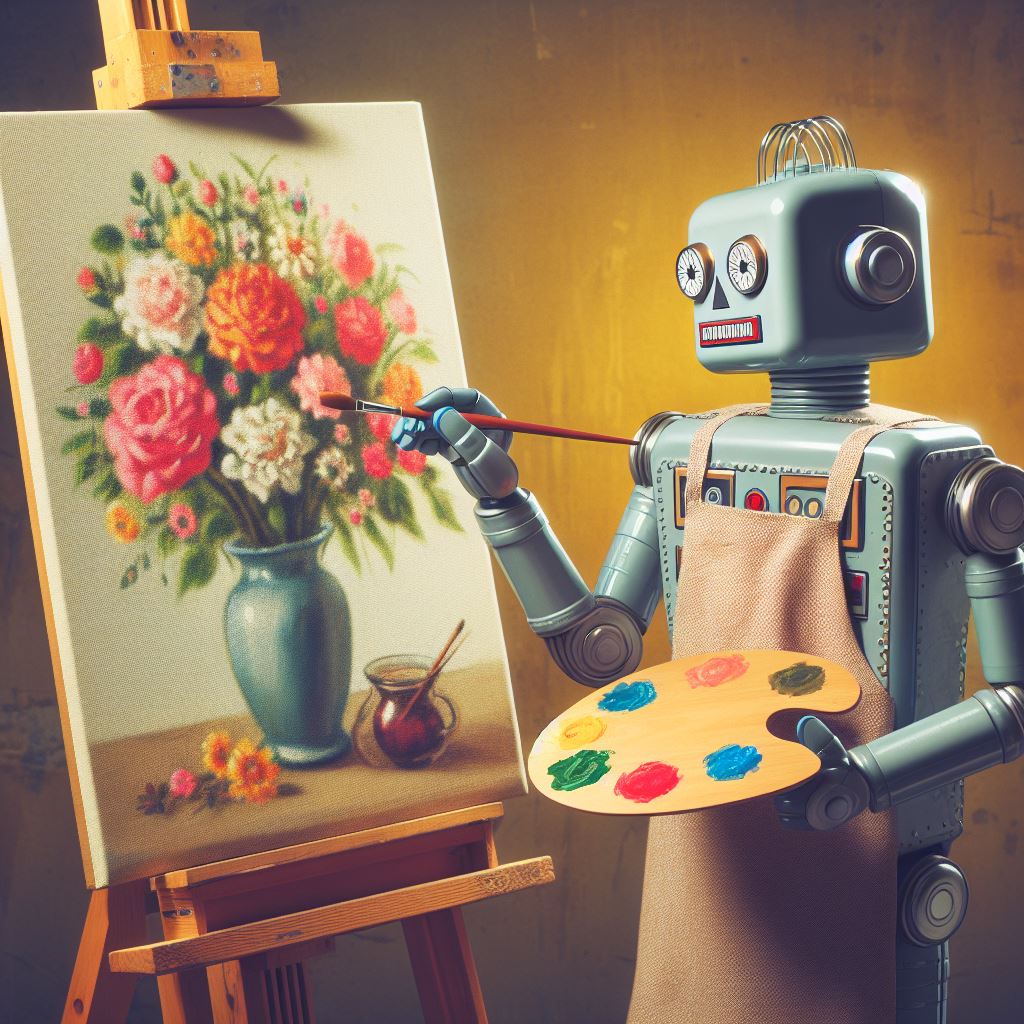
An example of AI art - a generated image of a robot painting a picture of some flowers on an easel

You may have noticed that several of my recent blog posts have featured custom AI art work related to the topic. I’ve generated these using Microsoft’s Bing AI Image Creator, which uses OpenAI’s DALL-E text-to-image model. DALL-E can generate an image based on a text prompt; for example, the featured image on this post was ‘A 1950s style robot standing in front of an easel painting a bouquet of flowers in a vase’.

These are some of the other AI art images that I’ve used recently:

AI art is controversial. It can create images in a few seconds that would take a human artist hours or days to produce. And, in some cases, these image prompts can be told to create images in the style of a particular artist, depriving them of income from a commission. It’s also notable that models like DALL-E and Stable Diffusion have been trained on copyright works, without the rights holders’ permission.

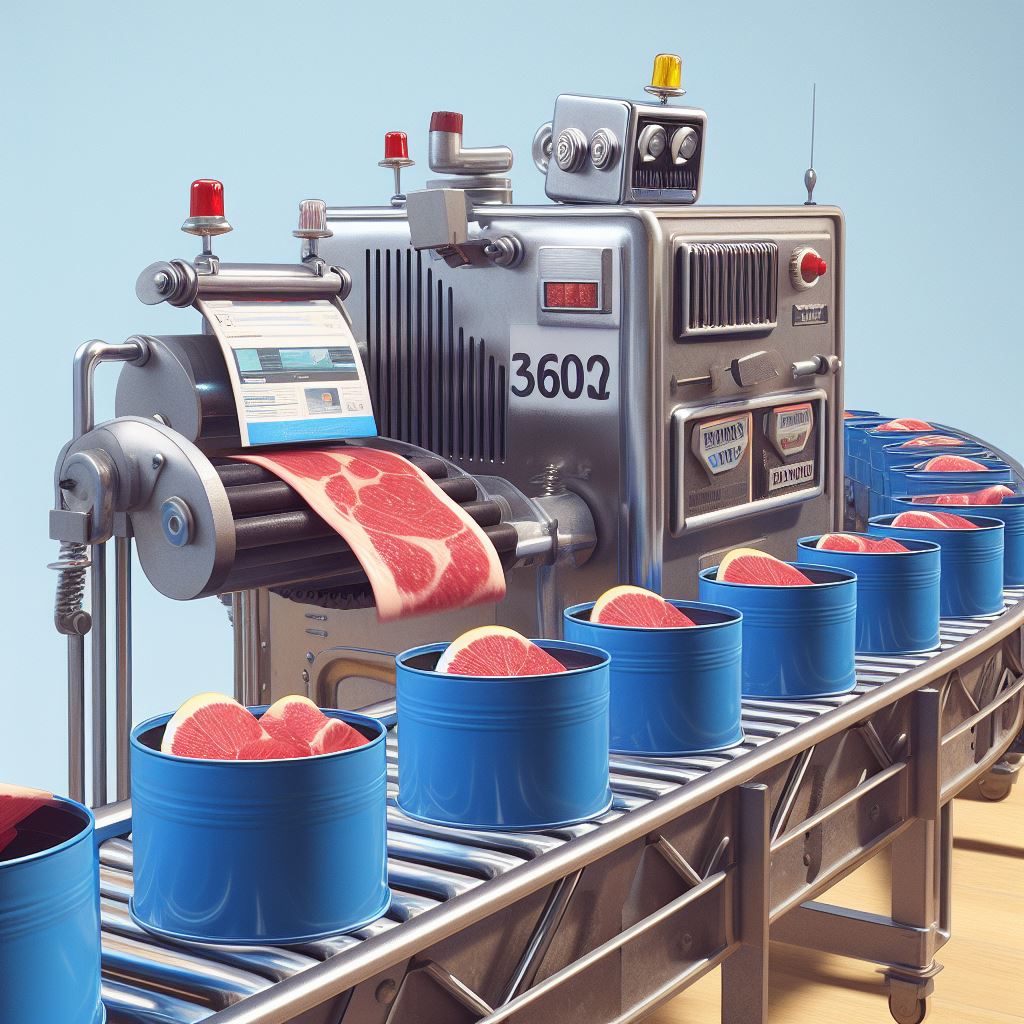
With this in mind, I’m justifying my use of AI art on some of my blog posts because I’m not an artist myself, and as an individual blogger who doesn’t make money from blogging, I wouldn’t have the money to pay a human artist. Whilst I have over 5000 photos that I’ve uploaded to Flickr, there isn’t always a relevant photo to use that I have taken. For example, in my recent post on comment spam, I decided to generate the above image of a robot converting blog posts into a tinned meat product, because I don’t have a photo that represents that. And whilst I make use of screenshots where relevant, sometimes this isn’t appropriate.

Of the AI art generators that I have used, the Bing AI Image Creator seems to be the one that gives me the best results. Any images you create are saved in the cloud, and can be downloaded for re-use. And each prompt produces four images so that you can choose the one which looks the best.

Comment Spam strikes back

An illustration of a robot turning web pages into canned meat product. Generated using Bing AI Image Generator

So now that I’m blogging again, it’s the return of comment spam on my blog posts.

Comment spam has always been a problem with blogs – ever since blogs first allowed comments, spam has followed. Despite the advert of the rel=”nofollow” link attribute, automated bots still crawl web sites and submit comments with links in the hope that this will boost the rankings in search engines.

In the early days of blogging, blogs often appeared high in Google’s search engine results – by their very nature, they featured lots of links, were updated frequently, and the blogging tools of the time often produced simple HTML which was easily parsed by crawlers. So it was only natural that those wanting to manipulate search engine rankings would try to take advantage of this.

I’ve always used Akismet for spam protection, even before I switched to WordPress, and it does a pretty good job. Even then, I currently have all comments set to be manually approved by me, and last week a few got through Akismet that I had to manually junk.

Humans, or AI?

These five interested me because they were more than just the usual generic platitudes about this being a ‘great post’ and ‘taught me so much about this topic’. They were all questions about the topic of the blog post in question, with unique names. However, as they all came through together, and had the same link in them, it was clear that they were spam – advertising a university in Indonesia, as it happens.

Had it not been for the prominent spam link and the fact they all came in together, I may have not picked up on them being spam. Either they were actually written by a human, or someone is harnessing an AI to write comment spam posts now. If it’s the latter, then I wonder how much that’s costing. As many will know already, AI requires a huge amount of processing power and whilst some services are offering free and low cost tools, I can’t see this lasting much longer as the costs add up. But it could also just be someone being paid using services like Amazon Mechanical Turk, even though such tasks are almost certainly against their terms of service.

I think I’m a little frustrated that comment spam is still a problem even after a few years’ break from blogging. But then email spam is a problem that we still haven’t got a fix for, despite tools like SPF, DKIM and DMARC. I’m guessing people still do it because, in some small way, it does work?