
Ampleforth Abbey

A photo of Ampleforth Abbey taken on Easter Saturday in April 2019.

Following our trip to the National Centre for Birds of Prey, we drove a little further to Ampleforth Abbey, a church and monastery to the south of Helmsley. Unlike many monasteries in the area, this one was built in the 19th Century and so was long after Henry VIII disbanded them. It’s currently home to around 40 monks.

The church is open every day, with regular services that are open to the public. There’s also a new visitor centre, which opened last year, giving the history of the site and offering some activities for children. There is, of course, a tea room.

Ampleforth Abbey Cider

Nowadays, Ampleforth Abbey is probably best known for its cider. The monks have been growing apples on site since the monastery was founded, and now has the largest commercial orchard in the north of England. The cider is produced on site, and is one of my favourites – the visitor centre includes a shop which sells it by the bottle. Alas, whilst tours of the cider mill and orchard used to be on offer, they’re not available at present.

If you’re not the cider-drinking type, non-alcoholic apple juice is also available, as is a beer that’s brewed over our neck of the woods by the Little Valley Brewery, near Hebden Bridge.

Whilst I wouldn’t make a special journey to Ampleforth Abbey, it’s worth stopping off if you’re passing.
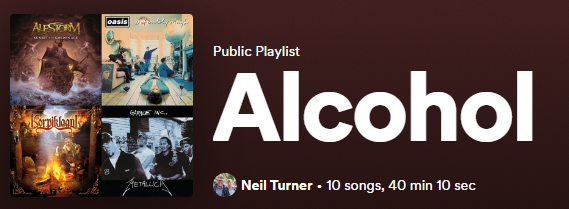
Playlist of the month: Alcohol

Screenshot of the alcohol playlist on Spotify

Time for the fourth instalment of my Playlist of the Month, and this month, it’s all about alcohol and drinking seeing as Dry January is over. Unlike last month, this was a relatively easy topic to come up with.

Here’s the Spotify playlist if you want to listen along.

  • Drink – Alestorm. As you’d expect from a band called Alestorm, they’ve written a lot of songs about drinking over their seven (soon to be eight) albums. This was the first single from the fourth (and in my view best) album. Indeed it’s about 11 years ago since I saw them in Leeds.
  • Cigarettes and Alcohol – Oasis. I’m not a big Oasis fan but any playlist about alcohol would be remiss without this.
  • Vodka – Korpiklaani. This Finnish folk metal band has several songs about alcohol, with others including ‘Happy Little Boozer’ and ‘Bring Us Pints Of Beer’. ‘Vodka’ is probably their best.
  • Whiskey in the Jar – Metallica. It’s a traditional Irish folk song but this version by Metallica is probably its best known recording. A staple at any ceilidh.
  • Love Drunk – Boys Like Girls. You can be drunk, and indeed hungover, on love as well as alcohol, and this is one of my favourite songs in this genre.
  • Drinking in LA – Bran Van 3000. Quite the one-hit wonder from 1997.
  • Tequila – Terrorvision. A local band coming from just up the road from me in Keighley; this was probably their biggest hit thanks to a remix by Mint Royale.
  • Tubthumping – Chumbawumba. Another big song from the 1990s. Whilst Chumbawumba have released 16 albums to date, this is by far their most well-known song.
  • Drunken Lullabies – Flogging Molly. Another Irish-themed song; again, Flogging Molly have no shortage of songs about drinking but this is their most well-known song.
  • Beer – Reel Big Fish. And finally, a bit of ska to finish off.

Brewing my own beer with Brew Barrel

The Brew Barrel kit - a barrel and a box with ingredients

The folks at Brew Barrel approached me to review their eponymous home brewing kit. For £25, you can get everything you need to make 8 pints of beer, with a choice of different hops and flavouring to make different styles. It’s made by a German company, which, considering that Germany is famed for its beers, means it should be good.

The Brew Barrel kit includes a five litre barrel, and the ingredients – hops, yeast, flavourings and rather a lot of malt syrup. To make the beer, you combine all of these in the barrel, along with lots of water. Instructions are, of course, provided. It takes around 10 to 15 minutes of preparation initially, but after that it doesn’t require much attention – you have to turn the barrel after 24 hours, and then refrigerate it after five days. Two days later (so a total of seven days since starting), your beer is ready to serve from a small tap at the bottom of the barrel.

A photo of the Brew Barrel ingredients

I decided to brew an IPA, which is one of my favourite beer styles. Putting it together was quite easy – all the components are numbered so that you can be sure of the required order. Unfortunately, I couldn’t get the barrel in the fridge – our fridge is rather small, and full. As you have to keep the barrel upright, I would have needed to extensively re-arrange the fridge and get rid of the contents, which I doubt my wife would be best pleased about. Especially as she doesn’t like beer.

So when it came to trying the beer, it probably wasn’t at its best. Despite this, I liked it – it was rather sweet and very, very foamy, but drinkable and certainly nicer than some other homebrews that I have tried in the past. Once opened, the beer in the Brew Barrel should keep for around two weeks, if kept refrigerated.

Should you buy one? If you want to brew your own beer, but are completely new to it, then yes – the Brew Barrel keeps it simple for you and doesn’t require too much effort. Those with existing home brew experience may find it useful to have all of the necessary materials in one package, but could feel limited as it’s aimed more at novices. Financially it’s probably more expensive than just buying eight pints of beer to consume at home, but where’s the fun in that?

Gin

Christine, my dear wife of nine months, has recently discovered that she likes gin. I’m sure most of you have heard of gin, but essentially it’s an alcoholic spirit, usually made with juniper berries, that is commonly consumed with tonic water. It can also be served with lime, bergamots or cucumber.

Gin used to be incredibly popular in England, in a period during the early 18th century called the ‘Gin Craze‘. Back then, even the average person would consume 10 litres of gin each year – roughly equivalent to six single gin and tonics a week. This was partly due to the fact that gin was safer than water, which was frequently contaminated. It had a renaissance in the 19th century, when ‘Gin palaces‘ started appearing, but nowadays it isn’t so popular.

Certainly if you were to go to a typical pub today, your choice of gin would be rather limited. In Britain, Gordon’s is the biggest selling brand, and frequently is the only one available. Though I don’t really like gin myself, Christine informs me that Gordon’s isn’t particularly good – i.e. Gordon’s is to gin like Foster’s is to beer.

A number of places will also sell Bombay Sapphire, which is distilled in England despite its name. Better pubs may have Hendricks or Beefeater. But if you’re lucky enough to happen across a bar with a bigger range of gin brands, then there are a large number to choose from. In fact, if you have around £100 to spare, then you can buy the Ginvent Calendar – an advent calendar with 24 drams of gin, each one a different variety. My cousin has bought this for two years’ running.

For those with a passion for gin, then there are gin festivals where you can try different varieties – like at a beer festival. Leeds played host to one last year, and the Manchester Gin Festival is on the 5th April.

I’m afraid I find gin a bit too bitter, although I recently tried Hendricks and tonic and it was quite nice. And I quite like damson gin. But unlike my wife, I can’t see myself drinking it regularly.