Heaton Park

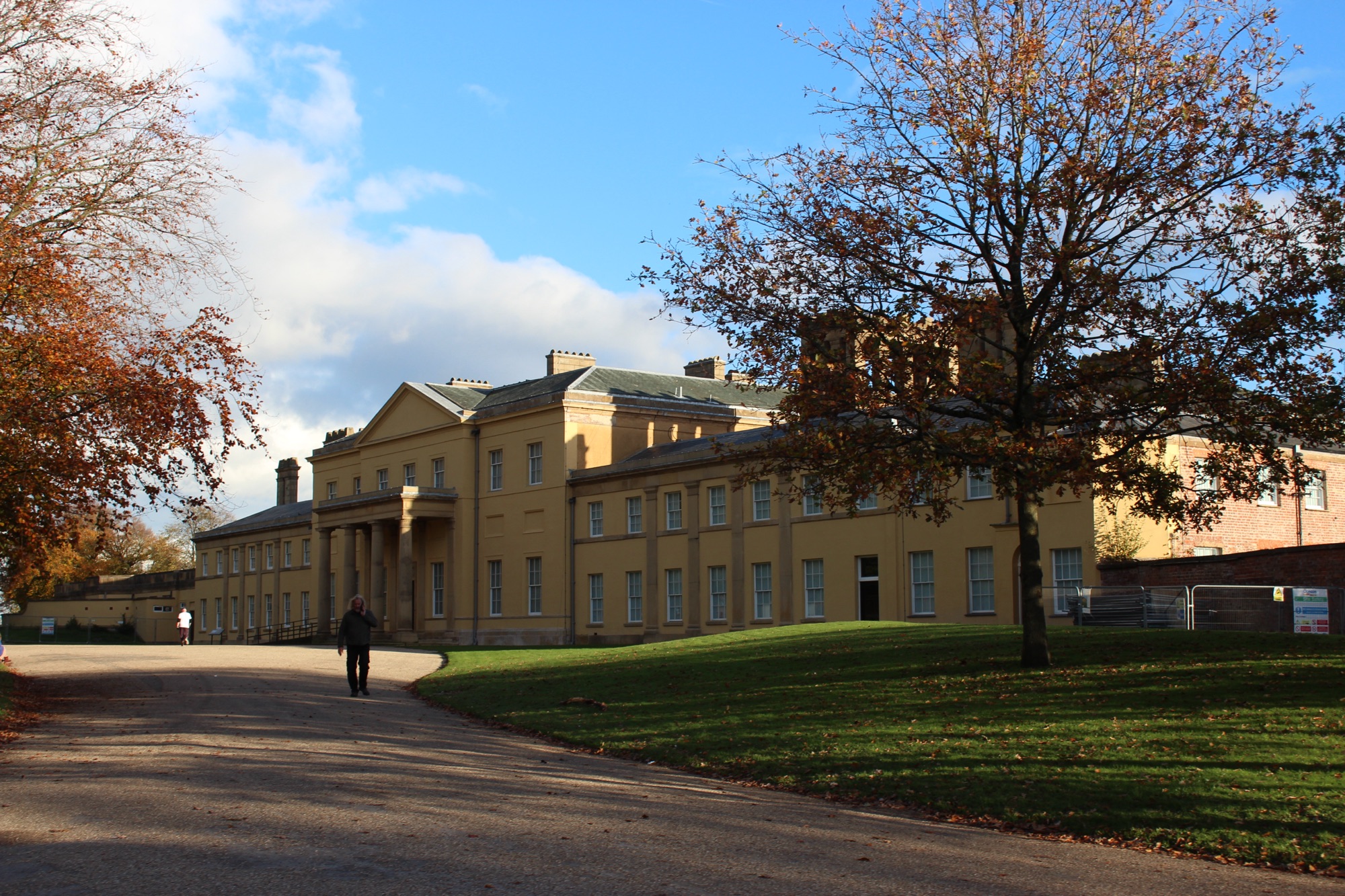
A photo of Heaton Hall, in Heaton Park in Manchester

Somewhere that we go to regularly, but I have hitherto not blogged about, is Heaton Park in Manchester. It’s the largest public park in the north west of England, and, being in the north-east corner of Manchester, it’s only about half an hour’s drive from us.

To give you some idea of how big Heaton Park is, it effectively spans junctions 17, 18 and 19 of the M60 motorway. Indeed, depending on which of its multiple car parks you use, you may end up leaving the M60 at either junction 17 or 19. Its large size means that there are plenty of things to see and do inside the park.

History of Heaton Park

Heaton Park is the parklands surrounding Heaton Hall, which was built in the late 18th Century and remains to this day. Whilst originally in private hands, the park and hall transferred into public ownership in 1902, and has been open to the public ever since. The hall is Grade I listed, and is occasionally open to the public. Here’s a video of the inside.

The parklands were laid out with a lake and pleasure grounds whilst still in private ownership, and these remain today. There are a number of other listed structures and monuments across the park, including the colonnade from the original Manchester Town Hall which was re-assembled in the park when the current City Hall in Manchester city centre was built.

Playgrounds

There are two large playgrounds for kids at Heaton Park. One is by the hall, towards the northern end of the park, and has a space theme. The second is down by the lake, with a woodland theme. Both are far better than the average playground that you get in a typical municipal public park, both in terms of size, range of play equipment and that there’s a consistent theme. We mostly visit the park on weekends and they’re both always busy.

Heaton Park is also home to Zip World Manchester, a Go Ape style treetop adventure park. Whilst entry to the other playgrounds is free, this is a chargeable attraction. We’ve not done it yet.
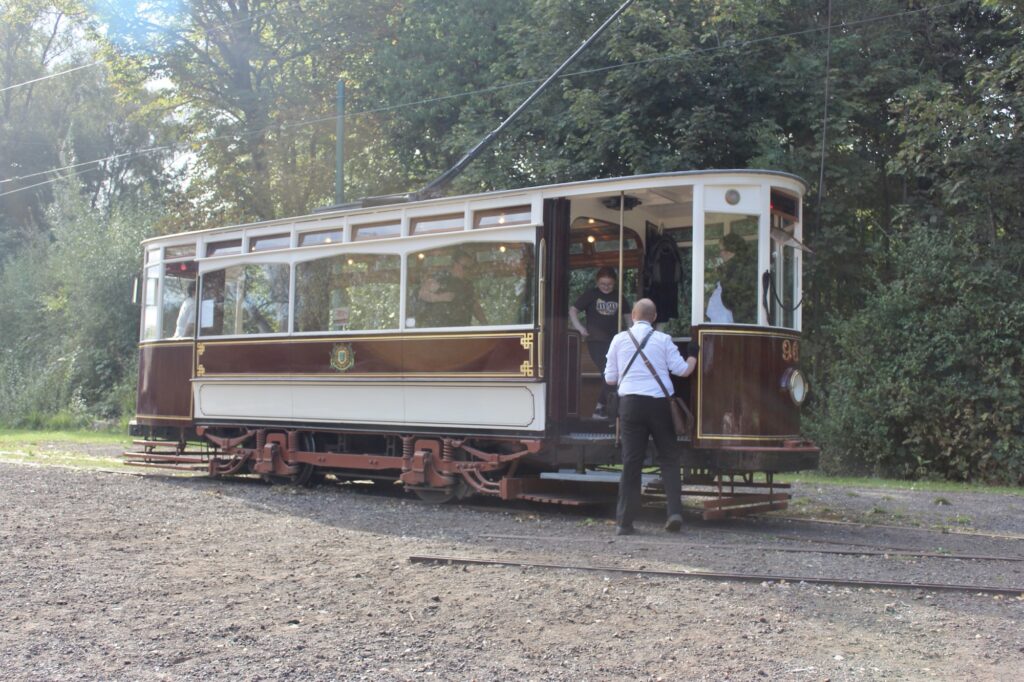
A tram at Heaton Park

Trams

As well as having a dedicated stop on Manchester’s Metrolink tram network, there are heritage trams that run on a short tramway within the park itself. This tramway is Britain’s only dedicated heritage tramway that still runs on original tram track, as it uses a short spur built by the original Manchester Corporation Tramways that runs into the park. It’s been extended a couple of times, most recently in 2011, and now runs from the edge of the park to the boating lake, over a distance of about half a mile. There are two depots, at each end, and one of these includes a small tramway museum inside the original waiting shelter.

Tram services usually run at weekends in the summer. The heritage trams all come from the north of England – some from Manchester but others from Blackpool.

Heaton Park Animal Centre

Behind the hall’s old stables block, which is now a café and toilets, is the Heaton Park Animal Centre. This would have been the farm for the hall in its heyday, and nowadays a range of animals live there. They’re mostly farm animals – chickens, sheep, pigs and donkeys – but there are some alpacas and a tortoise there too. Like the rest of the park, entry is free although its opening hours are limited to 10-4. Whilst not as impressive as places like Cannon Hall Farm, it’s nice to pop in and see the animals.

Boating lake

There’s a large lake towards the southern tip of Heaton Park, where you can hire a boat for 25 minutes at a time. There’s a choice of boats – some are electrically powered, but you can opt for a swan-shaped pedalo or a traditional rowing boat. Prices range from around £15-30 and ideally you should book ahead.

Other attractions

Other things that we haven’t really visited ourselves include a garden centre, golf course, and crown green bowls. There’s also a series of guided walking routes around the park, and like most public parks, there’s a Parkrun at 9am every Saturday. There are also multiple places to buy food, and plenty of ice cream vans.

In the summer, Heaton Park becomes an outdoor events venue – Oasis had their homecoming gig there last year.

Overall, Heaton Park offers enough for a full, varied day out – especially in summer. And, unless you need to pay for parking, the majority of what it offers is free. This is really important, in an age where lots of family activities cost increasing amounts of money. Whilst we often visit properties operated by the National Trust and are happy to pay for our annual membership, it’s really important that everyone has access to safe leisure activities and green space.

Accessibility

If you struggle with stairs, then you should still be able to get around most of the park as there are few steps. However, it is on a hillside, and some slopes may present a challenge for some powered wheelchairs. Disabled toilets are available, and there is a Changing Places toilet at the pavilion by the lake.

There are five car parks spread around the edge of the park. The largest of these is the Lake Car Park, with 263 spaces and a much larger overflow. We tend to use the Hall Car Park, which is closer to the hall, stables and animal centre and offers 252 spaces. All car parks have disabled spaces. Parking is pay and display, or using the PayByPhone app, and typically costs up to £4 to park all day.

The Golf Car Park, which is on the eastern tip of the park, is the only one with electric car charging facilities. It offers two 7 KW AC chargers on the Be.EV network; payment appears to be by app (including Zapmap and Electroverse) or RFID card. I haven’t used this one myself – as mentioned, it’s about a half hour drive for us. If you need a rapid charger, then there are several available around the perimeter of the park, including a 150 kW charger with five bays just off Junction 17 of the M60.

As mentioned, Heaton Park is served by Manchester Metrolink, with regular services on the Bury line. The tram stop is on the western edge of the park, across a road. Trams actually pass underneath the southern tip of the park in a tunnel.

A return trip to Cannon Hall Farm

A photo of the start of a ferret race at Cannon Hall Farm

Last weekend, we went back to Cannon Hall Farm, which is in the so-called ‘Tuscan hills‘ surrounding the town of Barnsley. We’ve been many times before, the most recent of which was in 2024, and I last wrote about it in 2017.

Since that visit, Cannon Hall Farm has seen a number of developments. All of the outdoor play areas have been renovated, with new equipment installed, and there are a couple of new indoor attractions. These include a reptile and minibeasts room, and a mammal house, where the lights are kept low as most of the mammals are normally nocturnal. In other words, it’s now a farm with a small animal zoo tacked on. I suppose they had to get a zoo license to have meerkats, which have been there for many years now, and have leaned into it. On the plus side, it means that there are more indoor areas, and so it’s still a good place to visit even if the weather isn’t great.

Still a farm

Despite the new additions, Cannon Hall Farm is still fundamentally a farm. There are still plenty of opportunities to see farm animals, and this time of year is a good time to visit. Many of the sheep have newborn lambs, some of which are wearing woolly jumpers donated by the public. We saw quite a few little bouncy bundles of joy on our visit.

There are also regular sheep and ferret races (pictured above) throughout the day. Get there a few minutes before the races start, and you can get a free coloured ticket; if that ticket is drawn after the race, then you win a free day pass for a return visit. That’s assuming that your chosen colour of ferret doesn’t decide to fall asleep for the duration of the race.

The huge soft play gym is still there, which again is good for rainy days. There are also more food options available; as well as the Hungry Llama inside the soft play gym and the White Bull at the entrance, there’s now a dog-friendly café called the Lucky Pup, also at the entrance.

Expanding into other media

Nowadays, Cannon Hall Farm is well-known nationally, thanks to various TV programmes on Channel 5. They’re also very active on Facebook, offering ticketed live streams for events such as lambing season.

The Nicholson family, who have owned the farm since the late 1950s, have now written three books and a cookbook, all of which can be bought at the farm or online. There’s also a wide range of branded merchandise, including an official set of Top Trumps.

Accessibility

As mentioned, Cannon Hall Farm is on a hillside, so the site is on a slope. However, almost everything has step-free access. Wheelchairs and mobility scooters are available to hire. Assistance dogs are welcome, but ideally with some form of identification – it is, after all, a farm, and so untrained pet dogs shouldn’t be brought along as they may upset the animals.

There is a Changing Places toilet next door at the Cannon Hall Museum (which I also wrote about in 2017), however, the museum is shut until next month. Having one on site, as well as a dedicated quiet space, would be really good additions to improve accessibility for people with more profound disability needs.

There is a £3 charge to park on site; it’s pay and display (cash and cards accepted), although you can also pay in advance online when purchasing tickets. If you want to visit by public transport, there’s the number 94 bus from Barnsley bus and rail interchange which runs every two hours to the nearby village of Cawthorne. From there, it’s about half a mile off-street walk through the Cannon Hall Country Park.

Entry prices vary; midweek is usually cheaper than weekends. Carers get in free with a paid ticket, and Max card holders can (at the time of writing) get up to two free tickets – one each per paid ticket.

Bowland Wild Boar and Animal Park

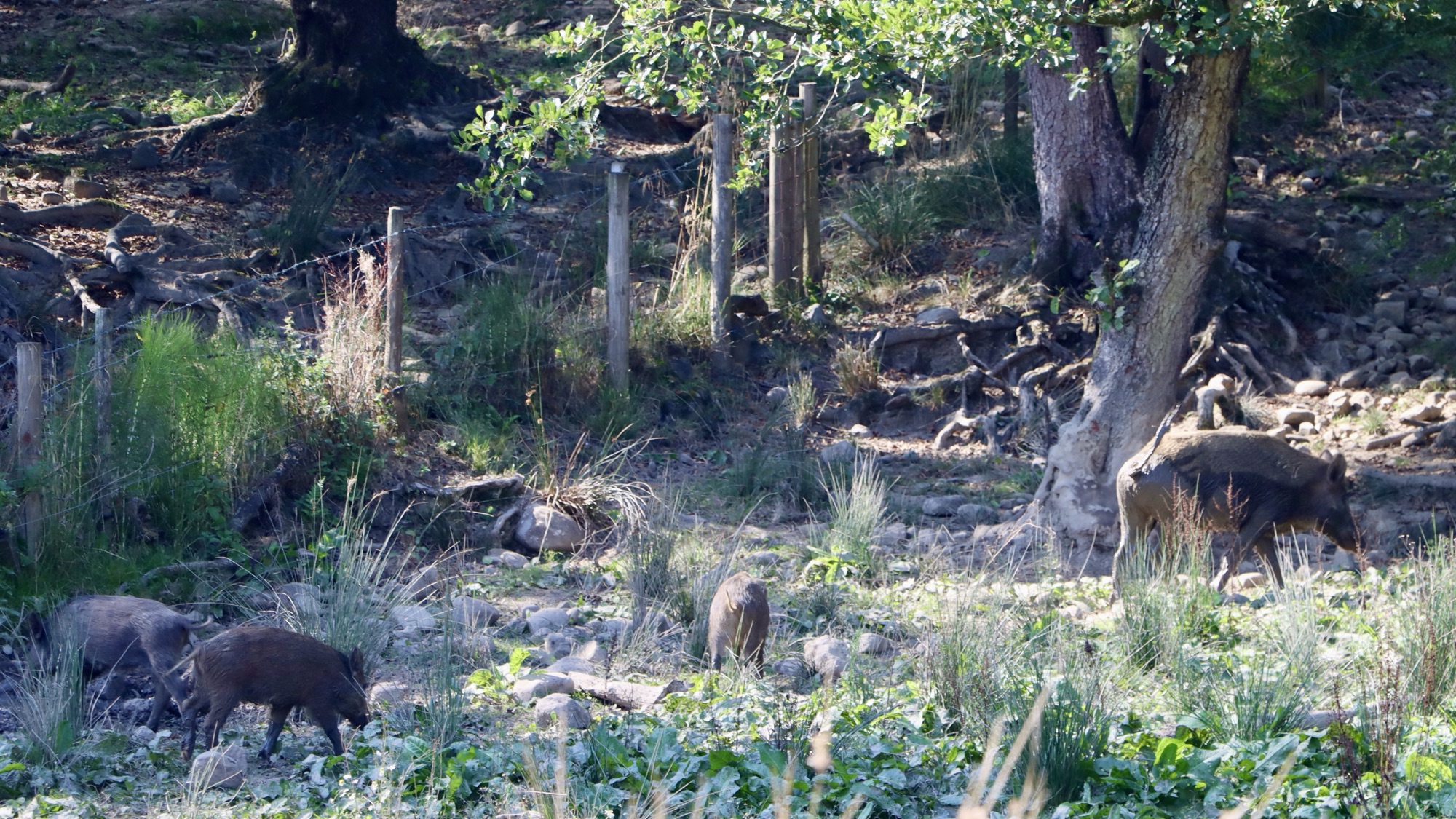
A photo of some wild boar at the Bowland Wild Boar Park

We’re finally at the end of the list of the things we did over the summer. And yes, I’m aware that it is now October and the weather is distinctly un-summery. On the August Bank Holiday Monday, we went to the Bowland Wild Boar and Animal Park, which is in the Forest of Bowland Natural Landscape in North Lancashire.

The Bowland Wild Boar Park is an open farm, and one of many across the UK that doubles as a visitor attraction. However, as the name suggests, it’s also home to a herd of wild boar, who have a large paddock to roam around in. Indeed, the photo at the top of this post was about the best shot as I could manage on the day. Besides the wild boar, there are also emus, goats, llamas, alpacas, peacocks, geese, hens, owls, deer, pigs, donkeys, ducks, and the ubiquitous meerkats.

It’s quite a large site, with the animals having plenty of space. You can also buy bags of animal feed, to give to (some of) the animals, and there’s a playground, café and ice cream shop. If you’re able to stay for a whole day, then there are walks around the site that you can go on, but we mainly stayed around where the animals were. On the day we visited, there was an excellent food truck visiting, so I can’t comment on the food at the café.

Geese and goats at the Bowland Wild Boar Park

Accessibility

If this all sounds great, just be aware that the park has limited opening outside of the summer peak, so don’t head off there this weekend. It’s open throughout the forthcoming October half term, with Halloween themed activities (Saturday 25th October to Sunday 2nd November), but not until then. After that, you’ll need to check the web site as it’s often only open at weekends or for special events. I gather that the site doesn’t have mains electricity, and so it’s reliant on a couple of massive free-standing solar panel arrays and generators.

The site is on a slope, and there’s a lot of uneven ground. However, you can rent a rugged mobility scooter in advance if needed.

We drove there, taking a rather scenic route across the top of the Calder Valley avoiding Todmorden, and then through some of the more well-to-do villages near Clitheroe. If you don’t have a car, then there are hourly buses from Clitheroe (which is the nearest railway station with trains from Manchester and Bolton) that take you to the village of Chipping, where it is then a 3-4 mile walk. Maybe bring a bike.

What to do if you find a bat

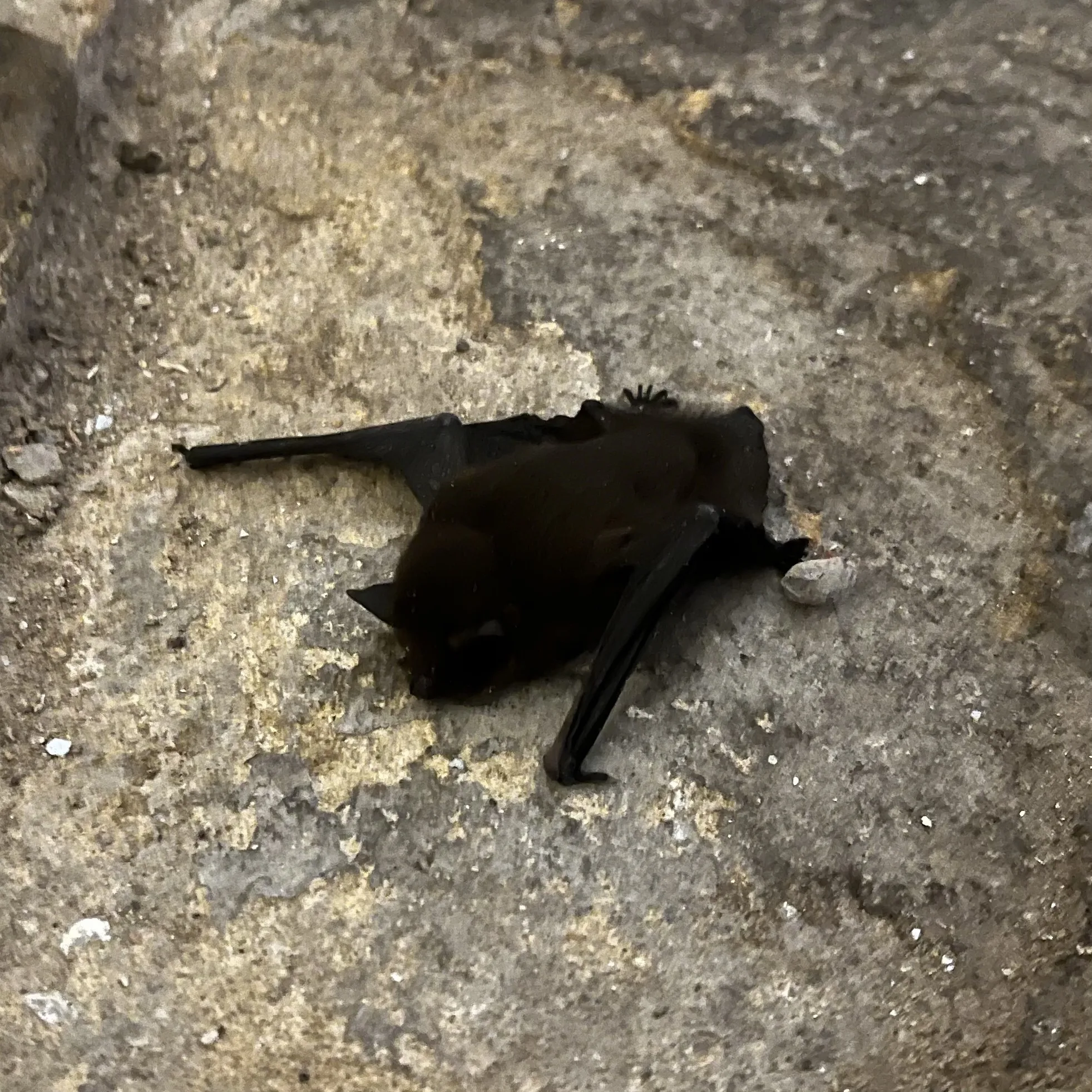
A photo of the common pipistrelle bat that we found on the floor of our cellar

On Friday, I found a bat on the floor of our cellar. There’s a photo of it above.

This was a problem. Bats are well-known for being mammals that can fly, and when they’re not flying, they hang upside down to rest. A ‘grounded’ bat lying on the floor is not a sign of a healthy bat.

A quick search led me to the ‘Help! I’ve found a bat‘ page on the Bat Conservation Trust web site. I gave the National Bat Helpline a call, and contained the bat in a shoebox with a small dish of water until a volunteer could arrive to rescue it.

Although it took a while, a lovely volunteer came on Friday evening to collect the bat and take it to a place of safety, where it could be fed and then (hopefully) be released back into the wild. By this time, my wife and eight-year-old got to see the bat, which was nice as my wife loves bats. And it’ll be an interesting story to tell at school this week.

We also found out that it was a male common pipistrelle bat, one of the more common UK bat species. Whilst the IUCN considers them to be ‘least concern’, all bat species in the UK are protected by law. Hopefully, the little guy will get better now that he’s being looked after, and we’ve donated some money to the charity.

However, we’re still not sure how the little bat got into our cellar in the first place. Though the cellar was partly open to the elements as recently as the end of 2022, we’ve since had a new window fitted and a hole fitted in, partly due to a couple of other furry rodents getting in. I suppose it could have been down there all that time and had finally run out of insects to eat. At least he’s in a better place now.

Chester Zoo

Rhinos

A couple of weeks ago, I took our two-year-old on a day out to Chester Zoo, whilst Christine was working. Christine and I have been before, most recently in 2012 when we stayed in Chester for the weekend.

We’ve been planning to go back for some time, but it’s an expensive day out for two adults. You can expect to pay over £20 per person, even when booked in advance. But as under-threes go free, so for one adult and a very young child it’s not so bad. Even with a ticket booked on the morning of the visit, I still saved a bit of money over the gate price.

From Sowerby Bridge, Chester Zoo is a little over an hour’s drive with clear roads. So, after dropping Christine off at work, we headed straight over and got there just before the official opening time of 10am. And, apart from a half hour lunch break, we didn’t leave until 4:45pm.

This is because Chester Zoo is huge. It claims to be England’s most visited zoo, and it can certainly absorb a lot of people. Which is good – the weather was glorious and so there were thousands of people visiting. I reckon there were a couple of hundred cars there already, even before 10am. And yet it never felt too busy – we had no trouble getting close enough to see the animals.

Baby elephant

Chester Zoo’s new arrival

What I hadn’t realised was that, only three days before, a baby elephant had been born. The day we visited was only its second day out in public, which explained the crowds around the elephant enclosure.

There was also a baby rhino, which was just a few weeks old. I didn’t manage to get a good photo of it, unfortunately.

Since our last visit, Chester Zoo has extended somewhat, with a new ‘islands’ zone that focusses on animals from the islands of South East Asia. We got around most of it, but must’ve taken a wrong turn as we missed the tigers.

Towards the end, we went on the Monorail. This runs in a circuit around the site, although you can only travel point to point between two stations. I hadn’t been on it before, but it allows you to get another perspective of the animals. It’s £2.25 for a single trip or £4 for multiple trips, but as it was getting to the end of the day we just made a single trip.

Lizzie loves animals and really enjoyed herself. Unfortunately she wasn’t so keen on walking around or being in the pushchair, so I spent a lot of the day pushing an empty pushchair whilst carrying her. My back did not thank me the next day.

The rest of my photos are up on Flickr. Oddly, I never uploaded my photos from our 2012 visit.

Ponderosa Farm & Rural Therapeutic Centre

Iguana

Until recently, if someone had told me that there was a zoo in Heckmondwike, West Yorkshire, I wouldn’t have believed them. But there is, and it’s called Ponderosa Farm & Rural Therapeutic Centre.

It turns out that I’ve walked past it before. Back in 2009, I walked the Spen Valley Greenway, but the section south of Heckmondwike had been closed by Yorkshire Water. They were installing a new sewage pipeline, and had signposted a diversion. It just so turns out that this went straight past Ponderosa without me realising what it was.

We visited on Saturday. It’s not very big, but it’s also quite cheap – £5 for adults.

I’d been a little hesitant to visit having read the reviews on TripAdvisor. I’d probably rate it three out of five, and I agree with some of the points made in the negative reviews. Namely, it’s rather run-down in places, and the animals have smaller enclosures than in some newer zoos. The lemur enclosure in particular was full of nettles, and some of the vivariums holding the lizards didn’t look very sturdy.

Asian small-clawed otter

It’s also not a great zoo for photographers. Most enclosures are behind mesh that obscures the animals, unless you get very close up to the bars. This isn’t so good when taking photos of animals that are right up to the bars themselves, like this Asian small-clawed otter. The Yorkshire Wildlife Park is much better for wildlife photography, but it is also much newer.

Ponderosa is, however, a very good place to bring kids. There are several playgrounds, and when I went (which was a warm August weekend afternoon) there was a bouncy castle. The far end of the site has a huge sandpit as well. Its outdoor nature means that it’s only really suitable for good weather, but we could have probably spent far longer here.

There were some animals there that I haven’t seen before – the tri-coloured squirrel, for example.

Tri-coloured squirrel

Ponderosa clearly needs investment, and underlines why I have issues with local authorities (who often lack the relevant expertise) issuing zoo licenses. In my mind, licenses should be issued by a central government agency, possibly attached to DEFRA, that also carries out inspections. It’s also why I don’t plan to visit South Lakes Zoo any time soon.

That being said, I think we will go back to Ponderosa. Our toddler had a good time, it’s not far from us, and it’s cheap. Plus, Christine hasn’t been yet.

Update (January 2025): Ponderosa is now known as Ponderosa Zoo, and is under new ownership. We’ve been back several times and it has improved significantly over the years.

Cannon Hall Farm

A pygmy goat standing on top of a llama at Cannon Hall Farm

Following last month’s visit to Thornton Hall Farm, we took our toddler to Cannon Hall Farm a couple of weeks ago. It’s another farm park, but on a much bigger scale.

This was actually our second visit; our first was in September last year, when our toddler was 9 months old. I seem to remember them being asleep for a lot of it. This time, they were awake the whole time, and seemed to really enjoy themselves.

The main attractions are the barns where the farm animals live. The barns are designed for visitors, with raised viewing platforms at the back. The first four barns are for the pigs, several of which had piglets; then there are cow barns, and a rare breeds barn with a wide variety of animals. These include goats, donkeys, llamas, alpacas and rare breed pigs. To access these barns, you pass through a small animals shed, and there are regular rabbit and guinea pig handling sessions.

The farm is also home to some meerkats – not typical farm animals, but popular with visitors. Elsewhere, there’s a roundhouse with some more animals, and sheep and ferret racing events.

What makes the farm a great place for families is the soft play barn. It’s huge – one of the biggest I’ve seen, with an extensive area for the under 4s. There’s a large café attached, with some of the produce coming from the farm. You can sip Prosecco whilst your kids throw themselves down a giant slide, should you wish to. Bigger kids can also play in the outdoor play areas.

Childrens’ parties are big business for Cannon Hall Farm, and there are several bookable party rooms. If we lived more locally, we’d probably consider it for one of Lizzie’s birthdays.

Outside the main entrance (and therefore open to the public without paying for entry) is a restaurant called The Black Bull. Again, some of the food comes from the farm, and it’s good quality food at a reasonable price. There’s quite a big farm shop too, although it’s focused on the higher end of the market – you wouldn’t want to do your weekly shop here, unless you have a very high disposable income.

We all had a very good day out at Cannon Hall Farm. The entry price is reasonable, and although there is a £3 charge for parking, you get this back provided you spend £10 or more at one of the restaurants or farm shop on the site. It’s around 10 minutes drive off the M1, to the west of Barnsley. It’s worth watching out for special events, which take place regularly throughout the year.

A return visit to the Yorkshire Wildlife Park

Lion

Having visited last Valentines Day, we made a return visit to the Yorkshire Wildlife Park near Doncaster at the weekend. We really enjoyed it last time, but our visit was cut short when the weather turned. Saturday was a cold but dry day, so we headed over for another visit.

Getting there was a little easier this time, thanks to the opening of the Great Yorkshire Way. This links the M18 – the motorway that bypasses Doncaster to the south – with the A638, the road that feeds the wildlife park and nearby Robin Hood Airport. A second phase, due to start construction shortly, will see the road make it all of the way to the airport. But even the first phase cut our travelling time by at least 10 minutes each way.

The main attraction that we missed last time was the lions, so we went there first. The lions were rescued from a run-down zoo in Romania, and flown to the UK on a specially-adapted Jet2 plane. Their new enclosure is as big as the whole of the zoo that they called their home previously. Indeed, one thing I like about the Yorkshire Wildlife Park is that the enclosures are big, and designed so that visitors can see in over the fencing in many cases. On both visits, my Canon EOS 600D DSLR camera has seemed almost amateur compared to some of the specialist photography kit that other visitors have brought, and it’s easy to see why.

We also got to see one of the leopards; last time, none of them fancied making an appearance. And we saw a stoat – not one of the zoo’s animals, but it was on an area of rough ground near the polar bears that has yet to be developed.

As usual, I have uploaded the better photos that I took to Flickr.

Home Farm at Temple Newsam

Pig and piglets

On Saturday, Christine and I took out little one to the Home Farm, part of the Temple Newsam estate near Leeds. It’s a working farm with many rare breed animals, that is open to the public for visits. And, with it being the springtime, it was also full of cute baby farm animals.

Although much of the Temple Newsam estate is free to access, including the parkland, gardens and an accessible adventure playground for kids with disabilities, entry fees are in place for the farm. But it’s free for the under-5s and it’s only £3.60 per adult, and you’ll probably spend over an hour there so it’s good value. There’s also an additional playground that’s only accessible to those who have paid to enter the farm, and a lower field with donkeys.

Goat and kid

At three months old, our little cherub is a bit too young to appreciate the farm (and was asleep most of the time anyway) but it’s great for families with young kids. Most of the animals are willing to be petted, and there are information boards and staff on hand to talk about the animals. Many of the animals are ‘rare breeds’ – breeds that are less common in British farming, and, in some cases, under threat. The pigs, for example, are British Saddleback, Tamworth and Middle White breeds, and the sheep include Manx Loaghtan which are native only to the Isle of Man (although I don’t think any where publicly viewable when we went).

With it being the Easter holidays, I expect the farm to be really busy at present, but it’s well worth a visit, as long as the weather is okay. There are some indoor bits, but most of the farm is outside so it’s probably not the best way to spend a rainy day. Also, if you’re pushing a pram or wheelchair like we were, be aware that there are a lot of uneven cobbles, and that the farm is on a hillside.

Blackpool Zoo

Ring-tailed Lemurs

Happy new year everyone!

I spent the new year with Christine in Blackpool and on Sunday went to Blackpool Zoo. It’s open 364 days a year (seeing as the animals there need caring for all year round) and is nice and quiet outside of the busy summer tourist season. The weather on Sunday was bright and sunny (if bitterly cold) so it made an ideal day to go, and to give credit to the zoo staff the educational talks during feeding times were still going ahead despite there being probably no more than 50 people in the park all day.

Naturally I took my camera and 40 out of the 100 photos I took are on Flickr. The above picture of the ring-tailed lemurs is probably my favourite, but I was also impressed with this picture of a red panda (or firefox) and this pair of magellanic penguins.

Having done the Sea Life Centre before Christmas (which has a £5 discount per adult out of tourist season), the next big Blackpool attraction on my list is the Blackpool Tower. I’m sure I’ll get chance to do that soon.