
The Current Account Switch Guarantee

A screenshot of the home page of the Current Account Switch Guarantee web site.

Until this year, I had never changed my bank account. I was still using the same account, with the same bank, that I opened when I was 18, shortly before starting university. But with the account no longer meeting my needs, and incentives to open a new account, I switched back in May, as mentioned last week.

Most UK banks are signed up to the Current Account Switch Guarantee, and this means that the switching process should be relatively painless. It’ll take about a week, during which your new account will be opened, everything moved across, and your old account is closed. You only have to interact with your ‘new’ bank – they take ownership of the process and will handle the closure of your old account for you.

What gets transferred

As part of the switch, the following will get moved across to your new account:

  • Any money in your account. You may also be able to switch if your account is overdrawn, but check your new bank’s terms and conditions.
  • All Direct Debit payments.
  • All Standing Orders.

Plus, any payments made into your old account will be automatically redirected to your new account. Payees should be notified of this and payroll systems may be able to update to your new bank account details automatically. When I logged into my employer’s payroll system to check my details, my new bank account number and sort code were already there.

What doesn’t get transferred

Basically, anything paid for using recurring card payments, or Open Banking, won’t get automatically transferred. When your old current account is closed, your old debit card will be deactivated and so any payments using this will fail. So any subscriptions that use recurring card payments will need to be amended to use your new card details.

Similarly, if you make payments using Open Banking (for example, to app-based savings accounts like Chip (referral link) or Zopa), these will need re-authorising using your new account.

Incentives for switching

Banks often offer incentives for switching your account – I got a low three figure sum as a reward for switching my account. MoneySavingExpert tracks the current deals on offer – £175 seems to be the going rate, but such incentives come and go. Also, I was able to get a little bit more by initiating the switch using Quidco (referral link), which gave me around £10 cashback in addition to the switching incentive.

Just be aware that whilst almost all banks are signed up to the Current Account Switch Guarantee, not all of them are. If they aren’t, then you may have to manually switch over your payments, which is a major disincentive to switch.
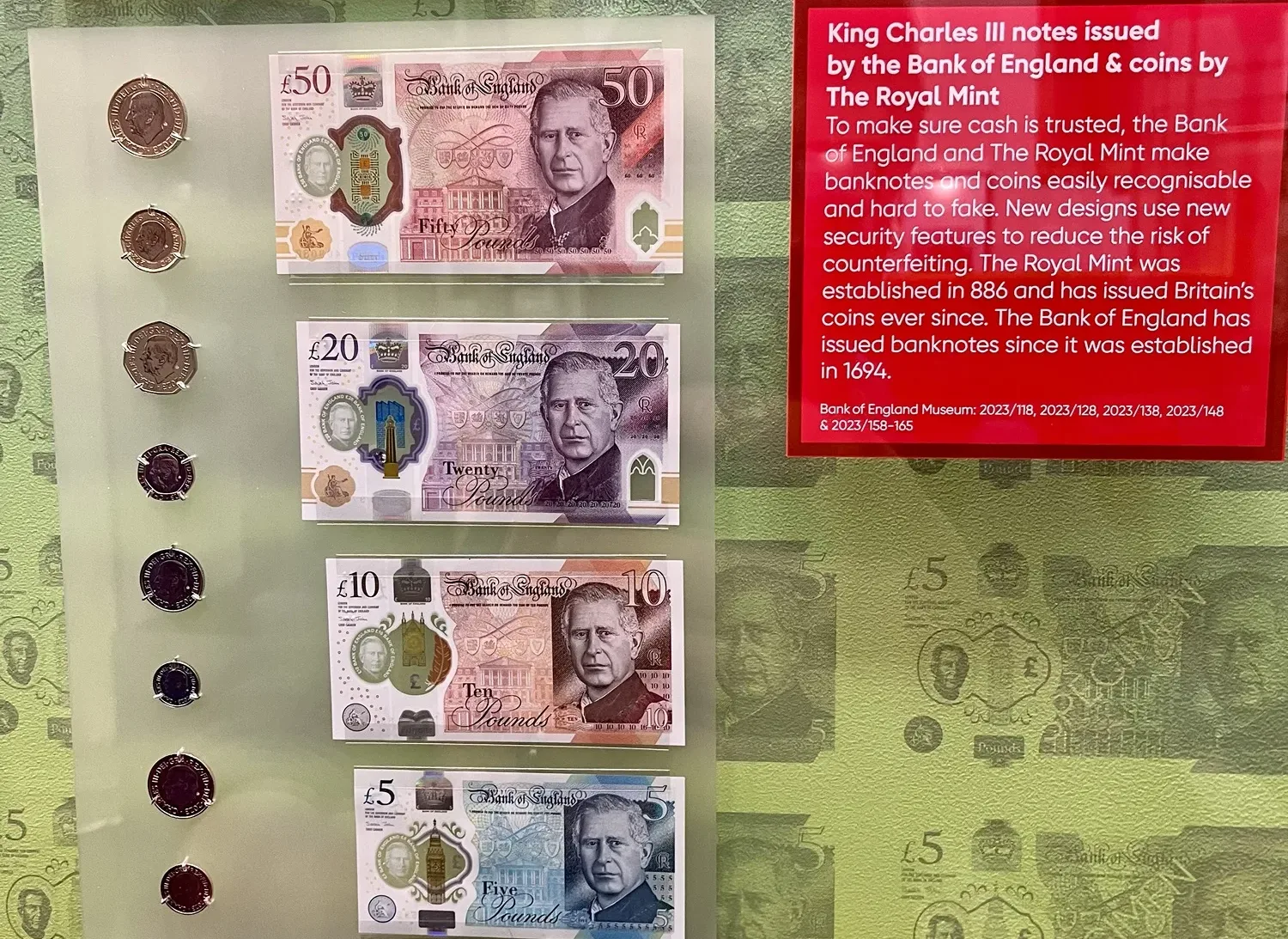
Bank of England Museum

A photo of the new King Charles coins and bank notes at the Bank of England Museum in London

The first place we went to on our trip to London last weekend was the Bank of England Museum. Which is pretty much what you would expect it to be – a museum based at the Bank of England headquarters in the City of London. Access is via a side entrance, and, as you would expect, you have to go through a security scanner to get in.

This is only the second time that I have been to the Bank of England Museum. The first time was a long time ago. I can’t remember exactly when, but I was definitely still living at home, so probably 25-ish years ago. Part of the reason for this is that the museum is only open on weekdays, and we normally visit London at weekends. As we had the benefit of an extra day, we were able to visit last Friday.

It’s not a big museum – a typical visit will take 1-2 hours – but it’s free to get in. And the exhibits are regularly updated. As shown in the photo above, there are samples of the new coins and banknotes featuring King Charles III which are not yet in general circulation. I was also amused by the satirical FTX t-shirt in an exhibit about cryptocurrencies. These are in a new exhibition called The Future of Money, which opened a couple of days before we travelled and runs until next September.

Like many museums, the Bank of England Museum has also acknowledged the darker sides of its past. Recent new exhibits include copies of ledgers listing the names of slaves that came into the bank’s possession, and there’s a display about the Windrush generation. On arrival in the UK, many of those who travelled on the Empire Windrush to start new lives were denied access to traditional banks, and the museum has a series of panels on Pardner Hand to allow people to borrow or save money.

Other permanent exhibits include some examples of forged bank notes (including some introduced by the Nazis in the Second World War to de-stabilise the economy), and of course there’s plenty on the history of the bank.

If you haven’t been to the Bank of England Museum before, I’d recommend going. It’s not a full day out, but it’s free and there are some interactive elements for children.

Accessibility

Predictably, the nearest tube station is Bank, which has step-free access from the Northern and Waterloo & City Lines, and the DLR. There are steps in the museum, including at the entrance, however, security staff can escort those with mobility issues from the bank’s main entrance and ramps can be provided once inside. There isn’t a quiet room, but ear defenders are available to borrow.

Money to burn

Yay! I finally have a bank account!

This time, I went with my mum to the bank from which my parents have several accounts. And, despite having to wait a few minutes until one of their staff was available, the process was quick and easy – I was approved instantly.

So, I now have an account with £50 sat in it, and my chequebook and other stuff on its way – I don’t get a debit card until I cash in a further £50. I’ve also sent off the form for my student loan, now that I have the bank details, so hopefully I’ll have nearly £3000 in there shortly.

While in town, I also picked up both CD1 and CD2 of “Alone” by Lasgo, which is better than “Something” in my opinion. It comes with a good selection of remixes, too 🙂

Back home, and I’m doing an experiment. After falling in from pressure from others, Mozilla is now my default browser, replacing IE6. And actually, I kinda like it. Okay, so its Java support isn’t so good (I’ve actually turned off Java… I can always load IE if necessary), and some pages won’t display properly (those which use over-complicated, non-standard compliant DHTML or that block any Netscape browser). But it’s quick and stable, and doesn’t impact the system as much as IE does (I have a lot more free memory than usual).

It’s now only 3 days until my results come out… help me…